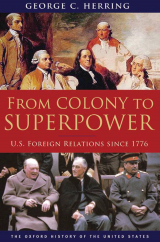
Текст книги "От колонии до сверхдержавы. Внешние отношения США с 1776 года (ЛП)"
Автор книги: Джордж Херринг
Жанр:
Публицистика
сообщить о нарушении
Текущая страница: 88 (всего у книги 91 страниц)
1298
Reynolds, Munich to Pearl Harbor, 127–29.
1299
Waldo Heinrichs, Threshold of War: Franklin D. Roosevelt and American Entry into World War II (New York, 1988), 46.
1300
Там же, 90; Reynolds, Munich to Pearl Harbor, 126–30.
1301
Max Paul Friedman, «Specter of a Nazi Threat: United States-Colombian Relations, 1939–1945», Americas 56 (April 2000), 577.
1302
Kyle Longley, In the Eagle’s Shadow: The United States and Latin America (Wheeling, Ill., 2002), 173.
1303
Howard F. Cline, The United States and Mexico (New York, 1963), 229–48.
1304
Erik Benson, «Flying Down to Rio: American Commercial Aviation, the Good Neighbor Policy, and World War II, 1939–1945», Essays in Economic and Business History 19 (2001), 61–73; Friedman, «Specter», 565.
1305
Donald C. Meyer, «Toscanini and the Good Neighbor Policy: The NBC Orchestra’s 1940 South American Tour», American Music 18 (Fall 2000), 238; Emily Rosenberg, Spreading the American Dream: American Economic and Cultural Expansionism, 1890–1945 (New York, 1982), 207–9.
1306
Peter H. Smith, Talons of the Eagle: Dynamics of U.S.-Eatin American Relations (New York, 1996), 85.
1307
T. Christopher Jespersen, American Images of China, 1931–1949 (Stanford, Calif., 1996), 56.
1308
Doenecke, Isolation to War, 120–21.
1309
Divine, Reluctant Belligerent, 96–97.
1310
Там же, 98–99.
1311
Peter Mauch, «Revisiting Nomura’s Diplomacy: Ambassador Nomura’s Role in the Japanese-American Negotiations, 1941», Diplomatic History 28 (June 2004), 358, 362.
1312
Там же, 359.
1313
Warren F. Kimball, Forged in War: Churchill, Roosevelt, and the Second World War (New York, 1999), 90–91.
1314
George C. Herring Jr., Aid to Russia, 1941–1946: Strategy, Diplomacy, the Origins of the Cold War (New York, 1973), 22.
1315
Theodore Wilson, The First Summit: Roosevelt and Churchill at Placentia Bay, 1941 (rev. ed., Lawrence, Kans., 1991).
1316
Kennedy, Freedom from Fear, 498–99, представляет собой жесткую защиту действий Рузвельта.
1317
Heinrichs, Threshold of War, 92.
1318
Doenecke, Isolation to War, 138–39.
1319
Mauch, «Nomura’s Diplomacy», 375.
1320
Изложение тезиса о заговоре можно найти в John Toland, Infamy: Pearl Harbor and Its Aftermath (New York, 1982). Наиболее убедительным является Gordon W. Prange, At Dawn We Slept: The Untold Story of Pearl Harbor (New York, 1981).
1321
David Kahn, «Pearl Harbor as an Intelligence Failure», in Akira Iriye, Pearl Harbor and the Coming of the Pacific War (Boston, 1999), 158–68.
1322
Paul W. Schroeder, The Axis Alliance and Japanese-American Relations, 1941 (Ithaca, 1958), originally developed this argument. For a more recent statement, see Kennedy, Freedom from Fear, 513–14.
1323
Reynolds, Munich to Pearl Harbor, 4.
1324
Joseph C. Grew, Turbulent Era: A Record of Forty Years in the U.S. Diplomatic Service (2 vols., London, 1953), 2:1260.
1325
Arthur H. Vandenberg Jr., The Private Papers of Senator Vandenberg (Boston, 1952), 10.
1326
Robert E. Sherwood, Roosevelt and Hopkins: An Intimate History (New York, 1948), 490.
1327
Winston S. Churchill, The Hinge of Fate (Cambridge, Mass., 1950), 92.
1328
Beatrice Bishop Berle and Travis Beal Jacobs, eds., Navigating the Rapids, 1918–1971: From the Papers of Adolph A. Berle (New York, 1973), 400.
1329
Paul D. Mayle, Eureka Summit (Newark, Del., 1987), 37.
1330
Запись за 16 декабря 1943 г., Дневник Генри Л. Стимсона, микрофильмированное издание; Forrest C. Pogue, George C. Marshall: Organizer of Victory, 1943–1945 (New York, 1973), 585.
1331
Allan M. Winkler, The Politics of Propaganda: The Office of War Information, 1942–1945 (New Haven, Conn., 1978).
1332
George C. Herring Jr., «Experiment in Foreign Aid: Lend-Lease, 1941–1945» (Ph.D. dissertation, University of Virginia, 1965), especially 129–64.
1333
Central Intelligence Agency, The Office of Strategic Services (Washington, 2000).
1334
Spruille Braden, Diplomats and Demagogues: The Memoirs of Spruille Braden (New York, 1971), 275.
1335
John Morton Blum, V Was for Victory: Politics and Culture During World War II (New York, 1976), 45.
1336
Fred I. Israel, ed., The War Diary of Breckinridge Long: Selections from the Years 1939–1944 (Lincoln, Neb., 1966), 289–90.
1337
Mark A. Stoler, Allies and Adversaries: The Joint Chiefs of Staff, the Grand Alliance, and U.S. Strategy in World War II (Chapel Hill, N.C., 2000), viii-ix, 64–65.
1338
Pogue, Organizer of Victory, 38–39.
1339
Max Freedman, ed., Roosevelt and Frankfurter: Their Correspondence (Boston, 1967), 692.
1340
Warren F. Kimball, The Juggler: Franklin Roosevelt as Wartime Statesman (Princeton, N.J., 1991), 7.
1341
FDR to WSC, July 29, 1942, in Warren F. Kimball, ed., Churchill and Roosevelt: Their Complete Correspondence (3 vols., Princeton, N.J., 1984), 1:545.
1342
Sherwood, Roosevelt and Hopkins, 227.
1343
Kimball, Juggler, 64.
1344
Цитируется по Stoler, Allies and Adversaries, viii.
1345
Milovan Djilas, Conversations with Stalin (New York, 1962), 73–74.
1346
George C. Herring, Aid to Russia, 1941–1946: Strategy, Diplomacy, the Origins of the Cold War (New York, 1973), 18–22, 94.
1347
Например, Warren F. Kimball, Forged in War: Churchill, Roosevelt, and the Second World War (New York, 1997) and Christopher Thorne, Allies of a Kind: The United States, Britain, and the War Against Japan (New York, 1978). Kimball, «The Bomb and the Special Relationship», Finest Hour: The Journal of Winston Churchill 137 (Winter 2007–8), 37–42, подробно описывает проблемы атомного сотрудничества.
1348
Stoler, Allies and Adversaries, 87–96.
1349
Vladislav M. Zubok, «Stalin’s Plans and Russian Archives», Diplomatic History 21 (Spring 1997), 296.
1350
Там же; Melvyn P. Leffler, «Inside Enemy Archives: The Cold War Reopened», Foreign Affairs (July-August 1996), 124–25, and A Preponderance of Power: National Security, the Truman Administration, and the Cold War (Stanford, Calif., 1992), 49, 99, 102–3.
1351
Цитируется по Kimball, Juggler, 136.
1352
Berle and Jacobs, Navigating the Rapids, 394–95.
1353
David M. Kennedy, A Tale of Three Cities: How the United States Won World War II (Melbourne, Australia, 2001), 6, 12.
1354
Richard W. Steele, The First Offensive, 1942: Roosevelt, Marshall, and the Making of American Strategy (Bloomington, Ind., 1973), 79.
1355
Herring, Aid to Russia, 54–60.
1356
Foreign Relations of the United States: The Conferences at Malta and Yalta, 1945 (Washington, 1955), 768.
1357
Stoler, Allies and Adversaries, 79–86.
1358
Pogue, Organizer of Victory, 7.
1359
Stoler, Allies and Adversaries, 86.
1360
Kimball, Forged in War, 143–55; Robert Dallek, Franklin D. Roosevelt and American Foreign Policy, 1932–1945 (New York, 1979), 345–49.
1361
Herring, Aid to Russia, 68–74.
1362
Stoler, Allies and Adversaries, 103.
1363
Kimball, Juggler, 76–79.
1364
Maurice Matloff, «Franklin Delano Roosevelt as War Leader», in Harry L. Coles, ed., Total War and Cold War: Problems in Civilian Control of the Military (Columbus, Ohio, 1962), 42–65, and Kent Roberts Greenfield, American Strategy in World War II: A Reconsideration (Baltimore, 1963), both provide valuable analyses of FDR as grand strategist.
1365
Good short analyses of Teheran may be found in Kimball, Forged in War, 241–55, and David M. Kennedy, Freedom from Fear: The American People in Depression and War (New York, 1998), 674–85.
1366
Kimball, Juggler, 107.
1367
Frederick B. Pike, FDR’s Good Neighbor Policy: Sixty Years of Generally Gentle Chaos (Austin, Tex., 1995), 257.
1368
Там же, 257–61.
1369
Lars Schoultz, Beneath the United States: A History of U.S. Policy Toward Latin America (Cambridge, Mass., 1998), 312–13.
1370
Max Paul Friedman, «There Goes the Neighborhood: Blacklisting Germans in Latin America and the Evanescence of the Good Neighbor Policy», Diplomatic History 27 (September 2003), 569–97; Graham D. Taylor, «The Axis Replacement Program: Economic Warfare and the Chemical Industry in Latin America», Diplomatic History 8 (Spring 1984), 145–64.
1371
Gerald K. Haines, «Under the Eagle’s Wing: The Franklin Roosevelt Administration Forges an American Hemisphere», Diplomatic History 1 (Fall 1977), 375.
1372
Jimmie Irene Page, «A Study of the Institute of Inter-American Affairs as an Instrument of United States Diplomacy in Chile» (M.A. thesis, University of Kentucky, 1972); Luis Pena, «Fighting the Invisible Enemy and Enhancing the United States Image in Venezuela», Maryland Historian 15 (Fall-Winter 1984), 11–22.
1373
Haines, «Eagle’s Wing», 380–83.
1374
George C. Herring, «The Most Unsordid Act Revisited: Lend-Lease, War Aims, and Results», paper presented at the Anglo-American-Soviet conference on World War II, Middelburg, Netherlands, June 1985, 17.
1375
Mark T. Gilderhus, The Second Century: U.S.-Latin American Relations Since 1889 (Wilmington, Del., 2000), 102; Eric Paul Roorda, The Dictator Next Door (Durham, N.C., 1998), 219–20.
1376
Schoultz, Beneath the United States, 313.
1377
Kyle Longley, In the Eagle’s Shadow: The United States and Latin America (Wheeling, Ill., 2002), 183–84; Gilderhus, Second Century, 104–5.
1378
Friedman, «There Goes the Neighborhood», 582–83.
1379
Annette Palmer, «The United States in the British Caribbean, 1940–1945: Rum and Coca-Cola», Americas 43 (April 1987), 445.
1380
Schoultz, Beneath the United States, 314–15.
1381
Haines, «Eagle’s Wing», 375.
1382
Herring, «Most Unsordid Act Revisited», 18.
1383
Philip Bonsal report, June 24, 1944, Papers of Edward R. Stettinius Jr., Manuscript Division, University of Virginia Library; Haines, «Eagle’s Wing», 377–78; Roorda, Dictator Next Door, 187.
1384
Lloyd N. Beecher Jr., «The Second World War and U.S. Politico-Economic Expan sionism: The Case of Liberia, 1938–1945», Diplomatic History 3 (Fall 1979), 391–412.
1385
Gaddis Smith, American Diplomacy During the Second World War (2nd ed., New York, 1985), 96.
1386
John A. DeNovo, American Interests and Policies in the Middle East, 1900–1939 (Minneapolis, 1963), 387.
1387
Douglas Little, American Orientalism: The United States and the Middle East Since 1945 (Chapel Hill, N.C., 2004), 10.
1388
Peter L. Hahn, The United States, Great Britain, and Egypt, 1945–1946: Strategy and Diplomacy in the Early Cold War (Chapel Hill, N.C., 1991), 18.
1389
Little, American Orientalism, 48.
1390
Herring, «Experiment in Foreign Aid», 348–52.
1391
Daniel Yergin, The Prize: The Epic Quest for Oil, Money, and Power (New York, 1991), 396.
1392
Hahn, United States, Great Britian, and Egypt, 18.
1393
Robert Vitalis, «The ‘New Deal’ in Egypt: The Rise of Anglo-American Competition in World War II and the Fall of Neo-colonialism», Diplomatic History 20 (Spring 1996), 211–39.
1394
Hull to Harold Ickes, November 13, 1943, Department of State, Foreign Relations of the United States, 1943, vol. 4 (Washington, 1964), 941.
1395
William Eddy to Hull, September 7, 1944, Foreign Relations of the United States, 1944, vol. 6 (Washington, 1967), 734–36.
1396
James Moose to State Department, August 2, 1944, William Culbertson Papers, Manuscript Division, Library of Congress, Washington, DC.
1397
FDR to WSC, March 3, 1944, WSC to FDR, March 4, 1944, in Kimball, Churchill-Roosevelt Correspondence 3:14, 17.
1398
David Holden and Richard Johns, The House of Saud (New York, 1981), 139–40.
1399
James L. Gormly, «Keeping the Door Open in Saudi Arabia: The United States and the Dhahran Airfield, 1945–1946», Diplomatic History 4 (Spring 1980), 189–205.
1400
Mark Hamilton Lytle, The Origins of the Iranian-American Alliance, 1941–1953 (New York, 1987), 59.
1401
James A. Bill, The Eagle and the Lion: The Tragedy of Iranian-American Relations (New Haven, Conn., 1988), 19.
1402
Lytle, Iranian-American Alliance, 103–17.
1403
Bill, Eagle and Lion, 26.
1404
Lytle, Iranian-American Alliance, 60.
1405
Yergin, Prize, 405–8; Lytle, Iranian-American Alliance, 120–22.
1406
David Schoenbaum, The United States and the State of Israel (New York, 1993), 25.
1407
Dallek, Roosevelt and American Foreign Policy, 446–48; Kennedy, Freedom from Fear, 794–97. David S. Wyman, The Abandonment of the Jews: America and the Holocaust, 1941–1945 (New York, 1998) содержит сильную критику политики США. Michael C. Desch, «The Myth of the Abandonment: The Use and Abuse of the Holocaust Analogy», Security Studies 15 (January-March 2006), 16–23, предлагает убедительный ответ.
1408
Schoenbaum, United States and Israel, 25.
1409
Matthew Wayne Coulter, «The Joint Anglo-American Statement on Palestine», Historian 54 (Spring 1992), 469.
1410
Thomas M. Campbell and George C. Herring, eds., The Diaries of Edward R. Stet-tinius, Jr., 1943–1946 (New York, 1975), 170, 174.
1411
Holden and Johns, House of Saud, 137–40; Rachel Bronson, Thicker than Oil: America’s Uneasy Partnership with Saudi Arabia (New York, 2006), 38–42.
1412
Brenda Gayle Plummer, Rising Wind: Black Americans and U.S. Foreign Affairs (Chapel Hill, N.C., 1996), 87–100.
1413
Campbell and Herring, Stettinius Diaries, 40.
1414
О встрече в Касабланке см. Kimball, Forged, 192–93; взгляды Рузвельта на колониализм обсуждаются в Kimball, Juggler, 127–31; цитата о «безжалостной рекламе» взята из 145.
1415
Там же, 132–40.
1416
Stimson Diary, April 22, 1942; Kimball, Juggler, 136.
1417
Kenton J. Clymer, «The Education of William Phillips: Self-Determination and American Policy Toward India, 1942–1945», Diplomatic History 8 (Winter 1984), 29.
1418
Там же, 34.
1419
Mark Philip Bradley, Imagining Vietnam and America: The Making of Postcolonial Vietnam, 1919–1950 (Chapel Hill, N.C., 2000), 81.
1420
Smith, American Diplomacy, 80.
1421
Stimson Diary, April 17, 1945.
1422
Kimball, Juggler, 153–57.
1423
Herbert Feis, The China Tangle (New York, 1965).
1424
Warren I. Cohen, America’s Response to China: An Interpretative History of Sino-American Relations (New York, 1972), 162.
1425
Michael Schaller, The United States and China in the Twentieth Century (New York, 199o), 74–80.
1426
Theodore White, ed., The Stilwell Papers (New York, 1948), 171.
1427
Schaller, United States and China, 84.
1428
Barbara W. Tuchman, Stilwell and the American Experience in China, 1941–1945 (New York, 1971), 116.
1429
February 19, 1943.
1430
Stimson Diary, November 4, 1943.
1431
Dallek, Roosevelt and American Foreign Policy, 485–502.
1432
Schaller, United States and China, 102–3.
1433
Frederick Kevin Simon, «The United States Observer Group in Yenan: A Venture in Sino-American Relations, 1944–1945» (M.A. thesis, University of Kentucky, 1977), chapter 2.
1434
Schaller, United States and China, 103–4.
1435
Lloyd C. Gardner, Economic Aspects of New Deal Diplomacy (Madison, Wisc., 1964), 287.
1436
Alfred E. Eckes Jr., A Search for Solvency: Bretton Woods and the International Monetary System, 1941–1971 (Austin, Tex., 1975), 135–64.
1437
Robert A. Divine, Second Chance: The Triumph of Internationalism in America During World War II (New York, 1967), 78–81, 103–5, 124–27, 170–71, 177.
1438
Stoler, Allies and Adversaries, 144.
1439
Там же, 61, 190–200; Michael Sherry, Preparing for the Next War: America Plans for Postwar Defense, 1941–1945 (New Haven, Conn., 1977), 52–54.
1440
W. Averell Harriman and Elie Abel, Special Envoy to Churchill and Stalin 1941–1946 (New York, 1975), 338–49.
1441
Smith, American Diplomacy, 145.
1442
Stoler, Allies and Adversaries, 215.
1443
Warren F. Kimball, Swords or Ploughshares? The Morgenthau Plan for Defeated Nazi Germany (New York, 1976), 96.
1444
Campbell and Herring, Stettinius Diaries, 214.
1445
Kimball, Juggler, 100.
1446
Там же, 102–69; Kimball, «Bomb and the Special Relationship», 39–41.
1447
Sherwood, Roosevelt and Hopkins, 870.
1448
George C. Herring, «Yalta as Cold War Metaphor», in F. Kevin Simon, ed., The David A. Sayre History Symposium: Collected Lectures, 1985–1989 (Lexington, Ky., 1991), 121.
1449
John L. Snell et al, The Meaning of Yalta: Big Three Diplomacy and the Balance of Power (Baton Rouge, La., 1956), 105, 113.
1450
Smith, American Diplomacy, 151.
1451
Dallek, Roosevelt and American Foreign Policy, 515.
1452
Цитируется по Kimball, Juggler, 177.
1453
Stalin to FDR, April 3, 1945, FDR to Stalin, April 5, 1945, in Ministry of Foreign Affairs, USSR, Correspondence Between the Chairman of the Council of Ministers of the USSR and the Presidents of the United States and the Prime Ministers of Great Britain During the Great Patriotic War of 1941–1945 (2 vols., New York, 1965), 2:205–8.
1454
John Lewis Gaddis, The United States and the Origins of the Cold War (New York, 1972) and Alonzo L. Hamby, Beyond the New Deal: Harry S. Truman and American Liberalism (New York, 1973) приводит этот аргумент.
1455
Daniel Yergin, Shattered Peace: The Origins of the Cold War and the National Security State (New York, 1977) and Dianne Shaver Clemens, Yalta (New York, 1970) take this position.
1456
Waldo Heinrichs, Threshold of War: Franklin D. Roosevelt and American Entry into World War II (New York, 1988), 46.
1457
John Morton Blum, ed., The Price of Vision: The Diary of Henry A. Wallace, 1942–1946 (Boston, 1973), 313.
1458
Berle and Jacobs, Navigating the Rapids, 526–27.
1459
Alonzo L. Hamby, Man of the People: A Life of Harry S. Truman (New York, 1999), 293.
1460
Там же, 266–68.
1461
Herring, Aid to Russia, 198–99.
1462
Там же, 203–11.
1463
Yergin, Shattered Peace and Gar Alperovitz, Atomic Diplomacy—Hiroshima and Potsdam: The Use of the Atomic Bomb and the Confrontation with U.S. Power (rev. ed., New York, 1985) утверждают, что Трумэн отменил политику сотрудничества Рузвельта.
1464
Divine, Second Chance, 295–97.
1465
Herring, Aid to Russia, 195–96.
1466
Martin J. Sherwin, A World Destroyed: The Atomic Bomb and the Grand Alliance (New York, 1977), 223–24.
1467
Отличным введением в продолжающиеся споры о применении атомной бомбы являются J. Samuel Walker, «The Decision to Use the Bomb: A Historiographical Update», in Michael J. Hogan, ed., Hiroshima in History (New York, 1996), 11–37, и «Recent Literature on Truman’s Atomic Bomb Decision: A Search for Middle Ground», Diplomatic History 29 (April 2007), 311–34.
1468
Richard B. Frank, Downfall: The End of the Japanese Empire (New York, 1999), 132–33, 139–48, 194–95, 243–45, 338–40.
1469
J. Samuel Walker, Prompt and Utter Destruction: Truman and the Use of Atomic Bombs Against Japan (Chapel Hill, N.C., 2004), 75.
1470
Там же, 60.
1471
John W. Dower, War Without Mercy: Race and Power in the Pacific War (New York, 1986), 54, 142.
1472
Там же, 300; Walker, Prompt and Utter Destruction, 96.
1473
Tsuyoshi Hasegawa, Racing the Enemy: Stalin, Truman and the Surrender of Japan (Cambridge, Mass., 2005), 154–65.
1474
Frank, Downfall, 272, 293–94, делает акцент на бомбах; Hasegawa’s Racing the Enemy подчеркивает советское вмешательство.
1475
Walker, Prompt and Utter Destruction, 77.
1476
Sadao Asado, «The’Shock’ of the Atomic Bomb and Japan’s Decision to Surrender – A Reconsideration», Pacific Historical Review 67 (November 1998), 498.
1477
Kennedy, Three Cities, 2.
1478
Lytle, Iranian-American Alliance, 1.
1479
Walter LaFeber, ed., The Origins of the Cold War (New York, 1971), 28–30.
1480
Richard H. Pells, The Liberal Mind in a Conservative Age (New York, 1985), 12–13.
1481
Dean Acheson, Present at the Creation: My Years in the State Department (New York, 1969), xvi.
1482
Thomas G. Paterson, On Every Front: The Making of the Cold War (New York, 1979), 1–21. Цитата Мерфи взята со страницы 3, Лейна – со страницы 7. См. также Tony Judt, Postwar: A History of Europe Since 1945 (New York, 2005), 13–40, и John Dower, Embracing Defeat: Japan in the Wake of World War II (New York, 1999), 21–45.
1483
Raymond F. Betts, Decolonization (London and New York, 1998), 26.
1484
Paterson, On Every Front, 13; Charles S. Maier, ed., The Cold War in Europe: Era of a Divided Continent (New York, 1991), 3–17.
1485
Paterson, On Every Front, 31.
1486
Там же, 29.
1487
Paul Kennedy, The Rise and Fall of the Great Powers (New York, 1987), 358.
1488
Michael S. Sherry, Preparing for the Next War: America’s Plans for Postwar Defense, 1941–1945 (New Haven, Conn., 1977), 200.
1489
Там же, 202.
1490
Цитируется по Alan Brinkley, «For Americans It Was a Very Good War», New York Times Magazine (May 7, 1995), 57.
1491
James T. Patterson, Grand Expectations: The United States, 1945–1974 (New York, 1996), 145.
1492
Резко противоречивые оценки см. Alonzo L. Hamby, Man of the People: A Life of Harry S. Truman (New York, 1999), особенно 640–41, и Arnold A. Offner, Another Such Victory: President Truman and the Cold War, 1945–1953 (Stanford, Calif., 2000), особенно 16, 18, 23, 457–58, 465, 470.
1493
Robert L. Messer, The End of Alliance: James F. Byrnes, Roosevelt, Truman and the Origins of the Cold War (Chapel Hill, N.C., 1982), 4–7, 31, 77–79.
1494
Melvyn P. Leffler, A Preponderance of Power: National Security, the Truman Administration, and the Cold War (Stanford, Calif., 1992), 116.
1495
Там же, 49–54; Paterson, On Every Front, 43–47; Thomas G. Paterson, Soviet-American Confrontation: Postwar Reconstruction and the Origins of the Cold War (Baltimore, Md., 1973), 99–199.
1496
Messer, End of Alliance, 133–34.
1497
Там же, 137–55.
1498
Там же, 155.
1499
Offner, Another Such Victory, 121.
1500
Там же, 124.
1501
Там же, 121–24.
1502
Leffler, Preponderance of Power, 102.
1503
George F. Kennan, Memoirs, 1925–1950 (Boston, 1967), 293; Judt, Postwar, 119–30; Vladislav Zubok and Constantine Pleshakov, Inside the Kremlin’s Cold War: From Stalin to Khrushchev (Cambridge, Mass., 1996), 47–53.
1504
Offner, Another Such Victory, 128–29.
1505
Kennan, Memoirs, 293.
1506
Frank Costigliola, «Unceasing Pressure for Penetration: Gender, Pathology, and Emotion in George Kennan’s Formation of the Cold War», Journal of American History 83 (March 1997), 1331.
1507
Robert L. Beisner, «Patterns of Peril: Dean Acheson Joins the Cold Warriors, 1945–1946», Diplomatic History 20 (Summer 1996), 338.
1508
Offner, Another Such Victory, 135–38.
1509
Richard Paul Hedlund, «Congress and the British Loan, 1945–1946: A Congressional Study» (Ph.D. dissertation, University of Kentucky, 1976), 92–93, 101–3, 133, 144, 160–64, 181–84.
1510
Offner, Another Such Victory, 132.
1511
Там же, 138–40.
1512
James A. Bill, The Eagle and the Lion: The Tragedy of American-Iranian Relations (New Haven, Conn., 1988), 33–34.
1513
Там же, 37.
1514
Messer, End of Alliance, 200.
1515
Walter LaFeber, America, Russia, and the Cold War, 1945–1996 (8th ed., New York, 1997), 42.
1516
Messer, End of Alliance, 201–203.
1517
Beisner, «Patterns of Peril», 46.
1518
LaFeber, Cold War, 38.
1519
Eduard Mark, «The War Scare of 1946 and Its Consequences», Diplomatic History 21 (Summer 1997), 383–415.
1520
Leffler, Preponderance of Power, 131. Полный текст отчета Клиффорда можно найти в Arthur Krock, Memoirs: Sixty Years on the Firing Line (New York, 1968), 417–82.
1521
Paterson, On Every Front, 105–6.
1522
James Chace, Acheson: The Secretary of State Who Created the American World (New York, 1998), 167.
1523
Offner, Another Such Victory, 186.
1524
Walter Isaacson and Evan Thomas, The Wise Men: Six Friends and the World They Made (New York, 1986), 25–35, 738–41.
1525
Robert L. Beisner, Dean Acheson: A Life in the Cold War (New York, 2006), 88.
1526
Chace, Acheson, 442.
1527
Michael J. Hogan, A Cross of Iron: Harry S. Truman and the Origins of the National Security State, 1945–1954 (New York, 1998), 5–21.
1528
Там же, 24, 65.
1529
Clark Clifford with Richard Holbrooke, Counsel to the President: A Memoir (New York, 1991), 170; Offner, Another Such Victory, 192; Hogan, Cross of Iron, 65–68.
1530
Chace, Acheson, 164–66.
1531
Public Papers of the Presidents of the United States, Harry S. Truman, 1947 (Washington, 1963), 176–80.
1532
Howard Jones, «A New Kind of War»: America’s Global Strategy and the Civil War in Greece (New York, 1989), 45–61.
1533
Offner, Another Such Victory, 204.
1534
Там же, 206.
1535
Lawrence S. Wittner, American Intervention in Greece, 1943–1949 (New York, 1982) is sharply critical of U.S. involvement; Jones, «A New Kind of War» is more positive in its appraisal.
1536
Offner, Another Such Victory, 207–9.
1537
Leffler, A Preponderance of Power, 147.
1538
Там же, 188–92; Offner, Another Such Victory, 214–20.
1539
Michael J. Hogan, The Marshall Plan: America, Britain, and the Reconstruction of Western Europe, 1947–1952 (New York, 1987), 427, and «The Search for a’Creative Peace’: The United States, European Unity, and the Origins of the Marshall Plan», Diplomatic History 6 (Summer 1982), 267–85.
1540
Michael Wala, «Selling the Marshall Plan at Home: The Committee for the Marshall Plan to Aid European Recovery», Diplomatic History 10 (Summer 1986), 264.
1541
Irwin W. Wall, The United States and the Making of Postwar France, 1945–1954 (New York, 1991), 299.
1542
Hogan, Marshall Plan, 436.
1543
Там же, 432. The revisionist argument may be found in Alan S. Milward, The Reconstruction of Western Europe, 1945–1951 (Berkeley, Calif., 1984).
1544
Hogan, Marshall Plan, 445; also Judt, Postwar, 97, and David Reynolds, «The European Response: Primacy of Politics», Foreign Affairs (May/June 1997), 180–82.
1545
Wall, Making of Postwar France, 113, 125–26.
1546
Edmund F. Wehrle, Between a River and a Mountain: The AFL-CIO and the Vietnam War (Ann Arbor, Mich., 2005), 23.
1547
Wall, Postwar France, 96–112; Carolyn Eisenberg, «Working-Class Politics and the Cold War: American Intervention in the German Labor Movement, 1945–1949», Diplomatic History 10 (Fall 1986), 283–306.
1548
James Edward Miller, «Taking Off the Gloves: The United States and the Italian Elections of 1948», Diplomatic History 7 (Winter 1983), 35–55.
1549
Peter Grose, Operation Rollback: America’s Secret War Behind the Iron Curtain (New York, 2000), 98–99.
1550
Judt, Postwar, 192.
1551
Offner, Another Such Victory, 256.
1552
M. Steven Fish, «The Berlin Blockade of 1948–1948», in Alexander L. George, ed., Avoiding War: Problems of Crisis Management (Boulder, Colo., 1991), 204.
1553
William Stivers, «The Incomplete Blockade: Soviet Zone Supply of West Berlin, 1948–1948», Diplomatic History 21 (Fall 1997), 596.
1554
Martin Walker, The Cold War – A History (New York, 1993), 57.
1555
Цитируется по Lawrence S. Kaplan, The United States and NATO: The Formative Years (Lexington, Ky., 1984), 51.
1556
Martin H. Folly, «Breaking the Vicious Circle: Britain, the United States, and the Genesis of the North Atlantic Treaty», Diplomatic History 12 (Winter 1988), 75.
1557
Там же, 76.
1558
Kaplan, NATO, 1.
1559
Escott Reid, Time of Fear and Hope (Toronto, 1977), 63.
1560
Mark T. Gilderhus, The Second Century: U.S.-Latin American Relations Since 1889 (Wilmington, Del., 2000), 125–26.
1561
Stephen G. Rabe, «The Elusive Conference: United States’ Economic Relations with Latin America, 1945–1952», Diplomatic History 2 (Summer 1978), 293.
1562
Gilderhus, Second Century, 135.
1563
Там же, 133.
1564
Thomas Borstelmann, Apartheid’s Reluctant Uncle: The United States and Southern Africa in the Early Cold War (New York, 1993), 197.
1565
Там же, 193.
1566
Peter L. Hahn, Caught in the Middle East: U.S. Policy Toward the Arab-Israeli Conflict, 1945–1961 (Chapel Hill, N.C., 2004), 44–49.
1567
Douglas Little, American Orientalism: The United States and the Middle East Since 1945 (Chapel Hill, N.C., 2004), 80–85.
1568
Там же, 86–87.
1569
Marc S. Gallichio, The Cold War Begins in Asia: American East Asian Policy and the Fall of the Japanese Empire (New York, 1988), 73–112.
1570
Mark A. Stoler, George C. Marshall: Soldier-Statesman of the American Century (Boston, 1989), 148; Steven L. Levine, «A New Look at American Mediation in the Chinese Civil War: The Marshall Mission and Manchuria», Diplomatic History 3 (Fall 1979), 359.
1571
Stoler, Marshall, 149.
1572
Offner, Another Such Victory, 323–26.
1573
Michael Schaller, The United States and China in the Twentieth Century (New York, 1990), 117.
1574
Offner, Another Such Victory, 326.
1575
John H. Feaver, «The Chinese Aid Bill of 1948: Limited Assistance as a Cold War Strategy», Diplomatic History 5 (Spring 1981), 119.
1576
Dower, Embracing Defeat, 27, 203–4.
1577
Charles E. Neu, Troubled Encounter: The United States and Japan (New York, 1975), 204.
1578
Dower, Embracing Defeat, 253–73.
1579
Там же, 525–555.
1580
Stanley Karnow, In Our Image: America’s Empire in the Philippines (New York, 1989), calls it «dependent independence» (323–26).
1581
Robert J. McMahon, The Limits of Empire: The United States and Southeast Asia Since World War II (New York, 1999), 33.
1582
George C. Herring, America’s Longest War: The United States and Vietnam, 1950–1975 (4th ed., New York, 2001), 21–23.
1583
Leffler, Preponderance of Power, 333.
1584
Beisner, Acheson, 233; Gregg Herken, Winning Weapon: The Atomic Bomb in the Cold War, 1945–1950 (New York, 1980), 304–22.
1585
Department of State, United States Relations with China: With Reference to the Period 1944–1949 (Washington, 1949), xvi.
1586
D. W. Brogan, The American Character (New York, 1956), 207–8.
1587
Schaller, United States and China, 118–21, 130–34.
1588
«Упущенная возможность» обсуждается в «Symposium: Rethinking the Lost Chance in China», Diplomatic History 21 (Winter 1997), 71–115.
1589
Beisner, Acheson, 190–203.
1590
Там же, 238.
1591
Department of State, Foreign Relations of the United States, 1950: National Security Affairs, Foreign Economic Policy, vol. 1 (Washington, 1977), 237–90.
1592
Beisner, Acheson, 248.
1593
Там же, 239; Chace, Acheson, 168.
1594
Peter Lowe, The Origins of the Korean War (Essex, Eng., 1986) это хороший обзор. Bruce Cumings, in The Origins of the Korean War, vol. 1, Liberation and the Emergence of Separate Regimes, 1945–1947 (Princeton, N.J., 1981), и vol. 2, The Roaring of the Cataract, 1947–1950 (Princeton, N.J., 1990), предлагает провокационную ревизионистскую интерпретацию.