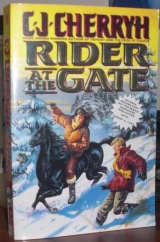
Текст книги "Rider at the Gate"
Автор книги: C. J. Cherryh
Жанры:
Научная фантастика
,сообщить о нарушении
Текущая страница: 17 (всего у книги 29 страниц)
The judge pounded the table, to no avail, until the marshal fired off a gun, into the air and off over the walls.
“Rider Chang,” the judge said. “Ordinance of Incorporation, Article Twelve, a rider can’t take oath. But you can give an unsworn deposition. What did you observe?”
“I talked to Brionne Goss in the horse den this morning. I saw her tracks, alone, going out the gate. I saw, at sunset, Andy Goss, Carlo, there, and Randy, coming in to ask about her whereabouts.”
“ Fornicator!” the religious yelled.
“—and those tracks.” Tara raised her voice, thinking only of the boys now, the way Mina had thought, and with the queasy notion that she could lie or tell the truth on this side of the wall and the minds in front of her wouldn’t hear the difference. “Were only of the girl. Goss identified them and I personally heard Goss threaten the boys, I personally heard the boys complain of beatings and blame unfairly placed on them.”
“Liar!” the wife shouted.
“Mr. Goss agitated my horse with his behavior. I advised him and his sons quit the camp for their own protection. Vadim and Chad went out the gate in search of Brionne Goss. They aren’t back. They’d promised to come straight back. I can personally report—” There was a rising murmur and she outshouted it with what she’d decided the town had damned well better know, and she needed to be surethe town knew. Two nights and no word from Vadim and Chad meant the odds weren’t in their favor, and the Gosses had already made fatal mistakes. “I can personally report, there’s something out there that scared my horse andme. Evidently Brionne heard it and didn’t have the sense to be scared.”
“You liar!” the mother started shouting—and nothing came through the ambient. It was a curious numbness.
“She wanted the horses!” Tara shouted back. “And thanks to the fact she didn’ttell us, and she went out that gate on her own, and without our advice, she’s probably met something we could have wished she hadn’t. It wasn’t the Goss boys’ fault. I sawthe father beating the boys; I saw it in his mind and I saw it in theirs!”
“Blasphemy’s not court evidence!” the religious yelled. “You can’t blaspheme against the almighty human God and call it evidence!”
“God,” Tara muttered in disgust, and cast a look at the judge, who hammered the table furiously.
“She is a liar!” the mother screamed. “She was luring our Brionne to perversions! They’reresponsible!”
“Then you can go to bloody hell!” Mina yelled. “There’s a rogue horse out there! Your precious Brionne went out to it! If she’s lucky, it didn’t take her! If she’s not—God knows what we’re in for! So if you want to winter here without riders, you’re on your way, woman! The road crew’s not back and the two that went out looking for your daughter were supposed to be back in a couple of hours—yesterday! So go to hell! We’ll take care of our own, if that’s where we stand!”
People were shouting over the last that Mina had to say, people who were scared about the rogue and scared as hell to have the riders offended, people yelling about God and blasphemy, going quickly from words to shoving and pushing—the judge was getting no attention from anyone with his hammering; and Tara grabbed Mina by the arm to get her away from the edge of the porch before rocks went flying.
“Take it easy, for God’s sake!”
“I’ll beout that gate! I’m not trading us for these fools!” Mina jerked away, headed for the side porch steps, and Tara grabbed her again.
“Mina, use your head!”
“I’ve used my head, I’ve waited. If you’re with them ahead of us, maybe that’s your choice, Tara, but it’s not mine.”
“Mina!”
Mina had jerked to be free, and Tara jerked hard back, realizing in the moment she did it that there wasan ambient now. It had come flooding around them subtle as body-temperature water– you didn’t know it was there, and it was, and it ran over the nerves and stole the breath. “ Mina, dammit!” Crowd-noise was everywhere. Minds were everywhere. A gunshot went off, right next them, but that was a gun on their side, the marshal firing his pistol off.
“ Shut up!” the marshal yelled into a sudden silence, and Tara dragged Mina back to Luisa’s spot near the rear of the porch. The marshal was yelling about law and order and how they’d better listen to the judge or he was going to start making arrests.
“You can’t argue against almighty God,” somebody yelled; and the judge ruled the man in contempt and fined him fifty on the spot. Other howls went up over that, and the mother started yelling about justice again—
“Shut up!” the judge shouted, and banged the hammer, until it had to dent the table top. “It’s clear we’ve got witnesses missing.”
“You can’t take testimony—” —from riders, the religious was clearly about to argue, but the hammer came down again.
“Another fifty! I say I’m not finding cause for a trial until after we’ve got all the principals, and they’re not here. Marshal, lock these boys up until somebody—”
But the words faded out. There was just
Tara felt
“Mina!” Luisa screamed, halfway down the steps, in pursuit of her partner, but Tara grabbed the railing and got focus enough to will
“Damnation!” a resisting mind cried, but the ambient was gibbering nonsense,
Tara needed the railing to keep her balance, and she fought with that noisy mind, with a deliberate < behave!>
A scream. Shocked quiet, after. She could feel the railing wobble under her gloves. She looked up at the marshal with a sense of desperation, her partners having cleared a space for themselves in the yard. The ambient was complete chaos.
“Something’s wrong,” she said, maybe louder than she should– her ears weren’t hearing: her mind was, and she felt she had to shout. “Keep that gate closed. If the kid comes back and wants in—don’t listen. Keep that gate closed!”
Her partners went toward the camp. She had to be there. She was the only one who might argue Mina out of doing something foolish, but they were
Bang! something went at the Little Gate. Bang! of nighthorse hooves.
She didn’t know what the marshal answered. She overtook her younger partners on the run, the crowd seething with questions and fears of the unknown outside—more than one voice was raised in screaming panic.
No comfort existed in the ambient.
Chapter xv
THERE WERE STORIES—HOW SOMETIMES IN SPRING THEY FOUND people frozen on the mountains, just the way they’d sat down, and when the wind blew the fire out, Danny began to fear some party coming up the road with the thaw would find them all that way in a melting snowbank, still huddled around dead sticks.
“Maybe the son of a bitch froze,” Quig said, hugging one hand under his arm for protection.
But Harper swore at everybody and Watt kept working, using a lighter, the lot of them using their bodies and holding a tarp to shield the fire until it took.
Stupid place to camp, Danny thought, while he contributed his own skinny body to the effort and held a corner of the tarp.
They’d found a less windy place a little downland, and thanks to Harper’s pushing everyone, they’d ended up at the edge of dark camped in hellish cold, on the high uphill of the road, where the wind could get a run at them and the horses had no grazing.
They’d run both late and tired, slogging ahead at a pace that taxed both humans and horses, walking and riding by turns—the last had been walking, the Hallanslakers’ horses and Cloud alike simply refusing to carry weight any farther on the uphill.
And finally their road had met another road at a rider-stone, way, way up in the windy cold, where—contrary to expectations of shelter one ought to find at a rider-stone—there wasn’t.
There might still be one fairly close. Maybe even a village—he wasn’t so clear on the distances up here. But the Hallanslakers either knew there wasn’t a shelter—or they had some reason not to go find it. Danny didn’t ask. He didn’t ask anything or question anything since they’d hit him for no more than thinking. He’d found he could tuck down and be quiet—and he was so cold he was brittle. He truly didn’t want to be hit right now. He just kept his grip on the tarp edge and kept as quiet as he could while Harper and his friends from Hallanslake did whatever seemed reasonable to people who couldn’t go into villages.
The rebel thought didn’t get him hit. He didn’t entirely understand why not, except maybe they didn’t want to let go of the tarp to do it.
And that thought didn’t get him hit, either.
He supposed what he thought wasn’t going into the ambient with any strength at all because the horses were tucked together at more than a stone’s toss distant, in a clump of old bearded evergreen, where the wind was less—except Cloud, who sulked apart, but on their lee side, so he had them for a windbreak, Cloud being no fool.
There was a phone line near them—they were making the fire near a telephone pole, so he knew they were on a main road, maybe the Tarmin road itself, and definitely, in that case, not far from real shelter. He hadn’t seen phone lines all the way up, and he remembered the Anveney road was the one—
But he didn’t want to think about that road. He just wasn’t sure what road they’d picked up, but there were the phone lines, and it did go off into Wild in either direction.
Stuart might be real near. But he didn’t want to think about Stuart at all, except he hoped Stuart had met up with Jonas and they were all out there in the bushes this very moment setting up to blow Harper and his friends to hell in a crossfire.
He really, really hoped Jonas wasn’t too mad at him.
He cast a furtive look at Harper, wondering that nobody had heard him, himself and Watt being in body contact at the moment. Maybe they were all thinking about the fire. Maybe everybody was too busy. Maybe Cloud was too cold to image. He hoped Cloud was all right out there in the cold.
But certainly he’d gotten away with more than he had this afternoon on the trail when Quig had elbowed him for thinking Quig was stupid.
Quig wasstupid.
Quig was reallystupid.
Still no notice.
Maybe they were just all too tired.
Maybe God was going to freeze them to death for punishment. He was in what his mother called bad company, he’d had no question of that, and it wasn’t God’s fault—stupidity had gotten him here.
Papa would be disgusted. Papa would have no respect for any of these men if they walked into his shop, loud and obnoxious, let alone the fact that they were riders. The men with Harper were scum. Nobodies, real nobodies. The Hallanslakers—who Harper was (by what Danny could gather) somehow kin to, or leader of, or both—thought a lot of things were funny that weren’t—and they were stupid.
Just damn-all mean, papa would call it. Anybody who was an outsider to them, like him, was a target, the way Stuart would have been a target when he’d worked with them. He understood now how that long ago knife-fight could have started. Stuart wouldn’t have backed down.
He didn’t want to know what they’d think up to do to himnow if there wasn’t Harper’s glum influence, and if there wasn’t Harper to knock heads when things got too rough. He couldn’t figure what hold Harper had over these men, except they’d wantedto go up that mountain: they’d egged each other on until they were blind, stupid tired and the weather turned on them. They’d challenged each other up that mountain because there was mischief to do, and they thought it was fun. They were men on the outside, but inside they were a nest of willy-wisps, all fangs and claws, all mean—he’d known boys like them in town, and he’d avoided them even before his father’d yanked him sideways, knocked him on the side of his head and said he expected brains in his sons and he expected his sons not to die stupid.
He’d never heard his father talk like that before and never since. But he’d remembered.
Then he’d gone to be a rider and his father didn’t talk to him about virtues at all now.
He’d not known everything before he left home—but, damn, he knew his father would have had the insight to have pitched any of the Hallanslakers and probably Harper out of the shop on first sight. He didn’t know where his father had learned about people like the boys his father had found him with, but his father had had them pegged, all right, and he’d gotten the measure of the Hallanslakers in the same way: eager to go up that mountain to do all the harm they could to Stuart, who’d, by all he could figure, never done any harm to them personally. About Harper’s motives—he didn’t want to think.
They just had to have a target for their meanness, he guessed, because if they didn’t have one, they just had each other to pick on.
And that wasn’t much fun, since they were too damn stupid to feel pain.
He could think that, with his knee right against Quig’s. That was really odd. He thought: Quig’s a pig, just to see—not wanting another elbow in the ribs.
But he was quiet and secret now—mad; but he’d grown far more canny in the passing hours. He’d had to be hit a couple of times, like with papa and the boys—and then, damn, yes, he did learn. He could keep his thoughts quiet.
Or Cloud wasn’t paying real close attention right now.
He stole a glance sidelong, saw Cloud about his own business, nibbling the weeds that still poked up above the snow at road’s edge.
But Cloud didn’t look up.
But he didn’t move his elbows when he thought it, and Cloud still didn’t look up—didn’t seem to notice at all.
Maybe he had a lot better luck being quiet if he wasn’t right in Cloud’s convenient view, attracting Cloud’s attention. There were trees in the way. He’d made himself ever so quiet, even wrestling with the tarp.
And that led him suddenly, while Watt was swearing at the tarp and Quig was a slightly less bearlike mass beside him, to the basic fact that he’d heard a hundred times but never, somehow, gotten through his head in reality—that he could think anything he liked if Cloud wasn’t in range, and he suddenly realized—astonished– that the fact that he heard uncommonly far wasn’t necessarily all Cloud’s doing. Cloud certainly didn’t seem to hear him right now.
And with that, he acquired a notion of howhe got a constant flow of images from farther than he was supposed to—dimbrained kid that he was, he naturally assumed when people called him noisy that it was some marvelous special gift he and Cloud had that nobody else did.
Special, hell. He fell off his horse and Cloud got into fights: it wasn’t exactly a shining performance on this trek. He’d annoyed two groups of seniors and nearly gotten shot on the last set-to because he couldn’t calm Cloud down.
Noise wasn’t exactly an advantage if you hadn’t any choice about it.
And Jonas had said that kids did it—and seniors didn’t—except Wesson, who needed to because of who he was.
So it wasn’t exactly a special gift, it was a special problem kids tended to have.
And if it ever was useful, this getting Cloud’s attention at a range at which most people didn’t have constant talk with their horses, it wasn’t alwaysuseful, witness the situation with Harper this afternoon.
When he was on the outs with people, he wanted Cloud’s attention; he just—wasn’t comfortable with people the way he was with Cloud, not even with his friends anymore, since the new had worn off him being a rider. Cloud was his friend. Cloud didn’t carp and criticize—
Maybe Cloud ought to criticize. Maybe somebody should have done what his father did and what Jonas did and what Quig had done—like tell him he was fouling up, mad as it made him. He was doing wrong with Cloud. Jonas had tried to tell him, but he’d been too righteous then to believe it.
Elbows still, Jonas had said. Knees still. Quit lookingat Cloud, which he began to realize was almost impossible for him—every two seconds he was reaching for Cloud, wanting to know where Cloud was, like a toddler running after his mother.
Which kept Cloud’s attention all the time on him and nervous. Other riders had seen it. He’d been the only one not to see it—and it turned out so damn simple: if he could just hold his body still and not demand Cloud’s constant attention, he could hate the sons of bitches as hard as he wanted. Horses could hear humans, just barely, but humans didn’t hear well enough to hear each other– he’d known that, sort of, as a townsman kid knew anything, even before Wesson had told him. And what that reallymeant had just slid off him as one of those details like long division, which he never liked so he never bothered to think about.
Stupid kid, he said to himself. Smarted himself right into a real mess. Didn’t needto know things. Didn’t liketo know things. Real damned bright—now he was in a situation where he wished to God he had listened to everything his seniors had tried to tell him. He swore he’d go back to mama, if God gave him another chance, and ask her to tell him again about long division. And he’d ask Jonas Westman to tell him all the things he was doing wrong, if God just let him and Cloud get out of this.
But thinking all those things, he didn’t move. He didn’t twitch. The tarp fluttered, but he didn’t bob around controlling it, he just bit his lips and tried to keep his arms still as if he had the same strength as Watt beside him.
The fire caught, streaming sideways in the wind. “Hold the damn tarp,” Watt ordered everybody. “Hang on, damn you.”
On one level he was fascinated with what Watt was doing. He’d never seen a fire built in a gale-force wind the way Watt was doing it, with a hastily thrown-up wall of wood, to which he figured the tarp was a help, not a necessity—and he wanted to see the technique. They’d failed it once and had to take it apart; but Watt, now that his inside kindling was set and lit, started assembling his small-grade wood inside his three-sided shield of bigger pieces, working fast so that the fire would stay lit—he stuck tinder and smallest kindling in out of the wind, shielding it with the edge of his hand the second after he set in a larger stick. There was never a hesitation in what he picked next, as if he’d had the sizes of the sticks in his head all along. Fast as he was working, every stick fit as tight as could be to its neighbor, so that, just with the irregularities of the wood, the fire could breathe; but the wind couldn’t get at the fire to blow it out.
Watt stuffed his next grade of sticks in with one hand while with the other hand he began to take bigger wood from the stack– he’d built the inner frame, and it was burning. The outer frame was a chimney now, and the fire held—until, Danny thought, the really big, last-an-hour stuff could go in after the firepit was full of coals and able to handle it, and when it wasn’t so prone to throw sparks on the wind. They were scum, but they were careful scum: nobodyburned a forest down.
Watt was scum. But he had an amazing skill.
“More wood,” Watt said. “That wind’s going to burn a pile of it tonight.”
The others grumbled about it, but they moved off. Danny, being still, followed them with his eyes, thinking—
But Harper hadn’t gone. Harper sat with his arms on his knees staring at him, and it was Watt himself who went to gather wood with Quig.
“I really wouldn’t,” Harper said darkly.
“Get more wood?” Danny played stupid. Harper didn’t buy.
“You know what I mean. Go ahead. Run. See what happens.”
He didn’t want Cloud involved in his thoughts. Not moving at all took willpower. He stared at Harper, thinking that Harper might be asking himself why Danny Fisher was so quiet this evening.
He wasn’t faster than a bullet in the back. That was certain. And Harper had served notice he was watching.
But he got up slowly after a moment, left the fireside and joined the men gathering wood, choosing at the same time to move as far away from the horses as he could, into the teeth of a freezing wind. He started gathering up deadfall, to prove his honest intentions.
But he knew now, all but bubbling over with the discovery, that he could keep quiet enough to have private thoughts, he coulddo what the senior riders did—and he resolved then and there that he was going to leave these men in a snowbank if he got a chance.
He didn’t know woodcraft the way the long riders did, that was his most serious handicap—like, right now, he would dearly love to know whether, say, common wood fungus was at least moderately poisonous. He could get plenty of it off the deadfalls, and he’d, oh, so gladly put it in their tea, and fake drinking his.
But if it turned out to taste too strong or if it wasn’t debilitating fast enough, they’d shoot him; and they’d shoot Cloud, because Cloud would go for their throats in an eyeblink if things blew up.
So that wasn’t a good idea. Whatever he did, he had to make good on fast, and it couldn’t give them a target. Like maybe if the snow got worse.
Maybe if a blizzard came. The middle of the night. He could slip away.
There had to be riders up here, maybe riders who wouldn’t take to what Harper or Jonas or anybody intended. He wasn’t alone up here. There were whole villages full of people up here—and they had to be close now that they’d come up on the phone lines, where Stuart had to come—
God, shut that thought down. Fast.
But that the Hallanslakers were willing to camp out in the cold like this, when there were supposed to be shelters with free food and firewood, as he understood it, argued to him that they were scared of Jonas. Harper or somebody had been thinking about Jonas earlier—even seniors were sometimes noisy. Harper had been thinking about Jonas and about Stuart—and it hadn’t been pleasant thoughts.
If Harper thought Jonas and his friends wereholed up in a shelter for the night, or, probably worse from Harper’s point of view, if Jonas had gotten up here first, he’d have gotten to shelter. Thatcould be the reason Harper had them out here shivering in the cold: they were scared to shoot it out with Jonas at a shelter where Jonas had cover, and maybe get shot at themselves. That was too much like a fair fight.
And they were going to go on skulking in the brush and the cold until they did find a place Harper didn’t mind shooting.
He wasn’t acutely scared anymore: he’d reached a stomach-upsetting kind of terror he could live with—but trouble was, now that he’d figured out how to be quiet—he didn’t know how to do anything else but be quiet without giving everything he thought away; and he didn’t know at what moment something was going to scare Cloud and upset the balance.
At which point Harper might decide he wasn’t any use finding Stuart, and that he was a liability among them if they ran into Jonas.
He stayed out at the perimeter as long as he dared, so long his fingers were growing numb through the gloves. He gathered up a fair armful of wood and followed Watt back to the fire. He dumped it down and squatted down on the edge of the wind-blown heat, chafing warmth back into his fingers, avoiding Harper’s eyes. Harper had never left the fire.
In the same moment he felt Cloud’s attention skitter over him– Cloud just brushing by his thoughts—and he thought of the fire and of
He stuck a little wood in the fire, not too much. They wanted less flame than coals in this wind. Nothing to carry into the trees. Hope they had a decent meal tonight. Watt scorched everything.
Always on the edge of catching the pan afire. He was better.
Close, close, close, he mustn’t look up. Little nervousness among the horses—they could solve it. He didn’t need to look up.
Then she’d trade it to a store or direct to an individual for more than she paid for it.
Or sometimes she just did refurbishings for the same owner– any of which paid money that came in handy before he started bringing in money and fixed the place up.
Mama would be sitting there with the bread baking, all the while she’d be painting flowers on a chair—she liked that part—or sanding and swearing—she always swore when she sanded—
There was always some piece of furniture in the apartment that you weren’t supposed to touch or sit on, and it always made his nose run when she’d been painting.
But the bread-smell was over all of it,
Harper never stopped watching him. Just watching.
They’d warned the village. They’d advised everybody lock the doors and the shutters and stay inside no matter what. People had guns. They had their storm-shutters locked.
The rogue-feeling went away and it came back, maybe two, maybe three hours into the night, as if it was feeling them over, and it wasn’t a thing anybody could catch with human senses. You didn’t know when you’d started being afraid. You just knew by the prickling terror behind you that it was there again. A shutter banging in the wind. Rattle of sleet against the roof. A sense of presence…
Something was near the walls.
“It’s Vadim,” Mina murmured as the three of them, sitting by their fireside in the shelter, listened. “God, it’s Vadim.”
“No!” Tara said sharply, because it was coming by way of their own horses now, she could hear them, could hear Flicker take up that
“That thing could be anywhere on the mountain. It’s no good going out there. God, it’s echoing in every creature in the woods, can’t you hear it? That’s what it’s doing—that’s why it’s so damn loud—”
The whole mountain seemed to echo it, loneliness, mourning over something lost. It echoed failures, or things undone, a terrible melancholy. It gnawed, it burrowed, it ran, it flew, it crawled—it slavered with winter-hunter and ached in rut and leapt along the ground, aching with loneliness and fear—
Then it dissolved, flew apart in screaming rage.
“Tara,” Luisa protested.
“I’m fine, dammit, Flicker’s not. I’m going out there.”
“We’ll all go,” Mina said.
So that was the way it was—they went out to the porch and down into the nightbound yard. Snow was gusting on a fierce and biting wind.
Then a presence came to them,
She lost her balance—slipped and skidded on the ice. Mina had her arm.
A presence so… lost… so idly strayed from reality… came flitting through her senses.
Brionne with the horses. All the horses loving her. Brionne in the moonlight, in the snow… the numbing, gentle snow… > “Get away from us!” Tara shouted into the dark. <“ Tara!”> Luisa hurt her arm, she grabbed it so hard. She slid on the ice and Mina grabbed both of them. “It’s her,” Tara said. “It’s the Goss kid—God, stay here. Keep the gates shut.” “Where are you going?” < Mama,> the voice cried on insubstantial winds. < Mama, let me in… > Tara ran, sleet stinging her face—she ducked through the village gate and let it slam behind her; she ran not for where instinct or whatever drove her told her to go: instinct was screaming at her to go the other way. She ran against it—ran for reason, ran down the center of a deserted, sleet-hammered street, all the way to the end of the street, her throat hurting with the cold air. She ran up the wooden, icy steps to the marshal’s office and pounded her fist on the door. She heard someone coming, footsteps inside. The feeling of presence behind her all around her—was overwhelming, a wave of living anger rolling toward them, from all around the walls. “Who’s there?” the marshal called out. “Who’s out there?” “Tara Chang!” she shouted back, holding to the rail—resisting the impulse to look back and see if anything was in the street. “It’s here—” she said, and got a chill breath as the marshal opened the door. The marshal’s wife was holding a pistol aimed at her: she paid it only passing attention. “It’s the rogue. It’s the kid. Brionne. She’s with it. She’s wanting her mama and her papa. You’ve got to send word down to Tuck—keep those gates shut. No matter what!” “It’s a kidout there,” the marshal began. “We’ve got to shoot that horse.”