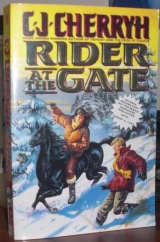
Текст книги "Rider at the Gate"
Автор книги: C. J. Cherryh
Жанры:
Научная фантастика
,сообщить о нарушении
Текущая страница: 18 (всего у книги 29 страниц)
“It’s hellout there.” She found herself shaking. “It’s my partners out there. It’s our men. It’s that kid. We can’t help them. We can’t do anything but hold that damned gate, do you hear me? Get out there! Keep that gate shut, I don’t care who wants in! That horse comes with her and everything in the woods comes next! Keep it out!”
The marshal went for his coat and his scarf and his shotgun. “Watch the boys!” the marshal said to his wife. “If it’s the Goss kid—she might try to get to the boys! Keep that door locked!”
Tara stood there shivering in the wind, trying to keep her hand from freezing to the icy porch rail—trying to be deaf and blind and numb to the ambient. Mina and Luisa were with the horses. She knew.
She knew that the Goss boys were still in lockup.
She knew that Brionne was with the rogue.
She knew that Brionne was calling to all that was hers—her mother, her father, her brothers, her friends and acquaintances… every one.
Brionne had never gotten on Flicker’s good side. But she was calling to
She called to
<“Papa!”> it wailed.
Shutters were opening. Lights from those windows flared out onto the snow, here and there down the village street. A door opened, a larger spill of light.
Answering that voice.
That was the way they heard it. The town was ready and armed for a rogue.
They heard a lost kid. They heard Brionne Goss wanting in, wanting rescue.
“Stay inside!” Tara screamed at the tanner, who came out on his porch. “That’s it, damn it! Get that door shut!”
She didn’t know whether he listened. She ran for the only source of help, half-blinded by the sleet, through the narrow gap of the Little Gate, into the rider camp—and had a clear sense of Flicker’s sending, that
But Skip and Green were absent from the noise. There was only a darkness wanting
“Mina? Luisa?” She ran for the den, skidding on the uneven ice—caught herself on the corner post as she came inside, unprepared for the darkness that rushed at her—
It flared past like a black rage and she pasted herself to the wall, blind and deaf to everything but
Gunfire, then. In the village, outside, she wasn’t sure. Shots were going off, echoing off the walls.
<“Luisa!”> she yelled, trying to get through the ambient, but
She reached the open air and the blast of the wind, she wanted
But she heard someone screaming then, into an ambient gone red and black amid the white, a voice beyond the village wall, a voice near the village gate.
<“That’s my daughter! ”> it cried—and she saw
An image of
She thought she saw—sight came fleetingly through the
She thought she saw snow whirling about her—white, thick snowfall, and wind so loud she couldn’t hear the screaming or the howling it made. It just was, and the snow was, and the cold was.
Then—then she was
Nothing could touch her. If she’d had another purpose she’d lost it. If she’d had another destination she didn’t know.
She was in the woods again, sweeping through the trees,
Harper hadn’t moved. Quig had come back with another load of firewood and dumped it.
But suddenly something was wrong—Danny felt it, just as the firewood struck the ground and scattered, like something witnessed at that half-aware substitute for sleep, a thing of strange importance and insignificant aspect. He felt a jolt, just the faint brush of something like horses, running horses—and acute fear—like Shamesey streets, when the horses imaged together—
The horses were in it—they snorted and milled about. But that wasn’t the only source. It was coming from somewhere completely opposite. It was huge, and full of anger, and it had a thousand feet. It moved—
“Cat, hell!” Quig reached for Danny’s arm. Danny hadn’t expected it, and scrambled backward from Quig’s hand, hit on his rump as Quig scrambled after him—and he scrambled away, scrambled up, turned and ran.
A weight hit from his back—he fell, skidded on the snow with that weight on his back trying to pin his arms. He spat snow from his mouth, dug with his knees, to get to
“Back that horse off!” Harper yelled from somewhere, and he panicked, wanted
He felt the jolt of nighthorse feet on the ground, sharp pivot, and
But none fired, or he’d gone deaf. He was still spitting snow when whoever had fallen on him hauled him up by the scruff and shook him, and somebody else grabbed his arm and cuffed him on the ear.
He could see Harper then. He knew where he was, in camp with the Hallanslakers, in the dark, in front of Harper, and Cloud was
Cloud had left him. He didn’t know what could make Cloud leave him—Cloud never had, never would, but he felt something so scary, so dark, so threatening in the ambient—
Then he felt as if the mountain were flying apart, as if the ground were dropping out from under all of them, as if the trees were about to fall on them.
“It’s the damn kid!” somebody yelled.
“Kid!” Someone cuffed him hard, across the face, and in that moment’s shock he tasted blood.
Blood was part of the ambient.
Blood was the smell, was the wind, was the air, was the taste on the tongue—blood was the anger and the envy and the hate and people were shooting—
“Get that horse back,” Harper said to him, holding his face in a hurtful grip. “You hear me, kid. Get that horse back!”
He tried.
“It’s his horse,” Watt said out of the dark behind him, and Harper hissed:
“It’s the rogue, fool. That’s what it is—watch the dark! Watch the dark, dammit, and hold on to the horses! Keep them here!”
But more real than Harper’s voice came something moving and dark—an ambient full of screams, cold of snow under Danny’s hands—he tasted blood and sprang up and ran, with
“That’s Tarmin,” Quig said. “That’s Tarmin gates, damn, that’s Tarmin, do you see it? They’re shooting each other!”
“You got to catch him, you got to, you fool! Stop him! He’s doing it!”
<—fire blazing up, firelight on snow. Gunshots. People yelling—people falling under him—>
He couldn’t hear. Somebody hit him across the face. His head snapped back and then he was in the woods again. His right ankle had folded, but the hands that held his arms had held him up, dizzied as he was, and cut the blood off from his lower arms.
He felt the entire side of his face hot and numb, and he was
He wanted his family. His. Now. And they were
A second time a blow landed across his face. Second time someone shook him.
“God, shut him up!” someone yelled, and he saw
He had no other chance. He got his knee under him, he lurched to his feet, branches breaking—immediately recoiled from a sheer drop, and ran along the edge.
<(Voices—screams in the houses. Fire reflecting on window-glass. Embers glowing on the wind.)>
He ran and ran, breaking through branches, plowing through thickets, blind, desperate. His side caught an agonizing stitch and the world was still churning with images,
But snow began to muffle the shouts and the screams, as if the wind-driven white that skirled through the dark had deadened the pain and smothered the fear.
He walked, breathing through his mouth, holding his side, knowing he was free of Harper, but equally well aware he had no gun, no supplies, no idea where he was going.
<(Log walls and fire. Gates open. Going through streets, on horseback.
<(Looking. Searching.
<(Days-old ice crunching under three-toed nighthorse feet.
<(Everything the same as she remembers, all the street the same, but windows reflect orange with fire. Fire through veils of sleet, sleet flying out of the dark, touching face, making stars in nighthorse mane—
<(Gunshot. Horse jumping forward, horse wanting fight, wanting her, wanting—what horse can’t find.
<(Red-haired woman.
<(But she can have red hair like that. She can be grown like that. No one can ever stop her again, no one can tell her no.
<(Wanting what horse wants. Wanting what she can’t find, a mind she doesn’t hear, but listening, listening, all up and down the streets she knows, because it might be here.
<(Faces come. Voices come. People walking about their daylight business as if they’d forgotten the dark.
<(People buying and selling.
<(Old woman making soap—telling her go away, don’t bother her.
<(Riders with horses—telling her go away.
<(Girl with baby—blond braids. Pretty clothes. Kick and bite. Nasty girl.
<(Her hair… red like the autumn leaves. Fringes fluttering about her. Her horse going where she pleases.
<(Horse trampling over something in the street. Not caring.
<(Buildings reflect fire on window-glass. Fire shines paler on the snow.
<(White drifts down. Ash. Or snow.
<(Riding, searching, still, for what she can’t find.)>
<“Cloud!”> he shouted out loud, desperate. The other sending was pouring over him, overwhelming all sight, all sense of direction.
<(The dark is all, dark streets, new snow falling—)> < Thump. Ahead turned to up, fire to night, ash-fall to snow-fall, thick white puffs fell in a stillness of the wind, on his sweating face, into his dry mouth. The world was strained to the limit. He felt half of him missing and he desperately wanted that piece of him, stretched thin into the dark— Not she. He. Him. Here. <(She)> screamed out into the dark after what she was missing. But he was alive. Breathing. And the strain grew less. The missing part drew near to him. He’d dropped off a ledge. He’d fallen in a snowbank. He’d had the breath knocked out of him. He lay there, got his breath back, relatively undamaged—too stunned to be alarmed at the moving of the brush on the ledge over him. Not surprised, either, at the “No!” Danny found self-awareness at least to wish Then before Cloud tried it again, he had to move an arm, a leg– finally to turn on elbows and knees and crawl up the snow-chill slope, past the screen of thorn branches— He hauled himself up by the brush that overhung the last of the slope. He was on his feet then, couldn’t remember getting up, just Cloud made a sound between a cough and a snort and shivered up and down his shoulder. Cloud wanted But after that Danny just thought Cloud moved, walked, not sure where they were going except Danny rode, not at all sure where he was going, except that, for the hour, he was where that thingwasn’t, that thingthat he’d felt and had no question— –no question she was a killer. He heard too much. He didn’t want to listen anymore. He just wanted Cloud; he wanted to drift on through the dark and the downfalling white. He wanted He rode until he was keenly aware of the snow and the cold. He rode until his hands and feet and face were numb. He rode until he found himself in Then he was afraid to go farther. He’d been following the beacon of that place—but it was nowhere he wanted to reach. Nothing stirred. Nothing dared. The air felt warmer than it had. The wind had stopped blowing. The snow fell, real snow, in thick, fat lumps. Because he remembered He hadn’t even the knife. They’d taken that. But he had his bare hands. In everything about him, even, if it got to that, tearing the fringes off his jacket for bindings, he had the makings of shelter, of tools. He slid off Cloud’s back, imaging Cloud tore at a few small limbs, using his teeth. But gloved hands jerked, ripped, twisted until branches splintered, until muscles ached. He tore at the trees, sweating and gasping for breath, until he had a pile of branches he thought was enough. With them he made a bed, and he had Then Cloud himself sighed, gentle movement against his shoulder. Snow fell on him, but that was all right. It could do that. Snow was an insulator, wasn’t what he’d heard?—as long as he had Cloud’s body radiating warmth into his. Snow was warm, if it kept away the wind, if it kept away the dark. If it didn’t let him dream of streets and fire reflecting off glass, and if it didn’t let him dream, sweating warm despite the cold, of dark and something more terrible than the preachers’ devils— He wanted daylight. God, he wanted the day to begin and this night to be over. He tried not to image, but kids, Jonas had said, couldn’t keep from noise. Kids couldn’t shut down. (Kids in that village, oh, God, they’d have been close to that thing. Mamas and papas couldn’t do a damned thing to help them—they’d have been the first, they’d have gone to it.) He kept seeing Cloud snorted, shifted, settled. The whole woods was so scarily quiet you could almost hear the snowflakes land. He’d not realized that until now: the whole woods was hushed, and Cloud was part of that silence. They’re born to this world, Stuart had said to him. They hear the Wild first. If you can’t hear what’s going on, listen to your horse. Always remember that. Cloud’s rider listened. Cloud’s rider lay still, noticing only the trees, only the wind, only the snow, until he was as quiet as Cloud. He wasn’t there. For any number of very long hours, he wasn’t there. Chapter xvi THE ROAD UP FROM ANVENEY WAS THE SHORTEST, FASTEST WAY UP to the High Wild—a good idea, Guil thought as the morning brightened to warmer daylight, good idea, considering both the season and the condition of the rider, because he and Burn weren’t going to make any record time; and he damned sure didn’t want to trek all the way back to the main road and then take that ascent: speed was everything when the weather was chancy, and when you had to factor in that long trek even to get to the other road. He didn’t mind camping on the main road in clear weather. But he didn’t trust it would stay clear of snow long enough for him to get over there and get up the mountain. Its gentle slope was treacherous, piling up snow in overhangs—and the chill was definitely in the air. Whichever route you chose, the long, avalanche-prone ridge to the south or the steep, icy climb he was on, you didn’t want to be on the ascent or the descent once the snows started in earnest: once he made Tarmin Ridge he had choices and shelters—which in the high country didn’t mean any shabby lean-to: the high-country riders took their storm shelters seriously and stocked them reliably. Get just that far and he could survive the worst the mountain could throw at him. There was even a shelter at the halfway point of the climb he was on, so he’d heard, but by all he knew it was just a shack, no regular maintenance, no store of food, and he wasn’t going to push himself beyond reason to reach it or stop early to use it. Nothing in the world cost more than an hour or two delay when you were reckoning the weather by the minute. The ill-famed Anveney service road looked easy, at least the rolling part of it, that went through the sparse, bad-grass hills– but that, he knew, was the gentle prelude. One had only to look up at the towering northeast face of the mountain to see that what the south road did by gentle turns, this road did on the most hellacious grades trucks or ridden horses could manage. And increasingly as he rode, the mountain took on the appearance of a sheer wall. A series of hairpins, on the most meandering of which he began to realize he’d already embarked, laddered the same steep face that, you had to remember, ten k north, plunged away into river-cut Kroman Gorge, a view straight down for most of a mile. It was a famous sight, it was certainly worth a ten k ride to look at—and he’d seen that vertical slit in the earth at least in Aby’s mind as He wasn’t sure, facing this upward perspective, that it was going to be much better up there. But the road he was on still looked to be faster than the other from bottom to top, maybe even by a couple of days, even with the road in the condition it was in. He’d lost precious time, two whole days he was relatively sure of, drying out his clothes and his gear and nursing his headache, or his several headaches, counting the knots on his skull. He’d been concussed, he was almost certain—not thinking too clearly for a day or so; and concussed meant, if you talked to doctors, lie down, do little, eat and sleep, if you had somebody to wait on you. Fine, he’d rested, between the necessity to get a fire going and to fend for himself. He’d used up money-bought supplies he’d rather not have touched, but a forced lay-up was what such supplies were for—he supposed they were well-spent. He was alive. He’d done some fool things—but close as he was still to Anveney and doctors, rational or irrational (as he’d been when he’d taken that ride after wood instead of going for an Anveney doctor), he’d turned out all right. He didn’t need any townsman doctor, one he couldn’t talk to, understand, or deal with. He wasn’t going to have any strangers, however well-intentioned, poking around at him while Burn fretted at the gates. He’d known, when he waked that morning with the headache that didn’t go away, exactly what he had, at worst, unless his skull was fractured, which time proved it wasn’t. He certainly didn’t need any high-paid town doctor to tell him that his head hurt, and not to walk any distance in that condition. So he’d won. So he’d been able to lie about feeling his head expand and contract, and watching the colors come and go behind his closed eyelids, wanting occasionally to pass out until it was over— Eventually you died or you got better. And since he hadn’t caught pneumonia, and he hadn’t gone into coma, and since the leg the bank guard and the marshals had banged about didn’t seem infected, just ached like hell, swelled, and hurt when he walked on it—he guessed he’d saved himself and the town doctor the bother, and he was still going to make the Ridge before the snows came down. He was going to deal with Aby’s problem, and finish Aby’s business up there. Money was hindmost in that calculation: the doctor would have cost time and kept him off the trail; and the snows would have beaten him. And by the time they’d gone up a distance, with him walking and limping on the steep grade, he began to fear they weren’t going to make the speed he would have wanted today: his sore leg was aching, his good one was burning, his head was splitting, and his breaths came as if he’d run a race. He leaned on Burn’s side and stood there a while staring up at the first true hairpin before he could find it in him even to consider going on up the grade. He walked as far as he could: Burn wasn’t going to make any speed, either, slogging along under his weight at the angle the road climbed. A turn or so higher, Burn took him up, and when Burn tired again—where they stopped for breath and for him to get off—the view down, where the edges had eroded in a series of slides, was absolutely spectacular: raw rubble spiked with trees that had found a foothold on the slopes; while the view up from there was enough to give a man or a horse serious doubt whether they were sane to try this road at all. He couldn’t see some of the roadway, the angle was so steep—what he could see of the zigzagging trace of back and forth hairpins and phone lines was daunting, entirely. But underfoot, tribute to mechanical persistence, he could still see the scarring that trucks this summer or last had made on the road, such tough, small trucks as ran emergency supplies and phone lines for the line-riders. The modern log and lumber monsters, and the tankers, couldn’t hope to take even the lowest and easiest of the turns to get up here. It was risky, his eye could well judge, even for the line repair trucks, and they couldn’t go all the way up these days. Once that happened you hadn’t a chance, no way to recover your traction. He pulled back from that thought, heart pounding as if he’d been onthat edge. He started walking, diverting himself with the pain in his leg and the search for breaks in the phone line, not that he could do anything about them, but Cassivey had promised him to call Tarmin and warn them if the lines were up. If he knew a call couldget through—that would take at least some weight of necessity off his mind. But it looked chancy. Watching where the line climbed, ahead of them, he saw poles braced up with rocks—some of them leaning in impending breaks. Wait till the winter winds, he thought. Wait till the ice. They wouldn’t hold. They might not have held on the road above. No phone line at all on the main road—that was why they’d kept maintaining this old run on Anveney West, specifically because the phone lines were already here and because avalanche was constant hell on the other one in winter, sweeping poles and all away, more than they lost here to slides. So Aby’d said. And they kept the phones going. Fifty years ago, when the gold fever had been rampant in the hills and speculators in every sort of vehicle had made Anveney their base of operations, this ill-conceived switchback had been all the road that served a network of mining roads and little, isolated camps. Most who had tried winter camp, with just their guns and their gold-fever to insulate them from the Wild, hadn’t made it through the first winter, but by the second winter, the survivors had clumped in larger camps and the survivors of those had made a dozen villages up on the Ridge, only a few of which still held out– compared to those that had once been. That, also, Aby had said: her man in Anveney told her so. And, headache and all, he looked for line-breaks. But you couldn’t, as the inside edge of the road grew more wooded, always see the poles, let alone the lines. Thickets of greenwood and shag had grown up around them, unrestricted. Worse, washouts were multiplying, eroding away the outside edge of the road in graveled gullies that were a real danger to the trucks. Weeds, untouched by trucks’ undercarriage chains, had grown up on the center ridge. Scrub leaned well over the wheel tracks, and grass had grown up in the tracks themselves. It had to have been some time since the last line repair truck had come up here—let alone the road crews it badly needed. And that neglected road repair, it took no intelligence even for a lowland townsman to guess, increased the frequency of spooks along the way: like weeds, spooks were, no single breed, just vermin, prolific and nuisanceful to humans. Hunted out of any traveled territory, they expanded right back into any territory where brush provided adequate cover. He heard them as he rode: a constant shifting image of giant grass and the noise of something large and the fear of something The little spooks were no harm to a rider, or anyone a rider escorted. But once little spooks grew plentiful, they made rich hunting for midsized spooks, which would happily add the vermin-rich offal heaps of villages like Tarmin and Verden to their hunting range; they’d dig and gnaw and try the defenses of supplies in the rider-shelters—and clear out fast if riders showed up. One had to know, though, that after the middle-sized spooks like nightbabies and lorry-lies moved in, serious trouble was right behind: goblin-cats and spook-bears and bushdevils and every other sort of creature that could make a village’s dreams uneasy. Tarmin and the rest of the high-country villages in Anveney’s mining union should have raised hell about the washouts and the brush. It was a steep, steep face, and if it grew brushy and the road got beyond even riders, then there was a breeding area and hunting ground for things the villages up on the Ridge might not like for neighbors. But figure it, too, that Anveney with its smelters and furnaces was the chief customer of the mining camps, chief user of the phone lines between Anveney and the camps, and while the mining and logging camps had riders encamped and accessible, even semipermanently resident, Anveney, alone of towns, didn’t have riders, especially in the current feud with Malvey, to maintain those lines. So blame the want of action on the camps and the villages, he decided, who might regret it once their politicking with Anveney or their neglect had let the whole east face of Rogers Peak go back to the Wild. Two more turns and the road grew worse, with washouts trenching the whole road surface, with rockfalls lying in the roadway some rocks of which were considerable—if you met that kind of thing with a convoy you stopped and with shovels you filled the washes and fixed it as best you could—