Текст книги "Imperial Earth"
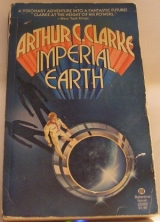
Автор книги: Arthur Charles Clarke
Жанр:
Научная фантастика
сообщить о нарушении
Текущая страница: 19 (всего у книги 19 страниц)
Duncan Makenzie closed the beautifully designed souvenir book-a masterpiece of the printer’s art, such as had not been seen for centuries and might never be seen again. Only five hundred copies had been produced—one for every year. He would carry his back in triumph to Titan, where for the rest of his life it would be among his most cherished possessions. Many people had complimented him on his speech, enshrined forever in these pages-and, much more accessibly, in lib aries and information banks throughout the Soar System. Yet he had
felt embarrassed to receive those plaudits, for in his heart be knew that he had not earned them. The Duncan of a few weeks ago could never have conceived that address; he was little more than a medium, passing on a message from the dead. The words were his, but all the thoughts were Karl’s.
How astonished, he told himself wryly, all his friends on Titan must have been, when they watched the ceremony! Perhaps it had been slightly inappropriate to use such a forum as this for what might be considered self-serving propaganda-even special pleading on behalf of his own world.
But Duncan had a clear conscience, and as yet there had been no criticism on this score. Even those who were baffled by his thesis had been grateful for the excitement he had injected into all the routine formalities.
And even if his speech was only a seven-day wonder to the general public, it would not be forgotten. He had planted a seed; one day it would grow—on barren Mnemosyne.
Meanwhile, there was a slight practical problem, though it was not yet urgent. This splendid volume, with its thick vellum, and its tooled leather binding, weighed about five kilograms.
The Makenzies hated waste and extravagance. Tt would be pleasant to have the book on the voyage home, but excess baggage to Titan was a hundred so lars a kilo…. It would have to go back by slow boat, on one of the empty tankerS-UNACCOMPANIED FREIGHT, MAY BE STOWED IN
VACUUM….
THE MIRROR OF THE SEA
Dr. Yehudi ben Mohammed did not look as if he belonged in a modern hospital, surrounded by flickering life-function displays, Comsole read-outs, whispering voices from hidden speakers, and all the aseptic technology of life and death. In his spotless white robes, with the double circlet of gold cord around his headdress, he should have been holding court in a desert tent, or scanning the horizon from the back of his camel for the first glimpse of an oasis.
Duncan remembered how one of the younger doctors had com men ed, during his first visit: “Sometimes I think El Hadj believes he’s a reincarnation of
Saladin and Lawrence of Arabia.” Although Duncan did not understand the full flavor of the references, this was obviously said more in affectionate jest than in criticism. Did the surgeon, he wondered, wear those robes in the operating theater? They would not be inappropriate there; and certainly they did not interfere with the feline grace of his movements.
“I’m glad,” said Dr. Yehudi, toying with the jeweled dagger on his elaborately inlaid desk-the two touches of antiquity in an otherwise late-twenty-third century environment– ~‘that you’ve finally made up your mind. The—ah-delay has caused certain problems but we’ve overcome them. We now have four perfectly viable embryos, and the first will be trans planted in a week. The others will be kept as backups, in case of a rejection-though that is now very rare.”
And what will happen to the unwanted three? Duncan asked himself, and shied away from the answer. One human being had been created who would
never otherwise have existed. That was the positive side; 291 better to forget the three ghosts who for a brief while had hovered on the borders of reality. Yet it was hard to be coldly logical in matters like this. As he stared across the intricate arabesques, Duncan wondered at the psychology of the calm and elegant figure whose skillful hands had controlled so many destinies. In their own small way, on their own little world, the Makenzies had played at God; but this was something beyond his understanding.
Of course, one could always take refuge in the cold mathematics of reproduction. Old Mother Nature had not the slightest regard for human ethics or feelings. In the course of a lifetime, every man generated enough spermatozoa to populate the entire Solar System, many times over-and all but two or three of that potential multitude were doomed. Had anyone ever gone mad by visualizing each ejaculation as a hundred million murders?
Quite possibly; no wonder that the adherents of some old religions had refused to look through the microscope…. There were moral obligations and uncertainties behind every act. In the long run, a man could only obey the promptings of that mysterious entity called Conscience and hope that the outcome would not be too disastrous.
Not, of course, that one could ever know the final results of any actions.
Strange, thought Duncan, how he had resolved the doubts that had assailed him when he first came to the island. He had learned to take the broader view, and to place the hopes and aspirations of the Makenzies in a wider context. Above all, he had seen the dangers of overreaching ambition; but the lesson of Karl’s fate was still ambiguous and would give him cause to wonder all his life.
With a mild sense of shock, Duncan realized that he had already signed the legal documents and was returning them to Dr. Yehudi. No matter; he had read them carefully and knew his responsibilities. “I, Duncan Makenzie, resident of the satellite Titan presently in orbit around the planet
Saturn” (when did the lawyers think it was going to run away?) “do
hereby accept guardianship of one cloned male 292 child, identified by the chromosome chart herewith attached, and will to the best of my ability .. …. etc.” etc.” etc.Perhaps the world would have been a better place if the parents of normally conceived children had been forced to sign such a contract. This thought, however, was some hundred billion births too late.
The surgeon flowed upward to his full commanding two meters in a gesture of dismissal which, from anyone else, would have seemed slightly discourteous.
But not here, for El Hadj had much on his mind. All the while they had been talking, his eyes had seldom strayed from the pulsing lines of life and death on the read-outs that covered almost one whole wall of his office.
In the main hall of the Administration Building, Duncan paused for a moment before the giant, slowly rotating DNA helix which dominated the entrance.
As his gaze roamed along the spokes of the twisted ladder, contemplating its all-but-infinite possibilities, he could not help thinking again of the pentominoes that Grandma Ellen had set out before him years ago. There were only twelve of those shapes-yet it would take the lifetime of the universe to exhaust their possibilities. And here was no mere dozen, but billions upon billions of locations to be filled by the letters of the genetic code.
The total number of combinations was not one to stagger the mind-because there was no way whatsoever in which the mind could grasp even the faintest conception of it. The number of electrons required to pack the entire cosmos solid from end to end was virtually zero in comparison.
Duncan stepped out into the blazing sunlight, waited for his dark glasses to adjust themselves, and set off in search of Dr. Todd, guide and friend of his previous visit. He would not be leaving for another four hours, and there was one major item of business still to be settled.
Luckily, as Sweeney Todd explained, there was no need to go out to the
Reef.
“I can’t imagine why you’re interested in those ugly beasts. But
you’ll find some on a patch of dead coral at the end of that groin; not much else will live there. The water’s only a meter deep-you won’t even need flippers, just a strong pair of shoes. If you do step on a stonefish, your screams will bring us in time to save your life-though you may wish we hadn’t.”
That was not very encouraging, but ten minutes later Duncan was cautiously walking out into the shallows, bent double as he peered through his borrowed face mask.
There was none of the beauty here that he had seen on the approach to
Golden Reef. The water was crystal clear, but the sea bed was a submarine desert. It was mostly white sand, mingled with broken pieces of coral, like the bleached bones of tiny animals. A few small, drably colored fish were swimming around, and others stared at him with anxious, unfriendly eyes from little burrows in the sand. Once, a brilliantly blue creature like a flattened eel came darting at him and, to his great surprise, gave him a painful nip before he chased it away. It was every bit of three centimeters long, and Duncan, who had never heard of cleaning symbiosis, worried about poison for a few minutes. However, he felt no pangs of imminent dissolution, so pushed his way onward through the tepid water.
The concrete groin-part of the island’s defense against the ceaseless erosion of the waves -stretched out for a hundred meters from the shore and then disappeared beneath the surface. Near its seaward end,
Duncan came across a pile of jumbled rocks, perhaps hurled up by some storm. They must have been here for many years, for they were cemented together with barnacles and small, jagged oysters. Among their caves and crevices, Duncan found what he was seeking.
Each sea urchin appeared to have hollowed out its own cavity in the hard rock; Duncan could not imagine how the creatures had performed this remarkable feat of burrowing. Anchored securely in place, with only a bristling frieze of black spines exposed to the outer world, they were invulnerable to all enemies except Man. But Duncan wished them no harm, and this time had not even brought a knife. He had seen
294 enough of death, and his sole purpose now was to confirm-or refute-the impression that had haunted him ever since he had set eyes on that drawing in Karl’s notebook.
Once again, the long black spines started to swing slowly toward his shadow. These primitive creatures, despite their apparent lack of sense organs, knew that he was there, and reacted to his presence. They were scanning their little universe, as Argus would search the stars…. Of course, there would be no actual physical movement of the Argus antennas-that was unnecessary, and would be impossible with such fragile, thousand kilometer-long structures. Yet their electronic sweeping of the skies would have an uncanny parallel with Diadema’s protective reaction. If some planet-sized monster, which used ultra long radio waves for vision, could observe the Argus system at work, what it “save’ would be not unlike this humble reef dweller.
For a moment, Duncan had a curious fantasy. He imagined that he was such a monster, observing Argus in silhouette against the background radio glow of the Galaxy. There would be hundreds of thin black lines, radiating out from a central point-most of them stationary, but some of them waving slowly back and forth, as if responding to a shadow from the stars.
Yet it was hard to realize that even if Argus was built, no human eye could ever see it in its entirety, The structure would be so huge that its slender rods and wires would be totally invisible from any distance.
Perhaps, as Karl had suggested in his notes, there would be warning lights dotted all over the millions of square kilometers of the spherical surface and strung along the six principle axes. To an approaching spaceship, it would look like some glittering Star Day ornament.
Or-and this was more appropriate-a discarded toy from the nursery of the
Gods… Toward evening, while he was waiting for the shuttle back to the mainland,
Duncan found a secluded corner of the coffee shop-cum-bar which
overlooked the lagoon. He sat there thoughtfully, sipping from time to time at a Terran drink he had discovered something called a Tom Collins. It was a bad idea, acquiring vices which could not be exported to Titan; on the other hand, it could equally well be argued that it was foolish not to enjoy the unique pleasures of Earth, even if one had to relinquish them all too soon.
There was also endless enjoyment in watching the play of wind over the water protected by the barrier of the inner reef. Some stretches were absolutely flat, reflecting the blue of the unclouded sky as if in a flawless mirror. Yet other areas, apparently no different, were continually quivering so that not for a moment was the surface still; it was crossed and crisscrossed by innumerable tiny wavelets, no more than a centimeter in height. Presumably some relationship between the varying depth of the lagoon and the velocity of the wind was responsible for the phenomenon, quite unlike anything that Duncan had ever before seen. No matter what the explanation, it was enchantingly beautiful, for the countless reflections of the sun in the dancing water created sparkling patterns that seemed to move forever down the wind, yet remained always in the same spot.
Duncan had never been hypnotized, nor had he experienced more than a few of the nine states of consciousness between full awareness and profound sleep.
he alcohol might have helped, but the scintillating sea was undoubtedly the main factor in producing his present mood. He was completely alert indeed his mind seemed to be working with unusual clarity-but he no longer felt bound by the laws of logic that had controlled all his life. It was almost as if he was in one of those dreams where the most fantastic things can happen, and are accepted as matter of-fact, everyday occurrences.
He knew that he was facing a mystery, of the sort that was anathema to the reputedly hard-headed Makenzies. Here was something that he could
never explain to Malcolm and Colin; they would not laugh 296 at him–or so he hoped-but they would never take him seriously.
Besides, it was so utterly trivial. He had not been vouchsafed some blinding revelation, like an ancient prophet receiving the word of God. All that had happened was that he had come across the same very unusual shape in two quite independent contexts; it might have been a mere coincidence, and the sense of deja vu pure self-delusion. That was the simple, logical answer, which would certainly satisfy everyone else.
It would never satisfy Duncan. He had experienced that indescribable shock a man may know only once in a lifetime, when he is in the presence of the transcendental and feels the sure foundations of his world and his philosophy trembling beneath his feet.
When he saw that careful drawing in Karl’s sketchbook, Duncan had recognized it at once. But now it seemed to him that the recognition came not only from the past, but also from the future. It was as if he had caught a momentary glimpse in the Mirror of Time, reflecting something that had not yet occurred-and something that must be awesomely important for it to have succeeded in reversing the flow of causality.
Project Argus was part of the destiny of mankind; of this, Duncan was now sure beyond any need for rational proof. But whether it would be beneficent was another question. All knowledge was a two-edged sword, and it might well be that any messages from the stars would not be to the liking of the human race. Duncan remembered the dying cries of the sea urchin he had killed, out there on Golden Reef. Were those faint but sinister crepitations wholly meaningless-an accidental by-product? Or did they have some more profound significance? His instincts gave him not the slightest clue, one way or the other.
But it was an act of faith to Duncan, and to those he had worked with all his life, that it was cowardice not to face the truth, whatever it might be and wherever it might lead. If the time was coming for mankind to face the powers behind the stars, so be it. He had no
doubts. All he felt now was a calm contentment—even if it was the calm at the center of the cyclone.
Duncan watched the light trembling and dancing on the lagoon, as the sun sank lower and lower toward the horizon and the hidden coast of Africa.
Sometimes he thought he could see, in those flaring, coruscating patterns, the warning beacons of Argus, staking a claim to the billions of cubic kilometers of space they enclosed-fifty or a hundred years from now…. Changing shape even as Duncan watched, the Sun kissed the horizon and spread out a crimson, bellshaped skirt across the sea. Now it looked like the film of an atomic blast-but run backward, so that the fires of hell sank harmlessly into the ocean. The last golden arc of the departing disc lingered on the edge of the world for an instant, and at the very second it disappeared there was a momentary Bash of green.
As long as Duncan lived, he might never see such heartbreaking beauty again. It was a memory to take back to Titan, from the island on which he had made the great decision of his life and opened the next chapter
in the story of the outer worlds. Part IV
I 1~ I
71 L Titan
HOMECOMING
It was over. All the good-byes had been said to crew and passengers, all the formalities had been completed, everything he had brought from Earth was already moving along the conveyor belt. Everything, that is, except for the most important gift of all.
He could walk through that door marked TITAN CITIZENS, and he would be home. Already he had forgotten the crippling gravity of Earth; that-and so much else-was fading into the past like a dissolving dream. This was where he belonged and where his life’s work would be done. He would never again go sunward, though he knew there would be times when some remembered beauty of the mother world would drive a dagger into his heart.
The family must be waiting, there in the reception lounge; and now, with only seconds before the moment of reunion, Duncan felt a reluctance to face the whole Makenzie clan. He let the other travelers go hurrying past him, while he stood irresolutely, trying to pluck up his courage and clutching his precious bundle awkwardly to his chest. Then be moved forward, under the archway, and out onto the ramp.
There were so many of them! Malcolm and Colin, of course, Marissa, more beautiful and desirable than even in his most restless dreams, now free of
Calindy forever; Clyde and Carline-could she really have grown so much, in so short a time? And at least twenty nephews and nieces whose names he knew as well as his own, but just couldn’t recall at the moment.
No-it was impossible! But there she was, standing a little apart from the others, leaning heavily on her cane, yet otherwise completely
unaltered since he had 300 last seen her on the cliffs of Loch Hellbrew. Much else had changed indeed if Grandma Ellen had retamed to Oasis for the first time in fifty years.
As she saw Duncan’s astonished gaze, she gave a barely perceptible smile.
It was more than a greeting; it was a signal of reassurance. She already knows, thought Duncan. She knows and approves. When the full fury of the
Makenzies breaks upon my head I can rely on her…. There flashed into his mind an old Terran phrase, whose origin he had long ago forgotten: the Moment of Truth. Well, here it was They all crowded eagerly around him as he drew back the shawl. For an instant only he felt regret; perhaps he should have given some warning. No, it was better this way. Now they would learn that he was his own man at last, no longer a pawn of others-however much he might owe to theta, however much he might be part of them.
The child was still sleeping, but normally now, not in the, electronic trance that had protected it on the long voyage from Earth. Suddenly it threw out a chubby arm, and tiny fingers gripped Duncan’s hand with surprising strength. They looked like the pale white tentacles of a sea anemone against the dark brown of Duncan’s skin.
The little head was still empty even of dreams, and the face was as void and formless as that of any mont hold baby. But already the smooth, pink scalp bore an unmistakable trace of hair-the golden hair that would soon bring back to Titan the lost glories of the distant Sun.
ACKNOWLEDGMENTS AND NOTES
my first thanks should go to Truman Talley, who in the early ‘50’s made what was then (and for that matter still is) a most generous offer for this book, on the strenath of the title and one conversation. I have often wished that I could remember what I said then; it might have saved me much trouble, twenty years later. I now have no idea if this book bears the slightest resemblance to that early concept, but “Macls” initial encouragement kept me from abandoning it.
Like many other addicts, I was introduced to polyominoes by Martin
Gardner’s Scientific American Book of Mathematical Puzzles and Diversions, which, however, fiendishly refrains from giving the solution to the 20 X 3 rectangle. In his definitive book Polyominoes, Solomon W. Golomb takes mercy on his readers. In the hope of preventing a few nervous breakdowns,
I reproduce his answer herewith:
UXPILNFTWYZV
Anyone who wishes to construct this rectangle from the twelve pentominoes should have no difficulty in matching them with the letters they (sometimes approximately) resemble. It is easy to see that the second of the (only) two solutions is obtained by rotating a seven-element central portion.
Dr. Golomb, who is now professor of Electrical
Engineering and Mathematics at the University of
Southern California, has also invented an ingenious game called Pentominoes@ (distributed in North
America by Hallmark Cards and in Europe by Zimpfer
Puzzles). It has more openings than chess. In an earlier version of 2001: A Space Odyssey, Stanley Kubrick shot Hal playing this game against the astronauts.
I am indebted to Dr. Robert Forward of the Hughes Research Laboratory,
Malibu, for introducing me to the fascinating concept of mini black holes, and for making such encouraging noises about the somewhat outrageous propulsion system of S. S. Sirius that I am almost inclined to patent it…. Dr. Grote Reber, the father of radio astronomy and builder of the world’s first radio telescope, started me thinking about the extent of the heliosphere and, its possible consequences. I am grateful for his comments on cutoff frequencies, but he is in no way responsible for my wilder extrapolations of his ideas. Dr. Adrian Webster, of Cavendish Laboratory’s
Mullard Radio Astronomy Observatory, also gave much vital information, and he too is not to be blamed for my use of it.
I am especially indebted to Dr. Bernard Oliver, vice-president and director of research of Hewlett Packard not only for hospitality at Palo Alto but also for an advance copy of the Project CYCLOPS Design Study NASA Ames CR 114445), which he directed. And I hope Barney will forgive me for the assumption-which in fact I regard as highly improbablo–that CYCLOPS would not have detected intelligent signals, even after two hundred years of operation.
Indignant antenna designers who feel that Argus would not work as specified are invited to contemplate ABM search radars, and to Think Big. All I will say in self-defense is that the Argus elements would be superconducting, active, and divided into many switchable subsections, perhaps with cross-connections between the “spines.” I leave minor practical details (as in the case of the Asymptotic Drive) as an exercise for the student.
The “exasperated” remark in Chapter 21 was made to me at a NASA conference by Professor Neil Armstrong in July 1970. I hope it is the last word on some famous first words.
I am deeply grateful to my old friend William Mac
Quitty, producer of A Night to Remember, for much material concerning the Titanic-including the menu in Chapter 27. Collectors of unlikely
coincidences may be interested to know that just three hours after I had decided to incorporate it in the text, I read in the May 1974 Skin Diver that the
Titanic Enthusiasts of America had served this menu at their Annual
Dinner…. Some readers may feel that the coincidences-or “correspondences”-that play a key part in this story are too unlikely to be plausible. But they were, in fact, suggested by far more preposterous events in my own life; and anyone who doubts that this sort of thing can happen is referred to Arthur
Koestler’s The Roots of Coincidence. I read this fascinating book only after completing Imperial Earth, though that fact itself now seems somewhat improbable to me.
Even more improbable is the fact that when, on July 24, 1975, I appeared as a witness before the House of Representatives Subcommittee on Space Science (in the very building libeled and demolished in Chapter 33!), I was able to quote extensively from Duncan’s address to Congress in Chapter 41. Thus the
House of Representatives’ hearings now contain extracts from the
Congressional Record for July 4, 2276, which should cause confusion among future historians.
The curious acoustic behavior of the spiny sea urchin, Diadema setosum, was observed by me on Unawatuna Reef, off the south coast of Sri Lanka. I have never seen this recorded elsewhere, so it may be my one original contribution to marine biology.
Finally, my speculations about conditions on Titan were triggered by a series of papers that Dr. Carl Sagan was good enough to send me. Needless to say, I am also indebted to Carl for many other stimulating ideas, which any properly designed universe would be very foolish to ignore. “For if not true, they are well imagined…
ARTHUR C. CLARKE Cinnamon Gardens, Colombo January 1974-January 1975
ADDITIONAL NOTE
Several expert readers have accused me of grave error by assuming that
Malcolm would pass on the Makenzie defect to his clones. Though I was well aware of this problem (and tried to avoid it by being carefully unspecific)
I did not go into the matter as seriously as I should have done. I am still hoping that some ingenious geneticist will be able to contrive a solution; unfortunately, I doubt if I will be able to understand it.
Meanwhile, for those biologists who refuse to be placated, I can only fall back upon what is known in the trade as Bradbury’s Defense, viz:
One dreadful boy ran up to me and said:
“That book of yours, The Martian Chronicles?”
“Yes,” I said.
“On page 92, where you have the moons of Mars rising in the East?”
“Yeah,” I said.
“Nah,” he said.
So I hit him
ARTHUR C. CLARKE
Colombo, June 1976
Mars and the Mind ol Men (Harper & Row 1973.)