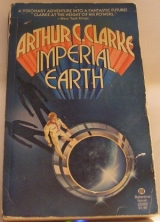
Текст книги "Imperial Earth"
Автор книги: Arthur Charles Clarke
Жанр:
Научная фантастика
сообщить о нарушении
Текущая страница: 11 (всего у книги 19 страниц)
“Because Bill,” said another voice from the darkness, “tomorrow we explore the caves of the maneating vampire bats of Bongo Bongo. Now
for heaven’s sake shut up and go to sleep.”
PRIMEVAL FOREST
TDuncan’s surprise, it was already full daylight when he awoke. He decided that the wine must have been responsible, and even wondered if it had been drugged, for all his companions were still sleeping stertorously.
He rolled off the air mattress, and treading carefully over unconscious bodies, opened the flap of the tent. The glare drove him back for his dark glasses, for the sun was now shining from a blue, cloudless sky. As he walked to the portable shower, carrying towel and toothbrush, he scanned the circle of trees. In broad daylight, they seemed much less ominous; but with that infernal howl still echoing in his memory, nothing would have induced Duncan to venture there alone. For that matter, he was not quite sure how many companions he would need to give him any sense of security in the forest-but unless the jet returned for them, that was precisely where they would have to go. At one point he could see what looked like the beginning of a jungle trail, though from this distance it was impossible to tell whether it was made by men or animals. Nothing else was visible; the trees were so high, and so thick, that there could have been a range of mountains a few kilometers away, completely hidden from view.
Duncan ran into Boss on the way back from his toilet. The fearless leader looked as if he could use some extra sleep, but otherwise still seemed in full charge of the situation.
“Did you put something in that wine?” Duncan asked, after they had exchanged greetings. “Usually I dream-but last night..
Boss grinned. “Don’t expect me to reveal all Enigma’s little secrets. But in this case, we’ve nothing to hide. You can thank the natural, open-air life for your good night’s sleep-though the wine probably helped. Now let’s wake up the others.”
This took some time, but eventually all the troops were on parade, though in a slightly disheveled condition, with not a few stiff yawning mightily.
Groans of protest greeted Boss’s first order.
“We’re going for a little safari before breakfast. Coffee will be along in a minute, but that’s all you’re having now. Your appetites will be all the better when we get back.”
“And when will that be?” cried half a dozen voices simultaneously.
“It depends how fast you march. Bob-you’ll need better footwear than those sandals. Miss Leesorry, but in the jungle it’s advisable to wear something above the waist. And even more advisable below it, Miss Perry. Right, everybody-back here in five minutes, then we start. No breakfast for stragglers.”
There were no stragglers, though it must have been more than ten minutes before Boss had everyone lined up in double file. Then he disappeared into his private tent, only to emerge again at once, heavily laden.
Instantly, the babble of conversation stopped. There were sudden gasps of indrawn breath, and Duncan found himself staring at Enigma’s latest surprise with a curious mixture of fascination and disgust.
The fascination was undoubtedly there, despite the conditioning of a lifetime. He was ashamed of it -yet, somehow, not as ashamed as he might have been. Duncan had never concealed his impulses from himself; now he recognized the almost irresistible urge to reach out and take one of those monstrous instruments in his hand, to feel its power and weight-and to use it for the only purpose for which it was designed.
It was the first time he had ever seen a gun, and Boss was carrying
two, as well as a pair of cartridge belts. He handed one gun and belt over to an assistant, who took up his position at the end of the file.
“O.K.,” said Boss, just as nonchalantly as if he were unaware of the impression he had created. “Let’s go!”
As he. walked toward the edge of the clearing, he threw the gun over his shoulder and buckled on the belt of ammunition. It was perfectly obvious that He knew how to handle his armament, but Duncan did not find this in the least reassuring. And judging by the glum silence, neither did anyone else.
The track through the jungle turned out to be surprisingly well kept; when someone commented on this, Boss called back over his shoulder: “We have an arrangement with the local tribes-they’re friendly -you’ll meet them later.”
“That’s a giveaway!” whispered Bill van Hyatt in Duncan’s ear. “The only primitive tribes left are in the Far East. I knew it was Borneo.”
They had now walked perhaps a kilometer through the closely packed trees and were already beginning to feel the effects of the day’s increasing heat. There was a chorus of relief when Boss abruptly called back: “We’re nearly there—close up!”
He stepped to the side of the trail, and let the file walk on past him.
Duncan was near the head of the line, and saw that they were approaching a mass of bare rocks which formed a small hillock. Now at last, he told himself, we’ll be able to get a good view of the land around us.
Those ahead of him were already scrambling up the rocks, eager to see what lay ahead. Suddenly, there were cries of astonishment, inarticulate shouts.
Millie van Hyatt, who had reached the top long before her husband, suddenly collapsed in hysterics. “Borneo!” she screamed. “He said Borneo!”
Duncan hurried to join her as swiftly as he could, in this unaccustomed gravity. A moment later, he reached the top of the little hill, and the vista to the south lay open before him.
Engima had certainly fulfilled its promise. Not more than five
kilometers away, gleaming in the morning 164 light, was the most famous structure in the world. And now that all its upstart rivals had long since been demolished, it was once again the tallest.
Even a visitor from Titan could have no difficulty in recognizing the
Empire State Building.
“Very clever,” said Bill van Hyatt in grudging admiration. “They must have flown us straight back over the same course, when they picked up the second load of passengers. But there are still some questions. That hideous noise last night-“
“Oh, eat your breakfast, Bill. Don’t always try to get ahead of the game.”
Boss, who was clearly relaxed now that his deception had been successfully carried off, called back from the end of the table: “Surely you’ve guessed that one, Bill?”
“Probably the sound track of an old Tarzan movie.”
Boss chuckled and glanced at his watch. All timepieces and communicators had been returned to their owners, and Duncan no longer felt so naked. He had never been able to stop himself looking at his absent watch, and he realized how cleverly Enigma had managed to disorient him in all four dimensions.
“In about five minutes, Bill, you’ll know better.”
“In that case, I’d appreciate it if you’d bring up the artillery again.”
“No use. The guns were real, but the bullets weren’t.”
“I see-just another part of the act. Tell me-have you ever used one of those things?”
V9
“Yes.
“On what? Anything big?”
“Fairly. 99
“Was it dangerous?”
One had -to admire Bill’s persistence, almost as much as his resilience.
It was obvious that Boss was getting tired of this line of questioning, but was too polite to shut it off.
“Quite dangerous.”
“Could it have killed you?”
“Easily,” said Boss, and now his voice had suddenly become bleak and impersonal. “You see, it was carrying a gun too.”
In the ensuing uncomfortable silence, Duncan came to several quick conclusions. Boss was speaking the cold truth; it was no concern of theirs; and they would never learn any more.
Conversation was just getting under way again after this derailment when there was another interruption.
“Hey!” somebody shouted. “Look over there!”
A man was walking out of the “jungle,” and he was not alone. Trotting beside him were two enormous animals, attached to leashes which seemed highly inadequate. They were undoubtedly dogs of some kind, though Duncan had not realized that any grew to such a size. There were, he knew, thousands of different breeds, but there seemed something strange about these; they did not fit any of the visual records he had ever seen.
“Of course!” someone exclaimed. “That’s Fido and Susie.”
There were murmurs of assent, but Duncan was none the wiser. He also thought that he could have chosen more appropriate names.
He was even more certain of this by the time that the monsters had reached the camp. They stood half as high as a man, and must have weighed two hundred kilos.
“What are they?” he asked. “Wolves?”
“Yes and no,” Boss answered. “They’re dire wolves. They’ve been extinct for about ten thousand years.”
Now Duncan remembered. He had heard vaguely of the experiments on genetic reversal that had been taking place on Earth. There had been much excitement a few years ago about something called a passenger pigeon, which had now become such a pest that efforts were being made to control it. And there was even talk of restoring dinosaurs when the technique was perfected.
“Hello, Professor,” said Boss. “Your hounds really shook some of us last night. By the way, folks, this is Cliff Evans, head of the
department of. animal 166 genetics at the Central Park Zoo-have I got that right? And as some of you have guessed, this is the famous Fido and Susie. Is it safe to feed them a few scraps, Cliff?”
The professor shook his head.
“Not on your life; I’m afraid they’re not terribly bright. We go to a lot of trouble balancing their diet. I should hate to get human protein mixed up in it.”
“Very considerate of you. Now, how’s the transport going to work out?”
“I can let you have ten well-behaved horses and five ditto ponies. ““That only enough for fifteen. We need at least twenty-five.”
“No problem. You can also have six miniphants. They can each take two riders, and they’re safer than horses….”
While this discussion was in progress, Duncan examined the professor and his pets. The survey did not inspire much confidence; in particular, he did not care for the way in which the scientist was covered from head to heels in smooth leather, with massive reinforcements around the throat and from elbow to heavily gloved hands. It could not have been very comfortable on a hot June morning, and presumably he was not wearing this armor for fun.
However, Fido and Susie seemed sleek, well fed, and even somnolent. From time to time they yawned and licked their chops, with a disturbing display of dentition, but they showed no interest in after-breakfast snacks. In fact, they showed very little interest in anything, and Duncan could see the truth of the professoes remarks about their intelligence. Their narrow skulls obviously contained much smaller brains than those of modern wolves; it was no wonder that they had become extinct. Duncan-himself an experiment in controlled genetics-felt rather sorry for the big, clumsy beasts.
“Attention, everyone!” Boss called. “We’re breaking camp in thirty minutes, and then we have a short trip to make—only about six kilometers. You know the restrictions on transport in New York City,
so we have the following choices-foot, horse, or m-in-i-phant. On a beautiful morning like this, Fm going to walk. But it’s up to you-who wants to ride horseback? One, two, three-was your hand up,
Bill? .. . four … eleven, twelve, thirteen … that’s unlucky—any more? No? O.K.” thirteen it is.”
“What about bicycles?” somebody shouted.
“Not allowed in the park,” said Professor Evans. “Only last year a mad cyclist killed one of my ponies. Unfortunately, he survived. If you want a bike, you can go across to Fifth Avenue and hire one. For that matter, you can walk to the 96th Street station and catch the subway. It runs every ten minutes in the tourist season.”
There were no takers, but all the miniphants were snapped up. Duncan opted for this mode, on Boss’s advice. The rest of the party elected to walk.
Half an hour later, the string of animals arrived at the camping site. To
Duncan’s astonishment, they were unaccompanied by humans. One large miniphant led the procession, and the other five kept the horses from straying. The two species seemed to be on excellent terms with each other.
“I suppose it’s the first time you’ve seen a miniphant?” said Boss, noticing Duncan’s interest.
“Yes-I’d heard about them, of course. Why are they so popular?”
“They have the advantage of the elephant without the handicap of its size.
As you see, they’re not much bigger than horses. But they’re much more intelligent, understand several hundred words, and can carry out quite complicated orders without supervision. And with that trunk they can open doors, pick up parcels, work switches-would you believe that they can operate viddies?”
“Frankly, no.”
“You’re wrong; some of them can, though not reliably yet. They get the right number about eight times out of ten.”
The leader ambled up to Boss and raised his trunk in salutation.
“Hello, Rajah-nice to see you again.”
Rajah brought down his trunk and wound it affectionatoly around BoWs wrist.
Then he bent his legs 168 and knelt ponderously on the ground, so that his riders could climb easily into the pair of seats arranged sidesaddle on his back. The other five miniphants performed the same act with the timing of a well-trained corps de ballet.
Did a boat feel like this? Duncan asked himself, as he swayed gently and comfortably out of the park. This was certainly the way to travel if the weather was fine, you didn’t have far to go, and you wanted to enjoy the view. As all three criteria were now satisfied, he was blissfully content.
The file of animals and humans made its way out of the clearing, through the belt of trees, and past the pile of rocks from which the morning’s revelation had been vouchsafed. They skirted the little hill, and presently came to a lake on which dozens of small boats were being languidly paddled back and forth. Each boat appeared to contain one young man, who was doing the paddling, and one young lady, who was doing nothing. Only a few couples took enough notice of the procession wending past to wave greetings; presumably New Yorkers were too accustomed to miniphants to give them more than a passing glance.
After the lake, there came a beautiful expanse of grass, smooth and flat as a billiard table. Though there were no warning signs, not a single person was walking on it, and all the animals avoided it with scrupulous care.
Duncan’s fellow passenger twisted around in his seat and called over his shoulder: “They say the New Yorkers are getting more tolerant. Last man to walk on that wasn’t lynched on the spot -they gave him a choice between gas and electrocution.” Duncan presumed he was joking, but didn’t pursue the matter; this back-to-back seating was not good for conversation.
From time to time Bill van Hyatt, who was riding-quite expertly-a beautiful cream-colored pony, came up to him to deliver snippets of information. Most of these were welcome, even though not always necessary.
Of all Man’s cities, New York was still the most famous-the only one
where all exiles, every169 where in the Solar System, would feel at home. Now that they were clear of the taller trees, it was possible to see many of the midtown landmarks-not only the dominating finger of the Empire State Building, but the slowly orbiting Grand Central Mobile, the shining slab of the old United Nations, the great terraced pyramid of Mount Rockefeller spanning half the island from Fifth Avenue to the Hudson River…. Duncan had no difficulty recognizing and naming these, but the more distant structures to the east and west were strange to him. That big golden dome over in-was it New
Jersey?-was most peculiar, but Duncan had grown a little tired of exposing his ignorance and was determined to ask no more nonessential questions. He could always look up the guidebooks later.
They reached Columbus Circle and started climbing the ramp up to the bridge over the Grand Canal that now bisected Manhattan. On the level below, bikes, trikes, and passenger capsules were racing silently back and forth; and on the level below them, the famous Checker Gondolas were shuttling between the East River and the Hudson. Duncan was surprised to see such heavy traffic so far north of the city area, but guessed it was almost all recreational or tourist
There was a brief pause at an Eighth Avenue comfort station for the benefit of the horses and miniphants—which, like all herbivores, had low-efficiency, rapid-turnover conversion systems. Some of the passengers also took advantage of the stop, even though the facilities were not intended for them. Remembering his contretemps at Mount Vernon, Duncan tried to imagine what the New York streets must have been like in the days when horses provided the only transportation, but failed and thankfully abandoned the attempt.
Now they were skirting the northern flank of Mount Rockefeller, which towered two hundred and fifty meters above them—challenging the Empire
State Building in altitude and completely eclipsing it in bulk. With
the exception of a few dams and the Great 170 Wall of China-hardly a fair comparison-it was the largest single structure on Earth. Here had gone all the rubble and debris, all the bricks and concrete, the steel girders and ceramic tiles and bathtubs and TV sets and refrigerators and air conditioners and abandoned automobiles, when the decayed uptown area was finally bulldozed flat in the early twenty second century. The clean-up had, perhaps, been a little too comprehehsive; now the industrial archaeologists were happily mining the mountain for the lost treasures of the past.
The straggling line of men and animals continued south along the wide, grassy sward of Eighth Avenue, skirting the western face of the huge pyramid. Unlike the southern facade, which was entirely covered by the celebrated Hanging Gardens of Manhattan, this side was a montage of frescoes, murals, and mosaics. It would never be completed. As fast as one work of art was finished, another would be demolished, not always with the consent of the artist. The west side of Mount Rockfeller was an aesthetic battlefield; it had even been bombed-with cans of red paint. The terraces and stairways of the man-made bill were crowded with sightseers, and on many of the vertical surfaces craftsmen were at work in swinging chairs suspended by cables. Morbidly conscious as he was of terrestrial gravity,
Duncan could only look on these courageous artists with awe-struck admiration.
Nearer ground level, there were hundreds of more informal attempts at expression. One section of wall, four meters high and fifty long, had been set aside for graffiti, and the public had taken full advantage of the opportunity with crayons, chalk, and spray guns. There was a good deal of cheerful obscenity, but most of the messages were totally meaningless to
Duncan. Why, he wondered, should he SUPPORT THE MIMIMALIST MANIFESTO? Was it true that KILROY WAS HERE and if so, why? Did the announcement that COUNCILMAN WILBUR ERICKSON IS A YENTOR convey praise or censure? He brooded over these and similar world-shattering problems all the way south to 44th Street.
Here, in a small plaza between Tenth and Eleventh avenues, they said good-bye to the horses and miniphants. Duncan’s mount gently collapsed in slow motion, so that its riders could step off onto terra firma; then, with equal solemnity, it rose to its feet, gravely saluted them with upraised trunk, and headed back toward its home in the
Central Park Zoo. The ride had been an enjoyable experience, and Duncan could imagine few nicer ways of sightseeing, in perfect weather such as this. Nevertheless, he was glad to be back on his own feet again. That gentle swaying had been growing a little monotonous. And although he had been in no real danger, he now knew what the first intimations of seasickness must be like.
They were now only a few hundred meters from the elevated ribbon of the
West Side Highway and the impressive expanse of the Hudson River, blue and flat in the mornine sunlight. Never before had Duncan seen so large a body of water at such close quarters. Though it looked calm and peaceful, he found it slightly ominous-even menacing. He was more familiar with the ocean of space than the realm of water, with all its mysteries and monsters; and because of that ignorance, he felt fear.
There were numerous small villas and cafes and shops along the riverfront, as well as dozens of little docks containing pleasure boats. Although marine transport had been virtually extinct for more than two centuries, water still had an irresistible fascination for a large part of the human race. Even now, a garishly painted paddle boat loaded with sightseers, was skirting the New Jersey shore. Duncan wondered if it was a genuine antique, or a modern reconstruction.
The three-masted man-of-war with the gilded figurehead could not possibly be the real thing-it was much too new and had obviously never gone to sea. But moored at a dock close to it was the scarred yet still beautifully streamlined hull of a sailing ship which, Duncan guessed, might have been launched in the early twentieth century. He looked at it with awe, savoring the knowledge that it had already
finished172 its career before the first ships of space lifted from
Earth.
Boss did not give them an opportunity to linger over these relics; he was heading toward an enormous, translucent half-cylinder lying along more than three hundred meters of the shoreline. It appeared to be a makeshift, temporary structure, quite out of keeping-in scale and appearance-with the careful good taste of everything around it.
And now, as they approached this peculiar building, Duncan became aware of a sudden change in the behavior of his companions. All the way from the park they had been chattering and laughing, completely relaxed and enjoying themselves on this beautiful summer day. Quite abruptly, it seemed as if a cloud had passed across the face of the sun; all laughter, and almost all talking, had suddenly ceased. Very obviously, they knew something that he did not, yet he was reluctant to disturb this mood of solemn silence by asking nal ve questions.
They entered a small auxiliary building, so much like an airlock that it was easy to imagine that they were going into space. Indeed, it was a kind of airlock, holding rows of protective clothing: oilskins, rubber boots, and-at lasO-the hard hats that had been exercising Bill van Hyatt’s imagination. Still in that curious expectant hush, with only a few fleeting smiles at each other’s transformed appearance, they passed through the inner airlock.
Duncan had expected to see a ship. In this, at least, he was not surprised.
But he was completely taken aback by its sheer size; it almost filled the huge structure that surrounded it. He knew that, toward the end, oil tankers had become gigantic-but he had no idea that passenger liners had ever grown so huge. And it was obvious from its many portholes and decks that this ship had been built to transport people, not bulk cargo.
The viewing platform on which they stood was level with the main deck and just ahead of the bridge. To his right, Duncan could see one huge but truncated mast and a businesslike maze of cranes, winches,
ventilators, and hatches, all the way up to the prow. Stretching away on the left, toward the ship’s hidden stern, was an apparently endless wall of steel, punctuated by hundreds of portholes. Looming, high above everything were three huge funnels, almost touching the curved roof of the enclosure. From their spacing, it was obvious that a fourth one was now missing.
There were many other signs of damage. Windows were shattered, parts of the decking had been torn up, and when he looked down toward the keel, Duncan could see an enormous metal patch, at least a hundred meters long, running just below the waterline.
Only then did all the pieces of the puzzle fall into place. Now he understood the awed silence of his companions, and was able to share their emotions of wonder and of pity.
On that day, he had been a boy on a distant world; but he could still remember when, after her three-hundred-and-fifty-year maiden voyage, the
Titanic had at last reached New York.
THE GHOST FROM THE GRAND BANKS
“They never built another one like her; she marked the end of an age-an age of wealth and elegance which was swept away, only two years later, by the first of the World Wars. Oh, they built faster and bigger, in the half century before air travel closed that chapter for all time. But no ship ever again matched the luxury you see around you now. It broke too many hearts when she was lost.”
Duncan could not believe it; he was still in a dream. The magnificent Grand
Saloon, with its vast mirrors, gilded columns, and ankle-deep carpet,
was opulent beyond anything he had ever imagined, and the sofa into which he was sinking made him almost forget the gravity of
Earth. Yet the most incredible fact of all was that everything he saw and touched had been lying for three and a half centuries on the bed of the
Atlantic.
He had not realized that the deep sea was almost as timeless as space. “All the damage,” the speaker had explained, “was done on that first morning.
When she sank, two and a half hours after the spur of ice ripped open the starboard hull, she went down bow first, almost vertically. Everything loose tumbled forward until it was either stopped by the bulkheads, or else smashed through them. By miraculous good luck-and this tells you how superbly she was built-all three engines remained in place. If they had gone, the hull would have been so badly damaged that we could never have salvaged her…. “But once she reached the bottom, three kilometers down, she was safe for centuries. The water there is only two degrees above freezing point; the combination of cold and pressure quenches all decay, inhibits all rust.
We’ve found meat in the refrigerators as fresh as when it left Southampton on April 10, 1912, and everything that was canned or bottled is still in perfect condition.
“When we’d patched her up-a straightforward job, though it took a year to plug all the holes and reinforce the weak spots-we blasted out the water with the zero-thrust cold rockets the deep sea salvage people have developed. Naturally, weather conditions were critical; by good luck, there was an ideal forecast for April 15, 2262, so she broke surface three hundred and fifty years to the very day after she sank. Conditions were identical-dead calm, freezing temperature-and you won’t believe this, but we had to avoid an iceberg when we started towingl
“So we brought her to New York, pumped her full of nitrogen to stop rusting, and slowly dried her out. ~Io problems here-the underwater archaeologists have preserved ships ten times older than Titaydc. It’s the sheer scale of the job that’s taken us fourteen years, and will
take us at least ten more. Thousands 175 of pieces of smashed furniture to be sorted out, hundreds of tons of coal to be moved-almost every lump by hand.
“And the dead… 158 so far. Only a few people were trapped in the ship.
Those in sealed compartments looked as if they had been drowned yesterday.
In the sections the fish could reach, there were only bones. We were able to identify several, from the cabin numbers and the White Star Line’s records. And that story you’ve heard is quite true: we found one couple still in each other’s arms. They were married-but each to someone else. And the two other partners survived; I wonder if they ever guessed? After three and a half centuries, it doesn’t much matter…. “Sometimes we’re asked-why are you doing this, devoting years of time and millions of so lars to-salvaging the past? Well, I can give you some down-to earth practical reasons: This ship is part of our history. We can better understand ourselves, and our civilization, when we study her.
Someone once said that a sunken ship is a time capsule, because it preserves all the artifacts of everyday life, exactly as they were at their last instant of use. And the Titanic was a cross-section of an entire society, at the unique moment before it started to dissolve.
“We have the stateroom of John Jacob Astor, with all the valuables and personal effects that the richest man of his age was taking to New York. He could have bought the Titanic-a dozen times over. And we have the tool kit that Pat O’Connor carried when he came aboard at Queenstown, hoping to find a better living in a land he was never to see. We even have the five sovereigns he had managed to save, after more years of hardship than we can ever imagine.
“These are the two extremes; between them we have every walk of life-a priceless treasure trove for the historian, the economist, the artist, the engineer. But beyond that there’s a magic about this ship which has kept its name fresh through all the centuries. The story of the
Titanies first and last voyage is one that has to be told anew in every generation, lest men forget the workings of fate and chance.
“I have talked longer than I intended, and pictures speak louder than words. There have been ten movies about the Titanic-and the most ambitious will start production shortly, using the actual location for the first time. But the extracts we want to show you now are from a film made three hundred and twenty years ago. Of course it will look oldfashioned, and it’s in black and white, but it was the last film to be made while survivors were still alive and could check its details. For this reason, it remains the most authentic treatment; I think you will discover that A Night to
Remember lives up to its name.tg
The lights in the Grand Saloon dimmed, as they had dimmed at two-eighteen on the morning of April 15, 1912. Time rolled back three and a half centuries as the grainy, flickering real-life footage merged into the impeccable studio reconstruction. Titanic sailed again, to make her appointment with destiny, off the Grand Banks of Newfoundland.