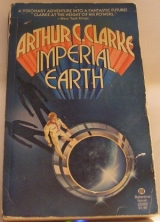
Текст книги "Imperial Earth"
Автор книги: Arthur Charles Clarke
Жанр:
Научная фантастика
сообщить о нарушении
Текущая страница: 12 (всего у книги 19 страниц)
Duncan did not cry easily, but presently he was weeping.
When the lights came on again, he understood why men had spent so much of toil and treasure to win back what the sea had stolen from them long ago.
His eyes were still so misty, and his vision so uncertain, that for a moment he did not recognize the woman who had just entered the Grand Saloon and was standing by one of the ornate doors.
Even carrying a hard hat, and with shapeless plastic waterproof covering her from neck to knees, Calindy still looked poised and elegant. Duncan rose to his feet and walked toward her, ignoring the stares of companions.
Silently, he put out his arms, embraced her, and kissed her full on the lips. She was not as tall as he had remembered—or he had grown -because he had to stoop.
We Ill she exclaimed, when she had disentangled herself. “After
fifteen years!” “You haven’t changed in the least.” 177 “Liar. I hope I have. At twenty-one I was an irresponsible brat.”
“At twenty-one you should be. It’s the last chance you’ll have.”
This scintillating conversation then ground to a halt, while they looked at each other and everyone in the Grand Saloon looked at them. I’m quite sure,
Duncan told himself wryly, that they think we’re old lovers; would that it were true…. “Duncan, darhling-sorry-I always start talking early twentieth century when
I’m in here: Mr. D. Makenzie, please excuse me for a few minutes while I speak to my other guests-then we’ll tour the ship together.”
He watched her dart purposefully from one group to another, the very embodiment of the efficient administrator, confirming that everything was going as planned. Was she playing another of her roles, or was this the real Calindy, if such a creature existed?
She came back to him five minutes later, with all her associates trotting dutifully behind.
“Duncan-I don’t think you’ve met Commander Innes-he knows more about this ship than the people who built her. He’ll be showing us around.”
As they shook hands, Duncan said: “I enjoyed your presentation very much.
It’s always stimulating to meet a real enthusiast.”
His words were not idle flattery. While he had been listening to that talk,
Duncan had recognized something that he had not met before on Earth.
Commander Innes was slightly larger than life, and seemed to be inclined at a small angle to his fellow Teffans. A world which had put a premium on tolerance and security and safe, well-organized excitements like those provided by Enigma had no place for zealots. Though enthusiasm was not actually illegal, it was in somewhat bad taste; one should not take one’s hobbies and recreations too seriously. Commander Innes, Duncan suspected, lived and dreamed Titanic. In an ealier age, he might have been a missionary, spreading the doctrines of
Mohammed or Jesus with fire and sword. Today he. was 178 a barmless and indeed refreshing anomaly, and perhaps just a trifle mad.
For the next hour, they explored the bowels of the ship-and Duncan was thankful for his protective clothing. There was still mud and oil sloshing around on G deck, and several times be banged his head against unexpected ladders and ventilating ducts. But the effort and discomfort were well worth it, for only in this manner could he really appreciate all the skill and genius that had gone into this floating city. Most moving of all was to touch the inward-curling petals of steel far below the starboard bow, and to imagine the icy waters that had poured through them on that tragic night.
The boilers were shapeless, crumpled masses, but the engines themselves were in surprisingly good condition. Duncan looked with awe at the giant connecting rods and crankshafts, the huge reduction gears. (But why on earth did the designers use piston engines and turbines?) Then his admiration was abruptly tempered when Commander Innes gave him some statistics: this mountain of metal developed a ludicrous forty thousand kilowatts! He remembered the figure that Chief Engineer Mackenzie had given for Sirius’ main drive; a trillion kilowatts. Mankind had indeed gone a long way, in every sense of the phrase, during the last three centuries.
He was exhausted when he had climbed back up the alphabet from G to A deck (one day, Commander Innes promised, the elevators would be running again) and was more than thankful when they settled down for lunch in the First
Class Smoking Room.
Then he looked at the Menu, and blinked:
RMS. “TITANIC”
April 14, 1912
LUNCHEON
Consomme Fermier Cockie Leekie Fillets of Brill Egg A I’Argenteuil
Chicken A la Maryland Corned Beef, Vegetables, Dumplings FROM THE GRILL Grilled Mutton Chops Mashed, Fried, and Baked Jacket Potatoes Custard Pudding Apple Meringue Pastry
BUFFET
Salmon Mayonnaise Potted Shrimps Norwegian Anchovies Soused Herrings Plain & Smoked Sardines Roast Beef Round of Spiced Beef Veal & Ham Pie Virginia & Cumberland Ham Bologna Sausage Brawn Galatine of Chicken Corned Ox Tongue Lettuce Beetroot Tomatoes
CHEESE
Cheshire, Stilton, Gorgonzola, Edam, Camembert, Roquefort, St. Ivel, Cheddar
Iced draught Munch Lager Beer 3d. & 6d. a Tankard
“I’m sorry to disappoint you,” said Calindy. “We’ve done our best, within the limits of the synthesizers, but we don’t even know what half these items were. The secret of Cockie Leekie went down with the ship, and perhaps it’s just as well. But we do have a substitute for the Munich
Beer.”
Duncan would never have given this ordinary, unlabeled bottle a second thought had he not noticed the extreme care with which it was carried. He looked questioningly at his hostess.
“Vintage ‘05, according to the wine steward’s records-1905, that is. Tell me what you think of it.”
With one bottle to forty guests, there was just enough to get a good taste.
It was port, and to Duncan seemed just like any other port; but he was too polite to say so. He made vague mumblings of appreciation, saw
that Calindy was laughing at him, and added, “I’m afraid we don’t have much chance of studying wines on Titan.”
“Titan,” said Commander Innes thoughtfully. “How very appropriate.”
“But hardly a coincidence. You can thank Cal Miss Ellerman.”
“You’ve no seas on Titan, have you?”
“Only small temporary ones. Of liquid ammonia.”
“I couldn’t live on a world like that. I can’t bear to be away from the sea more than a few weeks. You must go to the Caribbean and dive on one of our reefs. If you’ve never seen a coral reef, you can’t imagine it.”
Duncan had no intention of following the Commander’s advice. He could understand the fascination of the sea, but it terrified him. Nothing, he was sure, would ever induce him to enter that alien universe of strange beasts, full of known dangers that were bad enough, and unknown ones that must be even worse. (As if one could possibly imagine anything worse than the maneating shark or the giant squid…. ) People like Commander
Innes must indeed be mad. They made life interesting, but there was no need to follow their example.
And at the moment, Duncan was too busy trying to follow Calindy-without much success. He could appreciate the fact that, having’ some fifty people to deal with, she could give him only two percent of her time; but when he tried to pin her down to a meeting under less hectic circumstances, she was curiously evasive. It was not that she was unfriendly, for she seemed genuinely pleased to see him. But something was worrying her-she was holding him at arm’s length. It was almost as if she had been warned that he was bringing deadly Titanian germs to Earth. All that he could extract from her before they parted was a vague promise that she would contact him “just as soon as the season is over”-whatever that might mean.
Enigma Associates had not disappointed him, but their vice-president had left him puzzled and saddened. Duncan worried at the problem
throughout the thirty-minute ride in the vacuum subway back to 181 Washington. (Thank God the van Hyatts were staying in New York-he would not appreciate their company in his present mood.)
He realized that there was nothing he could do; if, like some lovesick suitor, he persisted in bothering Calindy, it would merely make matters worse. Some problems could be solved only by time, if indeed they could be solved at all.
He had plenty to do. He would forget about Calindy…. With any luck, for as much as an hour at a time.
AKHENATON AND CLEOPATRA
Sir Mortimer Keynes sat in his armchair in Harley Street and looked with clinical interest at Duncan Makenzie, on the other side of the Atlantic.
“So you’re the latest of the famous Makenzies. And you want to make sure you’re not the last.”
This was a statement, not a question. Duncan made no attempt to answer, but continued to study the man who, in an almost literal sense, was his creator.
Mortimer Keynes was well into his eighties, and looked like a rather shaggy and decrepit lion. There was an air of authority about him-but also of resignation and detachment. After half a century as Earth’s leading genetic surgeon, he no longer expected life to provide him with any surprises; but he had not yet lost all interest in the human comedy.
“Tell me,” he continued, “why did you come yourself, all the way from
Titan? Why not just send the necessary bio type samples?”
“I have business here,” Duncan answered. “As well as an invitation to the
Centennial. It was too good an opportunity to miss.” “You could still
have sent the sample on ahead. 182 Now you’ll have to wait nine months-that is, if you want to take your son back with you.”
“This visit was arranged very unexpectedly, at short notice. Anyway, I can use the time. This is my only chance to see Earth; in another ten years, I won’t be able to face its gravity.”
“Why is it so important to produce another guaranteed one-hundred-percent
Makenzie?”
Presumably Colin had gone through all this with Keynes-but, of course, that was thirty years ago, and heaven knows how many thousands of clonings the surgeon had performed since then. He could not possibly remember; on the other hand, he would certainly have detailed records, and was probably checking them at this very moment on that display panel in his desk.
“To answer that question,” Duncan began slowly, “I’d have to IF, ve you the history of Titan for the last seventy years. ‘
“I don’t think that will be necessary,” interrupted the surgeon, his eyes scanning his hidden display. “It’s an old story; only the details vary from age to age. Have you ever heard of Akhenaton?”
“Who?”
“Cleopatra?” Oh yes-she was an Egyptian queen, wasn’t she?”
Queen of Egypt, but not Egyptian. Mistress of Anthony and Caesar. The last and greatest of the Ptolemies.”
What on Earth, Duncan thought in bemusement, has this to do with me? Not for the first time, and certainly not for the last, he felt overwhelmed by the sheer detail and complexity of terrestrial history. Colin, vdth his interest in the past, would probably know what Keynes was driving at, but
Duncan was completely lost.
“I’m referring to the problem of succession. How do you make sure your dynasty continues after your death, on the lines you want? There’s no way of guaranteeing it, of course, but you can improve the odds if you can leave a carbon copy of yourself….
“The Egyptian Pharaohs made a heroic attempt at this-the best that
could be done without modern 183 science. Because they claimed to be gods, they could not marry mortals, so they mated brother and sister. The result was sometimes genius, but also deformity -in the case of Akhenaton, both. Yet they continued the tradition for more than a thousand years, until it ended with Cleopatra.
“If the Pharaohs had been able to clone themselves, they would certainly have done so. It would have been the perfect answer, avoiding the problem of inbreeding. But it introduces other problems. Because genes are no longer shuffled, it stops the evolutionary clock. It means the end of all biological progress
What’s he driving at? Duncan asked himself impatiently. The interview was not going at all in the way he had planned. It had seemed a simple enough matter to set up the arrangements, just as Colin and Malcolm had done, three and seven decades ago, respectively. Now it appeared that the man who had made more clonings than anyone on Earth was trying to talk him out of it. He felt confused and disoriented, and also a little angry.
“I’ve no objection,” the surgeon continued, “to cloning it it’s combined with genetic repair-which is not possible in your case, as you certainly know. When you were cloned from Colin, that was merely an attempt to perpetuate the dynasty. Healing was not involved—only politics and personal vanity. Oh, I’m sure that both your precursors are convinced that it was all for the good of Titan, and they may well be absolutely right.
But I’m afraid I’ve given up playing God. I’m sorry, Mr. Makenzie. Now, if you will excuse me-I hope you have an enjoyable visit. Goodbye to you.”
Duncan was left staring, slack-jawed, at a blank screen. He did not even have time to return the farewell-still less give Colin’s greetings, as he had intended, to the man who had created both of them.
He was surprised, disappointed-and hurt. No doubt he could make other arrangements, but it had never occurred to him to go anywhere than to his own point of origin. He felt like a son who had just been
repudiated by his own father. There was a mystery here; and suddenly, in a flash of insight, Duncan thought he had guessed the solution. Sir Mortimer had cloned himself-and it had turned out badly.
The theory was ingenious, and not without a certain poetic truth. It merely happened to be wrong.
PARTY GAMES
It was well for Duncan that he was now becoming less awed by conspicuous displays of culture. Impressed, by all means; overwhelmed, no. Too strong a colonial inferiority complex would certainly have spoiled his enjoyment of this reception.
He had been to other parties since his arrival, but this was by far the largest. It was sponsored by the National Geographic Society-no, that was tomorrow -by the Congressional Foundation, whatever that might be, and there were at least a thousand guests circulating through the marble halls.
“If the roof fell in on us now,” he overheard someone remark, rather smugly, “Earth would start running around like a headless chicken.”
There seemed no reason to fear such a disaster; the National Gallery of Art had stood for almost four hundred years. Many of its treasures, of course, were far older: no one could possibly put a value on the paintings and sculpture displayed in its halls. Leonardo’s Ginevra de’ Benci,
Michelangelo’s miraculously recovered bronze David, Picasso’s Willie
Maugham, Esq.” Levinski’s Martian Dawn, were merely the most famous of the wonders it had gathered through the centuries. Every one of them, Duncan knew, he could study through holograms in closer detail than he was doing now-but it was not the same thing. Though the copies might
be technically perfect, 185 these were the originals, forever unique; the ghosts of the long-dead artists still lingered here. When he returned to Titan, he would be able to boast to his friends: “Yes-I’ve stood within a meter of a genuine Leonardo.”
It also amused Duncan to realize that never on his own world could he move in such a crowd-and be completely unrecognized. He doubted if there were ten people here who knew him by sight; most of them would be ladies he had addressed on that memorable evening with the Daughters of the Revolutions.
He was, as George Washington had neatly put it, still one of Earth’ s leading unknown celebrities. Barring untoward events, his status would remain that way until he spoke to the world on July Fourth. And perhaps even after that … However, his identity could be discovered easily enough, except by the most short-sighted individuals; he was wearing a badge that bore in prominent letters the words DUNCAN MACKENZIE, TITAN. He had thought it impolite to make a fuss about the spelling. Like Malcolm, he had given up that argument years ago.
On Titan, such labels would have been completely unnecessary; here they were essential. The advance of microelectronics had relegated to history two problems that, until the late twentieth century, had been virtually insoluble: At a really big party, how do you find who’s there—and how do you locate any given person? When Duncan checked in at the foyer, he found himself confronting a large board bearing hundreds of names. That at once established the guest list or, to be more accurate, the list of guests who wished to make their presence known. He spent several minutes studying it, and picked out half a dozen possible targets. George, of course, was there; and so was Ambassador Farrell. No point in hunting up them; he saw them every day.
Against each name was a button, and a tiny lamp. When the button was pressed, the guest’s badge would emit a buzz just loud enough for him to hear, and his light would start Bashing. He then had two
alternatives. He could apologize to the group he was with, 186 and start drifting toward a central rendezvous area. By the time he arrived-which could be anything from a minute to half an hour after the signal, according to the number of encounters en route-the caller might still be there; or he might have gotten fed up and moved away.
The other alternative was to press a button on the badge itself, which would cut off the signal. The light on the board would then shine with a steady glow, informing the world that the cal lee did not wish to be disturbed. Only the most persistent or bad-mannered inquirer would ignore this hint.
Although some hostesses thought the system too coldly mechanical, and refused to use it at any price, it was in fact deliberately imperfect.
Anyone who wished to opt out could neglect to pick up his badge, and it would then be assumed that he had not put in an appearance. To aid this deception, an ample supply of false badges was available, and the protocol that went with them was well understood. If you saw a familiar face above an innocuous JOHN DOE or MARY SMITH, you investigated no further. But a
JESUS CHRIST or a JULIUS CAESAR was fair game.
Duncan saw no need for anonymity. He was quite happy to meet anyone who wished to meet him, so he left his badge in the operating mode while he raided the lavish buffet, then beat a retreat to one of the smaller tables.
Although he could now function in Earth’s gravity better than he would once have believed possible, he still took every opportunity of sitting down.
And in this case it was essential even for Terrans, except those skillful enough to manipulate three plates and one glass with two hands.
He had been one of the early arrivals—this was a folly he never succeeded in curing during his whole stay on Earth-and by the time he had finished nibbling at unknown delicacies, the hall was comfortably full. He decided to start circulating among the other guests, lest he be identified for what he was-a lost and lonely outsider.
He did not deliberately eavesdrop; but Makenzies had unusually good hearing, and Terrans-at least party-going Terrans–seemed anxious to
spread in formation as widely as possible. Like a free electron wandering through a semiconductor, Duncan drifted from one group to another, occasionally exchanging a few words of greeting, but never getting involved for more than a couple of minutes. He was quite content to be a passive observer, and ninety percent of the conversations he overheard were meaningless or boring.
But not all…
I loathe parties like this, don’t you?
It’s supposed to be the only set of genuine antique inflatable furniture in the world. Of course, they won’t let you sit on it.
I’m so sorry. But it will wash out easily.
–buying at one fifty and selling at one eighty. Would you believe that grown men once spent their entire lives doing that sort of thing?
–no music worth listening to since the late twentieth century…. Make it early twenty-first.
Sorry-I don’t know who’s throwing this party, either.
Did El Greco come before Modigliani? I just can’t believe it.
Bill’s ambition is to be shot dead at the age of two hundred by a jealous wife.
How’s the Revolution going? If you need any more money from the Ways and
Means Committee, let me know.
Food should come in pills, the way God intended…. Anyone in the room
she’s not slept with? Well, maybe that statue of Zeus. French is not a dead language. At least five million people still speak it-or at least read it.
I’m getting up a petition to save the Lunar wilderness areas.
I thought it was the Van Allen Belt.
Oh, that was last year.
At that point, Duncan’s badge started to hum gently. For a moment he was taken by surprise; he had quite forgotten that it was part of a paging system. He looked around for the rendezvous point, a discreet little banner bearing the notice L-S HERE, PLEASE. Needless to say it was on the far side of the room, and it took him a good five minutes to plow through the crowd.
Half a dozen complete strangers were waiting hopefully under the banner. He scanned their faces in vain, looking for some sign of recognition. But when he got within name-reading range, one of the group broke away and approached him with outstretched hands.
“Mr. Makenzie-how good of you to co me! I’ll take only a few minutes of your time.”
From bitter experience, Duncan had learned that this was one of Terra’s great understatements. He looked cautiously at the speaker to sum him up and to guess his business. What he saw was reasonably reassuring: a very neat, goa teed little man wearing a traditional Chinese/ Indian shervani, tightly buttoned up at the neck. He did not look like a bore or a fanatic; but they seldom did.
“That’s all right, Mr.-er-Mandel’stahm. What can I do for you?” -I’d intended to contact you-it was pure luck, seeing your name on the list-I knew there could be only one Makenzie-what does the D stand for-Donald, Douglas, David—2’
“Duncan.”
“Ah, yes. Let’s move over to that seat-it’ll be quieter-besides, I love
Winslow Homer’s Fair Wind, even though the technique is so crude-you
can almost smell the, fish sliding around in the boat-why, what a coincidence-it’s exactly four hundred years old! Don’t you think coincidences are fascinating? I’ve been collecting them all my life.”
“I’ve never thought about it,” replied Duncan, already feeling a little breathless. He was afraid that if he listened much longer to Mr.
Mandel’stahm, he too would start to talk in jerks. What did the man want?
For that matter, was there any way of discovering the intentions of a person whose flow of speech seemed to be triggered by random impulses?
Luckily, as soon as they were seated, Mr. Mandel’stahm became much more coherent. He gave a conspirational glance to check that there was nobody in earshot except Winslow Homer’s fisher boys then resumed his conversation in a completely different tone of voice.
“I promised I’d take only a few minutes. Here’s my card-you can use it to key my number. Yes, I call myself an antique dealer, but that covers a multitude of sins. My main interest is gems-I have one of the largest private collections in the world. So you’ve probably guessed why I was anxious to meet you.99
“Go on.”
“Titanite, Mr. Makenzie. There are not more than a dozen fragments on
Earth-five of them in museums. Even the Smithsonian doesn’t have a specimen, and its curator of gems-that talI man over there-is most unhappy.
I suppose you know that titanite is one of the few materials that can’t be replicated?”
“So I believe,” answered Duncan, now very cautious. Mr. Mandel’stahm had certainly made his interests clear, though not his intentions.
“You’ll understand, therefore, that if a swarthy, cornute gentleman suddenly appeared in a puff of smoke with a contract for several grams of titanite in exchange for my signature in blood, I wouldn’t bother to read the small print.”
Duncan was not quite sure what co mute meant, but he got the general picture quickly enough, and gave a noncommittal nod.
“Well, something like this has been happening over the last three
months-not quite so dramatically, of course. I’ve been approached, in great confidence, by a dealer who claims to have titanite for sale, in lots of up to ten grains. What would you say to that?”
“I’d be extremely suspicious. It’s probably fake.”
“You can’t fake titanite.”
“Well-synthetic?”
“I’d thought of that too-it’s an interesting idea, but it would mean so many scientific breakthroughs somewhere that it couldn’t possibly be hushed up. It certainly wouldn’t be a simple job, like diamond manufacture. No one has any idea how titanite is produced. There are at least four theories proving that it can’t exist.”
“Have you ever seen it?”
“Of course-the fragment in the American Museum of Natural History, and the very fine specimen in the Geological Museum, South Kensington.”
Duncan refrained from adding that there was an even finer specimen in the
Centennial Hotel, not ten kilometers from here. Until this mystery was cleared up, and he knew more about Mr. Mandel’stahm, this information was best kept to himself. He did not believe that burglarious visitors were likely, but it was foolish to take unnecessary chances.
“I don’t quite see how I can help you. If you’re sure that the titanite is genuine, and hasn’t been acquired illegally, what’s your problem?”
“Simply this. Not everything rare is valuable-but everything valuable is rare. If someone’s discovered a few kilograms of titanite, it would be just another common gemstone, like opal or sapphire or ruby. Naturally, I don’t want to make a big investment if there’s any danger that the price might suddenly nose-dive.”
He saw Duncan’s quizzical expression and added hastily, “Of course, now that the profit motive’s extinct, I do this for amusement. I’m more concerned with my reputation.”
“I understand. But if there had been such a find, I’m sure I would have heard of it. It would have been reported to my government.”
Mr. Mandel’stahm’s eyebrows gained altitude perceptibly.
“Perhaps. But perhaps not. Especially if it were found—off-planet. I’m referring, of course, to the theories suggesting that it’s not indigenous to Titan.”
You’re certainly well informed, Duncan told himself -in fact, I’m sure you know far more about titanite than I do…. “I suppose you mean the theory that there may be bigger lodes on the other moons?”
“Yes. In fact, traces have been detected on lapetus.95
“That’s news to me, but I wouldn’t have heard un less there had been a major find. Which, I gather, is what you suspect.”
“Among other things.”
For a few seconds, Duncan processed this information in silence. If it was true–and he could think of no reason why Mandel’stahm should be lying -it was his duty as an officer of the Titanian administration to look into it. But the very last thing he wanted now was extra work, especially if it was likely to lead to messy complicatons. If some clever operator was actually smuggling titanite, Duncan would prefer to remain in blissful ignorance. He had more important things to worry about.
Perhaps Mandel’stahm understood the reason for his hesitation, for he added quietly: “The sum involved may be quite large. Fm not interested in that, of course-but most governments are rather grateful to anyone who detects a loss of revenue. If I can help you earn that gratitude, I should be delighted.”
I understand you perfectly, said Duncan to himself, and this makes the proposition much more attractive. He did not know the Titan law on these matters, and even if a reward was involved, it would be tactless for the
Special Assistant to the Chief Administrator to claim it. But his task would certainly not be much easier if-as he gloomily expected-he were compelled to apply for more Terran so lars before the end of his stay.
“I’ll tell you what I’ll do,” he said to Mandel’stahm. “Tomorrow, I’ll send a message to Titan, and initiate inquiries-very discreetly, of course. If
I learn something, I’ll let you know. But don’t expect too much or for
that matter, anything at all.” Mandel’stahm seemed quite, happy with this arrangement, and departed with rather fulsome protestations of gratitude. Duncan decided that it was also high time that he left the party. He had been on his feet for over two hours, and all his vertebrae were now starting to protest in unison. As he made his way toward the exit, he kept a lookout for George Washington, and managed to find him—despite his short stature—without falling back on the paging system.
“Everything going well?” asked George.
“Yes-I’ve had a very interesting time. And I’ve run into a curious character-he calls himself a gem expert—2’
“Ivor Mandel’stahm. What did the old fox want from you?”
“Oh-information. I was polite, but not very hellyful. Should I take him seriously, and can he be trusted?”
“Ivor is merely the world’s greatest expert on gems. And in that business, one can’t afford even the hint of a suspicion. You can trust him absolutely.”
“Thanks-that’s all I wanted to know.”
Half an hour later, back at the hotel, Duncan unlocked his case and laid out the set of pentominoes that Grandma had given him; he had not even touched it since arriving on Earth. Carefully, he lifted out the titanite cross and held it up to the light…. he first time he had ever seen the gem was at Grandma Ellen’s and he could date the event very accurately. Calindy had been with him, so he must have been sixteen years old. He could not remember how it had been arranged. In view of Grandma’s dislike of strangers (and even of relatives) the visit must have been a major diplomatic feat. He did recall that Calindy had been very anxious to meet the famous old lady, and had wanted to bring along her friends; that, however, had been firmly vetoed.
It was one of those days when Ellen Maken2ie’s co-ordinate system coincided with the external world’s, and she treated Calindy as if she were actually there. Doubtless the fact that she had a fascinating new
novelty to display had much to do with her unusual friendliness. This was not the first specimen of titanite that had been discovered, but the second or third-and the largest up to that time, with a mass of almost fifteen grams. It was irregularly shaped, and Duncan realized that the cross he was now holding must have been cut from it. In those days, no one thought of titanite as having any great value; it was merely a curiosity.