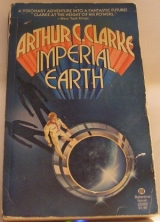
Текст книги "Imperial Earth"
Автор книги: Arthur Charles Clarke
Жанр:
Научная фантастика
сообщить о нарушении
Текущая страница: 14 (всего у книги 19 страниц)
He was startled by a sudden, distant crash, altogether out of place on this idyllic ally peaceful morning. It came from somewhere out at sea, and Duncan spun around just in time to see a column of spray slowly falling back into the water. Surely no one would be allowed to set off submarine explosions in this area…. Now there was a jet of vapor, which rose slanting from the sea, hung for a moment in the bright sunlight, and gradually dispersed.
For a full minute, nothing else happened. And then Duncan was paralyzed with astonishment. With unbelievable slowness, but with the inevitability of some continent rising from the primordial depths, a vast gray shape was soaring out of the sea. There was a flash of white, as monstrous flukes slammed against the waves and created another cloud of spray. And still that incredible bulk continued to climb, as if defying gravity, until it was completely clear of the water, and hung poised for a moment above the blue ledge of the horizon. Then, still in slow motion, as if reluctant to leave an alien element, it fell back into the ocean and vanished beneath a final geyser of spray. The booming crash seemed to come ages later.
Duncan had never imagined such a spectacle, but he had no need of any explanation. Moby Dick was one of the thousands of Terran classics he knew only through repute, but now he understood how Herman Melville must have felt when, for the first time, he saw the sea furrowed by a
glistening back as large 210 as an overturned ship, and conceived in the image of the white whale a symbol of the forces that lie behind the universe.
He waited for many minutes, but the giant did not leap again, though from time to time there were brief spouts of vapor, becoming more and more distant until they vanished from sight.
“Why did it do that?” he asked Dr. Todd, his voice still hushed by the lingering aura of departed majesty.
“Nobody really knows. It may be pure joie de vivre. It may be to impress a lady friend. Or it may be merely to get rid of parasites-whales are badly infested with barnacles and lampreys.”
How utterly incongruous, thought Duncan. It seemed almost an outrage that a god should be afflicted with lice.
Now the trimaran was slowing down, and the sheer strangeness and beauty of the underwater scene captured his attention so completely that Duncan forgot his remoteness from land. The fantastic shapes of the corals, and the colors of the fish that sported or sauntered among them, were a revelation. He had already been astounded by the vexiety of life on land; now he saw that it was far exceeded by the reckless profusion of the sea.
Something like an antique jet plane went flapping slowly past, with graceful undulations of its spotted wings. None of the other fish took any notice. To Duncan’s surprise, there was no sign of the carnage he had expected to witness, in this realm where everything fed on everything else.
In fact, it was hard to imagine a more peaceful scene; the few fish that had been chasing others were obviously doing so merely to protect their territory. The impression he had gathered from books and films had been almost wholly misleading. Cooperation, not competition, seemed to rule the reef.
The trimaran came to a halt, the anchor was thrown out-and was followed almost instantly by three rubber dinghies, four doctors, five nurses, and a mass of diving equipment. The scene appeared to
Duncan to be one of utter confusion; actually, it was much better planned and disciplined than he realized. The swimmers promptly divided into groups of three, and each trio went off with one of the dinghies, heading in a purposeful manner toward spots that had obviously been chosen in advance.
“If it’s so safe,” remarked Duncan after the last splashings had died away, “why are they all carrying knives, aand those vicious-looking little spears?”
The trimaran was now almost deserted, its only other occupants besides
Duncan being the skipper who had promptly fallen asleep in front of the wheel -the engineer, who had disappeared below deck, and Dr. Todd.
“Those aren’t weapons. They’re gardening tools.”
“You must have rather ferocious weeds. I wouldn’t care to meet them.”
“Oh,” said Todd, “some of them put up a good fight. Why don’t you go and have a look? You’ll be sorry if you miss the chance.”
That was perfectly true, yet Duncan still hesitated. The water in which the trimaran was gently rocking was very shallow; indeed, it appeared no deeper than the swimming pool at the Centennial Hotel.
“I’ll go in with you. You can stand on the diving ladder, until you get the hang of the face mask-and snorkel-breathing should be easy to anyone who’s used to a spacesuit.”
Duncan did not volunteer the information that he had never worn a genuine spacesuit; nevertheless, a Titan surface life-support system should be good training. And anyway, what could go wrong in a couple of meters of water?
Why, there were places here where he could stand with his head above the surface. Sweeney Todd was right; he would never forgive himself if he turned down this opportunity of a lifetime.
Ten minutes later, he was splashing inexpertly but steadily along the surface. Although it had seemed astonishing-and even indecent-to put on clothing when one entered the water, Todd had insisted that he dress from head to foot in a light, one-piece overall of some closely knit fabric. It scarcely affected his movements, but he wished he could do
without it. “Some of these corals sting,” the doctor had explained “It could spoil your day if you backed into one-and you might have an allergic reaction.”
“Anything else you can think of?”
“No, that’s about it. Just watch me, and hang on to the rubber dinghy whenever you want a rest.”
He was now rapidly gaining confidence and beginning to enjoy himself thoroughly. There was obviously no danger whatsoever while he drifted along behind the dinghy, never letting go of the rope dangling in the water. And
Dr. Todd, he was reassured to observe, always kept within arm’s length; he was being almost ridiculously overcautious. Even if a shark came shooting up out of the depths, Duncan believed he could be aboard the dinghy in two seconds flat-notwithstanding Earth’s gravity.
Now that he had mastered the use of the snorkel tube, he kept his head under water all the time, and even essayed shallow dives which involved holding his breath for considerable periods. The panorama beneath was so fascinating that Duncan even occasionally forgot the need for air, and emerged sputtering foolishly.
The first signboard was at a depth of five meters and said, in fluorescent yellow letters: NO UNAUTHORrZED VISITORS BEYOND THIS POINT. The second warning was a flashing holographic display in mid water which must have been very perplexing to the fish. It announced ominously: THIS REEF IS
MONITORED. Duncan could see no trace of the projectors; they had been very cunningly concealed.
Todd was pointing ahead, to the line of divers working along the edge of the reef. So he had not been joking. They really were going through the unmistakable motions of gardeners digging up noxious weeds. And each one was surrounded by a small cloud of brilliantly colored fish, clearly benefiting from all this activity.
The coral formations seemed to be changing shape. Even to Duncan’s untrained eye, they looked strange-even abnormal. He had grown accustomed to the branching antlers of the stag-horns, the convoluted
labyrinths that looked like giant brains, the delicate 213 mushrooms sometimes meters in diameter. They were still here, but now subtly distorted.
Then he saw the first metallic glint-then another, and another. As he came closer, and the blue haze of distance no longer softened the details of the underwater world, Duncan realized why this reef was cberisbed and protected.
Everywhere he looked, it glittered and sparkled with gold.
Two hundred years earlier, it had been one of the greatest triumphs of biological engineering, bringing world fame to its creators. Ironically, success had come when it was no longer required; what had been intended to fulfill a vital need had turned out to be no more than a technological cul-de-sac.
It had been known for centuries that some marine organisms were able to extract, for the benefit of their own internal economies, elements present in seawater in unbelievably small proportions. If sponges and oysters and similar lowly creatures could perform such feats of chemical engineering with iodine or vanadium, the biologists of the 2100’s had argued, why could they not be taught to do the same trick with more valuable elements?
And so, by heroic feats of gene-manipulation, several species of coral had been persuaded to become gold miners. The most successful were able to replace almost ten percent of their limestone skeletons with the precious metal. That success, however, was measured only in human terms. Since gold normally plays no part in biochemical reactions, the consequences to the corals were disastrous; the auriferous reefs were never healthy, and had to be carefully protected from predators and disease.
Only a few hundred tons of gold were extracted by this technique before large-scale transmutation made it uneconomic; the nuclear furnaces could manufacture gold as cheaply as any other metal. For a while, the more accessible reefs were maintained as tourist attractions, but souvenir hunters soon demolished them. Now only one was left, and Dr.
Mohammed’s staff was determined to preserve it. So, at regular intervals, the doctors and nurses took time off from their usual duties, and enjoyed an arduous working holiday on the reef. They dumped carefully selected fertilizers and antibiotics to improve the health of the living corals, and waged war against its enemies-particularly the spectacular crown of thorns starfish and its smaller relative the spiny sea urchin. Duncan floated, perfectly relaxed, in the tepid water, lazily flippering from time to time so that he remained in the shadow of the dinghy. Now he understood the purpose of those sinister knives and spikes; the adversaries they had to deal with were well protected indeed.
Only a couple of meters beneath him, one of the divers was jabbing at a colony of small black spheres, each at the center of a formidable array of needle-sharp spines. From time to time one of the spheres would be split open, and fish would dart in to grab the pieces of white meat that came floating out. It was a delicacy they could scarcely ever have enjoyed without human intervention; Duncan could not imagine that these spiky beasts had any natural enemies.
The diver—one of the nurses-noticed the two spectators hovering overhead, and beckoned Duncan to join her. He had become so fascinated that he now obeyed automatically, without a second’s thought. Taking several deep breaths, and partly exhaling on the last one, he hauled himself slowly down the line anchoring the dinghy to its small grapnel.
The distance was greater than he had imagined more like three meters than two, for he had forgotten the refractive effect of the water. Midway, his left ear gave a disconcerting “click,” but Dr. Todd had warned him about this, and he did not check his descent. When he reached the anchor, and grabbed its shank, he felt a tremendous sense of achievement. He was a deep-sea diver-he had plumbed the fabulous depth of three meters! Well, at least two point five … The glitter of gold was all around him. There was never more than a tiny speck, smaller than a grain of sand, at any one spot-but it was everywhere;
the entire reef was impregnated with it. Duncan felt that he was floating beside the chef-d’oeuvre of some mad jeweler, determined to create a baroque masterpiece regardless of expense. Yet these pinnacles and plates and twisted spires were the work of mindless polyps, not-except indirectly-the products of human intelligence.
Reluctantly, he shot up to the surface for air. This was easy; he felt ashamed of his previous fears. Now he understood how visitors often reacted to Titan. Next time, when someone politely declined an invitation to take a pleasant jaunt outside, he would be a little more tolerant.
“What are those black things?” be asked Dr. Todd, who was still hovering watchfully above him.
“Long-spined sea urchin, Diadema something-or other When you see so many, it’s a sign of pollution or an unbalanced ecology. They don’t really damage the reef-unlike Acanthaster-but they’re ugly, and a nuisance. If you back into one, the needles may take a month to work their way out. Are you going down again?”
“Yes. 99
“Good. Don’t overdo it. And watch out for those spines!”
Duncan hauled himself down the anchor line once more, and the diver waved him a greeting as he approached. Then she offered him her deadly-looking knife, and pointed toward a small group of sea urchins. Duncan nodded, took the tapering metal blade by the proffered handle, and started jabbing away inexpertly, being careful to avoid those ominous black needles.
Not until then did he realize, to his considerable surprise, that these lowly animals were aware of his presence, and were not relying merely on a static defense. The long spines were swinging toward him, orienting themselves in the direction of maximum danger. Presumably it was only a simple automatic reflex, but it made him pause for a moment. There was more here than met the eye-perhaps the first faint intimations of dawning consciousness.
His knife was longer than the sea urchin’s spines, and he jabbed
vigorously again and again. The cara216 pace was surprisingly tough, but presently it gave way, and the waiting fish raced in to grab at the creamy white flesh that was suddenly exposed.
And then, with growing discomfort, Duncan realized that his victim was not dying in silence. For some time he had been aware of faint sounds in the water around him-the hammering of the other divers on the reef, the occasional “clang” of the anchor against the rocks. But this noise came from much closer at hand, and was most peculiar-even disturbing. It was a crackling, grinding sound; though the analogy was patently ridiculous, it could only be compared to the crunching of thousands of tiny teeth, clashing in rage and agony. Moreover, there was no doubt that it came from the eviscerated sea urchin.
That faint, inhuman death rattle was so unexpected that Duncan checked his onslauLyht and remained howe ring motionless in the water. He had completely forgotten the necessity for air, and the conscious part of his mind had dismissed the mounting symptoms of suffocation as irrelevant-to be dealt with later. But finally he could ignore them no longer, and shot gasping to the surface.
With a profound sense of shock-even of shame Duncan realized that he had just destroyed a living creature. He could never have imagined, before he left Titan, that such an experience would ever come his way.
One could hardly feel much guilt over the murder of a sea urchin.
Nevertheless, for the first time in his life, Duncan Makenzie was a
killer.
SLEUTH
When Duncan returned to Washington, the second time bomb from Colin was ticking away in the Centennial Hotel. Once again, it was so cryptic that it would have been almost unintelligible, even to an outsider who had succeeded in decoding it.
CONFIRM YOUR OLD FRIEND HAS UNAUTHORIZED ACCOUNT 65842 GENEVA BRANCH
FIRST
BANK OF ARISTARCHUS. BALANCE SEVERAL TENS OF THOUSANDS SO LARS THIS
INFORMATION NOT TO BE DISCLOSED ANY CIRCUMSTANCES. PRESUME FROM SALE
OF
TITANITE. MAKING INQUIRIES MNEMOSYNE. MEANWHILE SUGGEST YOU KEEP
ALERT.
REGARDS COLIN.
Duncan understood perfectly well why this information was “not to be disclosed”; the Lunar banks guarded their secrets well, and heaven alone knew by what prodigies of persuasion or genteel blackmail Colin had managed to get hold of Karl’s account number. Even so, he had been unable to obtain a figure for the balance-but it was obviously considerable. Ten thousand so lars was far more than anyone would need for the purchase of a few Terran luxuries. And several times that was more than the Makenzies held in their own, perfectly legal accounts. Such an amount of money was more than a cause for envy; it was disturbing, especially if it was intended for some clandestine use.
Duncan allowed himself a few moments of wistful daydreaming, imagining what he could do with twenty or thirty thousand so lars Then be put
the seductive vision firmly aside and concentrated all his mind upon the problem. While Karl’s involvement had been only a vague suspicion, he had been reluctant to waste time on a detailed analysis of how, when, and-above all -why. But now that speculation had congealed into certainty, he could no longer evade the issue.
What a pity that the obvious line of approach was out of the question! He could hardly call up the First Bank of Aristarchus and ask for a print-out of Account 65842. Not even the World Government could do that, unless fraud or crime had already been proved beyond a shadow of a doubt. Even the most discreet inquiry would trigger an explosion; someone would certainly be fired, and Colin might be faced with most embarrassing questions.
The only real problem in life, an ancient philosopher had once said, is what to do next. There was still no link with Calindy-or anyone else.
Duncan did not relish playing a role in some sleazy, old-time spy or detective melodrama, and was not even sure how one got started on such an enterprise. Colin would have been much better at it; of the three
Makenzies, he was the only one with any flair for subterfufe. indirection, and secrecy. He was probably enjoying himself-especially since he had never liked Karl, being one of the few people on Titan immune to his charms.
But Colin, though he was do ini g a remarkable job, was more than a billion kilometers away, at the end of an expensive three-hour time-lag.
There was no one on Earth in whom Duncan could confide.
This was a private Titanian matter, and might yet turn out to be a storm in a teacup. However, if it was serious, the fewer people who knew about it, the better.
Duncan considered, and dismissed, the idea of talking to Ambassador
Farrell. He might have to enter the picture later, but not now. Duncan had not been too impressed with Bob Farrell’s discretion-and, of course, he was a Terran. Moreover, if the Embassy discovered that there was a large amount of master less money floating around Earth, that would undoubtedly precipitate a tug-of-war. It was true that the rent on Wyoming Avenue had to be paid, but Titan’s demands were even more urgent.
A,nd yet perhaps there was one Terran he could trust-the man who had raised the matter in the first place, and who was equally interested in finding the answer. Duncan tapped out the name on his
Comsole, wondering if it would accept that ridiculous apostrophe. (He had managed to misplace the dealer’s card, which would have placed the call automatically.)
“Mr. Mandel’stahm?” he said, when the screen ]it up. “Duncan Makenzie. I have some news for you. Where can we meet for a private conversation?”
“Are you absolutely certain,” said Duncan anxiously, “that no one can overhear us?”
“You’ve been seeing too many historical films, Mr. Makenzie,” Ivor
Mandel’stahm replied. “This isn’t the twentieth century, and it would take a singularly determined police state to bug every auto jitney in Washington.
I always do my confidential business cruising round and round the Mall.
There’s absolutely nothing to worry about.”
“Very well. It’s imperative that this doesn’t go any further. I am fairly sure that I know the source of the titanite. What’s more, I have a very good idea of the Terran agent-who has apparently already made some substantial sales.”
“I’ve discovered that,” said Mandel’stahm, a little glumly. “Do you know how substantial?”
“Several tens of thousands of so lars
To Duncan’s surprise, Mandel’stahm. brightened appreciably.
“Oh, is that all?” he exclaimed. “I’m quite relieved. And can you give me the name of the prime a-ent? I’ve been operating through a very close-mouthed intermediary.”
Duncan hesitated. “I believe you implied that no Terran laws were being broken.”
“Correct. There’s no import duty on extraterrestrial gems. Everything at this end is perfectly legal-unless, of course, the titanite is stolen, and the Terran agent is an accomplice.”
“I’m sure that isn’t the case. You see-and it’s not really as big a coincidence as you might think-the agent is a friend of mine.”
A knowing smile creased Mandel’stahm’s face. “I appreciate your problem.”
No you don’t, Duncan, Id himself. Tt was an excruciatingly complicated situation. He was quite sure now why Calindy had been avoiding him. Karl would have warned her that he was coming to Earth and would have advised her to keep out of his way. Yes, Karl must have been very worried, up there on little Mnemosyne, lest Duncan stumble upon his activities.
It was essential to keep completely out of the picture; Calindy must never guess that he knew. There was no way in which she could possibly link him with Mandel’stahm, with whom she was already dealing through her own exceedingly discreet intermediary.
Yet still Duncan hesitated, like a chess master over a crucial move. He was analyzing his own motives, and his own conscience, for his personal and official interests were now almost inextricably entangled.
He was anxious to find out what Karl was doing, and if necessary frustrate him. He wanted to make Calindy ashamed of her deceit, and possibly turn her embarrassment to his emotional advantage. (This was a rather forlorn hope;
Calindy did not embarrass easily, if at all…. ) And he wanted to help
Titan, and thereby the Makenzies. All these objectives were not likely to be compatible. Duncan be ian to wish that titanite had never been discovered. Yet, undoubtedly, there was a brilliant opportunity here, if only he had the wit to make his moves correctly.
Their auto jitney was now gliding, at the breathless speed of some twenty klicks, between the Capitol and the Library of Congress. The siqht reminded
Duncan of his other responsibility; already it was the last week in June, yet his speech still consisted of no more than a few sheets of notes.
Overpreparation was one of the Makenzie failings; the “all right on the night” attitude was wholly alien to their natures. But even allowing for this often valuable fault, of which he was well aware, Duncan was beginning to feel a mild sense of panic.
The problem was a very simple one, yet its diagnosis had not suggested a remedy. Try as he could, Duncan had still been unable -to decide on
a basic theme, or any message from Titan more inspiring than the usual zero-content official greetings.
Mandel’stahm was still waiting patiently when they passed the Rayburn
Building-now encrusted with a vast banyan tree brought all the way from
Angkor Wat; it was hoped that within the next fifty years, this would do the job of demolition at vir tm-Pv no nublic expense. There were times when aesthetics took precedence over history, and it was generally agreed that -unlike the old Smithsonian-the Rayburn Building was not quite hideous enough to be worth preservation. (But what would that vegetable octopus do next, the professional alarmists had worried, when it had finished this task? Would the monster crawl across Independence Avenue and attack the hallowed dome?)
Now the jitney was cruising past the prone hundred meters of the Saturn V replica lying on what had once been the site of NASA Headquarters. They could not spend all day orbiting central Washington; very well, Duncan told himself with a sigh … “I have your promise that my name won’t come out, under any circumstances?” Yes,”
“And there’s no risk that-my friend-may get into trouble?”
“I can’t guarantee that He won’t lose any money But there will be no legal problems-at any rate, under Terran jurisdiction.”
“It’s not a ‘he.” I leave the details to you, but you mipht make some tactful inquiries n.bout he vi-(-president of Enigma Associates,
Catherine Linden Ellerman.”
STAR DAY
Though be tried to convince himself that he had done the right thing-even the only thing-Duncan was still slightly ashamed. Deep in his heart, he felt that he had been guilty of betraying an old friendship.
He was glad that some impulse had kept him from mentioning Karl, and with part of his mind he still hoped that Mandel’stahm-and Colin-would run into blank walls, so that the whole investigation would collapse.
Meanwhile, there was so much to be done, and so much to see, that for long periods of time Duncan could forget his twinges of conscience. It seemed ridiculous to have come all the way to Earth-and then to sit for hours of every day (in beautiful weather!) in a hotel room talking into a Cornsole.
But every time Duncan thought he had completed one of the innumerable chores they had given him before he left home, there would be a back-up message reopening the subject, or adding fresh complications. His official duties were time-consuming enough; what made matters worse were all the private requests from relatives, friends, and even complete strangers, who assumed that he had nothing else to do except contact lost acquaintances, obtain photos of ancestral homes, bunt for rare books, research Terran genealogies, locate obscure works of art, act as agent for hopeful Titanian authors and artists, conjure up scholarships and free passages to Earth-and say “Thank you” for Star Day cards received ten years ago and never acknowledged.
Which reminded Duncan that he had not sent off his own cards for this quadrennial occasion. Since ‘76 was a leap year, Star Day was
therefore looming up 223 in the near future-to be precise, between June 30 and July 1. Duncan was glad of the extra day, but it also meant that there would shortly be three days in five where no business could be done. For July 1, being at the beginning of a new quarter, was of course a Sunday; and the Sunday before that was only June 28. It was bad enough, in an ordinary year, to have two
Sundays at the end of every 91-day quarter, with only a Monday and Tuesday between them-but now to have another holiday as well made it even worse.
There was still time to mail cards to all his Terran friends-Ambassador
Farrell, the Wasbingtons, Calindy, Bernie Patras, and half a dozen others.
As for Titan, there was really no hurry. Even if they took six months to get there, the cards, with their beautiful gold-leaf Centennial stamps (five so lars each, for heaven’s sake, even by second-class space mail!), would still be appreciated.
Despite these problems, Duncan had found some opportunities to relax. He had been on personal tele tours of London, Rome, and Athens, which was the next best thing to being there in the flesh. Seated in a tiny, darkened cubicle with 360 degrees of high quality sound and vision, be could easily believe that he was actually walking through the streets of the ancient cities. He could ask questions of the invisible guide who was his alter ego, talk to any passers-by, change the route to look more closely at something that took his interest. Only the senses of smell and touch remained immobile-and even these could be tele extended for anyone willing to foot the bill. Duncan could not afford such a marginal luxury, and did not really miss it.
He also attended several concerts, two ballets, and one play-all arranged for the benefit of visitors in this Centennial year, and all unavoidable without the exercise of more diplomatic illness, or sheer bad manners, than Duncan felt able to muster. The music, though doubtless magnificent, bored him; his tastes were oldfashioned, and he enjoyed little written after the twenty-first century. The ballet was also a disappointment; to anyone who had spent all his life at a fifth
of a gravity, the most remarkable of Terran grands jet6s was unimpressve-and also nerveracking, for Duncan could never quite get over the fear that the dancers would injure themselves. He watched them with envy, but he had no wish to imitate them. It was enough that he could now walk and stand without conscious effort. This achievement was a matter of modest pride, for there had been a time when he would not have believed it possible.
But the play delighted him. He had heard vaguely of George Bernard Shaw, now undergoing one of his periodic revivals, and The Devil’s Disciple was perfect for the occasion. Though George Washington muttered from time to time in Duncan’s ear such comments as “General Burgoyne wasn’t the least like that,” he felt that he at last understood the American Revolution in human terms. It was no longer a shadowy affair of two-dimensional puppets, five hundred years in the past, but a life-and-death struggle involving real people, whose hopes and fears and loves he could share.
Though love, with a capital L, was not a complication that Duncan would welcome during his stay on Earth. He could not imagine anyone ever replacing Marissa, and to have a really serious affair with a Terran would be the stuff of tragedy, since separation would be inevitable when he returned to Titan. He wanted no part of that; he had been through it once before, with Calindy.
Or so it had seemed at the time. Now he realized that the calf love of a sixteen-year-old boy, though it had once dominated all his waking hours, was indeed shallow and transient. Yet its aftereflects still lingered, shaping all his later passions and desires. Although he was annoyed and disappointed with Calindy, that was unchanged; her deliberate avoidance had, if anything, added fuel to his emotions and contributed to some notably fevered dreams.
Bernie Patras, of course, was happy to relieve his symptoms, and had arranged several enjoyable encounters. One cuddlesome and talented young lady, he swore, was his own girl friend, “who only does this with people she really wants to meet.” She did, indeed, show a genuine interest in