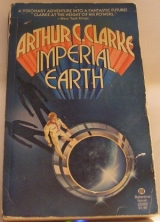
Текст книги "Imperial Earth"
Автор книги: Arthur Charles Clarke
Жанр:
Научная фантастика
сообщить о нарушении
Текущая страница: 10 (всего у книги 19 страниц)
Duncan walked to the Comsole, and the screen became alive as his fingers brushed the ON pad. Now it was a miracle beyond the dreams of any poet, a charmed magic casement, opening on all seas, all lands.
Through this window could flow everything that Man had ever learned about his universe, and every work of art he had saved from the dominion of Time. All the libraries and museums that had ever existed could be funneled through this screen and the millions like it scattered over the face of Earth. Even the least sensitive of men could be overwhelmed by the thought that one could operate a Comsole for a thousand lifetimes-and barely sample the knowledge stored within the memory banks that lay triplicated in their widely separated caverns, more securely guarded than any gold. There was an appropriate irony in the fact that two of these buried complexes had once been control centers for nuclear missiles.
But now Duncan was not concerned with the heritage of mankind; he had a more modest objective in view. His fingers tapped out the word INFo, and the screen instantly displayed:
PLEASE SPECIFY CATEGORY
01. General 02. Science 03. History 04. Arts 05. Recreatibn 06. Geography 07. Earth Directory 08. Moon Directory 09. Planet Directory and so on for more than thirty subject headings.
As his fingers tapped out 07, Duncan could not help recalling his very first confrontation with the Terran Comsole system. The categories were almost the same as on Titan, but ACTIVATE was on the left-hand side of the keyboard, and the unfamiliar position had made him forget to press it. So nothing had happened for a good five seconds; then a really beautiful girl had appeared on the screen and said sweetly, in a voice to which Duncan could have listened forever: “You seem to be having some difficulty. Have you remembered to press ACTIVATET’
He had stared at her until she faded out, leaving a dazzling smile
that, like the Cheshire Cat, lingered in 146 his memory. Though he had promptly repeated the same mistake five times in a row, she never came back. It was a different girl each time. Oh well, he told himself, they had probably all been dead for years…. When EARTH DIRECTORY came up, he was requested to give Family Name, Given
Names, Personal Number, and Last Known Address-Region, Country, Province,
Postal Code. But that was the problem-he had not heard from Calindy for five years, and had never known her personal number. It had even been hard to recall her family name; if it had been Smith or Wong or Lee the task would have been hopeless.
He typed Out ELLERMAN, CATHERINE LINDEN, and a string of DON’T KNOWS. The
Comsole shot back: WHAT INFORMATION DO YOU WANT? Duncan answered:
ADDRESS AND VIDDY NUMBER: ACTIVATE
Suppose Calindy had changed her name? Unlikely; she was not the sort of woman who would let herself be dominated by any man, even if she established a long-term relationship with one. Duncan could imagine the man changing his name, rather than the other way around…. He had barely completed this thought when, to his surprise, the screen announced:
ELLERMAN, CATHERINE LINDEN
North Atlan
New York
New York
Personal: 373:496:000:000
Viddy: 99:373:496:000:000
The speed with which the system had located Calindy was so amazing that it was several seconds before two even more surprising facts registered in
Duncan’s mind.
The first was that Calindy had managed to secure a–quite literally—one-in-a-million personal identification. The second was that she had been able to get it incorporated in her viddy number. Duncan would not have believed it possible; Karl had once tried to do
the same thing, and even he had failed. Calindy’s powers of persuasion had always been remarkable, but be realized that he had underestimated them.
So here she was, not only on this planet, but on this continenta mere five hundred kilometers away. He had only to tap out that number, and he could look once more into the eyes that had so often smiled at him from the bubble stereo.
He knew that he was going to do it; of that there was never any question.
Yet still he hesitated, partly savoring the moment of anticipation, partly wondering just what he was going to say. He had still not decided this when, almost impulsively, he tapped out the fourteen digits that opened up the road to the past.
Duncan would never have recognized her had they met in the street; he had forgotten what years of Earth gravity could do. For long seconds he stared at the image, unable to speak. Finally she broke the silence, with a slightly impatient: “Yes? What is it?”
Before he could answer, Duncan found it necessary to start breathing again.
“Calindy,” he said, “don’t you remember me?”
The expression in those lustrous eyes changed imperceptibly. Then there was the trace of a smile, though a wary one. Be reasonable, Duncan told himself; she can’t possibly recognize you, after fifteen years. How many thousands of people has she met in that time, on this busy, crowded world? (And how many lovers, since Karl?)
But she surprised him, as usual.
“Of course, Duncan-how lovely to see you. I knew you were on Earth, and had been wondering when you’d call.”
He felt a little embarrassed, as perhaps he was intended to do.
“I’m sorry,” he said. “I was incredibly busy. The Centennial celebrations, you know.”
As he stared into the screen, the remembered features slowly emerged from the stranger looking back at him. The impact of the years was not as great as he had supposed; much of the unfamiliarity was purely artificial. She had changed the color of her hair so that it was no longer black, but brown, shot with flecks of gold. The oval of the
face was the same, the ivory skin still flawless. When he forgot that imagge in the bubble stereo, he could see that she was still Calindy -more mature, and even more desirable.
He could also see that she was sitting in a crowded office, with shadowy figures coming and going all around her, and occasionally handing her sheafs of documents. Somehow, he had never imagined Calindy as a busy executive, but he was quite sure that if she had set her heart on the role, she would be a great success. It was obvious, however, that this was no time for tender endearments. The best that he could hope for was to arrange a meeting as soon as possible.
He had come all the way from Saturn; it should not be difficult to span the extra distance between Washington and New York. But, it seemed, there were problems. He even got the impression that there was some hesitation, even reluctance, on Calindy’s part. She consulted a very complicated diary, threw several dates at him, and appeared slightly relieved when Duncan found that they clashed with his own appointments.
He was becoming quite disheartened when she suddenly exclaimed: “Wait a minute-are you free next Thursday-and Friday?”
“I think so-yes, I could manage.” It was almost a week ahead; he would have to be patient. But two days-that sounded promising.
“Wonderful.” A slow, mischievous smile spread over her face, and for a moment the old Calindy looked back at him.
“And it’s perfect-so very appropriate. I couldn’t have arranged it better if I’d tried.”
“Arranged what?” asked Duncan.
“Contact the van Hyatts at this number-they’re just outside Washington-and do exactly what they tell you. Say that Enigma’s asked them to bring you along as my personal guest. They’re nice people and you’ll like them. Now
I really must break off-see you next week.” She paused for a moment, then said carefully: “I’d better warn you that I’ll be so busy we won’t have much time, even then. But I promise you -you’ll really enjoy the experience.”
Duncan looked at her doubtfully. Notwithstanding that assurance, he felt disappointed; he also hated to be involved in something over which he had no control. Makenzies organized other people-for their own good, of course, even if the victim did not always agree. This reversal of standard procedure made him uncomfortable.
“I’ll come,” he said, taking the plunge. “But at least tell me what this is all about.”
Calindy gave that stubborn little moue which he remembered so well.
“No,” she replied firmly. “I’d be violating the motto of my own organization, and even the executive vice7 president can’t do that.”
“What organization?”
“Really?” she said, with a smile of pure delight. “I thought Enigma was rather well known, but this makes it even better. Anyone on Earth will tell you our slogan…” She broke off for a second to collect some documents from another harried assistant.
“Goodbye, Duncan-I have to rush. See you soon.”
“Your slogan!” he almost yelled at her.
She blew him a dainty kiss.
“Ask the van Hyatts. Lots of love.”
The screen was blank.
Duncan did not immediately contact the van Hyatts; he waited for a few minutes, until he had emotionally decompressed, then called his host and general adviser.
“George,” he said, “have you heard of Enigma Associates?”
“Yes, of course. What about them?”
“Do you know their slogan?”
“We astonish.” dgEh?99
Washington repeated the phrase, slowly and caro fully
“Well, I’m astonished. What does it mean?”
“You might say they’re very sophisticated entertainers or impresarios, working on a highly individual basis. You go to them when you’re
bored, and want novelty. They analyze your psych profile, run it through their computer banks, and come up with a program to fit the time and money you’re prepared to invest. They may arrange for you to live at the North Pole, or take up a new profession, or have an exotic love affair, or write a play, or learn three-dimensional chess…. And they rely a great deal on the element of surprise-you never know what they’ve planned for you until you’re already involved….”
“Suppose you don’t like their program, and want to pull out?”
“Apparently, that very seldom happens. They know their job-and, moreover, you don’t get your money back. But how did you hear about them? I hope you aren’t bored!”
Duncan laughed.
“I haven’t had time for that luxury. But I’ve just contacted an old friend who’s apparently vice-president of the organization, and she’s invited me to join a group for a couple of days. Would you advise it?”
“Frankly, that’s very difficult to say. How well does she know you?”
“We’ve not met for fifteen years, since she visited Titan.”
“Then whatever program she’s invited you to join will be fairly bland and innocuous, especially if it lasts only two days. Your chances of survival are excellent.”
“Thank you,” said Duncan. “That’s all I wanted to know.”
The van Hyatts, when he introduced himself to them a little later, were able to fill in a few more details. They were a friendly but rather highly strung couple in late middle age, which was itself some reassurance.
Calindy would hardly dump them in the heart of a desert with one canteen of water, or set them climbing Mount Everest. Duncan felt reasonably confident that he could handle whatever was in store for them.
“We’ve been instructed,” said Bill van Hyatt, “to wear old clothes and sturdy boots, and to carry raincoats. It also says here, “Hard hats will be provided when necessary.” What on Earth is a hard hat?”
The van Hyatts, Duncan decided, had led somewhat sheltered lives. “A hard hat,” he explained, “is a protective helmet of metal or plastic.
Miners and construction workers have to wear them.”
“That sounds dangerous,” said Millie van Hyatt, with obvious relish.
“It sounds like cave-exploring to me. I hate caves.”
“Then Enigma won’t send you into them. They have your profile, don’t they?”
“Yes, but sometimes they decide that what you don’t like may be good for you. Shock treatment. Remember what happened to the Mulligans.”
Duncan never did discover what happened to the Mulligans, as he thought it best not to intervene in what looked to be escalating into a family quarrel. He made hasty arrangements for a rendezvous at Washington airport next Thursday, signed off, and then sat wondering if he had done the right thing.
It was quite some time before he was suddenly struck by a curious omission on Calindy’s part—one that both surprised and saddened him.
She had never asked about Karl.,
MYSTERY TOUR
Only an expert on the history of aeronautics could have dated the vehicle that stood glistening in the late-afternoon light. Like sailing ships, though in less than a tenth of the time, aircraft had reached their technological plateau. Improvements in detail would continue indefinitely, but the era of revolutionary change was long past.
Bill van Hyatt was convinced that this flying machine was at least a hundred years old. “It’s powered by rubber bands,” he insisted. “When
we get inside, 152 there’ll be a big windlass and weT all have to walk round and round, winding it up.”
“Thank you, Mr. van Hyatt,” said the Enigma representative, who had met them at Washington airport. “That’s a very interesting idea. We’ll bear it in mind.”
There were twenty clients in the party, and they all seemed a little tense and expectant. The only person who was in complete control-in more ways than one -was the man from Enigma. He was a tough, selfassured character (“Just call me Boss-you may think of something else later”); Duncan would have guessed his age at about fifty. They never discovered his real name, but he had that indefinable air of authority that comes only from years of command; van Hyatt advanced the plausible theory that he was a spaceship captain, grounded for some technical misdemeanor. However, he showed no signs of concealing any secret disgrace.
Boss’s first order to his customers was completely unexpected, but set the tone of the whole enterprise.
“I must ask you,” he said, “to hand over all watches, radios, and communication devices. You won’t need them until you get home.”
He held up an admonitory hand at the chorus of protests.
“There’s a good reason for this-and for any other peculiar requests I may make. Remember, this whole program has been worked out for your benefit. If you won’t cooperate, you’re only cheating yourselves. Cameras and recorders-yes, of course. Use them as much as you like.”
There was a general sigh of relief at this. Duncan had noticed that most of his companions were festooned with equipment designed to capture every aspect of their experience. A couple were obviously “tapeworms,” those peculiar addicts who went through life accompanied by voice-actuated recorders, so that nothing they said-or heard-was ever lost. Unless they could do this, Duncan had been told, they did not believe that they had really and truly lived…. Such a
backward-looking obsession was typically 153 Terran. Duncan could not imagine anyone on his world trying to encapsulate his whole life so that whenever he wished he could recall any moment of the past. On Titan, it was the future that mattered.
As he walked to the aircraft, carrying his scanty baggage (toilet necessities, a change of underwear, raincoat), Duncan decided that van
Hyatt’s guess at its age was not too far out. An obvious vertical-lift fusion jet, it probably dated from the turn of the century, and looked as if it had been built to last forever. He guessed that it was designed to operate in the five thousand-klick range, which meant that it could reach anywhere on Earth in three or four hours. Now he began to understand why all watches had been confiscated; if the flight lasted any length of time, it would be almost impossible to estimate how far they had traveled.
Though the jet was a small one, the score of passengers barely half filled it, and quickly segregated themselves into little groups. Duncan, with some skillful seatmanship, managed to get away from the van Hyatts. He was beginning to suspect that he would see—or certainly hear-more than he wanted of them before the adventure was over.
He snuggled down into the luxurious, though slightly worn, upholstery and tried his luck with the video screen. As he had expected, there was no external view, just continuous loops of canned scenery. And the global viddy channels were all blank. There would be no clues here…. There was, however, a bulky package of literature thoughtfully provided by
Enigma, and he settled down to read this. It described, in tantalizingly vague detail, the types of service provided by the organization. As far as
Duncan could judge, Enigma seemed to combine many of the functions of travel agency, psychiatrist, nursemaid, procurer, baby-sitter, father confessor, educator, and theatrical impresario. He could understand how
Calindy had been attracted to such an enterprise, and was sure that she was very good at her job.
There was a brief announcement from Boss, who had disappeared into the
crew quarters. “Good evening, ladies and gentlemen. Please prepare for takeoff. Our flight time will be between one hour and one day, and we shall not be going beyond the orbit of the Moon. Refreshments will be available shortly for those who need them. Thank you.”
There was scarcely any change of sound level in the cabin as the jet lifted and began to climb like an elevator. Presently Duncan felt a surge of forward acceleration, but by this time he had already lost all sense of direction, despite a deliberate attempt to monitor his inertial-guidance system. There was no way of telling whether they were flying north, south, east, or west.
He continued to browse through the Enigma literature, glancing from time to time at the fare provided by the video screen. If this was to be believed, they were flying in rapid succession over a desert, over the open sea, over a range of magnificent mountains, over an ice field, over clouds, over the
Moon (or Mercury), and over an apparently endless stretch of flat, cultivated fields, laid out in huge squares. This last display was particularly interesting, for Duncan was quite sure that nothing like it had existed for a couple of hundred years. However, he reluctantly dismissed the theory that Enigma Associates had managed to invent a time machine.
Presently, coffee and light snacks were brought around by the inevitable and unchanging stewardesses. Perhaps an hour later-it was amazing how soon one lost the ability to estimate the passage of time when mechanical aids were no longer available -they came around again with a second serving.
Almost immediately after this, the aircraft started to descend.
“We’ll be on the ground for about fifteen minutes,” Boss announced. “If you want to stretch your legs, you’re free to do so. But don’t get too far away; we’re not going to wait for stragglers.”
He had scarcely finished when there was a barely perceptible bump, and the whisper of the jets faded away into silence. Almost at once there was a rush to the doors. The anticlimax was considerable Wherever
they 155 were, it was already night, and all that could be seen was a large shed, lit by flickering oil lamps-oil lamps!-beneath which about twenty people were standing expectantly. The night was so dark and so completely overcast that it was impossible to see beyond the limited range of the lights. The shed was apparently standing in a large field or clearing; Duncan thought he could just see some trees at the limits of vision. There was no sign of any other form of transportation—either of land or air.
“Any guesses?” said the ubiquitous van Hyatt.
“I haven’t the faintest idea. Remember-everywhere on Earth is new to me.”
“We’re somewhere in the tropics.”
“What makes you think that? It doesn’t seem particularly warm.”
“It’s so dark. Remember, this is early summer in Washington-twilight lasts all night, and it never gets really dark.”
Duncan was aware of this, somewhere at the back of his mind; but it was theoretical knowledge, which he would never have thought of applying to a practical situation. It was very hard for a resident of Titan to understand all the implications of Earth’s seasons.
“So where do you think we are?” be asked.
“Well, we were airborne about two hours…”
“As long as that? I would have said not much more than one.” ” At least two. So we could be anywhere in Africa, or South America. That is, if we were traveling at full speed. Perhaps the newcomers will have some ideas.”
They turned out to be equally ignorant, having left Los Angeles about two hours earlier in another jet, which had dumped them and taken off again.
When be learned this, van Hyatt walked away muttering, “Well, it could still be Africa … what a pity we can’t see the stars.
There were few empty seats when the aircraft took off again, and soon after they were airborne Boss announced: “As this will be a long hop, we’ll be dimming the lights shortly so that you can get some sleep.”
This was obviously nonsense, and merely intended 156 to further confuse the now thoroughly disorientated passengers.
Nevertheless, Duncan thought it not a bad idea to accept the suggestion. He might need an his physical resources to face whatever ordeals Enigma had in store for him.
He got to sleep more easily than during his first night aboard Sirius. But it was a far from dreamless sleep, and after many improbable adventures on a world that seemed neither Earth nor Titan, he found himself trying to reach Calindy, beckoning to him from a mountaintop. Unfortunately, judging by the gravity, he must have been on the surface of a neutron star.
“Wake up,” said Boss, “we’re there…
“Out of luck again,” grumbled van Hyatt. “If only I could see a few stars .”
There was no chance of that; the sky was still overcast. Yet it did not seem quite as dark as at the last stop, even though that was several hours earlier.
Van Hyatt agreed, when Duncan pointed this out. “Either we’re overtaking the sun, or we’ve flown all the way back toward tomorrow morning. Let’s see that would put us somewhere in the Far East.”
“Come along, you sluggards!” shouted Boss. “We’ve got a couple of tons of gear to unload!”
A human chain was quickly formed, and equipment and packages were rapidly shuttled out-of the cargo hold. This all had to be carried a hundred meters to avoid the jet blast at takeoff, and his very modest exertions as a porter gave Duncan a chance to examine the landing site.
It was a small, grassy clearing, surrounded by a high wall of trees. For the first time, Duncan began to have serious qualms. He remembered his night at Mount Vernon; he could laugh at his fears, now that he realized how tame and harmless everything had been down on the farm. But this appeared primeval jungle, and there were still dangerous wild animals on
Earth. Did Enigma really know what it was doing?
Well, it was too late to back out now. With a deep throated roar, the jet heaved itself off the grass and started to climb into the sky. Duncan turned his back to the blast, and for a minute was -whipped by
flying debris. The diapason of power faded away into clouds. They were alone in the forest.
For the next hour, however, no one had time to brood over the precariousness of the situation. There were tents to be erected, a small mobile kitchen to be activated, lights to be strung from poles, portable toilets to be set up…. All this was done under the supervision of
Boss, with the expert help of four assistants and the enthusiastic but far from expert help of a dozen volunteers. Duncan was not one of these; camping was not a recreation that could be practiced on Titan, and he could best serve by keeping out of the way.
However, he found it fascinating to watch the deployment of all this strange technology. The inflatable beds looked extremely inviting, and the collapsible seats, though liable to live up to their name if carelessly handled, turned out to be surprisingly comfortable. Life in the jungle need not be too rigorous -but Duncan was still worried about wild animals. His imagination was full of confused images of carnivorous beasts-lions, tigers, bears, wolves-against whom the flimsy fabric of the tents appeared very inadequate protection.
He felt much happier when the bonfire was lit. Its cheerful glow seemed far more effective than electricity in dispelling the dangers of the night. To
Duncan, being able to feel, smell, and throw logs onto a large open fire was a unique experience, and another rare memory to store for the future.
For the first time, he could understand what fire must have meant to early man. Looking around at his companions, he could see that many of them were also discovering their lost past. He was not the only stranger here wherever “here” might be.
Needless to say, Bill van Hyatt had come up with a theory.
“We’re not too far from the Equator,” he assured Duncan, passing on his way to the fire with an armful of wood. “Probably a couple of thousand meters above sea level, or it would be even warmer. Judging by the
distance we must’ have flown, this could be somewhere in Indonesia.” ‘~But wouldn’t it be daylight there?” asked Duncan, somewhat uncertainly.
He did not want to reveal his ignorance of geographical details, but he had a vague idea that Indonesia was almost as far from Washington as one could get. And the one fact of which they were sure was that they had left late in the afternoon.
“Look at the sky,” said Bill confidently. “It soon will be sunrise. Very quick in the tropics-you know, where the dawn comes up like thunder.”
An hour later, however, there was not the slightest sign of the dawn, but no one except Bill van Hyatt seemed to worry in the least. A loud and happy campfire party was in progress, consuming food and drink in amazing quantities. Almost equally amazing was the speed with which forty perfect strangers could become intimate friends. Duncan would never have recognized this uninhibited and noisy group as Terrans. Though he still felt a little apart from the scene, he enjoyed watching it and wandering round the circle listening to the discussions in progress. He was also surprised to discover how much he could eat; something seemed to have happened to his appetite.
And there were some splendid wines-all new to him, of course, so it was necessary to do a great deal of research to discover which he liked best.
Presently, singing started, led by an Enigma staff member whose voice-and repertoire-were so professional that he had obviously been selected for this role. In a very short time, he had the whole group rocking and stomping, and joining in choruses describing events most of which were wholly unfamiliar to Duncan. Some seemed to be tragic, though he judged this by the musical treatment rather than the words. He was not quite sure what fate had befallen Darling Clementine, but that song was crystal clear compared with one recounting the exploits of Waltzing Matilda. He listened for a few minutes in -utter bafflement, then drifted away from the circle of firelight into the semidarkness.
“It’s perfectly safe to go as far as the trees,” Boss had said. “But
if you go into them, we can accept no responsibility whatsoever, and the indemnity clause of our contract comes into force.”
Duncan would probably not have traveled even as far as this without the encouragement of the wine but presently he was standing about fifty meters from the edge of the forest, and a considerably greater distance from the songsters. The illumination was roughly that of a cloudy night on Titan, when Saturn was in its crescent phase. Thus he could see general outlines, but no fine detail.
The trees were large and impressive, and he guessed that they were very old. Somehow, he had expected to see the slender palms which were the universal symbol of Earth’s tropics-but to his disappointment, there was not a palm in sight. The trees were not very different from those at Mount
Vernon; then he remembered van Hyatt’s suggestion that they might be well above sea level, where the climate was mild.
Duncan’s chemical courage was beginning to desert him; the thrill of standing at the edge of the unknown was rapidly losing its novelty. He turned back toward the now dwindling glow of the bonfire, from which stragglers were slowly departing as they headed to the tents, but had taken no more than a dozen paces when the sound from the forest rooted him to the spot.
Never in his life had he heard anything remotely resembling it. Only a soul in the lowest circle of hell could have produced the wail of anguish that burst from the trees and instantly quenched the festivities at the campsite. It rose and fell, rose and fell, then ululated away into silence.
But even in that first moment of sheer terror, when Duncan felt the strength ebb from his limbs, he found himself feeling thankful that at least no human throat could have produced that awful sound.
Then the paralysis left him, and he was already halfway back to the camp before he remembered that he was unable to run. Deliberately slowing down was one of the bravest things he had ever done especially
when that nightmare howl echoed once more from the forest. When he reached the tents, Boss was still trying to restore morale.
“Just some wild animal,” he explained soothingly. “After the noise we’ve been making, I’m surprised everything has been so quiet until now.”
“What kind of animal, for heaven’s sakel” someone expostulated.
“Ask Mr. van Hyatt-he seems to have all the answers.19
Bill van Hyatt was completely unabashed, and ready as ever to accept the challenge.
“It sounded like a hyena to me,” he replied. “I’ve never actually heard one, but it fits the descriptions I’ve read.”
“I don’t see how anyone could describe that,” somobody muttered.
“Hyenas live in Africa, don’t they?” said another voice. “Anyway, they’re quite harmless.”
“Personally, I don1 consider death from heart failure harmless.”
“All right, all right,” Boss interjected. “We’ve a busy day ahead of us.
It’s time to go to bed.”
Everyone glanced at absent wrist watches, but no confirmation of this fact was really needed. The camp slowly settled down for the night.
Despite maneuverings that had barely stopped short of actual rudeness,
Duncan had been unable to avoid sharing a tent with the van Hyatts. Just before he dozed off, he heard Bill remark sleepily to his wife: “I’ve just remembered-the program said that hard hats would be provided. I wonder why?”