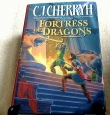
Текст книги "Fortress in the Eye of Time"
Автор книги: C. J. Cherryh
Жанр:
Классическое фэнтези
сообщить о нарушении
Текущая страница: 8 (всего у книги 47 страниц)
“Not to lose it,” the man in charge said. “And who said?”
“My master, sir.”
“Ah. Now His Lordship has finally owned a master. And who would that be?”
“My master said—” He knew dangerous questions by some experience now; and not to name Names carelessly. “My master said—I should follow the Road.”
“And who said this?”
“My master, sir.” He truly did not want to answer that question. He feared that they had their minds made up that he was in the wrong, and the men in the woods had liked least of all where he had come from. He was light-headed from hunger and from exhaustion, and he began to fear they would hit him again. “Please give me the Book, sir.” “He’s mad,” the man on his feet said.
“And never will answer the question. —Who is this master, man?
Answer, or I’ll become angry with you.”
He feared to answer. He feared not to. He had no knowledge how to lie.
“Mauryl,” he said, and by the look on the man’s face once he said that Name, he feared it would have been far better for him to have kept still, no matter what they did.
Chapter 9
Te assizes were done, the evening headache, promoted by a boundary dispute and a squabbling lot of voices, had given way to a pleasant warmth of wine, and a wind from the west stirred the air from the open window-panels above a candlelit tumble in the silken sheets. Orien and Tarien were a red-haired bedful, a welcome diversion on this night when Cefwyn felt the need to forget the day’s necessities. Together the twins had the wit of half the council combined, a more astute judgment, a keener humor; and their perfumed oil, Orien’s hands and Tarien’s lips were a potent, delirious persuasion to think of nothing else at all and hold himself as long as he could manage—Which he could do, thinking of the water rights of Assurn-brook and two border lords at each others’ throats. He could distract himself quite effectively for perhaps a breath or two, asking himself whether bribery, diversion, or main force was the appropriate answer to fools—a mandated marriage, perhaps: Esrydd’s light-of-wit son, the thane of Assurn—Hawasyr, and Durell’s plump wayward daughter, both with ambitions, both lascivious, both—Was it through the female line the lands of Payny could descend?
The earl’s daughter by a second wife.., that could pose a problem.
The intricacies of Amefin titles were another source of headache, the thane of this and the earl of that, and the province of Amefel as a whole ruled over by the Aswydds, ducal in the Guelen court at Guelemara in Guelessar, and styling themselves aethelings, though discreetly, in their own provincial and very luxurious court ....
“Gods,” he moaned, the vixen proving she had teeth. The other threatened Tarien with the pillow, and he took the game for what it was, rolledTarien under and suffered a buffeting of feathers and a flank attack, Oriencomplaining she was slighted. Or was it, after all, Tarien?
He let himself be wrestled onto his back, and a furious battle ensued between the twins, in which he was the disputed territory, and in which he had an enchanting view of both well-bred ladies, before they smothered him in unison, and not with pillows.
He was taking random choice, then, perilous decision, when came c thump at the inner door, and a second.
And a third. Which roused his temper, which defeated other process in midcourse, and left him utterly confused between the twins, who wanted him to continue, and his door, at which some fool continued hammering assault.
“Gods damn you!” he cried, flat on the battlefield, overwhelmed and unhorsed. “Gods damn your knocking and battering, what do you war that’s worth your neck?”
“M’lord,” came from the other side of the doors. “Forgive me ...”
“Not damned likely!”
“...but there’s a stranger in hall. Master Emuin said you should hear this.”
“Master Emuin has no natural impulses,” he muttered, and drew pillow over his face, momentary refuge. “Master Emuin has now”
Thump. “My lord?”
He groaned and tossed the pillow aside. Orien—or was it Tarien?—kissed him on the mouth and clung to his arm. Her twin tossed a wealth of red-gold hair over a sullen shoulder and gathered the wine-stained sheet about her, rising.
He rolled to the doorward end of the bed, sighed as his feet found the fleece rug, searched blindly down the bed for remnants of his clothing.
“My lord?”
“Idrys,” he said to the batterer, “—Idrys, damn you, go down, tell them I’m aware, awake, bothered, duly alarmed, and duty-bound, I shall be there in a gods-cursed moment—I can dress myself, I learned at my lady mother’s knee, curse you all—”
Orien cried out as he snatched her by the wrist, squealed as he fell atop her and recovered his moment, at least enough to serve.
After which.., after which: “I’m duty-bound,” he said. “Tomorrow night.”
“Perhaps,” said Orien—he believed it was Orien. Lord Heryn’s sisters did as they pleased, and she would please herself again, or Tarien would, or both together. They played pranks on their lovers, which were more numerous than Heryn Aswydd accounted of ... but not many more, one could guess. Their lord brother, His Grace the Duke of Amefel, aetheling of the Amefin, was much about the court himself, in and out of this bed and that, trading gossip in every profitable ear.
One talked no affairs of state with the twins, who never asked gifts-least of all from him, whose acceptance they courted, oh, so gladly, since Luriel’s abrupt departure from the court.., but wager that this untimely knocking would clatter straight to Heryn’s ear for whatever value it had.
Emuin, about at this hour. A stranger, with some matter of import, enough to bring the old man from his bed.
Idrys, moved to rattle his doors to have him to some meeting.
Business with a stranger smelled of assassins, aimed at him or aimed at someone who wished to point a finger. Conspiracy was constant in this gods-cursed and often rebel district, and it could well wait until morning—late morning. Or three mornings hence for what he cared tonight.
The headache was recurring.
He pulled on his hose, struggled, servantless, with the boots, and found the shirt ... not overly rumpled. The doublet—no. He damned such formalities. He wore the shirttail out, splashed cold rose-scented water into his face, groped after the towel and blotted his beard and eyebrows dry—a cursory brushing of his hair, then, an apology to a braiding on his way out of the bedroom and to the door—the hell with it, he decided, and left the bedroom for the foyer doors.
A clash of arms resounded as, passing through the foyer, he left his apartment, four guards relieved at least of their nighttime boredom and mandated to endless discretion. The senior two went with him without asking. The junior and less privileged pair, with a second noisy salute, settled back to night-watch over his rooms as he went toward the east stairs.
The twins would dress and find their way out, and his guards would ignore their departure as they ignored their presence.
Such tedious games they played, when it involved dynasty, and heir-getting, Amefin ladies, and the Marhanen prince’s bed.
Avoiding gossip. Avoiding ... public acknowledgment of a known situation.
Down the hall he went with his guard about him, boots resounding on marble, and down the broad white stairs, on which the Guelen staff, instigated by his majordomo, made profligate expenditure of candles (your father the King, they began, when he protested the cost).
His father the King, in the capital at Guelemara, a province away, in the heart of the realm of Ylesuin, had an extravagant fear of the dark.
And of assassins.
Entirely justified, as it happened, by Grandfather’s example. Hence the guards. But it had not been for want of candles that Grandfather had died.
Clatter and rattle down the steps behind him: his bodyguard, ready to defend the Prince of Ylesuin from axe-wielding priests and jealous lovers.
Himself, he dreaded only the dank, after-midnight chill of the marble halls, undiminished by the candles. He walked, followed by clatter and clank, toward the open doors, the gathering of guards, the fuss and bother of wakened staff in the lower halls. A page overtook him, clearly wakened from sleep, having brought his cloak, which in summer and after the heat of his exertions he could well have done without, but the cloak was there, the air was always cooler in the audience hall than elsewhere, and he slung it on, freed his hair from it, encountered Emuin just inside the doors, along with a clot of night-staff and guards.
“This had better be worth it,” he muttered to Emuin, whose habit, in former years common cloth and perpetually inkstained, now was the immaculate gray of the Teranthine order—although within the court he wielded secular power his monastic and meditative order abhorred.
“I assure Your Highness ... “Emuin began, but he brushed past, sleepy, by now, and not in any good humor. “My lord Prince—”
His captain of the guard, Idrys, slipped up to him like a pike to a passing morsel, a black pike, wily, and veteran of hooks. Cefwyn waved a hand, a limp, circular signal that said to Idrys what he had just said to Emuin, in less polite terms, and stalked up the dais steps to the gilt, antique and unwarrantably uncomfortable throne, on which he disposed himself in no formality. He hooked a knee over the arm, heaved a sigh, and blinked, bleary-eyed, at the scatter of political expediencies that cluttered this midnight audience. He could list agencies that might be behind this undoubted ploy to obtain the unaware, uninformed state in which he found himself. Certain courtiers would have the stomach to play these games, such courtiers as aimed for his ear, his table, his bed, such noble families of the Guelenfolk from the capital as constantly plied their politics in this chamber; such of the Amefin locals as lurked in the aisles on feast days to catch his attention, hand him a petition—offer him an assignation with their sisters.
Little difference, one from the next, except he mortally loathed the ones that arrived after midnight, determined to have his ear privily and at unusual length regarding some piece of skullduggery gone awry before the other side of the business, no more nor less at fault, could counter it with appearances and protestations of their own.
Emuin. With Idrys. One did hope for consideration from one’s intimates, at least. And was disappointed.
One did expect, being roused at this ungodly hour by those same intimates, at least something of spectacle, an Elwynim assassin, a clutch of lordly conspirators.., a ravished and indignant lady of high degree.
And what was there? A dark-haired and dirty fellow in the ruins of good clothing restrained by two of the Guelen guard, a desperate case, to be sure, but hardly worth two armored men.
Tall for any Elwynim. Lanfarnesseman, perhaps; many were tall and slender, although most were as fair as the Guelenfolk and very few Lanfarnessemen went beardless. The prisoner stared consistently at his feet and one could not be otherwise certain of the features, but the bare, well-muscled forearms and the slender hands, alike the face, said young; and youthfulness said maybe fool enough—counting nine skulls of wouldbe assassins bleached and raven-picked on the Zeide’s south gate, in his year-long tenure here—to carry some personal pique against him, for hire or for, gods save them, the ancestral Amefin grudge.
He truly hoped not to have that old business begin again.
“So what have we?” he asked, swinging his foot in deliberate contempt of amateur intrigues. “A stolen mule? A pig-napper? And two of you to restrain him? Good gods.”
“Highness,” Idrys said. “This were best heard in private.”
“Well, well, my bed chamber was private, at least, the while. Morning would not do for this? Nothing would serve but I come down myself, over cold floors and colder—”
“Highness,” Emuin chided him, his tutorial voice.
Cefwyn waved his hand. “Have your play, then. Proceed.” The hall was emptying of servants and of the curious, a last few lingering near the door; but scribes, the borderland of needful elements of the court, and occasionally discreet, stayed. “Out,” he ordered the lingerers. “No record of this. Back to your beds. Shut the doors.”
The doors shut. He swung his foot, and frowned at the prisoner, who still studied the marble steps in front of him. “So what have we?” he addressed said prisoner, but it was unproductive of answers.
Idrys came to him and offered him a small book, a codex, leather-bound, old, the worse for wear. He flipped the pages open at random, saw a blockish, antique hand, a forgotten—perhaps wizardly—language.
His heart skipped a beat—a little skip, true, and he would not betray the fact, nor mend his posture, no, not for this, which he began to suspect as some priestly game with him. He did not think it was Emuin’s doing. It had the smell of a priestly matter, illicit and heretical practice, meaning the Bryalt faith, dominant in this province, could again be afoul of the orthodox Quinaltines, who had probably come a long and dusty ride from the capital to urge some obscure point of theology and rant to the Prince about cults and conspiracies on the borders.
But that it came through Emuin set it above the inconsequential and the purely theological.
He shut the book, left it idly in his lap, and cast a narrow look at his
01d tutor. “Well, old master. I take it the pig-thief came bearing this. And of course I must be roused out most urgently.” “He claims it as his, Highness.”
Not likely his, Cefwyn thought, the youth being a youth, and lacking in every sense the plausibility of the occasional graybeard who gulled the villagers and roused—if merely for a season—Amefin expectations and Amefin disaffections from the Crown.
He considered Aman and Nedras, the gate-guards who were the anomaly in this gathering of court and guards—not the restrainers of the culprit, but those whose part in this doubtless intrigue-ridden malfeasance he had yet to hear. They were the ones who had brought with them, as he supposed, this head-hanging, straw-bedecked youth, the unwilling center of all this commotion. He would have thought, absent the gate-guards in the affair, that the Quinalt and the Teranthines were at odds over some point of abstract logic—but, gods, he had thought better of Emuin than to wake him for some priestly rivalry; and the matter did look to be some arrival at the Zeide gate.
“Man,” he said, curiosity aroused, “pig-thief. Look up. Look up here.
Whose book is this?”
The prisoner had been considerably knocked about. He seemed to need the guards’ holding him on his feet, and needed a shake from Aman to have his attention.
That brought his head up, jolted him to alertness ... and for a moment in Cefwyn’s awareness there was nothing—nothing—but that pale gaze.
Fear, Cefwyn thought, heart racing in his breast, his sense derived of judicial experience reasserting reason. It was fear he saw in most faces that came before him under such compulsion; far rarer, however, was the courage to look him in the eyes; and, he was ready to swear, although he had never met it in this court ...
He saw innocence. Absolute, stark, terrifying innocence.
He had moved without thinking—had dropped his knee off the arm without knowing it; had held his next breath and feared the whole assembly in the hall had seen, did see. He was not accustomed to be so moved by anyone, and he was vexed with himself. He felt no threat in the stare, only an uncanny, helpless attraction toward this creature, an attraction all but physical, unprecedented, and intimate, so acute that he felt exposed in that motion of his heart. He had never been so set aback in his life; and he was afraid, as this creature seemed afraid, this ... youth, this.., man, this ...
He had no way to name what he felt or what he saw; he had no reckoning even how much time had passed in the creature’s looking up, and shaking back his loose and tangled hair, and meeting him stare for stare.
But he knew that the men who held him were no restraint at all, if this bedraggled, fragile, glorious creature should decide to contest them.
Did no one but him see it? Did not Emuin, who was reputed wise in such matters, know that this threatening youth was not in any sense held by the guards? They had beaten him. There was straw in his dark hair and dirt on his clothes. If his guards had no terror of him, they were fools.
But maybe they had after all felt afraid—had they not, clearly, exhausted their chain of command?
And had those superior to them not called others, until the affair of the prisoner racketed to Emuin?
And had not Emuin insisted, through Idrys, that His Highness needed to be dragged from bed urgently to intervene in the matter? This was not an ordinary case. In any sense.
“Come. Come here.” Cefwyn beckoned the young man closer, and the two guards brought him to the lowermost step. The young man gazed at him again, that intimate and terrifying stare—as if the young man– which he could not possibly do—knew secrets that would damn his soul.
The impression was so strong that almost he would have disposed the guards from the hall for fear of the youth speaking too much, or bringing some business worth lives—and he did not even know he owned such dreadful secrets. He found no reason for such a fear; and the youth, besides, seemed weak and uncertain on his feet, apt at moments even to fall to the marble floor without the guards’ steadying hold.
A moment while his thoughts raced, that silence continued in the room, until one could all but hear the snap of candle flames, until the melting of wax—like the melting of flesh just now in chambers above—it made the air cloying sweet. It was Orien’s perfume. It clung to him. His thoughts scurried like mice, this way and that, desperate, looking for an approach to the problem—and found it under his fingertips.
“Is this your book?” Cefwyn asked, lifting it from his lap.
“Yes, sir.”
“And are you indeed a thief?”
“No, sir. I am not.”
“Where were you and what were you doing, to be arrested by my guards?”
“I was at the gate. I asked to see the master.”
The Guelen guards were unhappy with that. They shook him and cuffed him, saying, “Mind your manners, man. Say, ‘yes, Your Highness’ and ‘no, Your Highness’, and ‘Your Highness, if you please’.”
Cefwyn winced, almost protested—but Aman, of the guard, added:
“‘E’s a wee bit daft, Your Highness. We had a notion he might be some
Elwynim wi’ that writing, if ye know, Your Highness, him and his clothes and his speech and all, and his being a stranger.”
“Who brought him in?” Cefwyn asked, and had a confused and apologetic muttering from an officer of the gate-guards, and an avowal from Idrys himself, to which he waved a negligent hand: he knew the chain of command, and by now so did the young man—too well, he was sure.
“And you think him Elwynim? Walking in by daylight, in those clothes?”
“Your Highness, he flew right by the town guards, like their eyes was blinded, Your Highness, and them good men. He said he had old Mauryl for his master. He says he come down the road out of Marna, right from the cursed tower.”
His heart skipped a beat, but it was only confirmation. He knew now that there was omen and worse in the young man. He had seen it in the book. He had been certain of it with never a breath of a name. And to judge by Emuin’s urging to come intervene in this matter—Emuin also had opinions, and fears to disturb his sleep, he could rely on that, too.
“From the old keep,” Cefwyn said, with the gooseflesh prickling on his arms, and a sense of peril and moment now to every move he made-not acute, not inescapable, but there. The young man was looking at him, and he avoided those eyes with a glance at his captain of the guard.
“And them knocking the man about. Hardly prudent. One might make him angry.”
“This is not a jesting matter, my lord Prince.”
And Emuin, unbidden: “Ask him his business, my lord Prince. He asked for you.”
That was not news he wished to hear. He rested his chin on his hand, assumed a stony indifference and slid a glance at the youth, trying—trying to see flaws and faults in that countenance, in that overwhelming force of the youth’s expectations.
That was what it was: expectation. Unmitigated. Unquestioning.
Faith. Appalling, utter faith, directed at him, in the gods’ mercy, who was not accustomed to such impositions.
“So. And what is your name, young stranger in my lands? And what are you to rouse me out of my well-earned bed at this midnight hour?”
“My name is Tristen, sir.”
“No other name?”
“None that I know, sir.”
“And do you live most times at Ynefel, or do you travel about the land, rattling gates and conversing with honest guards?”
Incomprehension grew, and fear became foremost in the youth’s eyes.
“I did live there, sir. But the wind came, and the roof slates fell, and Mauryl—” The youth’s voice faded altogether, not into tears, although the young man was distraught—simply into bewildered silence.
“So how does Mauryl fare?” Cefwyn asked him.
“I fear—he is not well.”
“.And the roof slates fell,” Cefwyn echoed him.
“Yes, sir. They did. Not all. But—”
“Because of the wind, they fell.”
“Yes, sir.”
“And what brought you here to my hall?”
“I wish a place to sleep, sir. And supper.”
There was anxious laughter among the guards. But the young man seemed quite, quite fragile. Childish of manner, now, and altogether overwhelmed.
Cefwyn did not laugh. “Supper,” he said. “Did you walk all that way for supper?”
“And a place to stay, sir.”
“Bringing one of Mauryl’s books.”
“I didn’t steal the book. Mauryl gave it to me. He said I should read it.”
“Did he?” He could not find in the young man’s face the innocence he had seen before. He might have deceived himself. It might be an Amefin-sent deception, challenging his dignity and his authority. So he challenged it in turn. “How many days did you walk from Mauryl’s tower?”
“Four. Five. Perhaps five.”
“Walking? One takes it for twice that many days. At least.”
“Days and nights, sir.”
“Days and nights.”
“I feared to sleep, sir.”
“One does doubt this,” Idrys said coldly, and a spell seemed broken-or provoked. Cefwyn felt uneasiness at what he heard, but although it seemed to him that, if his maps were true, the youth’s account was far short of the truth—still, the youth’s remembrance might be in question.
He felt more uneasiness at the habit Idrys had of provoking a situation.
He saw it building.
“He does seem unlikely simple, Your Highness,” the chief of the gate guard said, “from time to time. An’ then again, he don’t.”
“Well-acted, though,” Idrys said. “Quite well-acted, boy.”
“The book,” Emuin said, “the book.”
“Oh, the book.” Idrys waved his hand. “I’11 have you two its like by morning. Amefin maunderings. Lyrdish poetry. Gods know. Save it for the library. Some musty priest will make sense of it.” “I think not.”
“Monastic pantry records,” Idrys said under his breath. “Household accounts.”
“A plague on you.”
“Enough,” Cefwyn said, watching the youth instead, whose glances traveled from one disputant to the other.
A Road there was indeed in Marna Wood, and legend held that no matter where one found that Road, it went to Ynefel, and not easily away again.
And by his speech, by his manner, by that unreadable book in his possession Had Mauryl had a servant? Cefwyn asked himself.
Or, gods save them, an apprentice?
–Or—worse still, a successor?
Not even the Amefin locals, with the old Sihhé blood still, however thin, in their veins, would readily venture that Road, that forest, far less go asking admittance at Ynefel’s ancient gate. If an apprentice, surely no ordinary lad had come asking for the honor. But reputedly the old wizard had stirred forth, from time to time, though not to court, and reputedly the old wizard still dealt with those willing to risk the river—if indeed it was, as some credulous maintained, the same Mauryl who had dealt with his grandfather, still dealing in Sihhé gold and wizardly simples, and having Olmern lads bringing baskets of flour and oil and such like goods as far up that river as they dared go.
And never would Olmernmen cheat the old man, or short a measure.
In truth—so his spies’ reports had it, they made the measures as much as possible, and tucked gifts in as well.
So the Olmernmen, particularly those of the village of Capayneth, still honored the Nineteen, the wizards’ gods, as did the rural folk of Amefel,
–while the local Quinalt priests, for a share of the gold, looked the other way. As a deity, Mauryl had been demonstrably efficacious for centuries-at least, skeptics said, the many who had had the name of Mauryl and occupied the tower since the legendary rise of the Sihhé kings. More, on the medicines and spells the old man sold, Capayneth’s sheep bore twins, Capayneth’s women never miscarried, Capayneth’s crops somehow never quite headed-out and dried before hail that flattened other fields, and Capayneth’s folk lived long and healthy lives. So they said.
And mutter as the Quinalt would, it could not prevent the veneration that outlasted the Sihhé themselves.
Mauryl fallen? The sun had as well come up in the west. Comets should fill the heavens.
The youth’s acute attention had flagged now. The youth’s head had drooped under his study as if bearing himself on his feet was all that he could do. If this lad was local deity, heir to immortal Mauryl, he bore the wrong name and showed himself a mortal and weary godling, smudged with mud and traces of blood, wilting before his eyes. The spark that had leapt out of the youth for that moment seemed utterly irrecoverable now, the force all fled, —for which the Prince of Ylesuin could be grateful. Here was only a tired young man with an unkept look and a convincing innocence at least of pig-theft, wife-beating, and petty banditry. “Tristen.”
“Sir?” The head came up, the eyes met his, and that moment was indeed almost back, that intense, that unbearable innocence—so appalling and so unprecedented that a man was drawn to keep looking, wishing to be sure, from heartbeat to heartbeat, that it was truly there or had ever been there.
But he could not find it again, not with the same force. Perhaps the young man did have secrets. Perhaps the young man had discovered them in himself, and was not quite so innocent.
Or perhaps he had found that his hosts were not what he had hoped.
“Aman.”
“Your Highness?”
“This young man is not to be harmed in any way. Do you understand?”
“Yes, Your Highness.” There was true commitment in that answer.
Aman knew when the Prince of Ylesuin was completely serious, and when default would entrain sure consequences.
“Idrys. The west wing, the blue room.”
“My lord Prince, —”
“Idrys. The west wing. The blue room.”
“Yes, my lord Prince.”
“Tristen.”
“My lord?”
A change. An awakening to proprieties. A wit wakening—or a pretense abandoned. It could betoken lies. Or utter ignorance. Cefwyn did not so much as blink. “Tristen, these several honest men will take you to a room, and servants there will provide you whatever you reasonably need. Your requests will be moderate, I trust .... “
“Supper?”
“Assuredly.” One did not interrupt the Prince of Ylesuin when he was speaking. There were breaths bated. Not his. He became imperturbable.
And equally plain-spoken. “I also suggest hot water.” The young man looked to have been accustomed to cleanliness—and if he had himself walked five days and five nights through the woods, as the youth had claimed to have done, a bath would have ranked foremost among his requests.
“I would be very grateful, my lord.”
Ah. Politeness. Courtly politeness. And a moment, all unanticipated, to set the hook.
“These things,” Cefwyn said, “if you will answer a question.”
“Sir?” Back to the first mistakes of protocol, in such an audience.
And in an eyeblink, the young man’s self-possession began to fray about the edges. In vain, perhaps, the guards’ knocking-about: threats of harm had not shaken the youth’s composure or come near the truth.
But now, in the diminishing of threats, the offering of comfort—then the abrupt withholding of it—the young man’s voice trembled.
Not a chance tactic. Nor kind. No more kind than a prince could afford to seem, in getting at the facts of a case.
“A simple question, Tristen. An easy question.”
“Yes, sir?”
“Who sent you?”
“Mauryl, sir.”
“Is that the truth I am to believe?”
A hesitation. A careful, apparently earnest, rethinking. “No, sir.”
“What is true, then?”
“Mauryl said to follow the Road.”
“And?”
“Nothing more, sir. Only to follow the Road. I thought—”
“Go on, Tristen with no name. You thought—”
“Thought, since the Road came here, through the gate, that this must be the place he meant me to be.”
Mauryl’s student. Possibly. The young man could dice his reasons quite, quite finely, point by point, and say what he chose to say. A common villager did not do that. It came of courtly records. Priestly teaching.
And a prince could parse reasons down the list—I, thou, he, whence, why, and to what end—quite, quite well on his own.
“And for what purpose, Tristen of no name, did Mauryl Gestaurien send you—ah!—bid you to take to the Road?” “He never told me that.”
“Did he say—go left or go right?”
“No, sir. It only—seemed—as the gate showed me.”
“And Mauryl is not well, at the moment.”
“No, sir.”
“In what way is he not well?”
“He—” Clearly they had reached an abrupt precipice of reason. Or a brutal wall of understanding. “I—saw his face above the door. In the wall, my lord. Like—like the other faces.”
From an improper ‘sir’ to a presumptuous ‘my lord.’ And on such a chilling declaration. There was consternation at various points about the hall. He hoped there was none from him—he tried at least to maintain calm. The matter of the faces was well-rumored, the work of the last Galasieni—or the succession of Mauryls all hight Gestaurien: accounts varied, none of which he had taken as truth, and he would not be daunted, not by the claim, not by the innocence in the voice.