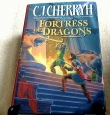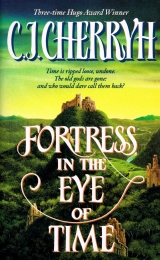
Текст книги "Fortress in the Eye of Time"
Автор книги: C. J. Cherryh
Жанр:
Классическое фэнтези
сообщить о нарушении
Текущая страница: 25 (всего у книги 47 страниц)
“I am tired.” Cefwyn eased a chair behind him, extended his wounded leg, and sat down, holding it. “Gods.”
“Better you had followed your physicians’ advice, Majesty,” said Idrys. “The guards should bear you up to bed.”
“No.” Cefwyn reached to the crown about his brow, rubbed it, where it left a mark and bloodied a cut. He settled it on again. For a moment he rested his eyes against his hand, wiped at them, looked up again. “I have no subtlety left at all, Efanor. This province has undone it. I pray you be my loyal brother, nothing less.”
“I am astonished,” Efanor said dryly. “I am truly astonished. But bear you good faith, I shall, if you bear it to me. I had not expected your trust, Cefwyn.”
“I need all such allies as I can trust. We are under attack. Mauryl-was a grievous loss. —Tristen.” “Sir.”
“You were out there. Tonight.”
“I saw, sir.”
“It was justice,” Cefwyn said.
“I believe you,” Tristen said, knowing nothing else to say.
“You had news of Emuin. A messenger? To you and not to me? Or what?”
It was not Cefwyn and himself, it was not Cefwyn who could be his friend and bear with his imprecisions and his foolishness.
Nor was he the same as he had been, even days ago. He said, with cold at heart, “No, sir. Emuin does speak to me. He tries to help me. But he can’t, always. I think that’s why he went away.” “Wizardry,” Efanor said.
“No, sir,” Tristen said, “I don’t think so. I don’t feel so. Just—he hears me.”
“How can you dispute such things?” Efanor demanded, not of him, but of Cefwyn. “How can you countenance such arguments—wizardry and not wizardry? Do natural men hear wizards?”
“We had no natural man at issue in Mauryl,” Cefwyn said in a hard voice, “and damned well we should consult, brother, both Tristen and Emuin, where they have something of significance to say.” “Consult as you like, then. I’ll none of it!”
“I’11 warrant you’ll hear nothing to imperil your delicate holiness.
Stay. As a wizard, Tristen is gentler than Emuin is.” “I saw his gentility on the field.”
“And he ours, and yours tonight, brother! Forbear. Father gave me a province next a wizard and Emuin for a counselor to help hold it. Now Mauryl’s fallen, and left me Tristen for a ward—whom Emuin approved.
Tristen swore to be my defender, and kept his oath like a good and godly man, or this realm would have no king, not you, nor me, nor Marhanen at all—and Heryn would lord it over a realm of his own tonight, snugged right close to Elwynor. Wherewith the Regent would go down, some pretender would rise up with the marriageable daughter, and Heryn would become bulwark of an Elwynor no longer held at bay by a river that Mauryl, I have long suspected, defined as their border until his overdue but unwelcome departure from these mortal bounds. That is my fear-that whatever stricture the old man laid on the Elwynim no longer holds.
But it is not a fear I wish to rehearse before the Amefin lords—”
“Whom I would not have admitted to counsel, let me tell you.”
“Brother, I know these men, that some are in dire fear of being tied to Heryn’s sins, and others hated Heryn bitterly for reasons of their own and thought until today that he had had unquestioned Marhanen support. As perhaps Father did find him useful, Father not well knowing the inner workings of Amefel—but, to be quite pragmatic about Heryn Aswydd, I have been in this province long enough to have known too much about his excesses in office and to have received at least tentative approaches from the lords most desperate of those excesses, so that I no longer needed him. Therefore his head will adorn the gate.’
“And in your manipulations you drew Father into this—”
“Do not you dare say that to me!” Cefwyn brought his hand down on the maps, hard. “Father chose to believe Heryn instead of me. Ask Father’s councilors if they could dissuade him, or whether they fed the fires. Ask them! I do not ask where you stood.”
Tristen clenched his hands together, wishing he knew what to say to prevent a fight. But after a moment Cefwyn said, more quietly,
“I do not ask, brother. I take your presence here as exactly what you said, coming here to make things look better than you feared they were.
But I do not think you looked to find me in Henas’amef.” “I did not,” Efanor said, also quietly.
“To what an extent we have left our childish trust. We swore, you and I—we swore not to let Grandfather divide us.”
“I keep that oath,” Efanor said. “I do not know if you do, brother.”
“I shall. Nor shall I believe the lies men tell. Heryn finally realized that small change in his affairs, tonight. I fear that Father did trust him. But I would not. Tristen. Tristen, my friend. What do you need of me?”
He was confused in the flow of Words, Words that made great sense in the instant he heard them, and faded the next, but that advised him that far more had passed than he knew, and that nothing in these chambers was so clear or unequivocal as matters had seemed on the battlefield.
How alike these two lords were, he thought, Efanor and Cefwyn, alike in features, alike in stature, in small turns of expression—but for Efanor’s smooth chin and the crown on Cefwyn’s brow.
“I came to say,” he began, and his thoughts were still chasing the matter of Heryn and the fire, and the hanged men, and Heryn beheaded because he was noble. And the Marhanens. “I came to say, sir, I fear-fear—”
“Be at ease,” Cefwyn said.
He could not but look at Efanor, who he knew disapproved him. At Idrys, who frowned. And, distractedly, last at Cefwyn.
“I saw Ynefel,” he began. “I saw Mauryl’s enemy reaching out of it.”
“How do you know that?”
“I saw it, sir.”
“You were nowhere near Ynefel. You dreamed, you mean.”
“I dreamed awake, sir. And I think the harm never left Ynefel when Mauryl—died. Mauryl said I should go, I think, to keep me from it. It’s not a good thing, to let his enemy stay there. His enemy is reaching out into Elwynor. Even here. My window rattled, more than once, and it did that in Ynefel. He did it.”
“The man’s mad,” Efanor said in disgust.
“No, now,” Cefwyn said. “Tristen. Go on. He, you say. This danger.
What should we do about it?”
“You ought to have shutters, sir. Mauryl closed them every night.”
“Shutters,” Efanor said. “Of course. Shutters will save us. Good gods, brother!”
“Be still, Efanor. You are no help to his good sense. —Tristen. What about the windows? Are we speaking of magic, here? Is it something Mauryl did?”
Efanor made it hard to remember things in order. Idrys was staringhim, listening to everything he said and ready to find fault with what hecould scarcely explain in words. He tried to gather his points in order.
“Mauryl’s enemy, m’lord King. He came to Ynefel, usually with ~, He rattled the shuttersat night. Now the windows rattle here.”
“Wind does that!” Efanor said, and Cefwyn: “Hush, brother.”
“Mauryl said—Mauryl said that holes in the roof were no matter. there are lines on the earth Men make when they build, and so long as youtake care of them, the enemy can’t get in. You ought to close all the windowswhen the Shadows go across the courtyard. You should have shuttersm’lord, and close them. Everyone in the town should. Doors and windowslet a spirit in. It can’t cross at other places.”
“And it seeks to come indoors.”
“I don’t think it has, here. People are careless in town—but I don’tthink it’s powerful here, yet. I think it could become powerful, if peoplestarted listening to it. I think Heryn was listening to it. I think that someone in Elwynor might be.”
“Is this a god, this creature?” Idrys asked. “Or what?”
“It was a man. I think it’s a ghost. A haunt. Emuin calls it Hasufin. I’m not certain that’s its name.”
“Hasufin,” Cefwyn said.
“Gods forfend,” Efanor said, and he no longer sounded scornful. “I said there would no good come of this place. It’s the whole cursed province. But past the holy shrines, no ill will come.”
“It wants a Place, sir, that’s what I know. But it’s not just staying there.
I’m afraid it’s not. I don’t know if it has help to go outside Ynefel, or even if it wants to. If you’d give me soldiers, sir, I’d go find out.”
“No,” Cefwyn said. “no such thing. I’ve sent for Emuin. I expect him soon. He’ll deal with whatever it is.”
“I don’t think so. Emuin can’t deal with it by himself. I think Mauryl did. But he was so old. He wasn’t strong enough. I think—” He was trembling, and folded his hands under his arms to hide it. “I think that’s what I was brought here to do. But I can’t read the Book, and I don’t know how.”
“Gods bless,” Efanor muttered.
“I would go,” Tristen said. “I would go back to Ynefel. If you would give me soldiers. I would go there and find out what the trouble is.”
“Well offered, Tristen, but what would they do?”
“I don’t know, sir. But I would try to send it away.”
“Try you would. But it’s not a task for soldiers.”
“A task for priests,” Efanor said.
“No, sir,” Tristen said. “Soldiers are more apt than priests. I do think they are.”
“Against unholy magic?”
“Against whatever this is, sir.”
“Tristen,” Cefwyn said, “I fear no men would follow you. You ask far too much of them.”
“Uwen said so. But I think—sometimes—I shouldn’t have left there. I think—if I were what Mauryl wished me to be—I should have known what to do.”
“Believe Uwen in this. Leave it to experienced men.”
“To priests,” Efanor said.
“I don’t find any strength in them, sir. They seem more afraid than helpful. I’ve seen this thing. I saw it in the courtyard.” “Here?”
“No, sir, at Ynefel. It was a man made of dust. And it fell down into leaves.”
There was long silence. “Sihhé,” Efanor muttered finally. “And here we are, brother. The old ills, the magic, the wizardry, are all returned with him. What next?”
“Tristen,” Cefwyn said, “you will not work against me. Whatever you do, you will not work against me or against the realm of Ylesuin.” “No, sir, I would not.”
“You saw nothing of my father’s death, by fact, hearing, rumor, or conjury before it happened. You would have told me if you had any warning at all.”
“No, lord King. I never saw it. I would have told you.”
“Nor have you plotted with Heryn.”
“No, sir. I would not. I would have stopped him if I could.”
Cefwyn had seemed to believe him all along. He thought that Cefwyn wanted him to say all these things for Efanor’s sake.
“Heryn named two names,” Cefwyn said. “Those when pressed may name others. In the meanwhile—in the meanwhile—we can hope the Elwynim will not dare another move, since none has come by now. I say we go to bed, brother. And, Tristen, I say you leave matters to Emuin. He will come. And you can ask him what to do.” Cefwyn stood, favoring his injured leg, and embraced him. “I never thanked you. I do that now, from the heart. Go back to your bed and have better dreams. We’ll talk on this again when Emuin comes.”
But, Tristen thought, but—Cefwyn had never yet understood him.
Cefwyn had never understood there was imminent danger, and Efanor certainly had not. He looked to Idrys, who was holding the door, as first Cefwyn, then Efanor, left the room.
“Sir,” he said to Idrys, “sir, please tell him—”
“M’lord King has his father lying dead,” Idrys said coldly. “He has his pious brother to deal with, no easy matter. He has fractious lords chafing to establish their influence, and to add to his problems he has the Quinalt aghast over your influence as it is, m’lord of Ynefel. I suggest for the moment and in days following you keep very quiet and do not offer advice on priests again in Prince Efanor’s hearing. This is a religious man, to whom priests mean much. I would not, not, sir, say again what you said to him about the ineffectuality of priests.”
“But it is true, sir. If they could have kept me out of the shrine they would have, this morning. And they could not.”
“M’lord of the Sihhé, if you persist, you may find what priests can do in this world. They can move princes to do the bloody things you saw in the courtyard, and they can move lords to speak and act against your King, to whom you swore fealty and obedience, sir. That you saved my lord on the field counts much with me and I honor that. But you will do as much harm to Cefwyn as you did good today if you turn the Quinalt priests against him with your talk, and well you might. I shall oppose you in that, I do warn you.”
“But the danger, sir, —”
“Is in no wise as urgent as you have presented it. If you can prove otherwise, come to me with it and I shall batter His Majesty’s doors down to gain you audience with him. Otherwise admit that while you may know Emuin’s thoughts from afar you know nothing of Quinalt orthodoxy, on which rock you will founder if you persist in speaking such opinions, true or not. Good night, lord of Ynefel.”
Cefwyn was going away with Efanor and with the guard, upstairs.
Idrys left the door and followed, already well behind and hastening to overtake Cefwyn.
There were men of the Guelen guard still about the council door who might take him to his room, separately. And he sensed that Idrys had listened to him, but Idrys was telling him that truth or falsehood did not matter, and against all Mauryl’s teachings—it did. There was no equivocating with thunderstorms and less with the Shadows.
And least of all, he feared, with what he saw in that gray realm which Cefwyn did not see, which no one but Emuin seemed to travel with him.
He did not know how to make Idrys understand, when he did not understand the threat himself. He did not know how to make Cefwyn believe what he himself could only half believe was so. He held Cefwyn’s cloak about him, thinking of doing as Cefwyn expected him to do, and asking the guard to escort him back to a place where he could be guarded, and kept, and, he feared on his experience with Men, locked more securely away from seeing unpleasant truths.
That meant that he should know less of Cefwyn’s affairs, not more, and he should have none of his questions answered, and none of his warnings heard: the more ignorant they kept him the less they would sensibly heed his warnings of what little he did see.
He moved away from the doors and left the guard, who had not questioned him and perhaps did not think of doing something without someone asking them to move, for someone who was not their assigned duty—he had learned of Uwen how the guards thought, and what they were told to do.
He walked to the massive central doors. The rain was still coming down, but the fire was not wholly drowned. It burned sullenly, and a handful of men, some well gone in wine or ale, stood in the shelter of the arches, watching the fires. There were guards, but they were watching the men, or talking with each other. And, he thought, he had Cefwyn’s cloak about him, with the Marhanen Dragon blazoned on the leather edges.
So it was no difficulty to walk out onto the steps in the drizzle, and to walk down the steps in the shadow of the wall, and then to walk around the corner of the wall, and to walk on in that shadow, along the puddled base of the wall, to a dividing wall and a gate that always stood open by day.
It was open by night, too. He walked through, past the steps and the doors at the end of the wing, doors which were shut, their guards inside in the dry warm air, where sensible men had rather be.
The gate to the stable court was latched, but not locked: he supposed there were so many guards about and there was so little place to take a horse without leave that, absent the chance the horses would stray from there, no one cared. The stable door was shut, but that had no lock, only a latch. He went inside, and heard a stirring in the straw.
He thought at once of Shadows. Then he thought that the horses who lived here Would not stand quietly if there was harm about; and it proved only a sleepy, half-scared stableboy who called out asking who was there.
“Tristen,” he said.
“Me lord?” The child came as far as the door and shoved it open to the drizzly night. “They don’t ’low no lamps, m’lord, on account of fire.
What would ye be wantin’?”
“I need a horse,” he said.
“Aye, m’lord.” The boy-shadow sounded doubtful, and scratched his ribs. Lightning lit the aisle, shone off the white-edged eye of a heavy-headed and dark horse that looked out of its stall, waked by the goings-on. “Ye want ’im f’ far or fast, m’lord?”
“The best you have,” he said. “A horse that didn’t work today.”
“‘At sure ain’t many, m’lord. We brung Petelly here from pasture.
He’s a big fellow, fair fast. ’E don’t mind th’ weather, but ’e’s a stubborn mouth, and ’e sure don’t like the spurs, m’lord, ’e pitches like a fool.”
“I wouldn’t like them, either,” Tristen said. The boy went to the horse who had put his head out; and who regarded him with a wary eye as the boy led him out in the flickers of the lightning. Petelly stood patiently while the boy searched up the tack, stood sleepily through the saddling and bridling—sniffed over Tristen’s hands as Tristen took the reins and heaved a sigh as Tristen climbed up, moving into a sedate walk as Tristen rode out into the rain.
He tucked Cefwyn’s cloak about him and over as much of Petelly’s back and gear as he could make it cover. He rode Petelly quietly to the Zeide gate, and the guards, surprised in a dice game, let him through with only a question who he was and a look at him by lamp-light from their open gatehouse door.
“Tristen, sirs, from the Zeide.”
“What business?” one asked.
“My own, sirs.”
But one plucked at the other’s arm and said,” ’At’s a King’s messenger, don’t ye see?”
The second man held the shielded lamp close, and said. “Pardon, sir.”
Perhaps it was the cloak. He did not think they knew him. They were not the guards who had been on duty the night he came, and it was at least the second, if not the third, watch of the night. But he did not quarrel with their notion he was a messenger—which was, he supposed, wrong, but, then, he was doing nothing he ought to be doing, and it was, he supposed, too, less wrong than running off with Petelly, which he knew was going to perturb master Haman, and probably get the poor stableboy in trouble.
But he could not do other than he did, and did not tell them the truth: they opened the gate for him, and he rode Petelly slowly down the slick cobbles of the town’s main street to the town gate, and the gatehouse there.
“Who goes there?” the challenge came to him. The gatehouse door opened, its lamps sending out a feeble light onto flooded cobbles, water pocked with rain, where the drainage was not good. One resolute man waded out into it, carrying a lantern and dutifully looking him over.
“Gods, didn’t know ye in the dark, m’lord. Hain’t you no escort?”
“None tonight,” he said. He did not know the guard’s name, but the guard seemed to know him. “Open the gate, sir.”
The other came out, saw him and made a quick sign over his heart.
“Gods bless, ’at’s the Sihhé” The thunder was booming off the walls, and the lightning lit the faces, whiter than the lantern-light. “The gate,” Tristen said.
The guards’ faces were fearful. They both made signs against harm, and hurried to lift the bar on the little gate, the Sally-port, the Word came to him. He rode through, and they began quickly to shut the gate after him. But he had thought of one trouble he had not accounted of when he had begun to evade the watch Cefwyn set over him.
“When my man comes here,” he said, “as I’m sure he will, tell him I did not go to Ynefel.”
“Where is ye goin’, m’lord?” one asked, under the stamp and splash of Petelly’s restless hooves.
“Searching,” he said, which was at least a part of the truth. “Tell him I will be back.”
He turned Petelly along the wall-road, and at his asking Petelly picked up his pace, laying back his ears at the thunder-strokes, but shaking his neck and wanting to run.
“Go,” he said, and let Petelly have the rein he wanted. Petelly stretched out and ran, splashing through puddles and tearing along the road beside the Ivanim camp.
He had at no point of his evolving escape been sure he could escape and ride out past the guards, and past the camps—but no one now put his head out of a tent, no sentry prevented him in this downpour. He passed the Ivanim. He passed the camp of Lanfarnesse. The guards in town were not at fault, if no one had told them not to let him out. The sentries of the camps outermost, watching Cevulirn’s horses, and those watching Pelumer’s, had no reason to challenge him: he had come from the town, past other sentries.
And with the last tents and the last picket lines behind him—there was nothing but open road and the night ahead of him.
Now he had no one to account to and no one to harm but himself: his greatest fear had been Uwen’s finding out, and rushing after him in a mistaken and utterly dangerous direction, because they had talked of Ynefel.
He was sure that Uwen, hearing Cefwyn and others come in, as he must have done, would be wondering already why he had not come back.
Uwen would have begun to worry; and probably already Uwen would have dressed and gone downstairs to look.
Then Uwen would ask close questions of the guards, who perhaps had not seen where he went. But once they began to search as far as the stable-court, which was a favorite haunt of his, and far more likely than the garden in the dark and the rain, then the boy would surely say at once that he had given him a horse.
But after that—after that, Uwen had to ask for a horse, too, and Uwen was not a lord: Uwen could not obtain a horse for the asking. Uwen would have to go to the commander of the watch, who might have to wake someone of more authority, like Captain Kerdin.
Or Idrys. Idrys would be angry, and cast about very far and very fast looking for him, bringing his cold wrath down on those who should have asked more questions. He was sorry for that, he was very sorry for it.
But there was no way at least Idrys could blame Uwen, who had not been on duty. It was, if it was anyone’s fault for not watching him-Idrys’ own fault, though he did not think it would put Idrys in any better humor. Idrys would send down to the town gates to ask where he had gone, and they would surely say, He went west, and Idrys would know at once, the same as Uwen would, where besides Ynefel he might go.
Then Uwen would beg a horse and orders that would let him and the guards ride out to catch him. He hoped that Idrys did not ride out himself.
But the boy had said that they were bringing in horses from the pastures, horses that were not the best; and if the boy had given him one of the strongest and fastest horses they had, in Petelly, that meant whoever of the guard chased him would not have the best. And Uwen was not a foolish man. Uwen would not rush ahead of other riders.
What he was doing was disobedient. Mauryl would say so. Dangerous. Uwen would say so. But it was clever. He thought so.
Not wicked. Or—not as men reckoned wickedness. He had harmed no one, except, perhaps, the guards who had let him do what they thought he had a right to do. He had disobeyed Cefwyn’s order to go back to Cevulirn’s forces, and not to go with him, and Cefwyn had thanked him for it, because he should have clone that. And if they would not listen to him in their council, still, someone had to do something, because the enemy was not waiting for a more convenient time—and Cefwyn had acquired new advisors who urged Cefwyn to listen to the priests, who knew least of all about Mauryl’s enemy.
And once Emuin arrived, Emuin also would forbid him to try, even enough to find out what that enemy was doing—he had begun to perceive the reasons of Emuin’s retreat far from him, and it was because Emuin doubted he could do anything. Emuin was afraid of his enemy, and did not want to face him.
But if Emuin waited until the enemy did more than rattle the windows of the Zeide, then the threads he had seen going out of Ynefel would be very many, and very dark. And that was not good advice.
He had been at two places where he had felt the Shadows most powerfully. He had gone on Mauryl’s Road as far as Henas’amef, but he thought now, tonight, that Henas’amef was not, after all, the end of his travels, only a resting-place, a place to learn. He could not rest too long, or remain too safe—Mauryl had not brought him into the world to be safe; he knew that now: Mauryl himself had not been safe. Mauryl had been fighting an enemy all unknown to him, an enemy that had finally overwhelmed him, and now, though he had never yet been able to read Mauryl’s Book or understand Mauryl’s reasons, he knew at least something of Mauryl’s fight.
The rest of the answers were not, he assured himself, at Henas’amef. He had been closer to them at Emwy than he had been anywhere since he had left Marna, in that place where the Emwy road came closest to Ynefel.
Chapter 23
Train was a misery, pouring off the tent, finding ways under the edge to soften the ground around the stakes. The holy brothers had already been out in the rain, struggling to reposition the stakes at the end of the tent, and a man who had not begun his life’s work as a priest reflected that prayers and the brothers’ inexpert efforts did less for tent-stakes than minor wizardry could. Sit in the shelter of this rock, good father, rest yourself, good father: leave the tent to us, good father, in the gods’ good grace, father.
Emuin was more and more tempted to fix that corner stake himself, suspecting that the good brothers would not feel a twinge or a tingle in the air if he did.
But there were powers in the air tonight that might. He did not think that they had reached as far as Arreyburn, but he was not willing to wager on it.
“Rocks,” he called out finally, impatient, and wishing he had closer attended the setting of the tent in the first place. He had trusted woodcraft in two seventh sons of some town mayor, gods save him, and let them position it when the gale came down on them and drenched them.
“Pardon, father?” one asked, rain-drenched gentility.
“Rocks. Good bloody gods, boy, you set the left-side stakes in a runnel down the damned hillside, what do you expect?” He brushed past the pair and slogged into the rain himself, gathered up three sizable wet rocks from the hill and jammed them, one after the other, tightly up against the three tent stakes and trod on each of them, hard.
After that he retreated, drenched, inside the tent, stripped off his sodden clothing, and seized up a relatively dry blanket to wrap in while he pulled off his boots.
He had a change of clothing in the baggage. The good brothers among whom he had been in retreat had given him no hired guards, who might have known how to set a tent. The hired guards had been off seeing to the protection of ten brothers going to the blessing of the harvest in this end of season, and the assessment of land-rent for the abbey’s tenants.
Collecting the annual rent was a mission occasionally fraught with high passions, and occasionally beset by banditry, and the soldiers were reasonably called for. The abbot had not anticipated a message from His Highness or, now—if one believed Tristen, and he did—the King, bidding him come to a place and a danger he had tried very hard to avoid.
The brothers shivered in modest propriety in their wet robes, scorning the tyranny of the flesh. They lit the lamp after its overset in the collapse of the tent end: they were at least good for that. The oil had not caught fire, their tent had not burned down, and the brothers thanked the gods in their constant muttering of, “Thank you, sweet gods, thank you, dear gods,” that could drive a man to desperation. The muttering, as of doves, increased in times of trouble. They blessed the lamp, they blessed the tent pole, they blessed the oil-sopped carpet that, with the mud, was going to have the lot of them looking like mendicant friars by morning.
“In the gods’ good name, sit down and be warm, brothers. Don’t press against the canvas. It makes leaks.” Emuin tucked his own dry blanket around him, and wished the lamp oil had not had attar of roses added. It gave off a cloying perfume that had the closeness of the grave to a man who was holding the grave at bay with such difficulty tonight.
The pair settled. They heard the beating of the rain on the canvas.
Thunder boomed, and the good brothers made prayers, quietly, at least.
But true gods, unlike spirits, did not permit themselves to be summoned, did not manifest at a wizard’s whim—or a priest’s—did not answer a mortal’s demand; and did not know, perhaps, mortal needs, or mortal fears. Even the Nineteen, They of Galasien, the hidden gods, were wisps in the ether, a breath, an unanswering, unanswerable riddle.
And a wizard-turned-priest began to ask himself—then what earthly good were they? Were they more or less than Hasufin? Was that what wizards prayed to, and what the Elwynim held sacred? He no longer knew, and now doubted his years of prayers and all his attempt to save the old lore.
Inéreddrin dead, Cefwyn King—and Tristen set at liberty in the midst of it: none of the news that had flooded toward him by earthly messenger and unearthly summons could give a wizard-priest peaceful dreams. He felt the danger in the ether, where Tristen’s every disturbance of that expanse of dream and substance gave advisement to the enemy which sat gathering forces at Ynefel. Every breath of wind through the insubstantial realm informed the power they least wished informed, and Tristen had no inkling what a powerful presence he was there. Tristen could not see himself—Tristen could not see the disturbance he made, could not, at least, understand that his manifestation was not ordinary, that it shouted to the heavens and drew attention. He was Sihhé. He was indubitably Sihhé, and that power was born in him—if he had been born. That power was in his bones, if he had had them shaped in anything but the womb of air and Mauryl’s will.
If he had ever personally doubted since he laid eyes on Tristen, it was only regarding the order of presence he had to deal with—not its potency.
No, Tristen was not a wizard. He did not need to be. No, Tristen did not work magic. Tristen willed things, and the ether bent, bending the earthly realm with it—even when Tristen was unaware he was doing it.