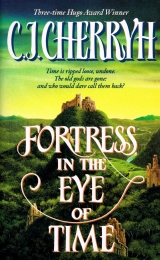
Текст книги "Fortress in the Eye of Time"
Автор книги: C. J. Cherryh
Жанр:
Классическое фэнтези
сообщить о нарушении
Текущая страница: 32 (всего у книги 47 страниц)
“Do you think Emuin is deceiving himself?”
“Not that we have all the truth out of Emuin, nor shall ever have.”
Idrys’ shoulders lifted, as if he had caught a chill, and he looked back. “I told Emuin before he left that he served you ill. He denied it. And I said to m’lord Tristen that if he harmed you I would be his enemy. He knows that. But I foresaw nothing of this bolt toward Althalen, I confess, and I find fault with myself for that—at least for not instructing the guards, who saw only his favor with you.”
“I would I had seen it too. But maybe natural cautions had nothing to do with it. Wizards. Seeing clear to Althalen. —Emuin never told me he could do such things. I never read that they could do such things. Tristen told us the truth. He was feckless toward wizard-secrets, too—and were it not for him I swear I would not believe Emuin now. I’d swear his warnings came of some other source. —And damn him, he ignored my messages.”
“We believe now the dead do walk. Should we stick at this? I greatly fear for our men up by Emwy, m’lord. None of our evening’s messengers have arrived, from any direction. It may simply be the rain. But master Emuin did not want to discuss Althalen. That doubly worries me.”
Men would have gone in search of those missing reports by now, up the road, to find the messengers if the causes were the weather, or a horse gone lame. If they did not meet them they would ride all the way to the borders to find out the conditions and come back again, while a third set of messengers took to the roads outbound. It was a new arrangement he had ordered, precisely to have nightly reports on that uneasy border, and it was already in disarray. He hoped it was initial confusion, some misunderstanding in the orders, possibly the weather, indeed, bridges out, torrents between—such common things, and nothing worse. “Damn him,” he said again. And meant Emuin.
“Master grayfrock is very worried,” Idrys said. “And will not discuss Tristen’s actions. Or Althalen. He drank more than I have ever seen him drink. He did not want to return here. He sees a danger, and he may have named it very honestly tonight.”
“This Hasufin? This dead wizard at Althalen?”
“Lord King, he said it in this chamber tonight, and you didn’t hear him. When he rebuked me with his fears—they regarded Tristen.”
The way ahead was a maze of trees and overgrown walls, forgotten foundations hidden in the dark and the rain, and Tristen dared not set the company to running here. To his eyes, perhaps to the lady’s, the walls and the traces of foundations of this arm of the ruins showed still wanly glowing, the masons’ long-ago defenses yet holding, however weakly, as he led along the old courses of the ruins.
He might have gone faster. It risked losing the men, especially the soldiers, who with their armor weighing on the horses were riding slower and slower, and who could not take another jump. It had become a curious kind of chase, keeping the horses to the fastest pace they could—for despite the misdirection at the height, they could not for an instant trust that their pursuers, Men or otherwise, were not following on guidance better than his and more familiar with these ruins. Hasufin could do such things, and the gray space seethed with Shadows.
Now, nightmare smell, came the faint stench of smoke, and then, between two blinks of rain-blinded eyes, the apparition of fire touching the brush, setting the shadows to leaping. “They’ve fired the brush!” a man said, and the lords drew rein in confusion, refusing to ride further, gathering their men about them.
Whether it was burning in the real world or not, it seemed to Tristen that the tops of real walls did reflect red, that the sky had lightened to gray beneath the spitting clouds, and that firelit stakes lifted figures above the tops of the walls, a ring like a dreadful forest, at which he did not wish to look twice.
With the lady and her men gathered about him—some swearing they smelled smoke and others denying they saw any fire—Lord Haurydd demanded of him in a frightened voice to know the way out, while Tasien called him a liar. “Find the path, sir,” the lady demanded in a thin, high voice, cutting through their confusion. “These are haunts, specters.
The place is known for them. Keep going.”
He urged Petelly away, then, trusting they would follow. Petelly snorted, breathing hard, and of two ways clear he chose the right-hand way, at random in the first choice and then with a clear conviction that it was the right way, the way he had to lead them. A spatter of rain rode the wind into their faces. He blinked water from his eyes, feeling Petelly struggling for footing on wet leaves. A horse slid as they went downhill, and took down another, downed riders and horses struggling to untangle themselves from among the trees and get up. He delayed an instant for their sakes—saw the first horse and rider afoot and then rode, sensing safety so near them.
Uwen, he became sure: Uwen was out there. He didn’t know how far ahead that was, but he tried to press more speed out of Petelly and the riders behind him, fearing they were bringing enemies to Uwen, and were out of strength themselves. Petelly was laboring as they cleared the edge of the ruins, and he flung a glance over his shoulder at the others still following as best they could.
“Hold there!” someone shouted from ahead of them.
He reined in, reaching fearfully into the dark and the gray to know who hailed them as the other riders came in around him. “Who goes?” Tasien shouted.
“King’s business!” a voice called out. “Who goes?”
His heart leapt. He knew that voice. “Uwen, don’t harm them!” he called out on what breath he could gather, and on a second, shouted out loud and clear: “Beware men behind us, Uwen!”
“Hold, hold, hold there!” Uwen’s voice called out. “All of ye, hold!
Let ’em pass! This is m’lord Tristen. I don’t know who them with ’im is-just brace up. We got others comin’ we don’t want!”
Tristen could scarcely see the riders on the hillside for the misting rain—the horses were blowing and panting around him. as he let Petelly move forward. The rain-laden gale blasted along the dell, blew up under the bellies of the horses and startled them, exhausted as they were.
Then a wayward breeze blew soft and warm all about Petelly, at Tristen’s back, at his side, under Petelly’s chin and around again.
The bad men, he heard wafting on the wind. The bad men is coming, the wicked, wicked men. Run, run, run! Mama, run!
It was a child’s voice. Seddiwy’s voice. Child! he cried after her.
But the shadow-shape of a child ran implike back through the company, waving her arms, startling the horses one after another.
After that, what came was dark and angry. The sapling at his right went crack! and broke. Others did, white wounds in the dark thicket.
From the hill and the ruin behind them also came the cracking of brush, then the screams of men overcome by fear. The Elwynim with him looked about them in alarm—but no more trees broke in their vicinity.
The presence—a great many presences—had followed the child, back along their trail. Tristen tried to see them, but they were all darkness in the gray, darkness that walled off all Althalen.
In a moment more there was only the ordinary wind, and the rumble of thunder.
Then a rider was coming down the slope, braving all that was unnatural, and Tristen knew that manner and that posture even in the dark.
“Uwen!”
“M’lord, what is it back there?” Uwen was plainly ready to fight whatever threatened them; and the Elwynim had turned about to face that crashing of brush and the gusting of wind behind them, drawing swords and setting the lady to their backs.
But the enemy who should have overtaken them by now—was up on that hill, where now there was nothing to see but the night and the rain.
“We come chasin’ all about this damn ruin,” Uwen was saying, at his left, breathless, sword in hand as he looked uphill. “Sometimes we was on a path and then again we weren’t, and then, damn! m’lord, but we was smellin’ fire and being rained on at the same time—your pardon.”
Ninévrisé and Tasien had drawn back close to them, Tasien with sword in hand.
“These are your men?” Tasien asked.
“Uwen is mine,” Tristen said. “Who are they, Uwen?”
“Ivanim, m’lord,” Uwen said, “looking for you. Blesset a long chase you run us. I’d draw back, m’lord. It don’t feel good up there.”
It seemed good advice. Even the Elwynim accepted it, and drew away with them up the hill, toward the waiting men.
“M’lord of Ynefel!” a voice came out of that dark, from among shadowy horsemen. “Who is that with you?”
“The lord Regent’s daughter, sir, his heir, three of her lords and—” He looked back, unsure of numbers; there were only a handful of soldiers, no threat to anyone. And the valiant packhorse, that one man led, that had somehow stayed with them. “The lady Regent, her men, half a score of her guard. To see King Cefwyn, sir!”
Tasien shouted toward the hill: “We ask safe conduct for Her Most Honorable Grace, the Regent of Elwynor and her escort, sir: Tasien Earl of Cassissan, His Grace Haurydd Earl of Upper Saissonnd, and His Grace Ysdan of Ormadzaran. The lord of Ynefel has agreed to be our hostage against your King’s safe conduct!”
“Lord Tristen of Ynefel,” the shout came down to them. “What will you?”
The wind was still blowing back on the hill. A new sound had begun in the ruins up there. It sounded as if stones were falling and clattering, as if walls were coming down in the anger of the Shadows—Shadows, he thought, not of the dead of Althalen, but of Emwy—that was where the child had come from. And only the child had guarded them.
“I agree to what he wishes, sir. I think we should go to the road as soon as we can!”
“Gods hope.” The Ivanim rode downhill and met them and Uwen in the dark. “Captain Geisleyn of Toj Embrel, at your service, Your Lordship. How many are there, asking safe conduct?”
“Scarcely fifteen,” the lady said on her own behalf. Lightnings flickered, showing a sheen of wet leather, wet horse, wet metal about all of them. “Captain, please take us to His Majesty of Ylesuin, if he is in Henas’amef. And then we wish ourselves and our men given safe conduct back to the river.”
“Brave lady,” Geisleyn said. “His Majesty himself must say for your return—but on my life, you and yours will reach him without any difficulty.”
“That is agreeable,” Ninévrisé said.
“And if any of Your Lordships,” Geisleyn said then, somewhat sheepishly, “has a notion where the road is, we might all be there the sooner.”
“Follow me,” Tristen said, for he had no doubt at all.
And perhaps, as Uwen said as they rode away in that direction, some wizardry had been acting on Uwen’s side and on his to have gotten them this far and to have brought them together. “We was going one way,”
Uwen put it, “and then we was going another, and we had no idea how, but there you was, m’lord, and, gods! I was glad to see you.”
“I was glad, too,” Tristen said. “I wish I had done better by you, Uwen, I swear I wish so. I knew you would follow me. I didn’t want you to. I’ve treated you very badly.”
“Oh, I knew when ye didn’t come upstairs,” Uwen said, “that you was off somewheres. I just thank the good gods it weren’t the tower.”
“You were entirely right about the tower,” he said with a feeling of cold. “It would have been very foolish to go there. I could not have matched him.”
“Who, m’lord?” He had puzzled Uwen. But it was not an answer he wanted Uwen to deal with, ever.
Uwen said, after they had ridden a distance, “I wish I’d come downstairs sooner.”
“It was very good you came when you did.” He asked himself if he had said that, or thanked Uwen. He could not remember. “I am grateful.
Petelly couldn’t have run further. But, Uwen, be ever so careful when an idea comes into your head to do something you know really is not the safest thing to do. Ideas come to me sometimes, very strongly. I don’t know if they do to you. But I think some ideas come from wizards. And some come from my enemy.”
Uwen made a sign above his heart. It was rare that Uwen did that—or, at least, other men did so more frequently at moments when he discussed things in absolute honesty. “That’s certainly a thought,” Uwen said.
“That is a thought to keep a man awake a’ nights, m’lord.”
“I think it’s wiser not to think a great deal on the tower, at least, or on this place, either. I don’t know if ordinary folk have a gray place they can go to when they think about it, but it’s become very dangerous.”
“A gray place.”
“Do you?”
Uwen scratched his nose. “I guess summat of one if I just shut my eyes.
But it fills up with dreams and such.”
“Mine is shadows,” he said, and Uwen made that sign a second time.
He thought he should not say more to Uwen than he had, or make Uwen wonder about something maybe he never had wondered about before.
And he could not himself answer all those questions—what Shadows were and why they were, except—except he might be one himself, and that was a thought he did not want to pursue.
The old man had wanted to be buried there because it gave him some special power: maybe their moving the stones had made new lines of which the old man was now part—but they had disturbed something else in doing so, and dislodged other bones. He did not know whose, but he hazarded a frightened guess.
–Emuin, he said, touching that grayness. Master Emuin, I’m safe now. We are all safe. I met Uwen and some of Cevulirn’s men. There’s a lady whose picture Cefwyn has, and she will come to see him. I hope that’s not a mistake. Advise me, sir. I do very much need advice.
But no answer came to him, not even that fleeting sense of Emuin’s presence he had had earlier in the day. Toward Althalen he did not wish to venture. Toward Ynefel he least of all wanted to inquire.
At least the Shadows stayed at distance, the ones that belonged to Althalen and the ones that belonged to Emwy, Shadows which, he suspected, down to the witch’s child, had fought for them tonight, for whatever reason.
Chapter 27
Emuin had hangover, abundantly, the natural and just result of a pious life returned suddenly to old habits.
Emuin was, Idrys reported, suffering the prayers of two pious brothers above his bed, and they were brewing a noxious tea.
It served him right, Cefwyn thought. He had, right now, this morning, the departure of the Duke of Murandys to the capital: Murandys had come with his father’s men, had fought at Emwy, and would go back to the capital full of news.
He had, on his desk, the disposition of the Lord Commander of the Dragon Guard. The Prince’s Guard had to guard the heir. That was now Efanor. He would not cede Idrys from his own service, which meant replacing Gwywyn, but he had to consider the morale of the Dragon Guard, which had a strong attachment to its Lord Commander. Promoting Gwywyn to higher office was the apparent answer—but he had to find the right office.
Soon, atop his other worries, delegations from Guelemara were bound to come pouring in, condolences and good wishes from lords offering to give their oaths, as they were obliged to do, and this and that royal secretary with papers to sign—the inevitable flood of petitioners who thought a new reign might give new answers. He had seen his father face it with their grandfather’s death, he braced himself for it, and meanwhile he had the local business to attend. He was already arranging to receive the oaths of the several barons, —counting Orien—who were within daily reach of him, a ceremony which had to be arranged in due formality, with all respect to the color and pageantry that bolstered the dignity of the courtiers as much as that of the King.
But, no, at the moment he did not want to consider the menu for the attendant festivities, or his wardrobe—his Guelen tailor was beside himself, having discovered himself suddenly in charge of a King’s oath-taking for a third of the provinces. Master Rosyn, at the height of his dreams, was obsessed with secrecy and cursing the necessity of dealing with what cloth two very rivalrous and doubtless gossip-prone merchants of Henas’amef had in hand.
He did not count his tailor’s requirements for secrecy quite on a par with the reports that were not coming in from the border. He privately feared there would be no ceremony at all, and that the oath-taking would be on horseback and soon: the account-books on his table now weighed down a set of maps also far more secret than master Rosyn’s forays to the drapers’ shops. The books contained the Aswydds’ reckonings of the armories and the Amefin levies; and, on separate parchments, a small curling pile, were the voluntary but probably far more accurate accounts of the other southern barons detailing their resources. War at least on some scale was all but a foregone conclusion to the building of those bridges, and the death of the Regent (if Emuin’s wizardly knowledge was accurate and Uleman Syrillas was in fact dead and not leading his forces across the river) did not mean peace: it would not affect the Elwynim rebels except to encourage more reckless moves inside and outside Elwynor.
But their fighting each other under such circumstances was a possibility, and he hoped such a war was long and very wearing on them before the victor turned any other direction.
If, in order to gain the advantage of surprise over the Elwynim before they spilled over the river, he went to war immediately, he might face an enemy divided and vulnerable. If he raised an army, however, it meant taking men from the harvest in his own lands, a harvest now in progress and already suffering from the rains—and he would have angry lords and hungry peasants on his hands, especially if later intelligence proved it unnecessary. He had also to consider that there would be no demonstrable gain of land or property from such a war, as he was certain there would not be: they could hold Elwynor out of Amefel, but never hope to take and hold Elwynim territory—while Elwynor could gain a province, if it could peel away Amefel.
The warring earls of Elwynor might unite if he attacked, uneasy and fragile union though it might be. And he himself was a new King, bolstered with the popular expectations of a new reign and vulnerable to those expectations turning very quickly to apprehensions: any early reverse could make the new King of Ylesuin look a fool, not even considering the reasonable anxiousness over Mauryl’s demise, and the shifting of all balance of power in the region—which certainly his barons were considering. In any loss of confidence in him, the barons north and south would have their heads together in two opposing councils making plans to take certain decisions into their own hands, and to assure their own survival.
There was all that at risk in going to war. But if he wagered everything that the Elwynim would not move until spring, and if he acted too late, and could not hold the Elwynim out of his land, they could be defending Henas’amef from siege it was ill-prepared to sustain. The walls of his only walled town in the province were not modern. The inner citadel’s defenses were the only ones up to modern standard, which said a great deal about where Heryn Aswydd regarded his real threats to be, but the outer town defenses were, he had seen from the first hour he rode up on the town, generally too low to protect against the engines he was certain Elwynim engineers were as capable of building as were his own engineers. Modern ballistae would send fire and stones of tremendous weight right over the wall which two generations of Marhanen kings had not seen fit to authorize raised, and which Heryn probably had never asked to raise, preferring to spend the money on his marble floors and his wardrobe.
Two generations of Marhanen kings, however, had not considered as urgent the possibility they would be the besieged inside Henas’amef and not the besiegers outside.
All of which argued to him that Efanor might be right, and that perhaps he should retreat to the capital immediately. But his leaving Amefel would virtually cede a rich and generally willing province to Elwynor:
Amefel had no loyal lord, the earls were divided, and its fall was certain in the absence of a strong royal hand on the reins. If it did fall, in the stead of a deep and treacherous river, Elwynor’s southern frontier with Ylesuin would be a wide land boundary defined by nothing more than a meandering brook—a vast, open approach with well-maintained roads leading right to the heart of Ylesuin and Guelessar itself.
Ceding Amefel, whether by policy or by defeat in war, was not a viable option: Amefel one summer, and an Elwynim army coming right down those well-maintained highroads by the next spring. The Elwynim need not spend any time consolidating their hold on a province the commons of which were of the same customs and religion as themselves, and considering they had both been the heart of the Sihhé holdings only eighty years ago.
He had never conducted a war. Skirmishes, yes; the wide-scale movement of fair-sized forces against bandit chiefs on the edges of Ylesuin ... but no outright war between Ylesuin and another kingdom.
He had the dicta of his grandfather, helpful advice such as: Make the first strike and make the last one; Taking prisoners encourages surrender
(this from the man who had butchered the Sihhé at Althalen); and, lastly, Never outmarch your baggage.
The latter seemed sensible advice. Tents and supper were a reasonable requisite for men who had to keep all Elwynor from pouring across the bridges—who might already, if the silence out of Emwy was an indication, have established themselves in fortified positions across the river.
He had read about fortifications such as the Sihhé of the middle reigns, notably Tashfinen, had built. One could see remnants of them in the ditches all about Amefel.
The earthworks Tashfinen’s Art of War described had been his despair in Emuin’s hard tutelage. Even the copied Guelen version, in the modern alphabet, had not been easy going for a nine-year-old. But it had stayed with him. It was part of him. When he was twelve he and Efanor had dug a miniature of such earthworks in the middle of the herb garden, which had won them severe reprimand: cook’s wife had turned an ankle and fallen very painfully in their siege of the thyme and the goldenseal.
He did not forget the old lessons. There had been no place to use them. Earthworks and rapidly advanced entrenchments ill-suited a bandit war in the stony terrain of the foothills eastward. But defending a valley of villages and farms and a prosperous towns was another matter.
Tashfinen had dug in along the Lenfialim’s lower course in his war, combining mobility behind the fortifications with clever design, reshaping the land itself to make it more convenient for his enemy to do what he wanted his enemies to do. More, Tashfinen, relying, as Sihhé would, only seldom on war engines, and far more on mobility, had still set outlying defenses to make their use against him impossible. He had had no hesitation to attack in winter, at planting or harvest, or any other time inconvenient for the enemy—possible, since the Sihhé of those days had had a large standing army that did not go home on the annual schedule of farmers: it had been hellish famine in the lands where that war was fought, but Tashfinen had kept it out of his own territory, another lesson.
The warfare of the Marhanens had never been so elaborate or so deliberate: Grandfather had been one of Elfwyn’s generals, but, again, King Tashfinen had subdued the whole south when, consequent of a rift in the Sihhé royal house, a claimant to the throne had broken away and fortified himself, as he had thought, invincibly in what was now Imor Lenfialim. Grandfather in his day had faced no such advanced threat or tactical necessity: Grandfather in the wars he had undertaken for the Sihhé had faced nothing but what existed today, a matter of subduing isolated rebels and pacifying the perpetually troublesome Chomaggari border—skirmishes that required mobility over strength, and on which various lords of Men had gained fair reputations of generalship.
Entrenchments had not been the style, not for hundreds of years, not since Tashfinen’s dynasty had dwindled away in foolish grandsons, enabled by Tashfinen’s brilliance to be foolish and to base their court in luxurious, unwalled Althalen. The Art of War bad existed in one known copy, which his grandfather had taken and had copied for his own use along with various other Sihhé works—fortunately not burned by the Quinalt like so much else. It was one of his grandfather’s best acts, the saving of such Sihhé wisdom—granted Grandfather had burned the library at Althalen, not intending the fire, so he claimed.
And if a general taught by some other surviving copy of Tashfinen’s Art of Warwere ordering things on the Elwynim side, it was possible he could look not only for bridge-building across the river at several points, not one, and on the land border a series of incursions to establish fortifications at various points along the frontier, where the enemy would dig in behind steep wall-and-trench formations designed to funnel cavalry into brutal traps; that situation could last for several seasons, the enemy seeming to claim no more than a few hundred paces of territory.
But from those initial castellations, the enemy would extend wall-and-trench-works to the left and right until they formed a formidable earthwork, increasingly difficult to take, and a screen behind which the enemy might shift forces about and arrange surprise excursions into the countryside: then try to dislodge them, or prevent their taking one set of villages, and the next, and the next.
Considering the Sihhé wars, which had been fought on this very land, before, there was indeed a way to attack and hold a territory the size of a kingdom. Barrakkêth had done it first, through wars rarely involving siege; and the halfling Tashfinen, whether by his own genius or by relying on some other work now lost, had repeated Barrakkêth’s feat and written down his tactics.
But Barrakkêth, one of the five true Sihhé, had relied on magic, wizardry, whatever Sihhé truly used, as well as arms, and come down from the Hafsandyr, where Men were, if anything, a distant rumor and where, one supposed, wizards’ towers were common as haystacks—more common, granted there was, by other account, nothing but barren ice to live on, as far as the eye could see, and gods knew what sustained a people there besides magic.
What then, did one do, if one’s opponents could work magic? He had seen in the last two days the efficacy of wizardry at getting messages passed—while his own couriers could not. The whole question was a matter Tashfinen’s book had scanted, though supposedly there had been Sihhé and magic on both sides. And Tashfinen, mortally disappointing for the boy of nine who had expected magic as his reward for pressing on in a very demanding text, had not so much as mentioned it except in reference to Barrakkêth. He wondered why now. He wondered was it forbidden, or simply buried between the lines so matter of factly his eyes could not see it. Did the Sihhi5 put some sort of magical barriers about them? Did they curse their enemies? Was there simply some point of honor about war and wizardry?
There was Tristen. If they could find him, there was Tristen for advantage-if Tristen had any sense of what to do. He could lose abundant sleep on that score.
Worse, he was not in Tashfinen’s position, able to snap his fingers and move an army without destroying his own source of supply: he sat, instead, at the edge of harvest, with winter approaching, in a town vulnerable to siege, with no earthworks to defend it—although that was at least one thing he could change at Henas’amef, if he was willing to sacrifice the three-hundred-year-old orchards and pasture hedges.
But that fortification set him inside entrenchments that were a damned embarrassing trap to be in, a king of Ylesuin sitting still while the Elwynim hammered at him. They had gotten ahead of him with their bridges. He might try to take them down without their using them. But it was a long river, and action at one place might bring action at another-besides that he had limited numbers of men to take away from the fields to create such an elaborate defense.
They would more than lose their harvest for certain if Henas’amef fell.
And, with all disadvantages, the notion of making Henas’amef too tough a nut to crack did tie the Elwynim down to a siege in which they could be under attack from the other provinces, unless they wished to rush past an untaken town to attack Guelemara. That would be a mistake if they did it, exposing their supply lines to attack from Henas’amef.
Fortifying Henas’amef with earthworks would not please the peasantry, of course, nor the lords who derived income from those fertile, long-tilled fields, which in turn thrived on the sweepings of the lordly stables.
But fortifying that outer wall might be an answer to the town’s other defensive faults.
He had the book with him. It was in his small chest of personal items.
He was reading it again, had it under lock and key so as not to have it disappear to the Amefin, and hoped the Elwynim earls did not have a better book. They might. The Quinalt burning of the libraries had not gotten to their side of the river, and gods knew what they had, as gods knew what was sitting in Mauryl’s tower, prey to the mice and Tristen’s fancied enemy.
He wished he could see how magic worked into Tashfinen’s account.
Emuin had professed not to know, except to say the Sihhé had used it-or wizardry, which distinction Emuin had drawn in Tashfinen’s case, and an angry nine-year-old had not paid strictest attention: gods, he’d deserved the stick, and not gotten it at the right times.
He also wished he could believe he had months to prepare. But the system of scouts and post riders he had instituted (lacking magic or a wizard reliably willing to inform him) had been supposed to shuttle back and forth with messages regularly from a watch on every bridgehead on the river, and settling King’s men in way stations or villages, whichever happened to be feasible.