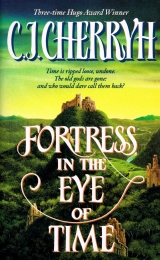
Текст книги "Fortress in the Eye of Time"
Автор книги: C. J. Cherryh
Жанр:
Классическое фэнтези
сообщить о нарушении
Текущая страница: 5 (всего у книги 47 страниц)
The wind breathed in sudden hush between the gusts, sported about the courtyard, whirled among dead leaves that.., for a moment ... showed a dust-formed cloak and cowl.
–Destroy the Shaping, the man of dust said. Do that, my old mentor, and, aye, we might together sleep the sleep. Will that content thee?
Come, take my band, let us kiss like brothers. Destroy him. And we shall sleep in peace.
–Wboreson liar. Worms, I say, worms for your bed, Hasufin, thou braggart, thou frail, mistaken fool I weary of the war. —Lies for lies, thou lord of delusion.
The dust whipped away, stung the face, blinded the eyes. Mauryl flung it back, and Hasufin struck in kind.
The stones, the former inhabitants of Galasien, screamed with all their voices.
Chaos closed around. The thunder of the staff kept rolling, echoing, cracking stone.
Then came silence. Long silence.
Chapter 6
Tristen’s ears still rang. His flesh still was chilled by the wind. But the Shadow had gone, and broken straw prickled against his face and through his shirt and his breeches—prickled until he was, first, aware of lying on the dusty boards, and second, aware that one knee had gone through a second gap in the boards, and third, aware that he still held the Book safe beneath his body.
Holes were everywhere about the roof, letting in large, dusty shafts of sunlight. Pigeons murmured, a handful going about their ordinary business on the rafters and on the central beam which upheld the roof. A quiet breeze stirred through the loft.
The trouble was past, Tristen thought, and dragged himself from his precarious position, gathered his knees under him and sat up, holding the Book against him. Mauryl would be pleased that he had saved it.
Mauryl would have sent the wind away. Mauryl would have held everything safe downstairs ...
But Mauryl would be in no good mood.
He decided he should present himself very quietly downstairs, and straighten up the parchments and blot up the ink before Mauryl saw it and lost his temper. He had had thunders and screams and ragings enough: he wanted to please Mauryl, and he most of all wanted calm and peace and Mauryl’s good humor.
He gathered himself up and crossed the creaking boards, causing a quiet, anxious stir among the pigeons. He dusted himself as he went, raked random straws from his hair, wanting to have no fault Mauryl could possibly find. But when he went out and down the narrow stairs, and down again to the balcony, the light was shining into the hall from holes in the roof of the keep itself, which it had never done, and the balcony he walked had settled to a precarious, twisted tilt among the rafters.
“Mauryl?” he called out, wanting rescue.
But there was not a sound.
“Mauryl? I’m upstairs. Can you hear me?”
Rain would get in, at the next storm, and fall where it never had, on the parchments and the books in Mauryl’s study. They had to do something about that, surely—someone must climb up on the roof.
The balcony settled under him, a jolt, and a groan, sending his heart into his throat. He darted for the stairs, hearing little creaks and groans the while, which wakened other groans and creaks in the rafters.
He went down and down, as quickly as he could. The railing of the stairs shook under his hand, and the creaking boards on Mauryl’s balcony roused a fearsome shriek of settling timbers; the triple stone faces at the turning of his balcony seemed changed, frozen in some new horror-or maybe it was the shadows from the myriad shafts of dusty sunlight that never before had breached the lower hall.
From overhead came another fearful thump and groaning. A roof slate fell past him and smashed on the stones below.
Tristen caught a breath and ran the steps, trailing his free hand down the banisters, clutching the Book in the other. He reached the study, where a chaotic flood of parchments from off the shelves lay crushed under fragments of slate.
Slates had fallen on the table and smashed the overset ink pot. He bent and gathered up an armful of parchments, laid them on the table, then sought more, arranging them in stacks, making them, stiff and of varying sizes as they were, as even-edged as he could.
There was a fearsome jolt. An unused balcony came loose, one of the rickety ones on the far side, where they never walked—it groaned, and distorted itself, and fell in great ruin, taking down other timbers, jolting the masonry and raising a cloud of dust.
“Mauryl?” he called out into the aftermath of that crash. “Mauryl?”
Mauryl should know; Mauryl would not abide it; Mauryl should prevent the timbers falling.
But light fell on him from his right since that crash, and turning his head, he saw a seam of sunlight, saw doors open, or half-open, near him, down the short alcove mostly cluttered with Mauryl’s parchments.
He had never seen those doors ajar—had asked Mauryl once did those doors go anywhere, and Mauryl had said, Doors mostly do.
Anywhere in the world, Mauryl had said, is where doors go.
Another slate crashed on the stones, and another. He ducked under the kitchenward arch for safety as a third and a fourth fell.
Mauryl had never opened that south door, nor let him lift the bar. He had never guessed that sunlight was at the other side.
But the door was thrown from its metal hinges, and the bar was thrown down, one end against the stones, with the sun flooding through the crack—the sun, the enemy of the Shadows.
It seemed safer than where he was. He ventured a dash across the slate-littered floor to the arch of the alcove and, finding the gap almost wide enough to let him out, pushed and scraped his way through.
He stood on low steps in a place he had never seen—a stone courtyard within high walls, and a white stone path which led off at an angle through weeds and vacancy, as far as the gate that—he knew all too well—was the start of the Road that led through the encircling woods, the Road that Mauryl had said he must find and follow.
He had thought Mauryl would go before him. He had hoped Mauryl meant him to follow him when he went away.
And perhaps Mauryl had indeed gone, and expected him to have the wits to know that.
“Mauryl?” he called out to the emptiness around him. Sometimes Mauryl did amazing things, things he never expected, and perhaps, even in this circumstance, Mauryl could speak to him out of the sun or the stones, or give him a stronger hint what he should do next.
Mauryl?-Mauryl?-Mauryl? was all the echoes gave him, his own question back again, the way the walls echoed with the axe.
He could not bear to call aloud again. The courtyard sounded too frighteningly empty.
But the Road was more frightening to him still, and unknown, and he did not want to leave by mistake, too soon: he was prone to mistakes, and it was far too great a matter to risk any misunderstanding at all.
So he sat down on that step in front of the door; he pressed his Book close against him, and told himself that Mauryl was surely still somewhere about, and that it was not time yet for him to go. He should only wait, and be certain.
Mauryl was not, at least, inside; the sun was high, and he was, he said to himself, far safer out here than inside where the roof slates were crashing down, and where the balconies were creaking and falling.
Mauryl could make the balconies stay still if Mauryl were not busy.
Mauryl said that making things do what they did naturally was easy, and surely it was natural that things be the way they had always been.
Pigeons came down and walked about on their own errands, expecting grain, perhaps, but he dared not go in again under the chance of falling slates and cross the study to get it for them, not until the slates stopped coming down, or until Mauryl turned up to make everything right again—which he wished most of all.
“Please,” he said faintly. “Mauryl? Mauryl, please hear me?”
It was the same as in his room, when the fear came. And no, Mauryl did not always arrive at the moment one would wish. Mauryl did not have every answer; Mauryl had tasks to do that a boy could not understand, and Mauryl’s silence could well mean that Mauryl was busy.
There had been a danger, but Mauryl had overcome it, and Mauryl would pay attention to him as soon Mauryl found the time. He should wait patiently and not take hasty action, that was what Mauryl would advise him.
So he sat on the low steps, and he sat, and he sat, until the sun was behind the far tower and the shadow of that tower touched the courtyard.
While he sat, he tried earnestly, fervently, to read his Book, telling himself that now, perhaps, once the moment called for it, Words might come to him and show him everything Mauryl had wanted of him in his command to read this Book, things which would prevent Mauryl going on the Road, and which would prevent his having to go, as well.
But hours passed in his efforts, and in his fear. The shadow of the walls joined the shadow of the tower and grew long across the courtyard stones.
At last the shadow touched the walls, complete across the courtyard, and he knew that on any ordinary day he should be inside and off the parapets and out of the courtyard by now. He was thinking that when the wind suddenly picked up, skirled up the dead leaves from a corner of the wall, and those leaves rose higher and higher, dancing down the paving stones toward the tower.
And back again. That was odd for a wind to do. It was a chill wind as it touched him. The pigeons, while he read, had deserted the courtyard stones, seeking their towers for the night. The shadows, while he read, had come into nooks where no shadows had been at noon. The faces in the stone walls seemed more ambiguous, more ghostly and more dubious than they appeared by day.
Be certain, Mauryl had always said, that the shutters and the doors are bolted every night.
Be afraid of the dark. When the sky shadows, be under stone and have the shutters closed and the doors well shut. Have I not said this before?
He shivered, with the Book folded in his hands, his hands between his knees as the wind danced back again. He looked up at the color stealing across the sky. The faces set in the walls changed their expressions with the passage of shadow. Now they seemed to look down in horror.
He looked up at the walls above his head—and saw Mauryl’s face above him, stone like the others, wide-mouthed and angry.
He stumbled off the middle step, fell on the bottom one and picked himself up, staring at the face in horrid surmise—backed farther and farther across the courtyard stones, with Mauryl’s face among the stone faces he had seen in the walls from the beginning of his existence here, wide-mouthed and wide-eyed as if Mauryl could at any moment scream in anger or in terror, either one.
“Mauryl?” he said faintly, and somewhere within the hall timbers fell with a horrific crash and splintering. Another balcony, he thought.
“Mauryl?” he cried aloud, daring not admit he still could not read the
Book. There must be an exception. There must be a way out. “Mauryl, what shall I do, Mauryl? Please tell me what to do!”
He heard slates fall inside, a lighter, sharper-edged ruin.
A cold skirl of wind went past him.
An immense mass of something crashed inside and knocked the door shut, as if someone had slammed it in his face. He stared in shock, terrified.
He had no recollection, then, of turning away, except he was walking toward the gate. Reaching it, he tried not the heavy bar but the lesser one, which closed a gate within the gate; that was enough to let him out.
He shut it once he was through, and asked himself foolishly how he should bar it, and then—against what should he bar it? and protecting what? Mauryl had set great importance on locking and latching doors, but it was far beyond his ability to seal this one against harm. He turned and faced the bridge and the river, and the forest beyond it, already shadowing toward dark—and could only set out walking on the Road. Go where you see to go, Mauryl had said. Take the Road that offers itself.
And he did, over the rotten boards and stonework of the Bridge that spanned the river Lenfialim.
The water was dark beneath the gaps over which he walked, clinging fearfully to the stones along the edge of the high-arched bridge. The river looked murky green in the deep shadow and made patterns on its surface, swirls and ripples which on another day might tempt him to linger and wonder; but haste and dread overwhelmed all curiosity in him-haste—clinging to an ancient, crumbling stone railing, and with old mortar sifting from under his feet. If he should fall, he said to himself, he would slip beneath that surface, where it must be as cold and as dark as the rain barrel or the cistern, and where all that Mauryl had done with him and all that Mauryl had told him would come to nothing: he could not be so foolish.
A moaning sounded behind him, as if the gate had opened. He cast a look over his shoulder and saw it still shut. It might be the wind keening through some board up in the towers—if there were a wind, which there was not. He looked about again just as a stone left the railing ahead of him and dropped from the Road, for no cause that he could tell. It splashed into the water, making a plume, and it was gone, as he himself might be, without a trace, should the road give way.
He hurried feverishly, then, holding to the stones, and heard another fall of stones behind him: one, two, three splashes. He dared not waste a moment to look. It was the solid ground ahead that beckoned him, a shadowed shore where the Road went over safe earth, under deep-rooted trees, and his feet were very glad to feel that solidity under them as he left the bridge behind.
The moaning came to the trees then, making them toss their heads and whisper around him in a rush of sound he had never heard the forest make even in storm. Chill came with that wind, as leaves and fine grit went flying around him, stinging his eyes. The wind shouted aroun6 him, until twigs and then small branches flew like leaves. The whole forest seemed to shiver, and then– Then it grew very quiet, no leaf stirring—a dank and breathless air as frightening in its lifelessness as all the previous fury of the wind. He hesitated to move at all, and when he hesitated, it seemed more difficult than before simply to move, or breathe, as if some soundless Word bade him stand still, and wait, and wait.
But, heart in his throat, he obeyed Mauryl. It seemed more important than ever to honor Mauryl’s instruction, in the failing of all substantial refuges he knew. Dark was gathering in this dank hush, a convocation of Shadows that as yet had done him no harm, but he had no defense against them here, no stone to shelter him, no Mauryl to send them away, no light against the coming dark.
–Tristen, the Shadows mocked him, calling his name in tones that Mauryl might use. But Mauryl had never trusted them and he refused.
He walked not because he knew where he was going but because that was what Mauryl had said to do. No harm had yet come to him doing what Mauryl said.
A shape glided after him, dark and silent. He felt it pass near. But when he looked straight at it, he saw nothing.
Shadows were like that, treacherous and evasive of the eye. But there was no Mauryl tonight to set a seal on his sleep, and no door, and no bed, no supper, no cup, and no means of having one—forever, so far as he knew.
The Road appeared and disappeared by turns in the dark. It seemed to meander aimlessly, but, Tristen thought, he had nowhere to go, except as his Road led him; it seemed to have no reason for itself, but then, he had none, so that seemed apt. If he had the wish of his heart all through the weary night it would be only to go back to Mauryl, and to have his room and his supper and to do forever what Mauryl told him—but it was not his wishes things obeyed, it was Mauryl’s; and without Mauryl, he had to take what came to him and do as wisely as he could.
If, he thought, if he could have read the Book Mauryl had given him, he might have prevented the ruin that had taken Mauryl from him. But he had not been able. Mauryl had known his inability. He was certain now that Mauryl had always known that he would fail in that most important task, and he was certain that that had always been Mauryl’s unhappiness with him—for Mauryl had been unhappy. He had sensed, quite strongly at times, Mauryl’s unhappiness and dissatisfaction in his mistakes, and, latest of all, Mauryl’s despair and Mauryl’s acceptance of his shortcomings. He should have been more able, he should have been quicker to understand, he should have understood Mauryl’s lessons and done better. But he had not been good enough. Follow the Road, Mauryl had said.
But Mauryl had also warned him to be under stone when the sun set, and as this one set and the world went gray, he saw no stone to be under.
Mauryl had said avoid the Shadows, but he walked through constant shadow, and darker shadow—limped, finally, in a darkness deeper than any the fortress had held except in its blackest depths.
He was bruised through his thin shoes. His right ankle ached, and he had not remembered exactly where that pain had started, until he recalled his flight off the steps, and his fall off the edge of the step. Body as well as spirit, Mauryl had warned him, and the very hour that Mauryl had left him on his own in the keep, he had forgotten the first lesson he had ever learned, and fallen and done himself harm, exactly as Mauryl had warned him not to do.
He walked and walked, unhappy with himself, following the ancient stonework until the trees grew so close he could no longer find the next white stone to guide him.
So he had made another mistake. He had lost the Road. He was afraid, standing alone in the dark and trying to know what to do in this place where the path ran out. But it seemed to him that, if there were no white stones, still a long track stretched ahead clear of trees, and that seemed indisputably the right direction to go.
And, true enough, when he had gone quite far on that treeless track he saw something in the starlight that he deluded himself was another of the white stones.
His heart rose. He went toward it as proof that he had solved the dilemma.
But it was only a broken tree, white inside, ragged ends of wood showing pale in the night.
Then he was truly frightened, and when he looked about him he saw nothing even to tell him which way he had come. He might have made, he thought, the worst mistake of all the mistakes he had ever made and lost the Road once for all, Mauryl’s last, Mauryl’s most final instruction– beyond which he had no idea in the world what to do.
At that moment a shadow brushed his cheek, substantial enough to scare him. It settled on a branch of that dead tree, hunched up its shoulders and waited.
“Owl?” Tristen said. “Owl, is it you?”
Owl, a sullen bird, only spread his wings and ruffled his feathers with a sound very loud in the hush of the woods.
“Do you know the way?” Tristen asked him, but Owl did nothing.
“Have you come on the same Road?” Tristen asked then, since they came from the same place perhaps at the same moment, and Mauryl had set great importance on his being here. “Did Mauryl tell you to come?”
Owl gave no sign of understanding.
He had never trusted Owl. He had never been certain but what the smallest birds disappeared down Owl’s gullet, and he was all but certain about the mice.
But he felt gladder than he had ever thought he should be of Owl’s presence, simply because Owl was a living creature as well as a Shadow, and because Owl was a force whose behavior he knew—and because he was despondent and lost.
“Do you know where the Road is?” he asked Owl.
Owl spread his wide blunt wings and, Shadow that he was, flew through the darkness to another tree and perched there. Waiting, Tristen thought, and he followed Owl in desperate hope that Owl knew where he was going. Owl flew on again, which he also followed. A third time Owl took wing, and by now he had no hope else but Owl, because he had no notion as he looked back where he had come from, or where his last memory of the Road might lie.
Owl kept flying in short hops from tree to tree, never leaving his sight—and by now he feared that he might have done something Mauryl would never have approved, and trusted a bird that Mauryl had never told him was acceptable to trust. One of the pigeons he might have relied upon, never questioning its character or its intentions; but Owl was the chanciest of creatures he knew, and he knew no reason Owl should go to such great difficulty to guide him to the Road. Certainly he would have helped Owl. That was a point: creatures should help one another, and perhaps Owl was constrained once there was such calamity.
He had never apprehended Owl to have great patience with him. He knew no reason Owl should not lead him far astray and then fly away from him. But Mauryl was often peevish himself, and yet Mauryl had never failed him or done him harm.
So he kept tracking Owl’s flights through the woods, fending branches aside, scratching himself and snagging his clothing on thorns and twigs all the while. His ankle hurt. His hands hurt. Owl traveled farther at each flight now, and sometimes left his sight. He struggled to keep up and called out, “Owl! Wait! I’m not so fast as you!” but Owl only took that for encouragement to make his next flight through a low spot filled with water and to lure him up a muddy bank.
He was altogether out of breath now. “Owl, wait,” he called out.
“Please wait!”
Owl flitted on.
He tried to run, and caught his foot on a stone in the tangle of brush and fell to his knees, bruising them and his hands and sticking his left palm with thorns.
But the stone on which he had fallen was pale, a tilted, half-buried paving of the Road, and he sat there catching his breath, seeing other stones before him.
“Who?” he heard a strange voice calling. “To-who?” He had never heard Owl’s voice, but something said to him that that was indeed Owl speaking his question into the night.
And it struck him that it was like Mauryl’s questions, and that he had no answer, since the world was far wider and the Road was far longer than he had ever imagined.
“Come back,” he said to Owl, rising to his feet. He tried to follow Owl further, but Owl left the pale trace that was the Road, and he gave up the chase, out of breath and sweating in the clammy night air.
But he could have no complaint of Owl. He kept walking, comforted that he was not alone in the woods, and hearing from time to time Owl’s lonely question.
In the black, branch-woven sameness of the woods, the Road seemed finally to acquire a faint glow in the night, a glow against which Tristen could see the detail of branches in contrast. And slowly thereafter the whole world of black branches and pale stone Road widened around him until, looking up, he could tell the shadow of the trees from the gray sky.
It was the dawn creeping through, not with a bright breaking of the sun, but a stealthy, furtive dawn that took a long, long time to insinuate itself into the black and gray of the woods. He might not have made any progress at all. Nothing looked different from where he had lost the light.
He had walked the night through without resting, and he supposed that since he had somehow reached the dawn unharmed he had done something difficult that Mauryl would approve, but he felt no comfort in his situation. He was very thirsty, there was no breakfast, he was bruised from his falls, and he missed Mauryl’s advice and asked himself whether Mauryl had ever given any hint, any remote hint if, after Mauryl had gone away, he might ever find him again—because without Mauryl, he had no idea what to do next, or what he should be thinking of doing.
Use your wits, Mauryl was wont to say, but one had to know on what question to use one’s wits in the first place—like wondering how long his ankle and his knees would hurt when there was no Mauryl to make the pain stop, and wondering how long and how far the Road went, and wondering where Owl was and why Owl had followed him, out of all the birds he liked far better.
His thinking had become merely a spate of like questions with nothing to suggest the answers, and long as he walked, the sights around him never changed, one tree being very much like another to his opinion.
Sitting down, which he did when his legs were utterly exhausted, offered him only time to think up more questions, so he proceeded slowly and steadily, in pain that was more persistent than acute, pain that might, for what he knew, go on forever, as the Road might—in his worst imaginings.
But after a measureless time he found a little trickle of water running down from rocks beneath the roots of trees, at the side of the Road, a trickle that ran away and lost itself beneath a layer of leaves, but where it emerged from the rocks it was bright and clear.
And the mere fact it existed made this a Place, not just a part of the endless Road. It was not more trees and more Road; it existed as a difference in his condition, it offered relief from thirst, and he bent down by it and drank—then washed his face and his hands to the elbows and then his head and hair in the good, clear water, not caring that it chilled him through. He scrubbed and scrubbed until he began to shiver in the light breeze that blew, because Mauryl had taught him to love being clean.
He knew a Place along the Road, then, that offered him water, if he began to be desperate—clean water, as pure as that from the cistern at Ynefel, and it occurred to him that he could stay by it and not be thirsty today; at the very least, he could sit for a while and rest. He could let his head down against the mossy stones. He could shut his eyes a moment in the sunlight, knowing he could drink again any time he wished.
He found a dark gray nothing behind his eyelids. It shadowed with wings like the wings of his birds, quiet, dizzy movements, like their gliding in the sky, and he rode that for a precious few moments, content to be rocked in it, absorbed in it.
“Owl?” he asked then of that vision, remembering that Owl had followed him; and he saw the loft again, but they were only silly pigeons that came and went, and their voices lulled him deeper into sleep.
How strange, he thought, to dream of falling asleep. That was twice asleep. And very, very deep this sleep within a sleep seemed to be, layer upon layer of it folding him over like thick quilts on a chill night.
He looked for Mauryl in the grayness of the loft, then. He looked for Mauryl, but he saw only birds walking to and fro. He saw only dust on the boards, and there was a gap in the boards of the dividing wall that the storm had made, toward which he knew he ought not to look. He did not know why he ought not now, when he had ventured to explore the other side of that gap back at Ynefel. But it seemed to him that the gap in that barrier was a source of dreadful harm.
He hid in the loft, instead, and something came searching for him, something he could not put a shape to, or understand. He thought it was a Shadow. He tucked himself deep within the nook he had found between the rafters and hoped for it to go away.
It brushed by him. It came back again. It seemed he was not in the loft at all, but lying on moss-covered stone, among the leaves, and for some reason a deep leaf-shadow was on him, protecting him from the presence that paced along the Road. Looking for him, it was, he thought. He did not know what else it might be looking for.
The Book burned the skin of his waist where he had tucked it, as that presence paused beside his broad daylight hiding-place. It was not at all the loft now that sheltered him, and it was not the birds coming to and fro that made that strange sound, it was a patter of rain drops falling on the forest’s discarded leaves.
And in the awareness of that sound the presence he had felt so strongly had ceased to be there.
Something loomed above him instead, spreading wings between him and the sky. It was Owl, out by daylight, perched on a leafless branch and peering fiercely off into the distances up the Road as Owl would do—Owl suspected things, and he seemed to suspect this one intensely.
“What do you see, Owl?” he asked, awake, as he thought, with his heart beating harder than a dream warranted. “What was it?”
But Owl flew off down the Road with a sudden snap of his wings and gave him not a second glance.
He was still afraid, then—of what, he had no idea, but the Place no longer seemed safe. Neither did the Road behind him, now that Owl had fled it in such haste. But he gathered himself up immediately and set out walking, following Owl.
The notion of danger behind him in the endless woods—and the notion of Ynefel also lying behind him and at the heart of the woods—was a new thought to him: the Road had at least one end, and he had come from there. The water was a Place. So he began to form in his mind then the notion that the Road might equally well go to Places, as doors did, and that to must be at least as important as from.
Then he thought that tomorrow or this evening must at least be at least as substantial as yesterday—and that tomorrow and toward a yet-to-find Place was where Mauryl had wanted him to go. Owl had gone, showing him the way in great urgency.
So there was somewhere to be, and somewhere to have been, and somewhere yet urgently to go, which Mauryl had assigned him. And his slowness had made him almost fall into the Shadow. It was another mistake to have delayed at all to rest—a mistake to have been wandering as much as walking, not knowing he had a place to be, not, he had to admit to himself, really wanting to follow Mauryl’s instruction, not wanting to be anywhere but Ynefel, because he had conceived of nowhere else despite the Names that Mauryl had told him. Of course there were other Places. Mauryl had tried to tell him, but like rain off the shingles, it had slid right off his mind, as everyday sights did, until the Word was ready to come. Or—and this one had done that—a Word would come partway, and he would go on attaching more and more pieces of it all day or for days after, until a new and startling idea came to him with all its various pieces attached.