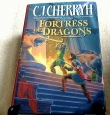
Текст книги "Fortress in the Eye of Time"
Автор книги: C. J. Cherryh
Жанр:
Классическое фэнтези
сообщить о нарушении
Текущая страница: 37 (всего у книги 47 страниц)
“Brother,” he said, to Efanor, in the first row of standing nobles, and invited him to the same place, which his father had not done with his own brother, but he did.
Then, taking that one step higher, he turned and looked over the assembled barons and household.
Orien was, indeed, not there. One assumed that Lady Often still claimed her lordship over Amefel, but as she had not answered the general summons, they need not have the protests when he barred her at the doors, as, damn it, he would do. She might have attended in good grace last night and possibly, by a gracious show, won a step toward a royal pardon. She might have done many things besides what Idrys had reported to him she had done, and his tolerance of Orien Aswydd and all her kin was balanced on a knife’s edge this morning. He was very close to ordering her arrest before they left this hall.
Idrys had brought down the requisite, unmarked, maps. The servants had provided tables at the side of the hall, adequate to spread them out for general view. Everything was in its place. Everything was in order.
“My lords,” he said, receiving the bleary-eyed silence and courteous attention of the company. “Lords of the Elwynim, your plan to fortify a camp at Emwy Bridge has our agreement, and as some of you are aware, I have already set men and wagons moving with supplies, counting that you can quickly overtake them on horseback, today, as I believe is my lady’s wish.”
Ninévrisé inclined her head. “Just so, my lords.”
“Also,” Cefwyn said, “I am requesting those forces of the Dragon Guard which came to this town in my late father’s company stay with me, as well as the Prince’s Guard; I require that official messages now return to the heart of Ylesuin with orders for the movement of supply and the disposition of forces all along our northern border with Elwynor, as a precaution against an incursion taking an unexpected route. Also, far from least of my concerns, I am issuing orders for the arrangement of civil matters in the capital. The news of my royal father’s assassination has undoubtedly reached the city by now, and I do not wish the court convening here at this time, for reasons I shall make clear. I have had documents drawn up which provide for the transfer of authority in the capital, and I am maintaining all my father’s appointed councilors and officers pending a review of records.”
No one looked away from the King while he was speaking except the King’s guard. He saw Efanor’s face relatively complacent: a very lengthy missive had arrived at Efanor’s door this morning—he had trod all around the edges of Efanor’s religious sensibilities and superstitious fears, and wished him to stay at Henas’amef at least for two more months, until they could establish a sustained effort against Aséyneddin and secure the border. Leaving the capital without a head was one sort of risk. Leaving it to Efanor, with Efanor’s weakness toward religious appeals, was another. Idrys had urged that such was the case, and while the realm would carry on very well and stably in the care of old Lord Brysaulin, who though elderly and feeble was an iron-willed administrator, the realm would be in danger in the to-do surrounding a younger and obsessively religious prince unexpectedly turned up as caretaker of the realm, overturning Brysaulin’s sensible decrees—which had never favored the Quinalt.
Disturb nothing that his father had set in place until it was time to take hold of it and shake it mightily, that was what he had determined: the roads to the capital were good enough—the winter would not greatly discommode them from travel to the capital once the wedding was a fact the Quinalt would have to live with, and by then– By then he would have the border matter at least at a state he dared leave to Idrys and Cevulirn.
“Meanwhile,” he continued, “the greatest change in my plans—precludes my waiting for the oath-taking of the northern barons before I pursue matters against this incursion on our frontiers. I had wished to have the winter to prepare. We are not to have that grace, I much fear, and while I had asked you, sirs, to remain here at disadvantage to your domestic affairs, I must now prepare differently. I took the crown on the field without ceremony. I have entered into agreements with the Regent of Elwynor. I have done many things—” For a moment he lost his thoughts and his breath at once. But the next breath brought the next line back. “—many things unanticipated. As King holding power from the gods I swear to them due observance and reverence, and am prepared to swear so. So I shall swear to you. So I ask you to give oaths of homage, first of all the provinces, and of fealty for yourselves as I am prepared to swear, without ceremony such as the capital could provide, so that when you part from this company of brothers and friends you will have the assurance of me, as I require of you.”
There were looks, shaking of heads in amazement, a little muttering from Sovrag’s lieutenants, who, with war pressing on the border, and-which they did not necessarily know—with Ynefel increasingly perilous, could not get their boats safely home. He could not permit the attempt.
He had other use for those boats.
Emuin came, in his immaculate gray: his personal—Teranthine-priest, well-known to the court, now counselor to the King, bearing the battle-crown, and presenting it.
Then he could let go his careful grip on the things he had to say: then it was for Emuin to remember, and Emuin to deal with while he answered yes and I swear, and had the crown in his hand and in Emuin’s.
The hall was very quiet. No one so much as coughed, the lords surely wondering by now why they had not been advised and where the trap might lie. There were the solemn bows and the oaths the Teranthine rite required. There was the setting of the crown on his head, the religiously valid coronation, which would hold valid against all claims until his death, and which settled any remote challenge to his kingship.
He called his brother first; Efanor knelt and swore the simple oath as he swore his to Efanor, confirming him as heir, in terms he had advised Efanor, against the getting of an heir of his own body. Then the officers of his household, the Marhanen custom; and third the barons, in the order their houses had sworn to his grandfather, first Pelumer, and then Cevulirn, in their true sequence. Third of ducal houses present was Umanon’s, then Sulriggan’s, and, far down the ordinary precedence of history, Sovrag, who, after swearing to defend the King and to be his friend, to preserve the life, the person and the honor of his sovereign, and receiving the customary vow of his sovereign to defend his life, his person, and his honor, asked if he could add the decks of his boats to his domains.
He could all but see Duke Umanon, with a port Sovrag used, gathering wind for a storm of protest: he knew the dispute on which the old pirate based his request, and the King did not grant it. “No,” he said pleasantly, and gave Sovrag his hand to kiss.
“Don’t hurt to try,” Sovrag said.
“I need a brave man, riverlord. I hold you are that.”
“Then we talk?” Sovrag asked.
“Swear and give me your hands, riverlord. I’ll repair your boats. Or build you new ones. And hold you dear as a friend.”
Sovrag gave him a look as sober as any he had had of Sovrag. He might have touched the man. “Aye,” Sovrag said in a husky voice, “aye, Majesty.” And kissed his hand with a grip fit to break it.
“Tristen Lord Warden of Ynefel,” the next proclamation was, as Sovrag went down the steps. “Lord High Marshal of Althalen.”
There was a murmur then. And he could feel the anxiousness arising among the Elwynim. But of Tristen he asked and gave only the oath of fealty, and set its term from harvest-time to harvest-time. “Annually to be renewed, an oath of friends, to save each other’s life, limbs, rights and honor, before the blessed gods and by their favor.” He lifted Tristen up and, embracing him, said against his ear, “Say, Before the blessed gods, and say it so they hear.”
“Before the blessed gods, Your Majesty,” Tristen said, and added, in his own way but with a straightforward look as clear and as knowing as ever he had heard from Tristen, “I am your friend.”
Thank the aforesaid gods he said nothing else. Cefwyn could see the clenched jaw of Efanor’s priest, and Efanor’s hand tightly clenched on a prayer-book.
No one knew what oath had existed between Mauryl and his grandfather. There had been no witnesses, no priest, nothing holy. The barons were surely asking themselves where Tristen ranked in relation to lords grown old in service to Ylesuin: the Warden of Ynefel had never been at court, nor ever fit within the protocols.
Cefwyn embraced him a second time. “Thank you,” he said into Tristen’s ear, and released him.
After that, Ninévrisé in brief and in her own as Regent: “Before the gods, to bear true friendship to the land and people and the Crown of Ylesuin.”
Then he dared breathe. No one had refused their oath, no one had protested, and Lord Tasien through Ninévrisé was bound. “My faithful friends,” he said, and added, “truly first, as your houses were to the first of my line. I shall not forget who stood here, and who swore.”
“No one is here to swear for Amefel,” Cevulirn pointed out, “Your Majesty.”
“For Amefel we do as we can,” Cefwyn said under his breath. And more loudly: “Gentle lords, I shall swear for Amefel, under Ylesuin’s law.
Under my wardship Her Grace Duchess Orien holds the province. For one thing, we shall fortify all the bridgeheads leading to Amefel, since I take Amefel for Aséyneddin’s immediate desire, rather than to attack the northern border, which would be exceedingly foolhardy. As6yneddin, on my best information, believes that he can peel away Amefel easily and present Ylesuin a land-bound border directly fronting Guelessar. He thinks that Amefel will defect to him as lord. I think not. He thinks we dare not arm the Amefin. I think not. We shall fortify all along the river to protect Amefin villages from Aséyneddin’s threats. Her Most Honorable Grace the lady Regent will herself send to those villages jointly with me, urging them to stand fast against Aséyneddin. Those messengers go today.” The politics of that joint appeal were an embarrassing fact Ylesuin was not wont to admit, one that brought mouths open and lords ready to speak, but he plunged ahead.
“We have already sent men and supplies for the fortifications; and Lord Haurydd has, by now, in company with Lord Sovrag’s nephews, entered Elwynor, to reach forces loyal to the lady Ninévrisé and defeat the rebel Aséyneddin, so that the lady Regent’s loyal men may set her in authority at Ilefinian.”
That was a careful treading through a maze of prickly jealousies: he carefully skirted any statement that credited or rewarded Ylesuin in saving the Elwynim Regency, as if fifteen men with no more than their horses and their swords were going to accomplish that. There was a murmur of dismay, even indignation, among his own barons, but he refused to acknowledge it. “Lord Tasien will command the Elwynim fortification at Emwy, which we will supply. I ask that you delegate captains, my lords of Ylesuin, to command the extension of fortifications along the river, which these captains will build according to a design I shall give you.”
Part of those instructions involved the last-moment destruction of the bridge decks on two bridges north of Emwy. But he reserved that for Sovrag, personally.
“And instead of holding you here idle, I dismiss you now to attend matters of need in your own provinces, to return on the next full of the moon prepared to launch war against Aséyneddin. If there is an incursion sooner than that, I shall notify you to move on the instant, so you must have men ready to muster to a forced march to reach us. Leave all your baggage here, wagons, teams and drivers. We will bring them in our train. If I must call you before the appointed time, you will need all the speed you can make. I do not doubt that Lord Aséyneddin will take very hard my betrothal to the Regent of Elwynor when he hears it. We should be ready to defend all along the frontier. I do not think his attack will wait until spring. But I do not think it will be immediate: he has yet to subdue Elwynor’s loyal men. He cannot move against us until he assembles sufficient force from various points in Elwynor where he is holding districts who would otherwise be loyal to the Regency. If he moves those troops out of those regions they now hold by such force and terror, they may attack at his rear. It is my earnest hope—though one on which I do not heavily rely—that a strong enough presence threatening that important bridge may distract his forces from regions of Elwynor uneasily in his grip, and encourage the loyal men of Elwynor to remove him. But if he crosses this border—as he may—at whatever point he crosses—he will face an army prepared to fight him in any season, and he will face the justice of our ally the lawful Regent.”
There was silence. Even Sovrag, who had his nephews off with Haurydd, and who had no water-route home but through Marna, had not been advised in advance of the full scope of what that night mission meant; and for the first time in recent memory it seemed not even the whisper had gotten out to the staff of exactly what he would ask. The barons were surprised, they were taking it with sober faces and likely a clear realization that they were, indeed, counting the inclusion of the Elwynim Regent against Aséyneddin, facing all-out war—costly, dangerous, and without a conquest of Elwynim towns and fields at the end of it.
“No,” said Tristen suddenly. “Please. I have to speak, my lord King.”
“Lord Tristen,” Cefwyn said, feeling the whole matter lurch perilously sideways. He sought to catch Tristen’s eye, and failed. “We have another matter before us. Wait. I will hear you later.” “My lord King, I know I—”
“Wait, I say.” His voice came out harshly. He took a step and the leg shot fire. “Privately, Tristen.”
“I cannot!” Tristen said. “You said I should tell you what I know. And I do know, sir.” Tristen crossed the hall, reached out his hand to the map centermost on the table and laid his forefinger on what, to Cefwyn’s distant observation, appeared to be the district of Arys-Emwy. “This is what must be stopped. There is the danger. He will not go to the east, not to these other two bridges, because he wants to draw you west and north, near Marna.” Tristen’s face was pale and glistening with sweat, and Cefwyn found fear closing like a fist about his heart, fear that Tristen was, Emuin had said it, hearing things ordinary men did not.
“And he will come,” Tristen said. “He will not wait until spring-because you are threatening him, and he will not let you grow stronger.”
He, Tristen said. And they must all think he spoke of Aséyneddin—all who did not know better. But he did know, and felt everything, all the affairs of his kingdom and his reign, slipping into ruin on a wizard’s purpose.
“The plan is made,” Efanor said, “and you should leave this to military men, lord of Ynefel.”
Tristen’s gray eyes went vague for a moment, and he turned his head and stared at the other lords, one by one as if acquainting himself with them deeply. Lastly his gaze fell on Efanor, Cefwyn could see it, with that naked quality that made it hard to endure.
“How can I tell you?” The voice was scarcely louder than a breath. “I see it. Here, here by Marna Wood is a narrow place. Spread this Shadow wide over the land and there are no more places where you may hold it.”
His hand moved over the wide frontiers of Amefel. “You must make this fortification so he will go past and straight onto the plain here. There will be no more chances to stop it. If he turns you back, you will fall as Ynefel fell. Everyone will die.”
“He is Sihhé,” Pelumer said at last. “I no longer doubt it. But let me ask, aside from the oaths we have all sworn, how he is disposed to us.”
Tristen looked about at all of them. “! know all your lands but Olmern,” he said in that hushed, strange voice. And indeed, Cefwyn realized with a chill, Olmern alone of all districts of Ylesuin was younger than a hundred years. Most had been independent kingdoms. “Yet I don’t know how I am disposed toward any of you,” Tristen said. “I have knowledge of the devices you wear. I know names, but—they are not your names. I only know that you must stop him here, by Emwy.”
“One asks,” said Lord Sulriggan’s cutting voice, “where your loyalties are disposed, sir. With these Elwynim? Or with Ylesuin?”
“At Emwy it will not matter how I am disposed to you. Cefwyn says that I am Sihhé, but Mauryl is all my memory. Cefwyn says that the Marhanen murdered me, but I know nothing of that, since I am clearly alive. I am Cefwyn’s friend. If you are his friends, you are mine. If you wish otherwise, still I wish that you were my friends. And that is not important, either. Your going to the river, here, is. There is an enemy all your plans are forgetting. And he is my enemy, and Aséyneddin listens to him. The lord Regent knew. I think the Elwynim know. I am certain that Aséyneddin knows.”
Efanor said not a thing, only made a sign against evil. As did his priest.
But Tasien: “It is at Althalen. It killed, there. It killed our lord.”
“Halfwit he may be,” muttered Cevulirn, “or mad, —or unnatural as the rumor is ... but the further it spreads, and bordering Marna, the worse it is. We of Ivanor know whereof he speaks. As does Lanfarnesse.
A wide battle is worse than a narrow one, if our task is to hold anything of that sort.”
“We may move the army to that quarter,” said Umanon, “and find no enemy; and then we shall have twice the difficulty. There is a certain danger in moving too soon—or committing force to one area. I agree with His Majesty. If we commit up there, Aséyneddin will immediately strike where we have no presence.”
“More danger in acting too late, where they do have one,” said Sovrag. “I’ve got cousins on boats, holding the river near them bridges, with Marna twixt them and home, and I don’t see no Imormen in danger.
I don’t trust may be and might wi’ my men, m’lord King, they’re damn poor whores, might and maybe. I’m for putting an army up there, damn fast. Hell with the harvest.”
“You may wish to hell with the harvest,” Umanon said. “Those of us who obtain our honest revenues from the land think otherwise, sir. As happens, I should be concerned, did the general council defer action; but we all have concern for that border—as well as for what flows out of Marna. But if units from Ivanor come in with that dust and to-do, and the Amefin on the riverside are roused, what enemy there is may melt away and strike gods know where and when. There are clearly Elwynim on this side, of ill intent.”
“Caswyddian of Saissond,” said Lord Tasien, “is no longer to fear. He is dead.”
“There are Elwynim rangers,” said Ninévrisé, “who doubtless are on this side of the river. But most do not serve him and none of them fight in the field. They know where your forces are, I am sure, Your Majesty. But if Ynefel says the attack will come to the north, I do indeed believe him.”
There were frowns. The lords were uneasy and thinking each of their own interests. Cefwyn cast a surreptitious glance at Emuin, who, damn him, had not said a thing, not to Tristen’s ill-timed declaration, not to this supposition of disaster.
“Particularly difficult,” said Umanon, “if we drag this out. Each man returning to his village will bear tales and discontent. A smaller, more flexible force might do more.”
It was possibly good advice; and still Cefwyn had that fear, that Tristen knew what he was saying, and that Tristen—and Emuin, standing there silent as a stone—had sources beyond any of them.
“Your own counsel, lord of Ynefel,” Efanor asked sharply, “or a wizard’s sorcery? Where is Emuin’s advice?”
Cefwyn glared at him, wordless for the instant under the witness of the others.
“Your Majesty’s pardon,” Efanor said, “but you are my brother, and I ask you again before these lords—abjure sorcery altogether. I have serious doubt whether it be friendly to you or to us. Stay by the plan. Do not listen to this.”
“No,” Ninévrisé said in that perilous silence. “I would believe Tristen.
I saw this thing, lords of Ylesuin. I saw it. Every man with me saw it. Ask Lord Cevulirn what his captain saw. We were all witnesses. There were Shadows behind the walls, and trees broke with no one touching them, and men died.”
“Your Majesty,” Idrys said from behind Cefwyn’s shoulder, and Cefwyn found his heart pounding. For a moment he could not answer, and then caught his breath and made his voice level and calm.
“Your concern is appreciated, brother. But Tristen’s urging is not to use sorcery; his warning is that unholy sorcery may be aimed at us.”
That sent more than one misgiving glance toward Tristen, and toward Emuin, who stared, arms folded in his sleeves, at the floor of the dais.
“You and I are old friends, Lanfarnesse,” Cefwyn said, feeling the whole alliance, the whole kingdom tottering. “How do you say?”
Pelumer drew a deep breath. “I have already come here on faith, my lord King. My house and the Marhanen were first to rise against the Sihhé kings. You became kings; we, your most loyal subjects on Marna’s very border. I have a great respect for wizards. I’ve lived too near ’em, too long. I like less committing my men into any pitched battle. Lanfarnesse will support you with archers, the best of my men. But I much prefer the notion of fortifications.”
“No,” said Tristen. “They will not hold. There will no man be alive, sir. There will be substance and Shadows to fight. Enough men, enough men can deter even my enemy, because he has no substance without moving men to act for him, and if his men can be frightened, it may daunt him. At very least it would remove some of his strength. If the men can be stopped, it will stop him—at least in the world of substance. But you cannot replace numbers of men with walls.”
“I like this not at all,” Sulriggan said. “This is folly, Your Majesty.
One cannot fight unholy magic with swords. Our war is against As6yneddin. We should root out the influences—all godless influences-we should purify our land of taint and accept no advice from those who carry that vile taint into our land.”
“Tristen’s is advice worth listening to,” Cefwyn said sharply, because, now it was launched, he had to keep his hand on its scruff and not have the Elwynim war and Tristen’s war become the same thing in the lords’ minds. “I suggest, sir, that we do so.”
“Wizardry and Elwynim,” Sulriggan muttered. “On our very souls, Your Majesty, —we—”
“A warning of wizardry; and these are allies opposed to intrusion into this border!”
“Heretics, Your Majesty! We cannot swear with heretics!”
“By the blessed gods whose anointing I bear, sir, hold allegiance to me, or count yourself forsworn. Bear faith to this kingdom’s allies, or, if not, wait at your fireside for the issue, and deal with me later. And I warn you, if you fail my summons when attack does come on this province, if I go only with what Guelen and southern forces I can muster, then pray for our enemies across the river, because if I prevail, I shall be next at your gates, sir, with questions to which I shall want answers. I’ve no doubt of Lord Tristen’s good will to us, and if his advice runs counter to my plans I shall still heed it and take precautions of both sorts. I will support the Elwynim who are fighting with us: it is unconscionable and foolish to turn away from them, and I will not! Olmern is already in a predicament: he cannot withdraw; and I think that Ivanor may stand with us. I think that Lord Cevulirn understands me.”
“Aye,” said Sovrag. “You do got us, m’lord King.”
“You will have cavalry, Your Majesty,” Cevulirn said, his thin lips taut.
“Cavalry and foot,” said Umanon, “as soon as we can muster, Your Majesty.”
“I shall be with you,” said Pelumer heavily. “If so many fall, we have no safety, else. But I greatly fear for us, Your Majesty.”
Cefwyn found himself almost trembling, angry at Pelumer, angry at Sulriggan, angry at Efanor, and tried to disguise it by leaning on the table. “Brother?”
“Aye, my lord King.”
Gods, that infuriating, punctilious manner.
“Will you hold Henas’amef for me? Will you be my right hand here, my viceroy, to serve here and gather forces, and advise yourself what action should be taken should anything go amiss? At any time you find it wise to withdraw to the capital, do so, but I would have you here, at my back, close enough to be of help.”
“As the northern lords come in, Your Majesty?”
“Yes. If needed. —My lords of Ylesuin, prepare to meet on Lewen plain in Arys-Emwy at the full moon. Sooner if we must. Give me the tallies you anticipate before you depart. Establish signal fires along the way through Amefel—we shall do the same for outlying villages—and set those men by fives, under canvas, and well supplied. The weather may turn any day and it will be a difficult, long watch for them.”
Heads nodded, Pelumer’s reluctantly, Sulriggan’s last of all and but slightly.
The trembling did not leave his hands. Gods, gods, he thought, first thinking it was rage, and then knowing it for fear. Why am I in such haste, he asked himself, to start this menace from cover? It might bide longer and give us more time, time to bring in the northern lords. Efanor could be right.., sometimes he is right.
Northern lords of Sulriggan’s ilk, or at least men solidly Quinalt, and Sulriggan’s natural allies. That arrant fool Sulriggan will politic with any situation. And dares front me, in this hall, and in peril of the realm? He has to fall—and soon.
“Brother,” said Efanor, “by your leave I’ll dispatch a messenger of our own, summoning half the Guelen levies. They can be in reserve in Henas’amef against Your Majesty’s need.”
He looked at Efanor’s frowning face, suspecting his motives, suspecting that Efanor, with the help of such as Sulriggan, wished to protect himself and keep himself isolated from the Amefin as much as he meant to have those men in reserve for his rescue. Did he send for them in some hour of need, there even was a chance Efanor would not send them: in his worst fears, Efanor, realizing Henas’amef’s defensive deficiencies and besieged by his priest, would feel constrained to secure a peace with Aséyneddin, abandon Ninévrisé, and cede heretic Amefel to the Elwynim for peace in his reign over provinces solidly orthodox.
But that was only supposition. And it gave too little credit to the clever little brother he had once—loved—when the enemy was their grandfather.
Efanor gave him nothing—nothing—of what he thought, or agreed to, or purposed. Efanor had not ventured an opinion—except to bring in the Guelen regulars in force, which, with their officers, gave the new heir of Ylesuin a Quinalt force under his hand.
“Call them,” he said to Efanor. “And call Lord Maudyn with them.”
That was, next Idrys, the most experienced of Ylesuin’s commanders. “We dare not risk both of us. I know you would rush in if I needed you. But I forbid it. I forbid it, do you hear me? Send Maudyn.”
Something like guilt, or was it bitter shame? touched Efanor’s face and Efanor ducked his head. He clapped Efanor on the shoulder in walking down from the dais, closed his hand on Efanor’s arm and pressed it.
Emuin had always counseled him that if he would have the best from a man it was needful to expect that best. And (his own sullen thought} to do so as publicly as possible.
Then he walked on down the steps, taking a chance, desperately willing the leg to work—to convince the lords it would. It didn’t hurt so much. He could ride in two days, he thought, with sufficient bandaging-it would heal by the next full moon.
Meanwhile Efanor’s precious Quinaltines were not doing outstandingly well at praying calamity away from their borders. Call it fate, call it the actions of wizards more than one in number—he had his heart in his throat when he thought about entering battle with a very demonstrable wizardry as one of the weapons, far more demonstrable than the gods’ presence on the field; and when Tristen admitted that he was afraid—he began to worry indeed.
Change the plans? Rely on Tristen’s untutored skill? Tristen’s guesses which were no guesses?
Somehow, in the push and pull of wizardry that seemed to be a condition outside plain Guelen sensibilities, Tristen might prove their worst ally or the best defense they had. The wound that kept him sleepless with pain had only happened when he sent Tristen away. His father had not died until he sent Tristen away. In constant pain, he was exhausted of mind and body and becoming outright childishly superstitious about
Tristen’s presence, as superstitious, he feared, as Efanor had become about his gods: he wanted to know where Tristen was. He began to feel safe only when Tristen was in his vicinity. Tristen had brought the
Elwynim to him, which was more than good fortune; Tristen had brought him Nin6vrise when malign force had meant otherwise. He had never ignored Tristen’s warnings except to his peril and now he took the most emphatic one entirely to heart.
He knew what Idrys must think, and he sensed Idrys’ worry, when he had begun improvising on their already deliberated plans that suddenly, on as little sleep as he had had—Idrys would warn him. Idrys would have very strong things to say to him for this morning’s work, though Idrys had renewed his oath without demur or question.
Meanwhile the lords must be scratching their heads, trying to figure had they witnessed a real change of plans or a maneuver cleverly devised to sweep their objections sidelong into an agreement with the Elwynim and wizardry that they would not have otherwise taken.
But he took Ninévrisé’s hand, and left the hall the private way, by which they could reach the stairs, Ninévrisé to her guarded apartment, himself to his own, in search of privacy and rest. The leg, although it would stay under him, hurt so much, walking and standing on it this morning, that the pain had begun to cloud his thoughts. He was scarcely past the door when a page came running to bring him the stick, all concerned—was his misery that evident? he asked himself, and in relative private, he followed Ninévrisé and her guards up the stairs, seeking his own floor and his own apartment where he could limp and hurt and worry about whether he could in fact sit a horse in the requisite time.