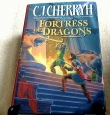
Текст книги "Fortress in the Eye of Time"
Автор книги: C. J. Cherryh
Жанр:
Классическое фэнтези
сообщить о нарушении
Текущая страница: 22 (всего у книги 47 страниц)
The hills enfolded them softly on all sides, the same craggy tree-crowned hills that they had passed on a much more leisurely ride to Emwy, and again at the end of a nightmarish ride by night. When they crossed the old Althalen road (though no one spoke the name) where it joined the road to Emwy district, they began to ride over the recent tracks of a fair number of riders—their father had a hundred twenty men with him, Efanor said, and that was where, if their father had wished to pass by Henas’amef unnoticed and unreported, he would have picked up the Emwy road.
By then they had passed beyond cultivated fields and into pasturages, and into the pastures of remote and smaller villages. They aimed the horses for a brief pause for breath and a limited watering at a stream that crossed the road, and came in on ground trampled by horses and now occupied by sheep. The shepherd was waving his staff and calling his clogs to gather the flock back again. The sheep bleated in panic and scattered from their horses down the narrow banks of the streamside.
“Have you seen riders today?” Cefwyn called out over the racket, as he got down from the saddle.
“Aye, m’lord,” the shepherd said, with his clogs yapping and his sheep in a panicked knot, climbing over one another at the high bank, “yea, m’lord, I seen a great lord wi’ red banners, a great lord, like he was a king .... “
“That he is,” Cefwyn said shortly. “How long ago, man?” and the man glanced at the sun and swung his stick at a growling dog.
“Oh, not so long. I was up to there on the height, m’lord, an’ I was bringing the sheep down—but ’is silly ewe had got herself down a bank, an’ I come down and around the long way, m’lord .... “
The tracks of horses, filled with water where the sheep had not trampled, told their own story. “Not that long,” Cefwyn called out, having walked a little distance up the stream and had a close look. He kept Danvy moving, not letting him fill up on water. But Efanor had not gotten down, and had let his horse stand, instead arguing with the reins—which itself annoyed him. Blessed chance his lordly brother Efanor would ever ask an Amefin shepherd the evidence of his eyes, or understand the man’s brogue if he did. The brother who had adventured in the sheep-meadow with him had gone; the younger prince of Ylesuin had rather argue with his horse than soil his boots, or deign to company with him and read the clues with him. He did not understand, or want to understand, Efanor’s state of mind at the moment. “We can overtake them before Emwy,” he said, rising into the saddle. “The horses have rested all we can afford.”
But banners at a distance was not the only thing the shepherd had seen today; he was looking straight at the emblem Tristen wore, and, on the sudden resolution of their remounting, tried to approach him. But Uwen prudently turned Tristen toward the horses and set himself with his back to the man, affecting not to see his approach.
Then Tristen looked back, on his own, staring at the shepherd, who, thus confronted, reached for amulets of gods knew what sort at his neck—until Uwen maneuvered the red mare between, put the reins in Tristen’s slack hand and gruffly bade him mount at once as Tristen went on staring.
Not one of his fits, Cefwyn prayed, not a lapse in front of Efanor, and not a shepherd going on his knees to an outlawed symbol. They were near Althalen, and cursed ground, and he damned the whole miscarried day, as he rode Danvy between, to head off unwanted peasant adorations.
“Uwen,” he said, leaning from the saddle to catch Uwen’s attention,
“well done. Keep him from all mischief, either speaking or doing. Hear me. Althalen is very near this road. Do not, do not let him ride apart from us, and do not indulge his fits or his fancies if you must take the reins from him by force.”
It was all he could afford to say, for immediately there was Efanor riding close as the column formed. He said, “Good you should mention it,” to Uwen, and put Danvy across the stream, as the standards, his and Efanor’s, grouped to move to the front.
“What was that?” Efanor asked, overtaking him. “What do you fear?
Heryn? Or some other?”
“At Emwy,” he said, “men of ours died for reasons I suspect were Heryn’s malfeasance if not his maleficence. We have men in the region now trying to find answers. Our father may well fall in with them—or fall afoul of them, gods know. But by what this shepherd says we have every hope of overtaking him before he can ride into Emwy. His start is longer but our horses are fresher.”
“What happened there?” Efanor said. “What happened at Emwy? A plague on your evasions!”
“Treason,” he said. “Bluntly, treason, brother. Heryn is dealing with the Elwynim. No evasions. And high time you should ask. Heryn’s a thief and the son of a thief. He’s either conniving with certain of the Elwynim to kill me, or conniving simply to keep profitable hostilities going. If I knew which, I’d have beheaded him before this.”
“On what proof?” Efanor asked. “On what damned proof, brother mine?”
“The books. His books. I’d written to Father. If anyone read my reports. Or if my men, gods help them, ever got through to him.”
“And the reports of Elwynim marriage offers?”
“Is that what brought this on?”
“That? That, do you say, as if it’s nothing?”
“It’s nothing until I answer the offer, one way or the other, and I’ve not answered it, nor would have answered it without Father’s advisement.
But that was not my report. Who said so? Heryn?”
“I heard it in Father’s camp. Last night.” Efanor lifted a gloved hand.
“I know nothing. No one takes me in confidence.”
He bit his tongue. He did not say what he thought, which was bleak and accusatory: At least you knew Father was coming. At least you heard, brother, at least he aimed no inquiry at you, after setting you to investigate your host.
Or was Heryn to spy on me?
“Was it not,” he said instead, as they rode knee to knee, “the way Grandfather dealt with his sons? And did we not swear together Father should never do the same to us?”
“Yet here we are,” Efanor said. “And you suspect me, and never a reason for it. I swear to you, I did come to warn you, as well as to secure the books, brother.”
“There was no warning of this whim of our lord father’s?”
“None.”
“I believe your word, brother. Forgive my doubting nature.”
Forgive that the desire of their father’s heart was for Efanor to succeed him as King of Ylesuin, and forgive that no few of the northern and eastern lords their father played off one against the other likewise wanted Efanor to succeed to the Dragon throne, for much the same reasons as Lord Heryn would doubtless prefer Efanor.
How could he say to Efanor, They do not love you. They believe you a fool. Wake up from your pious dream. You have duties besides your own salvation. The kingdom needs a prince with his wits about him.
And yet that blunt challenge of Efanor’s just now had rewakened hope in him. The younger brother he had known in childhood had played their grandfather’s game right well, by seeming not to have an opinion. Facing every direction was surely Efanor’s chief attraction to certain lords, as his piety attracted priests. But he had known his brother’s real nature, before manhood added reticences and other considerations, and—dare he remotely hope?—possibly even the veneer of his piety. If that were in any degree a pretense, Efanor might be many things, but not, toward the ambitions of the northern barons, at least, a fool.
Desperate as they were to overtake, they could not push the horses to the limit and have anything left for fight or pursuit: already the column was threatening to string apart, the slower horses and the heavier riders making the difference. They held to their sensible pace, slacked back a little at intervals, then picked up the pace and kept moving, steadily, riding with all the skill they had. The sun declined another hour at such a rate, and it was a question in Cefwyn’s mind whether they dared assume their father had gone to Emwy, and whether they might save more time going overland and through the haunted precinct; or whether the easier going of the road would make up for the distance.
He gambled on the road as the better choice, and they went another hour on.
Then as they came atop the rise, with the turn toward Emwy a ridge away from them, there appeared a haze of dust above the hills. Cefwyn saw it at the same moment Efanor and several of the other men called out. There were riders ahead. They could believe it was the King’s party.
But they still dared not ask the horses for more than they were giving.
They kept moving, and the interval lessened. They were on the rise of the hill between them and the other force, the horses hard-breathing on the climb when, under the noise of their own horses, they heard the hammering of arms that was like no other sound on the gods’ earth.
“Ambush,” Cefwyn exclaimed, and bitter fear was in his mouth, for here in one place were both Princes of Ylesuin, and the King was under attack. “Efanor, take ten of your guard and ride clear!” No, Efanor began to say. But:
“Brother,” he said sharply, “ride back to Cevulirn on the road, and take Tristen and his man with you. Too many of the Marhanen are at risk here. Come for us with that force. You can trust Cevulirn.”
Efanor dropped back then, and Cefwyn turned his head and shouted at Uwen to take Tristen and ride with him. He saw them fall behind, and turned his attention forward, for they were coming over the hill, with the woods and the road and the embattled forces perhaps two, three hundred in number, before them.
He rode hard then, hard as he dared to have his guard around him as he came down toward the fray. He saw light horsemen, well-armed, with no colors evident, attacking the bright scarlet of the Dragon banner. He set his shield on his arm, he drew his sword, and rode into the oncoming horsemen, Kerdin and other men with him.
The meeting was a blur of motion, of bone-jarring impact to wrist and elbow as his sword struck, a flash of bodies in the press, racket of arms and the squall of angry horses on every hand as they plunged into the motley-armed lines.
Like quicksilver, the bannerless attackers melted aside from their charge and let them see the center, where red and motley engaged in a crush that threatened to overwhelm with numbers the knot of men and red banners. There was the King his father. There was the danger.
Cefwyn hauled on the reins to turn Danvy to that quarter and plied the spurs, wishing to the gods at this moment for Kanwy and not Danvy under him. The light horses were faster in pursuit, and they would not have been here in time—but they could not deliver the shock of heavy horse in driving straight for that embattled center, where the King’s banner was, and where the enemy would resist—while the hostile outriders skewed aside from them and let them through. He knew he was riding into a trap and a trick older than the Amefin hills, to fold in on them when they reached that center, but for his father’s life, he had no choice.
“Sound our presence!” he bade Kerdin. “Loud as you can!” He hoped to gain his father’s attention and have his father try to fall back toward him, but he dared not stop his own charge for fear of losing momentum and bogging down in a separate envelopment.
Danvy stumbled and regained his feet on the rutted roadside as Cefwyn pushed him for more speed, and more attackers, nightmare sight, came down from their right flank, down off a hillside.
Then he had view of a red horse, black rider, sweeping along the side of that hill toward those threatening riders—it was Tristen, with Uwen close behind: perhaps Efanor as well, was his instant, frightened thought.
He damned them for fools if they had not retreated.
But he could not help them—he had to reach the King’s force, a disarrayed mass, banners askew in the midst of a furious assault of light-armed riders, and to that sole objective he put the spurs to Danvy, swearing. He had no time to attend Tristen’s folly: he was about to lose a friend, and maybe the other heir of Ylesuin—but his father’s lines had been folded in, packing men in on each other so that lances and well nigh swords and shields were useless at the center, around the King. He wrung the last from Danvy to come in hard with what men could stay with him, to batter his way toward the center of that closing entrapment, to open it up and give the King’s men a chance to use their weapons on the envelopment he knew was now coming around both their forces, separately and fatally if he could not break that knot around his father.
Danvy hit shoulder to shoulder with another horse. Cefwyn took a hit on the shield and shoved and swung blindly, felt the sword bite as
!,
Danvy staggered, recovered, and stumbled his way over yielding bodies.
After that, he hacked and shoved whatever was in his path until it became a solid press of horseflesh and bodies and he could go no further.
He was in danger of being cut off, now, from his own companions.
Danvy went almost to his knees on a body, recovered his footing, and a blow came down on the shield, an axe stuck fast in the gap. He struck back at what target he could see past the encumbrance, wrestling with the axe-wielder for possession of the shield until the man’s sheer strength dragged him into clear sight of the man and half out of Danvy’s saddle.
One of his men hacked at his attacker, who left the axe and reeled aside. Danvy struggled for footing and Cefwyn tried to clear his shield, laying about him half blind and encumbered, until it was red badges all about him, red banners, and he knew the King’s men as well as his own guard were bringing their forces to bear.
Danvy jolted hard then as a horseman careened into him, and Danvy stumbled and went down. Cefwyn sprawled, rolled from the path of oncoming hooves and staggered up, still owning his sword by its wrist thong, still with the remnant of his shield on his arm. He had wet haze in his eyes, blurring the riders coming down on him.
I die here, he thought with strange amazement, and, clearing the drip of blood from his eyes with a shake of his head and a pass of his sleeve, realized he had lost his helm and the half-shield was the defense he had-his own lines had been driven back and it was only the enemy in his view.
He braced his feet among the dead, facing that gray and brown wall of horsemen coming at him, every detail astonishingly clear, as if the last moments of living must be stretched thin till they broke, till a prince had a chance to know he had led his kingdom’s forces to disaster.
A red horse plunged between. Tristen’s black form cut across his view, Uwen close on his heels ... Tristen swung the red mare about; and Uwen was trying to reach him as Tristen rode Gery head-on into the oncoming riders.
A blade swung. Unengaged, Cefwyn watched helplessly as Tristen ducked under and kept riding, the edge passing over his body by the narrowest of margins—he was going deep in among the enemy; and Uwen accounted for the man who had missed him.
“M’lord!” a voice cried near at hand; a second horseman rode across in front of him and slid to a stop. The guardsman leapt off, and Cefwyn swung up to the offered saddle, took a new grip on his sword and braced himself for the onslaught about to come down on both of them.
But it had fallen back. Among those motley horsemen, from the dead or the living, Tristen had found a blade and wielded it, shieldless, turning the red mare with his knees this way and that, the blade swinging dark and deadly in the light, as enemies went down. Tristen kept pressing, a dark and terrible force cutting into the enemy’s ranks, methodically taking man after man, forcing the red mare further. There began to be space about him—a rider in black velvet, and with a single man beside him and no shield at all.
“Sihhé! Sihhé!” the shout was ringing out from the enemy ranks now. They had seen, Cefwyn guessed, the emblem he bore. But Tristen gave no mercy to the rout that began around him. The red mare did not cease to weave and seek openings in the retreat and the sword did not cease to take lives. The arm was unerring, hewing down men, no move wasted. The clash of blades that did oppose him became a distant music, and the turning movements assumed a strange beauty, like a dance, the movement of a natural force of destruction that swept the enemy back and back.
The scene hazed, with a sting of salt in his eyes. Cefwyn struggled for breath, left with no enemies, no battle for him to face. He sat the saddle, arms limp, battered beyond the strength to lift sword or shield, and he realized a remote sting and swelling in his leg as his strength ebbed. He tasted copper, realized that he had been hit, and that the pain had yet to reach him—but the leg obeyed him when he signaled the horse with his heel, and turned, looking for the King.
More riders thundered up. He looked about in horror, lifted an arm that weighed double, and saw then the White Horse of Cevulirn sweeping onto the otherwise silent field.
A horseman came up beside him. A hand seized him, stayed him in the saddle, and he could not see the man until he blinked his vision clear.
“Idrys.” He recognized his black-armored would-be rescuer, who, late to the field of combat, held him ahorse until others could dismount and come about him. “No,” he protested, not willing to be lifted down. He refused their ministrations and, laying his sword across the saddlebow because he had no strength or steadiness to sheath it, he rode with Idrys for escort this way and that among the corpses and the knots of men still ahorse.
He saw the Dragon banner, then, and put the horse to as much speed as it could make over the trampled, littered ground, realizing that men around that banner were standing silent and with heads bowed. He saw Efanor among the men kneeling there—Efanor would have come in with Cevulirn’s men—and by Efanor’s grief-stricken demeanor he foreknew the worst.
He dismounted—Idrys was instantly at his elbow to take his arm, to help him limp forward to where his father lay. The Dragon Guard had fallen thick about their King. He walked over bodies of men whose names he might know well if he looked. But his father’s white hair was the only thing truly clear to his eyes—their father was only exhausted, he said to himself: their father was hurt, not dead; their father was a force of nature, a fact of their lives—he could not die.
But why feel the sting? he thought then. In death, no different truth than in life. Father loved him, never me.
Father practiced Grandfather’s tactics down to his dying breath, and gave Efanor his one victory, his sole recompense to be by one year not the heir.
But no man on the field chose to regard that last gesture as negating the sworn succession. Cevulirn, the Duke of the Ivanim, was a southern man, and his own. And Efanor had knelt, and kissed his hand, and owned to the legal truth—righteous priestling that he was; though he had been nowhere—nowhere when their father was fighting for his life, not priestly Efanor.
But that was manifestly unfair. He had sent Efanor for Cevulirn.
Efanor had followed his orders. He had brought Cevulirn—too damned late. Efanor had come to the field with Cevulirn’s men, on a horse he’d just worn down with a ride back to reach the Duke of the Ivanim and then, anxious for appearances, would not, he would personally swear to it, have sensibly bidden Cevulirn leave him ignobly on the road and make all haste to their father’s rescue without him.
Which was also unfair to suppose. He was looking for someone to blame.
Idrys steadied him. Someone had found a linen pad to tuck into the gash on his leg, and a bandage to wrap about his leg, over the reinforced leather. The pain as the man jerked a knot taut hazed his vision, then lessened, over all, as the wound found firm support.
“Get me to a horse, Idrys,” he said, and with a sweeping glance about him at the Ivanim, and to Cevulirn, he said, “Well that you heard my message and followed. I thank you.”
“My lord King,” said Cevulirn, and sent a chill through his blood.
“I heard late,” Idrys said on his other side. “Your message did reach me.” Idrys’ hands were gentle as he helped him.
“Is Danvy gone? Did he go down?” He heard himself sounding like a small boy asking after a favorite pet, knowing as a man knew, that miracles did not happen on a field of battle.
And he remembered then, upon that thought of miracles—or of damning wizardry: “Gods, Tristen. Where, Tristen?”
“He’s well, Your Majesty,” Idrys said calmly, coldly. “I’ll have men look for Danvy.”
“Stay,” Cefwyn said thinly, and caught a breath, insisting to stop at an ankle-high hummock on which he could stand and where Cevulirn and his father’s officers could both see him and hear his orders. “Take up the King. Make a litter. We’ll carry him—” He lost his breath and his clarity of thought both at once and stood shaking like a leaf. “To the capital, Your Majesty?”
The notion dazed him, as for the first time he considered that he had
There was more to do, quickly, much more, —but first the necessity to move them clear of further attack. “Cevulirn!” he said. “Men of yours to ride ahead on the road, men to lag back, by your grace, Ivanor! We’ve yet to know whether this is all they have in reserve in this cursed place. Either they swam these horses across, or we’ve a bridge decked and in use—and we’re not in strength to find it out now.”
“Leave it to me, Your Majesty,” Cevulirn said, and gave orders more rapidly and more astutely than he had managed. He had babbled. He had given not commands, but reasons. It was not a way to order soldiers, or lords who might be tempted to give back contrary reasons and not actions. It was not his father’s way. It was not a king’s voice he had, or a king’s confidence-inspiring certainty on the field.
But the things he ordered were being done. He tried to think what he might have omitted to do. The crown worked at the wound on his head when he clenched his jaw or when he frowned, and was its own bloody misery.
“Efanor,” he said, and his brother came to him. Red-eyed, Efanor was, pale of face, still leaking tears, like the little boy who’d suffered tragedies enormous at the time—the little brother who’d been his constant ally in the house. On an impulse he embraced his brother, as he had rarely done since they’d become men. “Efanor, with all my heart—I would we had all come even moments sooner.” He said it consciously and publicly to remove any sting Efanor might have felt in his late arrival, and to remove any doubt Efanor had had of his acceptance. But Efanor was stiff in his embrace.
“My lord King,” Efanor said through the tears. The face had hardened in that instant of that embrace. The voice had gone cold. It was clearly not a time to press Efanor on anything, least of all with an appeal to familial loyalties which Efanor had ample familial reason to doubt. He had loosened his hold on his heart once: he could not risk it twice, or he might break down in the witness of these men, and perhaps Efanor felt the same. He made himself numb, incapable of further grief or astonishment, in favor of calculation that told him that trouble for Ylesuin was far wider than the loss on this field. He felt sweat on his face, that began to dry and stiffen on his cheeks, and he did not let expression fight against it.
“I will grieve for this tomorrow,” he said then. “Forgive me, Efanor.”
“You have no tears.”
“I shall have. Let be.”
“Where is your Sihhé wizard, Cefwyn king?”
He was still dazed, conscious of Efanor’s attack on his associations, and of the bitter nature of that attack—and at the same time keenly reminded of the question of Tristen’s whereabouts. Looking about, he saw no sign of him.
“My lord King,” said Idrys, “we can make a litter for you, too, if you need. You need not ride.”
“No,” he said. “Where has Tristen gone? Where is he?”
“Majesty,” Idrys said, “we’re searching for him. No one’s seen him since the fighting.”
“The man saved my life, damn it—saved the lot of us! I want him found!”
The buzz of flies hung in the air. Men coughed, or cursed or grunted in pain, bandaging their hurts. Men and horses wandered at apparent random through trampled, bloodied grass, seeking order and direction. One such whisper through the grass and accompanying jingle of bits brought him Danvy. A man had found him, Danvy showing a cut on his shoulder but nothing that would not heal, nothing that even precluded him being ridden home, and he wanted not to part from Danvy again: he patted Danvy’s neck and gathered up the reins, guilty in recovering a creature so loved, so dear to him, amid other, more grievous losses to the realm.
A man helped him into the saddle. Other men were mounting up.
Their dead were too many to take with them, the danger in the area too great to detach more than a squad of Cevulirn’s cavalry from their main body to stand watch over them against village looters. He had heard Idrys give necessary orders for the removal of weapons from the dead, so as not to meet them coming back in hostile hands—and to search for clues of allegiance among the fallen enemy.
But that was Idrys’ concern and Idrys was giving all the orders for those that stayed: Cevulirn and Efanor were ahorse. Still he saw no sign of Tristen, and could not ask again, petulantly, like a child: Idrys was doing all he could to be sure of the area, and who was in it, and if Tristen and Uwen were among the fallen or the wounded, the men staying behind would advise him and do more than he could do.
The Crown meanwhile had other obligations too urgent, among them to secure his own safety, and Efanor’s, as the only two Marhanen, and them without issue. “Shall we move?” Efanor asked him, prompting him to issue orders which no one but he could give, and numbly he said,
“Let’s be on our way.”
So the King’s litter began to move. The elements of Cevulirn’s men and the Guelen guard sorted themselves into order, the King’s Dragon Guard with their tattered red standards, the men of the Prince’s Guard, who now—he realized with faint shock—must attach to Efanor as heir to the throne (but not Idrys, he swore to himself: Efanor should never inherit Idrys). The two red-coated Guard units came first, with the gray and white contingents of Toj Embrel and Ivanor at large riding under their own banners and under their own lord.
At some length Idrys overtook him, and rode beside him, apart from Efanor, who rode with Gwywyn.
“You are not fit to ride,” Idrys grumbled. Idrys’ face, whitened by the road dust, was a mask. “You should have taken the litter. The bleeding is worse.”
“Where were you?” Cefwyn snapped. His leg hurt him, now, swelling against the bandage, muscles stretched by sitting the saddle.
“Heryn almost eluded us. He led me a chase. We did overtake him.
And he dispatched another messenger. Heryn’s man babbled treason-and will say more.”
It was news that flooded strength into him. Vindication. Proof, for his father’s men. For all the realm besides. He drew a deep breath. The hooves scuffed deadly slow in what had become a warm day, belying the clouds in the west. The flies pursued them. The band about his head seemed a malicious and burning fire.
“He will believe me,” he said, thinking of Efanor. “My brother will believe me now.”
“My lord?” Idrys asked.
But he chose not to answer. He had said too much, in that, even to Idrys.
They came up behind a pair of horsemen on the road, riding ahead of them so slowly that even at their pace they were gradually overtaking them. Cefwyn watched them from his vantage at the head of the column, and knew who they were, long before the interval closed enough for anyone to see the red color of the mare, and the black of her rider, and the stocky figure of the man on the bay.
“Your Majesty.” It was Gwywyn. “Shall we ride forward and find them out?”
“No,” he said, “I know who they are. Let be.” So the Lord Commander fell silent riding on one side of him with Efanor, and Cevulirn arrived beside Idrys on the other, to hear the same. They drew steadily nearer.
“Majesty,” his father’s Lord Commander whispered, justifiably apprehensive, for there was indeed an eeriness about the pair, who had never looked to know what rode behind, as if a king’s funeral cortège and the procession of his successor were nothing remotely of interest to them.
The stocky man looked back finally. The other did not, but rode slumped in the saddle, dark head bowed.
He is hurt, Cefwyn thought in anguish, and yet—and yet—in the trick of the setting sun and the dust the two horses raised in the trampled roadway, it was as if two ghosts rode before them, beings not of this time or place, nor accessible to them.
Not Elfwyn, he thought. Whatever soul Mauryl had called—it was surely not Elfwyn’s unwarlike soul that had ridden to save their company. It was not the last Sihhé king whose hand and arm and body had found such warlike skills as drove armored enemies in panicked retreat.
Sihhé! their attackers had cried, falling back in consternation. He would never forget that moment, that the enemy about to pour over him had given way for fear of two men, one of them having ridden out unarmed but for a dagger.
Tristen rode loosely now, as if sorely hurt, as if he expected no help, Cefwyn thought, and would rebuff what aid might be offered him. But gingerly he moved his horse forward, while the main column kept the pace it could best maintain.
He rode alongside, met Uwen’s anguished face.., saw Tristen’s profile in a curtain of dark hair. Tristen’s head was bowed against his breast, as if only instinct kept him in the saddle. His face was spattered with blood like his hands, and the black velvet was gashed, showing bright mail underneath. Blood had dried on the velvet, and on the mane and neck and feet of the red mare. Tristen’s hands did not hold the reins. They clenched a naked sword, on which sunset glinted faint fire, and blood sealed his hands to it, hilt and blade across the saddlebow. “Tristen,” Cefwyn said. “Tristen.”