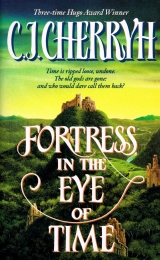
Текст книги "Fortress in the Eye of Time"
Автор книги: C. J. Cherryh
Жанр:
Классическое фэнтези
сообщить о нарушении
Текущая страница: 13 (всего у книги 47 страниц)
Trust this man, Cefwyn had said. Yet Idrys called him dangerous, and spoke of harm, when he had only looked for a little freedom. Idrys might be right, by what Cefwyn said. It might well be that Idrys was right.
“I shall go to my room, sir, if you please, I want to lie down. Please, sir.”
“He has not drunk all that much,” said Idrys.
“Much for him, perhaps. Perhaps you should see him to bed.”
“Aye, my lord.”
Tristen turned, then, to go to the door, and had to lean on the table, bumping the salt-cellar. “Sometimes,” he tried to explain to them,
“sometimes—too many Words, too many things at once—”
“Too much of Amefin wine,” Cefwyn said with a shake of his head.
“Debauchery over maps. That you’ll sleep sound tonight I don’t doubt. Idrys, find some reliable Guelen man that can stand watch on him personally, someone he can confide in, and mind that the man is both kind and discreet. He’s utterly undone. Have care of him.”
“Sir,” Tristen murmured, yielded to Idrys’ firm grip and made the effort at least to walk, foolish as he had already made himself. He wondered if Cefwyn would after all take Idrys’ advice and send him back to solitude.
But Idrys’ advice he already knew, and asked him no questions.
Idrys escorted the wobbling youth to the care of the assigned guards—one could take that for granted, as Idrys knew his duties.
And for no particular—and more than one—reason, Cefwyn wandered to the clothes press in his bedroom, and to a chest that, with a turn of the key set in its lock, yielded up a small oval plaque set in gold, with a chain woven through with pearls.
Ivory, on which an Elwynim artist had rendered black hair, green gown, a face– A face lovely enough to make a man believe the artist was bewitched himself. A face fair enough to make a man believe in Elwynim offers of peace and alliance, while Elwynim bones bleached above the gate for trying to cut short his tenure in Henas’amef.
A face of which one could believe gentleness and intelligence, wit and resolve alike. Could such clear eyes countenance assassins? Could such beauty threaten?
There might for all the prince knew be a bewitchment, not on the artist, but on the piece itself, which warmed to his hand. He should have sent the piece back with the last dagger-wielding fool, or flung it in the river, but he had not. He had not been fool enough to reply to it, save by the means of word passed to suspected spies that he wished to hear more—how should a man or a prince wish not to hear more of such a face, even from his mortal enemies?—but no answer had come, either floating the river, flying pigeon-fashion, or trudging down Amefin roads.
And, failing such elaboration—he should have tossed the miniature out the window, lost it, forgotten it at least, and kept the chest, which was finely done, of carved wood and brass.
But at certain moments he still resorted to it, asking himself—that in fact was this offer of the Regent in Ilefinian, what was the scheme that had the sonless Regent offering his only daughter to prevent a war his lords and advisors seemed bent on provoking, a war the Elwynim march lords invited in daggers, in poison, in cattle-theft? Count the ways:
Elwynim found occasions to make his tenure difficult, and he counted this proposal among the tactics, a way to ruin his father’s digestion did he even mention it in court in Guelemara.
Perhaps, on the other hand, Elwynor thought to create a better chance for its assassins, and that was why the chest had come to him secretly, by an Amefin carter, who said a man had given him the box and said the prince in Henas’amef would pay more than Heryn Aswydd to have the piece.
That was the truth. One wondered what other rules of commerce the Amefin commons had understood.
The door opened and shut. Idrys walked back in.
“Ah,” Idrys said, having caught him temporizing again with the border.
“Ah, yourself,” Cefwyn said. “I take oath that he knows nothing of Elwynor.”
“Oh, that one? Sir mooncalf? I take oath he knows nothing Mauryl did not tell him.”
He had, in fact, rewarded the messenger handsomely for this ivory miniature, carried to him from the border by an Amefin peasant. And he doubted not at all that Heryn Aswydd wished to have intercepted that box.
But no paintings in ivory comprised Heryn’s offer of alliance. Heryn’s offer came straight to his bed. Often. And twice over.
Cefwyn tossed the miniature back into the chest and closed the lid and locked it, insofar as the lock could serve to protect it from general knowledge.
“Is there a reason,” Idrys asked, “my lord contemplates such Elwynim gifts, on the eve of a ride so near the border?”
“I might, of course, wed Orien instead. Or Tarien. It would secure the province.”
“My lord jests, of course.”
“Heryn counts it no jest. Nor does Orien. As my Lord Commander knows.” Cefwyn walked to the window, where the sun went down into sullen dark. The window showed the far horizon and a seam of red light.
One could not see Ynefel from here. One could not know for certain, except as one believed Tristen’s tale, that the fortress had fallen. And one did, in such unsettled times, want to know what the situation was, bordering Marna, and what the locals saw and surmised about changes in their sheep-meadows.
Though in the wizardly fashion in which Emuin knew things, Emuin had confirmed it was so, that Ynefel and its master had indeed fallen-and a prince could become so utterly dependent on such attesters as Emuin, and Heryn, and even Idrys, with all his attachments and private reasons.
By far less arcane means a prince knew that the twins had their own designs, independent of Heryn, and knew that their brother Heryn, who could not keep his tax accounts in one book, had his private reasons, and his none-so-private ambitions. And all the cursed pack of them, Elwynim, Amefin Aswyddim, and the Elwynim barons, had a notion how to secure in bed and by other connivance what they could not win of Inéreddrin’s heir in war—unless Inéreddrin’s heir grew careless about personally verifying the reports others gave him.
One wondered what effect Mauryl’s fall had had on the border—or if they were remotely aware of it.
Or what the inhabitants of such villages as Emwy thought their taxes were, that Heryn collected for the Crown.
And how far the Crown Prince of the kingdom of Ylesuin should ignore the situation.
It was given as truth among every borderer that Ylesuin would eventually have to marry and mistress some sort of agreement to settle the ancient question of the border heritance. That such an agreement was imminent and due in this generation was an article of faith among borderers; that the Prince of Ylesuin had no more choice in the matter than Lord Amefel’s sisters had was an article of faith on his father’s part—but the heir of Ylesuin did not accept that role yet: the heir of all Ylesuin had other ideas, which involved bedding the Aswydd twins, enjoying the labor, and affording the Aswyddim the confidence that their habitually rebel province had secured useful influence.
And if the heir of Ylesuin was bedding the Aswydd twins, the heir of Ylesuin thus became too valuable to offend or assassinate, at least for the Aswydd partisans in Amefel, if not the other Amefin nobles who hated Heryn and his taxes.
It was thus far a comfortable and tacit bargain, one he was certain the Aswyddim had no wish to see the Elwynim outbid with a marriageable daughter. Heryn Aswydd had lately betrayed two Elwynim assassins who thought they could rely on Aswydd aid; and thus far (at least until, at his pleasure, the matter of Aswydd taxes racketed to Guelemara and the King’s exchequer) Heryn’s sisters, particularly Orien, the eldest, were a pleasant dalliance, so long as Aswydd excesses and Aswydd ambition stayed in bounds. It was all Amefin sheep Heryn Aswydd sheared, and thus far none of them had complained to the Crown.
But now Mauryl entered the game, with this wizardling—for that was a very good guess what the youth was—casting his own sort of feckless spell over sane men’s credence and doubts, and saying, all unexpected, Believe in me, lord Prince. Cast aside your other plans, lord Prince. Mind your former allies, Marhanen Prince, in Ynefel.
“He might be Sihhé,” Idrys said, out of long silence, and sent a chill down the princely spine.
“He might well,” Cefwyn said, looking still into the gathering dark, at the last red seam left of the sky, far, far toward Ynefel. “But Mauryl did serve us.”
“Mauryl Kingmaker. Mauryl the sorcerer.”
“Wizard.”
“The Quinalt will have apoplexies.”
“Priests seem to recover quite handily.”
“Three bids, Cefwyn prince. Do you realize? The Elwynim, the Aswyddim, —now Mauryl. How many directions can you face at once?”
He made no answer for a moment. The light was going. To see the horizon became, through the distortion of the crown glass, a test of vision.
He said, then, “Only guard my back, master crow. I’ll care for the rest.”
Chapter 12
Words trembled in air, writings black and red, Names, that were Ashiym, Anas Mallorn, Ragisar, Malitarin ... villages, that were Emwy and Asmaddion, and sheep were there, but Anas Mallorn ruled the riverside—Owl flew above a parchment and faded land. Owl’s wings were barred and blunt and shadowed villages at a time. Owl, Tristen called to him, standing at some vantage he could not at the time understand. But Owl was on a mission, or hunting mice, and would not heed him.
Owl eluded him and kept flying, opening up more and more of the land to him, Names that writhed in red ink and fortresses in black.
Streams snaked under Owl’s broad wings to join the Len6alim, and all, all went under him.
“M’lord,” someone called to him. But he was losing Owl.
Owl, come back! he called, for it seemed to him that Owl would leave the edge and enter the dark. But the map kept widening, Words and Names and lands like Guelessar and Imor ... Marisal and Lanfarnesse ...
“M’lord.” Someone touched him, and he blinked, realizing it a gruff voice and perhaps one of the gate-guards, standing over him by dim candlelight.
It still might be, as he opened his eyes wide and gazed on a scarred and broad-nosed face, fair-haired, but gray and bald on the crown. He feared the man at first glance.
But it did not seem an unfriendly face.
“Uwen Lewen’s-son, m’lord. The captain sent me. He said I should wake ye. Sorry. But it are toward dawn. And ye’ll be ridin’ wi’ His Highness, so best ye be up and breakfasted.”
“Yes, sir.”
“M’lord, I ain’t sir yet, no wise. Uwen’s all. Servants is waiting wi’ a small breakfast, and I’ll fit ye for the ride, if ye please.”
“Thank you,” he said, if Uwen would not be called sir. Still—he was going out riding, Cefwyn had kept his promise, and for the first time in days he was glad to get up. He rolled out of bed and went immediately to wash and dress, while the servants were bringing breakfast in and lighting more candles in the early-morning darkness.
“Here’s a robe, m’lord,” Uwen said, flinging a robe about his shifted shoulders. “Ye have a bite, now. Ye’ll be regretting it halfway through the day, else ye do.”
He thought it sensible advice, and he sat down to a breakfast of hot bread and butter and honey, while Uwen was working with something of padded cloth and oil and metal, taking up laces, as it seemed.
He finished his breakfast more quickly than usual. He stood up, and Uwen gave him a padded undergarment, such as he had seen the soldiers wear about the barracks, such as, he thought, Uwen also wore under his mail and leather.
He was disturbed and fascinated at once, exchanging his robe for the soldier’s padding. Uwen snugged the laces tight around him, saying,
“Well, ye’re slighter ’n ye seem, m’lord. Breakfast an’ all. Does that seem fitted, here, m’lord?”
“Yes,” he said, and Uwen took up a mail shirt.
“Watch your hair, m’lord,” Uwen said, twisted his loose hair into a rope and helped him on with the shirt. The shining metal settled on and shaped itself about him like water, like– His fingers traveled over the links, smooth going one way, rough-edged going the other, and as he breathed, he found the weight-like a Word, like a Name, settling about his shoulders and about his ribs and becoming part of his own substance—but he was not this Thing. He was not this Weight. He was Mauryl’s, not a soldier.., he was not this thing that enveloped him in steel.
“Ye’ll get used to it,” Uwen said. “Here’s rough land, m’lord. We got bandits, we got Elwynim, we got Amefin who could mistake ye for a target, silly lads. Here.”
Uwen had a coat in his hands, and Tristen put his arms in like a shirt.
Uwen buckled it on, then looped a belt around his waist and snugged it tight.
“His Highness has got you a nice, quiet horse. She don’t do no nonsense. Ye ready, m’lord? Ye set fair?”
“I think I am.” The coat was red, like Cefwyn’s guard, and like what Uwen wore. He looked like another soldier, except the brown hose and brown boots where the soldiers wore black.
“Them are house boots,” Uwen said, following his downward glance.
“But the captain didn’t warn me ’a that. They’ll have to do, begging your pardon, m’lord, just stay t’ horseback and mind ye got light feet.”
“I will,” he said. Uwen certainly must have leave to speak to him.
Uwen chattered in a friendly way, in a manner of speech he found like singing to his ears, and when he went out, Uwen spoke in the same way to his guards, knowing them all, it seemed, laughing, clapping the one named Lusin on the shoulder as they left.
They walked down the shadowed hall to the stairs. The sun was just coming up. Servants were removing last night’s candles, hurrying about on early-morning errands, some bearing linens, some coming from the kitchens. Guards were changing watch downstairs, and a few early-morning clerks were on their way to archive.
Uwen led him down the outside steps, past guards who also knew Uwen, as it seemed, and down and around to the stable-court in the first light of dawn, where a troop of soldiers and another of stableboys were saddling horses, and pages were standing with banners and bringing other gear.
Uwen picked up weapons by the side of the stableyard, weapons which had a worn, well-used look; and Uwen buckled on a sword and a dagger as Tristen watched, queasy at his stomach and hoping no one expected him to go likewise armed.
The mail surrounded his breathing, reminding him constantly that there was danger as well as freedom in the outside. In Uwen’s close company he walked among the red-cloaked guard ... saw Cefwyn, who looked little different than his soldiers, with brown leather and a gold dragon, like that his guards wore, on his red coat. All, armor and arms alike, that distinguished him from the soldiers at all was the silver band on the plain steel helm.
“Tristen,” Cefwyn hailed him, and strode through the others to meet him.
Idrys walked like a dark shadow at Cefwyn’s back, hand on hilt, where that hand always, even indoors, seemed most comfortable.
And at Cefwyn’s orders a man brought up a horse, red from crown to feet, with a clipped mane and a look of stolid patience. “She will bear you gently,” Cefwyn said. “Her name is Gery and the stablemaster swears she’s easy-gaited.”
Tristen took the reins in his own hand, rubbed the red, warm shoulder and threw the reins over, set foot in the stirrup and swung up as he had seen, dizzy for a moment at the mare’s shifting of weight—a haze of sensations, of smells, of sounds. He looked down at Cefwyn’s anxious face, at Idrys’ frowning one.
“Well enough,” Cefwyn said then, patting him on the boot, and patting Gery. Cefwyn turned away and a groom brought Cefwyn’s horse and held it as he swung up. It was dark—Bay—the Word came to him; it had black stockings and a black mane as bays did. Idrys mounted a big black; and Uwen another bay—it was a color common in the guard’s horses.
Idrys gave the order, the Zeide’s iron gates swung open, and horses grouped together, stringing out as they passed the narrow gate.
“Ride to the fore,” Idrys ordered, passing by him, and Tristen set himself as near Cefwyn as he could, almost at the head of the column, save that Idrys and a handful of the guard rode before him; but suddenly a number of men thundered past on either side and increased that number in front. Shod hooves echoed down the cobbles of the hill, disturbing the streets, where townsfolk early from their beds scurried from their path.
Shutters came open. It was strange to see the town from the height of a horse’s back, and to ride swiftly down the very street over which he had walked, sore-footed and hungry.
A child ran from their path and a woman cried out. Tristen took Gery aside with his knee and turned in the saddle to look back, frightened by that cry of alarm, but the child had made the curb safely. And in that glance back– He saw Bones. Skulls—above the gate. The bones of men.
He all but dropped the reins, and caught his breath as Cefwyn said sharply, “Tristen!” and Gery bumped Cefwyn’s horse—his fault, he knew. His knee in Gery’s ribs had caused Gery to drift; the uneven hand, the uneven seat—he suddenly knew with exquisite precision where his hands were and where his knees were, and how Gery had understood every move, every shift of weight he made. He straightened around, found his balance, found the right stress on the reins that made Gery know where to be and Gery at once struck a different, confident stride.
Gery looked to him, he thought, as he looked to his teachers; Gery, like him, wanted to do right, and wanted to understand, and he was talking to her with his knees and the reins alike as they went clattering at a fair speed through the streets, past all the buildings, all the scaffoldings and the shuttered windows and the fine buildings and the less fine, all the way down to the level courtyard by the main town gate, which he had once passed behind an idle cart, slipping past the guards.
But the gates stood wide for them and the guards there stood to attention as they went out with a rush onto the open and dusty road, out through the fields, toward his Road—
But not onto it. They went along the wall, and they went past the town, toward the horizon of rolling fields.
Then Idrys and the men in front slacked their pace, and Cefwyn did, and all the column behind.
Men outside the walls were already at work, already walking the roads, carrying hoes or mattocks or other such. The countryside was awake far and wide as the light came stealing over the fields.
“You ride well,” Cefwyn said, “Tristen.”
“Sir?” He shook off the haze that had come on him, blinked and brought the morning into clarity again, the fields, the creak of leather and the ring of harness—the give and substance of mail that surrounded him.
“You ride well. In the streets, you rode well. And you say you have never sat a horse.”
“Some things come to me.” He patted Gery’s neck, overwhelmed with the feel of her, with the smells and the sounds around him. He was trembling. He wished to make little of it, but Cefwyn cast him such a look that he knew he had not succeeded in indifference; and he feared that calculation in Cefwyn’s eyes.
“Mauryl’s doing,” Cefwyn said. “Is it?”
“I know things. I read and write. I—ride.” Gery’s warmth comforted him. He kept his hand on her. He felt her strength and good will under him. “I didn’t know I knew, m’lord Prince.”
Cefwyn frowned. The horses kept their steady pace and if Idrys or Uwen heard what passed between them, they gave no sign of it.
“You know it very damned well,” Cefwyn said. “For down a hill and out a gate.”
“It’s like Words. I know them, sir. I know things.”
“Am I to believe you?” Cefwyn said at last.
“Yes, sir,” he said faintly, fearing to look at Cefwyn. Good things seemed always balanced on edge, always ready to leave. He did look, finally, as they rode, and Cefwyn stared at him in a way different from other people, even Mauryl, even Emuin—afraid of him; but not angry with him, he thought, nor willing to abandon him.
He knew not what to do or say. He looked away, embarrassed, not knowing whether he should have perceived this fact of Cefwyn. They rode in silence a time, well past the walls, now, and out along a narrow track where men rode two by two as the road went around the west side of the town and toward the rolling fields and pastures. The Dragon banners fluttered and snapped ahead of them, carried by young men. The morning sun glanced silver off a small brook in the valley. Hills rose on the eastern horizon, just past their shoulders, and beyond them—perhaps the Shadow Hills, perhaps even the mountains Mauryl had named to him, Ilen61uin, drifted in morning haze.
In the west were lower hills. The forest was that way. Marna Wood lay that way, and south. He knew. He gazed in that direction, remembering that dark path, remembering the wind in the leaves.
“A long walk.” Cefwyn’s voice startled him.
“Yes, m’lord.”
“A fearsome walk.”
“It was, m’lord.”
“Would it fright you now?”
“Yes, m’lord.” He did not think they would ride that way. He hoped they had no such plans. “The horses could not cross the bridge.” That thought came to him.
“Bridges can be mended.”
“The stones are old.”
“Wizardry raised them. Wizardry could mend them, could it not?”
“I don’t know, sir. Mauryl would have known. Emuin might know.
We never saw any men, ever.”
“Elwynim press at us. The skulls above the gate? Those are Elwynim.”
“Did those men steal sheep from Emwy?”
“They came to kill me.”
He found it shocking. “I don’t know about that, sir.”
“Don’t you?”
“No, sir. M’lord Prince. I don’t at all.”
“Mauryl knew. Mauryl assuredly knew.”
“He didn’t tell me, sir. He didn’t tell me everything.” He became afraid, here, riding alone with Cefwyn, with no advice from anyone, and with the talk drifting to killing and stealing. “What should I know?” “Uleman.”
“Is that a name, sir?”
“One might say,” Cefwyn said, seeming in ill humor. Then Ce00vyn said:
“The Regent of Elwynor. That must mean something to you.”
Names, again. Words. Tristen shut his eyes a moment, and there was nothing in his thoughts, only confusion, Words that would not, this morning, take shape. “I don’t know. I don’t know, sir.” “I thought you just—knew things.”
“Reading. Writing. Riding. Words. Names. But I don’t know anyone in Elwynor, sir. Nothing comes to me.”
He was afraid to have failed the test. For a time Cefwyn looked at him in that hard and puzzled way, but, unable to answer, he found interest in Gery’s mane. It was coarser than a man’s hair. It was clipped short, and stood up straight. He liked to touch it. It was something to do.
“Tristen,” Cefwyn said sharply.
“Sir.” His heart jumped. He looked to find what his fault was. Perhaps even his respectful silence. Cefwyn kept staring at him as they rode side by side. He was afraid of Cefwyn when Cefwyn looked like that.
“Ninévrisé. Does that name come to you? Does Ilefinian, perchance?”
“Ilefinian is the fortress of the Elwynim.”
“And? What does that name conjure?”
He shook his head. “I have no idea, m’lord. Nothing.”
“Such names don’t come to you.”
“No, m’lord.”
“Do you take me for a fool?”
“No, sir. I don’t think you are at all.”
“And where do you find your truths? Do they come to you—” Cefwyn waved his hand. “—out of the air? The pigeons tell you, perhaps.” “My teachers do.”
“Your teacher is dead, man. Emuin is gone. He fled to holy sanctuary.
Who teaches you now?” “You, m’lord.”
“I? I am many things—but no teacher, I assure you. And damned certainly no moral guide.”
“But I have to believe you, my lord. I have no other means to know.”
He was afraid, and shaken by Cefwyn’s rough insistence on what he knew must be the truth. “The philosophy I read makes no sense of Names. Rarely of Words.”
“Gods witness,” Cefwyn said after a moment, “gods witness I am a man, not a cursed priest. Choose some other. At large and random you could fare better.”
“Emuin said to listen to you.”
“Then damn Emuin! I am not your guide, man. Moral or otherwise.
–Would you believe anything I told you?”
“I believe everything you’ve told me, m’lord Prince.” The prospect of doubt in things he had taken for true was sufficient to send sweat coursing over his skin. “I must believe you, sir. I have no other judgment, except to judge the people that tell me.”
“Gods.” Cefwyn slumped in his saddle, then suddenly took up the reins. “Follow me!” he said, and spurred around Idrys and past the van– guard.
Tristen followed; Idrys and Uwen would have, but Cefwyn turned and shouted, ordering their separate guards back. Their lead widened until they two rode alone with the escort far too distant to hear.
“Do not,” Cefwyn said, “ever confess to any man what you have just told me.”
“Yes, sir.”
They rode in silence a time. “I have never lied to you,” Cefwyn said at last, and quietly. “At least that I can recall. —Do you know who I am, Tristen? Do you really understand?”
“You are the King’s son,” Tristen said, looking at him, “of Ylesuin.”
“Of Inéreddrin, King of Ylesuin, son, yes, his heir; and of Amefel, by His Majesty’s grace, his viceroy in Henas’amef and over Amefel and its uneasy borders.” Cefwyn looked down his nose at him, a narrow stare.
“Most men—and women, oh, especially the women—have ambitions to share that grace. I have a vast multitude of devoted followers, and from none but a handful of my guard would I take untasted wine. What say you, Tristen?”
“Of untasted wine?”
“Poison. Poison, man. Poison in the cup, a knife in the dark. I defend this cursed tedious border against old resentments, and the Amefin, in particular those Amefin who are opposed to the Aswyddim on account of their burdensome taxes, would prefer another heir, since me they cannot manage, and they have discovered that. Now with nine heads on Henas’amef’s gates, the Elwynim sue for peace and the Regent offers me his daughter. And the Amefin like that well, save Heryn Aswydd and his lovely and well-traveled sisters, who like that least of all.” He lifted his hand to the east, where Henas’amef itself showed small and remote, now, falling behind them. “And should you lack for suspect affections or affiliations, or even bedmates, why, my dear sir, consider Guelemara. The capital. My father, my kith and kin, another pack of wolves, but with far better and courtly graces. The capital is vastly more civilized than here. They poison only fine vintages. You’ve been treated far more shabbily, having experienced Henas’amef’s rough hospitality.”
“I find it kind,” Tristen said, “mostly.”
“You are quite mad, you know.”
“Most have been kind to me.”
“Mad, I say.”
“I think I am not, sir, please you.”
Cefwyn’s hand moved to a medallion he had at his throat, like Emuin’s. “Do you not suffer midnight impulses to revenge? Do you not resent what certain folk did to you? Do you not think remotely of serving them in kind?” “Who, sir?”
“A man has a right—” Cefwyn’s words tumbled one over the other in a passion and fell to a halt. “Sir?”
“Don’t look at me like that! I am not Emuin. Don’t look to me for answers, damn you, don’t you dare look to me for answers! I’m no arbiter of virtue! You’ll not trap me in that!”
“Emuin said you were a good man. But he said not to copy what you did.”
Cefwyn’s mouth opened. And shut. Cefwyn stared at him.
“I ought not to have said that,” Tristen said. “Ought I?”
“Gods. You will terrify the court.”
He was terrified, too. And lost. Cefwyn used words very cleverly, very quickly turning them from the course Tristen thought they would take.
“Or is such your humor?” Cefwyn asked.
“What, sir?”
“Cry you mercy, Tristen. I have never met an honest man.”
“You confuse me,” Tristen said. He felt cold, despite the sun. “I don’t understand, sir, I fear I don’t.”
“I don’t ask that you understand,” Cefwyn said, “only so you don’t ask too much of me. Emuin did tell you the truth.”
The sun climbed the sky, and far past the view of the town, even beyond the reach of the fields, they took a westward road that ran up among low hills. The guard had long since swept them up again within their ranks and Idrys rode with a small number out to the fore, sometimes entirely out of sight as the road bent back and forth.
But it seemed the land declined, then, and in very little time the hills gave way to meadow, where a breeze that had made the day a little chill grew warmer and stronger, and lifted the banners and pennons.
They kept a moderate pace over an hour or so, between pausing to rest the horses. One such rest, as the sun passed its zenith had bees buzzing about a stand of white and pink flowers, and the horses cropping grass and the blooms of meadow thistles. Their company disposed themselves on a grassy slope and shared out a portion of the food they had brought.
It was wonderful, in Tristen’s mind: he sat on the grass next to Cefwyn and Idrys and Uwen, and felt a pleasant camaraderie with these rough soldiers—a joking exchange which Cefwyn and all the rest seemed to find easy, and in which the respect men had to pay Cefwyn seemed quickly to fall by the wayside. There was laughter, there was nudging of elbows at what might be cruel remarks, but the object of them rolled right off a stone, feigning mortal injury, and got up again laughing. Tristen was entranced, thinking through the way these men joked with one another, laughter a little cruel, but not wicked: he understood enough of their game to see where it was going, involving a flask that emptied before its owner regained it; there was mock battle, the man laughed, and Tristen thought that if he were so approached, he could laugh, too. It was good not to be on the outside watching from a distance, and Cefwyn laughed—even Idrys looked amused.
It was good not to be protected into safe silence. He wished the men would play jokes on him. He had not understood jokes before, not this sort. Mauryl had had little laughter in him.
But he saw Cefwyn easier, saw Uwen grinning from ear to ear—even Idrys flashed half a grin. He hadn’t known the man had another expression; and he doubted it after he had seen it—but it made him know other things about the man.