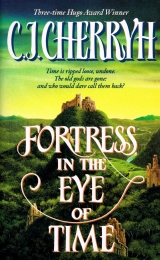
Текст книги "Fortress in the Eye of Time"
Автор книги: C. J. Cherryh
Жанр:
Классическое фэнтези
сообщить о нарушении
Текущая страница: 15 (всего у книги 47 страниц)
The smell of burning was overwhelming. It clung to them as they went, the horses all panting with the pace Cefwyn set, white froth flying from the bits in the gathering dark.
“I surely wisht I had me a bow,” said one of the soldiers.
“Keep ahorse,” breathed another. “Ain’t no arrows to touch the cursed dead.”
“Quiet,” Cefwyn hissed.
“Fire,” Tristen insisted.
The air seemed gray, then, and he knew he had slipped again into that dangerous place. Worse, it had become full of Shadows.
He saw fire spreading through the shadow-woods, pale and dimmed, sickly orange in a white and gray landscape of shadows, and he could no longer find Cefwyn nor the men with him as he rode.
–Stay, a voice said to him. Stay, fledgling. Feel your feathers singed, do you? The fire will not touch you. I would not let it touch you. Believe me. Trust me. Follow me. I’ll lead you safely borne.
–Emuin? he called out. Emuin, are you there?
“Stop him!” voices cried.
Hands reached, Shadows rippled and rushed through the gray and the smoke and the pale, pale glow of fire against the pearl-colored sky.
He saw a gulf of darkness ahead of him and sent Gery flying across it, riding for the only gap in the fire be saw.
He struck a level plane where Gery fairly flew, away from the fire, away from the flames, away from the voices and the Shadows that reached for him.
But Gery and he went soaring through empty air, and a way loomed in front of him through breaking branches, a way of escape with fire on either band, a path that went on and on, into the pearl-gray air.
Darkness loomed up; the bodies of horses checked Gery’s forward rush. Catch the reins! he heard one shout, and hands dragged at Gery, hands dragged at him, too, until Gery stumbled and slogged to a stop.
The gray was no longer clear but charged with man-shaped shadows, full of harsh voices and reaching hands ...
“Stay,” Idrys advised in a voice hardly recognizable for its rawness.
“Stay, damn you! Enough! M’lord Prince!”
Other shadows came up behind him. He was still on Gery’s back. The whole sky spun and wove with lesser Shadows, the sort that men made: pale gray, not the deadly black of the true ones. The air echoed with voices reporting riders in the hills.
“Cursed ground,” someone said, and: “They’re Sihh8 dead,” which was a Name potent with their fear. “What’s it to him?” another asked. And another: “He’s right with ’em all. He’d have led us to very hell!”
“He led us to the road,” a louder voice said. “Shut your damned mouths.”
And amid all those voices he heard Cefwyn ask, “How did you chance here?” and heard Idrys answer: “The woods and damned good fortune.
There was manure that no sheep nor goat made, m’lord Prince, horse manure spread about Emwy’s orchard, bold as you please. I fired the hay, sent ten men after you overland and took the short way after—four good Guelen men, m’lord Prince, four good men lost on this cursed venture not counting Lewen’s-son!”
He was no longer holding Gery’s reins. Gery moved, and he swayed and Gery moved out from under him as someone called out warning, but he found nothing at all to hold—he was drifting in that gray place, and a hand pushed him until he was straight in the saddle and Gery moved back under him.
More men came riding up, enemies, some thought, but they were not.
He knew them, not their names, but he felt their presence and knew them for Cefwyn’s men. They were men Idrys had sent to track them through the countryside, and they complained of ghosts, and haunts, and swore they had smelled smoke, too, that it clung to their clothes. That they had heard voices and children screaming.
The night came clear about him, then: a place, a road, open to a sky beginning to show stars. They were on the road, and Idrys spoke of ambush. “We should be on our way, m’lord Prince,” Idrys said. “There’s nothing to gain, few as we are. We’ve tripped something before they’d like—so let us have the advantage of it, not throw lives away in chasing ghosts. It’s phantoms you’re seeing.”
“A plague on Heryn’s lost sheep,” Cefwyn said, and, “We’ll have questions for Emwy district. If they won’t respect my banner, they’ll pray for me back again. And they’ll answer my questions.”
They rode away from the place. Things came clearer as they went, the dark of ordinary night succeeding gray in his vision. But they were going, they said, back to the town, back to safety, where they might send men to find out the truth of business about Emwy district.
“Althalen,” he heard Idrys mutter. “A fit place to murder the Marhanen heir.”
A Name, a Name that rose up and coiled along the road, a Name that cast the night into confusion and distrust.
A Name that wrote itself on aged parchment, and shadowed with Owl's broad wings.
The gray was more, then, and the light in that place breathed with voices all striving to tell him something, but so many spoke at once he could not hear a single word.
He was sitting on a rock, and horses were nearby. He swayed as he sat, and a hand touched him—he reached to feel it, seeking something solid in the reeling, giddy light.
A blow stung his cheek. A second.
“Cold as the dead,” Cefwyn breathed. “Tristen.”
“M’lord,” he said. The world was clear, if only the small dark space of it where Cefwyn was kneeling on one knee—that was not right. Cefwyn should not do that; but all else was gray, and cold, and went and came by turns as Cefwyn fumbled at his own collar and drew out a circlet of metal on a chain.
“Here.” Cefwyn drew the chain off and pressed the object into his hand perforce. He felt the shape. He felt it as something alive and potent. Numbly he clenched it tight, pressed it to his heart and breathed, seeing the world dark and overwhelmed with Shadows and starlight.
“I was lost,” he murmured, trying to make them understand.
“Cefwyn, —”
–The Marhanen. We are betrayed once and twice, creature of Mauryl Gestaurien. You are deceived if you trust in these. Mauryl cannot have intended this, of all things else he would have done. You are in the wrong place. Leave them. Come away.
“Unnatural,” a soldier muttered. “They’s ghosts about. They’s no good for a Marhanen nor a Guelen man on this road.”
“Get him up. Set him ahorse,” someone said, and Tristen tried to see, but the Shadow was around him. He knew he stood. He knew Cefwyn took the object and the chain from his hand and put it over his head, and about his neck, insisting that he wear it. It chilled him through the mail.
“I am afraid,” he said. “Cefwyn, I don’t know the way from here. I can’t find the road home.”
“Hush,” Cefwyn said, or Mauryl said. He was not certain. Rough hands pulled him, guided him, lifted him up and across a saddle which he struggled at the last to reach, knowing it was his way to home and safety.
A long time later he heard the sound of horses. He said as much, but no one would listen. Later, after another rest, and after they were on their way again—it might have been hours—they heard them, too, and he heard men curse and some invoke the gods. He heard metal hiss and knew the sound for the drawing of swords.
He felt at his side, but he had no sword. As in the loft when Mauryl died, when others took measures against the danger, he waited, not understanding, searching through the grayness to know whether the riders that came toward them were friend or foe.
Someone hailed them in the distance. “M’lord Prince?” that voice said, then closer. And eventually another called, rough and grown familiar since a morning that now seemed a world past, a voice that had called him out of a safety amid the bedcovers, out the dark of his room yesterday morning.
“M’lord Prince? Lord Commander? Is that you?”
He trembled, recognizing Uwen’s voice. He saw Uwen with a bandage about his head, ahorse and leading other horsemen toward them out of a faint coloring of dawn above the hills.
Among the riders was His Grace Lord Heryn in velvet hall-clothing.
Heryn made haste to get down and kneel on the roadside and to offer Cefwyn his respects and his concern.
“Well you came,” Cefwyn muttered. “And with the Guelen guard.
How kind of you to bring my soldiers. Or was it my soldiers who brought you?”
“I heard the news,” Heryn said. “Your Highness, I had no inkling, none, of any disaffection in the area. My men have come and gone there with no hint of their doings. I swear to you I’ll find out the truth. I’ll get to the heart of this. I’ll find the ones responsible and their kin. Damn them all!”
It was not the last word that Heryn said. Cefwyn also gave some answer to him. But the sound of voices grew dim. Uwen had ridden close, and asked if he was well.
“I think,” he began to say, but did not finish.
–Tristen, the Wind breathed. Tristen, Tristen.
He felt the chill, and struggled against the touch.
–No, said the Wind, and there was fear in it. Tristen is not your name.
“Uwen, —” he found wit to say. He stood on the ground. He had gotten down from Gery at the rest they took; but he stood foolishly with Gery’s reins in hand, and could not manage them, he was shaking so.
“Uwen. Help.”
“Aye, m’lord. Here’s a stirrup clear. I got ye.” A hand reached down to him, took Gery’s reins, and lingered to take his hand. “Put your foot in ’t, m’lord, I’ll pull.”
He set his foot in Uwen’s stirrup. Uwen pulled on his hand as he tried to rise, pulled until he could catch a grip on Uwen’s coat, and then on Uwen’s arm, as he came astride the horse. He settled, taking a grip on the saddle, not knowing what else to do with his hands, but Uwen bade him to put his arms around him– “The horse can carry us both a ways,”
Uwen said. “Ye ain’t got but a mail coat, nor me much more, m’lord.
Rest forward against my back, there’s a lad.”
He let his head sink again, trusting Uwen, trying with all his will not to fall into that grayness again. It had become a deadly place. He knew this as he recognized Words when they came to him. The gray space, which Emuin had warned him was not their own, was not a refuge here, this close to haunted things. He had not reached Emuin. He could not attract Emuin, only that hostile Voice that called and urged at him, and of all things else, he dared not listen to it.
But it was safety he had found at Uwen’s back, at long last, after long running. Uwen offered him protection, a trusted, a kindly presence, strong enough to chase the shadows for him.
He slept, utterly, deeply slept, then, his head bowed against Uwen’s shoulder.
Chapter 14
I done what I knew,” Uwen said. The veteran’s voice shook. And Uwen Lewen’s-son, Cefwyn thought, was not a man who feared that much of god or devil—or the lord court physician. “I talked to ’im all th’ way home, Your Highness,” Uwen said, “I told ’im, don’t you fear, I told him, Don’t ye go down, lad, and he clung on. He hears what ye say. —He ain’t deaf, sir.” The latter to the physician, who tucked his hands in his black sleeves and scowled.
Cefwyn scowled at Uwen and at the physician alike, as the learned fool shook his graying head and withdrew from Tristen’s bedside.
“In sleep, despite the protestations of unlearned men, there is no awareness,” the physician said. “It is perhaps a salutary sleep, Highness.
There is no hurt on him that mortal eye can see, naught but scratches and bruises, doubtless from the falls—”
“A fool can see that! Why does he sleep?”
“Nothing natural can cause so profound a sleep. I would say, ensorcelment. If he would bear the inquiry—” The physician moistened thin, disapproving lips. “I should say this far more aptly is a priest’s business.
Or—failing that—the burning of blessed candles. The Teranthine medal—is that his choice?”
“I gave it to him,” Cefwyn said sharply, and whatever sectarian debate the physician was about to raise died unsaid. “Holy candles, is it?”
“He needs a priest.”
“He needs a physician!” Cefwyn snapped. “I engaged you from the capital because I was assured of your skill. Was I misinformed, sir?”
“Your Highness, there are—” A clearing of the throat. “—rumors of his unwholesome provenance. —And if it is true that he came from Ynefel, I understand why you have engaged no priest. Yet I have risked the inquiry, Your Highness, and made the recommendation. Perhaps a lay member—”
“A plague on your candles. What in the gods’ name ails him?”
“Not a bodily ill.”
“A priest, you say.”
“I would not for my own soul stay an hour in Althalen; the feverous humors of that place, particularly at evening—”
“Out on you! You’ve never come near Althalen!”
“Nor ever hope to, Your Highness.” Secure in his physician’s robes, his officerships in the guild, and in his doddering age, the man gathered up his medications, restored each vial, each mirror, each arcane instrument to its place, while the patient slept unimproved and an unlettered soldier did the only things that seemed effective, kneeling by the bedside and talking, simply talking.
Baggage packed, the dotard pattered to the door and opened it.
Guards closed it after him. They were Guelen men, of the Prince’s Guard, men he trusted—as he would have thought he could have trusted the Guelen physician not to be affrighted by the unorthodox goings-on of a largely heretic province.
But Uwen stayed, on his knees, arms on the bedside, pouring into the sleeper’s ear how red Gery was to be let out to pasture tomorrow with his own horse for a well-earned rest, how she’d taken no great harm of the run Tristen had put her to, and how he was very sorry to have left Tristen in the woods, but he’d had the prince’s orders to ride to town and he had done that.
Uwen had indeed done that. With two of Uwen’s comrades dead and Uwen himself struck on the head with a sling-stone that might have cracked a less stubborn skull, Uwen Lewen’s-son had ridden his own horse to the limit and roused Lord Captain Kerdin and a squad of the regular Guard in an amazingly short time. Then, instead of pleading off as he well might have done with his injury, Uwen had changed horses and ridden with the rescue, joined of course by His Grace Heryn Aswydd’s oh-so-earnest self.
Uwen Lewen’s-son had stayed with his charge all day and night after, besides his breakneck ride and a lump on his skull the size of an egg.
Uwen had bathed the man, warmed the man from the chill that possessed him, and talked to an apparently unhearing ear until he was hoarse.
Uwen had hovered and worried without the least regard to his captain’s casually permissive order to retire, and not expected a prince’s reward for his staying on duty, either.
“You’ve done him more good all along than that learned fool’s advice,” Cefwyn said. “But there’s no change. I’ll have reliable men watch him. Do go to bed, man.”
“By your leave,” Uwen said in his thread of a voice. “By your leave, Your Highness, I had to leave him in the woods. I’d not leave him to no priest who won’t stir for thunder. I’d rather stay.”
So Uwen Lewen’s-son had looked Mauryl’s work in the eyes, too, poor ensorcelled fool. Idrys had called Uwen a longtime veteran of the borders, a man of the villages, not of the Guelen court, but long enough about the borders to know wizard tricks and sleight-of-hand; and to know now—a shiver went through his stomach—what the hedge-wizards only counterfeited to do.
He recalled the gust of wind that had skirled around the old woman in Emwy. That was either a timely piece of luck, or it was something entirely different. Tristen had been involved. Therefore Mauryl had.
Kerdin, in a moment out of Heryn’s hearing, had wanted to send a force of Guelen men to occupy Emwy and poke and pry into local secrets; Idrys, having seen the area himself, had wagered privately that such a force would find bridges as well as witches, and advised them, in colder counsel and with his prince safe in retreat, that they ought well to consider how much they wished to discover, and when.
Heryn, during that ride home, had said the horsemen whose sign they had seen near Raven’s Knob might have been nothing more sinister than his own rangers, going about their ordinary business and keeping out of sight.
Then where are Emwy’s young men? he had asked Heryn plainly, himself, and Heryn, always ready with an answer, had said they were in fact hunting outlaws, that Emwy district had indeed lost numerous sheep, and that the prince was entirely mistaken and misled if he thought there was possibly aught amiss in Emwy.
That meant that the prince, the Lord Commander, and his company had foolishly panicked at the sign of friendly Amefin rangers, that they had fled those friendly forces in confusion, and outlaws—outlaws, where supposedly Heryn’s rangers were thick!—had shot and slung from ambush, killing the prince’s men, for which they would pay—so Heryn Aswydd swore.
The bedside candle, aromatic with herbs, not holy oil, broke a waxen dam at its crest and sent a puddle down the candlestick and down again to the catch-pan beneath it. The puddle glowed like the sleeper’s skin, pale, damp, flawless.
Heryn had implied, by what he had said, that the prince and the Lord Commander of the Prince’s Guard, who, himself, had led His Majesty’s forces in border skirmishes before this, were fools, starting at shadows.
Or Heryn thought to this very moment that the prince and his Lord Commander were fools to be tricked by shadows.
Shadows of which Amefel had many, many, in its secret nooks and
Missing stuff
“Yes?”
“The physician didn’t hint at any cause, Your Highness? I seen men hit on the head, m’lord, or knocked in the gut, and I seen ’em sleep like this.” Uwen’s scarred chin wobbled. “I didn’t think he’d fallen, Your Highness, and I couldn’t feel aught amiss, but maybe he sort of cracked his head, or one of them slingers—”
“He had a good soldier’s helm till he lost it, Lewen’s-son. Where was yours?”
“I guess I give it him, Your Highness.”
“So your own head is the chancy one, isn’t it? No, Lewen’s-son. This is Mauryl’s working, and by Mauryl’s working he lives or not.” “They say Mauryl’s dead, Your Highness.”
“That they do. And perhaps the old man’s work is unraveling. Or maybe it isn’t. If we knew, then we’d be wizards and our own souls would be in danger, so I’d not ask, man. I’d just keep the fool covered and pour a little brandy wine down him if he wakes. You could bake bread in this room, gods, and it won’t warm him.”
“I been thinkin’ of warming stones. Summer ’n all, Your Highness, if we could once get ’im warm ...”
“It could do no worse. Tell the servants.” He gave a shake of his head and walked out, through the anteroom where Lewen’s-son had a bed he refused to use, and across the hall where Guelenmen stood guard over his own quarters. It was a larger room he’d allotted Tristen. It was a finer room, but that was beside the point for a man who might not wake. It was—the holy gods knew, a twinge of conscience, that he’d so failed Emuin’s simple behest to take care of their visitor.
He’d sent to Emuin, last night, post-haste, a royal courier, one of twelve such silver tags which the King in his expectations of calamity had allotted his son and heir. They allowed a courier anything he needed anywhere along his route, under extreme penalty for refusal of his demands.
He’d not used a one, before last night.
He’d not needed one before last night. Or had, counting what had been quietly going amiss over in Emwy district, and he had failed to see it growing.
Outlaws. Using shepherd weapons. And, if one believed Heryn
Aswydd, rangers on horses, unusual enough in a woodland district.
Rangers who didn’t show themselves even to the prince’s banners plainly and unequivocally displayed?
Not proper behavior, as he added the tally.
He crossed through the anteroom of his chambers and inside, where the servants were disposing bath and bed, and where Idrys was poring over maps on the sideboard.
“No change in him,” Cefwyn said.
Idrys said nothing. Cefwyn unlaced cuffs, collar, side laces, and hauled off shirt and doublet together, before the staff could receive all the pieces thereof.
“The men I wanted?” Cefwyn said to Idrys. “I’ll see them between bath and bed.”
Idrys frowned. They had had their argument already: it was bootless to dispute it in front of servants. Idrys said, “Yes, my lord Prince,” and turned and went.
Four messengers.
To four lords of the south besides the Duke of Henas’amef, proud Heryn Aswydd. There was a lesson to be taught, and it began now, before the sun had risen on this silken-smiling Amefin lord, who asked with such false concern after his safety, who rode in hall clothes out to the windy road to ask after a Marhanen’s welfare.
Cefwyn shed the rest of his clothing, stepped into the bath and ducked down under the tepid surface long enough to scrub the sickroom heat from his skin and hair, long enough to count to twenty, and to want air; and to find the bath too warm for pleasure after the stifling warmth across the hall. Gods alone knew how Lewen’s-son stood it.
“Your Highness,” Annas said, alarmed as he broke surface again-expecting a near drowning, perhaps; but Cefwyn found the draft from the open window vents more pleasant than the heat of the water. He clambered up to his feet, reached for the linen which a servant, taken aback, was slow to give him, and snatched it around himself, splashing the marble floor and the plastered walls as he stepped out. Servants mopped to save the woven mats and other servants scrambled to offer his dressing robe and more dry linens. The bath smelled of roses and hot oils. It cloyed. The water heated the air around him. He shrugged the dressing robe about him and mopped his own hair with the linen towel, ignoring the servants’ ministrations as, in his wake, Annas ordered the just-poured bath removed, the bath mopped—the linens taken away.
“Leave it,” he said, and tossed the towel at the boy nearest him. “It can cool.” It took six servants half an hour to empty the cursed tub. “Do it in the morning, Annas, please you, I prefer quiet.”
Annas understood. The three pages seniormost in his service understood. The latest come, he doubted. But he sat down in front of a window vent in his double-layered robes, and endured, still damp, the noxious airs of the night breathing from the open windowpane, despite his physicians’ earnest disputations and predictions of the upsetting of his humors—his humor was vastly upset already, and if anything, the damp wind cleared his wits and made him less inclined to order summary execution for the servant who escaped Annas with an offer to light the, he was assured, already-laid fire.
“Out!” he shouted, he thought temperately, and moving to his desk, taking up pen and uncapping the inkwell, he wrote four brief notes to four provincial lords, affixed the seal of his personal ring, which precluded tampering with the ribbon he wrapped about each. Then he waited.
The chest was in front of him. The Elwynim chest. The bride offer.
And perhaps it was imprudent and tempting his own immoderate anger to lift the lid and to take out the ivory miniature, and to test his mood against that wide-eyed expression, the full lips, the midnight cloud of curls and swell of bosom daringly portrayed to entice a man, an offer of luxurious peace—to snare the heir of Ylesuin.
And ask—ask whether there were old bridgeheads being refurbished across the Lefialim. Ask what this offer meant against the arrant folly of Heryn Aswydd who, if he were wise, might know his two sisters, fields for every plow, were temptation to lesser lords, but not to the heir of Ylesuin, not to promote His Grace Heryn Aswydd of rebel, perpetually heretic Amefel up to high estate in the court at Guelemara.
All that Heryn expected, in return for no more than a tumble in the bedclothes, for the latest gossip, for a whisper of Heryn’s ambitions, for a night few whores could match for invention or few councilors for wit: oh, well indeed the twins (who came in a set, he had always believed, principally because neither trusted the other) were full of plans. By what he had heard, Tarien never, never forgave her sister her minute precedence into the world and would knife her in an instant if she thought Orien might gain anything above her.
Mothers thereby of a royal heir? No. That was for ladies richer, less versatile, more religious, less profligately trafficked, and certainly of larger, more influential and orthodox provinces. He could name an even dozen candidates of higher degree; ladies virginal, well-brothered and
–fathered and -uncled– Close-kneed, religious, limp and meek.
But—this—Elwynim. This—ivory bewitchment at which he stared, at odd moments, imagining that face alive with hints of both virginity and hoyden mischief—a crown of pearls and maiden violets, mirth dancing in the eyes, lurking about the edges of the mouth ...
The Regent’s maiden daughter and only offspring, a bid for peace, an end of the old rivalry.
Meanwhile the vicinity of Emwy seethed with so-called outlaws, that near the ruins of Althalen, that near the Lenfialim’s dividing shores, open defiance aiming at seeing the Prince of Ylesuin come to the same end the Sihhé had met—while the Aswydds simply pursued kin-ties, bed-sharings and bastard offspring (who might be worth lands and money in the coffers of the Aswydds, if nothing else) and endlessly embellished this great gilt palace which, the prince would greatly suspect, came not only of hidden Sihhé gold, but of other sources.
Foolish offer, this ivory Elwynim loveliness. A message had come with it that Elwynor did not propose to yield up its sovereignty, but that the Regent’s line, having come down to a daughter with no other royal prospect, considered a matrimonial alliance and separate title for the heirs.
Audacious. Damned audacious of a man waiting all his sonless years for the Sihhé! to rise from their smoky pyre, or for Mauryl Gestaurien to mend his treason and send them a King.
The more to worry—considering the feckless young man across the hall, who’d shown a seat any rider could envy and a skill at riding he claimed not to have.
Damn Emuin. Damn Emuin for kiting off to prayers and piety and leaving him a young man so full of mysteries. Every possibility and every fear he owned was potentially contained in the young man lying cold as a corpse in that bed—who might be fading, for what he knew, with Mauryl’s power leaving the world, who might be ensorcelled by gods knew what, who might be afflicted by some malady that—naturally?-gods! came on the raised dead.
The source of souls, Emuin had said.
And fallen into languor at Althalen, the very place where the last Sihhé king perished?
He heard the sound of men entering the antechamber and knew by the plain fact there had not been a rush to arms among his guards outside that it was Annas or Idrys, and by the scuff and clump of soldierly feet that Idrys had come back with the men he had asked Idrys to find.
He disposed the miniature to the chest; he closed the lid; he looked up as Idrys shepherded his choices to his desk. Idrys took a stance with arms folded, his eyes disapproving; and Cefwyn ignored the pose as he had ignored Idrys’ objections to his decisions.
Four men, plainly armored and armed, Guelen men. So was the patrol that was going out in pursuit of the bandit remnant that had official blame for the attack on the Marhanen prince. They were Guelen men, too, that patrol, with orders to believe nothing too fantastical of bandit origins, and to look closely at kinships with Emwy and with Henas’amef did they take any bandits—did they take any, which a gold sovereign would wager they did not.
But these four men would not ride all the way with the patrol.
Nor would the four parchments bearing the Marhanen Dragon and
Gillyflower personal seal of Cefwyn Marhanen, the King’s viceroy—who did have specific authority to do what he proposed, but who.., with the
King’s grant of a viceroy’s power in Amefel ... held the royal command over this whole uneasy border, with authority the southern barons would ignore at their peril.
“A patrol will go out under sergeant Kerdin Ansurin,” Cefwyn said.
“And once out of view of the town, you four will go your ways, avoiding
Afterward Cefwyn lay in the broad bed, threw a coverlet over himself against the breeze from the window, and stared at an unrevealing mural on the ceiling, a trooping of fairy and a breaking-forth of blossoms, wherein smaller fay lurked under leaves and made love in the branches.
A star was in the painted sky. A gray tower—or was it silver?—was on the hill. A star and a tower were the arms of the Sihhé, alike the arms of Mauryl, the Warden of Ynefel, were they not banned throughout Ylesuin. But surely Heryn would not lodge his prince in this chamber, under that painting, if they were more than chance elements of the piece.
Perhaps the prince was suspicious and uncharitable even to suspect Amefin humor in the arrangement—as he was suspicious and uncharitable to suspect Amefin humor in Heryn’s riding, oh, in hall velvet, and lightly cloaked, with the guard, risking danger– —only in his tardiness to make his claim of innocence. Heryn had faced no danger of alleged outlaw weapons, the real nature of which he would wager his royal stipend Heryn knew.
He had laid out his riding clothes, his sword and his leather coat on the bench nearest the bed, without advising Annas or asking the servants’ or the pages’ help. He wanted no rumors running the halls until a bolt was on the armory door.
He did not take for granted at all that he could, without a blow struck and with but a handful of loyal guard, collar Heryn Aswydd—who was no novice in deceit and who had far cannier and hereunto unknown advisors. Even relying on Idrys’ skills to avoid surprise, he knew Idrys’ failings in diplomacy toward recalcitrant outsiders, and knew he risked stirring resentment where none had existed—at least where none existed to any extent that would prompt Amefin to assail the prince of a realm that had been, if not loved, at least peacefully and reasonably obeyed.
It seemed to him urgent, however, to act. His household officers generally had thought it best to tiptoe about the secrets of Amefin disaffection and map all the edges of it before making any move, all for fear of starting something far larger than Heryn from cover—meaning Amefin collusion with their ancient allies the Elwynim—and stirring themselves up a far wider conflict than a bandit or two in Emwy’s bushes.