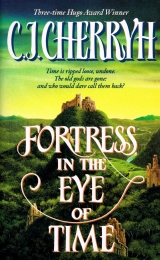
Текст книги "Fortress in the Eye of Time"
Автор книги: C. J. Cherryh
Жанр:
Классическое фэнтези
сообщить о нарушении
Текущая страница: 44 (всего у книги 47 страниц)
“That is Umanon,” Cefwyn speculated aloud, his heart lifting.
Idrys, quick as his own thought, pulled back in the column and gave orders, and two more scouts immediately rode away from the column and overland in that direction, this time to welcome the lostlings in.
“Thank the gods,” Cefwyn breathed, certain now that they had found at least two of their missing contingents.
Within the hour the riders from the south had crested the rise along the road, a rolling tide of the swift-moving Ivanim light horse, and behind them, their slower-moving allies of Imor, a dark mass of riders and warhorses at lead. The banners were plain in the sunset, and Tristen drew a deep, glad breath when he saw it.
“Two of them,” Cefwyn said in Tristen’s hearing. “Now, gods save us, if now Pelumer will come in ...”
Olmern had perhaps succeeded, Tristen thought when Cefwyn made that wish. He could in no wise tell for certain, but he felt none of the hostile influence to the northeast, and that said to him that their enemy had not gone that way. The way they had left open to As6yneddin had cost them dearly, those two bridges eastward of Emwy district, which Cefwyn had hoped would make an incursion from the forest-edged west the only answer if Aséyneddin wished to cross quickly into Amefel. Tasien was gone. The Elwynim had crossed and committed themselves. No second rebel force could threaten Henas’amef without coming by way of Emwy, and without passing them.
That portion of the plan was, he hoped, working. Cefwyn had designated reciprocal messengers that daily came to Henas’amef from the east reach of the river, upstream, and one would have reached Henas’amef last night. After that, Efanor should have sent the regular relay out north to the river and sent another courier west after them, bringing Cefwyn word of the riverside and Sovrag.
Cefwyn’s system of messengers, Tristen thought, was very well done; it had freed him personally of the necessity to try to reach Emuin, which was the most dangerous thing he could do short of speaking to Hasufin himself. Cefwyn’s couriers had gone out from the army directly north this morning, to reach Sovrag directly and to bear Ninévrisé’s second messages of reassurance and encouragement to the Amefin riverside villages, jointly with Cefwyn’s, to assure them they were not abandoned, that Sovrag was not a threat to them, and to urge the villages to report to them directly overland in the now remote chance Lord Aséyneddin should cross somehow—on that matter, the defense of the province might have turned.
But now the bonfires they had lit on the hills had brought them Cevulirn and Umanon, and that was another wonder of Cefwyn’s forethought: the simultaneous muster of the barons and their being able to join Cefwyn’s column on the move had all relied on measuring distances, which Cefwyn had done in advance, and knowing very accurately how fast the various forces could move, granted they saw the signal fires and moved at all.
If one had no way into the gray space, it was a very clever way of doing things. It was a way of getting around wizards—and it was important to know how that could be done. He marked it always to remember, and never to become complacent in what he saw.
And the gray place was constantly urging at him. It was full of shadows and lights and whispers. Now with the sun taking the light for the land and making the hills gold, and with their allies riding toward them, he felt that the missing pieces that had to exist had now come together.
But he did not have that feeling of inevitability about Pelumer that he had had all along about Cevulirn’s coming and Umanon’s. Marna’s dark edge was Pelumer’s route—and he had no wish to look deeply or long in that direction.
Cevulirn came riding up in the sunset with the White Horse flying, leading his own warhorse with him, as every man in his company had a remount with him and his lance and shield and a small amount of provisions packed on the warhorse’s saddle.
That was the way the southern horsemen had done forever, constantly changing from mount to mount. So Cefwyn advised him as the riders came, and it unfolded in Tristen’s thoughts that it had indeed been that way, that on their longest marches they had two and even three horses in their string. He saw it so vividly that a Name almost came to him, and he felt comfortable with the Ivanim, and knew their thinking, for reasons he did not clearly know.
Cefwyn told Cevulirn his place in line and his place in camp from memory—a precedence in line behind the Amefin, whose province it was, and ahead of Umanon, whom he had beaten in—Cefwyn told Cevulirn where his warhorses should be, and where his wagon was and where his tents would be, which they had brought for him.
“Your Majesty leaves no work for the scribes,” Cevulirn said with the mild lifting of a brow. It had seemed a point of amazement among the barons in all the preparations that Cefwyn did remember such things in very certain detail.
“Join us this evening!” Cefwyn wished him in sending him Off. “We’ll take a cup of wine together—and explain this haste!”
Umanon also came riding up, his men traveling in the same style as the Ivanim, leading a contingent of heavy horse. “Majesty!” Umanon called out. “A short stay at home. I’d scarcely built a fire in the hearth!”
“I shall explain tonight!” Cefwyn said. “But things are as well as they can be. Thank the gods for your meeting us. We’re in good order, with you here, Your Grace! See me when first you’ve set your tents!” And Cefwyn told Umanon the numbers and place of his camp as well, after which Umanon rode off to his assigned place in the order, and to claim his personal baggage.
The day had worn hard on Cefwyn. He had started the day as he had started yesterday, riding strongly, but now despite the good news of a moment ago, he seemed to Tristen to be clinging to his courage and to his composure even at Danvy’s sedate walk. Danvy had given a couple of quick steps as horses came up to him, and Cefwyn had corrected that, but at a price.
“Not far,” Tristen said to him, the only encouragement he could offer, for if there was one road in the world he knew it was this one and if there was one thing he could now sense like his own bonfire in this night, it was Althalen.
It was deepest dusk when they came to their projected camp, in that area of the road respecting Althalen’s perimeter and across the road from any accidental encroachment on what Cefwyn called the cursed precinct.
Tristen was very glad, himself, to get down. The wagons were yet to come and the least essential ones, with the units of horse that guarded them, would be arriving long into the night.
“Set the unit standards with their units,” Cefwyn called out, pointed warning against any such carryings-on as yesterday night. “Bid everyone keep their standards in good order. From this place on, there is danger of the enemy at any hour!”
Ninévrisé had not gotten off her horse, and Tristen walked over to see if she needed help; so did Cefwyn, at the same time. “My lady?” Cefwyn said.
“My father’s grave is here,” she said. “I wish to ride just to the edge of the ruin, my lord, to stay only for a moment, if I can do it without endangering the camp. But I feel—I wish to, my lord.”
Tristen stood by, having been ready to offer Ninévrisé a hand down.
He knew that Cefwyn did not want to grant such a request, and that Cefwyn out of his willingness to please Ninévrisé would get back on Danvy and take a guard and go, though he was in pain. He would not send Ninévrisé only with an escort.
“I shall go with you,” Cefwyn said, with never a protest.
“My lord,” Tristen said. “My lord King, this is a place where I can see things others may not, and defend against things others cannot. I can take Uwen and my guards.”
Cefwyn looked at him, seemed to consider, and let weariness and gratitude touch his face. “Half yours,” he said. “Six of the Dragon Guard.
We’ve tents to raise. —And be careful. In this matter, I trust you as no other, but for the gods’ own sake, for the gods’ sake and on your oath to me, be careful.”
“Yes, sir.” He went to get Petelly and gave orders to Uwen, glad that Cefwyn had been reasonable—but most of all feeling now in his heart, as clearly as he saw the sun sinking, that Ninévrisé’s request was both urgent and advised.
He mounted up and by that time Uwen had collected the men Cefwyn lent him. They crossed the road, on which a seemingly endless line of riders and men afoot stretched on out of sight, and they entered the meadow on the other side, riding up through a screen of trees to another grassy stretch, farther and farther then, out of sight of their camp, and up into the area where they had met Uwen that dreadful night, in the rain, and with Caswyddian’s forces behind them.
Uwen grew anxious. So did the men with them. And perhaps, Tristen thought, he should be apprehensive himself, as he saw streaks of wind run through the grass, and one little one, following a thinner, very erratic course. He knew the child, saw her frolic without seeing her at all.
Ninévrisé said, “Something is there.”
“It is,” he said. “But don’t look too closely. She doesn’t like to be caught, Uwen, it’s the witch of Emwy’s child. She’s a little girl. I’m glad to see her. Her name is Seddiwy.” “That old woman?”
“I don’t think the child died when Emwy burned. I think she might have died a long time ago. I don’t know why I think so, except the Emwy villagers are here, too, and they’re not so friendly, or so happy as she is.
–But they won’t harm us. She’s stronger than she seems.”
“Gods,” Uwen muttered, as four distinct marks flattened the grass ahead of them, leading where they had to go. “Is it those streaks in the grass?”
“Yes, those.”
“M’lord, I do hope you know where we’re going.”
The light was leaving them very fast, now, and none of the men looked confident—they were very tired, they had been two days now on the
road, and they might, except for this venture, be sitting at the fires and drinking wine with their friends and waiting for their suppers; but on
Cefwyn’s orders they came, and fingered amulets more than weapons.
Petelly snorted and twitched his head up as the little spirit darted beneath him—and then right under a guardsman’s horse. It shied straight up, and the man, most anxious of their company, fought hard to hold it from bolting.
“Behave!” Tristen said sternly, and that stopped.
They were coming among saplings that had been all broken off halfway up their trunks. Rocks lay shattered in the grass.
Then one of the Dragon Guards reined aside from something lying in the grass, and said, not quite steadily, “Here’s a dead man, Lord Warden.”
“Caswyddian’s men,” Ninévrisé said calmly enough, though her voice was higher than its wont. “Are we in danger, Lord Tristen? Might their spirits harm us?”
It was to ask. But—”No, I don’t think so. The Emwy folk seem to hold this place to themselves.”
They came up that long, difficult ridge, where two men had fallen. The rains had not quite washed away the scars they had made on that climb.
They reached that place that overlooked the ruin, and it stretched very far under the cover of trees and brush and meadows. Despite the chill of the winds below, the air on this exposed ridge was quite still, even comfortable. There was a sense of peace here that had not existed before, tempting one who had the power to look in that different way—to stop and cast a look in this fading last moment of the light.
Ninévrisé said, in a shaken voice, “Father? Father, is that you?”
Then a change in that other Place caught Tristen’s attention, as certainly a presence would: and in that instant’s glance he saw pale blue, and soft gold. He risked a second look and saw the Lines of the ruin, the lines on the earth that had grown fainter and fainter in the hour of the Regent’s death now spreading out brightly far and wide. Brighter and brighter they shone in the dusk as the world’s light faded, until they blazed brightly into inner vision. Other lines glowed where those lines touched, and those touched other lines in their turn, like fire through tinder, blue and pale gold, each form in interlocking order, as far as the eye could make out, one square overlaying the other—all through the grass, and the thickets.
It was the old man’s handiwork, he thought, astonished and reassured.
Late as it was, the earth was still pouring out light. Shadows flowed along the walls, but respected the lines of those walls now. The men about him glowed like so many stars to his eyes; and then his worldly vision said it was not the men, but the amulets they wore, the blessed things, the things invested with their protection against harm—as Emuin’s amulet glowed on his own chest, in the midst of the light that was himself.
That glow seemed the old man’s doing, too—yet none of the men with them, not even Uwen, seemed to see all that had happened. Only Lady Ninévrisé gazed astonished over the land.
“Your father’s work!” he said. “Do you see, my lady? He is not lost!”
“I see it,” she said, holding her hands clasped at her lips. “I do see!”
“What, Lord Warden?” a guardsman asked; but Uwen said, quietly,
“What m’lord sees ain’t bad, whatever it is. Just wait. He’s workin’.”
“No,” Tristen said, for the men’s comfort. “It’s not bad. It’s safe. It’s very safe here.”
The Lines, as they had that night, showed him what Althalen had been, bright as a beacon, now, advising him here had been a street, here had stood walls, here was a way through the maze, though brush had grown up and choked the open ground.
And when he thought of that, a Name the old man had not been able to tell him seemed to sound in the air, unheard, that Question to which the old man had known the answer resounded through the grayness, and Lines on the earth rose into ghostly walls and arches, halls full of people who walked in beautiful garments, and ate delicate food, and laughed and moved in gardens and a river ran near that had boats sailing on it, boats with colored sails and with the figures of beasts and birds on their bows. He did not know whether he could say it as the old man did—but he had almost heard it ringing through the world.
Not Althalen, he thought, then, aware he was slipping very rapidly toward the gray space—but not—suddenly—at Althalen.
There was a murky river. He knew where that river ran—he was in sudden danger. He had risen into the gray space—and gone badly astray, trapped, by an enemy old and clever, and still able to have his way.
He met the attack. He set himself to the fore of Ninévrisé, approaching the enemy on his own, hut not taking the enemy’s vision– When he thought that, immediately he found a vantage he knew, outside, on the parapet of Ynefel, in the sunset. He knew his loft, the high point of a vast hall across the courtyard, highest point in the keep.
He could see his own window, with the horn panes glowing with light in the twilight, as if he were there himself, reading by candlelight—but with the shutters inside open. That was wrong, and dangerous.
It was his window, and it was his home, and he knew the study below, in which he kept his books, many, many of them—not Mauryl’s books, but his own books. He was puzzled, and thought, That was never true.
The height of Ynefel rang with a Word, then, which he could hear, but not hear, in the curious barriers of this dream; and at that Word, all of this glorious building trembled and fell quiet.
He stood on the very parapet, where he had gone—or would go-naked in the rain.
He watched all the buildings from there—the illusion of a living city widespread about Ynefel’s skirts, streets busy as the streets of Henas’amef.
But it had not been Ynefel on that day. It had had another Name. So had he. And he had come there with Mauryl’s help to cast all that citadel down.
He was angry, he knew not why or at what. That anger grew in him, and as it reached the point that he must loose it or die, he let it loose.
In that loosing, a wind swept the halls, swept up the men in their elegant clothing, and the women in their bright gowns, and the children, alike, with their toys, and whirled them all about the towers, tumbling one over the other, out of the bright world and into that gray space where they hurtled, lost and afraid.
Some, more determined and more powerful, found their way back to their former home, and peered out of its walls, frozen in the stone.
Some became Shadows, angry ones, or fearful ones, or simply lost ones, wailing on the winds that carried them through that gray light, until darker Shadows hunted them down, one by one, and ate their dreams and their hopes and their substance.
But all such shadows as came to him for refuge he breathed in and breathed them out again with his will, and by them he mastered the anger that threatened his reason. By them he learned.., better things.
A young man in gray had stood by him, but that man was gone. He possessed securely the walls, the woods, the river, in all the vacancy he had made.
He had done this. All the City was gone. He remained. The Tower of Ynefel remained.
The faces watched from the walls, and the lives flowed through him with a heat like too much wine. He was trembling now. He wanted to know—who had done such a thing, and could it possibly be himself who had begun it?
But of his own countenance and his own reasons he could discern nothing.
He had lived—or would live—in that small room with the horn-paned window. He had come at Mauryl’s asking, and he knew at once his enemy was the man who had stood beside him, the young man in gray, against whom he had fought with all the resources at his disposal—even binding the lives of the people of Ynefel to his effort.
He wanted to know who he was. He wanted to see the face of the one who would have drunk up all the world only to cast out the man in gray.
He had asked Mauryl—or would ask one day—whether Mauryl could see his own face. He thought it clever of himself to wonder that in this dream, a trick by which he could make the dream reveal itself—and him.
But in this dream he had no mirror, nor were there any such, until, still in this dream, suddenly standing within his own room—or what would be his room—he found on the bedside table a small silver mirror.
Threads of shadow formed about it, resisting, strands clung to it as be picked it up, and shriveled when be would not be deterred.
He bad been clever. He bad gained in this dream the mirror Mauryl bad given him; but once be bad found it, be was back in the courtyard by the kitchen door and the rain-barrel. Daylight was behind him and even with the mirror be could see no more than be had seen in the rain-barrel that day, only his own outline, an outline with a shadowed face.
So the dream bad tricked him, and would not at any trick be could play unfold more than be bad seen.
He was sitting on Petelly’s back again. He had his hands locked before his lips. He was aware of the men watching him. He had come all that distance through the past, alone of those living, and alone of the dead-but he knew nothing. Nothing.
He had found reason to fear—and out of his fear, and in revulsion at Hasufin’s cruelty, he thought now, had flowed his terrible anger.
And when his anger broke loose—at least in the dream—he had used lives for the stones and anger for the mortar of his fortress.
It might be illusion. Mauryl had said not to fear dreams, that there was not always truth in them. He thought that Mauryl had had a part in what had happened.
The old man had said—Hasufin would use even his dreams.
The old man had proposed to hold Althalen, and everywhere around him, now that he had broken with Ynefel, was the evidence of the old man’s power. Surely Hasufin could not make something seem so fair-more—feel so fair, and so safe, and so familiar.
But the faces of Ynefel lately in his memory were a truth he could not deny.
They moved on certain nights—or seemed to, when the wind blew, the balconies creaked, and candle flame wavered in the drafts.
Ynefel, which held always a warm, homelike feeling for him—was a terrible place, where he—he!—had done something unthinkable and destructive.
“M’lord,’ Uwen said, moving his horse close. “M’lord?”
He could not move. He could not look aside from that structure of glowing lines, feeling always less than he needed to be, less wise, less kind, less—able to create something like this, so fair and so bright in the gray world.
His handiwork—was other than this.
Men feared him. All men did well to fear him.
Uwen took the reins somehow, and turned Petelly about, and once they were faced the other way he realized that Ninévrisé was close beside him on one hand, and the guardsmen had gathered about them, hands on weapons and yet with no enemy against which they could defend him.
He put his hands on Petelly’s neck, and patted his neck. “I can n age, Uwen,” he said as steadily as he could.
“M’lord,’ Ninévrisé said—frightened, too, he thought. He had takenher into danger. “I saw nothing—nothing amiss here.”
“Then the harm, if there is harm, is in me.”
“No such thing, m’lord,” Uwen said firmly, and, leaning from his saddle, managed to pass the reins over Petelly’s head again, which require his help to straighten out. Petelly lifted his head, making the maneuver more difficult; but he secured the reins, settled Petelly’s anxious starts, one direction and the other, and as their small party began to ride hoi went quietly, reasonably back the way they had come, among the hi, shadowing with night, and finally across the road, down the busy center lane of the camp, where wagons and men continued to come in.
He said, to the men, when they crossed the road, “What I saw boded no harm to you.” He knew that he had acted in such a waythat might spread fear through the army. “I beg you not mention it. Ishall tell His Majesty when I know the answer.”
The leg ached, ached so that a cup of wine was Cefwyn’s chief wish, far mo than a supper, no matter the servants’ efforts. It was past dark, there was r sign of Tristen and Ninévrisé, and he had debated with himself whether t offend Ninévrisé by sending men out—or whether to sit and worry.
But the mere sight of Cevulirn and Umanon was reassuring, and persuaded him he had so many men in the vicinity that no enemy scout would be too daring, and that the Elwynim rebel that tried Tristen’s mettle, would find that small band no easy mark at all. Sit still, he told himself Let them learn what they can learn in their own way. Sending someone into wizardous doings was not wise.
Sending two most valuable persons to seek out wizardry worried him intensely.
But he had trusted Tristen too little so far. He could not rule by hampering his best counselors, whatever the frightening nature of their investigations.
Outside the royal pavilion, the White Horse of the Ivanim and the Wheel of Imor Lenfialim were snapping in a stiff wind alongside the Dragon and beside them, the Tower and Star, the Regent’s Tower and the Amefin Eagle. The wagons belonging to the Guelen regulars were disgorging their supplies. The Duke of Ivanor and the Duke of Imor had pitched their tents alongside his, with Tristen’s on the other side, next Gwywyn’s tent, which was the command post for the Dragon and the Prince’s Guard. They made no individual fires tonight, in the tents of the common men, so as to give any spies that did venture onto surrounding hilltops no convenient way to count their number. But fires were starting outside, and cooks were hard at work with the big kettles, boiling up soup and unpacking hard bread they had brought from town. The common men would not fare at all badly tonight, mutton stew and enough ale to wash it down, very good ale, he had ordered that personally. But it would not be enough to become drunk.
There was a grimmer and very businesslike feel to this camp, from which they would set out on their final march either to fight or to establish a camp in the face of the enemy, from which they would launch a more deliberate war.
There was more and quicker order, for one thing, so Idrys had reported from his latest tour about. Untaught peasants, accepted into Amefel’s line, followed lords’ and officers’ orders and soldiers’ examples tonight in the not unreasonable confidence that their lives very soon would hang upon what they learned. So from a slovenly behavior at the outset, things were done remarkably well this evening among the Amefin, and two of the Amefin village units, of Hawwyvale, were at drill even in the dark and by lantern-light, an excess of zeal, Idrys said, and he agreed: they dared not have the men exhausted.
Meanwhile, Kerdin Qwyll’s-son said, the Guelen regulars moved among the Amefin, impeccable and meticulous in their procedures, instructing those who would listen. A few officers had gone about near the fires and had eager and worshipful entourages of wise Amefin lads who wanted to live long lives.
Among them, too, in the attraction of the bonfires, were Cevulirn’s riders, drilled from boyhood to ride the land and teach the young village lads what time they were outside the service of Cevulirn’s court. They had set the small Amefin section of the horse-camp in good order very quickly, and joined the tale-telling around the fires. So did Imor’s men, mostly townsmen, well-ordered and well-drilled; merchants’ and tradesmen’s sons, they drilled on every ninth day, and of those merchants’ sons every one that afforded his horse and attendants was proud and careful in his equipment-a haughty lot, more so than Cevulirn’s riders, who, if the ale did start flowing, might grow less reserved than their gray, pale lord.
But they had not heard from Pelumer and they had not received Olmern’s messenger.
He had made his third venture to the door, and to the fire at which his own cook was preparing the lords’ fare, when horses came down the main aisle of the camp, and he saw Ninévrisé and Tristen and their escort coming in safe and sound.
Then he could let go his anxiousness, particularly when firelight lit the arriving party’s faces, and Ninévrisé leapt down and ran to him saying that things were very well at Althalen.
“It was beautiful,” she said, accepting his hands. “It was beautiful. I wish you had seen—”
“I doubt that I could,” he said, conscious of Guelenfolk about and wondering what she might have said or seen out there that might find its way to orthodox ears; but he had not meant to make it a complaint.
“The lord Regent protects us here,” Tristen said. “I was right. He has won Althalen. He’s held. Men loyal to the Regent died there, and so did his enemies—but most of all is Emwy village. They’ve sided with the lord Regent. I think they have, all along.”
“They fed us when we were camped there,” Ninévrisé said. “They kept us secret from Caswyddian’s men. They were good people, in Emwy village.”
“Then the gods give them rest,” Cefwyn said, though he thought perhaps the wish was ill considered. They were uneasy dead, by what Tristen claimed, and would always be.
But Tristen was looking downcast as he turned Petelly off to the groom. He stood gazing off into the distance at the moment, and comprehension seemed to flicker in those pale eyes, cold and clear in the firelight, as if he had heard from some distant voice.
“What is it?” Cefwyn steeled himself to ask—as he should have asked in council before. He had determined to mend his faults. And to tell Ninévrisé what he did know.
“Trouble,” Tristen said, “trouble. My lord, I very dangerously misstepped tonight. He carried me to Ynefel. I was very foolish. I almost lost everything.”
“What did he gain?” He did not need to ask who it was Tristen meant; and he had no room for charity. “Tristen?”
“Little, I hope. Perhaps knowledge of me. I—do not think lord Pelumer will join us. My enemy is moving. He is well ahead of us.”
“Tasien?” Ninévrisé asked in alarm, and looked at Tristen.
Tristen had spilled it. Gods knew what else he had let loose. “We fear Lord Tasien may have fallen,” Cefwyn said, gently. “My lady, —Tristen only fears so. At this point—”
“It is certain,” Tristen said; and anger touched Cefwyn’s heart—he bore with all Tristen’s manners, but he could not accustom himself to interruptions especially on important points.
And something happened, something clearly happened, then. Tristen had looked at Ninévrisé and Ninévrisé looked at Tristen, her clenched fists against chin an instant, and then—then something else was there—all he himself could have done, the knowledge, the comfort—all that passed in changes he saw, and could not touch, and could not feel. Anger welled up in him.
And yet—yet how could they do otherwise, and how could Tristen not be the gentle creature he had always been, with all his impossible questions and his impossible ways.
He could not rebuke Tristen. He turned and began to limp into the tent, and Ninévrisé came hurrying after, to walk beside him, to offer a gentle, almost touching hand, respectful of his royal person, at least, when his friend would have had no such good sense.
Tristen said, from behind him, “Sir, I know now. He has Tasien and all his men, my lord King. If we defeat him—there might be help for the men.”
He turned. “And what will you do? Raise them from the dead?” He was angrier than he had known. He wished it unsaid an instant after. He feared what he had said.
But Tristen said, quietly, as if anger could never touch him, “No, my lord King.”
“The leg pains me,” he muttered, and turned and went inside the tent, with Ninévrisé He looked back at Tristen standing by the fire. “Come.
Come. Sit with me. Share a cup. Bear with my humors. I was in desperate fear for you.”
“Yes, sir,” Tristen said mildly, and came into the tent, in its shortage of chairs—but before they had gotten to that difficulty, from one of those arcane signals that provided such things, two boys of Tristen’s service had come in with his chair for him.
So, close on that, came Umanon, with his page, and bearing a chair, a cup, such necessities as even the King’s pavilion did not manage to provide all comers.