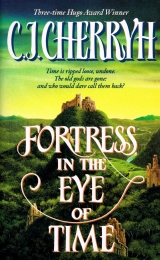
Текст книги "Fortress in the Eye of Time"
Автор книги: C. J. Cherryh
Жанр:
Классическое фэнтези
сообщить о нарушении
Текущая страница: 6 (всего у книги 47 страниц)
Now he feared that other Place he was going as possibly one that would take him in and close off to him forever the Place that he had been. He refused to imagine a world in which Mauryl was gone for good.
It terrified him, such a Place, which could exist, now that he began to think about such things as tomorrow, and tomorrow after that.
Owl’s precipitate flight frightened him. It drove him to desperate haste, far beyond his ordinary strength.
And when the dark came down again in his walking on the Road he was afraid to sit down and sleep, hungry and thirsty and miserable as he was, because the shadows were abroad. He kept walking until he was staggering with exhaustion and light-headed with hunger.
“Owl?” he begged of the formless dark. “Owl, can you hear me?”
It was the hour for Owl to be abroad. But perhaps Owl was busy. Or ignoring him, as obstinately as Mauryl would, when he interrupted Mauryl at his ciphering, and if he persisted, then Mauryl’s next answer-and, he suspected, Owl’s—would not be polite at all.
But he wished, oh, he wished Owl would come back. There were clearly sides to the Road which went on unguessably far, forest into which Owl could go, but he dared not venture. The air as he walked grew cold and the woods grew frightening. There were stirrings and movements in the brush where by day he had heard nothing. The place felt bad, the way the stairs and balconies of the keep, safe and familiar by day, had felt dangerous when the Shadows were free to move about.
No Owl, no Mauryl, no shelter and no door to lock. There was no safety for him tonight, and nowhere to stop. He sat down only when morning came sneaking into the woods, and he sat and hugged his knees up to his chest for warmth, his head both light and aching. He had no idea where he was, except beside the Road. He had no idea yet where he was going, or how far he had already come. The world remained measureless to him on all sides now.
And when he waked he was so light-headed and so miserable he tried eating a leaf from the bushes that sheltered him, but its taste was bitter and foul and made his mouth burn. He wished he had the water he had found yesterday, but there was no food there, he knew that for very certain. So he ate no more leaves, and after a long time of walking his mouth quit burning.
Then his stomach seemed to give up the idea of food at all. He was not quite hungry. He told himself he could keep going—he had gone farther than he had ever thought he could, he was stronger than he had ever thought he was, and miserable as he was, nothing had laid hands on him, nothing had stopped him, nothing had daunted him from Mauryl’s instructions.
“Who?” came from overhead. Owl was back. Owl flew off from him with no time for questions.
Owl intended, perhaps, encouragement, since of Words there were, Owl was not profligate, and Owl asked his question without an answer.
Who? indeed. “Tristen! Tristen is my name, Owl! Do you hear me?”
“Who?” came from the distance now, beckoning him, a known voice, if not a friendly voice.
“Owl, did you eat the mice?”
“Who?” came again.
Owl denied everything, and flew away from him, too distant now for argument. Tristen saw him, a feathered lump, far, far through the branches.
But Owl guided him. Owl seemed to hold some secret, and constantly flitted out of his reach—but Mauryl had done that, too, making him learn for himself: he knew Mauryl’s tricks.
He called out: “Are you Mauryl’s, Owl? Did he send you?”
“To-who?” said Owl, and flew away out of sight.
But the mere sound of voices, Owl’s and his own, had livened the leaden air, an irreverent fracture of the silence, and once the deathly silence was broken, from seeing for days now only the gray and the black of dead limbs, he began to see shafts of sunlight, green moss growing, and green leaves lit by the passage of sunbeams.
Perhaps the sunbeams had always been there, working their small transformations, but Marna, when it had first come to him as a Word, had seemed a name for darkness and loss; his eyes until this moment might have been seeing only the dark. But now that he looked without expecting gloominess, Marna showed itself in a new and livelier way—a tricky and a changeable place, as it seemed.
But then, Ynefel itself ran rife with terror and darkness, so long as the Shadows ruled it—and, again, Ynefel shone warm with firelight and smelled of good food, and Mauryl sat safe by the fireside, reading. Were not both ... equally ... Ynefel, to his mind? And were not both ... equally and separately.., true?
So perhaps Marna Wood could be fair and safe at one time and have another aspect altogether when the Shadows were abroad.
And if he could think—as he had—one way and then the other about its nature, and if the forest could put on an aspect according to his expectations, then it seemed to him much wiser to think well instead of ill of the place, and to expect sunlight here to shine brightly as the sunlight came to the loft at home, to fall as brightly here as it fell on the pages of his Book when he read his lessons among the pigeons.
And perhaps other things came from expecting the best of them as hard as he could.
So immediately he drew his Book out of his shirt, stopped in the full middle of a sunbeam, and opened it and looked at the writing, hoping that if one thing had changed, if he fully, truly, with all his heart expected to read the Book, then the Words might come to him—just a few Words, perhaps, so he turned from page to page.
But the letters remained only shapes, and even the ones he had thought he understood now looked different and indecipherable to his eye. His expectation, he thought, must not be great enough, or sure enough, in the way that Mauryl expected bruises not to hurt, or Shadows not to harm them. He clearly had not Mauryl’s power—but then– But, was the inescapable conclusion, then Mauryl had never expected him to read the Book—or had not expected it enough. That was a very troubling point. Mauryl could expect his hand to stop hurting, and it would. Mauryl could expect that the rain would come, and it would.
Mauryl could expect the Shadows to leave his room alone, and Mauryl could bar the door against them, and bang his staff on the stones and bid them keep their distance; the Shadows would obey Mauryl, if not him.
Yet Mauryl had doubted that he would read the Book?
Mauryl had doubted him and doubted his ability, but all else, including very difficult things for him to do, Mauryl had seemed so certain of.
He no longer knew what Mauryl had thought of him, or what Mauryl had expected.
So he tucked his Book away fearfully and kept walking; and when the sun was at its highest overhead, he sat down on a fallen log in a patch of sunlight, took out his Book and tried again to read, tried, mindful of Mauryl’s doubt, tried until his eyes ached and until his own doubt and his despair began to gray the woods around him.
But then the sun, which had faded around him, shone brightly and clearly in a new place farther down the Road.
So it seemed to him that the sun might be saying, as Owl had said, Follow the Road, and he rose up, tucked away his Book, and walked further, relying on the sun, relying on Owl, and hoping very much for an end of this place.
Came another nightfall, and the sky turned mostly gray again and the woods went back to their darkness. Tristen was growing more than tired, he was growing weak and dizzy and wandering in his steps.
He had begun, however faintly, to promise himself that at the end of the Road might lie a place like Ynefel, a place with walls of strong stone, and, he imagined, there might be a fireplace, and there might be a warm small room where he could sleep safe at night—that was what he hoped for, perhaps because he could imagine nothing else outside of this woods, and he wanted the woods to end.
Perhaps, in this place he imagined, there would be someone like Mauryl, since there surely would be someone to keep things in order.
There would be someone like Mauryl, who would be kind to him and teach him the things he needed to know.
“Why did you go?” he asked that grayness inside him, speaking aloud and hoping faintly that Mauryl might be simply waiting for a question.
“What am I to do, Mauryl? Where are you sending me?”
But nothing answered him, not even the wind.
“Owl?” he asked at last, since Owl at least had been visible. It occurred to him that he had not seen Owl in a very long time, and he would at least like Owl’s company, however surly Owl could be.
But Owl might be sleeping still, despite the dark that had fallen. Owl also failed to arrive.
So he followed his faintly visible path of fitted stones, which disappeared under forest earth, which reappeared under a black carpet of rotten leaves, which found ways along hillsides and threatened to disappear under earth and leaves altogether and forever. He was afraid. He kept imagining that Place like Ynefel. He kept thinking.., of that fireside and a snug room where the candles never went out.
The Road lost itself altogether in nightbound undergrowth, where trees had grown and dislodged the stones.
“To-who?” a voice inquired above him.
“There you are,” Tristen exclaimed.
“Who?” said Owl, and flew up the hill.
He followed, trying to run as Owl sped ahead, but he had not the strength to keep his feet. He slipped at the very top, among the trees, and tumbled downhill to the Road again, right down to the leaf-covered stones.
“To-who?” said Owl.
He brushed leaf mold from his fall-stung hands and his aching knees.
He was cold, and sat there shaking from weakness.
“Are you different than the other Shadows?” he asked Owl. “Are you
Mauryl’s? —Or are you something else?”
“To-who?” quoth Owl. And leapt out into the dark.
“Wait for me!” Now he was angry as well as afraid. He scrambled to his knees and to his feet, and followed as he could.
But always Owl moved on. He had caught a stitch in his side, but he followed, sometimes losing Owl, sometimes hearing his mocking question far in the distance.
His foot turned in a hole in the stones, and he landed on his hand and an elbow, quite painfully. He could not catch breath enough to stand for two or three painful tries, and then succeeded in setting his knee under him, and rose and walked very much more slowly.
“Who?” Owl called in the distance. The fall had driven the anger out of him and left him only the struggle to keep walking. But he could do no more than he was doing. He hurt more than he had ever hurt in Ynefel, but that seemed the way of this dreary woods: pain, and exhaustion. He walked on until he had hardly the strength to set one foot in front of another.
But as he reached that point of exhaustion, and thought of sitting down and waiting for the dawn to come, whatever the hazards and in spite of Mauryl’s warnings, he rounded the shoulder of a hill and heard Owl calling. And in scanning the dark for Owl, he saw a triple-spanned stonework with an arch at either end.
It looked to be a Bridge like that at Ynefel. His spirits were too low by now for extravagant hope, but it was a faint hope, all the same, that he had come to some Place in the dark. A lightless, cheerless Place it might be, but it was surely stone, and the arched structure offered shelter of a kind Mauryl had told him made the dark safe.
So he walked, wavering and shaking as he was, as far as let his eyes tell him the arch let through not into a building but into utter dark—and reaching the second arch, and seeing planks between, he could see that the dark to the other side of the rail was no longer the woods but the glistening darkness of water.
A Bridge for certain, he thought. An arch and a Bridge had begun his journey; and now, with a lifting of his heart, he remembered Mauryl saying that Lenfialim was at the start of his journey and that Lenfialim should meet him on the far side of Marna Wood. Amefel was beyond, and Amefel was a Word of green, and safety.
He pressed forward to reach that span, and when he stood on it, beneath the arch, he saw faint starlight shining on the water beyond the stone rail, and saw to his astonishment a living creature leap and fall with a pale splash in the darkness.
“Who?” said Owl, somewhere above him.
This bridge was not so ruined as the one at Ynefel. The second arch, looking stronger than the first, stood above the edge of the shore where the reflective surface of the water gave way to the utter dark of forest on the far side. He stood beneath the first arch with his knees shaking, and with all that water near at hand—and was acutely thirsty. He could see the stars—truly see the stars for the first time in his life, for there were neither clouds nor treetops between him and the sky. He saw the Moon riding among them—a knife-sharp sliver. He had seen it only by day, in its changes. Its glory at night was unexpected and wonderful, a light that watched over him.
He did not leave the Road to go down beside the river. He sat down where he stood, his legs folding under him. He leaned against the stone.
He knew it was not wise to leave the Road where he was, even to venture clown to the river he could see. In the limited way the starlight showed it to him, it looked broad, and uncertain at the edges. Fool, Mauryl would say to him, if he fell in, after all this, and had not the strength to get out again.
Owl came and perched on the stone rail of the bridge. Owl came and went from there, and once brought back something which he swallowed with some effort. Tristen had no idea what it was nor wanted to know.
Owl was a fierce creature, but Owl was all he had, so he tried not to think ill of him.
Chapter 7
Te water was brownish green and fast-running beneath him, as Tristen crossed the Bridge in the earliest glimmer of dawn, not trusting the middle of the boards—the loft had taught him that wisdom. Stone felt far safer, and he kept to the rim with the railing to hold to, where the planks lay on the stonework.
Owl had left him at some time last night and he had no guide in this crossing. But no stones fell. That heartened him. And oh, the other side of the river beckoned him, greener than Marna and lit in dawn sun. He was shaky with hunger, but he wanted to run, to rush whole-heartedly toward that green, bright place. Instead, he proceeded as carefully as he was certain Mauryl would advise him, all the way to the endmost span.
But only the width of the arch from a sunnier, younger forest, he asked himself, looking back, what if there were no way back, or what if he were, after leaving the bridge, at the end of all Mauryl’s instructions?
He went. He saw no choice. The Road led him onto solid ground and up to a forest that smelled of life. The wan sunlight itself seemed greened by the leaves through which it came. The Road vanished momentarily beneath a thick blanket of gold-colored leaves, but beckoned reassuringly further on.
Marna Wood had indeed stopped with the bridge, every sense told him so as he walked onto that solid ground, and smelled a fresher, warmer wind. He heard a bird singing to the rising sun, and another Word flickered into memory, Wagtail, although it flitted just far enough he could not see it.
And desperately thirsty as he had been since last night, his first venture in this new feeling of safety was down to the water, among green reeds, where, having reached that edge, he stood and looked back a second time at the far side of the river.
Marna stood as gray and as black as it had felt when he had traveled it last night.
Then he saw a lump in a tree branch on that other side, down where the woods met the water.
“Owl!” he called, loudly, so Owl could hear across the river. He waved his arm. “Owl? Do you hear me? I’m here!”
There was no answer, and he was disturbed at the thought of leaving Owl. He hoped Owl knew he had crossed the bridge. He hoped Owl could find him tonight where he was going, wherever the Road would lead him.
He sank down then on the water’s edge to drink, dry-shod on a spot of grass between two clumps of water-weed. In the shallows he saw brown and yellow stones. And before he could drink, a living creature swam up and looked at him from under the water surface.
Fish, the Word came to him. That had been the leaper in the river last night. It was brown and speckled and he sat very still as he would with the mice, until with a flip of a tail it sped away across the stones, free and very much in its own element.
One ate fish. That came to him, too, and he was repelled by the thought. He had no wish to be like Owl, who gulped down his neighbors.
The river as he drank made one sound, a hoarse voice of strength. The trees sighed with another. But those were not the only sounds. The air hummed with bees and a thicket by him twittered quite happily. He washed his head and hands and looked up to find the source of the commotion.
Birds had gathered about a bush, just up the bank, birds scolding and chasing one another, as he thought at first—but he saw when he came closer that berries were thick on the bush, and ripe berries had fallen on the ground, where birds lay, too, hale and well, but quite silly and flopping about, or sitting with feathers puffed, like pigeons on a chill morning. The birds, though unacquainted with him, did not all flee him, being much too eager for the berries, and those birds lying and sitting about the bush scarcely evaded his feet, so he was careful where he trod. He took a handful of berries for himself—they were sweet, overripe, and stained his fingers, and he ate a double handful of them before the birds that had fled ventured back to take the ones he dropped.
He was sorry to take their breakfast. He sat on the bank and shared with them, tossing berries out where they dared snatch them. Some squabbled and fought over the ones he threw, while others, full-fed, scarcely reached after the ones he set in front of them. One let him pick it up, and he smoothed its feathers and set it on a branch, but it swung upside down, hung from one foot, and fell into his hands again. So he set it on the ground. It was quite puffed and quite silly, and very full, seeming completely healthy, except the sleepiness. He left some berries on the bush for the birds, and walked with something in his belly for the first time in days, feeling quite giddy, but very much better, thanks to the water he had drunk and the berries he had eaten.
He could have made cakes, he thought, if he had had flour and oil and fire. Cakes with berries. He had made them for Mauryl very often.
And the instant he thought of flour and oil and fire he thought of Mill, and Fields, and when he thought of Fields, then he thought of Men and Houses, Oxen, and Fences, recognitions that tumbled in on him disorderly as the squabbling birds, one thought chasing the other, one seizing a perch and fleeing or falling off in its turn, so chaotic that he struggled not to wonder about anything, and tried not to think beyond the necessity to place his feet one in front of the other and to keep moving, light-headed as he was.
But this morning, on this Road, the thoughts refused to stop coming.
The whole woods chattered and rang with birdsong. It was full of Words for him, and Words brought thinking that conjured more Words. His wits wandered, his feet strayed. He turned an ankle painfully in a hidden hole in the pavings, which did nothing to stop the dizzying spate of Words—trees, mosses, leaves, stones, sky, directions, the names of birds and the track of a Badger—all these things crowded into his head until it ached, and he might have wandered in complete confusion if not for the stone Road that came and went beneath the leaves.
Long and long before the supply of Words seemed exhausted—before each had confounded the last—he knew Oak from Ash, knew Acorn and leaf and every sound that came and went. The knowing poured in on him more abundant than the recognition—but he could not, it seemed, exhaust the forest’s store of Words.
In weariness of knowing things, in a muddle of sights and sounds, he sat down to rest and slept without intending to, until he blinked at a sky that had dimmed toward dark.
He had come through so much that was difficult and let his eyes close when the going became safer. Now he set out on another night of walking-he dared not sleep when the Shadows came, and he followed the Road as he had before.
Meanwhile the jumble of Words, though less than the rush by day, wanted to come back again, clamoring within that grayness in his mind, where Mauryl was, or might be. He knew Moon and Stars, and now he learned Marten and Fox.
But he tried to still the tumult and to hear only Mauryl, if Mauryl should send a Word to him out of that grayness.
He tried to hear Owl, who had not appeared all day long, but the creature that was singing now was, the song said to him, Frog, saying that it might soon rain.
He was thinking that when a wayward breeze brought the scent of smoke wafting down the Road—smoke, and the smell of something that might possibly be supper: he was not quite convinced that it was, but it smelled so like supper cooking that the hunger the berries had wakened in the morning became more and more urgent as he walked.
Fire was warmth and light, and fire also meant Men, his awareness informed him. Whatever seemed to be cooking—or burning, he thought from moment to moment—it might be good to eat. It smelled like that, although it certainly seemed overdone.
But he was still fearful, and not knowing how to call out to men who might themselves be afraid of Shadows in this woods, he decided it would be safer to go up soft-footed, as Mauryl’s tempers had taught him, and to know them first, whether they were in a good mood or otherwise, or whether it was in fact supper they were about, and not just wood or rubbish afire.
He left the Road, and followed that smell of smoke up the wind as quietly and stealthily as he could over the dry leaves. He spied firelight shining through the brush and branches, and treading now with greatest caution, he slipped up to spy on the place.
They were indeed men. They had a small fire going in a spot cleared of leaves. They were not old like Mauryl. They were not young like himself.
They went clothed in brown cloth and leather, clothes rougher than his own white shirt and breeches. They had beards, dark and full; they were cooking something on a stick above the fire, he had no notion what, but it struck the edges of a Word, and at once dismayed him and advised him that eating living things.., was permissible. It was something men did by their nature—that he should perhaps do, if they offered him a share of their supper.
“Sirs,” he said, stepping into the light, and instantly all four men were on their feet. Metal flashed—they had knives, and drew them and threatened him with them, with anger and fear on their faces.
“Sirs,” he said, quietly, “please, sirs, I’m very hungry. May I have supper?”
“He ain’t no woodsman,” one said, and with a squint across the fire:
“Who are you?” “Tristen, sir.”
“Sir,” another said, and elbowed the first man in the ribs. “Sir, ye are.”
“Where from?” the first asked. “Lanfarnesse?”
He pointed in the direction from which the Road came. “From the keep, sir. Mauryl’s fortress. Ynefel.”
One changed knife-hands to make a sign over his heart, hasty and afraid. The others looked afraid, too, and backed away, all to the other side of their fire.
“Please,” Tristen said, fearing this meant no. “I need something to eat.”
“His speech,” the third man said, “ain’t Elwynim, nor Lanfarnesse, nor any countryman’s, that’s certain. O gods, I liked it little enough bein’ here. Lanfarnesse rangers be hanged, we shouldn’t ever have come here, I said so, I said it, they’s naught good in this forest, I told ye it hove on to Marna Wood.”
The Names echoed through his bones, Words, confusing him, opening lands and fields and hills and Words Mauryl had said.
“You!” the first man said. “Whatever ye be, ye take yourself out away from here! We hain’t no dealin’s wi’ you nor your cursed master. Get away wi’ ye, ye damned haunt!”
“Please, sirs! If you could only spare a little—”
One threw something at him—it struck him and fell at his feet, a round, light something that he realized was a chunk of bread.
“Away, then!” the man cried. “Ye got what ye wanted, now take yerself away from us! Go back where ye belong!”
He picked up the bread, wary of more things thrown. “Thank you,” he said faintly, and bowed. Mauryl would call it rude, not to give them thank you.
“Ye give us no filthy thanks,” they said. “Ye got what ye asked. Now begone, away! Leave us be, ye cursed thing, in the name of the good gods and the righteous!”
“I mean no harm,” he protested. But one bent and picked up a stick of wood and threatened to throw it, too. “Get on wi’ ye!”
The wood flew. He left the firelight. Something crashed after him through the brush and hit him in the back, painfully.
He began to run, fearing they were chasing him, fended branches with his elbow, the bread in the other hand, as branches tore his hair and his face, snagged and broke against his shirt and trousers. He dodged through the trees upslope and down again the way he had come, and finding the Road, he set out running and running on the uneven stones until he caught a stitch in his side and his knees were shaking under him.
At least, he thought, looking back, the men had not chased him. He walked a while, with his knees still shaky and weak. A spot on his back hurt where they had hit him—the stick of wood, he decided, and was glad it had not been one of their knives. His mouth was dry, and now that he had bread to eat, between the dryness of his mouth and the lump of distress in his throat, he could scarcely swallow. Still, he was hungry enough that he tore off tiny morsels and forced them down, still walking, only desiring to be far away from the men and their anger as soon as possible.
They had had no cause to throw things at him.
They had had no cause to be afraid of him—unless they took him for a Shadow. He thought they should have been able to see he was not.
They called him Names, like Cursed, and Haunt, and spoke of Hanging, all of which made terrible pictures in his thoughts. They were angry with him for no reason at all, but he supposed that they were afraid, and perhaps having had no experience of Shadows, took him for something as dire and harmful as the worst ones, the noisy, hammering kind.
They might, truly, have thrown the knives. The stick had stung, but the knife might have– Killed him, he thought, with a bite of bread in his mouth. Dead.
Death.
Like the ragged black thing they were burning over the fire, Killed.
That was both Meat, and Dead.
Then he could scarcely swallow the bread at all. He forced down a few more bites and tucked it in his shirt along with his Book, and walked a long, long way before he felt like tearing off more bits of the gritty stuff and eating them to make the pain in his stomach stop.
He reached a point after which he no longer feared the men following.
He kept walking, all the same, because he was certain those men were not what Mauryl had sent him to find, and because, all the same, they had waked important Words in him—Lanfarnesse, and Rangers, and Elwynim, that echoed and kept echoing and would not let him sit down and rest. They feared Shadows, which told him the Shadows did come into this place, and therefore he still had them to fear.
He heard frogs still predicting rain. He listened for Owl’s return, and he had a great deal to tell Owl, who, however sullen, was far friendlier to him than men had shown themselves, and whose presence he felt as a bond to Ynefel itself.
If those had not been polite or proper men, there must be better ones.
Words had shown him Houses, and he had not found that sort of men that lived in Houses, not yet, and certainly not at that fireside. Words had shown him Fields, and this thicket was certainly not that place.
Most of all—the thought of Fields had shown him great Walls, and a keep very like Ynefel.
That was what he looked to find. That was what he suddenly believed he was searching for.
He walked until he could scarcely keep his feet under him, rested and walked on. He smelled nothing more of men and heard nothing more of Owl, but he was looking to find Men of gentler kind, and most of all a Place and a Tower like Ynefel.
With a room and a soft clean bed, and a supper, and most of all a wizard who would know what to do next.
Chapter 8
Morning came as the frogs predicted, with a sprinkling of rain through the leaves, a gray dim dawn, a first, with a slight rumbling of thunder. He ate most of the bread, fearing it might be ruined if the skies opened and poured as they had a habit o doing at Ynefel.
But before he was quite through, the sun was breaking through the clouds and shining through the leaves, dappling the gray stone of the roadway in patterns of light and shadow. Rain dripped at every breath t wind.
The birds sang, his clothing dried on his body and his hair began t blow lightly in the wind as he plucked the leaves and twigs from it.
And before he quite realized what he was seeing, with the cresting another hill the trees grew thinner, gave way to brush, and then—a vision fraught with Words—to broad Meadows, where the Road ran, most overgrown with grass. The sky was dotted with gray-bottomed clouds that occasionally obscured the sun and sent patterns of shadow walking the smooth hillsides.
He had never seen a meadow. He only knew the Word. Everything I saw was marvelous and new. He walked the Road, picking his way along the grass-chinked stones, listening to new birds, Lark and Linnet, making their flight across an open sky.
Then, as his Road crossed between two hills, he saw a different land spread before him—a patchwork like the quilt on his own bed, in green and brown. Fields, he thought, and knew he had come indeed to son thing different, and a Place where Men lived.