Стихотворения
Текст книги "Стихотворения"
Автор книги: Владимир Набоков
Жанр:
Поэзия
сообщить о нарушении
Текущая страница: 10 (всего у книги 16 страниц)
Артюр Рембо
413. ПЬЯНЫЙ КОРАБЛЬ {*}
В стране бесстрастных рек спускаясь по теченью,
хватился я моих усердных бурлаков:
индейцы ярые избрали их мишенью,
нагими их сковав у радужных столбов.
Есть много кораблей, фламандский хлеб везущих
и хлопок английский, – но к ним я охладел.
Когда прикончили тех пленников орущих,
открыли реки мне свободнейший удел.
И я – который был, зимой недавней, глуше
младенческих мозгов – бежал на зов морской,
и полуостровам, оторванным от суши,
не знать таких боев и удали такой.
Был штормом освящен мой водный первопуток.
Средь волн, без устали влачащих жертв своих,
протанцевал и я, как пробка, десять суток,
не помня глупых глаз огней береговых.
Вкусней, чем мальчику плоть яблока сырая,
вошла в еловый трюм зеленая вода,
меня от пятен вин и рвоты очищая
и унося мой руль и якорь навсегда.
И вольно с этих пор купался я в поэме
кишащих звездами лучисто-млечных вод,
где, очарованный и безучастный, время
от времени ко дну утопленник идет,
где, в пламенные дни, лазурь сквозную влаги
окрашивая вдруг, кружатся в забытьи —
просторней ваших лир, разымчивее браги —
туманы рыжие и горькие любви.
Я знаю небеса в сполохах, и глубины,
и водоверть, и смерч, покой по вечерам,
рассвет восторженный, как вылет голубиный,
и видел я подчас, что мнится морякам;
я видел низких зорь пятнистые пожары,
в лиловых сгустках туч мистический провал,
как привидения из драмы очень старой,
волнуясь чередой, за валом веял вал,
я видел снежный свет ночей зеленооких,
лобзанья долгие медлительных морей,
и ваш круговорот, неслыханные соки,
и твой цветной огонь, о фосфор-чародей!
По целым месяцам внимал я истерии
скотоподобных волн при взятии скалы,
не думая о том, что светлые Марии
могли бы обуздать бодливые валы.
Уж я ль не приставал к немыслимой Флориде,
где смешаны цветы с глазами, с пестротой
пантер и тел людских и с радугами, в виде
натянутых вожжей над зеленью морской!
Брожения болот я видел – словно мрежи,
где в тине целиком гниет левиафан,
штиль и крушенье волн, когда всю даль прорежет
и опрокинется над бездной ураган.
Серебряные льды, и перламутр, и пламя,
коричневую мель у берегов гнилых,
где змеи тяжкие, едомые клопами,
с деревьев падают смолистых и кривых.
Я б детям показал огнистые созданья
морские – золотых, певучих этих рыб.
Прелестной пеною цвели мои блужданья,
мне ветер придавал волшебных крыл изгиб.
Меж полюсов и зон устав бродить без цели,
порой качался я нежнее. Подходил
рой теневых цветов, присоски их желтели,
и я как женщина молящаяся был, —
пока, на палубе колыша нечистоты,
золотоглазых птиц, их клики, кутерьму,
я плыл, и сквозь меня, сквозь хрупкие пролеты,
дремотно пятился утопленник во тьму.
Но я, затерянный в кудрях травы летейской,
я, бурей брошенный в эфир глухонемой,
шатун, чьей скорлупы ни парусник ганзейский,
ни зоркий монитор не сыщет под водой, —
я, вольный и живой, дымно-лиловым мраком
пробивший небеса, кирпичную их высь,
где б высмотрел поэт всё, до чего он лаком, —
лазури лишаи и солнечную слизь, —
я, дикою доской в трескучих пятнах ярких
бежавший средь морских изогнутых коньков,
когда дубинами крушило солнце арки
ультрамариновых июльских облаков, —
я, трепетавший так, когда был слышен топот
Мальстромов вдалеке и Бегемотов бег,
паломник в синеве недвижной, – о Европа,
твой древний парапет запомнил я навек!
Я видел звездные архипелаги! Земли,
приветные пловцу, и небеса, как бред.
Не там ли, в глубине, в изгнании ты дремлешь,
о стая райских птиц, о мощь грядущих лет?
Но, право ж, нету слез. Так безнадежны зори,
так солнце солоно, так тягостна луна…
Любовью горькою меня раздуло море…
Пусть лопнет остов мой! Бери меня, волна!
Из европейских вод мне сладостна была бы
та лужа черная, где детская рука,
средь грустных сумерек, челнок пускает слабый,
напоминающий сквозного мотылька.
О, волны, не могу, исполненный истомы,
пересекать волну купеческих судов,
победно проходить среди знамен и грома
и проплывать вблизи ужасных глаз мостов.
<16 декабря 1928>
Иоганн Вольфганг Гете
414. ПОСВЯЩЕНИЕ К «ФАУСТУ» {*}
Вы снова близко, реющие тени.
Мой смутный взор уже вас видел раз.
Хочу ль теперь безумия видений?
Запечатлеть попробую ли вас?
Теснитесь вы! Средь дымных испарений —
да будет так! – вы явитесь сейчас;
по-юному мне сердце потрясает
туман чудес, что вас сопровождает.
Отрада в вас мне чудится былая,
а тень встает родная не одна,
встает любовь и дружба молодая,
как полузвук, преданье, старина,
и снова – боль, и, жалуясь, блуждая
по лабиринту жизненного сна,
зову я милых, счастием жестоко
обмеренных, исчезнувших до срока.
Те, для кого я пел первоначально,
не слышат песен нынешних моих,
ушли друзья, и замер отзвук дальний
из первого привета. Для чужих,
неведомых, звучит мой стих печальный,
боюсь я даже одобренья их,
а верные мне души, если живы,
скитаются в изгнанье сиротливо.
По истовом и тихом царстве духа
во мне тоска забытая зажглась,
трепещет песнь, неясная для слуха,
как по струнам эоловым струясь,
и плачу я, и ужасаюсь глухо,
в суровом сердце нежность разлилась;
всё настоящее вдали пропало,
а прошлое действительностью стало.
<15 декабря 1932>
СТИХОТВОРЕНИЯ НА АНГЛИЙСКОМ И ФРАНЦУЗСКОМ ЯЗЫКАХ
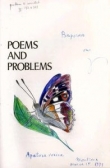
POEMS AND PROBLEMS {*}
415. A LITERARY DINNER {*}
Come here, said my hostess, her face making room
for one of those pink introductory smiles
that link, like a valley of fruit trees in bloom,
the slopes of two names.
I want you, she murmured, to eat Dr. James.
I was hungry. The Doctor looked good. He had read
the great book of the week and had liked it, he said,
because it was powerful. So I was brought
a generous helping. His mauve-bosomed wife
kept showing me, very politely, I thought,
the tenderest bits with the point of her knife.
I ate – and in Egypt the sunsets were swell;
The Russians were doing remarkably well;
had I met a Prince Poprinsky, whom he had known
in Caparabella, or was it Mentone?
They had traveled extensively, he and his wife;
her hobby was People, his hobby was Life.
All was good and well cooked, but the tastiest part
was his nut-flavored, crisp cerebellum. The heart
resembled a shiny brown date,
and I stowed all the studs on the edge of my plate.
<11 апреля> 1942
416. THE REFRIGERATOR AWAKES {*}
Crash!
And if darkness could sound, it would sound like this giant
waking up in the torture house, trying to die
and not dying, and trying
not to cry and immediately crying
that he will, that he will, that he will do his best
to adjust his dark soul to the pressing request
of the only true frost,
and he pants and he gasps and he rasps and he wheezes:
ice is the solid form when the water freezes;
a volatile liquid (see «Refrigerating»)
is permitted to pass into evaporating
coils, where it boils,
which somehow seems wrong,
and I wonder how long
it will rumble and shudder and crackle and pound;
Scudder, the Alpinist, slipped and was found
half a century later preserved in blue ice
with his bride and two guides and a dead edelweiss;
a German has proved that the snowflakes we see
are the germ cells of stars and the sea life to be;
hold
the line, hold the line, lest its tale be untold;
let it amble along through the thumping pain
and horror of dichlordisomethingmethane,
a trembling white heart with the frost froth upon it,
Nova Zembla, poor thing, with that В in her bonnet,
stunned bees in the bonnets of cars on hot roads,
Keep it Kold, says a poster in passing, and lo,
loads,
of bright fruit, and a ham, and some chocolate cream,
and three bottles of milk, all contained in the gleam
of that wide-open white
god, the pride and delight
of starry-eyed couples in dream kitchenettes,
and it groans and it drones and it toils and it sweats—
Shackleton, pemmican, penguin, Poe's Рут—
collapsing at last in the criminal
night.
<28 ноября 1941>
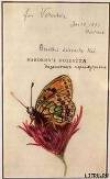
417. A DISCOVERY {*}
I found it in a legendary land
all rocks and lavender and tufted grass,
where it was settled on some sodden sand
hard by the torrent of a mountain pass.
The features it combines mark it as new
to science: shape and shade – the special tinge,
akin to moonlight, tempering its blue,
the dingy underside, the checquered fringe.
My needles have teased our its sculptured sex;
corroded tissues could no longer hide
that priceless mote now dimpling the convex
and limpid teardrop on a lighted slide.
Smoothly a screw is turned; our of the mist
two ambered hooks symmetrically slope,
or scales like battledores of amethyst
cross the charmed circle of the microscope.
I found it and I named it, being versed
in taxonomic Latin; thus became
godfather to an insect and its first
describer – and I want no other fame.
Wide open on its pin (though fast asleep),
and safe from creeping relatives and rust,
in the secluded stronghold where we keep
type specimens it will transcend its dust.
Dark pictures, thrones, the stones that pilgrims kiss,
poems that take a thousand years to die
but ape the immortality of this
red label on a little butterfly.
<12 января> 1943
418. THE POEM {*}
Not the sunset poem you make when you think aloud,
with its linden tree in India ink
and the telegraph wires across its pink cloud;
not the mirror in you and her delicate bare
shoulder still glimmering there;
not the lyrical click of a pocket rhyme —
the tiny music that tells the time;
and not the pennies and weights on those
evening papers piled up in the rain;
not the cacodemons of carnal pain;
not the things you can say so much better in plain prose —
but the poem that hurtles from heights unknown
– when you wait for the splash of the stone
deep below, and grope for your pen,
and then comes the shiver, and then —
in the tangle of sounds, the leopards of words,
the leaflike insects, the eye-spotted birds
fuse and form a silent, intense,
mimetic pattern of perfect sense.
<10 июня> 1944
419. AN EVENING OF RUSSIAN POETRY {*}
«…seems to be the best train. Miss Ethel Winter of the Department of English will meet you at the station and…»
From a letter addressed to the visiting speaker
The subject chosen for tonight's discussion
is everywhere, though often incomplete:
when their basaltic banks become too steep,
most rivers use a kind of rapid Russian,
and so do children talking in their sleep.
My little helper at the magic lantern,
insert that slide and let the colored beam
project my name or any such-like phantom
in Slavic characters upon the screen.
The other way, the other way. I thank you.
On mellow hills the Greek, as you remember,
fashioned his alphabet from cranes in flight;
his arrows crossed the sunset, then the night.
Our simple skyline and a taste for timber,
the influence of hives and conifers,
Yes, Sylvia?
«Why do you speak of words
when all we want is knowledge nicely browned?»
Because all hangs together – shape and sound,
heather and honey, vessel and content.
Not only rainbows – every line is bent,
and skulls and seeds and all good words are round,
like Russian verse, like our colossal vowels:
those painted eggs, those glossy pitcher flowers
that swallow whole a golden bumblebee,
those shells that hold a thimble and the sea.
Next question.
«Is your prosody like ours?»
Well, Emmy, our pentameter may seem
to foreign ears as if it could not rouse
the limp iambus from its pyrrhic dream.
But close your eyes and listen to the line.
The melody unwinds; the middle word
is marvelously long and serpentine:
you hear one beat, but you have also heard
the shadow of another, then the third
touches the gong, and then the fourth one sighs.
It makes a very fascinating noise:
it opens slowly, like a greyish rose
in pedagogic films of long ago.
The rhyme is the line's birthday, as you know,
and there are certain customary twins
in Russian as in other tongues. For instance,
love automatically rhymes with blood,
nature with liberty, sadness with distance,
humane with everlasting, prince with mud,
moon with a multitude of words, but sun
and song and wind and life and death with none.
Beyond the seas where I have lost a scepter,
I hear the neighing of my dappled nouns,
soft participles coming down the steps,
treading on leaves, trailing their rustling gowns,
and liquid verbs in ahlaand in ili,
Aonian grottoes, nights in the Altai,
black pools of sound with «l» s for water lilies.
The empty glass I touched is tinkling still,
but now 'tis covered by a hand and dies.
«Trees? Animals? Your favorite precious stone?»
The birch tree, Cynthia, the fir tree, Joan.
Like a small caterpillar on its thread,
my heart keeps dangling from a leaf long dead
but hanging still, and still I see the slender
white birch that stands on tiptoe in the wind,
and firs beginning where the garden ends,
the evening ember glowing through their cinders.
Among the animals that haunt our verse,
that bird of bards, regale of night, comes first:
scores of locutions mimicking its throat
render its every whistling, bubbling, bursting,
flutelike or cuckoolike or ghostlike note.
But lapidary epithets are few;
we do not deal in universal rubies.
The angle and the glitter are subdued;
our riches lie concealed. We never liked
the jeweler's window in the rainy night.
My back is Argus-eyed. I live in danger.
False shadows turn to track me as I pass
and, wearing beards, disguised as secret agents,
creep in to blot the freshly written page
and read the blotter in the looking glass.
And in the dark, under my bedroom window,
until, with a chill whirr and shiver, day
presses its starter, warily they linger
or silently approach the door and ring
the bell of memory and run away.
Let me allude, before the spell is broken,
to Pushkin, rocking in his coach on long
and lonely roads: he dozed, then he awoke,
undid the collar of his traveling cloak,
and yawned, and listened to the driver's song.
Amorphous sallow bushes called rakeety,
enormous clouds above an endless plain,
songline and skyline endlessly repeated,
the smell of grass and leather in the rain.
And then the sob, the syncope (Nekrasov!),
the panting syllables that climb and climb,
obsessively repetitive and rasping,
dearer to some than any other rhyme.
And lovers meeting in a tangled garden,
dreaming of mankind, of untrammeled life,
mingling their longings in the moonlit garden,
where trees and hearts are larger than in life.
This passion for expansion you may follow
throughout our poetry. We want the mole
to be a lynx or turn into a swallow
by some sublime mutation of the soul.
But to unneeded symbols consecrated,
escorted by a vaguely infantile
path for bare feet, our roads were always fated
to lead into the silence of exile.
Had I more time tonight I would unfold
the whole amazing story – neighuklúzhe,
nevynossímo– but I have to go.
What did I say under my breath? I spoke
to a blind songbird hidden in a hat,
safe from my thumbs and from the eggs I broke
into the gibus brimming with their yolk.
An now I must remind you in conclusion,
that I am followed everywhere and that
space is collapsible, although the bounty
of memory is often incomplete:
once in a dusty place in Mora county
(half town, half desert, dump mound and mesquite)
and once in West Virginia (a muddy
red road between an orchard and a veil
of tepid rain) it came, that sudden shudder,
a Russian something that I could inhale
but could nor see. Some rapid words were uttered —
and then the child slept on, the door was uttered —
and then the child slept on, the door was shut.
The conjurer collects his poor belongings —
the colored handkerchief, the magic rope,
the double-bottomed rhymes, the cage, the song.
You tell him of the passes you detected.
The mystery remains intact. The check
comes forward in its smiling envelope.
«How would you say „delightful talk“ in Russian?»
«How would you say „good night“?»
Oh, that would be:
Bessónnitza, tvoy vzor oonýl i stráshen;
lubóv moyá, otstóopnika prostée.
(Insomnia, your stare is dull and ashen,
my love, forgive me this apostasy.)
<2 декабря 1944>; Кембридж, Масс.
420. THE ROOM {*}
The room a dying poet took
at nightfall in a dead hotel
had both directories – the Book
of Heaven and the Book of Bell.
It had a mirror and a chair,
it had a window and a bed,
its ribs let in the darkness where
rain glistened and a shopsign bled.
Not tears, not terror, but a blend
of anonymity and doom,
it seemed, that room, to condescend
to imitate a normal room.
Whenever some automobile
subliminally slit the night,
the walls and ceiling would reveal
a wheeling skeleton of light.
Soon afterwards the room was mine.
A similar striped cageling, I
groped for the lamp and found the line
«Alone, unknown, unloved, I die»
in pencil, just above the bed.
It had a false quotation air.
Was it a she, wild-eyed, well-read,
or a fat man with thinning hair?
I asked a gentle Negro maid,
I asked a captain and his crew,
I asked the night clerk. Undismayed,
I asked a drunk. Nobody knew.
Perhaps when he had found the switch
he saw the picture on the wall
and cursed the red eruption which
tried to be maples in the fall?
Artistically in the style
of Mr. Churchill at his best,
those maples marched in double file
from Glen Lake to Restricted Rest.
Perhaps my text is incomplete.
A poet's death is, after all,
a question of technique, a neat
enjambment, a melodic fall.
And here a life had come apart
in darkness, and the room had grown
a ghostly thorax, with a heart
unknown, unloved – but not alone.
<13 мая> 1950; Итака
421. VOLUPTATES TACTIONUM [16]16
Радости осязания (лат.). – Ред.
[Закрыть] {*}
Some inevitable day
On the editorial page
Of your paper it will say,
«Tactio has come of age».
When you turn a knob, your set
Will obligingly exhale
Forms, invisible and yet
Tangible – a world in Braille.
Think of all the things that will
Really be within your reach!
Phantom bottle, dummy pill,
Limpid limbs upon a beach.
Grouped before a Magnotact,
Clubs and families will clutch
Everywhere the same compact
Paradise (in terms of touch).
Palpitating fingertips
Will caress the flossy hair
And investigate the lips
Simulated in midair.
See the schoolboy, like a blind
Lover, frantically grope
For the shape of love – and find
Nothing but the shape of soap.
<27 января> 1951
422. RESTORATION {*}
To think that any fool may tear
by chance the web of when and where.
O window in the dark! To think
that every brain is on the brink
of nameless bliss no brain can bear,
unless there be no great surprise —
as when you learn to levitate
and, hardly trying, realize
– alone, in a bright room – that weight
is but your shadow, and you rise.
My little daughter wakes in tears:
She fancies that her bed is drawn
into a dimness which appears
to be the deep of all her fears
but which, in point of fact, is dawn.
I know a poet who can strip
a William Tell or Golden Pip
in one uninterrupted peel
miraculously to reveal,
revolving on his fingertip,
a snowball. So I would unrobe,
turn inside out, pry open, probe
all matter, everything you see,
the skyline and its saddest tree,
the whole inexplicable globe,
to find the true, the ardent core
as doctors of old pictures do
when, rubbing our a distant door
or sooty curtain, they restore
the jewel of a bluish view.
9 марта 1952
423. THE POPLAR {*}
Before this house a poplar grows
Well versed in dowsing, I suppose,
But how it sighs! And every night
A boy in black, a girl in white
Beyond the brightness of my bed
Appear, and not a word is said.
On coated chair and coatless chair
They sit, one here, the other there.
I do not care to make a scene:
I read a glossy magazine.
He props upon his slender knee
A dwarfed and potted poplar tree.
And she – she seems to hold a dim
Hand mirror with an ivory rim
Framing a lawn, and her, and me
Under the prototypic tree,
Before a pillared porch, last seen
In July, nineteen seventeen.
This is the silver lining of
Pathetic fallacies: the sough
Of Populusthat taps at last
Not water but the author's past.
And note: nothing is ever said.
I read a magazine in bed
Or the Home Book of Verse;and note:
This is my shirt, that is my coat.
But frailer seers I am told
Get up to rearrange a fold.
1952
424. LINES WRITTEN IN OREGON {*}
Esmeralda! Now we rest
Here, in the bewitched and blest
Mountain forests of the West.
Here the very air is stranger.
Damzel, anchoret, and ranger
Share the woodland's dream and danger.
And to think I deemed you dead!
(In a dungeon, it was said;
Tortured, strangled); but instead —
Blue birds from the bluest fable,
Bear and hare in coats of sable,
Peacock moth on picnic table.
Huddled roadsigns softly speak
Of Lake Merlin, Castle Creek,
And (obliterated) Peak.
Do you recognize that clover?
Dandelions, I'or du pauvre? [17]17
Солнце бедных (фр.). – Ред.
[Закрыть]
(Europe, nonetheless, is over).
Up the turf, along the burn,
Latin lilies climb and turn
Into Gothic fir and fern.
Cornfields have befouled the prairies
But these canyons laugh! And there is
Still the forest with its fairies.
And I rest where I awoke
In the sea shade – l'ombre glauque [18]18
Тень цвета морской волны (фр.). – Ред.
[Закрыть]—
Of a legendary oak;
Where the woods get ever dimmer,
Where the Phantom Orchids glimmer —
Esmeralda, immer, immer. [19]19
Погружайся, погружайся (фр.). – Ред.
[Закрыть]
<20 июня> 1953
425. ODE TO A MODEL {*}
I have followed you, model,
in magazine ads through all seasons,
from dead leaf on the sod
to red leaf on the breeze,
from your lily-white armpit
to the tip of your butterfly eyelash,
charming and pitiful,
silly and stylish.
Or in kneesocks and tartan
standing there like some fabulous symbol,
parted feet pointing outward
– pedal form of akimbo.
On a lawn, in a parody
Of Spring and its cherry tree,
near a vase and a parapet,
virgin practicing archery.
Ballerina, black-masked,
near a parapet of alabaster.
«Can one – somebody asked —
rhyme „star“ and „disaster“?»
Can one picture a blackbird
as the negative of a small firebird?
Can a record, run backward,
turn «repaid» into «diaper»?
Can one marry a model?
Kill your past, make you real, raise a family,
by removing you bodily
from back numbers of Sham?
<8 октября> 1955
426. ON TRANSLATING «EUGENE ONEGIN» {*}
1
What is translation? On a platter
A poet's pale and glaring heard,
A parrot's screech, a monkey's chatter,
And profanation of the dead.
The parasites you were so hard on
Are pardoned if I have your pardon,
O, Pushkin, for my stratagem:
I traveled down your secret stem,
And reached the root, and fed upon it;
Then, in a language newly learned,
I grew another stem and turned
Your stanza patterned on a sonnet,
Into my honest roadside prose —
All thorn, but cousin to your rose.
2
Reflected words can only shiver
Like elongated lights that twist
In the black mirror of a river
Between the city and the mist.
Elusive Pushkin! Persevering,
I still pick up Tatiana's earring,
Still travel with your sullen rake.
I find another man's mistake,
I analyze alliterations
That grace your feasts and haunt the great
Fourth stanza of your Canto Eight.
This is my task – a poet's patience
And scholiastic passion blent:
Dove-droppings on your monument.
427. RAIN {*}
How mobile is the bed on these
nights of gesticulating trees
when the rain clatters fast,
the tin-toy rain with dapper hoof
trotting upon an endless roof,
traveling into the past.
Upon old roads the steeds of rain
Slip and slow down and speed again
through many a tangled year;
but they can never reach the last
dip at the bottom of the past
because the sun is there.
1956
428. THE BALLAD OF LONGWOOD GLEN {*}
That Sunday morning, at half past ten,
Two cars crossed the creek and entered the glen.
In the first was Art Longwood, a local florist,
With his children and wife (now Mrs. Deforest).
In the one that followed, a ranger saw
Art's father, stepfather and father-in-law.
The three old men walked off to the cove.
Through tinkling weeds Art slowly drove.
Fair was the morning, with bright clouds afar.
Children and comics emerged from the car.
Silent Art, who could state at a thing all day,
Watched a bug climb a stalk and fly away.
Pauline had asthma, Paul used a crutch.
They were cute little rascals but could not run much.
«I wish», said his mother to crippled Paul,
«Some man would teach you to pitch that ball».
Silent Art took the ball and tossed it high.
It stuck in a tree that was passing by.
And the grave green pilgrim turned and stopped.
The children waited, but no ball dropped.
«I never climbed trees in my timid prime»,
Thought Art; and forthwith started to climb.
Now and then his elbow or knee could be seen
In a jigsaw puzzle of blue and green.
Up and up Art Longwood swarmed and shinned,
And the leaves said yesto the questioning wind.
What tiaras of gardens! What torrents of light!
How accessible ether! How easy flight!
His family circled the tree all day.
Pauline concluded: «Dad climbed away».
None saw the delirious celestial crowds
Greet the hero from earth in the snow of the clouds.
Mrs. Longwood was getting a little concerned.
He never came down. He never returned.
She found some change at the foot of the tree.
The children grew bored. Paul was stung by a bee.
The old men walked over and stood looking up,
Each holding five cards and a paper cup.
Cars on the highway stopped, backed, and then
Up a rutted road waddled into the glen.
And the tree was suddenly full of noise,
Conventioners, fishermen, freckled boys.
Anacondas and pumas were mentioned by some,
And all kinds of humans continued to come:
Tree surgeons, detectives, the fire brigade.
An ambulance parked in the dancing shade.
A drunken rogue with a rope and a gun
Arrived on the scene to see justice done.
Explorers, dendrologists – all were there;
And a strange pale girl with gypsy hair.
And from Cape Fear to Cape Flattery
Every paper had: Man Lost in Tree.
And the sky-bound oak (where owls had perched
And the moon dripped gold) was felled and searched.
They discovered some inchworms, a red-cheeked gall,
And an ancient nest with a new-laid ball.
They varnished the stump, put up railings and signs.
Restrooms nestled in roses and vines.
Mrs. Longwood, retouched, when the children died,
Became a photographer's dreamy bride.
And now the Deforests, with fourold men,
Like regular tourists visit the glen;
Munch their lunches, look up and down,
Wash their hands, and drive back to town.
1953–1957