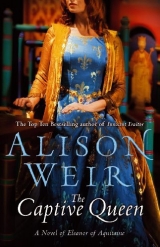
Текст книги "Captive Queen"
Автор книги: Элисон Уир
Жанры:
Историческая проза
,сообщить о нарушении
Текущая страница: 14 (всего у книги 37 страниц)
 19
19 
Falaise, 1162
They were keeping Easter at Falaise, the birthplace of the Conqueror, and the court was lodged in the massive fortress that dominated the town from its high position on the escarpment overlooking the River Ante.
“This was where William’s father, Duke Robert the Magnificent, was staying when he espied the woman Herleva,” Henry told Eleanor as they stood in the bailey staring up at the great buttressed keep with its Romanesque windows. “She was extraordinarily beautiful.” When he mentioned Herleva, he was thinking of Rohese.
“I heard he was called Robert the Devil,” Eleanor said wryly.
“Indeed he was, at least to begin with.” Henry grinned. “You see, I am doubly descended from the Devil!”
Eleanor made a face. “I can believe that!” she said, a touch tartly. “Wasn’t Herleva meant to be washing clothes in the river at the time?”
“She was, or so the story goes. She was a tanner’s daughter from the town. The duke saw her and fell in love instantly. She bore him two children. He couldn’t marry her, of course, as he had a wife already, so their son was called William the Bastard before his victories earned him the name of Conqueror.”
They strolled around the bailey and entered the little Chapel of St. Prix, where Henry pointed to an iron-studded door.
“That leads to the crypt, where I store some of my treasure. There are only two keys. I have one—and Thomas has the other.”
At the mention of Becket, Eleanor frowned. If anyone should have held the second key, it was herself, but again Becket had usurped her.
“I wanted to talk to you about Thomas,” Henry said. They sat down on a stone bench beneath the window.
“I have made up my mind that he is to be my archbishop. No, wait!” He held up a hand to still her unvoiced protest. “Thomas is my friend, and loyal to me. The Church has become too powerful, and I have radical plans for reforming the abuses within it. I know he will support me.”
“What makes you so sure?” Eleanor asked, her expression troubled.
“His unstinting and faithful service over these past years speaks for itself,” Henry said warmly. “With my true Thomas as Archbishop, I foresee no trouble in implementing these very necessary reforms.”
“Then you have made up your mind,” Eleanor stated, knowing that nothing she could say would make any difference. She knew too, in her bones, that Henry was making a bad decision for all the wrong reasons, and feared that no good would come of it. Others, wiser than herself—among them the Empress Matilda and Bishop Foliot—had voiced their concerns, but Henry paid them no heed. Well, he must go to Hell in his own way.
“I havemade up my mind,” Henry said firmly. “You could at least look cheerful about it!”
She smiled distantly. “Let us hope that your confidence in Thomas is justified.”
“Oh, it will be, it will be,” he assured her blithely.
–
They were enthroned on the dais in the hall when Becket came in response to Henry’s summons. Eleanor noticed how regally he was dressed, his embroidered scarlet tunic and blue cloak in stark contrast to the plain, mended garb of his master. But Henry had never cared much for the trappings of majesty. He let Becket be his ambassador in such things: Becket’s magnificence could proclaim the wealth and status of the King of England.
Henry leaped up from his throne and embraced his chancellor warmly.
“Thomas, I have a mission for you.”
“Yes, my lord?” Becket’s handsome face bore an eager look, as if he could not wait to hear about this latest duty that Henry was now to require of him.
“First, I want to ask after your adopted son, the Lord Henry. How is he?” the King inquired.
“He is well, my lord, and his diligence at his studies is indeed praiseworthy, although I daresay he would rather be learning swordplay than attending to his letters.” Becket smiled.
“I pray you, my Lord Chancellor, remember his mother to him,” Eleanor said wistfully.
“Rest assured, my lady, that he includes you in his daily prayers without fail,” he told her, then turned back to the King. “Does this mission concern my adopted son?” he asked.
“Yes. I want you to take him to England and have the barons swear fealty to him as my heir,” Henry commanded. “You are to leave at once, so that the ceremony can take place at Whitsun, but first, have the boy brought here now to say farewell to us.”
“If my lord will grant me leave,” Becket said, bowing and departing.
Eleanor was thrilled. She was to see her son, albeit briefly. It had been four long months since she’d set eyes on him.
When Becket returned later, bringing the seven-year-old Henry with him, Eleanor noticed the change in the boy at once. He seemed taller, more self-assured; on greeting, it became clear that there was, for the first time, a palpable distance between him and his mother. He bowed gracefully over her hand and stood a little stiffly when she opened up her arms to embrace him. His father’s boisterous hug he bore more readily, and it was brought home to her that in her son’s eyes, she had diminished in importance, although his courtesy toward her was faultless. It nearly broke her heart, but she remained smiling, and resolutely kept her distance.
“I see you have taught the lad courtly manners!” Henry observed, ruffling his offspring’s red curls. “Well, my Lord Henry. You are to go to England to receive the homage of my barons, as my heir. All you have to do is sit there and look happy about it. Just remember you are not king yet!”
They all laughed, but there was an excited and defiant glint in the boy’s eyes that rode ill with the humility he was supposed to show to his royal father. Eleanor alone noticed it, and felt a fleeting chill in her heart. Was her son, young as he was, ambitious to fill that father’s shoes? Had Henry’s words brought home to him the reality of his great destiny? Both of them had done their best to prepare Young Henry for eventual kingship, but maybe he had not quite understood what it would really mean—until now. Or maybe he was just excited at the prospect of a sea voyage and of being made to feel important, as any young boy would be. She shrugged off her fears. She was overreacting, she told herself, a bad habit of hers. It was the prospect of yet another parting from her son that was making her so sensitive, undoubtedly.
“Go and make ready, my young lord,” Becket was saying. “And walk! A future king does not run, but maintains a dignified pace.”
Henry burst out laughing. “I think Iought to take some lessons in kingship from you, Thomas!”
Becket bestowed that slow, attractive smile of his. “I too will go and prepare for the journey, my lord.”
“Wait,” Henry said. “You do not yet fully comprehend your mission.”
“My lord?” Becket, for once, looked bewildered.
“It is my intention,” Henry said, gazing upon him affectionately, “that you should become Archbishop of Canterbury.”
A look of horror fixed itself on Becket’s face. He stood there, seemingly unable to speak. Eleanor had never seen him so discomposed.
“My lord,” he whispered, his voice hoarse with shock, “do not do this, I beg of you.”
The smile froze on the King’s face.
“Come now, Thomas. Surely you can see the wisdom in my decision,” he said evenly.
“Lord King,” Becket replied desperately, “I beseech you to reconsider, for many good reasons. I know that if you make me Archbishop, you will demand many things of me—things I might be unable to grant. Allow me to speak plainly. Already it is said that you presume much in matters affecting the Church. If you seek to push through reforms that conflict with the honor of the Church, I would be bound to oppose them.”
“But Thomas, you have said yourself that the Church is in need of reform,” Henry protested.
“As your chancellor, I might voice such an opinion, but as Archbishop of Canterbury, I would be in a difficult position. And my enemies would be waiting to exploit that, to drive a wedge between us. Sire, England is not lacking in good churchmen who could ably fill Archbishop Theobald’s shoes. There is Bishop Foliot, for one, although I have never liked him; yet he would be the ideal choice. I am not even a priest, and I have never celebrated a mass!”
“It’s no good, Thomas. My mind is made up,” Henry declared with an air of finality. “I have thought long on this, over many months, and I knowthat you are the right man for the office. And you know, as well as I do, that you can be ordained priest one day, and consecrated Archbishop the next. I promise you, we will work together for the good of the Church—and of England. Now, no more arguments.”
Becket knew when he was defeated. He stood there miserably, looking as heavyhearted as a man who has just been sentenced to some terrible fate. Not for the first time, Eleanor felt pity for him. She knew his arguments were well founded, knew too that he would be at a disadvantage from the start. But both he and she were powerless to gainsay Henry once his mind was made up.
Becket had risen from his departing bow when the King bade him pause.
“I will have letters prepared, informing my English barons and bishops of my decision,” he said. “I must stay here in Normandy, but my son will be a witness to your enthronement. There is one other matter. I want you to purchase gold for the fashioning of a crown and scepter for Young Henry. I am minded to have him crowned in my lifetime, after the custom of the French kings.”
“Very well, sire,” Becket said, his voice unsteady, his face hollow. Eleanor was torn between elated surprise at her son’s coming elevation to kingship and dismay at Henry’s folly in believing that his friend would be able to render him unstinting loyalty once he was safely installed at Canterbury.
The court was still at Falaise when, in May, reports reached Normandy of Becket’s formal nomination as Archbishop in the presence of the Lord Henry and the King’s justices; then came the news of his ordination as a priest, and his consecration in Canterbury Cathedral the very next day. He had been overcome with emotion, it was said, and wept when the Archbishop’s miter was placed on his head. Eleanor wondered uncharitably if he had done that for effect; Thomas had a great sense of occasion, she knew, and a flair for the dramatic gesture. It appealed to his vanity.
The next news was brought by an unexpected visitor, the new Archbishop’s secretary, John of Salisbury. Eleanor had long known of John by reputation. He had studied in Paris and worked in the Papal Curia before entering the household of Archbishop Theobald, by which time he had become famous as a man of letters, and he was now accounted one of the greatest scholars and thinkers of his time.
“He has no great opinion of me!” Henry grimaced, after John had been announced and they were waiting for him to come into their presence. “He thinks my court too frivolous.”
“He sounds a lot like Abbot Bernard,” Eleanor observed dryly, thinking of that austere old terror who had long since gone to his reward.
“I think it was Abbot Bernard who recommended our friend John to Archbishop Theobald,” Henry told her.
A tall, dignified cleric in his early forties was ushered into the solar. John of Salisbury was known to be high-minded and uncompromising, yet his manner toward his King could not be faulted.
“Greetings, John,” Henry said.
“Greetings, sire. I trust that you and the Queen are in health. My Lord Archbishop sends his fealty and his love, and has charged me to give you this.” He held out a richly embroidered purse with drawstrings and placed it in Henry’s hands. Henry looked dumbstruck.
“The great seal of England?” he queried, in apparent disbelief.
“The very same, sire,” John replied gravely. “My master has sent me to tender his resignation as chancellor. He begs you to excuse him, but he wishes from now on to devote his life wholly to the Church.”
“What?” Henry was ashen, and also angered. “I need him both as my chancellor and as my archbishop.”
John of Salisbury regarded his king with something akin to pity. “My master has said that the burdens of both offices are too heavy for him to bear.”
“Does he no longer care to be in my service?” Henry burst out. There were tears in his eyes. Eleanor could not bear to look at him, or to witness his crushing disappointment, which seemed almost akin to a betrayal.
“Lord King, he has changed. You would not credit it.”
“In what way has he changed?” Eleanor asked sharply.
“A miraculous transformation took place just after his consecration, my lady.”
“Miraculous?” echoed Henry. Eleanor, remembering how Becket had always reveled in playing his roles to the hilt, thought that perhaps John should have said “calculated” instead.
“As soon as he put on those robes, reserved at God’s command for the highest of His servants, my Lord Archbishop changed not only his apparel, but the whole cast of his mind. Overnight, he who had been a courtier, statesman, and soldier, a worldly man by any standards, became a holy man, an ascetic even. He has changed from a patron of play-actors and a follower of hounds to a shepherd of souls.”
“Thomas? An ascetic?” Henry could not believe what he was hearing. He looked utterly bewildered. Eleanor said nothing. She was thinking that, having ceased to be the patron of play-actors, Becket seemed to have become one. She could not credit this transformation as sincere, let alone miraculous. Becket had never done things by halves.
“Yes, sire,” John was saying. “He has so completely abandoned the world that all men are marveling at the change in him. He has cast aside his elegant robes for a monk’s habit, and beneath it he wears a hair shirt, to keep himself in mind of the frailty of the flesh; my lord, it swarms with vermin. He drinks only water that has been used to boil hay. He has sold all his worldly goods, and now performs great acts of charity and humility. He washes the feet of thirteen beggars every day, and gives them alms. He asks his monks to whip his bare back in penance for his sins. His nights are spent sleepless in vigil.”
Henry was listening to all this with his mouth agape. It seemed incredible to him, who loved Becket, but not to Eleanor, who did not, and who viewed him with suspicion. She sensed that Becket was reveling in his new role, and enjoying the fame it was bringing him. How else could such a radical change be explained?
The King, still stunned, summoned Bishop Foliot and made John of Salisbury repeat to him what he had said of Becket’s transformation. Foliot, the only bishop who had opposed Becket’s election, looked grimly skeptical.
“My Lord King, you have wrought a miracle,” he said dryly. “Out of a soldier and a courtier, you have made an archbishop. And a saintly one, it seems.”
Eleanor made a face. The bishop looked at her, realizing that she was shrewder than he had hitherto supposed.
Henry was crestfallen. “I know not what to think,” he said. “I feel as if I have been abandoned. I feel as if I have lost a friend.”
20
Woodstock, 1163
Eleanor was walking with her children in the park that surrounded the royal manor of Woodstock. Earlier they had visited the menagerie established there by their father, and young Richard and Geoffrey were enthralled to see the caged lions, leopards, lynxes, and camels that had been sent as gifts to the King by foreign princes.
Matilda and little Eleanor were particularly taken with a curious stick-backed beast.
“Hedgehog!” Eleanor cried in delight.
“No,” her mother said, “it’s a porcupine.”
They stood watching it rootling about for a few more minutes, then Richard dragged them back to see the lions, shouting, “Raaarr!! Raaarr!” Eleanor smiled lovingly upon him, then her thoughts strayed to her eldest son, whom she still missed painfully. He had remained in Becket’s household, and she had not seen him since February, when she organized a little festival for his eighth birthday. But it fell somewhat flat. He was very grand now, Young Henry, too old to be thrilled by birthday treats, and all too conscious that he was his father’s heir.
The July sun was warm, and when they returned to the Queen’s enclosed garden, a pretty arbor made enchanting with its flowery mead of delicate, heavenly colors, and its laden fruit trees, they were served ale that had been hung in buckets to cool in the moat. There, Henry joined them, fresh from hunting deer in the park. He was feeling particularly pleased with himself, for only the day before, every one of the princes of Wales had come to Woodstock to pay homage to him, following his vigorous suppression of a Welsh uprising in the spring.
When the children’s nurses had taken them back to the manor house to have their supper, Henry and Eleanor sat on a stone bench, basking in the late afternoon haze and talking of his ambitious plans to enforce law and order in his kingdom. This was his cherished project, and he had been working on it from the moment of his accession.
“What worries me the most is the increase in crimes committed by the clergy,” he said. “And the law, as it stands, allows them to get away with it!”
This was a topic long familiar to Eleanor. She had heard him grumble about it many times before. But there was a new determination in his voice when he spoke again. “I intend to put an end to this anomaly,” he declared.
He could never have guessed, she was to think years later, looking back on this summer’s day, how brutally that resolve would impact upon his life.
“It’s wrong, and it must be ended,” Henry went on. “If a lay person commits a crime, they end up in my courts and are punished according to their desserts, and often severely. That is the law of the land, and it is just. I have seen to that.” He got up and began pacing up and down in his usual restless manner. “But anyone in holy orders, even the lowliest clerk, if he commits a crime, be it murder or theft or rape, can claim benefit of clergy and be tried in the Church courts. And you know what that means.”
“The Church is not allowed to shed blood,” Eleanor said.
“Exactly. So it imposes the lightest penalties. Murder a man, and as long as you’ve got a tonsure, you get three Hail Marys! But if you or I were to commit murder, Eleanor, we would be hanged.” Henry’s face was flushed with anger. This issue rankled with him, and had for a long time. She suspected there was only one reason why he had not decided to act until now, and that was because he had not wanted to provoke a quarrel with Becket. Relations between them since Henry’s return to England had been at first wary and then amicable, but increasingly there was a distance between them that had never been there in the past, and she guessed that Henry grieved for what he’d lost, and feared to upset the equilibrium of what remained of the friendship. Even so, either he had become sufficiently vexed by the matter of the criminous clerks, as he called it, to put Becket to the test, or had managed to convince himself that his beloved Thomas really was on his side.
“No, my love, I have decided,” Henry was saying. “All offenders must be tried in the royal courts, without exception.”
He sat down, and Eleanor laid her hand on his. It was becoming increasingly rare for them to share such private moments of tenderness these days. Henry was always too busy with the many cares and duties that went with ruling such vast and far-flung domains, while she, for her part, was preoccupied with the demands of her growing family. And above all that, they existed in a state of truce, skirting around the issues that divided them. It did not make for intimacy.
“Some will see that as an attack on the Church itself,” she said.
“I know that. I expect some resistance. But I am determined to have my way.” His jaw was thrust forward, his gray eyes steely with determination. It would be a brave man who defied him.
–
The next night, he came to her in some anger and distress.
“Thomas defied me!” he raged. “We were in council, and in order to replenish my treasury, which keeps emptying at an alarming rate, I proposed that the profits from revenue collected in the shires by my sheriffs be diverted to the crown. It’s a thoroughly reasonable proposal, but what did my Lord Archbishop do? He opposed it. He defied me openly. He made me look a fool!” Henry was almost shouting.
“What did your barons say?” Eleanor asked gently.
“They supported Thomas. Bastards, the lot of them!” His face was puce.
Eleanor, shaking her head in despair, snuffed some candles, took off her nightrobe, and slipped naked into bed.
“Perhaps my Lord Archbishop wishes to show that he can assert his authority as primate of England,” she suggested, as casually as she could. Privately, she wondered if Becket had gotten wind of the bigger issue that was soon to be made public, and was testing the water to see how much support he might expect to gain.
Henry sat down heavily on the bed and began stripping off his clothes. At thirty, he was still broad-chested and muscular, but he had the beginnings of a paunch, the result of enjoying too much of the good, sweet wines of Anjou.
“Does he indeed? Well, I’ll not let him best me again!” he vowed, and climbed in beside her. “But let us not waste time on Thomas. I came here for another purpose.” Gathering her in strong arms, he kissed her avidly, and she marveled at how her body still had the power to arouse him. She was forty-one now, and there was a light silvering of gray in her still-thick hair. Faint lines ringed her eyes, her lips were not as full as they had once been, and her jaw less defined; her breasts were soft from too many pregnancies, and her stomach rounded. Yet she still knew how to tease and please Henry, and her eager fingers and tongue could always find ways to bring him quickly to the point of ecstasy, as she was proceeding to do now, rejoicing to feel his penis grow instantly hard in her hand, and feeling her own surge of pleasure at his touch. They came together, as they always did, in a mad fervor of passion, and when it subsided, Eleanor lay slick and hot, with Henry’s weight upon her, marveling at how they could still take such joy in each other after eleven years of marriage and seven children.
Presently, Henry fell asleep, his arm flung across Eleanor in its usual position. When he awoke in the small hours, the candle had burned down, and in its dwindling light he lay gazing at his wife, recalling their lovemaking. She was still a magnificent woman, he reflected, and he still loved her. He might make secret trysts with Rohese de Clare—indeed, he was so captivated by her erotic appeal that he could not give her up—but Eleanor had his heart, and often his body, which was something of a marvel to him. When he was with her like this, he could forget for a space how deeply Thomas had wounded him by betraying their friendship. Never in history, he told himself, had a prince done so much for a subject, only to have it cast back in his face. It was as if Thomas was determined to assert his authority above that of his king! Thathe could not—and would not—tolerate. If there was to be a power struggle between them, then so be it. But why should Thomas wish to initiate such a thing, when he owed so much to him, and after they had enjoyed the most enriching of friendships? Dear God, Henry thought, must he keep torturing himself by remembering those heady days when he and Thomas had been close and carefree, heedless of the storms that were swirling threateningly on the horizon? He’d loved Thomas, loved him as a brother, and had believed that Thomas returned that love. It seemed he had been wrong about that, devastatingly wrong. And at the very thought, Henry of England buried his lionlike head in the pillow and wept.
Eleanor awoke in darkness and lay there gazing through the high, narrow window at the starry night sky. A light, warm breeze drifted across the pillow, gently stirring the tendrils of her hair. England’s climate might be as cold as that in northern France, but the summer months could be delightful, although not as blazingly hot and glorious as in Aquitaine. For the thousandth time she struggled to suppress a longing for the land of her birth. It had been four long years since she was in Poitiers, and longer since she’d seen the vast golden swaths of the South. Soon, she must contrive to go back, make any excuse. Her mind was full of plans.
Suddenly, she became aware of a harsh, muffled sobbing, and realized to her horror that it was coming from the pillow next to hers, and that Henry was weeping. She had never seen her tough, strong husband cry, and was at a loss to know what to do. Should she pretend she was asleep and hadn’t heard? Would it embarrass him to have her witness his vulnerability? Or should she follow her instincts and comfort him, as she comforted her sons when they came to her in tears over some childish hurt?
He had his back to her. She reached out a tentative hand and placed it on his bare shoulder.
“Henry? What is the matter?” she whispered.
He froze for a moment, then his shoulders slumped and he dragged his forearm over his eyes.
“I am betrayed,” he murmured brokenly, “betrayed by the one who has the most cause to love me.”
For answer, Eleanor drew him into her arms, pulling his head against her breasts. Normally, such intimate contact would inflame his desire, but not tonight. He just lay there, his eyes closed, sunk in misery.
“Henry,” she said at length, “you should not let Thomas affect you so. He is not worthy of this mindless devotion.” That roused him, and he drew back and stared at her through the gloom.
“Thomas was the best servant a king ever had,” he said hotly, “and the best friend. You never liked him. You’ve always been jealous of him—admit it!”
“I admit I resented his hold on you,” Eleanor said carefully, anxious not to make this situation any worse than it was. “I wanted you to seek myadvice and opinions, not his. That was only natural. Yet it did seem to me—and others—that you were in thrall to him, and that worried me, because I feared you would one day find him wanting in some way, as is sadly the case now. And I was not the only person who felt you had advanced him too greatly, as you well know.”
“I am not in thrall to him,” Henry snapped. “What rot!”
“Then why are you so hurt?”
“I feel betrayed!” he blurted out. “Anyone would, if they had done as much for someone as I have for Thomas, and then had it thrown back in their face!”
“Then let anger be your guide, not hurt,” Eleanor urged. “You have his measure now. You will be prepared when he thwarts you again, and displays such base ingratitude—as he will! Do not let him get away with it a second time.”
“It’s not as simple as that,” Henry said, a tear trickling down his cheek. “I loved that man like a brother, yet suddenly he is my enemy.”
“Oh, Henry, can you not see what others see?” Eleanor sighed. “Love can make us blind to others’ faults. Always remember, whatever he does, you are his king. He owes you fealty and duty. You must swallow your pain and make him obey you, as all your other subjects are bound to do.”
“You don’t understand at all, do you, Eleanor?” Henry was almost shouting. “He has a higher allegiance than his duty to me. He tells me he has God on his side, and I can’t fight God!”
“Thomas is a man, for all that he is an archbishop,” Eleanor flung back passionately, “and it’s as a man that you must deal with him, on the level. All this boasting of putting God first is more of his play-acting, yet you could never see it. He’s reveling in this role and playing power games with you. And you’re letting him do it!”
“Enough!” howled Henry, his face ravaged in the moonlight. “I won’t listen to your venom. You always hated Thomas.”
“It’s not venom, it’s common sense!” she cried. “You would see it if you weren’t so besotted with this man! By God’s blood, Henry, if I didn’t know better, I’d swear that you love him in the way that he loves you.”
He stared at her, shocked into silence for a moment. “What do you mean by that?” he asked, slowly, menacingly.
“I saw it years ago,” she went on, “and if I could see it, then others must have seen it too. The way he looked at you. He wantedyou, Henry. It was glaringly obvious. If you hadn’t been so blinded by love for him, you’d have known.”
The slap landed stingingly on her cheek, leaving her as shocked as he. Henry had never raised a hand to her before, unlike many other husbands she had heard of.
“You are truly sick in your mind if you think such things,” he snarled. “I can only think it’s your foul jealousy that has led you to make such vile allegations.”
“Believe that if you wish,” Eleanor said quietly, her palm pressed to her burning cheek. “I will say nothing more, for I know that what I am convinced is the truth is painful. But when he hurts you again, Henry, I will be here. I love you. Iwould do nothing to harm you or betray you.”
In later years, she was to look back on those words with bitter regret, and to that night as one that marked a turning point in their relationship. Suddenly, she had become the enemy too, for daring to probe the raw place within her husband’s heart. He had come to her for comfort, and she had only made matters worse. She was overwhelmed with the hopelessness of it all. Thomas Becket was still standing between them, more potent as an adversary than he had ever been as a friend.