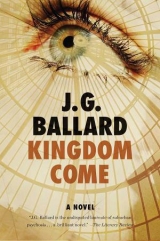
Текст книги "Kingdom Come: A Novel"
Автор книги: James Graham Ballard
Жанр:
Научная фантастика
сообщить о нарушении
Текущая страница: 8 (всего у книги 19 страниц)
‘Exactly.’ Maxted watched me smiling into my drink. ‘I hope you were an only child. You’ve seen the people around here. Their lives are empty. Install a new kitchen, buy another car, take a trip to some beach hotel. All these sports clubs financed by the Metro-Centre are an attempt to boost sales. It hasn’t worked. People are bored, even though they don’t realize it.’
‘So a lot of babies are going to turn blue in the face?’
‘Not just babies. What’s happening here involves entire communities. All these satellite towns around Heathrow and along the motorways. There’s one thing left that can put some energy into their lives, give them a sense of direction. You’ve run advertising campaigns—any ideas?’
‘None. Narcotics? A complete drug culture?’
‘Too destructive. Think of . . .’
‘War? It makes for good television.’
‘Difficult to organize. The Thames Valley can’t make territorial demands and invade Belgium. What I have in mind comes free, and is readily to hand.’
‘Sex?’
‘They’ve tried sex. Sooner or later, sex becomes hard work. Wife swapping is fun, but you meet too many people you look down on. Decadence demands a certain degree of innocence.’
‘So that leaves . . . ?’
‘Madness.’ Maxted lowered his voice and spoke more clearly, leaving behind his usual rush of words. ‘A voluntary insanity, whatever you want to call it. As a psychiatrist I’d use the term elective psychopathy. Not the kind of madness we deal with here. I’m talking about a willed insanity, the sort that we higher primates thrive on. Watch a troupe of chimpanzees. They’re bored with chewing twigs and picking the fleas out of each other’s armpits. They want meat, the bloodier the better, they want to taste their enemies’ fear in the flesh they grind. So they start beating their chests and shrieking at the sky. They work themselves into a frenzy, then set off in a hunting party. They come across a tribe of colobus monkeys and literally tear them limb from limb. Very nasty, but voluntary madness brought them a tasty supper. They sleep it off, and go back to chewing twigs and picking fleas.’
‘And then the cycle repeats itself.’ I lay back, aware of Maxted’s hot breath on the air. ‘More race riots and arson attacks, more immigrant hostels put to the torch. So the people of the motorway towns are tired of chewing twigs. One question, though. Who organizes these attacks of madness?’
‘No one. That’s the beauty of it. Elective insanity is waiting inside us, ready to come out when we need it. We’re talking primate behaviour at its most extreme. Witch-hunts, auto-da-fés, heretic burnings, the hot poker shoved up the enemy’s rear, gibbets along the skyline. Willed madness can infect a housing estate or a whole nation.’
‘Thirties Germany?’
‘A good example. People still think the Nazi leaders led the German people into the horrors of race war. Not true. The Germans were desperate to break out of their prison. Defeat, inflation, grotesque war reparations, the threat of barbarians advancing from the east. Going mad would set them free, and they chose Hitler to lead the hunting party. That’s why they stayed together till the end. They needed a psychopathic god to worship, so they recruited a nobody and stood him on the high altar. The great religions have been at it for millennia.’
‘States of willed madness? Christianity? Islam?’
‘Vast systems of psychopathic delusion that murdered millions, launched crusades and founded empires. A great religion spells danger. Today people are desperate to believe, but they can only reach God through psychopathology. Look at the most religious areas of the world at present—the Middle East and the United States. These are sick societies, and they’re going to get sicker. People are never more dangerous than when they have nothing left to believe in except God.’
‘But what else isthere to believe in?’ I waited for Maxted to reply, but the psychiatrist was staring through the picture window at the dome of the Metro-Centre, fists gripping the air as if trying to steady the world around him. ‘Dr Maxted . . . ?’
‘Nothing. Except madness.’ Maxted rallied himself and turned back to me. ‘People feel they can rely on the irrational. It offers the only guarantee of freedom from all the cant and bullshit and sales commercials fed to us by politicians, bishops and academics. People are deliberately re-primitivizing themselves. They yearn for magic and unreason, which served them well in the past, and might help them again. They’re keen to enter a new Dark Age. The lights are on, but they’re retreating into the inner darkness, into superstition and unreason. The future is going to be a struggle between vast systems of competing psychopathies, all of them willed and deliberate, part of a desperate attempt to escape from a rational world and the boredom of consumerism.’
‘Consumerism leads to social pathology? Hard to believe.’
‘It paves the way. Half the goods we buy these days are not much more than adult toys. The danger is that consumerism will need something close to fascism in order to keep growing. Take the Metro-Centre and its flat sales. Close your eyes a little and it already looks like a Nuremberg rally. The ranks of sales counters, the long straight aisles, the signs and banners, the whole theatrical aspect.’
‘No jackboots, though,’ I pointed out. ‘No ranting führers.’
‘Not yet. Anyway, they belong to the politics of the street. Our “streets” are the cable TV consumer channels. Our party insignia are the gold and platinum loyalty cards. Faintly risible? Yes, but people thought the Nazis were a bit of a joke. The consumer society is a kind of soft police state. We think we have choice, but everything is compulsory. We have to keep buying or we fail as citizens. Consumerism creates huge unconscious needs that only fascism can satisfy. If anything, fascism is the form that consumerism takes when it opts for elective madness. You can see it here already.’
‘In bosky Surrey? I don’t think so.’
‘It’s coming, Richard.’ Maxted pursed his lips, as if to shut out all possibility of a smile. ‘Here and in the towns around Heathrow. You can feel it in the air.’
‘And the führer figure?’
‘He hasn’t arrived yet. He’ll appear, though, walking out of some shopping mall or retail park. Messiahs always emerge from the desert. Everybody will be waiting for him, and he’ll seize his chance.’
‘Parliament, the civil service, the police? They’ll stop him.’
‘Unlikely. They aren’t directly challenged, so they’ll look the other way. This is a new kind of totalitarianism that operates at the checkout and the cash counter. What happens in the suburbs has never bothered the people in Whitehall.’
‘A new Dark Age . . . What do we do?’
‘We try to control it. Steer it onto the beach. A monster is stirring in the deep, and we need to get it onto the shore while it’s still drowsy. Now is the time to act, Richard.’
‘Right.’ I finished the last of my whisky, trying not to meet Maxted’s eyes. He was an impressive figure, with his huge head and powerful hands, but I too was being steered into the shallow water. He had begun to look at his watch, and I half expected the doors to burst open and admit a resistance unit led by Geoffrey Fairfax. In an offhand way, I said: ‘I take it you’re not alone? There are others who think like you?’
‘A few of us. We can see what’s coming and we’re concerned.’
‘Geoffrey Fairfax, William Sangster? Superintendent Leighton?’
‘As it happens, yes.’ Maxted seemed unsurprised. ‘There are others.’
‘Dr Goodwin?’
‘In her left-handed way. Julia is less nervy as a doctor than she is as a young woman. Why do you ask?’
‘It’s interesting that you’re the same group who happened to be in the Metro-Centre.’
‘And saw Duncan Christie in the South Gate entrance? That’s right.’
‘Lucky for him. His doctor, his psychiatrist, his head teacher . . .’
‘We met in the car park, and strolled in together.’
‘Fair enough. And your plans now?’
‘To nip this thing in the bud. If we wait much longer we’ll be overwhelmed.’
‘Willed madness . . .’ I repeated the phrase, already a slogan in a teaser campaign. ‘You think my father was killed by someone so bored he decided to choose insanity?’
‘For a few seconds. Long enough to pull the trigger.’ Maxted took off his leather jacket to free his arms, then reached out and gripped my shoulders in a sudden show of confidence. I could smell the sweat on his shirt, a blend of stale deodorant and sheer unease. He had been perspiring freely since we arrived at the penthouse, but the careful exposition of his fears had been more than a public health warning. He had been hiding his discomfort at having to expose his private guilt to someone who was watching him a little too closely. The bullheaded swagger was a screen carried by a thoughtful and unsure man. I remembered him sitting in the Range Rover outside the Odeon cinema, within earshot of a vicious riot that he and Fairfax had been orchestrating. Yet he had done nothing to stop it.
He released his grip on my shoulders, and did his best to straighten my suit. ‘Think about it, Richard. You could help us in all kinds of ways. While you’re thinking, I need to make a phone call. Help yourself to whisky and take in the view. It’s going to be a hot night . . .’
‘Dr Maxted, tell me.’ I waited until he reached the door. ‘Do you know who killed my father?’
‘I think so.’ Maxted studied me as if I were a dejected patient for whom the truth would be the ultimate lethal dose. ‘Yes, I do.’
‘But . . . ?’
‘I’ll be with you in five minutes. There’s a lot you don’t know.’
15
THE PRISONER IN THE TOWER
I LAY BACK on the sofa, watching the lights come on over the motorway flatlands, the desert wastes of retail England. It was a night of important sports matches: the arrays of arc lights above the football and athletics stadiums blazed through a hazy glare that caught every insect in the Thames Valley. Already thousands of spectators in St George’s shirts would be taking their seats, ready to work themselves into a frenzy before they seized the placid town.
I sat with my whisky, in this penthouse correctly sited above a lunatic asylum. Maxted had impressed me, but I discounted his claim that he knew who had shot my father. His motives were ambiguous even for a suburban psychiatrist who appeared too often on television. There he played the same role, the tough-but-tender physician moonlighting as a nightclub bouncer, but even the television audience had failed to be taken in. He was trying to recruit me into his ‘resistance’ group, but I could hear the communal singing from the stadiums, great war hymns that seemed to lift the night, and I knew that Maxted and his posse of eccentric professionals were doomed.
I stepped onto the balcony and gazed at the silver back of the Metro-Centre, a self-supporting structure far more impressive than the Millennium Dome at Greenwich, a glorified tent filled with patronizing tat. The Metro-Centre was a house of treasure that enriched the lives of its visitors. Like an unimportant but hard-working merchant in a souk, I had given my entire career to the task of displaying that treasure at its best.
I RETURNED TOthe living room and listened to the silence. It was easy to imagine Maxted with a prostate the size of a cricket ball, legs astride the lavatory pan, discussing a difficult patient on his mobile as he conjured the sluggish urine from his bladder.
I opened the door to the hallway. A corridor ran to the bathroom and bedroom, but there was no sound of Maxted’s voice on a telephone. The flat was silent, light flaring against the windows from the display screens at the football stadium. I was alone in the penthouse, and assumed that Maxted had hurried away to deal with an emergency call, too distracted to warn me.
I pressed the lift button and watched the indicator panel, then pressed again and waited. There was no response, and the red warning light glowed steadily in the swipe unit. Without a pass card the lift was closed to me, part of the elaborate security that guarded the research laboratories and their drug stores from escaped patients.
‘Maxted . . . for God’s sake!’
Irritated by the endless series of charades that seemed to unfold within each other, I pounded the lift doors and pressed my ears to the metal panels. Annoyed with myself for letting Maxted play his devious games, I walked back to the kitchen. A plate-glass door led to a narrow balcony, where a short stairway joined the main fire escape.
Cautiously, giving the security system time to think, I turned the handle on the door, but it failed to open. Somewhere in the penthouse lay the fuse box and the switching unit that controlled the security locks, but my temper was up. Holding the kitchen chair by its legs, I raised it above my head and drove the steel frame into the plate-glass door. The violent blows echoed like gunfire through the empty rooms, but left the barest marks on the toughened glass. Then, after the third blow, I heard an alarm shrill far below me.
THIRTY MINUTES LATERI was sitting in Maxted’s black armchair, finishing the last of the whisky in the decanter and mulling over the almost deliberate way in which everyone I visited in Brooklands had plied me with alcohol. Even my father had left a substantial supply of gin and whisky, as if keen to ease the culture shock awaiting me. Fairfax, Sangster and Dr Maxted had been as quick with a bottle as an over-attentive sommelier in an unpopular restaurant.
I was staring gloomily at the decanter when the lift doors at last opened. Two security men emerged, carrying a leather restraining harness. They approached me without speaking, feinting around the furniture like dog handlers cornering an alcoholic pit bull, but I was sure that they knew who I was. After checking the flat they beckoned me to the lift.
‘Mr Pearson, we’ll have to see you out.’
‘Good. I’ll come quietly. I take it you’re the Rapid Response Unit?’
‘Dr Maxted said—’
‘Don’t tell me. I couldn’t cope . . .’
I assumed that Maxted had slipped away on some errand of his own, knowing that I would set off the alarm, and had told the security men to release me half an hour later. I entered the lift, the guards behind me with their harness, ready to throw it over me at the first sign of dementia.
The doors closed. In the pause before the lift moved there was the distant sound of a powerful explosion, a loud percussive boom that entered the shaft above our heads and rocked the lift.
I stepped into the night air, and searched the sky for the burning debris of this huge firework. A police car was parked beside the rhododendron screen. The headlights were on full beam, and the distracted woman constable at the wheel was trying to speak through a blizzard of radio chatter. She saw me walk to the security barrier and signalled me to stop.
As I approached the police car a blonde-haired woman in a blue tracksuit and trainers emerged from the admin offices. She strode past me, and caught the tang of whisky on the dark air.
‘Mr Pearson?’ Sergeant Mary Falconer seemed surprised to find me. She pointed to the security men still watching me from the elevator. ‘What are you doing here? Did you break in?’
‘Break in?’ I raised my hands to seize her shoulders, and then let her step back. ‘This place really is a madhouse. For the last hour I’ve been trying to break out.’
‘Break out?’ She fussed with a stray hair. ‘Why? How did you get in?’
‘Forget it. No wonder the crime rate is soaring. Dr Maxted brought me here.’
‘Dr Maxted? Are you a patient of his?’
‘At this rate I soon will be. Now, I need to find a taxi.’
‘Hold on a moment. Just wait there . . .’
Sergeant Falconer listened to the radio chatter and rubbed the dial of her watch. She was dressed for the athletics field, or at least a run around the neighbourhood, though scarcely a hair or eyelash was out of place. At the same time she seemed ill at ease, like a supporting actor assigned the wrong role. Once again she reminded me of a strait-laced but vulnerable teacher aware that her class had seen her in a piece of questionable behaviour.
A second police car turned off the main road and approached the security barrier, but Sergeant Falconer was too distracted to notice it. She listened to the ambulance sirens in the distance and drew a mobile phone from her tracksuit top. She stared at the text message, then crossed the road to the second police car. She took the radio earpiece from the driver, listened briefly and ran back to me. For the first time she was alert and focused, as if the script she had been following now synchronized with reality.
‘Sergeant Falconer . . . ?’ I held her arm. ‘Something’s going on. What are you people playing at?’
‘Get into the car.’ Avoiding my breath, she pushed me through the rear door. ‘We’ll give you a lift.’
‘What is it?’ I watched the second police car reverse and speed away. ‘Have they caught the gunman?’
‘Who? Which gunman?’
‘The man who killed my father. They’ve arrested him?’
‘No.’ She fastened her seat belt, beckoning the woman driver to climb the grass embankment around the security barrier. ‘It’s the Metro-Centre. There’s been a bomb attack. Heavy damage, but no casualties. So far . . .’
16
THE BOMB ATTACK
THE TEMPLE WAS UNDER THREAT, and the congregation was rallying to defend it. Crowds of football supporters filled the streets, running past our police car as it sat in the stalled traffic near the town hall. Urged on by Sergeant Falconer, the woman constable tried to force our way through the throngs of fans and evening shoppers. All the matches in the Thames Valley Olympics had been abandoned as the news broke of the bomb attack at the Metro-Centre. Supporters turned their backs on ice-hockey grudge matches and penalty shoot-outs, and set off through the streets to give succour to the stricken dome.
Six hundred yards from the Metro-Centre we could clearly see the smoke lifting from the roof, dark billows lit by cascades of sparks swept aloft in the updraughts. Still intact, the dome loomed in front of us when we reached the central plaza, as always so huge that I failed to notice the police vehicles, ambulances and fire engines drawn up around the entrance to the underground car park.
A small section of the roof was dark, a narrow triangle the size and shape of a schooner’s jib sail. The huge bomb detonated in the upper level of the basement car park had torn through the floor of the Metro-Centre, the explosive pressure blowing out the glass and aluminium panels two hundred feet above the atrium. The shopping mall, according to the police radio reports, was largely untouched, and the smoke rose from the burning vehicles ignited by the bomb. Opening the passenger window, I gazed at the dark triangle near the apex of the dome. It would soon be repaired, but for the moment a section of space-time had been erased, exposing a deep flaw in our collective dream.
Sergeant Falconer showed her warrant card to the policemen keeping a lane open for emergency vehicles. Above the din of ambulance sirens an officer in a yellow jacket directed us towards the underground garage.
‘Looks like a car bomb,’ Sergeant Falconer told me. ‘Three pounds of Semtex. There’s another maniac on the loose.’
‘Anyone killed or injured?’
‘No one. Let’s thank God for that . . .’
But her relief at the news scarcely left the sergeant any less agitated. Threads of blonde hair were springing loose from their braids. For some reason, the slightest shift from the immaculate left Sergeant Falconer looking frayed and insecure. Impatient to get into the car park, she reached across the driver and gripped the steering wheel, trying to change lanes. The car stalled, and the flustered constable flooded the engine as Sergeant Falconer drummed her fists on the instrument panel.
When we approached the entrance ramp I looked back at the plaza around the Metro-Centre, now occupied by a huge crowd, drawn to the St Peter’s Square of the retail world. Everyone was staring upwards at the billows of smoke that lifted into the night. In the front row was Tom Carradine, the young manager who had first welcomed me to the dome. He darted to and fro, desperate to find a better view, too distraught to express himself in any other way, like a tennis player leaping around a court as he tried to ward off defeat by an invisible opponent with an invisible ball. The notion that anyone might dislike the Metro-Centre and wish to damage it had clearly never occurred to him.
WE ENTERED THEbasement car park, and followed the police guide rails into one of the delivery bays, finding a place between two articulated trucks. The night shift were being questioned by a team of investigators, and the freight carousels were stationary, stopped in mid-track at the moment of the explosion. Three-piece suites sealed in plastic sheeting, video-game consoles and coffee machines leaned against each other in a huge jumble. Over everything hung a stench of petrol and scorched rubber, and the acid dust of pulverized cement.
Police emergency lights shone through the haze, and crime-scene tapes marked out the empty parking bays being searched by forensics officers. A wedge-shaped section of the concrete ceiling had vanished, driven into the changing rooms of a health club near the atrium.
‘All the customers had gone to the sports matches,’ Sergeant Falconer explained. ‘So they’d closed for the night. It’s a miracle no one was hurt.’
I watched the forensics teams picking their way through the rubble. ‘Not much to find. What are they looking for?’
‘Timer fragments. A clock mechanism. Human tissues . . .’ Sergeant Falconer stared at me with concern. ‘This isn’t the place for you, Mr Pearson. It’d be best if you went home.’
‘You’re right.’
My presence unsettled her, and she was eager to get away from me. Why she had brought me to the Metro-Centre in the first place seemed unclear, like Dr Maxted’s motives for driving me all the way to his mental hospital.
I tried to remember where I had parked that morning, but the perspectives of everything in the basement garage seemed to have changed. I had driven around for a few minutes, searching for a place, then lost the numbered ticket during my scuffle with the thugs who attacked Duncan Christie.
A dozen cars caught fire when their petrol tanks exploded, burning fiercely before the sprinkler system came into play. Smothered in foam, the blackened vehicles sat in the wreckage of themselves, windows and doors missing, shreds of tyres peeling from their rims.
At the centre was the car that had carried the bomb, an agony of splayed body panels, exposed seating springs, engine block and drive shaft. The entire roof had vanished, and the forensics officers in white overalls were leaning into the debris, searching the carbonized remains of the instrument panel.
I assumed that the bomber had stolen the car before driving it to the Metro-Centre, and had left the bomb in the boot, directly above the fuel tank. Both the front and rear number plates had vaporized in the fireball, but the large engine had blunted the blast damage to the front of the car. A metal Guards Polo Club badge was still bolted to the front bumper.
A similar badge had been attached to my Jensen when I bought it from the young widow of a Grenadier lieutenant a few months after his death in the Iraq war. As a nod to the dead soldier, I left the badge where it was, hoping that it might catch the eye of his former comrades.
I looked away, shielding my face from the harsh emergency lights. Of all the vehicles to choose from in the Metro-Centre car park, the bomber had left his vicious surprise in my old but still sleek and handsome Jensen . . .
I took out my ignition keys and stared at the ancient fob, all that was left of the stylish tourer from a vanished age of motoring. It occurred to me that the driver, not the car, was the real target, and I had barely escaped being blown through the Jensen’s roof. My hour trapped in Maxted’s penthouse had probably saved me. Had I left Northfield Hospital with Maxted, and taken a taxi back to the Metro-Centre, I would have been driving the Jensen to my father’s flat when the bomb detonated.
I walked towards the forensics officer picking pieces of ragged upholstery from the car’s floor-pan. Within a few days, if not hours, the engine and chassis numbers would lead the police to the Grenadier’s widow, and then to me.
Would they assume that I was the bomber? My father had died in the Metro-Centre, and leaving a bomb in the garage would strike the police as a likely act of revenge. The forensics officer had turned to watch me, and I noticed that I was waving the Jensen’s keys in my hand, a nervous tic that had come from nowhere.
I calmed myself, and searched for Sergeant Falconer. She was standing with a group of journalists who were questioning a uniformed inspector. In a transparent plastic bag he carried a trilby hat with a ragged hole through its crown. He removed the hat from the bag and showed it to the journalists. As he spoke, his fingers flicked at a fishing fly sewn into the hatband.
The journalists scribbled into their notebooks, clearly impressed by the hat. But I was watching Sergeant Falconer. Even in the harsh glare of the emergency lights her face was unnaturally blanched. The blood had drained from her cheeks, revealing the bones beneath her skin patiently waiting for their day. She turned and swayed, then stumbled against the inspector. Still talking to the journalists, he beckoned to two policewomen behind him and they quickly helped Sergeant Falconer towards the driving cab of a forensics van parked inside the crime-scene area.
Concerned for her, I tried to cross the nearest tape, but an officer ordered me away. As I backed off, trying to clear the stench and grit from my throat, I brushed past the young constable who had driven us from the hospital.
‘Is she all right?’ I held her arm. ‘Sergeant Falconer? She fainted . . .’
‘She’ll be fine. There’s bad news. We’ve found the first victim. Or what’s left of him.’
‘Dear God . . . where is he?’
‘In a nasty little jigsaw puzzle.’ She took my hand from her arm and stared at me shrewdly, still unsure whether I was a patient at the mental hospital. ‘Don’t breathe in too much or look at the soles of your shoes . . .’
‘I won’t.’ I pointed to the inspector dismissing the troop of journalists. ‘The hat? Was the dead man a local fisherman?’
‘A Brooklands solicitor. His name’s inside it. Geoffrey Fairfax.’ She raised the brim of her cap, debating whether to detain me as a possible suspect. ‘Did you know him, Mr Pearson . . . ?’
I THANKED THEconstable and climbed the steps beside the freight entrance, trying not to breathe until I reached the open air, and an even deeper darkness than the night.