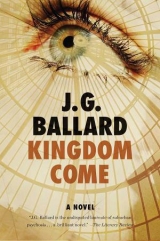
Текст книги "Kingdom Come: A Novel"
Автор книги: James Graham Ballard
Жанр:
Научная фантастика
сообщить о нарушении
Текущая страница: 16 (всего у книги 19 страниц)
34
WORK MAKES YOU FREE
VERY LITTLE HAD CHANGED, I told myself, but nothing was quite the same. By the end of the second week we were still convinced that we would soon be released from the Metro-Centre. That morning the remaining hostages emerged from their hotels, sleepless and dishevelled, and looking as if their dreams had attacked them. They selected a breakfast of sorts from the soft drink and confectionery shelves of the nearest supermarket, washed themselves in a litre of Perrier water, and then assembled in the South Gate entrance hall, ready to play their roles in an eternal baggage handlers’ strike.
By now nearly two thousand hostages had been freed, but those who remained were aware that their value to Tom Carradine and his mutineers had risen steeply. Barely a dozen were released each day, and Julia Goodwin no longer bothered to present her list in person. She had already despaired of me, and shook her head wearily whenever I appeared, asking about David Cruise’s health. Ask about your own health, her tired but punitive gaze seemed to say.
Out of duty, I hobbled to the South Gate entrance and joined the hostages patiently forming themselves into a queue. Tired of waiting, a group of parents with older children tried to force their way through the marshals guarding the fire door. Cheered on, they kicked aside the security rails and demanded to be released.
The reaction was prompt and violent. The marshals drew their batons, and the parents were pushed back with a show of force that hushed everyone in the entrance hall and left two of the husbands bleeding from head wounds. Behind his screen of bully-boys, Sangster watched all this with a resigned but understanding smile.
I wanted to talk to the head teacher, but I felt uneasy with him. He had begun to sway from side to side like a fourth atrium bear, keeping time to the music inside his head. His role was too ambiguous for comfort, and he had moved from hostage to principal ringleader without taking off his overcoat.
After the brutal response by the marshals everyone stared silently at the open floor where the scuffles had taken place. Bloody skid marks covered the tiles, and Sangster stepped forward and began to scrutinize them in a strangely obsessive way, like an anthropologist examining the foot paintings of a primitive tribe. Rousing himself from his reverie, he stepped through a service door and reappeared with a mop cart and bucket. Watched by the crowd, he swabbed away at the skid marks, squeezed out the bloodstained mop and worked it up and down the floor until the marble gleamed again. The hostages stared stolidly at their reflections but remained silent.
I said nothing to Sangster or Tony Maxted about my sighting of Duncan Christie, deciding to keep this to myself. The bullet thrown onto the beach, like the one he had pressed into my hand, was his way of reminding me that the Metro-Centre had killed my father, and that the agents of his death were now with me inside the dome. I kept my eyes on the high galleries, but Christie had disappeared into the mist that separated the seventh floor from the sky.
Rumours swerved around the Metro-Centre, phantoms that flew by day. I dozed for an hour behind the enquiry desk, and woke to find the hostages discussing the news that David Cruise had begun to revive in the intensive care unit. He had removed his oxygen mask and spoken to several witnesses about his determination to defend the Metro-Centre and return it to its rightful place in the M25 community.
I dismissed this as a near-hysterical fantasy, but Tom Carradine arrived and confirmed the good news through his megaphone. He looked confident and charismatic in his freshly pressed uniform, but almost too lucid for comfort, speaking with an amphetamine fluency, eyes bright and unblinking as he surveyed the exhausted hostages. Nonetheless, he announced that he would celebrate the good news by freeing a further fifty hostages. His decision was relayed to the police negotiators at their post beyond the fire door, and dominated the lunchtime television bulletins.
Everyone lined up for the selection, trying to look their worst as Carradine and Sangster moved along them. Parents did everything to irritate their already fractious teenagers, wives urged their middle-aged husbands to mumble and drool. Most of us were too tired to think of feigning exhaustion, but Sangster pointed to an ailing widow who had been injured by police truncheons and showed the effects of mild concussion.
The hostages accepted their fate, but a group of well-to-do Pakistanis were convinced that they had been deliberately ignored. They surrounded Carradine in a rage of indignation, shouting and thrusting at his shoulder. Sangster quickly signalled to the marshals, who forced back the gesticulating group and kicked open their parcels. To a chorus of jeers, they held aloft the silkily expensive underwear, then trampled the garments underfoot. The elderly barrister who was the family patriarch worked himself into a fury of anger, shouting abuse at Carradine and by chance spitting on his shirt. Batons were being drawn as I left the ugly scene.
I disliked the violence and limped back to the first-aid post, hoping to see Julia Goodwin. The marshals guarding David Cruise had seen enough of me for the day and turned me away, so I sat on the podium beneath the bears. Half an hour later I heard the emergency hatch clang shut as the last of the returnees stepped shakily into freedom.
About three hundred hostages now remained, and the same number of mutineers. The latter formed a hard core of supporters who had forsaken everything, their homes and families, their jobs and cars and loft extensions, to defend the Metro-Centre.
Despite their efforts, conditions in the dome were steadily deteriorating. Without the powerful air-conditioning units, the temperature inside the mall continued to climb. The supermarket floors were slick with melted ice cream oozing from their cabinets, and a foul air rose from the defrosting meat freezers. The water pressure was too low to fill the lavatory cisterns, and a farmyard stench enclosed the Ramada Inn where the dome’s director and senior staff were held prisoner. The Metro-Centre, once bathed in a cool and scented air, was turning into a gigantic sty.
At two o’clock that afternoon, when the hostages drifted off in search of lunch, they found all the supermarkets closed. They peered through the doors, rattling the chains and padlocks, until the public address system ordered them to assemble in the central atrium. Carradine appeared thirty minutes later, descending the staircase from the mezzanine, and informed us that lunch was off the menu until we cleaned up the supermarkets and returned them to their previously immaculate state. He called on everyone to remember their pride in the Metro-Centre, and repay the debt they owed the mall for transforming their lives. The hostages would be divided into ten work groups and each of these would be assigned a supermarket.
Carradine gazed triumphantly at the glum faces and listened to Sangster whispering in his ear. He then announced that the work groups would take part in a competition. The team that did the best job of cleaning and waste disposal during the next week would be allowed to leave the dome.
As the hostages dispersed, queuing to collect their mops and pails, I caught up with Sangster, still smiling slyly to himself.
‘Richard? Good . . .’ He laid a huge arm across my shoulders. ‘Rather a neat wheeze, don’t you think?’
‘ “Work Makes You Free”?’
‘Who said that? It’s very true. It keeps alive the sporting instinct, and gives them something to live for. At the same time it weeds out the stronger and more determined elements.’
‘Those who might cause trouble?’
‘We can’t lose. A sick hostage is much more valuable than a robust one. And less dangerous. Don’t worry, I’ll see that you’re excused from cleaning duties.’
‘I’m very grateful. It’s good to have a friend in high places. As it happens, I can barely walk.’
‘Your foot?’ Sangster frowned with distaste at my bloodstained bandage. ‘We could find you a sedentary job. Rinsing mops, say? Is it psychosomatic?’
‘I hadn’t thought of that. I’ll ask Tony Maxted.’
‘I would.’ Sangster stared at me with a straight face, then broke into a cheery grin. ‘You want to stay here, Richard. You know that.’
‘I don’t agree.’
‘Of course you do. This place is your . . . spiritual Eden. It’s all you have to believe in.’
‘Never. Tell me—the siege, when will it end?’
‘Let’s wait and see.’ Sangster seemed almost gleeful at the remote prospect. ‘That’s what’s so interesting. This isn’t about the Metro-Centre: it’s about England today. Now, go back to your room and rest. You’re too valuable to be ill. When David Cruise wakes, you’ll be there to cheer him up.’
‘Will he wake?’
Sangster turned to wave. ‘He’d better . . .’
I WATCHED THEhostages shuffle to their workstations, with all the enthusiasm of patients ordered to clean their own hospital. Discipline ruled, and a more martial spirit prevailed. The cartons of perished pizzas, the shoals of rotting fish fingers, the thousands of cartons of rancid milk were stripped from the shelves and carted away to the refuse hoppers in the basement. Carradine and Sangster introduced a strict rationing system, and we queued for our modest meals of corned beef, pilchards and baked beans.
Negotiations continued with the police, who were increasingly impatient as the release of hostages slowed, but the lack of violence forced them to bide their time. A full-scale assault would leave scores of hostages dead, and the Metro-Centre was a sniper’s paradise. More to the point, floor-to-floor street battles would inflict millions of pounds’ worth of damage on the unprotected merchandise.
A few hostages, the last of the sick and elderly, were released. On the portable radio that Maxted gave to me in an attempt to keep up my spirits, I listened to an account of their debriefing. All the freed hostages were carefully searched for any plundered jewellery, watches and cameras, but from the very start of the siege none had been found. No one had slipped a single fountain pen or gold chain into their pockets. The consultant psychologists were baffled by this, but a likely explanation struck me a few days later when I wandered through a large furniture emporium near the Holiday Inn.
Vaguely searching for a more comfortable mattress than my fever-sodden berth in the hotel, I stood in the entrance to the store as the pilot lights shone on the freshly waxed floor. A work party had moved through the ground level, and the tang of polish hung on the unmoving air, making me feel almost giddy. By sweeping out these temples to consumerism, by wiping and waxing and buffing, we made clear that we were ready to serve these unconsecrated altars. Every shop and store in the Metro-Centre was a house of totems. We accepted the discipline that these appliances and bathroom fittings imposed. We wanted to be like these consumer durables, and they in turn wanted us to emulate them. In many ways, we wanted to bethem . . .
WATER LAPPED ATmy feet, a cooling stream that drained away the fever in my bones. Half asleep in my deckchair beside the lake, I listened to the wavelets tapping at the sand. Somewhere was the rhythmic murmur of deep water, the same tides that my father had sailed as he circled the globe.
The chair legs sank into the wet sand, tipping me forward. I looked down to find the water swilling around my ankles. The lake had come alive, its surface rolling towards the shoreline.
Someone had switched on the wave machine. I stood up as dark water sluiced across my feet, covered by a slick of lubricating oil. Two engineers stood outside the Holiday Inn, working at the fuse box that controlled the lighting arrays around the roof and terrace. Bars of strip neon glowed and dimmed as the emergency generator pushed out its erratic current. Moving through the fuses, the engineers had switched on the wave machine. Roused in its watery vault, the machine stirred and woke, driving the deep water across the lake.
I stepped back onto the dry sand, as the waves washed through the debris of beer cans and cigarette packets, receding when the undertow sucked them into its deeps. A stronger wave rolled in, nudging a greasy freight of floating magazines and a soggy raft that I guessed was a waterlogged cushion from a restaurant banquette, trapped for weeks under the wave machine’s paddle.
The lumpy parcel, crudely lashed with rope and duct tape, drifted towards me, and with a last heave bumped against my chair. As I stepped forward, about to kick it back into the water, the undertow turned it onto its side. A figure with human features lay trussed inside a small carpet, perhaps a piece of teak statuary that one of the hostages had tried to hide before leaving the Metro-Centre.
A wave washed over the figure, dispersing the glaze of oil and dirt. Eyes with intact pupils stared up at me, and I recognized the blanched face of the Pakistani barrister I had seen remonstrating with Carradine.
Behind me, the engineers switched off the current. A last wave rolled across the beach, its foam hissing among the beer cans. With a faint sigh, the undertow retrieved the body and drew it down towards the dark floor of the lake.
35
NORMALITY
DAVID CRUISE WAS DYING, among stuffed elephants and kangaroos, surrounded by cheerful wallpaper and plastic toys, in sight of the television studio that had created him.
The Metro-Centre’s first-aid post, now housing an intensive care unit, occupied a suite of rooms below the mezzanine, usually visited by small children who had scraped their knees and pensioners with nosebleeds. For the present, the toys were corralled inside a playpen, and the reception room once manned by a kindly sister was filled with beds commandeered from a nearby store. The six patients lay on luxurious mattresses, unwashed pillows leaning against quilted boudoir headboards. Almost all were elderly hostages unable to keep up with Carradine’s more dictatorial regime.
Tony Maxted was crouching on a chair beside a white-haired woman, trying to extract a broken dental plate. He waved to me and pointed to the treatment room. He seemed unsurprised to see me, though every morning he urged me to make the most of my Sangster contacts and join the few hostages still leaving the dome.
Julia Goodwin, though, seemed surprised when I walked into the treatment room. Pale and nerveless, her neck flushed by a persistent rash, she was almost asleep on her feet, trying to break the seal on a bandage pack while searching for a stray hair over her eyes. As always, I was glad to see her, and had the odd sense that as long as I was with her, emptying the pedal bins and foraging for packets of herbal tea, she would be all right. An absurd notion, which reminded me of my childhood motoring trips with my mother, when I strained forward to watch the road as she argued with herself over the traffic lights.
‘Richard? What happened?’
‘Nothing.’ I tried to prompt a smile from her. ‘Nothing’s happened for days. We could be here for ever.’
‘You were supposed to leave. What are you doing here?’
‘Julia . . . I’ll make some tea.’ I pulled a packet of Assam breakfast tea from my shirt. ‘I’ve been tracking this down for days. Leaf, please note, not tea bags . . .’
‘Wonderful. That’ll block the drain for good.’ She held my shoulders, yellowing eyes under her uncombed hair. ‘You shouldn’t be here. I’ll speak to Carradine.’
‘No. I was held up at the hotel.’ I decided not to alarm her over the dead barrister. ‘There was a security problem—someone thought he saw Duncan Christie.’
‘Not again. People are seeing him all the time. It must be some sort of portent, like flying saucers.’ She took my hands and turned my anaemic palms to the light. ‘You have to get out of here, Richard. If there’s a release tomorrow . . .’
‘I will. I will. I want to leave.’
‘Do you? Maybe. Let’s have a look at that foot.’
Julia rebandaged my foot, using a fresh strip of lint, part of a consignment supplied, reluctantly, by the police. We were sitting in the pharmacy next to the treatment room, and our chairs were close enough for me to embrace her. Her fingers fumbled at the tie, and I took over when she seemed to lose interest. Her mind was elsewhere, in one of the high galleries closer to the sun, rather than in this airless clinic with its erratic air conditioning.
‘Good . . .’ I patted the bandage with its clumsy bows. ‘That should keep me going.’
‘I’m sorry.’ She leaned briefly against my shoulder, and then watched me with a faint smile. She was waiting for me to produce a ‘gift’ from my pockets, perhaps a foil sheet of antibiotics looted from a chemist’s shop. ‘It’s been a hell of a night. I keep hearing helicopters. Tomorrow, go straight to the entrance hall—you’ll be on the list.’
‘I’ll get there. Don’t worry.’
‘I do worry. We’re short of everything. We might as well close up shop.’
‘Why? The chemists here are packed with enough drugs to fit out a hospital.’
‘Haven’t you heard? It’s all got to stay as it was. We’re not allowed to touch a thing.’
‘Even for emergencies? I don’t get it.’
‘Dear man . . .’ Julia placed her worn hands around mine, for once glad of the physical warmth. ‘Emergencies don’t exist any more. For Carradine and his people everything is normal. He and Sangster did their ward round this morning and decided all the patients were getting better. Even the old pensioner who died in the night.’
‘And David Cruise?’
‘He’s holding on . . .’ She avoided my eyes and listened to the faint sighing of the ventilator from the empty storeroom, converted into Cruise’s intensive care unit. ‘I ought to take a look—I keep forgetting about him.’
I followed her into the storeroom, where Cruise lay in his makeshift oxygen tent. As always, the sight of him stretched inertly in his maze of wires and tubes made me deeply uneasy. The lithe and athletic figure with his tactile charm had vanished, as if the monitors and gauges were steadily pumping his life from him and transferring his blood and lymph to their voracious machines.
Only his hair survived, a blond mane lying across the phlegm-soaked pillow. I stood beside Julia as she adjusted the ventilator, now and then stroking the hair like the pelt of a sleeping cat. Cruise’s head had shrunk, his cheeks and jaw folding into themselves, as if his face was a stage set being dismantled from within. A transfusion bag hung from its stand and dripped serum into a relay tube, but the television presenter seemed so empty of life that I wondered if Julia was trying to revive a corpse.
‘Richard? He won’t recognize you.’ She led me back to the treatment room. ‘Now, we’ll find something for you to do.’
‘Julia . . .’ I put my arm around her shoulders, trying to steady her. ‘How is Cruise?’
‘Not good.’ She lowered her voice to a whisper. ‘I’ve got to get him to the hospital, but Carradine won’t let him leave. Sangster says he’ll be up in a couple of days.’
‘How long can he last?’
‘Not long. We’ll have to use car batteries to run the ventilator.’
‘How long? A day? Two days?’
‘Something like that.’ Her eyes darkened. ‘If he died . . .’
‘Would it matter?’
‘They believe in him. If anything happened . . .’ She laughed to herself, a desperate chuckle. ‘It’s a pity they can’t see him now, all those people who marched and stamped.’
‘Julia, hold on.’
‘You corrupted him, you know.’ She spoke matter-of-factly. ‘Still, it’s a kind of revenge.’
‘For what? Losing my job?’
‘Your job? Your father’s death, for God’s sake. This pays for it. In a way, I’m glad for you.’
‘Why?’ I took her arm, trying to hold her attention before her mind could slide away. ‘David Cruise had nothing to do with my father’s death.’
‘Cruise? No. But . . .’
‘Others did? Who? Is that why you went to the funeral?’
Her gaze, once so thoughtful and concerned, drifted away into the borders of fatigue. But her hands touched my chest, searching for refuge. The attempted murder of David Cruise had relieved her of the guilt I had sensed since our first meeting, an anger at herself that had always come between us.
‘Julia? Who . . . ?’
‘Quiet!’ She smoothed her hair. ‘The consultants are here. They’re starting their ward rounds.’
THREE MARSHALS INSt George’s shirts had entered the first-aid post and were strolling around the ward. Ignoring Tony Maxted, they began to read the clinical notes attached to the bed frames. With heavy earnestness, they bent over the patients and tried to take their pulses.
I started to protest, but Maxted caught my arm and bundled me through the entrance.
‘Right. We can take a breather.’ He was ruffled but unabashed. ‘They know I’m a psychiatrist—not the most popular profession in the Metro-Centre. I can’t think why . . .’
We sat on the plinth below the bears in the centre of the atrium, surrounded by jars of honey and the fading get-well messages. Trying to ease my ankle, I took off my shoe and stood up. I wanted to be with Julia, and resented being frogmarched from the first-aid post. But Maxted wearily pulled me against the baby bear’s massive paw.
‘Maxted . . . is Julia safe?’
‘Just about. Rape isn’t a problem . . . yet, I’m glad to say. The Metro-Centre is more important than sex.’
‘What are we doing here?’
‘Keeping you out of harm’s way. The bears are a tribal totem—you should be safe for a while.’
‘Am I in danger? I didn’t know.’
‘Come on . . .’ Maxted examined me wearily, taking in the sweat caked into my jacket, my hands bruised from prising the lids off corned beef tins, the tramp-like appearance that would once have barred me from the Metro-Centre. By contrast, Maxted was still wearing a shirt and tie, and maintained his professional air under the shabby lab coat. ‘As long as Cruise hangs on, you’ll be okay. Once he goes, all hell is going to break loose.’
‘I thought it had.’
‘Not yet. Take this siege—what’s the strangest thing you’ve noticed?’
‘No looting?’
‘Spot on. Not a diamond stud pinched, not a Rolex trousered. Look around you. These aren’t consumer goods—they’re household gods. We’re in the worship phase, when everyone believes and behaves.’
‘And if Cruise dies?’
‘When, not if. We’ll move into a much more primitive and dangerous zone. Consumerism is built on regression. Any moment now the whole thing could flip. That’s why I’m still here—I need to see what happens.’
‘Nothing will happen.’ I tried to push away the probing paw of the baby bear. ‘The siege will end any day now. Everyone’s bored. It could end this afternoon.’
‘It won’t end. Carradine doesn’t want it to end. His mind’s been under siege ever since he arrived at the Metro-Centre. Sangster doesn’t want it to end. All those years trapped in that terrible school, teaching those kids how to be a new kind of savage.’
‘And the Home Office?’
‘They don’t want it to end, though they’re being subtle about it. This is a huge social laboratory, and they’re watching from the front row as the experiment heats up. Consumerism is running out of road, and it’s trying to mutate. It’s tried fascism, but even that isn’t primitive enough. The only thing left is out-and-out madness . . .’
Maxted broke off as a squad of some fifty hostages trudged into the atrium, led by a marshal with a shotgun. They carried buckets and mops, brooms and aerosols of furniture polish, enough equipment to buff and shine the world. Surprisingly, they were in good spirits, as if determined to be the best cleaning squad in the dome.
Together they formed up below the mezzanine terrace, waiting as Carradine and Sangster walked down the steps where my father had met his end. An aide carried a pile of St George’s shirts, neatly pressed and store-new.
‘What’s going on?’ I asked Maxted. ‘Don’t tell me Carradine is going to complain about the ironing. The siege must be over.’
‘Nice idea. But I don’t think so . . .’
Carradine briefly addressed the cleaning squad. Sangster prowled behind him, eyes searching the upper terraces under the roof. The marshal signalled to his force, and a dozen members of the squad lowered their brooms and buckets to the floor and stepped forward. Carradine moved along the line, shaking them by the hand and handing over a St George’s shirt.
‘Maxted—it’s some sort of sick game . . .’
‘No. It’s exactly what you see. They’re being sworn in. They’re no longer hostages and they’re joining the rebellion.’
‘Joining . . . ?’
Without thinking, I stood up, steadying myself against Maxted’s shoulder. I watched the dozen former hostages don their shirts, then move away in an informal group, exchanging banter with Sangster. They were at ease with themselves and the vast building, with the deep rose light that lit the entrances to the stores and cafes around the atrium. They were immigrants to a new country, already naturalized, citizens of the shopping mall, the free electorate of the cash till and the loyalty card.
‘Richard . . .’
Maxted spoke warningly, but I was watching the ceremony. At the last moment a thirteenth volunteer, a sturdy young woman in jeans and a biker’s leather jacket, stepped forward to volunteer. All doubts satisfied, she walked up to Carradine, came smartly to attention and claimed her St George’s shirt.
Holding my shoe in one hand, I began to limp forward, then felt Maxted take my arm.
‘Richard, let’s sit down and think . . .’
He guided me back to the bears. Carradine and Sangster moved away, and the marshal drilled off his depleted hostage squad, assigning them to a supermarket near the atrium.
Maxted took the blood-caked shoe from my hand. Smiling a little wanly, he tapped it against his free hand.
‘Richard, what were you doing? Any idea?’
‘Not much.’ I looked up at his almost kindly face. ‘I wasn’t thinking.’
‘That’s what I mean. Now, go back to the hotel. I’ll see you later and we’ll find something to eat.’
‘But, Julia . . . ?’
‘I’ll see she’s all right.’ He handed me the shoe. ‘Dear chap, you were going to join them. The Metro-Centre finally got to you . . .’