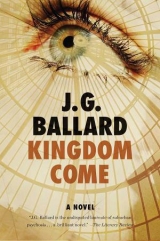
Текст книги "Kingdom Come: A Novel"
Автор книги: James Graham Ballard
Жанр:
Научная фантастика
сообщить о нарушении
Текущая страница: 2 (всего у книги 19 страниц)
But I left the drawers closed. I had learned enough to grasp that I scarcely knew this old man, and probably never would. I was looking for myself, but clearly I had played no part in his life.
In the centre of the mantelpiece was a framed photograph of a youthful airline captain standing with his crew beside a BOAC Comet, presumably my father’s first command. Gallant and confident, he looked ten years younger than his crew, and might have been my junior brother.
On either side of the photograph was a set of smaller frames, each containing a woman’s holiday snapshot. One showed a cheerful blonde legging her way out of a sports car. A second blonde posed in tennis whites beside a Cairo hotel, while a third grinned happily in front of the Taj Mahal. Others smiled across nightclub tables and lounged by swimming pools. All the women in this trophy corridor were happy and carefree; even the rather intense thirty-year-old in a fur coat whom I recognized as my mother seemed briefly to revive in front of my father’s camera lens. The display was oddly endearing, and already I liked the old pilot and decided I would get to know him better.
I drew the sitting-room curtains, ready to leave for my appointment with Sergeant Falconer at Brooklands police station, who would bring me up to date with the investigation into the tragic shooting. Trying not to think of the deranged youth who had fired into the crowd of shoppers, I looked out at the Brooklands racing track half a mile away. A section of the embankment had been preserved as a monument to the 1930s, the heroic age of speed, the era of the Schneider Trophy seaplane race and record-breaking flights, when glamorous women pilots in white overalls lit their Craven A cigarettes as they leaned against their aircraft. The public had been seized by a dream of speed no advertising agency could rival.
A FAINT SMELLhad entered the room, the tang of an expensive but unpleasant cologne. Standing in the shadows beside the drawn curtains, I saw a thickset man in a black suit pause in the doorway, right hand feeling for the light switch on the wall. In his left hand he carried what seemed to be a stout metal truncheon, which he raised to test the darkness.
Willing myself to keep my nerve, I breathed steadily and edged away from the window, hidden from the intruder by the sitting-room door. In the light reflected from the framed photographs on the mantelpiece I could see the heavily built visitor still hovering in the hall, unsure whether to enter the room. Then I tripped over a pair of my father’s golf shoes, stumbled and knocked the shade from the standard lamp beside the desk. The intruder flinched back, the truncheon above his head, searching for a target. I threw myself at the door, shoulder-charging it like a rugby prop forward, and heard the man’s hand hit the wall, shattering the face of his wristwatch. He turned in a flurry of huge arms, sweat and hair oil, but I pinned the door against his hand, forcing his pudgy fingers to drop the truncheon.
I lost my balance and fell across the leather armchair. When I stood up and pulled back the door, gasping at the scented air, the man had gone. Feet sounded unevenly down the stairs, the limping gait of someone with a fractured kneecap. Another door slammed, but when I went to the sitting-room window the car park and gardens were silent.
I drew the curtains and opened the windows, then sat in the armchair and waited for the intruder’s scent to disperse. I assumed that I had been so awed by my father’s flat that I had forgotten to close the front door after me when I arrived. The visitor with the truncheon had behaved more like a housebreaker or a private detective than a neighbour calling to offer his sympathies.
When I left for my appointment with Sergeant Falconer, I found the ‘truncheon’ on the floor beside the door. I picked it up, unrolling a heavy magazine, a copy of the Journal of Paediatric Surgery.
3
THE RIOT
‘I’VE THOUGHT OF IT,’ I said to Sergeant Mary Falconer. ‘Cyclops . . .’
‘Is that his name?’ She spoke slowly, as if trying to calm one of her dimmer prisoners. ‘The man in your father’s flat?’
‘No.’ I pointed through the canteen window at the roof of the Metro-Centre. ‘I meant the shopping mall. It’s a monster—it makes us seem so small.’
Without looking up from her notes, she said: ‘That’s probably the idea.’
‘Really? Why, Sergeant?’
‘So we buy things to make us grow again.’
‘That’s interesting. It’s almost a slogan. You should be working for the Metro-Centre.’
‘I hope not.’
‘I take it you don’t do your shopping there?’
‘Not if I can help it.’ Sergeant Falconer glanced into her pocket mirror, permanently to hand beside her files, and threaded a loose blonde hair into its tight braid. ‘I’d keep away from the place, Mr Pearson.’
‘I will. I wish my father had taken your advice.’
‘We all do. That was a terrible tragedy. Superintendent Leighton asked me to convey his . . .’
I waited for the sergeant to complete her sentence, but her mind had drifted away. She turned to the window, her eyes avoiding the Metro-Centre. A fast-tracked graduate entry, she was clearly destined for higher things than consoling bereaved relatives, not an ideal role for a steely but oddly vulnerable woman. She seemed unsure of me, and nervous of herself, forever glancing at her fingernails and checking her make-up, as if pieces of an elaborate disguise were in danger of falling apart. Much of her appearance was an obvious fake—the immaculate beauty-salon make-up, the breakfast TV accent, but was this part of a double bluff? In the interview room I explained that I had hardly known my father, and she listened sympathetically, though keen to get off the subject of his death. In an effort to reduce the tension, she opened her mouth and smiled at me in a surprisingly full-lipped way, almost a come-on, then retreated behind her most formal manner.
She tapped her notebook with a well-chewed pencil. ‘This man you say attacked you . . . ?’
‘No. He didn’t attack me. I attacked him. In fact, I probably injured him. He may be a doctor. You could check the local hospital.’
‘What exactly happened?’
‘I was drawing the curtains, looked round, and he was there, holding a kind of club.’ I rolled up the paediatric journal and raised it across the table, as if about to strike Sergeant Falconer on the head, then let her take it from me. ‘I probably overreacted. It’s a fault of mine.’
‘Why is that?’ The sergeant stared at me for a few seconds. ‘Do you know?’
‘I can guess.’ Something about this attractive but quirky policewoman made me want to talk. ‘My mother never remarried. I always felt I had to stick up for her. If the doctor complains, say I’ve been under a lot of stress.’
‘That’s true. Sadly, it won’t end for some time. Prepare yourself, Mr Pearson.’ In a matter-of-fact tone, as if reciting a bus timetable, she said: ‘This afternoon the accused will be brought back to Brooklands from Richmond police station. He’ll be held here overnight and appear before the magistrates tomorrow.’
‘Full marks to the police. Who is he?’
‘Duncan Christie. Aged twenty-five, white, a Brooklands resident. He’s already been charged with the murder of your father and two other victims. We expect he will be sent for trial at Guildford Crown Court.’ Sergeant Falconer pointed sternly to my bruised hands. ‘It’s important that nothing prejudices the hearing, Mr Pearson. You’ll attend court tomorrow?’
‘I’m not sure. I don’t know whether I can trust myself.’
‘I understand. The trial may not be for six months. By then . . .’
‘I’ll have calmed down? Guildford Crown Court . . . I take it he’ll be found guilty?’
‘We can’t say. I interviewed three witnesses who are certain they saw Christie with the weapon.’
‘All the same, he got away. No one stopped him.’
‘There was chaos, a complete stampede. The paramedics had to fight their way into the Metro-Centre. Four thousand people fled to the exits. Hundreds were injured trying to get out. There’s a moral there, Mr Pearson.’
‘And my father paid the price.’ Without thinking, I took her hand, surprised by its hot palm. ‘Why shoot an old man?’
‘Your father wasn’t the target, Mr Pearson.’ Quietly, she withdrew her hand, and let it lie limply on the table like an exhibit. ‘The sniper fired at random into the crowd.’
‘Insane . . . This Christie fellow, some sort of mental patient. Why was he allowed onto the streets?’
‘He was on day release from Northfield Hospital. The doctors felt he was ready to see his wife and child. It was a judgement call.’
‘You sound doubtful.’
‘We’re not psychiatrists, Mr Pearson. Christie was well known in Brooklands. He was always campaigning against the Metro-Centre.’
‘Quite a target to pick.’
Sergeant Falconer closed her files. I expected a display of passion from her, a denunciation of this psychopathic misfit, but her tone was as neutral as ice. ‘His daughter was injured by a contractor’s lorry. Some steel rails rolled off during one of his demos. The company offered compensation but he refused. He kept breaking the terms of his probation and was sectioned.’
‘Good. They got something right.’
‘It was a way of keeping him out of prison. At the time he had a lot of support.’
‘Support?’ I digested this slowly, trying not to look Sergeant Falconer in the eyes. Despite the neutral tone, I felt that she was trying to tell me something, and had invited me for coffee in the canteen so that she could address the real purpose behind our meeting. I said, calmly: ‘Sergeant? Go on.’
‘Not everyone likes the Metro-Centre. I can’t give you any names, but they think it encourages people in the wrong way. Everyone wants more and more, and if they don’t get it they’re ready to be . . .’
‘Violent? Here, in leafy Surrey? The consumer paradise? It’s hard to believe. Still, you can’t miss the banners and flags, the men in St George’s shirts.’
‘Team leaders. They help us control the crowds. Or that’s what Superintendent Leighton likes to think.’ The sergeant gazed warily at the ceiling. ‘Be careful if you go out at night, Mr Pearson.’
She sat back, turning her face in profile. The mask of the policewoman had slipped, revealing the emotional flatness of a strong-willed but insecure graduate. In her left-handed way she wanted my help. I remembered that not once had she criticized Duncan Christie, despite the pain and tragedy he had wrought.
I said: ‘Right . . . You hate the Metro-Centre, Sergeant?’
‘Not really. In a last-Thursday-of-the-month kind of way. Not hate, exactly.’
‘And the Brooklands area?’
Her shoulders eased, and she put away her pocket mirror, as if she realized that self-vigilance would never be enough. ‘I’ve applied for a transfer.’
‘Too much violence?’
‘The threat of it.’
I wanted to take her hand again, but she seemed to be blushing. As the afternoon ended, a reddish glow lit the deep mirror of the Metro-Centre dome, an inner sun.
I said: ‘It looks like it’s waking up.’
‘It never sleeps. Believe me, it’s wide awake. It has its own cable channel. Lifestyle guide, household hints, especially for households that know when to take a hint.’
‘Racist incitement?’
‘Along those lines. There are people who think it’s preparing us for a new world.’
‘And who’s behind it all?’
‘No one. That’s the beauty of it . . .’
She stood up, gathering her files. I could see that she was closing herself away. To begin with she had talked to me as if I were a child, and I assumed that her role was to defuse my anger and send me back to London. But she had used our meeting to get across a message of her own. In a way, she herself was the message, a bundle of unease and disquiet wrapped inside an elegant blonde package. She had slipped a few ribbons and then quickly retied them.
As we moved through the tables, I asked: ‘Did you find the weapon this Christie fellow used? What was it? Some mail-order Kalashnikov?’
‘It’s not turned up yet. A Heckler & Koch semi-automatic.’
‘Heckler & Koch? That’s a police-issue machine gun. It might have been stolen from a police station.’
‘It was.’ Sergeant Falconer surveyed the empty canteen as if seeing it for the first time. ‘An inquiry is under way. You’ll be kept informed, Mr Pearson.’
‘I’m glad to hear it. Tell me, which station was it stolen from?’
‘Brooklands Central.’ She spoke with deliberate casualness. ‘Where we are now.’
‘This station? It’s hard to believe . . .’
But Sergeant Falconer was no longer listening to me. She stepped to the window and peered down into the avenue beside the entrance to the station car park. A crowd was forming, well-dressed Brooklands residents in smart trenchcoats, many carrying Metro-Centre shopping bags. They filled the pavement outside the station, held back by half a dozen constables.
Several burly men in St George’s shirts acted as stewards, steering people away from a young black woman who stood in the centre of the road, holding the hand of a small child. The mother was clearly exhausted, trying to cover her swollen upper lip and cheek. But she ignored the hostile crowd and stared over the glaring faces at the police station windows.
‘Mrs Christie, and their bairn. Did she have to bring her along?’ Sergeant Falconer frowned at her watch. ‘I’m sorry, Mr Pearson. I didn’t want you exposed to all this . . .’
‘Don’t worry.’ I stood next to her at the window, inhaling her scent, a heady mix of Calèche and oestrogen. I stared at the young black woman, standing alone with her anger and fierce intelligence. ‘She’s got guts of a kind.’
‘Don’t feel sorry for her. I’ll get you out into a side street.’
Flashbulbs flickered near the gates to the car park. People in the crowd were hurling bouquets of torn flowers at Mrs Christie. As she brushed away the blood-red petals a set of TV lights lit her tired face.
‘Sergeant . . . the crowd’s working itself up. You’re going to have a riot.’
‘A riot?’ She beckoned me to the staircase outside the canteen. ‘Mr Pearson, people don’t riot in Surrey. They’re far more polite, and far more dangerous . . .’
WE PASSED THEempty CID offices, where computer screens glimmered at each other across untidy desks. The staircase windows looked out over the station car park, where the crowd pressed against the cordon of constables. Uniformed officers filled the hallway below us, ready to receive the prisoner.
Already spectators were running across the car park. A police car forced its way through, siren keening, followed by a white van with a wire-mesh windscreen guard lowered like a visor. A bottle of mineral water burst against it, sending a spume of frothing Perrier across the glass.
There was a roar from the spectators already inside the gates, the visceral baying of a mob who had scented a nearby guillotine. The police officers in the reception area moved into the yard, forming a cordon around the van as its rear doors opened.
Swept into the centre of the mêlée was the young black woman, daughter clasped in her arms. I waited for someone to rescue her, but my eyes were fixed on the man who was stepping from the van. A constable threw a grey blanket over him, but for a few seconds I saw his sallow, unshaved face, scarred chin pockmarked by acne, forehead flushed by recent punches. He was unaware of the crowd and the policemen jostling him, and stared at the radio aerials above the station, as if expecting a message from a distant star to be relayed to him. His head swayed drunkenly, a vacancy of mind coupled with a deep inner hunger that was almost messianic. I could see years of poor nutrition, self-neglect and arrogance, the face of assassins through the ages, of rootless metropolitan men from an earlier era who had survived into the twenty-first century, as out of place among the four-wheel drives and school runs of prosperous suburbia as Neanderthal Man discovered in a sun lounger beside a Costa Blanca swimming pool. Somehow this misfit and dement had evaded the juvenile courts and social-service inspectors, and had taught himself to hate a shopping mall so intensely that he could steal a weapon and fire at random into a lunch-hour crowd, killing a retired airline pilot about to buy his favourite tobacco.
A scrum of police surrounded him, arms locked together as they propelled the prisoner towards the station. On the outer edge of the scrum was Sergeant Falconer, arms outstretched to calm the shouting spectators. She was watching me as I stood in the staircase window, and I was certain that she had left me on the stairs so that I could see clearly the man who had killed my father.
The reception area was empty now, except for two civilian typists who had left their desks. I stepped past them, and stood by the open doorway as the police readied themselves to rush Christie into the station. I searched my pockets for a weapon, and came up with my car keys. I gripped them inside my fist, the largest key between my index and middle fingers. One lucky blow to Christie’s temple would rid the world of this mental degenerate.
Holding the key, I readied myself as Christie approached, bruised head emerging from the blanket. Seeing him beyond their grasp, the crowd surged forward, hands drumming on the sides of the van. In the crush of hatless officers trying to dodge the swinging carrier bags I saw Christie’s wife scream abuse at a woman constable trying to reunite her with her daughter.
I raised my fist to aim a blow at Christie, who swayed towards me in an idiot’s trance. But a powerful hand gripped my arm and forced it behind me. Strong fingers expertly stripped me of the ignition keys. I turned to find a large, military-looking man with an untrimmed ginger moustache, his deep chest and shoulders squeezed into a tweed jacket too small for him.
‘Mr Pearson?’ He shook the keys in my face, and steadied me as a policewoman lurched past with an arrested demonstrator. ‘Geoffrey Fairfax, your father’s solicitor. We’ve spoken on the phone. If I’m right, we have an appointment in ten minutes’ time. I must say you look as if you’d rather like to get out of here . . .’
4
THE RESISTANCE MOVEMENT
‘AS YOU CAN SEE, Mr Pearson, the bulk of your father’s estate goes to the pilots’ benevolent fund. Unfair to you, perhaps, and rather too final for my taste.’ With a resigned gesture, Geoffrey Fairfax let the cover of the antique wooden box-file fall like a coffin lid. ‘But in a good cause—the widows of pilots who died in aircraft accidents. After forty years he must have known a good many. Whatever consolation that is to you.’
‘A lot. He did the right thing.’ I finished my whisky and carefully centred the empty glass on its coaster. To myself I thought: a first rebuff from the old man, a warning from beyond the grave. ‘I won’t contest the will.’
‘Good. I was sure of that when I first saw you. The flat is yours, of course.’ Fairfax treated me to a sly smile. ‘People can be surprisingly high-minded when it comes to making their wills. Doctors bequeath their bodies to anatomy schools, even though they know they’ll be cut into tripes. Wives forgive philandering husbands. I’m glad your father didn’t change his will.’
‘Did he say he might?’
‘No. Your father was never impulsive. Except towards the end, perhaps . . . I really can’t say.’
I waited for Fairfax to continue, aware that I was watching a well-rehearsed performance by one of the last actor-managers in Brooklands. Grieving but avaricious relatives were his main audience, and he clearly relished every moment. Looking around his oak-panelled office, I wondered how his cavalier ways fitted into the new Brooklands. Conveyancing office blocks in a fast-food economy of automated cash tills and shopping malls was not Geoffrey Fairfax’s thing. He belonged to a world before the coming of the M25.
Framed photographs on a side table showed him as a half-colonel in the Territorial Army, and on horseback at an outing of the local hunt, before the foxes of west Surrey abandoned their ancestral farmland and took off for a better world of filling-station forecourts and executive housing patios. Like a lot of directors of old-style companies I had known, Fairfax was arrogant, vaguely threatening, and inefficient. One of the papers from my father’s box-file had floated to the floor at his feet, but he ignored it, trusting that the cleaner would return it to his desk. And if she stuffed it into the waste-paper basket, who would know or care? His pink-faced intelligence had a malicious edge. He sat behind his desk in his clubman’s armchair, head barely visible so that his clients were forced to strain to see him.
For a large man in his fifties he had shown quick reflexes when he rescued me from the riot at the police station, propelling me with a firm hand to the rear entrance of the car park, where a roofed pathway led to the section house and a side street off the main road. He sat me in the passenger seat of his Range Rover, and watched the crowd disperse through his wing mirror. He drove pugnaciously, almost running down two elderly women who were slow to get out of his way. Geoffrey Fairfax was an example of a rare species, the middle-class thug. There was a strain of brutality that had little to do with punch-ups on the rugby field and much more to do with teaching the natives a lesson.
‘My father . . . ?’ I reminded him. ‘You were about to say?’
‘A remarkable man. To tell the truth, we hadn’t seen him at the club for a few months. Sadly, he seemed to have changed. He made some new friends, rather unusual company . . .’
‘Who, exactly?’
‘Hard to say. I wouldn’t have thought they were really his type, but there you are. He used to be keen on bridge, liked amusing the ladies, played a wristy game of squash.’ Fairfax pressed his hands against the lid of the box-file, as if concerned that my father’s ghost might escape from its casket. ‘Terrible business, I hope they find whoever was responsible.’
‘I thought they had.’ I sat forward, picking up an odd note in the solicitor’s voice. ‘This fellow the police brought in, the local misfit or mental case . . . ?’
‘Duncan Christie? Misfit, yes. Mental case, no. Two hours in a police van can be quite an assault course. He goes before the magistrate tomorrow.’
‘He looked deranged to me. I take it he’s guilty?’
‘It does seem like it. But let’s wait and see. Calm yourself, Mr Pearson. I assume Christie will be sent for trial and almost certainly convicted. Curiously enough, we used to represent him.’
‘Isn’t that a little odd? A firm like yours, dealing with mental cases?’
‘Not at all. We couldn’t survive without them. Christie kept us busy for years. Public mischief cases, antisocial behaviour orders, attempts by various busybodies to have him sectioned. One of my junior partners acted for him when he sued the Metro-Centre.’
‘Christie hated it.’
‘Who doesn’t? It’s a monstrosity.’ Fairfax’s voice had deepened, as if he was berating a parade ground of slacking troopers. ‘The day they broke the first sod any number of people feared what it might do. We were right. This used to be a rather pleasant corner of Surrey. Everything has changed, we might as well be living inside that ghastly dome. Sometimes I think we already are, without realizing it.’
‘Even so.’ I searched for some way of calming him. ‘It’s only a shopping mall.’
‘Only? For God’s sake, man. There’s nothing worse on this planet!’
His temper up, Fairfax propelled himself from his chair, heavy thighs rocking the desk. His strong hands drew back the brocaded curtains. Beyond the leafy square and a modest town hall was the illuminated shell of the Metro-Centre. I was impressed that a suburban solicitor should give in to such a display of anger. I realized now why the curtains had been drawn when we arrived, and guessed that they remained drawn throughout the day. The interior of the dome glowed like a reactor core, an inverted bowl of light shining through the glass panels of the roof. A ten-storey office building stood between the mall and Fairfax’s burly figure, but the lights of the Metro-Centre seemed to shine through the structure, as if its intense luminance could penetrate solid matter in its search for this hostile lawyer squaring his shoulders.
Undaunted, Fairfax turned to me, stubby forefinger raised in warning. Eyeing me shrewdly, he nodded at my scuffed shoes.
‘You may not know that the place is open twenty-four hours a day. That’s an extraordinary thought, Mr Pearson. A structural engineer at the club tells me that the design life is at least a hundred years. Can I ask what business you’re in? Your father did tell me.’
‘Advertising. I’m thinking of a career change.’
‘Thank God for that. Still, you’re probably sympathetic to these so-called super-malls. But you enjoy the luxury of not living here.’
‘You make it sound like hell.’
‘It is hell . . .’ Fairfax hunched over the whisky decanter and replaced the stopper, a signal that our appointment was over. When I stood up, he turned aggressively to face me, as if about to knock me to the floor. A confused pride made him struggle with his words. ‘You’re from London, Mr Pearson. It’s a huge flea market and always has been. Cheap goods and cheaper dreams. Here in Brooklands we had a real community, not just a population of cash tills. Now it’s gone, vanished overnight when that money-factory opened. We’re swamped by outsiders, thousands of them with nothing larger on their minds than the next bargain sale. For them, Brooklands is little more than a car park. Our schools are plagued by truancy, hundreds of children haunting the Metro-Centre every day. The one hospital which should be caring for local residents is overwhelmed by driving accidents caused by visitors. Never fall ill near the M25. Evening classes were popular here—conversational French, local history, contract bridge. They’ve all closed. People prefer to stroll around the mall. No one attends church. Why bother? They find spiritual fulfilment at the New Age centre, first left after the burger bar. We had a dozen societies and clubs—music, amateur dramatics, archaeology. They shut down long ago. Charities, political parties? No one turns up. At Christmas the Metro-Centre hires a fleet of motorized Santas. They cruise the streets, blaring out tapes of Disney carols. Checkout girls dressed up as Tinkerbell flashing their thighs. A Panzer army putting on its cutest show . . .’
‘It all sounds terrible.’ I was thinking about the quickest route back to London. ‘Rather like the rest of England. Does it matter?’
‘It matters!’ Fairfax stepped around his desk, opened a glass cabinet behind the curtains and drew out a shotgun. Expertly, he snapped the breech, checking whether it was loaded. His face was flushed with more than rage, a deep tribal loathing of the people of the plain who had settled around him. ‘It matters . . .’
‘Mr Fairfax . . .’ I felt sorry for him, still holding his red flag in front of the first motor vehicle, but I needed to leave. ‘Can we call a taxi—I have to get back to my car.’
‘Your car?’ Fairfax waved this aside. He lowered his voice, as if the shadows in the deserted square might hear him. ‘Look around you, Mr Pearson. We’re facing a new kind of man and woman—narrow-eyed, passive, clutching their store cards. They believe anything that people like you care to tell them. They want to be tricked, they want to be deluded into buying the latest rubbish. They’ve been educated by TV commercials. They know that the only things with any value are those they can put in a carrier bag. This is a plague area, Mr Pearson. A plague called consumerism.’
Still carrying the shotgun, he remembered that I was waiting by the door. He paused, mentally ticking off the last bead in his rosary, then led me into the corridor. The offices were empty, but voices came from a conference room across the hall.
‘A plague area,’ I repeated. ‘Can I ask what the cure is? I take it you plan to fight back?’
‘Believe me, yes. We’ll fight back. I can assure you we’ve already started . . .’
Fairfax lowered his voice, but as we passed the conference room the door opened and his deputy, Susan Dearing, looked out at us. I had last talked to her at the funeral, and she seemed embarrassed to see me. She was about to speak to Fairfax, but he waved her away with the shotgun.
Through the open door I saw half a dozen people sitting around the conference table, chairs pushed back as if they were unsure of each other. I recognized none of them, though something about the unruly hair of a young woman with her back to the door seemed familiar. She wore a doctor’s white coat, like a medical attendant supervising a patients’ meeting, but her right foot tapped restlessly on the floor.
We walked through to the reception area. The desk was unattended, and a young black woman sat on a bench, her daughter asleep across her lap. Mrs Christie was scarcely aware of the child, her eyes above bruised cheeks staring at the hunting scenes on the walls. One lapel of her jacket had been torn from its seams, and her hand fretted over the loose fabric, trying to hold it in place. Her face had a beaten but still determined set. She had been punched and spat upon by the crowd, but some inner conviction kept her going. Watching her, it occurred to me that she believed her husband was innocent.
Behind the reception desk a narrow passage led to a pantry. Sergeant Mary Falconer stood by a gas element, pouring warm milk from a saucepan into two cups.
‘Mr Pearson . . .’ Fairfax beckoned me to the door, impatient for me to leave. ‘You’ll drive back to London tonight?’
‘If I can find the way. Brooklands seems to be off all the maps . . .’ I looked back at Sergeant Falconer, who was wiping spilled milk from the gas ring, trying to fit her into the larger events that had brought me to this curious town, and this even stranger firm of solicitors. I hailed an approaching taxi, and as it stopped I shook Fairfax’s hand. Before he could turn away, I said: ‘Mrs Christie—she’s sitting in there . . . ?’
‘Who?’
‘Mrs Christie. The wife of the man who killed my father. You’re not representing her?’