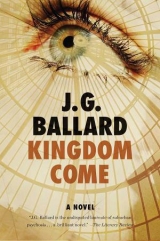
Текст книги "Kingdom Come: A Novel"
Автор книги: James Graham Ballard
Жанр:
Научная фантастика
сообщить о нарушении
Текущая страница: 7 (всего у книги 19 страниц)
13
DUNCAN CHRISTIE
A BRASS BAND struck up a spirited Souza medley, fireworks threw umbrellas of gaudy pink and turquoise light over the layabed town, car horns sounded and voices booed and cheered, greeting the Metro-Centre blimp as it sailed across the dome, more dreamlike than anything that had filled our heads during the night. The weekend was an extended sports festival, sponsored by the Metro-Centre and packed with more promises than even William Sangster could have imagined.
As I made a late breakfast I listened to the buses and coaches bringing teams and their supporters from the motorway towns. Under the evening arc lights there would be a ‘Thames Valley Olympics’, featuring football and rugby matches, athletics meetings, ice-hockey elimination rounds and a series of marathons and road races. Sport and shopping would celebrate a two-day marriage, to be solemnized by David Cruise. The sky would be the wedding marquee, and southeast England was invited. On the Metro-Centre cable channel the announcers worked up their audiences, playing up the mano-a-mano rivalries of the contact sports, the ‘hate’ matches between hockey teams from the Heathrow area.
By two o’clock, when I finally reached the Metro-Centre, the largest crowd I had seen in Brooklands filled the plaza beside the South Gate entrance, a congregation of worshippers that would have filled a dozen cathedrals. Shoppers chatted to each other, vendors in official livery carried placards listing the day’s discounts in menswear, minced beef and Botox treatments. Security men murmured into their lapel radios, stewards in Metro-Centre tracksuits struggled to keep clear a railed passage from the perimeter road to the entrance.
Sports-club supporters were out in force, a suburban crusader army in their St George’s shirts. I parked my car in the basement garage, using the complimentary VIP pass supplied by Tom Carradine. Emerging from the lift, I found myself co-opted into a football squad running and skipping on the spot. The scent of their sweat and good cheer, the pain-blessed grunts and shouts, rose into the air towards the circling blimp. Nearby, a women’s athletics club were exercising gracefully, moving like a dance class through a repertory of cheerleader motions. Nowhere was there a single policeman.
The only sign of tension came from the perimeter road, where a battered pick-up truck had broken down by the kerb. But this was not a day for parking violations, the cardinal sin of suburbia in which everyone happily indulged, along with bouncing cheques and credit card overruns. Double-parking, like adultery and alcoholism, was a vital part of the social glue that kept the suburbs healthy.
I walked towards the stranded truck, where the crowd seemed thinner. Radios began to buzz and fret around me, the group hive coming to life in the presence of an intruder. A young man stood by the tailgate, unloading a refrigerator onto the pavement. Already a small crowd had gathered around him, mothers holding back their pointing children. A black woman sat in the driving cab as her daughter played beside her, reading a magazine and ignoring the crowd and her husband.
I had last seen the young man outside the magistrates’ court, and now for the first time I had a good chance of speaking to Duncan Christie.
THE LARGEST OFChristie’s deliveries was still to be unloaded, a double-cabinet refrigerator with chromium doors and an ice-cube dispenser big enough for a hotel bar. Exhausted by the effort of moving his cargo, Christie leaned against the tailgate and smiled at the Metro-Centre blimp lazing above him. He had recovered from his rough treatment at the hands of the police, but his face was bruised and sallow, as if the violent storms seething within him had left their shadows on his skin.
His scarred mouth, self-cropped hair—no doubt sheared with a power tool during a building-site tea break—and general air of neglect made him look erratic and unfocused, a methadone addict forever emerging from rehab. Everything about him, from his large feet in a pair of unmatched trainers to the tic that pulled at an infected ear piercing, fixed him firmly as an urban scarecrow designed to frighten away any circling security cameras.
But his eyes were calm, and he seemed to have made his peace with the lazy blimp five hundred feet above him, as if hoping that the cameramen in the gondola would photograph the modest display of goods he had unloaded from his pick-up.
Lined up along the kerb was a selection of kitchen appliances—a spin-dryer, two refrigerators, a trio of washing machines and a microwave oven. None was new, and rust leaked from their hoses. They were the familiar furniture of every kitchen in Brooklands, but there was something surrealist about their presence that unsettled the small crowd. A middle-aged woman next to me pulled at the leash of her docile spaniel, prompting the beast to look up at me and growl menacingly.
‘Right, little beauty . . .’ Christie roused himself from his communion with the blimp and spat on his scarred hands. ‘Time to mount you, girlie . . .’
He seized the refrigerator around its waist, rocked it from side to side and walked it towards the lowered tailgate. He was stronger than I thought, with a stevedore’s hard arms, but the refrigerator was too heavy for him. When it tilted forward one of its doors fell open and trapped his right hand.
‘ . . . Jesus!’ Unable to move, the refrigerator pressing against his chest, he glared at the unmoving spectators. ‘Is none of you a fucking Christian? Maya!’
His wife watched all this through the rear-view mirror, assessed the situation and went back to playing with her daughter. I stepped forward and closed the refrigerator door, releasing Christie’s numbed fingers, then helped him lower the bulky machine to the ground. He leaned against it, a winded Samson clinging to his temple.
‘Thank you, sir. Thank you. A good deed these days takes courage.’
An elderly woman in a serge coat and pillbox hat peered at Christie, irritated by his apparent euphoria.
‘Can you hear me?’ she bellowed as he rolled his head. ‘You’re in the wrong place. Do you want a refund?’
‘Refund?’ Christie roused himself and surveyed the woman. ‘I don’t want a refund, madam. I want retribution.’
‘Retribution? You can’t get that here.’ The woman turned to her husband, who was nodding at the microwave as if recognizing a friend fallen on hard times. ‘Harry, what department is that?’
‘You’re not asking me?’
‘I am asking you.’
Still bickering, they wandered off towards a troupe of drum-majorettes snap-marching beside their pipe band.
Christie took up his position near the display of kitchenware. His manner was affable, but his eyes darkened as a squall blew through his mind. He was a Petri dish of mental infections, a smear-culture of grimaces and tics. He leaned behind the refrigerator and spat on the ground, then deployed himself like a salesman, turning a wild smile onto his customers.
‘Well, what am I offered?’ He caressed the microwave, and addressed a young woman with a daughter pushing a small pram. ‘One careful owner, perfect working order, a few chicken kievs, throw in a cheeseburger. Fully reconditioned.’
‘How much?’ The woman ran a finger over the greasy enamel. ‘There’s a written guarantee?’
‘Written?’ Christie rolled his eyes and confided to me: ‘A sudden trust in literacy. Written, madam?’
‘You know, a printed form.’
‘A form . . .’ Christie raised his voice to a shout above the pipe band. ‘Madam, nothing is true, nothing is untrue! Say nothing, admit nothing, believe everything . . .’
The woman and her daughter moved away, taking the small crowd with them. Seeing that I was the last of his audience, Christie turned to me.
‘Sir, I’ve been watching you. Am I right? You have your eye on that refrigerator. The big fellow . . . ?’
I waited as Christie sized me up. I was the enemy, in my dove-grey summer suit, a creature of the Metro-Centre and the retail parks. I was fairly sure that he no longer remembered me. His arrest, the violent police, his appearance at the magistrates’ court, had disappeared into some garbage chute at the back of his mind.
‘Yes, the big fellow.’ I touched the huge wreck of the refrigerator. ‘Can I assume it works?’
‘Absolutely. Enough ice cubes to freeze the Thames.’
‘How much?’
‘Well . . .’ Enjoying himself, Christie closed his eyes. ‘Seriously, you couldn’t afford it.’
‘Try me.’
‘No point. Believe me, the price is beyond your grasp.’
‘Twenty pounds? Fifty pounds?’
‘Please . . . the price is unimaginable.’
‘Go on.’
‘It’s free!’ An almost maniacal grin distorted Christie’s face. ‘Free!’
‘You mean . . . ?’
‘Gratis. Not a penny, not a euro, zilch.’ Christie patted me cheerfully on the shoulder. ‘Free. An inconceivable concept. Look at you. It’s outside your entire experience. You can’t cope with it.’
‘I can cope.’
‘I doubt it.’ Confidentially, Christie lowered his voice. ‘I come every Saturday, sooner or later someone asks, “How much?” “Free,” I say. They’re stunned, they react as if I’m trying to steal from them. That’s capitalism for you. Nothing can be free. The idea makes them sick, they want to call the police, leave messages for their accountants. They feel unworthy, convinced they’ve sinned. They have to rush off and buy something just to get their breath back . . .’
‘Very good.’ I waited as he lit a roll-up. ‘I thought it might be a piece of street theatre. But in fact you’re making a serious point.’
‘Absolutely. Maya, hear the man.’
‘This is your stand against the Metro-Centre, and all the other super-malls. Why not just burn them down?’
‘It could be done.’ Christie sucked the sweet smoke from the spliff. ‘If I lit the fuse, would you hold the torch?’
‘I might. As it happens, I have my own problems with the Metro-Centre. My father died in the shooting there.’
Christie puffed his spliff, and turned to look at me without surprise. For a few seconds all expression drained from his face, but he was devoid of emotion. Pain, sympathy and regret had moved to another floor of his mind. Whether or not he recognized me as the man who had watched him outside the magistrates’ court was now irrelevant. I realized that even if he had been responsible for the shooting he would have long since repressed all memory of it.
‘Your father? That’s a hard buy.’ He stepped away from me, drumming his fists on the washing machines. As his wife climbed from the driving cab he called out: ‘Maya . . . a close shave. I nearly had a customer.’
‘Christie, we need to go.’
She was quiet but determined, watching over her husband like a tired mental nurse. Her eyes met mine, then looked away, as if used to dealing with the human strays that Christie’s aimless garrulity drew to him.
A LARGE AMERICANcar had stopped by the kerb fifty feet away, a silver Lincoln with a cable-company logo emblazoned on its doors. A chauffeur in Metro-Centre livery stepped out, and strode around the car to the rear passenger door. A waiting television unit approached the car, guided through the watching crowd by three uniformed stewards. The Steadicam operator crouched inside his harness, filming the rear-seat passenger, a familiar handsome figure who was inspecting his deep tan in a vanity mirror.
David Cruise was wearing studio make-up, ready for the tracking shot that opened his Saturday show. The camera would film him stepping from the silver Lincoln, saluting the cheering customers and drum majorettes, and then entering the consumer palace over which he presided.
A band struck up ‘Hail to the Chief’, and a smile touched Cruise’s upper lip, a faint tremor that spread outwards to annex the muscles of his face. Energized by this grimace, he leapt nimbly from the passenger seat. He greeted the spectators like a practised politician, pinching the cheek of a delighted old lady, exchanging quips with two workmen in overalls, picking out people in the crowd and treating them to their own personal smile. I noticed his lack of aggression, and the softness of his hands, which were everywhere, fluttering around him like well-trained birds, squeezing, patting, waving and saluting.
With his lipstick, blusher and pancake make-up, Cruise seemed even more real than he did on television. He reminded me of all the minor actors I had coached while filming their commercials. The TV ad jumped the gap between reality and illusion, creating a world where the false became real and the real false. The crowd watching Cruise as he made his regal progress to the South Gate entrance expected him to wear make-up, and took for granted that he made exaggerated claims for the products they were so easily persuaded to buy. David Cruise, supporting actor in television serials that he always joined as their ratings slumped, was a complete fiction, from his corseted waist to his boyish smile. But he was a fake they could believe in.
‘You’re right,’ I said to Christie. ‘Nothing is true, and nothing is untrue. What was it? Say nothing, believe everything . . . ?’
Christie stood beside me, so close that I could hear his laboured breathing. His lungs moved in sudden starts, as if his body was trying desperately to uncouple itself from his brain. In a deep fugue, he stared at the retreating figure of David Cruise, parting the crowd like a cut-price messiah. I assumed that Christie was on the edge of an epileptic fit, surrounded by the warning aura that preceded an attack. I put my hands on his sweating shoulders, ready to catch him when he fell. But he pushed me away, straightened his back and gazed at the drifting blimp above our heads. He had willed himself into the fugue, expressing all his hatred of the fleshy actor who incarnated everything he loathed about the mall.
‘Christie—it’s time to go.’ His wife took his arm, and whispered loudly enough for me to hear, ‘Baby’s getting tired.’
‘Baby not tired. Baby waking up . . .’
I turned, glad to leave them to their marital games, and found myself facing a thuggish group of stewards in St George’s shirts. They pushed through the crowd, grappling with each other like wrestlers in a ruck. A child screamed, setting off a deranged Airedale that started barking and biting. Trying to escape, husbands collided into their wives, and a scuffle broke out as the cabinet refrigerator toppled to the ground. Stewards shouted above the pipe band.
‘Right! Let’s have you! Off with this rubbish!’
Fists pounded on the side panels of the pick-up. Clutching her daughter, Mrs Christie flailed with her free hand at the brawling stewards. Fully awake now, her husband wrestled with their leader, a blond-haired bruiser with ice-hockey armour under his shirt.
I stepped back, and lost my balance when I was shoulder-charged by a heavily built woman wearing a biker’s crash helmet. Through the mêlée of legs, knees and fists I saw an open-topped car draw up behind the pick-up. The driver sprang from his seat, fastening a leather jacket around his midriff, apparently eager to join the brawl.
He searched the crowd, forcefully pushing aside anyone who approached him. He was well into his fifties, with an almost jocular scowl, a boxer’s rolling shoulders and the shaven scalp of a nightclub bouncer. He often appeared on television, but the last time I had seen him he was sitting beside Geoffrey Fairfax in the front of the lawyer’s Range Rover. This was Christie’s psychiatrist, Dr Tony Maxted, and the third of his helpful witnesses.
He saw me kneeling by the rear wheel of the pick-up and came straight towards me. He gripped my shoulders, like a well-muscled orderly with a mental patient, and laughed good-humouredly when I tried to wrench his hands away. He lifted me to my feet, and propelled me towards his car.
‘Richard Pearson? We ought to leave before you beat anyone up. I think the Christies can look after themselves . . .’
14
TOWARDS A WILLED MADNESS
THE THIRD WITNESS.
Biding my time, I crouched in the bucket seat of the frisky Mazda as Dr Maxted steered us erratically through the streets of east Brooklands. We passed a young offenders’ prison, then veered through a business park where the research laboratories of Siemens, Motorola and Astra Computers tried to outstare each other across untrodden lawns and beds of subdued daffodils that had given up waiting for their Wordsworth. Emerging into a street of glass and metal warehousing, we joined a dual carriageway that led past a marina and water-skiing club built beside a reclaimed gravel lake.
I assumed that Maxted was trying to confuse me, constructing a maze around my head from a jumbled atlas of back streets and slip roads. When we passed the young offenders’ prison for the second time I tapped Maxted’s shoulder, but he pointed to the road ahead, as if the car needed my full attention.
I decided to humour him, and studied the heavy muscles of his neck, and the close-cropped hair over his broad skull. He drove the powerful car with a surprising lack of grace, his fingers barely touching the wheel, bruising the gearbox as he stamped the clutch pedal with a heavy foot. Like many psychiatrists, he needed to play games with anyone who entered his professional space, performing the private rituals of the modern-day shaman.
At last we approached Northfield Hospital, the mental asylum where Duncan Christie had been held. We paused by the gate, and Maxted punched the horn to rouse the security guard dozing over his evening paper. We moved past a gym and sports centre, blocks of staff apartments and an inter-denominational chapel that resembled an avant-garde pissoir. We parked outside the main admin building, and walked to a side entrance behind a screen of rhododendrons. Using his swipe card, Maxted led us into a coffin-like lift.
As we climbed towards the roof he looked me up and down, nodding without comment.
‘Thanks for the mystery tour,’ I said. ‘Quite a car, especially the way you drive it.’
‘Is that a compliment?’ Maxted loosened his tie. ‘I wasn’t trying to confuse you. Driving straight here would have done that. I’m impressed you ever found your way to Brooklands in the first place.’
‘I’m not sure I did . . .’
We stepped from the lift into a windowless lobby. After dialling an entry code, Maxted beckoned me into the hallway of an airy penthouse, apparently built as an afterthought from sections of glass and aluminium panelling. Deep balconies looked out over the hospital buildings below. A mile away, across a terrain of dual carriageways and industrial estates, rose the dome of the Metro-Centre, its blimp lazing above it like a tethered soul.
Maxted gestured at the expensive but anonymous furniture, the black leather sofas and chromium lamps lighting remote areas of carpet that no one had ever visited. It reminded me of the mezzanine television studio where David Cruise held court. In a sense the cable presenter and the psychiatrist were in the same business, redefining the world as a minimalist structure in which human beings were an untidy intrusion. Fittingly, the bookshelves were empty, and in the deserted dining room the table was set for guests who would never arrive.
‘It’s a kind of glamorous shack . . .’ Maxted gestured at the low-ceilinged rooms with a dismissive wave, but he seemed relaxed and confident, springing on his feet as if the penthouse reflected his secret view of himself. ‘The new research wing was financed by DuPont. I helped to raise a lot of the cash. This is one of the perks, like having your own lift. It takes away the pain.’
‘Is there any pain?’
‘Believe me. Still, you’re used to this kind of thing. A big London agency, seven-figure salary, share options, duplexes . . . Am I right?’
‘Wrong. As it happens, I’ve just been sacked.’ There had been a hint of longing in Maxted’s voice, untouched by envy, as if he was happy to live vicariously the elegant life that the penthouse only hinted at. I pointed to the Metro-Centre, unsure why he had brought me to the hospital. ‘It doesn’t look quite so large from here. The best view in Brooklands.’
‘Even though I’m living above a madhouse?’ Maxted laughed generously, walked to the drinks cabinet and came back with a decanter and two tumblers. ‘Laphroaig—private patients only.’
‘Am I a patient?’
‘I haven’t decided yet.’ Maxted steered me into the armchair facing him. His eyes ran over me, lingering on my scuffed but expensive shoes, though I decided not to tell him that I would never be able to afford another pair. He sipped noisily at the whisky, relying on his rough-edged charm to win me over. He was physically strong but insecure, glad to find shelter in the tumbler of malt. I assumed that he knew everything about me, and that Geoffrey Fairfax had told him about my enquiries.
‘So . . .’ Maxted put down his tumbler. ‘Tell me, do you like violence?’
‘Violence? What man doesn’t?’ I decided to let the whisky speak for me. ‘Yes, probably. When I was younger.’
‘Good. Sounds like an honest answer. Rugger brawls, nightclub aggro—that sort of thing?’
‘That sort of thing.’
‘Did you box at school?’
‘Until they banned it. We formed a martial arts society to get around the ban. We called it self-defence.’
‘Kick and grunt? Slapping mattresses?’ Maxted smiled nostalgically. ‘What’s the appeal?’
‘In a word?’ I looked away from his slightly prurient eyes. ‘Danger.’
‘Go on.’
‘Fear, pain, anything to break the rules. Most people never realize how violent they really are. Or how brave, when your back’s against the wall.’
‘Exactly.’ Maxted sat forward, fists clenched, Laphroaig forgotten. ‘That’s when you rally yourself, even when someone’s beating the blood out of your brains.’
‘Don’t tell me you box?’
‘A long time ago. Half-blue. But I remember how it feels. After three rounds you’re alive again.’ Maxted pulled the stopper from the decanter. ‘That’s the trouble with the video conference. Primal aggression tamped down, no straight lefts, no uppercuts to the chin. We’re a primate species with an unbelievable need for violence. White-water rafting doesn’t quite fit the bill. There must be something else.’
‘There is. You know that, Dr Maxted.’
‘I’d like to hear it from you.’
I stared hard at the dome, trying to guess at the mindset of this maverick psychiatrist, almost as odd as any of his patients. The afternoon had begun to fade, and the interior lights turned the Metro-Centre into an illuminated pumpkin. I said: ‘Danger, yes. Pain, the fear of death. And outright insanity.’
‘Insanity . . . of course.’ Savouring the word, Maxted lay back in the sofa, resting his thick neck against the black leather. ‘That’s the real appeal, isn’t it? The freedom deliberately to lose control.’
‘Doctor, can we . . . ?’
‘Right.’ Having drawn the answer he wanted from me, Maxted clapped his hands. He pushed the decanter away, clearing the table between us. ‘Let’s get down to business. I brought you here, Richard, because there are things we ought to talk over. You’ve been in Brooklands a few weeks, and frankly you’re cutting it a little fine. Every street brawl, every supporters’ punch-up, that daft business this afternoon with the Christies . . . you’re a magnet tuned to violence.’
‘I’m trying to find who killed my father. The police have drifted away.’
‘They haven’t.’ Maxted waved me down. ‘Listen to me. I’m sorry about the old man. A cruel way for him to go. Sometimes the wheel spins and you see nothing but zeroes. A terrible accident.’
‘Accident?’ I rapped the table with my glass. ‘Someone fired a machine gun at him. Perhaps Duncan Christie or—’
‘Forget Christie. You’re barking up the wrong tree.’
‘The police didn’t think so, until you and the other “witnesses” came forward. He was their chief suspect.’
‘The police always jump to conclusions. It’s part of their job, builds confidence with the public. You saw Christie today. He can’t concentrate long enough to mend a fuse, let alone carry through an assassination.’
‘Assassination?’ I turned to stare at the dome, which seemed to grow in size as it glowed in the fading light. ‘That implies someone very important. Who exactly?’
‘The target? Impossible to say. David Cruise?’
‘A cable-channel presenter? I once worked with him. The man’s a nonentity. Why would anyone want to murder David Cruise?’
Maxted simpered into his whisky. ‘There are folk here who’d give you a hundred reasons. He has a big power base. Sales are flat at the Metro-Centre, and without David Cruise they’d be in trouble. There’s even talk of him starting a political party.’
‘The kind that goose-steps? The Oswald Mosley of the suburbs? I don’t think he’d be convincing.’
‘He wouldn’t need to be. His appeal functions on a different level. It’s more your world than mine. Politics for the age of cable TV. Fleeting impressions, an illusion of meaning floating over a sea of undefined emotions. We’re talking about a virtual politics unconnected to any reality, one which redefines reality as itself. The public willingly colludes in its own deception. Is Cruise up to that? I doubt it.’
‘Then who was the target? And who killed my father?’
‘Difficult questions, and obviously you want an answer . . .’
Maxted gestured at the air, as if trying to conjure a genie from the decanter, and I remembered him sitting in the front of Geoffrey Fairfax’s Range Rover, and the headlight signals outside the shabby Odeon. But I decided to say nothing, hoping that he would lead himself into a useful indiscretion. For all his bull-necked toughness, he was uneasy about something, and more vulnerable than I probably realized. I waited as he stood up and paced the carpet, retracing a half-remembered dance step.
Impatient for an answer, I said: ‘We could push the police a little harder. Find out who their main suspects are. Dr Maxted?’
‘The police? They’d be touched by your faith in them. They haven’t realized how much everything has changed out here. They’re not alone in that. People in London can’t grasp that this is the real England. Parliament, the West End, Bloomsbury, Notting Hill, Hampstead—they’re heritage London, held together by a dinner-party culture. Here, around the M25, is where it’s really happening. This is today’s England. Consumerism rules, but people are bored. They’re out on the edge, waiting for something big and strange to come along.’
‘That sounds as if they’re going to be frightened.’
‘They want to be frightened. They want to know fear. And maybe they want to go a little mad. Look around you, Richard. What do you see?’
‘Air-cargo warehouses. Shopping malls. Executive estates.’ As Maxted listened to me, nodding gloomily, I asked: ‘Why don’t people leave? Why don’t you leave?’
‘Because we like it here.’ Maxted raised his hands to stop me interrupting him. ‘This isn’t a suburb of London, it’s a suburb of Heathrow and the M25. People in Hampstead and Holland Park look down from the motorway as they speed home from their West Country cottages. They see faceless inter-urban sprawl, a nightmare terrain of police cameras and security dogs, an uncentred realm devoid of civic tradition and human values.’
‘It is. I’ve been there. It’s a zoo fit for psychopaths.’
‘Exactly. That’s what we like about it. We like dual carriageways and parking lots. We like control-tower architecture and friendships that last an afternoon. There’s no civil authority telling us what to do. This isn’t Islington or South Ken. There are no town halls or assembly rooms. We like prosperity filtered through car and appliance sales. We like roads that lead past airports, we like air-freight offices and rent-a-van forecourts, we like impulse-buy holidays to anywhere that takes our fancy. We’re the citizens of the shopping mall and the marina, the internet and cable TV. We like it here, and we’re in no hurry for you to join us.’
‘I don’t want to. Take it from me, I’ll leave as soon as I can.’
‘Good.’ Maxted nodded vigorously. ‘Brooklands is dangerous. You’re going to get hurt. The motorway towns are violent places. We’re not talking about a few individuals who go off the rails. We’re talking about collective psychology. The whole area is waiting for trouble. All these sports-club supporters, they’re just street gangs in St George’s shirts.’
‘My father might have been wearing one when he was shot. A retired airline pilot in his seventies? The Asian family in the next flat were frightened of him. They look at me as if I were National Front.’
‘Maybe you are, without realizing it.’ Maxted spoke without irony. ‘You have to think about England as a whole, not just Brooklands and the Thames Valley. The churches are empty, and the monarchy shipwrecked itself on its own vanity. Politics is a racket, and democracy is just another utility, like gas and electricity. Almost no one has any civic feeling. Consumerism is the one thing that gives us our sense of values. Consumerism is honest, and teaches us that everything good has a barcode. The great dream of the Enlightenment, that reason and rational self-interest would one day triumph, led directly to today’s consumerism.’
I tried to reach the decanter. ‘In that case, why worry? Look around you here at Brooklands. You’ve found the earthly paradise.’
‘It’s not a paradise.’ Maxted tried to mask his scorn. ‘Brooklands is a dangerous and disturbed place. Nasty things are brewing here. All this racism and violence. Burning down Asian businesses. Naked intolerance for its own sake. And this is only the beginning. Something far worse is waiting to crawl out of its den.’
‘But if reason and light have triumphed?’
‘They haven’t. Because we’re not reasonable and rational creatures. Far from it. We resort to reason when it suits us. For most people life is comfortable today, and we have the spare time to be unreasonable if we choose to be. We’re like bored children. We’ve been on holiday for too long, and we’ve been given too many presents. Anyone who’s had children knows that the greatest danger is boredom. Boredom, and a secret pleasure in one’s own malice. Together they can spur a remarkable ingenuity.’
‘Let’s stuff baby’s mouth with sweets and see if he stops breathing?’