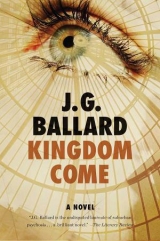
Текст книги "Kingdom Come: A Novel"
Автор книги: James Graham Ballard
Жанр:
Научная фантастика
сообщить о нарушении
Текущая страница: 17 (всего у книги 19 страниц)
36
SHRINES AND ALTARS
THE FIRST SHRINES had begun to appear, wayside altars for passing shoppers, places of pause and reflection for those making endless journeys within the universe of the dome.
At dawn, when the last gunfire had died down, I stepped onto the balcony of my room at the Holiday Inn. No one within the dome had slept through the night, and a thin mist filled the shopping thoroughfares, a hazy fog of insomnia that haunted the arcades and pedestrian decks, in places dense enough to conceal an army marksman.
I assumed that the police commandos had withdrawn, and that the real danger, as always, came from one’s own side, from Carradine’s untrained militia. After thirty seconds on the balcony, inhaling the over-ripe air with its guarantee of another tropical day, I wiped the sweat from my face onto the net curtain and found my way to the bathroom.
Two bottles of Perrier were all that remained of my stock. Standing in the shower stall, I drank one and then poured the second over myself, feeling the vivid, carbonated stream bring my skin alive.
As usual, I avoided the washbasin mirror, where I would be joined by the tramp-like figure who shared the bedroom with me. Whenever I saw him, bearded and scarily calm, he moved towards me like a sharp-eyed beggar spotting a prospect. Then he flinched away from me, repelled by my body odour and the even more rancid stench of deep and dangerous obsessions.
Still nominally playing my role as David Cruise’s adviser, I was left alone by Carradine and his marshals as they rallied their three hundred supporters, kept careful watch on the few score remaining hostages and defended the Metro-Centre against the armed might of a government. Meanwhile I did my best to look after Julia Goodwin, scavenged through the abandoned supermarkets and brought her enough food to feed her four patients and herself.
I always stayed until she had forced herself through the tins of frankfurters, condensed milk and foie gras, rewarding me with a plucky smile. Her two volunteer nurses had long since left the dome and returned to their husbands and children, but Julia was still determined to stay to the end. I sensed that in caring for David Cruise, keeping him forever on the edge of death, she was performing a penance similar to the shared bed into which she had drawn me at my father’s flat.
We were now into the second month of the Metro-Centre siege, and time had begun to dilate in unexpected ways. Days of sweaty boredom merged into each other, broken by the unending quest for food and water as Carradine’s quartermasters opened another supermarket for a few hours. Then everything would change abruptly, as Carradine released four or five of the more exhausted hostages. In exchange, the bathroom taps ran for half an hour, enough time to fill the baths and lavatory cisterns and stave off the danger of a typhoid epidemic.
But the patience of the police and Home Office had run out. Unsurprisingly, their willingness to go for the long haul, in the hope that the mutineers would lose heart or fall out among themselves, seemed to fluctuate with public interest in the siege. The television crews around the dome had been drifting away for weeks, and a Home Office junior minister blundered badly when he described the seizure of the Metro-Centre as part of an industrial dispute, a sit-in by disgruntled staff. When the siege was dropped from the main TV bulletins and exiled to late-night discussion programmes on BBC2 I knew that there would be a show of strength.
At three o’clock that morning, as I lay on the sofa beside the window, trying to breathe the humid, microwave air, I heard helicopters crossing the dome. Searchlights swerved and loudspeakers blared. Stun grenades exploded against the metal panels high above the atrium, showering debris on the luckless bears. A powerful explosion blew a hole in the dome above the portico of the North Gate entrance. A joint army and police commando entered the mall, and swiftly overpowered the small group of rebels defending the entrance. Unable to raise the fire door, the commandos moved to their primary target, the eighty remaining hostages held in the banqueting hall at the Ramada Inn.
As it happened, two days earlier Sangster had moved the hostages from their squalid quarters at the Ramada Inn and marched them to the empty Novotel. When the commandos burst unopposed into their original target they found themselves stumbling through the darkness among overflowing latrine buckets. This gave Carradine and his armed defence units time to arrive on the scene and surround the Ramada Inn.
A fierce firefight followed, which the police and army were certain to win. Tragically, a group of hostages at the Novotel made the mistake of overpowering their guards. After leaving the hotel, they raced across the central atrium towards their rescuers.
As a propaganda measure, and to deceive the police spy cameras that Sangster knew would be watching their every move, he had given the hostages a fresh set of clothes, equipping them with St George’s shirts. The commandos, assuming that they were faced with a suicide charge by defiant rebels, opened fire at point-blank range. Five of the hostages, including the general manager of the Metro-Centre and two of his department heads, were killed on the spot. The commandos withdrew, the helicopters ended their patrols, and the police loudspeakers faded into their own huge embarrassment.
But an even stranger phase of the Metro-Centre siege was about to begin.
AT EIGHT O’CLOCK,when there was no sign of police or army activity, I left the Holiday Inn and made my way towards the first-aid post. I wanted to make sure that Julia was unharmed, and help her with any wounded brought in during the night assault. Limping on my shooting stick, which I had filched from the best sporting goods shop in the dome, I followed a circular route that would bypass the central atrium.
A hundred yards from the Holiday Inn, I found myself in a thoroughfare of shops that specialized in electrical goods. All were unshuttered, since none of Carradine’s supporters would think of stealing from them. Their interiors were transformed by darkness into a street of caves crowded with treasure. I paused to gaze into these magical grottoes, aware that I was surrounded by all the toys I had so longed for as a child, and could take whatever I wanted.
Nearby was a store with a still intact pyramid of sample wares in its doorway. A trio of microwave ovens supported columns of computer towers, topped by a plasma television screen, the whole display decorated like a Christmas tree with a dozen digital cameras, lenses gleaming in the half-light. The structure had been lovingly designed to resemble an altarpiece. Bouquets of artificial flowers lay at its base, and a circle of candles surrounded a framed photograph of David Cruise. An almost religious aura glowed from the shrine, a votive offering to the threatened spirit of the Metro-Centre.
A few minutes later, in an alleyway behind the Novotel, I came across another of the pyramids, a modest tableau built from dozens of mobile phones and DVD players. Part sales display and part consumer shrine, it was clearly a prayer point for pilgrims on the great circuits of the Metro-Centre.
Beguiled by this votive trail, I had entered the northern sector of the mall. Little sunlight penetrated the roof, and the seven-storey galleries threw the lower levels into a twilight that even the brightest neon never fully dispelled. The rental charges were the lowest in the dome, and the shopping areas were dominated by cut-price travel agencies, bookshops and charity stores, areas of commerce where the lack of light was no disadvantage.
A spotlight flared in the North Gate entrance hall, briefly blinding me as I moved down a narrow street of car-rental offices and discount air-ticket agencies. From the doorway of a luggage store I watched the repair team at work. Metro-Centre engineers stood on a mobile scaffold, securing the roof section blown out by the police and army commandos. Sparks from a welding arc showered through the gloom, dancing among the glass and metal debris on the floor.
‘Mr Pearson . . . step back.’
Behind me I heard a metal display stand being dragged across the stone floor. The spotlight swung across the ceiling of the entrance hall, and the shadows veered and swerved around me like a demented dance troupe.
‘Richard . . .’
Only a few steps from me, a woman in belted blue overalls was watching from a doorway. The overalls bore no badges, but I was sure that she was wearing a police uniform favoured by crowd-control units. A blue peaked cap covered her eyes, but revealed her carefully braided blonde hair, and I recognized the strong chin and the broad mouth forever downturned in apology.
‘Sergeant Falconer . . . ?’ I moved towards her as she beckoned to me with a pair of night-vision goggles. ‘Be careful, the marshals are armed . . .’
‘Mr Pearson, come with me . . .’ She spoke softly, hissing at me through the gloom. ‘I’ll get you out now.’
‘Sergeant?’
‘Listen! It’s time to leave the Metro-Centre. You’ve been here too long.’
‘Sergeant Falconer . . . I have to stay—they need me here.’
‘No one needs you. Try to think for once.’
‘David Cruise . . . Dr Goodwin . . .’
‘They’re leaving, Mr Pearson. They’re all going.’ Her face was briefly lit by the reflected spotlight. Baring her teeth, she whispered: ‘Soon you’ll be alone here, Mr Pearson. You’re a little boy lost in a toy factory . . .’
‘Sergeant, wait . . .’
But she had vanished into a maze of shadows and doorways.
‘Mary . . . listen . . .’
I called out, and felt a pair of strong hands seize my shoulders and pull me into the light. A marshal wearing a St George’s shirt stared into my face. He ran a hand over my beard, recognizing me with some effort.
‘Missing your girlfriend, Mr Pearson? You look all in, mate. Mr Sangster said you might be here . . .’
HE LED MEinto the uneasy glare of the entrance hall. A golf cart had arrived, towing a luggage trailer in the livery of the Ramada Inn. Sangster was at the controls, his huge frame in its black overcoat almost squeezing out Tom Carradine. The PR manager sat beside him, eyes still resolute, hunched over his bandaged arms. He had been wounded in the previous night’s action, leading his squad of marshals from the front, but his courage and determination were intact.
Laid out on the trailer were five bodies, the unlucky casualties of the commando assault.
37
PRAYERS AND
WOOL-WASH CYCLES
‘RICHARD, YOU LOOK A MESS, poor man . . .’ Sangster ordered the marshal to release me. Smiling like an indulgent parent, he put a protective arm around my waist. ‘Too many strange dreams. Far too many . . .’
‘They are strange.’ I tried to clear my head. ‘Sangster, I saw Sergeant Falconer. And Duncan Christie . . .’
‘There you are.’ Sangster chuckled to himself, still light-headed after the excitements of the night. ‘You always were a dreamer, Richard.’
‘Sangster, listen—’
‘Think of it like this.’ He raised his huge hands to silence me, exposing his deeply bitten nails. ‘The Metro-Centre is dreaming you. It’s dreaming all of us, Richard.’
‘Sergeant Falconer was here. If she can get in, there must be other police inside the dome.’
‘Others? Of course there are. They want to join us. They can’t do us any harm. We control the Metro-Centre. Now, let’s get on with the transfer.’
Still holding my waist, he turned to the trailer carrying the five bodies. Armed marshals stood in a circle around the golf cart, ears tuned to the distant sounds of army helicopters. Sangster’s hands gestured at the air, as if conducting an invisible choir. His tall figure dominated the entrance hall, but he still deferred to Carradine, who sat quietly in the cart’s passenger seat, staring at his bandaged arms. The former publicity manager was grey with fatigue and blood loss, but his confidence was intact, and he clenched and unclenched his jaws as if savouring the aftertaste of the night’s violence.
Then he caught my eye, and stared at me for a moment too long, and I could see that he knew the game was up. Yet in a way this gave him the freedom to do anything, however deranged.
‘Sangster . . .’ I struggled to lower my voice. ‘Is Carradine . . . ?’
‘He’s fine. Last night was a shock. The police betrayed us. All that shooting. I keep warning Tom that violence is the true poetry of governments. Right, then . . .’
He steered me to the trailer, as if wanting me to stare at the bodies. Already they were turning blue in the morning light. The only victim I recognized was the Metro-Centre general manager, his eyes wide open as if puzzled by his unaudited and unplanned death. A bullet had pierced his neck, but he had scarcely bled, as if deciding to surrender his life with the least fuss.
‘Sangster . . .’ I turned away from the grimacing mouths. ‘What happens now?’
‘The exchange. We can’t keep them in the Metro-Centre. Carradine has a list of demands.’
‘Are the press here?’
‘A few agency reporters. They squat on cornices, fouling the stone. Why?’
‘The police and army killed them. Make sure the reporters know that.’
‘We will . . .’ Sangster turned to stare at me. His huge head began to nod. ‘You’ve given me an idea. Brilliant man . . .’
Carradine waited in his seat, painfully raising his left hand to read the list of demands. Sangster sat beside him, and began to stroke his shoulder, as if grooming an old dog.
‘Tom? You’re doing well. Don’t be afraid to look angry. There’s been a change of plan. I want you to tell the police negotiator that weshot the hostages. All five of them.’
‘We did . . . ?’ Carradine’s eyes stirred in their deep sockets. ‘All five?’
‘We executed them in retaliation. Can you remember?’
‘All five? That would be—?’
‘Murder? No. It shows we’re strong, Tom. Last night was an unprovoked attack. Many of our people could have died. As the occupying military power we are entitled to retaliate. Tell them, Tom—next time we will shoot ten hostages . . .’
SATISFIED WITH THEdeception, Sangster boyishly rubbed his hands and led me through the armed marshals. Their eyes forever scanned the high galleries, as if waiting for a messiah to overfly the dome. We watched the trailer being uncoupled from the golf cart and wheeled to the emergency hatch of the fire door.
‘Good . . .’ Sangster’s nostrils flicked. ‘Those bodies were getting a bit ripe. Even for you, Richard . . .’
‘I’ve let myself go. Why, I don’t know. I was supposed to leave with the last hostage release.’
‘What’s happening here is too interesting to leave.’ Sangster nodded eagerly, eyes brightening again now that the bodies were being lifted through the hatch. ‘You know that, Richard. All this is the culmination of your life’s work.’
‘In a way. I wanted to keep an eye on Julia.’
‘Good. It’s time for the patients to watch the physicians—that’s the twenty-first century in a nutshell.’ He gestured with both hands at the tiers of retail terraces and the silent escalators. ‘You created the Metro-Centre, Richard. But I created these people. Their empty, ugly minds, their failure to be fully human. We have to see how it ends.’
‘It’s already ended.’
‘Not quite. People are capable of the most wonderful madness. The kind of madness that gives you hope for the human race.’
We were following the stationary travelator that led from the North Gate entrance to the central atrium. We passed a kitchenware store with a display pyramid outside its doors, an altar of expensive oven dishes, fruit strainers and paper flowers adorning a publicity photograph of David Cruise.
‘Sangster . . .’ I pointed to the shrine. ‘Here’s another . . .’
‘I’ve seen them.’ Sangster stopped and bowed his head in solemn show. ‘They’re prayer sites, Richard. Altars to the household gods who rule our lives. The lares and penates of the ceramic hob and the appliance island. The Metro-Centre is a cathedral, a place of worship. Consumerism may seem pagan, but in fact it’s the last refuge of the religious instinct. Within a few days you’ll see a congregation worshipping its washing machines. The baptismal font that immerses the Monday-morning housewife in the benediction of the wool-wash cycle . . .’
WITH A WAVEhe turned and left me, walking back to the North Gate entrance hall, one hand tapping the travelator rail. I watched him whistling to himself, and then set off towards the central atrium, where the stronger sunlight was dispersing the warm mist.
I opened the handles of my shooting stick, and rested in front of an unlooted deli that had remained closed throughout the siege. Exquisite moulds climbed out of cheese jars and pesto bowls, turning the interior into an art-nouveau grotto.
I was almost asleep when a shot sounded from the central atrium, echoing around the upper circle of galleries. There was an erratic burst of rifle fire, followed by cries and shouts that merged into a wave of ululation, the stricken keening of a Middle Eastern bazaar. I assumed that another commando raid was taking place, but the sporting rifles were firing at random, an expression of collective grief and outrage.
As I reached the central atrium a crowd of mutineers in St George’s shirts besieged the first-aid post. A group of marshals emerged from the doors, clearing a path through the throng. They propelled a hospital bed fitted with serum drips and electrical leads hanging from its head rail, and raced alongside it like tobogganists setting off on the Cresta run.
As they swept past me the crowd of supporters ran beside them, firing their shotguns into the air. Someone stumbled and I had a glimpse of the bed’s occupant, a desiccated mummy with a childlike face under an oxygen mask, topped by a pelt of blond hair.
A distraught woman in a tear-stained St George’s shirt approached me, muscular arms above her head, as if ringing a mortuary bell. Trying to calm her, I gripped her hand.
‘What happened? Is Dr Goodwin . . . ?’
‘David Cruise . . .’ She pushed me away, and stared beseechingly at the impassive bears on their plinth. ‘He died . . .’
38
TELL HIM
‘WE’RE CLOSING THE SHOP, Richard.’ Tony Maxted paced around the cluttered treatment room, waving away the stench from the pails of soiled bandages. ‘I advise you to come with us. You’ve been here far too long, for reasons even I don’t understand.’
‘We’ve all been here too long.’ I sat on a broken-backed chair kicked aside when the marshals burst into the first-aid post. ‘How exactly do we get out?’
‘Hard to say yet. But things are on the turn. God knows what could happen.’
Maxted drummed his fingers on the sink. He was decisive but unsure of everything, and patted Julia Goodwin on the shoulder to settle himself.
She sat at the far end of the metal table, her back to the looted pharmacy cabinets. With her bruised forehead and torn blouse she resembled a casualty doctor who had barely fought off an assault by a deranged patient. I wanted to sit next to her and take her worn hands, but I knew that she would see the gesture as mawkish and irrelevant.
‘When did David Cruise die?’ I asked. ‘During the night?’
Maxted glanced at Julia, who nodded briefly to him. He waited for a gunshot to echo its way around the atrium and said: ‘Four days ago. We did everything we could, believe me.’
‘Why did they take him?’
‘Why?’ Maxted stared at his palms. ‘They think they can revive the poor man.’
‘How?’
‘I wish I knew. I’d make a fortune. Resurrection as the ultimate placebo effect.’ Seeing my impatience, he added: ‘They’re taking the body on a tour of the Metro-Centre. All that merchandise is supposed to bring him back. It’s worth a try.’
‘Does it matter?’ Julia spoke sharply, tired of two bickering men. ‘At least they don’t think we killed him.’
‘Four days?’ I thought of the ventilator pumping away, and Julia tiptoeing around the oxygen tent. ‘How did they know he was dead?’
‘They smelled it.’ Maxted reached into the refrigerator and took out a bottle of mineral water. He washed his hands in a splash of the brittle fluid and then drank the last drops. ‘Now it’s time to go. When Cruise doesn’t sit up and read out the sports results these people are going to flip. I doubt if the police understand that.’
‘Sergeant Falconer is here,’ I said. ‘I saw her an hour ago near the North Gate.’
‘Mary Falconer?’ Julia sat forward, suddenly alert. ‘What was she doing?’
‘Keeping an eye on Sangster. He’ll soon take over.’
‘That’s what I’m afraid of.’ Maxted kicked a pedal bin out of his way. ‘The magus of the shopping mall, a messiah without a message. You helped to write the script, Richard. The message is: there is no message. Nothing has any meaning, so at last we’re free.’
‘Falconer’s on to him,’ I said. ‘She’ll make sure he doesn’t go too far.’
‘I doubt it.’ Maxted sat at the table and spread his hands over the surface. ‘I suspect she’s on a different mission.’
‘Looking for Duncan Christie?’
‘Something like that.’ Maxted glanced sharply at me, avoiding Julia’s eyes. ‘Unfinished business. We need to find him, for his own safety.’
‘Why?’ I pressed. ‘Does it matter?’
‘Matter?’ Maxted stared at the table, as if expecting his cards to be dealt. ‘It does matter. Because Christie’s in danger.’
‘Good.’ Taking a gamble, and almost too tired to care, I said calmly: ‘He shot my father. You know that, doctor. You’ve always known it.’
‘Well . . .’ Without thinking, Maxted turned in his chair, clearly searching for an exit. ‘That’s not something I can discuss . . .’
‘He also shot David Cruise. Not those Bosnian brothers, whoever they are. Cruise was his real target all along.’
‘That’s a big jump, Richard.’
‘Not really.’ I waited for Julia to speak, but she was staring fixedly at Maxted. ‘What I can’t understand is why you’ve all been protecting him.’
‘Tell him.’ Julia stood up, rapping the table with her fist. She pulled back the hair from her forehead, wincing at a bruise on her scalp. ‘Maxted, tell him.’
‘Julia, it’s not that easy. The context . . .’
‘Fuck the context! Tellhim!’
Julia stepped around the table towards Maxted and picked a knife from the sink. She was no longer angry with herself but with the foolish men who had brought her to this makeshift clinic in a besieged shopping mall. Her shoulders squared against Maxted, willing him to back away from her. I could see the relief she felt as the truth hovered in front of us, ready to spill over in a torrent.
‘Julia, sit down . . .’ Maxted offered her a chair, and beckoned to me, trying to enlist my help in calming this enraged woman. ‘Context is important. Richard has to understand what our intentions were . . .’
‘Never mind our intentions!’ Julia waited until she could control herself. ‘Tell him who killed his father.’
‘Christie did.’ I spoke as matter-of-factly as I could. ‘I know that, Julia. It was obvious from day one.’
Julia nodded, then raised the knife to quieten me. ‘Yes, Christie pulled the trigger. He fired the shots. I’m sorry, Richard, desperately sorry for that. So many people killed and badly wounded. It was a blunder from the start. But Duncan Christie didn’t kill your father.’
‘Who did?’
‘We did.’ Julia pointed to herself and Maxted. ‘We planned it, and we gave the order.’
‘Hold on . . .’ Maxted took the knife from Julia’s hand. ‘Julia and I were on the fringe. There were a lot of others.’
‘Sangster, Geoffrey Fairfax, Sergeant Falconer . . .’ I recited the names. ‘Various other people who gave their support, but preferred to stay in the shadows. The mayor and one or two councillors, Superintendent Leighton and senior police officers . . .’
‘The old Brooklands establishment,’ Julia commented wearily. ‘Terrible bores, the lot of them. Dangerous bores. There was even a clergyman, but Maxted frightened him off. All that talk about elective insanity.’
‘He thought I meant the Christian Church.’ Maxted added: ‘They’d already had one assassination too many, and weren’t looking for a second.’
‘Assassination?’ I pushed myself away from the table. ‘You planned to kill my father. Why?’
‘Not your father. He was never the target.’ Maxted sank his exhausted face into his hands. ‘Go back six months, Richard. Brooklands was in turmoil, along with all the other motorway towns. More than a million people were directly involved. Racist attacks, Asian families terrorized out of their homes, immigrant hostels burnt down. Football matches every weekend that were really political rallies, though no one there ever realized it. Sport was just an excuse for street violence. And it all seemed to spring from the Metro-Centre. A new kind of fascism, a cult of violence rising from this wilderness of retail parks and cable TV stations. People were so bored, they wanted drama in their lives. They wanted to strut and shout and kick the hell out of anyone with a strange face. They wanted to hero-worship a leader.’
‘David Cruise? Hard to believe.’
‘Right. But this was a new kind of fascism, and it needed a new kind of leader—a smiley, ingratiating, afternoon TV kind of führer. No Sieg Heils, but football anthems instead. The same hatreds, the same hunger for violence, but filtered through the chat-show studio and the hospitality suite. For most people it was just soccer hooliganism.’
‘But the bodies kept arriving at the morgue.’ Julia reached across the table and gripped my wrist, angry with me even for being a victim. ‘I counted them, Richard.’
‘Asian and Kosovan bodies.’ Maxted wiped a fleck of spit from his mouth. He stared at it, as if disgusted with himself. ‘Julia had to deal with the relatives. Weeping Bangladeshi wives and deranged fathers of children with third-degree burns . . .’
Thinking of the Kumars, I said: ‘So you decided to do something?’
‘We had to move fast, while the whole nasty business was still controllable. A soft fascism was spreading through middle England, and no one in authority was concerned. Politicians, church leaders, Whitehall turned their noses up. For them it was just a brawl in a retail park off some ghastly motorway.’
‘But you knew they were wrong?’
‘Absolutely. Think of Germany in the nineteen-thirties. When good men do nothing . . . We needed a target, so we picked David Cruise. He wasn’t ideal, but shooting him down in the Metro-Centre, in the middle of one of his television rants, would make a powerful point. People would think hard about where they were going.’
‘So you needed a triggerman. And you came up with Duncan Christie?’
‘I found him.’ Maxted waited as Julia raised her hands in mock wonder. ‘He was sitting in a secure ward at Northfield. A misfit who’d twice been sectioned, a borderline schizophrenic with a fierce hatred of the Metro-Centre. His daughter had been injured and he wanted revenge. He was a missile primed to launch. All we had to do was point him at the target.’
‘You weren’t worried about the . . . ?’
‘Ethics of it all? Of course, we were planning a murder! We talked it through a hundred times. I kept Julia out of it—I knew I’d never convince her.’
‘I thought Christie was letting off a bomb. A smoke bomb.’ Julia pressed her hand to her bruised scalp, forcing herself to wince with pain. ‘So I gave my support. Madness—how did I think it would ever work?’
‘It did work.’ Maxted ignored her protests. ‘Everything was arranged. Geoffrey Fairfax knew his stuff. Sadly, when the hour came the only thing missing was the target.’
‘But my father and the bears filled in.’ I rearranged the dirt on the table, and then drew my father’s initials. ‘How many of you were involved?’
‘A small inner group. Fairfax was in the driving seat. He’d served in the army, he knew and loved the old Brooklands. He saw the Metro-Centre as a spaceship from hell. Superintendent Leighton supported us, but he had to be careful. He’d join our meetings, then slip away early. Sergeant Falconer was under Fairfax’s thumb—he’d got her mother off a shoplifting charge. She supplied the weapon, a standard Heckler & Koch, apparently mislaid by the armoury. Leighton covered up for her.’
‘Sangster?’
‘He reconnoitred the target area. Tom Carradine was an old pupil, and very proud to take his headmaster on a tour of the Metro-Centre and show off the fire and emergency systems. He gave Sangster a security pass for his visiting “nephew”. An hour before the shooting Sangster hid the weapon in the fire-control station.’
‘And Julia?’
‘I did nothing!’ Julia tore a children’s drawing from the wall and crushed it in her hands. ‘I didn’t think anyone would get killed, or even wounded . . .’
‘You did almost nothing.’ Maxted waited until she tossed the crumpled drawing among the bloody bandages in an overflowing bin. ‘Julia had treated Christie’s daughter after the accident. He may be schizoid but he’s no fool. He wasn’t sure we were serious. She gave him beta-blockers to calm him down and convinced him he was doing the right thing. Christie believed her, and that was vital.’
‘I drove him to the Metro-Centre.’ Julia half closed her eyes, smiling faintly to herself. ‘When we parked he didn’t want to get out of the car. He actually asked me if he should go ahead. I said . . .’
‘You said yes.’ Maxted sat back in his chair, letting the point sink in. ‘He trusted you, Julia.’
‘But after the shooting . . .’ Puzzled, I asked: ‘Weren’t you afraid that Christie would talk?’
‘Only if he went on trial. Hours of CID grilling, months in a remand centre away from his wife and daughter—he’d have given away everything. We knew that killing David Cruise would be easy. The cover-up was the difficult part. It was vital that Christie be arrested.’
‘Why? Arrested?’
‘Arrested and brought before a magistrate. If enough witnesses testified that they saw Christie at the time of the shooting and he was nowhere near the atrium the case against him would be dismissed. Especially if the witnesses knew Christie well and were worthy members of the local community.’
‘His doctor, psychiatrist, head teacher. So that’s why you went to the entrance hall. You were protecting Christie.’
‘And ourselves. If Christie confessed to the murder no one would take his word against ours. Misfits and psychotics are confessing all the time to crimes they haven’t committed.’ Maxted sighed to himself. ‘It was almost the perfect murder.’