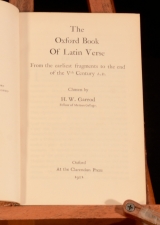
Текст книги "The Oxford Book of Latin Verse: From the Earliest Fragments to the End of the Vth Century A.D. "
Автор книги: H. Garrod
Жанры:
История
,сообщить о нарушении
Текущая страница: 2 (всего у книги 24 страниц)
There once more you have the unpredictable Celtic temperament—obscenity of wrath dissolving in the tenderness of unbidden tears, fond regret stung suddenly to a rage foul and unscrupulous.
But let me here guard against a misapprehension. The more closely we study Roman poetry the more clearly do we become aware of the presence in it of a non-Roman element: and the more does it seem as though this non-Roman element were the originative force, as though it were to this that Roman poetry owes most of that in it which we regard as essentially poetical. The quickening force in the best Roman poetry is the Italian blood. Yet we speak of this poetry as Roman: and it is not without reason that we do so. If it was to a great extent made by Italians, it was made by Italians who were already Romanized. Indeed the Italian and the Roman elements are never so separate or so disparate in actuality as they appear in literary analysis. The Italian spirit worked always under the spell of Rome, and not under any merely external compulsion. And the spell of Rome is over the whole of Roman poetry. The Italians were only a nation through Rome: and a great poetry must have behind it a great life: it must express a great people, their deeds and their ideals. Roman poetry does, beyond almost any other poetry, bear the impress of a great nation. And after all the languageof this poetry is the language of the Romans. It is said of it, of course, that it is an unpoetical language. And it is true that it has not the dance and brightness of Greek: that it is wanting in fineness and subtlety: that it is defective in vocabulary. All this is true. Yet the final test of the poetical character of a language is the poetry that is written in it. The mere sound of Roman poetry is the sound of a great nation. And here let us remember what we ought never to forget in reading Roman poetry. It was not made to be read. It was made to be spoken. The Roman for the most part did not read. He was read to. The difference is plain enough. Indeed it is common to hear the remark about this or that book, that 'It is the kind of book that ought to be read aloud'. Latin books wereread aloud. And this practice must have reacted, however obscurely, upon the writing of them. Some tinge of rhetoric was inevitable. And here I am led to a new theme.
II
Perhaps no poetry of equal power and range is so deeply infected with rhetoric as the Roman. A principal cause of this is, no doubt, the language. But there are other causes, and we shall most easily penetrate these if we consider what I may call the environment of Roman poetry.
Two conditions in Rome helped to foster literary creation among a people by temperament unimaginative. Of these the first is an educational system deliberately and steadily directed towards the development of poetical talent. No nation ever believed in poetry so deeply as the Romans. They were not a people of whom we can say, as we can of the Greeks, that they were born toart and literature. Those of them who attained to eminence in art and literature knew this perfectly well. They knew by how laborious a process they had themselves arrived at such talent as they achieved. The characteristic Roman triumphs are the triumphs of material civilization. But the Romans were well aware that a material civilization cannot be either organized or sustained without the aid of spiritual forces, and that among the most important of the spiritual forces that hold together the fabric of nationality are art and literature. With that large common sense of theirs which, as they grew in historical experience, became more and more spiritual, they perceived early, and they gauged profoundly, the importance of accomplishments not native to their genius. They knew what had happened to the 'valiant kings' who 'lived before Agamemnon'—and why. The same could easily happen to a great empire. That is partially, of course, a utilitarian consideration. But the Romans believed also, and deeply, in the power of literature—and particularly of poetry—to humanize, to moralize, to mould character, to inspire action. It was this faith which, as Cicero tells us, lay behind the great literary movement associated with the circle of Scipio Africanus. It was this faith which informed the Augustan literature. Horace was a man of the world—or he liked to think himself one. He was no dreamer. Yet when he speaks of the influence of high poetry upon the formation of character he speaks with a grave Puritanism worthy of Plato. These practical Romans had a practicality deeper than ours. The average Englishman, when he is told that 'the battle of Waterloo was won by the sonnets of Wordsworth', is puzzled and even offended. Nothing of Eton and its playing-fields? Nothing of Wellington and his Guards? What have sonnets in common with soldiering? But the Roman knew of himself that sonnets are a kind of soldiering. And much as he admired deeds, he knew that there is no deed greater than 'the song that nerves a nation's heart.'
These are not mere words: and this was not, in the Roman, an idle faith. It was a practical faith; that is to say, he acted upon it. Upon this faith was based, at any rate in the early period of Roman history, the whole of the Roman system of education. The principal business of the Roman schoolmaster was to take the great poets and interpret them 'by reading and comment'. Education was practically synonymous with the study of the poets. The poets made a man brave, the poets made a man eloquent, the poets made him—if anything could make him—poetical. It is hardly possible to over-estimate the obscure benefit to the national life of a discipline in which the thought and language of the best poetry were the earliest formative influences.
The second of the two conditions which favoured literary creation in Rome was a social system which afforded to a great and influential class the leisure for literary studies and the power to forward them. These two conditions are, roughly, synchronous in their development. Both take rise in the period of the Punic Wars. The Punic Wars not only quickened but they deepened and purified Roman patriotism. They put the history of the world in a new light to the educated Roman. The antagonism of Greek and Roman dropped away. The wars with Pyrrhus were forgotten. The issue was now no longer as between Greece and Rome, but as between East and West. The Roman saw in himself the last guardian of the ideals of Western civilization. He must hand on the torch of Hellenic culture. Hence, while in other countries Literature happens, as the sun and the air happen—as a part of the working of obscure natural forces—in Rome it is from the beginning a premeditated self-conscious organization. This organization has two instruments—the school of the grammaticusand the house of the great noble. Here stands Philocomus, here Scipio.
In the period of the Punic Wars this organization is only rudimentary. By no means casual, it is none the less as yet uninfected by officialism. The transition from the age of Scipio to the age of Augustus introduced two almost insensible modifications:
(1) In the earlier period the functions of the grammaticusand the rhetorwere undifferentiated. The grammaticus, as he was known later, was called then litteratusor litterator. He taught both poetry and rhetoric. But Suetonius tells us that the name denoted properly an 'interpres poetarum': and we may infer that in the early period instruction in rhetoric was only a very casual adjunct of the functions of the litterator. At what precise date the office of the litteratorbecame bifurcated into the two distinct professions of grammaticusand rhetorwe cannot say. It seems likely that the undivided office was retained in the smaller Italian towns after it had disappeared from the educational system of Rome. The author of Catelepton V, who may very well be Vergil, appears to have frequented a school where poetry and rhetoric were taught in conjunction. Valerius Cato and Sulla, the former certainly, the latter probably, a Transpadane, were known as litteratores. But the litteratorgradually everywhere gave place to the grammaticus: and behind the grammaticus, like Care behind the horseman, sits spectrally the rhetor.
(2) The introduction of the rhetorsynchronizes with the transition from the private patron to the patron-as-government-official. And by an odd accident both changes worked in one and the same direction. That the system of literary patronage was in many of its effects injurious to the Augustan literature is a thesis which was once generally allowed. But it was a thesis which could easily take exaggerated expression. And against the view which it presents there has recently been a not unnatural reaction. A moderate representative of this reaction is the late Professor Nettleship. 'The intimacy', says Nettleship[5], 'which grew up between Octavianus and some of the great writers of his time did not imply more than the relation which ... often existed between a poor poet and his powerful friend. For as the men of nobler character among the Roman aristocracy were mostly ambitious of achieving literary success themselves, and were sometimes really successful in achieving it: as they had formed a high ideal of individual culture ... aiming at excellence in literature and philosophy as well as in politics and the art of war, so they looked with a kindly eye on the men of talent and genius who with less wealth and social resources than their own were engaged in the great work of improving the national literature.'
There is much here which is truly and tellingly said. We ought never to forget that the system of patronage sprang from a very lofty notion of patriotism and of the national welfare. It implies a clear and fine recognition among the great men of affairs of the principle that a nation's greatness is not to be measured, and cannot be sustained, by purely material achievements. It is true, again, that the system of patronage did not originate with Augustus or the Augustans. Augustus was a patron of letters just as Scipio had been—because he possessed power and taste and a wide sense of patriotic obligation. So much is true, or fairly true. But if it is meant, as I think it is, that the literary patronage of the Princeps was the same in kind as, and different only in degree from, that exercised by the great men of the Republican period—if that is meant, then we have gone beyond what is either true or plausible.
I am not concerned here, let me say, with the moraleffects of literary patronage. I am concerned only with its literary effects. Nor will I charge these to Augustus alone. He was but one patron—however powerful—among many. He did not create the literature which carries his name. Nevertheless it seems impossible to doubt that it was largely moulded under his personal influence, and that he has left upon it the impress of his own masterful and imperial temper. Suetonius in a few casual paragraphs gives us some insight into his literary tastes and methods. He represents him as from his youth up a genuine enthusiast for literature: 'Eloquentiam studiaque liberalia (i.e. grammaticeand rhetoric) ab aetate prima et cupide et laboriosissime exercuit.' Even upon active military service he made a point of reading, composing, and declaiming daily. He wrote a variety of prose works, and 'poetica summatim attigit', he dabbled in poetry. There were still extant in Suetonius' time two volumes of his poetry, the one a collection of Epigrammata, the other—more interesting and significant—a hexameter poem upon Sicily.[6] Moreover Augustus 'nursed in all ways the literary talent of his time'. He listened 'with charity and long-suffering' to endless recitations 'not only of poetry and of history but of orations and of dialogues'. We are somewhat apt, I fancy, to associate the practice of recitation too exclusively with the literary circles of the time of Nero, Domitian, and Trajan. Yet it is quite clear that already in the Augustan age this practice had attained system and elaboration. From the silence of Cicero in his Letters (the Epistles of Pliny furnish a notable contrast) we may reasonably infer that the custom was not known to him. It is no doubt natural in all ages that poets and orators should inflict their compositions upon their more intimate friends. No one of us in a literary society is safe even to-day from this midnight peril. But even of these informal recitations we hear little until the Augustan age. Catullus' friend Sestius perhaps recited his orations in this fashion: but the poem[7] admits a different interpretation. And it is significant that we are nowhere told that Cicero declaimed to his friends the speeches of the second action against Verres. Those speeches were not delivered in court. They were published after the flight of Verres. If custom had tolerated it we may be sure that Cicero would not have been slow to turn his friends into a jury.
The formal recitation, recitation as a 'function', would seem to be the creation of the Principate. It was the product in part, no doubt, of the Hellenizing movement which dominated all departments of literary fashion. But we may plausibly place its origin not so much in the vanity of authors seeking applause, or in that absence of literary vanity which courts a frank criticism, as in the relations of the wealthy patron and his poor but ambitious client. The patron, in fact, did not subscribe for what he had not read—or heard. The endless recitations to which Augustus listened were hardly those merely of his personal friends. He listened, as Suetonius says, 'benigne et patienter'. But it was the 'benignity and patience' not of a personal friend but of a government official—of a government official dispensing patronage. Suetonius allows us to divine something of the tastes of this all-powerful official. He was the particular enemy of 'that style which is easier admired than understood'– quae mirentur potius homines quam intellegant. It looks as though the clearness and good sense which mark so distinctively the best Augustan literature were developed to some extent under the direct influence of the Princeps.
The Princeps and his coadjutors may perhaps be not unprofitably regarded as the heads of a great Educational Department. Beneath them are numberless grammaticiand rhetores. The work of these is directed towards the ideals of the supreme heads of the Department. How far this direction is due to accident and how far to some not very defined control it would be impossible to say. But obviously among the conscious aims of the schools of many of these grammaticiand rhetoreswas the ambition of achieving some of the great prizes of the literary world. The goal of the pupil was government preferment, as we should call it. And we may perhaps be allowed, if we guard ourselves against the peril of mistaking a distant analogy for a real similarity of conditions, to see in the recitations before the Emperor and his ministers, an inspection, as it were, of schools and universities, an examination for literary honours and emoluments. And this being so, it is not to no purpose that the rhetorin this age stands behind the grammaticus. For the final examination, the inspection-by-recitation, is bound to be, whatever the wishes of any of the parties concerned, an examination in rhetoric. The theme appointed may be history, it may be philosophy, it may be poetry. But the performance will be, and must be, rhetoric. The Aeneidof Vergil may be read and re-read by posterity, and pondered word by word, line upon line. But it is going to be judged at a single recitation. For Vergil, it is true, there may be special terms. But this will be the lot of the many; and the many will develop, to suit it, a fashion of poetry the influence of which even Vergil himself will hardly altogether escape. Moreover, there will be, of course, other patrons than the Princeps, at once less patient and less intelligent.
These effects of recitation we recognize, of course, easily enough in the case of such a poet as Lucan. But we must go back further. Vergil is, no doubt, as little like Lucan as he well could be. Yet he did not sit at the feet of Epidius for nothing: and he did not forget when he wrote the fourth book of the Aeneidthat he would one day read it to Augustus. We know that there are several kinds of oratory. But we are inclined, I think, to suppose that there is only one kind of rhetoric—that rhetoric is always the same thing. Yet there are at least two kinds of rhetoric. In the practical world there are two conquering forces—the iron hand and the velvet glove. Just so in rhetoric—which in the spiritual world is one of the greatest, and very often one of the noblest, of conquering forces—there is the iron manner and the velvet manner. Lucan goes home like a dagger thrust. His is the rhetoric that cuts and beats. The rhetoric of Vergil is soft and devious. He makes no attempt to astonish, to perplex, to horrify. He aims to move us in a wholly different manner. And yet, like Lucan, he aims to move us once and for all. He aims to be understood upon a first hearing. I know that this sounds like a paradox. I shall be told that Vergil is of all poets the most indirect. That is perfectly true. But whyis Vergil of all poets the most indirect? Just because he is always trying at all costs to make himself clear. Lucan says a thing once and is done with it. Vergil cannot. He begins all over again. He touches and retouches. He has no 'theme' not succeeded by a 'variation'.[8] In Lucan everything depends upon concentration, in Vergil upon amplification. Both are trying painfully to be understood on a first hearing—or, rather, to make, on a first hearing, the emotional or ethical effect at which they aim. Any page of Vergil will illustrate at once what I mean. I select at random the opening lines of the third Aeneid:
postquam res Asiae Priamique euertere gentem
immeritam uisum superis, ceciditque superbum
Ilium, et omnis humo fumat Neptunia Troia;
diuersa exsilia et desertas quaerere terras
auguriis agimur diuum, classemque sub ipsa
Antandro et Phrygiae molimur montibus Idae,
incerti quo fata ferant, ubi sistere detur.
The first three lines might have been expressed by an ablative absolute in two words– Troia euersa. But observe. To res Asiaein 1 Vergil adds the explanatory Priami gentem, amplifying in 2 with the new detail immeritam. Euertere uisum(1-2) is caught up by ceciditque Ilium(2-3), with the new detail superbumadded, and again echoed (3) by humo fumat– fumatgiving a fresh touch to the picture. In 4 diuersa exsiliais reinforced by desertas terras, sub ipsa Antandro(5-6) by montibus Idae(6). In 7 ubi sistere deturechoes quo fata ferant. One has only to contrast the rapidity of Homer, in whom every line marks decisive advance. But Vergil diffuses himself. And this diffusion is in its origin and aim rhetorical.
Yet he did not write, and I do not mean to suggest that he wrote, for an auditoriumand ἐт фὸ рбсбчсῆмб, and not for the scrupulous consideration of after ages. He wrote to be read and pondered. But he is haunted nevertheless by the thought of the auditorium. It distracts, and even divides, his literary consciousness. He writes, perhaps without knowing it, for two classes—for the members of his patron's salon and for the scholar in his study. We shall not judge his style truly if we allow ourselves wholly to forget the auditorium. And here let me add that we shall equally fail to understand the style of Lucan or that of Statius if we remember, as we are apt to do, only the auditorium. The auditoriumis a much more dominating force in their consciousness than it is in that of Vergil. But even they rarely allow themselves to forget the judgement of the scholar and of posterity. They did not choose and place their words with so meticulous a care merely for the audience of an afternoon. If we sometimes are offended by their evident subservience to the theatre, yet on the whole we have greater reason to admire the courage and conscience with which they strove nevertheless to keep before them the thought of a wider and more distant and true-judging audience.
I have intentionally selected for notice that rhetorical feature in Vergil's style which is, I think, the least obvious. How much of the Aeneidwas written ultimately by Epidius I hardly like to inquire. Nowhere does Vergil completely succeed in concealing his rhetorical schooling. Even in his greatest moments he is still to a large extent a rhetorician. Indeed I am not sure that he ever writes pure poetry—poetry which is as purely poetry as that of Catullus. Take the fourth book of the Aeneid, which has so much passionate Italian quality. Even there Vergil does not forget the mere formal rules of rhetoric. Analyse any speech of Dido. Dido knows all the rules. You can christen out of Quintilian almost all the figures of rhetoric which she employs. Here is a theme which I have not leisure to develop. But it is interesting to remember in this connexion the immense and direct influence which Vergil has had upon British oratory. Burke went nowhere without a copy of Vergil in his pocket. Nor is it for nothing that the fashion of Vergilian quotation so long dominated our parliamentary eloquence. These quotations had a perfect appropriateness in a rhetorical context: for they are the language of a mind by nature and by education rhetorical.
III
Roman poetry continued for no less than five centuries after the death of Vergil—and by Roman poetry I mean a Latin poetry classical in form and sentiment. But of these five centuries only two count. The second and third centuries A.D. are a Dark Age dividing the silver twilight of the century succeeding the age of Horace from the brief but brilliant Renaissance of the fourth century: and in the fifth century we pass into a new darkness. The infection of the Augustan tradition is sufficiently powerful in the first century to give the impulse to poetic work of high and noble quality. And six considerable names adorn the period from Nero to Domitian. Of these the greatest are perhaps those of Seneca, Lucan, and Martial. All three are of Spanish origin: and it is perhaps to their foreign blood that they owe the genius which redeems their work from its very obvious faults. It is the fashion to decry Seneca and Lucan as mere rhetoricians. Yet in both there is something greater and deeper than mere rhetoric. They move by habit grandly among large ideas. Life is still deep and tremendous and sonorous. Their work has a certain Titanic quality. We judge their poetry too much by their biography, and their biography too little in relation to the terrible character of their times. Martial is a poet of a very different order. Yet in an inferior genrehe is supreme. No other poet in any language has the same never-failing grace and charm and brilliance, the same arresting ingenuity, an equal facility and finish. We speak of his faults, yet, if the truth must be told, his poetry is faultless—save for one fault: its utter want of moral character. The three other great names of the period are Statius, Silius, and Valerius. Poets of great talent but no genius, they 'adore the footsteps' of an unapproachable master. Religiously careful artists, they see the world through the eyes of others. Sensible to the effects of Greatness, they have never touched and handled it. They know it only from the poets whom they imitate. The four winds of life have never beat upon their decorous faces. We would gladly give the best that they offer us—and it is often of fine quality—for something much inferior in art but superior in the indefinable qualities of freshness and gusto. The exhaustion of the period is well seen in Juvenal—in the jaded relish of his descriptions of vice, in the complete unreality of his moral code, in a rhetoric which for ever just misses the fine effects which it laboriously calculates.
The second century is barren. Yet we are dimly aware in the reign of Hadrian of an abortive Revival. We hear of a school of neoterici: and these neotericiaimed at just what was needed—greater freshness and life. They experimented in metre, and they experimented in language. They tried to use in poetry the language of common speech, the language of Italy rather than that of Rome, and to bring into literature once again colour and motion. The most eminent of these neotericiis Annius Florus, of whom we possess some notable fragments. But the movement failed; and Florus is the only name that arrests the attention of the student of Roman poetry between Martial and Nemesianus. Nemesianus is African, and his poems were not written in Rome. But his graceful genius perhaps owes something to the impulsion given to literary studies by Numerian—one of the few emperors of the period who exhibit any interest in the progress of literature. The fourth century is the period of Renaissance. We may see in Tiberianus the herald of this Renaissance. The four poems which can be certainly assigned to him are distinguished by great power and charm. It is a plausible view that he is also the author of the remarkable Peruigilium Veneris—that poem proceeds at any rate from the school to which Tiberianus belongs. The style of Tiberianus is formed in the academies of Africa, and so also perhaps his philosophy. The Platonic hymn to the Nameless God is a noble monument of the dying Paganism of the era. Tiberianus' political activities took him to Gaul: and Gaul is the true home of this fourth-century Renaissance. In Gaul around Ausonius there grew up at Bordeaux a numerous and accomplished and enthusiastic school of poets. To find a parallel to the brilliance and enthusiasm of this school we must go back to the school of poets which grew up around Valerius Cato in Transpadane Gaul in the first century B.C. The Bordeaux school is particularly interesting from its attitude to Christianity. Among Ausonius' friends was the austere Paulinus of Nola, and Ausonius himself was a convert to the Christian faith. But his Christianity is only skin-deep. His Bible is Vergil, his books of devotion are Horace and Ovid and Statius. The symbols of the Greek mythology are nearer and dearer to him than the symbolism of the Cross. The last enemy which Christianity had to overcome was, in fact, Literature. And strangely enough the conquest was to be achieved finally, not by the superior ethical quality of the new religion, but by the havoc wrought in Latin speech by the invasion of the Barbarians, by the decay of language and of linguistic study. To the period of Ausonius—and probably to Gaul—belong the rather obscure Asmenidae—the 'sons', or pupils, of Asmenius. At least two of them, Palladius and Asclepiadius, exhibit genuine poetical accomplishment. But the schools both of Ausonius and of Asmenius show at least in one particular how relaxed had become the hold even upon its enthusiasts of the true classical tradition. All these poets have a passion for triviality, for every kind of tour de force, for conceits and mannerisms. At times they are not so much poets as the acrobats of poetry.
The end of the century gives us Claudian, and a reaction against this triviality. 'Paganus peruicacissimus,' as Orosius calls him, Claudian presents the problem of a poet whose poetry treats with real power the circumstances of an age from which the poet himself is as detached as can be. Claudian's real world is a world which was never to be again, a world of great princes and exalted virtues, a world animated by a religion in which Rome herself, strong and serene, is the principal deity. Accident has thrown him into the midst of a political nightmare dominated by intriguing viziers and delivered to a superstition which made men at once weak and cruel. Yet this world, so unreal to him, he presents in a rhetorical colouring extraordinarily effective. Had he possessed a truer instinct for things as they are he might have been the greatest of the Roman satirists. He has a real mastery of the art of invective. But, while he is great where he condemns, where he blesses he is mostly contemptible. He has too many of the arts of the cringing Alexandrian. And they availed him nothing. Over every page may be heard the steady tramp of the feet of the barbarian invader.
After Claudian we pass into the final darkness. The gloom is illuminated for a brief moment by the Gaul Rutilius. But Rutilius has really outlived Roman poetry and Rome itself. Nothing that he admires is any longer real save in his admiration of it. The things that he condemns most bitterly are the things which were destined to dominate the world for ten centuries. Christianity is 'a worse poison than witchcraft'. The monastic spirit is the 'fool-fury of a brain unhinged'. The monasteries are 'slave-dungeons'.
It was these 'slave-dungeons' which were to keep safe through the long night of the Middle Ages all that Rutilius held dear. It was these 'slave-dungeons' which were to afford a last miserable refuge to the works of that long line of poets of whom Rutilius is the late and forlorn descendant. Much indeed was to perish even within the fastnesses of these 'slave-dungeons': for the monasteries were not always secure from the shock of war, nor the precious memorials which they housed from the fury of fanaticism. Yet much was to survive and to emerge one day from the darkness and to renew the face of the world. Rutilius wrote his poem in 416 A.D. If he could have looked forward exactly a thousand years he would have beheld Poggio and the great Discoverers of the Italian Renaissance ransacking the 'slave-dungeons' of Italy, France, and Germany, and rejoicing over each recovered fragment of antiquity with a pure joy not unlike that which heavenly minds are said to feel over the salvation of souls. These men were, indeed, kindling into life again the soul of Europe. They were assisting at a New Birth. In this process of regeneration the deepest force was a Latin force, and of this Latin force the most impelling part was Latin poetry. We are apt to-day, perhaps, in our zeal of Hellenism, to forget, or to disparage, the part which Latin poetry has sustained in moulding the literatures of modern Europe. But if the test of great poetry is the length and breadth of its influence in the world, then Roman poetry has nothing to fear from the vagaries of modern fashion. For no other poetry has so deeply and so continuously influenced the thought and feeling of mankind. Its sway has been wider than that of Rome itself: and the Genius that broods over the Capitoline Hill might with some show of justice still claim, as his gaze sweeps over the immense field of modern poetry, that he beholds nothing which does not owe allegiance to Rome: