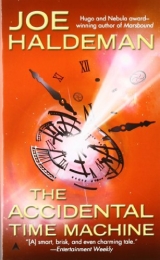
Текст книги "The Accidental Time Machine"
Автор книги: Joe William Haldeman
Жанры:
Научная фантастика
,сообщить о нарушении
Текущая страница: 8 (всего у книги 13 страниц)
This is where he had planned to start looking for a buyer for his rare letters from Garcнa Mбrquez and Lincoln. It used to be a street full of antique stores, a couple of them specializing in old documents. Would that commerce have gone underground when history was abolished and rewritten? Maybe the Angels would have gone after them first. The people with actual evidence.
There were more open shops and markets here than he’d seen in the suburbs. More fresh produce, though Arlington and Somerville were closer to the farms. They must get better prices in town, or maybe the city subsidizes them.
The place where he’d bought the Lincoln note to Grant was long closed and boarded up. On the next block, the shop that had sold him the Garcнa Mбrquez letter was still an antique shop, but only in that everything in it was old. It was more like a Salvation Army or Goodwill store in his time—very-used stuff being sold to people who would use it some more.
There was a dusty plastic bookcase with two shelves of Bibles and hymnals and a yellowed old booklet about Boston Baked Beans. There was no date on it, but it might have been pre-S.C.
In his time such a store would have been full of old questionable appliances—the question being, “If this still works, why is it here?”—but the main motif in this one was cast-off clothing, hanging on racks or neatly folded in stacks, according to size. Most of it was pretty threadbare, but he was tempted, since he had only one change of clothes. In this warm weather, he should emulate his graduate assistant and wear the robe with nothing underneath. He was contemplating that memory when a middle-aged male clerk came up, tubby and sweating.
“May I be of service, Professor? I do have an assortment of robes in the back, though none are as fine as yours.”
He hadn’t thought anything of it, but the robe Father Hogarty had bestowed on him was new. How rare was that now?
“Actually, I’m looking for scholarly materials, old things with writing in them.”
He drew back. “Not forbidden books.”
“No, of course not. I mean things like old letters. Written before Christ appeared.”
He scratched his head. “I do have a box of old letters, but they’re probably not that old. I’ll bring them up to the light.”
Matt looked through the coats, thinking of the winter ahead, but of course MIT might provide. He had an appointment tomorrow with the bursar, who would evidently haggle with him over terms of compensation, which took food and shelter into account, so possibly clothing as well. I’ll trade you two Saturdays of one-on-one physics tutoring for long underwear and a winter coat.
The clerk came huffing back with a microwave oven full of loose paper. So some old appliances were still of use.
He cleared off part of a shirt table and began laying out the letters. They seemed all to be post-Second Coming, formal notes of congratulation or condolence. The handwriting was mostly childish script or block printing, not surprising if paper had been a luxury for generations. The wording of the notes was formal and unimaginative, probably copied from an Emily Post-type guide.
Matt looked at about a hundred of them, and there was nothing really interesting. His feet were getting tired, standing. He stacked the letters all back in the microwave and clicked the door shut.
The clerk came up to him with a large padded plastiglass envelope held to his chest. “I do have a curiosity you might want to look at. A holy relic.” He opened the envelope and carefully worked out what looked like an ordinary Bible, and handed it carefully to Matt. “Signed by Jesus Himself.”
“Really.” He opened it, and on the front page was a dark "X,” deeply indented, as if someone had leaned into a ballpoint pen, with JESUS HIS MARK in parentheses.
Matt didn’t know quite how to react. “How much would this be worth, do you think?” he asked the clerk.
“Oh, at least five hundred dollars. I’m not sure I would sell it, though. It makes me feel good just to have it here, and I think it brings luck.”
“Selling it might be unlucky,” Matt said, handing it back. “But couldn’t anybody do this? How do you know it’s authentic?”
“Oh, my father was there when Jesus signed it. Down in Washington.”
That was interesting. Matt’s stomach growled audibly. “Thank you for showing it to me. I’ll be back later, probably buy some winter clothes.”
“God bless.”
Matt nodded gravely. Got to find a ballpoint pen somewhere.
Aromas from the food vendors were tempting,but Martha had told him that a tray would be delivered to his office unless he asked otherwise, so he climbed up the rusty stairs and hurried back onto campus, an appetite-building half hour. This time it was bread and a sausage and a fresh cucumber, all welcome. He wrote a note asking for salt and pepper.
He put the tray and note outside the door and sat down with the natural philosophy book and a piece of paper, and started a rough outline of a physics course that stopped short of special relativity. It was frustrating, but he did map out a thirteen-week schedule. He would never be able to fake the introductory bit about how the workings of nature reflect the handiwork of God, but he could probably ask one of the Fathers to step in for that part. Split the day’s salary with you?
At 3:30 he went back to Building 1 for his appointment with the bursar, a fat little man with a scowl and a squint and the improbable name Father Gouger. He said that in addition to room and board, Matt would be given an allowance for clothing and books. Paper and ink and pen points had to be ordered in advance from Supply. Above that, he’d be paid fifty dollars for every class he taught. The price of two and a half cups of “real coffey.” A good thing he was shaking the habit, and the coffee was lousy, anyhow.
MIT offered him a hundred dollars a week stipend while he wasn’t teaching. Not unreasonable, Matt thought, since all his basic needs were taken care of, but on general principles he asked for two hundred, and eventually settled on $127.50.
To his surprise, Gouger counted out that amount and handed it to him, saying henceforth it would be delivered to his office with the noon meal every Monday.
He went out onto Mass Ave and took his newfound fortune to the nearest tavern, which had a faded sign that identified it as the Brain Drain. He got a mug of beer and a small glass of spirits and retreated to the darkest corner, away from four young men arguing over free will and destiny.
His own destiny was unsure and complex in a way the boys wouldn’t be able to understand. He knew that on 2 February 2058, someone had appeared from somewhereto set him free—free enough to go to 2059 for a second or two, then zip to 2074 to celebrate Professor Marsh’s genius.
But where was that benefactor now? Matt might be caught in a strange closed loop of space-time that contacted another strange closed loop at the moment he stole the cab—and that might be two other strange closed loops away from the one where the shadowy benefactor showed up with the million-dollar check.
There was a jar of pickled eggs on the bar. Maybe that was the model. Each egg was a closed three-dimensional solid touching other closed three-dimensional solids, unaware that it was floating in a larger universe of vinegar. Unaware of the bartender with his fork, ready to change any egg’s destiny.
The liquor had an astringent green-apple taste, not unpleasant. The beer was even somewhat cool, having come up from the basement.
But he should be thinking, not drinking. He moved the shot glass a symbolic foot away.
One thing linking this egg with the one he’d come from was the fact that the library had scanned him and identified him as a full professor. A 177-year-old personnel record? Well, he’d neither quit nor died. Maybe there was no cell on the spreadsheet for “fired because he stole a taxi and escaped into the future.”
There was a larger question about causality; about how he should act. Assume that it hadbeen he who came back with the bail money. Since that had already happened– arguably, he couldn’t be sitting in this bar if it hadn’t happened—then it was going to happen no matter what he chose to do in the here and now.
That was A. Here was B: There was no way he was going to invent a time machine into the past with the resources of the Massachusetts Institute of Theosophy.
Therefore C: He had to be jumping into the future at least one more time, to a place and time where such a machine could be built.
Built by him? He hadn’t really built the one he was using now.
So somebody else would do the actual inventing—and maybe do the rescuing as well. Whatever, it wasn’t likely that he was going to stay here and make a career in theosophy. So it would be wise not to stray too far from the machine and keep an eye out for large metal containers. There weren’t a lot of cars and Dumpsters around.
Dean Eagan had said a team was bringing in the taxi. Better find out where it was going to be parked. Carry the time machine with him all the time? That could be awkward.
Another possibility was not exactly honest. He could follow his late, unlamented father’s motto: “Shut up and play the cards you’re dealt.” He could settle in here, teaching natural philosophy and doing research—and he could “discover” special and general relativity. Quantum mechanics.
And maybe get burned at the stake. It would be smart to tread carefully.
He sipped the applejack and followed that train of thought a little distance. To be honest, it was unlikely that he was ever going to make a significant breakthrough in the direction of his research back at the real MIT. The gravity-wave stuff looked like a dead end. Here, he had a chance to reinvent physics and perhaps give these people a chance to rediscover what they’d lost.
But the lesson of Giordano Bruno was hard to ignore. He’d tried to teach medieval Europe that their small Catholic God was inadequate in the face of the majesty of the actual universe. Matt didn’t know much about him, but remembered an image from a cube biopic he’d seen as a teenage protoscientist: Bruno dragged up from the Inquisitors’ dungeon and tied to the stake by chest and legs with rough rope, his arms free, over a pile of dry brambles and sticks. They brought the torch forward, and the priest presented him with a crucifix. He knocked it away scornfully and watched with a stony, heroic expression as they put the torch to the pile.
Matt didn’t think he was quite up to that. He moved his drinks up to the bar and bought one of the eggs and nibbled on it thoughtfully. He resisted the temptation to have another beer, and walked through the cooling afternoon sun back to his cottage.
He opened the strongbox and considered his worldly possessions. If he were to start carrying the time machine around with him, it would be in the expectation of having to use it with little or no warning. What else should he carry, planning to disappear suddenly into the future?
The gun. But no need for the whole box of ammunition; just the six cartridges that it carried fully loaded. It was just a noisemaker to him. He couldn’t imagine a scenario where he would shoot all six bullets and then have time to reload, and not be killed during the pause.
The money, of course, and the two rare documents. They might still be worthless 2094 years from now, or they might be priceless.
But the notebook with its store of pornography was questionable. In some futures it might also be a priceless asset. In others, presumably like here, it might be a serious crime to possess one.
Or maybe not like here. The attitude toward nudity was evidently relaxed, and to his knowledge there was nothing in the Bible about pornography. Thou shalt not look at graven images of professional sex workers in improbable geometries?
Besides, it would be hard to turn on the thing accidentally, especially in a culture almost innocent of modern machinery. It was childproof, which also meant “ignorant-adult-proof. ”
He put it all in the black leather bag and hefted it, less than ten pounds. Other professors didn’t carry their own bags, perhaps, but he was the man from the past, and ought to be allowed an eccentricity or two. For legitimacy, he put the New Testament Bible and the natural philosophy text in there, along with a pencil and several sheets of paper, folded over and slipped into the Bible.
Four rapid knocks on the door. “Come in?”
It was Martha, out of breath from running. “Professor! I just got word from Father Hogarty! You’re going to see Jesus! ”
“See . . . Jesus?”
“Right now—ten minutes from now!” She actually grabbed his arm and pulled. “Faculty chapel!”
He started to pick up the bag, but she snatched it away from him. “I’ll take that. Let’s go!”
When Jesus calls, Matt reflected, you might as well pick up the phone. “Okay. Lead on.”
14
The Faculty Chapel was in Christ Hall, a big “oldmodern” building that used to house art exhibits in the old days. The part for general worship was roomy and bright, even at this late hour, but the Faculty Chapel was a side room, lit with flickering oil lamps. The homey smell of corn oil burning reminded Matt of the popcorn in theater foyers, and the attendant feeling of expectation.
There were two church pews with cushions for kneeling. Father Hogarty was the only one there, kneeling in quiet prayer. When Matt and Martha came in, he unfolded painfully and offered Matt his hand.
“This will be a wondrous time for you, my son. I envy you. The first is always the best.”
“You talk with Jesus often, Father?”
“Only when he needs to tell me something. Perhaps once every two years.”
“So how—”
“Please, please, take my place. He’ll only come to you alone. We’ll wait outside.” With Martha’s help, he pulled closed a door that must have been eight inches of solid oak.
Matt knelt where Hogarty had been and self-consciously put his hands together in an attitude of prayer, not sure what to expect. Belatedly, it occurred to him to be afraid.
Jesus cleared his throat. “Welcome to my house, Matthew. ”
He looked just like the pictures, which was no surprise. Handsome, thirtyish white guy with shoulder-length hair and a short beard, both neatly trimmed. White robe with a belt of rough rope. It made Matt think uncomfortably of Giordano Bruno.
“I’ve been expecting you,” the image said. It was definitely a holographic projection. “Ever since I saw you appear up in New Hampshire.”
“You were expecting me?”
“I see everything. But yes, you appeared less than two meters from where you were expected, and within about nine seconds of when.”
“So you knew I was coming. But nobody here did?”
He smiled. “I’m God, Matthew, or at least one aspect of Him. That you don’t believe in Him doesn’t alter the reality of His existence. Nor of His omniscience.”
“If you’re omniscient, tell me what I’m going to do next.”
“You have free will. But I suspect you’re going to throw something at me, which will pass through, exposing me as a hologram.”
Matthew loosened his grip on the piece of chalk he had taken out of his pocket, ready to throw. “You claim not to be a hologram?”
“I don’t make any claims.” Jesus picked up a paper clip and tossed it at Matthew. It bounced off his chest. “Maybe you need to see me as a hologram. I’m all things to all men.”
Matthew’s brain was spinning with trying to explain the paper clip. “Could you walk out into the sunlight? That’s what I really need to see.”
There was a sudden sharp pain in his chest, and he couldn’t breathe. He tried to rise, but some force held him down.
“Don’t be petty, Matthew. God doesn’t do your bidding, and He certainly doesn’t serve unbelief.”
“Okay,” he croaked. “Let . . . me . . . breathe?”
“Gladly.” Air seeped back into his lungs.
Nothing supernatural. A pressor field that thumped him over the heart, then squeezed his chest. Same thing that tossed the paper clip.
It could kill him faster than being burned at the stake. “Thank you . . . Jesus.”
“You do believe in me, then?”
“Of course I do. This world belongs to you.” With his breath, he was getting back his equilibrium. “But I’m curious . . . what happened between my time and yours, here? I can’t find an actual history.”
Jesus smiled indulgently. “There is no history. This is a world without end. Without beginning, so without history.”
Like a closed strange Gцdelian loop. If he used the machine, which had never been invented, to jump out of this world, after affecting it. It wouldalways be, without beginning or end.
“But I’ve read about the One Year War and the Adjustment. Those must have been real.”
“There’s only one book you have to believe.” Matt felt a gentle pressure on his ribs. “Everything else is in error.”
“I understand,” he said quickly. “But you allow those other histories to exist.”
“For moral instruction. Don’t mistake it for literal truth.”
Without moving his arm, Matt flicked the chalk toward the image. When it was inches away, it suddenly spun up toward the ceiling.
An invisible slap spun Matt’s head sideways so hard his neck cartilage popped. “Stop trying to prove that I’m not real. I’m more real than you are, here.”
“I know you’re real,” Matt said, rubbing his neck, “but I was just trying to find out whether you were materialas well. I take it that you aren’t. That if I walked over and tried to touch you—”
“You would die.”
“I’m sure that’s true, and I wouldn’t try it in a million years. But I suspect that if I did try, my hand would be pushed away by a pressor field. We had those in my time, you know. They used them for security in the Museum of Fine Arts in Boston.” He swallowed hard, but continued. “And if the pressor field wasn’t turned on, my hand would go straight through your holographic image.”
“If that’s what you have to believe. As I say, it’s a manifestation of free will. When you come to judgment, your apostasy will be weighed along with all your other sins. Weighed against your good works; your service to God and man.”
The closest Matt had ever come to serving God was passing the plate at his aunt Naomi’s Seder table, which he never attended willingly. If you asked him, he would say the only connection between free will and religion in his life was the fact that he hadn’t set foot in a synagogue since he turned eighteen.
But he had to admit that this apparition was totally believable in a world that didn’t even have words for hologram and pressor. And since they evidently had total control over education and research, there was no way that was going to change.
Unless he did it.
After half a minute of silence, Jesus spoke. “You should now ask, ‘How may I serve you, my Lord?’ ”
“All right. What do you want me to do? Since you can obviously hurt me at any whim. Kill me, I suppose. I’ll do whatever you want.” He almost said, “within reason,” but that would be meaningless.
“Bring the time machine here in one hour. I want you to destroy it in front of me.” Jesus flickered and disappeared.
Well, that was interesting. Jesus didn’t know the time machine was right here in Matt’s bag. So he was all-seeing except when there was a roof in the way.
Matt put his shoulder to the heavy door and pushed out into the light, dazed and dazzled.
Father Hogarty and Martha were waiting expectantly. “You saw Him?” she said.
“Uh . . . yes. Yes, I did.”
“What did he ask you to do?” Father Hogarty’s eyes were bright.
“You were listening?”
“No, no. Whenever He talks to someone here, He asks him to do something. To prove his faith, usually.” He touched his face. “Every mark of rank I have, past the first, was at his request. Did he require that of you?”
“No, not yet. Father, does he always appear here?”
“Yes, of course.”
“In the chapel? Not in the other parts of the church here?”
He nodded. “Only the Elect may see him. And you,” he added quickly.
That made sense. The room was wired for the pressor field and the holograph projector.
“But Hesees all,” Hogarty continued. “He knew you had come before you arrived here. He told me.”
“He mentioned that,” Matt said. “He saw me appear when I came from the past, up in New Hampshire.” He didn’t appearthere because he couldn’t. But any spy satellite could home in and read the taxi’s license plate.
“If not a mark, what did he require of you?”
“Nothing yet. He’ll see me later.”
The old man studied him. “Matthew, don’t be afraid of the pain. It is fleeting, but the joy of service is eternal.”
It took him a moment to decode that. “He didn’t say anything about getting a scar. That will come later, I suppose. ”
Hogarty and Martha both touched their cheek scars. “The first one doesn’t require a command. Only a calling. We can take care of that anytime.” He stepped toward the chapel door. “I will pray for guidance.”
They watched him ease the heavy door shut. “Let’s go back to the cottage, Martha. I have to take care of some stuff.”
He thought furiously. He had one hour. If that room was wired up for a pressor generator, it would topologically be an enclosed volume of wires, and work as a Faraday cage. So he could go back in one hour, but instead of smashing the machine, he’d press the RESET button and carry the chapel with him up into the forty-fifth century. See whether Jesus came with him.
Or he could smash the machine and stay here, where at least some parts of the world were still familiar.
No. Whoever the man behind the curtain was, he was dangerous. That had to be the last time Matt would risk setting foot in that chapel.
“What was Jesus like?” Martha asked as they hurried across campus.
“Scary,” Matthew said. “I mean, he looked like all the pictures. But he can hurt you. Do anything he wants.”
“Why would He hurt you?”
“Power. Making sure I feared him.”
“Why would He do that? Everyone knows He’s all-powerful. ”
“Yeah, well, we have to talk about that.” They got to the cottage and Matthew checked his watch. “We have about fifty minutes.” He unlocked the door and went straight to the cupboard. “Give me the bag, please.” He put the cheese and bread in it, and a stoppered bottle of water. An unopened bottle of MIT wine.
“Professor? What are you doing?”
“This will all be clear later, Martha,” he said, knowing it wouldn’t be. “I have to run downtown, down to the bank, but you can stay here.”
“No, I’ll come with you.” She took the bag back. “But I don’t understand.”
“I don’t quite have it all figured out myself,” he said. “We used to call it ‘flying by the seat of your pants.’ ”
“Well, that sounds . . . it doesn’t sound nice.”
He led her out of the door and locked it behind them. “We used to have flying machines, all right? ‘Flying by the seat of your pants’ meant propelling one of those machines by instinct.”
“All right. Now I’m totallyconfused.”
“I’m just not sure what’s going to happen next. I think . . . well, I know. I can’t stay here. I’ll have to leave. Jump into the next future.”
“That’s what Jesus said to you?”
“Yeah. In a way. So I have to be prepared. I don’t know what it’s going to be like a couple of thousand years from now, in New Mexico, so I—”
“That’s a place? One of the Godless states?”
“Right. That’s where they calculated I’d wind up next.” After a few moments of silence, she said, “I can’t go with you.”
“I wouldn’t want you to.”
“No, I mean I should. But I’m afraid.”
“You couldn’t come back. Being a graduate assistant doesn’t require throwing your life away.”
“I think I would have to,” she said slowly, “if your life were in danger.”
Matt laughed. “I hereby relieve you of the responsibility. ”
“You can’t, Professor. I swore to God and Jesus that I would stay by you, and serve you.”
“Well, I don’t know about God, but the Jesus I saw and talked to was no more holy than that bird there.” He pointed at a mockingbird that was scolding something. “Less. It was just a product of technology”—she winced at the word—“that was old when I was born. A holographic projection; a moving hologram.”
“Holy gram?”
He wrestled with the robe and extracted his wallet and showed her the MIT card with the three-dimensional picture. “Like this, but moving and talking.”
She stared at it and, like the dean, tried to push a finger into the card.
“Somewhere there’s an actor made up to look like the historical Jesus. He watches me on a camera—you know what a camera is?”
“Sure. My Bible has pictures in it.”
“Well, he watches from a distant location and makes appropriate responses to what his audience does and says.”
“But that doesn’t make any sense,” she said, hurt and reluctance in her voice. “Why wouldn’t they just use the actor? ”
“He’d be vulnerable. This Jesus can’t be stabbed or shot or crucified. And he can do things that look like miracles.”
“How do you know they aren’t miracles?”
“Because I know how they’re done. I mean, I couldn’t duplicate them without help, but the science behind them is clear enough, simple enough.”
“They could still be miracles, though. Even though you could do some science that looked the same. Like turning water into wine; you could do something like that with a powder. I saw that when I was a child.”
“Phenolphthalein. Big deal.” They were walking up Charity, approaching Mass Ave. The intersection was a hopeless knot of people and animals and carts, so they cut diagonally across what used to be a parking lot, and was now a crowded, crazy quilt of merchants displaying their wares on makeshift tables or arranged on blankets.
“Look. Do you know Occam’s Razor?”
“I do. Basically it says the simplest explanation is usually the right one.”
“So there you are. You don’t need to invoke miracles.”
She looked genuinely perplexed. “But you have someone who looks like Jesus, who says He is Jesus, and He performs miracles—I would say that Occam’s Razor says that He isJesus.”
“Oh . . . Jesus.” The bank was half a block away, and there was a line out onto the sidewalk. Matt really had to pee, and they were passing a public toilet. “Look, I’d love to continue this argument, but nature calls.”
“Nature what?”
“I mean . . .” He gestured toward the toilet door.
“Oh, you have to go do. I’ll get us a place in that line.”
The latrine was dark, just a small skylight, but it had pretty good ventilation, and didn’t quite reek.
It had a piss-tube like the ones at MIT. He went through the complicated business of holding his robe out of the way and unzipping his jeans one-handed, and gratefully let fly.
“What’s that?” someone said in the murk. He could see two men sitting on toilets, and one was pointing at his dick. “He’s not cut!”
Well, that was beyond irony. The only Jew in Boston, and he was attracting attention because his parents had been New Reform and didn’t believe in circumcision.
“Can you explain that?” said a voice with the gravel of authority.
“I’m sorry,” Matt said inanely. “Where I come from—”
“He’s a spy from Gomorrah!” came a high-pitched voice. “Got to be!”
“No! I’m a professor at MIT!”
“You wait until I’m finished here,” said the authority voice. “I’m a policeman. We can talk to MIT.”
“Okay—I’ll wait outside.” Matt almost caught himself in the zipper, fleeing.
“Wait! I command you to wait! In the name of the Lord!”
Matt ran clumsily down the street, clomping in sandals, and was breathing hard when he came up to Martha, a couple of yards from the bank entrance. “Give me . . . the bag,” he wheezed, and pulled at it.
She resisted instinctively. “Professor? What—” A black-robed policeman with a staff had covered half the distance from the latrine.
“The safe. Have to—” He pulled it free and staggered through the door.
The clerk in front of the vault looked up with a quizzical smile. Matt strode up and reached into the bag and put the pistol straight into his face. “Drop it!”he yelled to the guard by the vault door, “or I’ll shoot him, I swear to God!”
The lone guard had a pump shotgun. He set it on the floor and stood with his hands up. Outside, someone yelled, “Stop that man! He’s a heathen spy!”
“Up!” Matt shouted. “Up! Into the vault!”
“All right,” the clerk said, almost falling over backward as he stood. Matt jammed the pistol’s muzzle into the man’s temple and started walking him toward the big enclosure, the largest Faraday cage on the block.
Martha ran to his side. “Professor?”
“Stay away, Martha. Everything inside the vault is going to go.”
Once he was inside the metal walls, he shoved the clerk back out, and kept the gun on him while he reached into the bag for the time machine. “Get out, Martha!”
There was a loud bangand a bullet whined, ricocheting around inside the vault. The cop from the latrine was at the door, holding his staff like a rifle.
Martha stood in front of Matt with her arms spread wide. “Put that down! He’s a holy man!”
Everybody else, now including Matt, was flat on the floor as the cop swung left and right, trying to get a clear shot past Martha. He fired, and a bullet spanged off the floor and a couple of walls.
Matt ignored his own gun and pressed the alligator clip to the metal floor and pried the protective plastic dome off. “Jesus fucking”—he mashed the RESET button—
15
"—Christ!”
"Oh, my,” Martha whispered. “It really works?”
“This is New Mexico?” Matt snapped the protective plastic dome back over the RESET button and stepped through the open door onto a manicured lawn. He turned to Martha, who stood staring. “It’s supposed to be desert.”
There was a white house that looked pretty much like a suburban rambler, though it wasn’t obvious what it was made of. The lawn was enclosed in a metal fence about shoulder high. On the other side of the fence, a nearly identical house, light beige, then a pale blue one, and so on, curving away in both directions. Behind them, a forest too regular to be natural.
The back door of the house slid open, and a man and woman of about middle age stepped out and looked at them warily, hands on hips. They were both wearing only shorts and sandals and were deeply tanned or of mixed race. Matthew assumed the latter, given a couple of millennia of intermarriage.
“How you do that?” the man said. His accent was odd but clear.
“Pushed a button,” Matt said. “It’s a long story.”
“Well, you’ll have to move it,” the woman said.