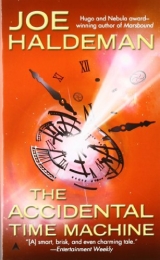
Текст книги "The Accidental Time Machine"
Автор книги: Joe William Haldeman
Жанры:
Научная фантастика
,сообщить о нарушении
Текущая страница: 6 (всего у книги 13 страниц)
A tea shop was open, so he sat down there to rest and watch the crowd. The teas on the menu were mostly herbal, probably homegrown or gathered locally. A cup of “Chinese tea” went for twenty bucks, the same as “real coffey.” He settled for a fifty-cent spearmint infusion.
So imports were expensive, even next to a huge port. It occurred to him that he hadn’t heard or seen a single airplane. At three in the afternoon the sky was a deep, unbroken blue. Had he ever seen a Boston sky without haze?
Nobody in the marketplace was wearing new-looking clothes. Maybe people didn’t dress up for going to the market. Maybe there weren’tany new clothes, or they were only for special occasions. Most of the women were dressed modestly, like Ruth, though some teenaged girls wore jeans or short skirts, startlingly seductive. That might be cultural; a sixteen-year-old was by definition a child, and so couldn’t be an object of desire.
Other men didn’t stare when they walked by. It would be prudent to follow that example.
He still had more than a mile to go, and he wanted to get to MIT well before offices closed. So rather than tarry for a second cup, he shouldered the bag and continued down the street. Where he saw a sign that stopped him in his tracks:
MASS. INST. OF THEOSOPHY, ONE MILE. It was over the MIT dome logo. What was theosophy? Had it existed in his time? He needed to Google.
“You need help, mister?” It was one of the gorgeous teenaged girls. He realized he was standing staring at the sign, and probably looked lost.
“What . . . uh, what’s theosophy?”
“It’s science,” she said with careful emphasis. “The science of God. Are you a pilgrim?”
“No, I guess not. Just a traveler.”
She opened her mouth to say something, then just nodded. “Good journey, then. God b’with you.” She bounced away, running to catch up with another girl.
The science of God. He’d better study that book.
Even more than that, he needed a history book. Something huge had happened. How long ago? Was it one thing, like a cataclysm, or was it a slow evolution?
The Massachusetts Institute of Theosophy? What did they do there? He would never fit in. Matthew Fuller, professor of atheism. You will be amused by his quaint theosophy.
Or maybe they still did do science and engineering, but had to make it appear closer to religion, for some social reason. Like this Second Coming.
Soon he was walking among tall buildings that in his day had been more or less independent research establishments associated with the Institute. People like Professor Marsh would often split their time, teaching at MIT a few days a week while maintaining lab space down the street at Biotech or Allied Chemical. MIT’s charter had forbidden some kinds of work, like weapons research, but it couldn’t control what happened slightly off campus.
Those tall, proud buildings were tenements now, with clothes flapping on lines, kids playing in the dignified court-yards. Scrawny vegetable gardens where there used to be elaborate flower beds and fantastic topiary.
But the fact that people could grow vegetables out in the open and not have their crops pilfered demonstrated a reassuring degree of social order. Along with the absence of actual starvation.
No telling where MIT’s administration would be nowadays. Building One would have enough natural light, assuming no electricity, so maybe it would still be there. He angled across campus toward the Infinite Corridor.
He wasn’t sure of the history behind it, but the oldest buildings in the Infinite Corridor dated back to 1916. By the middle of the twentieth century they comprised a linked chain of consistent design that shared a corridor about a quarter-kilometer long—not quite infinite, but a hike. It was precisely straight; twice a year students could prop the doors open and the setting sun would send a beam down 850 feet of suddenly not-dingy corridor.
Maybe they still did that, but sacrificed virgins. They used to joke that that was one thing you couldn’tdo at MIT, for lack of raw material. That might have changed. Depending on the theosophical attitude toward sex.
The campus wasn’t crowded, but it wouldn’t have been in August back in his time, either. The classrooms had been individually air-conditioned, to keep bills down, and the halls and unused rooms were ovens when it got into the nineties. It was close to that now. He walked up the stairs to the Infinite Corridor door and braced for a wall of heat.
It was dim and stuffy at this end, offices with closed doors. Plenty of light farther down, where there were classrooms with corridor windows and the dome’s skylight. It felt odd, walking down these halls, now yellowing whitewash instead of Institute Green, the woodwork centuries older, with amateur-looking repairs. Broken windows patched with plywood squares that didn’t look new.
The few students walked slowly and quietly, which was beyond odd. With the gloom at the periphery and overhead, and a whiff of mildew rather than the persistent subliminal tang of chemicals and machines, the place had the air of a monastery. Which it might now be.
In the rotunda windows, stained-glass panels that identified the Stations of the Cross, whatever that meant. On inspection, it was obvious that the windows had been moved here from some other source, probably a church. The panels were too small for their spaces and had to be framed in plywood, painted flat black for contrast.
Matt had noticed one improvement over the world of his last materialization, 2074, in that facial scarring was no longer the height of fashion. But it wasn’t completely gone; he’d seen a few scarred people walking the corridor, mostly older men. A few of the women had faint scar lines on their cheeks.
In fact, within the Infinite Corridor you could almost generalize that the older a man looked, the more scarred his face would be, and the scars weren’t particularly artistic. Parallel gouges on the cheeks and foreheads. Perhaps it was a fad that had recently petered out, possibly one with religious significance, and possibly more than meets the eye. God knew (presumably) what was under their robes.
Room 101 was General Administration, but the door was closed and locked. Of course; it was Sunday.
Beside the door was a handwritten list of curriculum changes for the Bachelor of Divinity degree. You now had to take Signs and Wonders 101 and 102 (instead of just Signs and Wonders 10) and Advanced Christian Ethics 111 and 112 simultaneously with two iterations of Preaching Workshop. Instead of Life Transformation, freshmen who could demonstrate their qualifications could opt for Interpretive Glossolalia.
A large man with one scar straight across his forehead came up. His cassock was blue and belted and he carried a heavy staff. He didn’t need a badge or a gun.
“You have business here, sir?”
“No, sir. I was just looking around.”
“The office will open tomorrow about ten. Until then, people who are not students or faculty ought not to be here.”
Matt didn’t protest that he wasfaculty, a genuine fake full professor. Instead, he meekly thanked the man and went out the front way.
It was still the impressive, sweeping colonnade, with marble steps down to the street. The steps were extremely rounded, worn down from millions of feet hurrying or trudging to class.
He had to find a place to stay and something to eat. And a bath and change of clothes; he was starting to smell like someone who had worn the same thing for a couple of centuries.
At the base of the stairs, next to what used to be a bus stop, a woman was selling clothes. A table displayed neat stacks of old shirts and trousers, and there was a rack of black academic robes, some less shabby than others.
He started looking through those, protective coloration.
“You’ll need an MIT ID to buy a robe,” she warned.
“Oh. Thank you.” He had one, of course, but the date on it might raise an eyebrow. He picked out a pair of sturdy jeans and a gray tee shirt with an MIT logo. That apparently didn’t require an ID.
It came to twenty-one dollars. She made change from an open box of bills and coins. No credit-card reader.
“I’m looking for a place to stay,” he said. “Not too expensive. ”
“You’re in the wrong place for that. You might get a room for fifty or sixty dollars up in Central Square. Magazine Street. Up Mass Ave a half mile or so.”
“Thanks. I’ll go check it.” In his time that had been a kind of artsy neighborhood. High crime rate but “interesting, ” full of transients and foreigners. He was both now.
He started up Mass Ave, and the smell of cooking stopped him in the second block. At an outdoor table he got a bowl of beans and potatoes cooked with onions and garlic, washed down with cool, thin barley wine, for five bucks. While he ate, a disheveled woman with one blind eye plucked a harp and sang. The last piece was a haunting blues, a vaguely religious song about unrequited love. He put a quarter in her cup as he left.
Most of the storefronts along Mass Ave were open, people selling pills, stationery, furniture, rugs. A large bookstore had textbooks of a general nature as well as religious texts. He leafed through a few mathematics ones and, unsurprisingly, they all started out with an inspirational chapter before getting down to geometry or calculus. But it was reassuring that students of theosophy still had to put up with the basics.
There were no physics textbooks, though. The light from the skylight was growing dim before he found things like Newtonian physics covered in the metaphysics section.
Thermophysics and basic electricity and magnetism. But no obvious treatments of relativity or quantum mechanics. Let alone chronophysics.
He’d have to come back later. He bought a text, Metaphysics and the Natural World, and headed on up to Magazine Street.
Dusk was closing in when he found a place with a card saying ROOMS AND BATH in the window. An old lady who smelled rancid took $40 and gave him a wooden coin that would pay for a bath once the sun came up. For an extra dollarhe got a candle with two matches, an admonition not to burn the place down, and directions to the outhouse.
The third-floor room was small, with just a bed, table, and chair. Moonlight came through a high window. He blew out the candle and sank gratefully into the soft bed.
12
Matt was half-awake, lying in a pleasant torpor,when church bells started banging next door. He dressed and went downstairs to a notice that said bath and breakfast would be available after church. On Monday? Not a good sign.
The outhouse was a little more hospitable with daylight filtering in; in the candlelight he’d been sure there were bugs everywhere, just out of sight. Instead of a roll of toilet paper, there were neat squares torn from church newsletters, which made the experience more pleasant than he’d expected. It also bespoke a certain level of civilization, he realized. In primitive cultures there were less sanitary expedients.
He went around front with the idea of going for a walk, but hesitated. There was nobody else in sight. No traffic up on Mass Ave. Maybe everyone was in church at this hour; maybe being anywhere else was illegal.
Back in the parlor, he stood still and listened. No one else up and around. An invitation to snoop.
The house was old, twentieth century or even earlier. It had electrical outlets in the walls, but nothing was plugged into them. Two Bibles, but no other books except a scrap-book of recipes in the kitchen.
The large Bible, fairly new, had a supplement tabbed “Revelations S.C.” and a pictorial section, “The Second Coming Illustrated.” It showed Jesus healing an entire intensive-care ward, Jesus standing in Times Square in front of a mountain of loaves of bread, Jesus in the Oval Office with a presidential-looking white-haired guy, Jesus hovering in midair with a glowing halo over his crown of thorns.
There were two possible explanations. One was that Jesus had returned to Earth in the brown-haired, blue-eyed visage that was familiar to Matt’s youth. The only other explanation was that it was a hoax.
Matt’s natural impulse was to go with the second one and start asking who and why and how. But first . . .
Was it possible that he had been completely wrong all his adult life? God and Jesus and all were real?
If that were true, then everything else fell apart. The rationalistic universe that he so completely believed in was an elaborate artifice that God maintained for His own reasons. Or some such circular assertion, neither provable nor disprovable. Literally sophomoric—he’d last heard someone seriously present such an argument back in those beery, youthful midnight bull sessions.
Actually, there had been one more recent time, the two well-dressed lads who’d knocked on his door and tried to infect him with enthusiasm for their faith. One of them had earnestly argued that Matt’s rationalism was just one belief system among others, and one that didn’t explain everything. It didn’t explain their own unshakable faith, for instance.
But it did, Matt said, as part of abnormal psychology. That was pretty much the end of the conversation. But he could have gone on to point out that rationalism doesn’t require “belief,” only observation. The real, measurable world doesn’t care what you believe.
He looked at the pictures again. A guy levitating with a halo. A pile of bread. An ICU ward full of actors and a president who was going along with the game. No actual miracles necessary.
Did the whole world believe this? He desperately needed to find someone who didn’t. Or a history book– anybook that wasn’t a Bible.
The front door clicked, and he guiltily closed the book, then opened it again. The landlady walked into the parlor pulling a brush through her hair.
She nodded at him. “As good as church, I suppose. Won’t put you to sleep like the good rev.” She held the door to the kitchen open. “Bread and coffee.”
The coffee was some burned herb, but the flatbread was crumbly and good, served with butter and a dab of strawberry jam. The landlady showed him the bucket of water steaming on the stove and said there were soap and “cloths” out back.
He lugged the bucket out onto the porch. There was a bathing area, about a square meter of slatted floor with head-high modesty screens on three sides. Another bucket, rinse water, and some gray tatters of towel. A cube of harsh soap that smelled of bacon.
It was good to be somewhat clean, though the soap turned his hair into a fright wig and left him smelling like breakfast. Back in the small room he changed into his new old clothes. He rented the room for another night, and the landlady gave him a padlock so he could leave his things behind in the room’s strongbox while he explored.
What should he leave behind? She probably had another key. It would be inconvenient if she started snooping around and sent the machine into the future. He wiggled at the plastic dome over the RESET button, and it was secure enough that removing it would be an act of deliberate vandalism. The pistol and ammunition were a problem, but maybe it would be wise not to carry them into MIT.
He wound up leaving it all, except his wallet and the taxi driver’s money. The two rare documents could wait until after he’d learned more.
He’d have to learn a lotmore before he decided what to do with the porn notebook. Its technology might make it extremely valuable. Its contents might put him away for the rest of his life, which could be short.
Mass Ave was sunny and pleasant, the clop and creak of horse and mule traffic, a slight barnyard smell overlaid with sea breeze from the harbor. He took a hundred-dollar bill into a bank and got a response similar to yesterday’s– are there more where this came from?—but the clerk initially offered him $100 and wound up paying $125. It would be smart to shop around.
He walked slowly down to Building One, getting his story together. His various possible stories, depending on what he could uncover. It wouldn’t do to just walk into the dean’s office and say, “Hey, I’m Matthew Fuller, the time traveler you’ve been waiting for.” That nobody hadbeen waiting evidenced a profound discontinuity with the past. The time and place of his projected arrival must have been widely known.
Or would they have been? Professor Marsh hadn’t been all that generous with the information Matt had given him about the time machine, back in 2058. Had Matt ever seen the actual time and place published? He couldn’t recall.
He went into Building One and walked past the administration offices, on down the Infinite Corridor toward the library, or at least the building that had once housed the science and humanities library.
The walls of the corridor were disturbingly bare. They used to be covered in a riot of posters and announcements, MIT-approved or not. Of course, it would have been bustling with students, too, Monday morning. There were only eight other people in the whole quarter-kilometer of hall.
He didn’t want to be the only person in the whole library. Kill an hour doing something else.
Halfway down the corridor, at the rotunda with the stained-glass Stations of the Cross, double doors led to the outside, what used to be the quad.
It was still a large quadrangle, not as well kept, the grass brown or bare dirt in places. A woman in head-to-ankles black was taking advantage of the morning cool to push a mechanical mowing machine. Matt had seen pictures of them. He wanted to go investigate, see whether this one was a museum piece or newly constructed, but it might not be smart to approach a single young woman that way. Or even look at her too hard. He averted his gaze and walked on toward the river.
That was different. Both banks of the Charles were solidly packed with ramshackle houseboats, most of them just moored rafts that obviously weren’t going anywhere except, eventually, straight down. Student housing in the twenty-third century, apparently; most of the people in evidence were young men, and a few women, all dressed in black. The men and women were separated.
The places weren’t drab; it was a riot of disorganized color. Walls of bright green next to orange and red, with cartoon figures stenciled or spray painted on. No obscenities, unsurprisingly; paragraphs of scripture in neat block printing. In some places, collages of scrap metal and glass clattered and tinkled in the breeze. Someone was quietly practicing intervals on a violin. That would’ve been grounds for murder, or at least musical defenestration, in the MIT dorms of Matt’s youth.
There was a faint aroma of fish frying, and people were fishing from some of the houseboats, idly watching lines or, in one case, throwing out a circular net. Matt wondered how often they caught the bioengineered Christ fishes, or whether those even swam in this river, open to the sea.
Well, he could wonder till the cows came home, though if they were bioengineered, they probably just stayed at home. He had to nail down some data. He angled across the frost-heave ruin of Memorial Drive toward the library.
The glass wall that faced Mem Drive was broken in several places, but those sections had been carefully repaired with glued stacks of clear glass bottles. The automated security system had been replaced by a guard with a wooden staff. He was sitting outside the door and looked amiable.
Matt didn’t lie. “I don’t have a card.”
“Are you carrying any books?”
“No.”
“Don’t bring any out, then.” Matt went on inside.
There were low stacks of books all around, and trays of books spine up in rows between irregular arrangements of tables and chairs. The books on shelves were behind glass, locked away, and the glass was frosted so that the titles were illegible. The trays held well-thumbed paperbacks that didn’t seem to be in any order.
There was no console for finding books. What did libraries do before there were computers? There must be a list somewhere. Look up a book and ask someone to get it for you.
Maybe he could figure it out. Meanwhile, be inconspicuous. He started sorting through the paperbacks, which seemed as limited in range and sophistication as the assortment he’d seen in the bookstore.
Then he found a slender volume simply titled American History. He sank into a soft chair by the window and opened it to the first page.
“On the first day of the first year, Jesus Christ appeared in the Oval Office of the president of the United States.”
On the facing page there was a photograph identical to the one in the Bible on Magazine Street.
The text dismissed all previous history with “Men and women had lived in the United States for centuries in a condition of sin, forgivable because of ignorance.”
Some few had refused to accept the reality of their senses and what their hearts told them about the Second Coming and so there was the One Year War, followed by the Adjustment. It didn’t say how long the Adjustment had been, or whether it was over.
It seems that President Billy Cabot, the one in the picture, had already been touched by God, which is why Jesus chose his office for His appearance. Cabot became First Bishop, and proceeded to simplify the government in ways that were part divine inspiration and part the stewardship of Jesus.
Looking at a map, it was easy to read between the lines. The One Year War had produced an entity that still called itself the United States of America, but it comprised only the Eastern Seaboard states south of Maine and Vermont, with obvious lacunae. The eastern third of New York was blacked out, as was a large part of Maryland and Virginia, bordering Washington. Metropolitan Atlanta and Miami. What had happened to them? The book had no index and little organization; it rambled along like a disjointed conversation. Well, the author was Bishop Billy Cabot, as told to Halleluja Cabot, presumably his daughter.
As a military history, the book was of questionable value. The Army of the Lord chose its battles well, evidently, and never lost. It apparently didn’t bother to fight for 80 percent of the fifty-one states, though.
What kind of battles were they? He couldn’t imagine tanks rumbling down Broadway, but New York City was in the blacked-out portion. Was it destroyed?
Maybe it was all metaphor. The “war” was not military at all, but some kind of propaganda war for this new version of Christianity. Which could be almost as scary as a fighting war.
He could walk up to Maine, which would only take a few days, a week, and ask his questions there. If he was allowed to cross the border into that heathen state. If there was anyone left there to talk to. What if Christ had nukes?
There was a thing about the all-seeing Spirit and His Avenging Angels that sounded a lot like satellite surveillance and low-orbit killer satellites. But how could he reconcile that with the horse-and-buggy technology around him?
He got up and searched through all the rest of the paperbacks. No politics, economics, world history. There were three other copies of Cabot’s American History, but no rivals.
“What is it you are seeking?” An older man had come up behind him, quiet on bare feet. He had on the black robe, white hair to his shoulders, and a pair of vertical scars on each cheek.
“Just . . . something to read. I’m not sure.” The man nodded slowly, not blinking or changing expression.
Silently waiting for input. It was a robot, like the McWaiters in Matt’s world. Ask it for a burger and fries.
“Is there a world history text?”
“Only for scholars. What level of scholarship are you?”
“Full professor,” he said firmly.
“At what institution? I don’t recognize you.”
“I . . . I’m freelance. I don’t have an institution right now.”
It stared at Matt, perhaps trying to process that idea. “You were at the Admissions Office yesterday, though it was Sunday.”
What to say? “That’s right.”
It didn’t move. “But no one could be in the office. It would be a sin.”
“I wasn’t looking for anybody,” he extemporized. “I was just checking the course changes on the wall.”
It nodded gravely. “I understand.” It turned and walked away silently.
A world where they put scars on robots and give them a large database but low intelligence. Where there wasn’t enough electricity to put lights in a library.
Matt sat down and looked at the history book without reading it. What was the deal here? There was electricity and artificial intelligence for robots. There was an industrial base adequate for mass-producing Bibles and history books with color pictures. But most of the world was living in the nineteenth century, if that.
Worse than that. It was a modern world overlaid with a nineteenth-century costume—this building still had elevators, but no way to make them go up and down. The McRobot was evidence of generally available computing power, but there were no data stations in the MIT library.
Another robot approached, robes and scars but bald. A short female behind it.
Not robots. They moved like people. The man smelled like old sweat. He introduced himself as Father Hogarty.
“You’re a visiting scholar,” he said, and offered Matt a black robe.
“Thank you.” Not knowing what else to do, Matt put it on over his clothes.
“This is your graduate assistant, Martha.” She was nervous and pretty, a blonde in her early twenties. One almost invisible scar on her cheek. “Hello, Dr. Fuller.”
Matt shook her hand. “Hello, Martha.” What the hell was going on? “Are you in physics?”
She looked confused. “I’m a graduate assistant.”
“She’s born again,” the man said. That explained everything.
“You know my name,” Matt said.
The old man nodded. “The library searched you and sent a messenger. He told me that you were the full professor we were waiting for. Even though you have no marks of scholarship.” He touched the scars on his cheeks. He had four prominent ones. “You are in the Data Base.” Matt could hear the capitals. “But your office number is wrong. It says you are in Building 54.”
Matt nodded. “The Green Building.”
“A green building? Where would that be?”
“There’s a bluish green one behind Building 17,” Martha said. “I had Prayer Variations there.”
“It’s not the color. It was named after a guy named Green.” The tallest building on campus, hard to miss. “Maybe it’s gone?”
They looked at each other. “Where would a building go?” Martha said.
“Not like it moved,” Matt said. “It maybe got old and was taken down.”
The old man nodded. “That happens. But how long ago? I would remember.”
Matt took a deep breath and plunged in. “I was born more than two hundred years before the Second Coming. I’m a time traveler who used to be a professor here. Back when it was the Massachusetts Institute of Technology.”
They both flinched, and the woman covered her ears. “Bad word,” the other said.
“You can’t say tech—” They both shrank away. “It used to be the nameof this place.”
“This place was evil once.” Hogarty stood up straight and put his hand on the young woman’s shoulder.
“What is a time traveler?” she asked. “We all move through time.”
“But I jump,” Matt said. “Day before yesterday, I was back in 2074. That was 106 years before the Second Coming.”
Hogarty laughed nervously. “If this is a joke, I don’t understand it.”
“The Nobel Prize for physics in 2072 went to the man who claimed he discovered time travel.”
“A noble prize?” the man said. “Physics?”
“It’s part of metaphysics,” the woman said.
“I know that. How do you get a prize for it, though? What does it have to do with time?”
“It’s all abouttime,” Matt said, “and space. And energy and mass and quantum states and the weak interaction force. You’re scholars?”
The man touched his scars again. “Of course.”
“Didn’t you ever study any of that?”
“It’s like you’re talking Chinese,” he said. “Quan tong states and interacting forces? What does that have to do with Jesus?”
Matt felt behind him, found a chair, and sat down. “Um . . . Jesus is part of God?”
“They’re both part of the Trinity,” he said. “They share attributes.”
Matt pressed on. “And God is everything?”
The man said, “In a way,” and the woman said, “Everything good.”
“So there are partsof everything that can be weighed and measured, rather than taken on faith. That’s what I’m a scholar of.”
Hogarty was thinking so hard you could hear the gears grinding. “But that’s for craftsmen and tradespeople. What is scholarly about things you can weigh and measure?”
“It’s because of the times he comes from,” Martha said. “The measurable world was very important to them.” She pursed her lips, then said it: “The T word. That’s what it was about.”
“Be good, Martha,” he warned.
“We shouldn’t be afraid of saying things,” she said. “Words aren’t magic.”
“You don’t know, child.” He appealed to Matthew. “Young people.”
Matt didn’t want to go there. “Why do you think measurable things aren’t scholarly, scholastic, whatever? The real world.”
Hogarty smiled, on comfortable ground. “You’re joking again. That’s the Devil’s big weapon.”
“The illusion that this world is real,” Martha supplied. “But not everybody thinks that way.”
“Martha . . .”
“God made this world, not the Devil. In six days? The actual world itself isn’t evil.”
“She’s an independent thinker,” the man said, not quite through clenched teeth. “An excellent graduate assistant for you.” Church bells were chiming outside. “Noontime. I have to meditate and break fast. Martha, you will see to the professor’s needs?”
“Of course, Father.”
“Professor, I’ll come by your office Wednesday morning sometime. There will be a faculty meeting in the afternoon. ”
“My office?”
“Martha will find you one. Tomorrow, then.” He left with the haste of someone really looking forward to meditation.
“So . . . how are you going to find me an office?”
“They gave me a list. But four of them are small. I know the one you want.”
“Okay. So who are ‘they’? How come they knew I’d need an office?”
“The administration. I had a note this morning saying I’d be assigned to you, and to expect you soon. Then Father Hogarty came by and said you were here in the library.”
“But the administration, they knew about me yesterday? ”