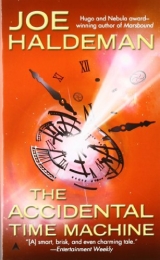
Текст книги "The Accidental Time Machine"
Автор книги: Joe William Haldeman
Жанры:
Научная фантастика
,сообщить о нарушении
Текущая страница: 7 (всего у книги 13 страниц)
She nodded. “Somebody knew you’d need an office. Maybe they knew your building was gone.”
All that from the casual encounter with the guard in Building One? It occurred to Matt that it had probably been a robot, too, and he’d been scanned and identified.
So who knew what around here? He was in a database as a scholar, even though he was last employed 177 years ago.
Did that mean someone was expecting him?
He followed Martha up three flights of stairs to a dim corridor. She gave him a brass key. “This is a nice bright one.” She pushed the door open with a creak.
Well, it was bright enough. It should have been in the shadow of the Green Building, but instead he looked down on the roofs of low wooden structures. No sign of the building or its venerable Brancusi sculpture.
But just a couple of days ago, he’d snatched the time machine there and commandeered a cab and come here.
“Professor? Don’t you like it?”
“It’s fine, Martha. I was just looking at where my old office used to be. The Green Building.”
She looked out the window. “It’s not one of those?”
“No, a lot bigger. You don’t have any pictures of what it used to look like here?”
“Of course not. Nothing before Jesus.”
“Because it’s a sin?”
“No,” she explained patiently, “because it was before.”
“All the pictures from before just disappeared?”
“Oh, no. We have Rembrandt and Leonardo and all those men. I like Vermeer best; there are two of his downtown. ”
Not very religious, a reassuring characteristic. “No photographs, though—nothing from my own time?”
“That all disappeared when Jesus came back.”
“What, it just went poofinto thin air?”
“That’s as it is written. Angels took it all away. I wasn’t there, of course.”
Like Billy Cabot’s Avenging Angels? “I have a lot to learn,” Matt said, “before I can think of teaching anybody anything.”
“I can help with everyday things,” Martha said. “Father Hogarty said you won’t be teaching this semester.”
“Glad to hear it.” There was an old metal desk to the left of the window. Matt went through the drawers and found a small stack of paper, two pencils, a dip pen, and a bottle of ink. Next to it, a cylinder of cloth obviously used as a pen-wipe was rolled up around a small knife and two extra pen points.
She picked up the two points and held them up to the light. “Somebody hasn’t been too careful. I’ll bring you a potato.”
“All right. Why a potato?”
“It keeps the points from getting rusty. You stick them into a potato when you’re done for the day.” She had the amused patience of a graduate assistant telling the professor how to turn on his new computer. “You didn’t have pens like this.”
“Actually, I’ve only read about them. Ours carried their own ink around.”
“I’ve seen those. The dean has one, his pen-stick. May I show you how this works?”
“Please.”
She pulled out the old desk chair, which was on wheels that didn’t roll, and sat down carefully. She treated the ink bottle with care approaching reverence, holding it tightly while the top unscrewed with a rusty squeak. She showed him how to dip the pen partway and remove the excess ink by sliding the nib left and right along the rim of the ink bottle. Then along the top of a piece of paper, she wrote, “Jesus died to save us from our sins” in a careful hand. Matt remembered the tollbooth’s crudely lettered BOSTON CITIE LIMMITS / PAY TOLE ONE DOLAR and wondered how rare her talent was.
She stood up and handed him the pen. “Would you like to try it, Professor?”
Not really. He sat down and tried to duplicate her motions. In block letters, he printed THE QUICK BROWN FO, and ran out of ink. The letters were wavering and blobby.
“A brown fo,” she read. “Is that like an enemy?” He completed the line, dipping the pen twice. “It sounds like the start of a parable, or a fable. The fox is quick and gets away?”
“It’s just a nonsense line. It uses every letter of the alphabet. ”
“Oh, like, ‘Jesus up on high rules few vexed crazy queers today.’ ” She laughed behind her hand. “The sister who taught me that in school was reprimanded. So I memorized it.”
“As you told Hogarty. Words aren’t magic.”
“Only some of them, in the right order.” She took the pen from him and wiped it with the cloth. “Always—” Someone knocked on the door. “That would be your midday. ”
She opened the door and a male student handed her a wooden tray covered with a black cloth. “Thank you, Simon. ” She set it on a small table by the door.
“Professors don’t eat with the students. I took the liberty of giving the kitchen this room number, but you might prefer to have it sent to your quarters.”
A long way to Magazine Street, he thought. “We’ll go find your quarters this afternoon,” she said. “I’ll be out of class at three. May I meet you here?”
“Sure, that’d be fine. Thanks.” She slipped quietly out the door.
Under the black cloth, a small loaf of bread and a wedge of crumbly cheese, like an old cheddar. A plate of dried apple slices on a string. Raisins in a cup, plumped with sweet wine. Ceramic flasks of water and red wine. It wasn’t Twinkies and speed, but it would do.
In fact, he had become ravenous, and though it was fine, he could have eaten twice as much. He kept the water and wine bottles and the ceramic cup that matched them, and set the rest on the floor in the hall.
There wasn’t much else in the room. A filing cabinet that was empty except for the bottom drawer, which held a rolled-up black leather bag. He’d seen people carrying them in the corridor; it was evidently a standard item. He’d use it to move his stuff here from the rented room; less conspicuous than the taxi driver’s plastic shoulder bag.
He sat down and practiced writing with the pen for a while. One of the nibs was flexible, and his writing with it went all over the place. The blunt one Martha had used worked best.
It wouldn’t be too smart to put his speculations down, where they could be read by others. He wrote random stuff for about a half hour and then his hand began to stiffen up. He dutifully made sure all the nibs were clean, waiting for their potato, and went downstairs to have a walk and look around.
The quadrangle that used to front the Green Building was still there, sporting oversized rusted bolts that had once held down the Brancusi Flying Wing. Too secular, he supposed, or maybe it had just worn down.
The silence of the place was eerie. It had always been relatively quiet, shielded from the Mem Drive traffic noise, but when the weather was as nice as this, there ought to be lots of students playing pickup football or Frisbee circles. Not a soul in sight now.
But then a bell chimed for end of classes, evidently, and there were dozens, then hundreds, of students surging out into the sunshine. They were very quiet, but then back in his day they hadn’t exactly been a horde of rabble.
He walked along with them, trying to blend in, but he did notice an occasional furtive glance. Maybe his evident seniority and lack of scars.
They walked among the low wooden buildings, a combination of dorms and meeting halls, to a large central building that smelled of cooking. Matt turned around and passed back through the crowd, observing.
In his time, about half the students would have been Asian. In this crowd there wasn’t a single one, and few black people. Was that the result of gradual change, or had there been a sudden purge? If he could find a reliable history of MIT, he could infer a lot about the missing history of the world. Even an unreliable history would hint at things.
He saw the back of a large sign a block away and angled toward it. It was at the easternmost entrance to the old campus, and it used to be a welcome sign with a map.
It still was, though the disciplines invoked were different. Anointed Preaching, Satanic Nature, Blood Covenant. What was a blood covenant and how many courses could they offer in it? Finally he found Natural Philosophy and Metaphysics, a part of the Mechanical and Mathematical Studies wing in Building 7, not far from his office. It might be a good idea to visit it now, incognito.
The walls on the Green Building had been a kind of inspiration, displays about the history of science, mostly physics, with replicas of old experiments along with old photographs. The walls in Building 7 were inspirational, too: reproductions of dignified paintings of Jesus and various saints. No cluttered bulletin boards, no stacks of returned papers—certainly no cartoons or provocative articles taped to doors, which used to be a professor’s declaration of individuality.
Perhaps Theosophy didn’t encourage individuality. He thought of Father Hogarty’s impatience with Martha.
He went into an empty classroom—none of them were in use at this hour—and sat down in the chair behind the teacher’s desk, fighting a tide of helplessness and panic. He was nottrapped here. He knew that ultimately he would find his way back, at least to the offices of Langham, Langham, and Cruise, in 2058.
He might have to go farther into the future, though, before finding that kind of rabbit hole. Maybe he should push the button now, before he got into trouble with these religious nuts. But there was no guarantee that the world 2094 years in the future would be safer or more sensible.
This place should have been comfortably familiar. He had spent most of his life in classrooms, and for many of his years had aspired to be right here, in front of a room full of young people pursuing knowledge. It smelled right; it felt almost right. But on the wall behind him there should be a clock. Not a picture of Jesus smiling benevolently.
Well, he’d spent many an hour staring at those clocks, praying for time to pass more quickly. Maybe kids were just more literal about that now.
He checked his watch. There wasn’t quite enough time to walk up to Magazine Street and back, but maybe he didn’t have to walk. He’d seen horses with carts parked across the street from Building 1, where there used to be a cab stand.
He went up to the office and retrieved the black bag, then went down and engaged the lead cart of four waiting there. The driver wanted eight dollars each way, but allowed himself to be bargained down to thirteen for a round trip.
It was stifling hot in the sun, but the cab had a leather canopy and moved just fast enough to generate a cooling breeze. It made the trip in a leisurely ten minutes, about what it would have taken in Matt’s time, crawling through traffic and waiting for lights.
The landlady wasn’t there. Nothing seemed to have been disturbed in the strongbox, so he transferred his stuff to the black bag and was back in his office by 2:30.
Waiting for Martha, he leafed through Metaphysics and the Natural World, which was full of biblical citations, but in between them did do a fair job of outlining Newtonian mechanics and basic electricity and magnetism, presupposing a knowledge of elementary calculus and trigonometry. The section on what caused the sun and stars to shine was ingenious, the heat generated by gravitational compressionand the constant infall of meteorites. It allowed for the Sun to be about six thousand years old, and close to burning out, which of course would happen on Judgment Day.
Martha knocked on the door just as bells were chiming for change of classes. “Shall we go find your quarters, Professor? ”
“Sure.” He got up and shouldered the bag.
She held out her hand. “Let me take that for you.”
“No, that’s all right.” The revolver’s heft was pretty obvious.
“But I’m your graduate assistant.” It was almost a whine.
“Look, Martha. I was a graduate assistant myself not so—”
“What? Menwere graduate assistants back then?”
“Sure. About half and half.”
She shook her head, openmouthed. “But what . . . what did you do?”
“Helped my professor out. Mostly math and electronics—that’s working with electrical machines. I gave tests and graded papers.”
“I can’t do anything like that,” she said. “I’m not supposed to. That’s for scholars.”
“So what does a graduate assistant do here?”
“I’m a graduate,” she explained. “And I’m your assistant. ”
“Oh. Okay. But humor me on this: I carry the bag.”
She shook her head. “But you’d look like a scholar, not a professor.”
“Humor me, Martha.”
Her mouth went into a tight line. “If Father Hogarty sees us, will you tell him it was your idea?”
“Absolutely.”
He followed her down the stairs and across the quadrangle, the same route he’d taken after lunch, but they kept going on past the dining hall. It was obvious when they entered professors’ territory: the residences were smaller, individual cottages, and instead of browning lawns they were fronted with carefully raked gravel and luxurious potted plants.
“Number 21.” The door was framed by two bushes covered in velvety purple flowers. She unlocked it and handed the key to Matt.
The single room smelled oddly of orange peel, some cleaning fluid, he supposed, and reflected on how far away the nearest orange tree must be. Which implied a thousand-mile chain of interstate commerce.
It looked comfortable. A large bed and bentwood rocking chair. An open rolltop desk with a padded office chair. On the desktop, an inkwell and a potato with two pen nibs stuck into it. What passed for a word processor in this place and time.
She handed him a folded-over piece of paper. “My schedule, Professor. I have Faith Enhancement twice a day, and directed reading in Alien Faiths three times a week. If you need me in those times, step outside and ring the bell in the yard. Another graduate assistant will go find me.”
He looked at the schedule, then his watch. She was due at Faith Enhancement in twenty minutes. “Well, you go on. I’ll settle in here. Then what, dinner?”
“At six. I’ll take you over there.”
She hurried off and he poked around the room. A covered chamber pot under the bed, how convenient. A small closet held stacks of sheets and blankets and a wooden box of candles, along with a red metal box that held matches, handmade and presumably dangerous. A cupboard held a loaf of bread, some hard cheese, and corked bottles of wine and water.
There was one window, with a gauze curtain, and a skylight. So he could read, after and before certain hours, without squandering candles and matches.
Next to the door a strongbox was bolted to the wall. Its padlock used the same key as the door. He unloaded the black bag into it. He held the porn notebook up to the window, but there wasn’t enough light to activate it. Having to go out into the sun would make its utility as an adjunct to masturbation questionable.
A single shelf for books had a Bible and a prayer book, along with a water carafe and glass. He poured a glass and longed for coffee, and realized that the dull ache at the base of his skull was caffeine withdrawal. He stifled a strong urge to go back to that place on Inman Square and squander $20 for a cup of “real coffey.” It would be better to invest it in aspirin and learn to do without.
He sat in the rocker and leafed through the natural science book. He could teach this stuff, second nature, but would he be able to stomach all the religion that kept cropping up?
Out of an obscure impulse, he went to the desk and took out a sheet of paper and duplicated an exercise that had been part of the final exam in undergraduate modern physics: derive the Special Theory of Relativity from first principles—there is no uniquely favored frame of reference and the speed of light is constant in any frame of reference. It took him two pages of scratching out blind alleys, but he wound up in the right place, with equations describing the distortion of measurements when one frame of reference regards another one that’s in motion relative to it.
Time dilation. Saint Albert, you should see me now!
He allowed himself a few moments of fantasy. What would happen if he worked through these equations in front of a classroom here? God does not favor any one position; everything is relative.
Martha came back just before six, to escort him to the faculty dining hall. He was nervous about it, ready for an inquisition. Could he be convincingly polite about religion? Would he have to lie outright, and pretend to believe? Would being honest lead to ostracism, loss of tenure, or burning at the stake? Polite silence was probably the best strategy, and intense observation.
The faculty dining hall was a block away from the student one, with its separate kitchen and, according to Martha, much superior food. (She had a friend who worked there, and occasionally snacked on leftovers.) She handed him over to Father Hogarty and went off to the student trough.
They sat at a table with six others, two of them addressed as “Father” and the rest professors. The Fathers were older, and all had horizontal scars on the forehead; the professors only had cheek scars.
They all treated Matthew with a kind of gravity that had nothing of deference in it. It took him a while to realize that most of them thought he was mad. Divine madness, perhaps, but still crazy. They were conspicuously incurious about the past he claimed to have come from.
It seemed odd that not even one wanted to quiz him about the past—as if they had time travelers drop by for dinner all the time—but then he realized the obvious. Their uniform lack of interest was prearranged; they’d been warned to keep the conversation on safe grounds.
So a lot of it was talk about students and subjects unrelated to Matt’s experience, which was a relief. He could just respond with conventional politeness and safe generalizations.
Hogarty and a younger man, Professor Mulholland, did mention Matt’s future at MIT. The new semester would start in a couple of weeks. He would monitor various natural philosophy classes with the intention of teaching next year. Mulholland would lend him copies of all the course outlines, and he could have Martha copy out the ones he was interested in teaching.
The meal was good, a thick stew of beef and vegetables with dumplings, and included wine with an MIT label, a weird scuppernong flavor that wasn’t bad. It was a 67, four years old.
Martha was waiting for him outside, totally absorbed in reading the Bible under a guttering torch. When he approached, he saw it was actually the Koran; she slapped it shut with a guilty start.
“I brought you some toilet things,” she said. “I don’t know what you have.” It was a wooden box with soap wrapped in a cloth, a handmade toothbrush, a jar of tooth powder, and a straight razor with a sharpening block. Maybe he’d grow a beard. “Do you know where the men’s necessary is?”
“No, in fact.” He’d used the one across from his office, but that had been a while ago, and “necessary” did describe it. She led him down an unmarked path to two buildings that had remarkably unambiguous pictures as to which was which. How Puritan were these people?
There were oil lamps in sconces dimly illuminating the place. A row of open toilets, two of which were occupied by men sitting with their robes pulled up, talking quietly. There was an obvious urinal, a thick pipe sunk diagonally in the ground, filled with gravel. He used it and went to a basin between two of the lights, with a mirror and a large water urn with a faucet. He brushed his teeth and put off the issue of the beard.
Martha was waiting for him, and they walked together back toward his cottage. “They told me you’re going to see the dean tomorrow.”
“Ten o’clock,” Matt said. “Do you know him?”
“Not to speak to. He’s very old and wise.”
“I guess a dean has to be,” he said lamely. “He’s the overall dean? I mean, there’s no one over him?”
“No one but Jesus. He’s the Dean of Theosophy.”
Matt thought of his own Dean of Science, Harry Kendall, dead now more than a century. A fellow Jewish atheist, how he’d roll his eyes at being under Jesus.
“I still have only a vague idea of what theosophy is.” He knew the word was adopted, or invented, by an obscure sect in the nineteenth or twentieth century, but there was no obvious connection to that, since it was dead as a doornail before he was born.
“You’ll find the way, Professor,” she said cheerfully. “Or the way will find you.”
He was getting a little annoyed at that assumption, but kept his peace for the time being. “Did you grow up here, Martha?”
“Not in Cambridge, no. Newton, south of here. My family sent me into Boston to find work, but I became a student instead.”
“Were they unhappy about that?”
“They pretended not to be. It would be sacrilegious.” That was interesting. “Where were you from, back in the past?”
“Ohio. Dayton.”
She nodded and pursed her lips. “I wonder if people still live there.”
“Why wouldn’t they?”
She looked left and right. “The Midland Plague,” she whispered. “We’re not supposed to talk about it.”
“A plague?”
“Most people younger than me don’t even know it happened. Maybe it’s just a rumor.”
“People don’t come from there anymore?”
“No. You’re the first I’ve ever met.”
They walked in silence for a block. “Ohio . . . was it part of the war? The One Year War?”
“Right at the end,” she said. “The infidels dropped a bomb from the sky. But it didn’t kill the faithful. So they used to say. They stopped teaching it before I was in school.”
Another isolated puzzle piece. They came to his cottage. She produced a key, opened the door, and followed him inside. She lit two candles from the one she was carrying. “What time do you want to be awakened?”
“Don’t worry about it. I’ll be up in plenty of time for the meeting.”
“All right.” She opened the closet and took out a rolled-up pallet and a pillow, and set them up neatly in a dark corner. She knelt and put her hands together and prayed silently for a minute.
Matt didn’t know what to say or do. She was sleeping here?
She stood up and stretched and then pulled the robe up over her head. She wasn’t wearing anything underneath. She folded the robe up neatly into thirds, then over once, and slid it carefully under the pallet, on the pillow end. Then she slipped between the sheets.
“Good night, Professor.”
“Um . . . call me Matt?”
She giggled. “Don’t be silly, Professor.”
13
Martha walked him to Dean Eagan’s office thenext morning, wearing the usual shapeless robe. His memory and imagination supplied the shape underneath it, though, and he found it hard to concentrate on the meeting with the dean.
He felt scruffy, too, having washed up with a cloth and cold water, not shaving. He was not going to try the straight razor just before an important meeting.
If he let his beard grow out, he would be the only professor on campus so adorned. “Why doesn’t anyone wear a beard?” he asked Martha.
She touched the scar on her cheek. “Nobody could tell your rank.”
“Maybe I could get away with it. Not having any real rank other than ‘professor from the past.’ ”
She reached up demurely and rubbed the stubble on his chin. “Maybe. It looks nice.”
When they stepped into the anteroom of the dean’s office, he smelled coffee for the first time since he’d left the past. He tried not to salivate.
Martha took a seat there, and the dean’s secretary, a beautiful woman with long black hair and no mark of academic rank, escorted him in.
It was a corner office, flooded with light. The walls that weren’t windows were crowded with paintings, some religious, but mostly portraits of deans, ending with Dean Eagan. Not a book in sight.
The dean was an old man, but vigorous. He came around the desk with a sure stride, helped slightly by an ebony cane, and shook Matt’s hand. When they sat down, the secretary brought over a tray with an elegant silver coffee service and delicate porcelain cups. The sugar was in irregular brown lumps, and the cream was thick and real.
She left after pouring the coffee, and the dean studied Matt for an uncomfortable moment. His eyes sparkled with intelligence.
“Matthew . . . Fuller. Is there a foolproof way for you to convince me that you are what you say you are?”
“A traveler from the past.”
He nodded. “From this Institute, when it was . . . before Theosophy.”
Matt clumsily sorted through his robe to the jeans underneath, and pulled out his wallet. His MIT ID was five years old, but it did still resemble him. And it was three-dimensional, a white-light hologram.
The dean looked at it and tried to stick his finger into the holo. He looked on the back, shook it, tapped it on his desk, then handed it back. “These were common then?”
“Every student and employee had one.” Matt had three, in fact, with different names, which he had done just to prove he could hack the system. “I was just a graduate assistant. ” The dean’s eyebrows went up. “It meant something different then, a kind of apprenticeship. I think like scholars, now.”
He took a sip of coffee and tried not to make a face. It was acrid and flat.
“All the way from Georgia,” the dean said. Matt decided to hold out for Colombian.
“So how did you do this, traveling through time?”
“There was a machine,” he said, not lying, “in the Green Building. That used to be near where the dining areas are now.”
“They did natural philosophy there?”
“Yes, physics. I used to work there, in the Center for Theoretical Physics.”
“Before Theosophy.”
“The term didn’t exist then. To the best of my knowledge. ”
“To teach here, though, you can learn Theosophy. It’s not as if you weren’t a Christian—a Methodist, I believe?—so you’re halfway there.”
“That’s right,” he said slowly. They’d talked to Moses. “I can learn quickly. My graduate assistant, Martha, said I wouldn’t be teaching until next year.”
He nodded, a faraway look in his eyes. “What was it like, traveling through time? Did you see the future going by?”
“I wish I had. It was all just a gray blur, which seemed to last only a minute or so.”
“You were in a car?”
“That seemed sensible. We didn’t know where I might end up.”
“We sent a team out to Arlington, to tow it in.” It took a moment for the meaning of “team” to sink in. Horses. “Do you think you could get it to work?”
“I don’t know. Can you generate electricity and store it in a fuel cell?”
“You’ll have to ask the people in mechanical studies. I’ve seen them make sparks with electricity that they carried in a box.”
“That would be a start.” He choked down some more coffee to be polite. “If it’s something like a chemical battery,in theory it could work.” Though it might take months to get enough charge to go a few miles, he wouldn’t mind having a getaway vehicle that was also a Faraday cage.
“Can you travel back? Go back to the . . . earlier MIT?”
“Some say yes, and some say no. If I were back in my own time, maybe I could build a machine that went the other direction. People were working on it when I left. But you can see the logical problem in going backward.”
The dean’s brow furrowed. “You would meet yourself? Be in two places at the same time?”
“That’s one manifestation of it. But the larger philosophical problem is that it blows apart cause and effect. You could use the time machine to go back and murder the person who invented the time machine.”
“But . . . that would be a sin.”
“I don’t mean you would actually doit.”
“No, of course. Theoretical possibility.” He laughed. “Sorry. I used to be a Father. So you would be using the machine to make the machine not exist in the first place.”
“Exactly.”
“But then . . .” He rubbed his chin and concentrated. “There doesn’t have to be a paradox. Time just starts over, and goes on as if the machine had never existed. Assuming the time traveler would have to disappear once his time machine stopped existing.”
Pretty damned good. “That’s right, sir. And the ‘loop,’ as we call it, of time and space when and where the machine existed—that loop itself ceases to exist.”
“So where does it go?”
Matt shrugged. “Limbo? Nobody can say.”
“Interesting.” He poured himself some more coffee, and Matt declined a refill. “How could one tell . . . how can youtell that you aren’t in one of those closed-off loops? Suppose you do invent a reverse time machine, and you go back and smash the machine that sent you here. The fact that you obviously exist—does that mean you didn’t do it? Aren’t going to do it? If you were in one of those closed-off loops, doomed to Limbo, how could you tell?”
“Well, you could jump forward again, and”—a thread of ice water down his spine—“you’d wind up in a future where your time machine had never been invented.”
Dean Eagan put his fingers together in a steeple and smiled. “Like this one.”
After the interview, Matt went for a walk to clearhis head. Could he be in a Gцdelian strange loop? It wouldn’t have to be he himself who went back and destroyed the time machine. Anyone capable of traveling into the past could do it, and deposit him in this odd future. A future where he was an anomaly, because the time machine had never been invented and Professor Marsh never stole the Nobel Prize from him.
But thinking about interference from the future made him wonder about the machine’s infuriating singularity. Thousands of copies had been made, and none of them worked; in essence, none of them had the vital, untraceable mistake that turned a graviton/photon calibrator into a time machine.
What if it hadn’t been anything Matt did? What if somebody from the future had come back and modified the machine, so as to make his own present possible? And then someone else from hispresent—or future—came back and destroyed the machine, because his own history required that it not exist? There could be an infinity of closed strange loops like this one.
Or the straightforward explanation could be true. Occam’s Razor. There was a conservative Christian revolution, and when they got into power, they systematically destroyed history in order to rewrite it. The Chinese had done that in ancient times, he remembered from an undergraduate history class—they defeated the kingdom that would become Vietnam in a war, and made the possession of historical documents a crime punishable by death.
But those wereancient times, before universal literacy and printing made books ubiquitous. Somewhere there had to be an old book stashed away, overlooked by the Angels.
He had walked over Longfellow Bridge, which used to carry the Red Line into Boston. At the end of the bridge, he carefully made his way down a rusting spiral stairway to Charles Street.