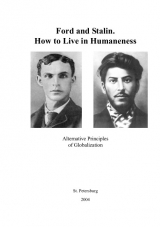
Текст книги "Ford and Stalin. How to Live in Humaneness"
Автор книги: (IP of the USSR) Internal Predictor of the USSR
сообщить о нарушении
Текущая страница: 23 (всего у книги 32 страниц)
A Japanese billionaire is in fact reproaching the insane Russian sociologists and economists – the pseudo-scientific consultants of the ruling regime – for abandoning the progressive conceptions of Stalin’s heritage. This is truly a sign that all the people who think on their own can co-operate in building communism on the principles of bolshevism no matter what country and what class they belong to.
In other words, the globalization based on the principles of Stalin’s bolshevism, is already taking place. Now that the public bolshevist initiative in Russia has worked out a social scientific theory and has gained conceptual power on its basis, making conceptual power available for anyone, the globalization based on the principles of crowd-“elitism” is doomed to fail.
Our cause is the right one. Victory will be ours, because we abide by God.
January 3 – July 15 2002
SUPPLEMENTS
1. The Biblical Doctrine of Global Slavery
«Do not charge your brother interest (your fellow Jew, as it follows from the context) whether on money or food or anything else that may earn interest. You may charge a foreigner (i.e. a non-Jew) interest, but not a brother Israelite, so that the LORD your god (i.e. the devil, if one judges the essence of usurious parasitism according to one’s conscience) bless you in everything you put your hand to in the land you are entering to possess» (the latter refers not only to ancient times and not only to Palestine, the land promised to ancient Hebrews, because it is a quotation not from a transcript of the ancient roll found at the place of excavations but from a widely published book claimed by all Churches and a part of the intelligentsia as the eternal truth supposedly passed on from above) – Deuteronomy, 23:19, 20. «You will lend to many nations but will borrow from none», – Deuteronomy, 28:12. «Foreigners (i.e. subsequent generations of the non-Hebrews who have run into a debt which could be repaid by no means to the tribe of usurious coreligionists) will rebuild your walls (today many Arab families from Palestine are dependant on the opportunity of working in Israel) and their kings will serve you («I am the Jew of kings» – was the way one of the Rothschilds answered the unfortunate compliment of «You are the king of Jews»); Though in anger I struck you, in favor I will show you compassion. Your gates will always stand open, they will never by shut, day or night, so that men may bring you the wealth of their nations – their kings led in triumphal procession. For the nation or kingdom that will not serve you will perish; it will be utterly ruined» – Isaiah, 60:10 – 12.
The hierarchies of all the so-called Christian Churches, including Russian Orthodox, claim this abominable conception to be holy, while the canon of the New Testament which had been censored and edited as far back as prior to the Nikean council (325 AD) proclaims it in the name of Christ as the righteous Will of God for all the times to come having no grounds whatsoever to do so.
«Do not think that I have come to abolish the Law or the Prop h ets; I have not come to abolish them but to fulfill them. I tell you the truth, until heaven and earth disappear, not the smallest letter, not the least stroke of pen, will by any means disappear from the Law until everything is accomplished» – Matthew 5:17, 18.
This is the Bible’s concrete meaning (according to texts of Russian Orthodox Church’s Bible, including Septuagint) which governs the entire Biblical civilization. The rest of the Bible is unimportant or attendant to that conception.
* * *
It is clear from the above that this conception lies within the bounds of the general control weapon means’ fourth priority. Yet in the 20th century the bosses of the Biblical project have used up all options of aggression by the means not higher than the fourth priority and decided to proceed up to the third priority.
There are two mutually dependent issues arising in social life which, depending on the way they are resolved, either provide the opportunity for personal, and hence social, development or deny that opportunity:
providing public access to cultural achievements (works of art, science, technology, etc.) required for the people’s personal development which takes place while they become familiar with the cultural achievements of the past and take over this cultural progress;
providing for the life of those who work in the field of art, science, technology and other fields of creative search.
Because creative search activities very often cannot be combined with profitably taking part in the socially common labor, the entire history of modern global civilization is full of people considered odd and idle by their contemporaries, who at least died in poverty even if they were not persecuted. Yet their descendants justly held them for outstanding creators, who were by decades or even centuries ahead of their contemporaries’.
Along with creators rejected by the crowd-“elitist” society there always are justly spurned graphorrea addicts who have nothing to say either to their contemporaries or descendants yet project an image of themselves as true creators. But this does not justify the society in escaping from practically addressing the two mutually dependent issues.
Let us make it clear once again: these are two different, though mutually dependent issues. They are by no means to be mixed up, and even more so it is unacceptable to pretend addressing the issue of providing for the people engaged in creative search activities while usurping the achievements in arts, science and technology and denying people access to them.
But it is exactly what is happening under conceptual power of the Biblical project’s bosses while the I-centric world understanding is dominant in the society.
A global control system of information distribution is being created. This is yet another system of the mafia regime oppres s ing the society based on the «laws on copyright and allied rights». When some have an exclusively high paying capacity and others are pa u pers owing to the organized corporate usury and stock exchange speculations, the following can happen:
first the institution of «copyright and allied rights» is established legally under the pretext of protecting the interests of authors and enabling them to be remunerated when their work is used;
then these laws and the practice of their application allows to buy up the works of art, inventions, technology and other information;
at the last stage a system is formed which allows to control access to cultural achievements appropriated by means of corporate mafias, and consequently to control the direction of cultural development by means of disseminating some information and prosecuting those who disseminate other information under the pretext of breach of «copyright» or allied rights.
This is not our imagination. H. Ford confronted this system when he was defending in court his right to manufacture cars in spite of the patent issued to some man called G. Selden. H. Ford describes that as follows:
«The way was not easy. We were harried by a big suit brought against the company[435] to try to force us into line with an association of automobile manufactures, who were operating under the false principle that there was only a limited market for automobiles and that a monopoly of that market was essential. This was the famous Selden Patent suit. At times the support of our defense severely strained our resources. Mr. Selden, who has but recently died, had little to do with the suit. It was the association which sought a monopoly under the patent. The situation was this:
George B. Selden, a paten attorney, filed an application as far back as 1879 for a paten the object of which was stated to be «The production of a safe, simple. And cheap road locomotive, light in weight, easy to control, possessed of sufficient power to overcome an ordinary inclination». This application was kept alive in the Patent Office, by methods which are perfectly legal, until 1895, when the paten was granted. In 1879, when the application was filed, the automobile was practically unknown to the general public, but by the time the patent was issued everybody was familiar with self-propelled vehicles, and most of the men, including myself, who had been for years working on motor propulsion, were surprised to learn that what we had made practicable was covered by an application of years before, although the applicant had kept his idea merely as an idea. He had done nothing to put it into practice». (“My Life and Work”, Henry Ford, chapter 3 “Starting the real business”).
H. Ford won the case, that is why now we know about a car-manufacturing company called «Ford Motors». The business of «protecting» «copyright and allied rights» has moved very much forward. Let us turn to an interview given to the Pravda.ru web-site by the «World of Internet» magazine content editor and one of the founders of the iFREE[436] public initiative Alexander Sergeyev.
«A. Sergeyev: Under the pretext of protecting the interests of the author information distribution of all kinds is artificially limited by insurmountable financial and legal barriers, – says the iFREE manifesto. As a result, creation outside the corporate framework that provides legal and financial support is doomed to be either illegal or marginal.
(…)
Now on the threat to culture. Copyright strengthens the principal division of all people into authors and consumers of cultures. But such a division is contrary to the modern tendencies of cultural and scientific development.[437] Of course, traditional forms of authored creative activity will remain, yet a different, non-authored culture is becoming more and more significant in comparison to it. It includes fan clubs, happenings, joint musical performance, public discussions, teleconference, network projects with undefined or changing number of participants.[438]
Non-authored culture has always existed, for example, as folklore. Its main difference from authored culture is in having no strict division into consumers and authors. Rather, it has participants and leaders. With the introduction of book-printing, sound records, radio, television non-authored culture receded into the background, as only professional authors and editors were able to manage expensive printing space and no less expensive broadcast time properly.
The Internet creates entirely new opportunities for developing non-authored culture. But in the 500 years since the times of Guttenberg and especially in the 20th century we have almost entirely forgotten that it exists. Modern copyright legislation provides authored culture many advantages over non-authored one. It creates an effective way of appropriating cultural values[439] and limits broad public access to them.
But the future belongs to non-authored culture. And one should not think that non-authored culture will be necessarily marginal. Professional authorship formed as a response to the challenge of publishers. The dominating form of cultural interaction is changing. After the era of broadcast we are entering the era of communication. And this must be certainly reflected in the legal procedures which regulate cultural activities. Above all the law on copyright – the main obstacle in the way of non-authored culture.
Question: Copyright has yet had little chance to go on the spree in post-Soviet countries. But it seems that Russia has prepared an analogue of Digital Millennium Copyright Act 1998 (DMCA) – the amendments to the RF Law «On copyright and allied rights». The bill on the amendments contains amenability for by-passing copyright protection hardware, as well as the ban on manufacturing and distributing devices used for by-passing or facilitating the by-pass of protection hardware… Among many other things. What will happen if the bill is passed?[440]
A. Sergeyev: If the bill is passed, our legislature will become even worse than that of America, which has almost reached the level of totalitarian regimes in the aspect of freedom of information distribution (put in bold type by the authors of the book). By the way, the next bill is being discussed in the US, concerning the ban on manufacture and sale of hardware and software not equipped with the means of copyright information control.[441]
The number of information activities and information relations is limitless. Any of them may appear unprofitable to someone. And if the corresponding lobby is powerful enough, this activity is banned. While the lobby of freedom is often the weaker side. Freedom is lost gradually, almost imperceptibly. Every such step in itself seems insignificant. But constant dropping wears away the stone.
Recently I received news – some companies are trying to prohibit through court placing links leading to pages other than the homepages of their sites as it may create a different impression with the user than the author originally intended. Even in the Soviet times[442] nobody thought of banning reference to particular pages of books. Yet now to someone this practice became unprofitable.
Actually, the more bans are introduced, the easier it is to make money on them. The scheme is a very simple one and has been known since the times of Inquisition: you introduce a public ban – a moral, legal, political one – and then you start selling pardons…»
Though the problem has been discovered by the society, it is clear that A. Sergeyev is speaking only about selling «pardons» to the end of making profit. The crucial issue has not been understood and clearly expressed. It has been left in silence, as it is necessary for the bosses of the Biblical project on enslaving the mankind:
A kind of mafia regime controlling the society is being formed and is becoming more powerful. Its power is exercised not by actual dictatorship, but indirectly – through controlling the distribution of information favorable to the Biblical project bosses and persecuting those who distribute unfavorable information, under the pretext of copyright breach. As an interim result, the direction of cultural development on the whole and of scientific and technological development in particular to a very large extent comes under legalized control of the international mafia of usurers who have started to buy up © copyrights.
Thus, substituting the issue of providing public access to all cultural accomplishments with the issue of presumably protecting the interests of creators from the attempts to parasitize on their work, the Biblical «world backstage» is trying to pursue its slave-owning ambition by new means.
The Russian idea of copyright is that it is the right of a person gifted by God to gift other people with the fruits of his or her work according with his genuine understanding of God’s Will. It is incompatible with the abominable Western conception of copyright and allied rights and the laws it is reflected in.
Ignore the laws on copyright and allied right for the benefit of all, and God speed you.
Only in a nightmare hallucination can one imagine Jesus as a pettifogger who defends in court his © copyright on the Gospel. But the very fact of the © copyright institution’s existence in the West explains that the West lives under the power of the New Testament which has been privatized and perverted by the mafia like the Testament given from the above through Moses had been privatized and perverted by mafia before.
2. The interview with Joseph E. Shtiglits
The interview with Joseph E. Shtiglits, former vice-president of the World Bank, economic advisor to US President Clinton, winner of the Nobel prize in economy for 2001. Published in the Sunday supplement to the «El Pais» newspaper of June 23, 2002. Recently he wrote a book about the IMF under the title of «El malestar en la Globalización» («The Disease of Globalization» – approximate translation). Here are some parts of that interview (based on Russian translation).
– You write that while working in the Clinton administration you were surprised by the circumstance that many decisions in the White House, as well as the IMF, were often taken out of ideological and p o litical co n siderations, rather than according to the requirements of economy?
– In a certain sense, I was not greatly surprised by what was happening in the White House. I was disturbed that ideology and politics played such a significant role in international economic organizations where professional economists are supposed to set the fashion. For example, research indicated that liberalizing financial market would result not in economic growth but in destabilization of economy. We knew that, it should not have been done according to the science of economics, yet the IMF kept trying to implement exactly this kind of liberalization. Its motives in doing so were purely ideological and political…
– When the reader comes to the end of your book, he might be puzzled with the following question: who is taking decisions which d e termine world events affecting the well-being of millions of people?
– According to my experience of working in the American government and the World Bank there is no single person who makes such decisions. This is a complex process involving many forces. Even the President of the USA is not able to influence many issues. He doesn’t even have the information necessary to do it. There are too many decisions to be made, one must also take into account the nature of information that he gets… Different groups try to control his incoming information, informing him only of what can persuade him to take a certain position favorable to them. Many people cannot understand that there is no such single man who controls the situation personally.
– OK, it is not a single person, not the President of the United States, but someone, some people do make decisions. Who are they?
– In my book I tried to clarify the fundamental role played in this process by major financial interests and transnational corporations. But at the same time, I would like to stress that there are other forces involved in this game. For example, the «Anniversary-2000» movement played a significant role in reducing the debt. The IMF resisted, but the civil movement turned out to be so strong that got the upper hand on that point. There are many economists inside the World Bank itself who are genuinely concerned with the problems of poverty and environment protection…
– You leave no doubts in your book about the US Treasury and the IMF having the real power. Is it they who determine policy?
– Yes, the IMF sets the macroeconomic and financial policy. Unfortunately, a country needs to get the IMF’s approval before it can receive help from the European Community or the World Bank. In this sense, the Fund’s power is enormous…
– In crisis situations in developing countries the US Treasury and the IMF deliberately gave recommendations which aggravated pro b lems, as you firmly claim in your book, but which corresponded to the ec o nomic and ideological interests of developed countries. What does it mean from the moral point of view?
– This means that they used the crises in those countries to pursue their own interests…
– You tell that some heads of states sadly admitted to you that they had to follow the IMF’s tastes though its recommendations were clearly bad for their countries; that the IMF played the role of an i n ternational p o liceman who forced them to make destructive decisions.
– Quite so. They were afraid to get on the IMF’s black-lists. In that case they would not get any credits either in the Fund, or the WB, or the EC. And owing to low IMF assessment they wouldn’t be able to count on attracting private investments. Worse than that, they were afraid even to speak of their problems openly, fearing that such an openness in itself will be considered as impudence and confrontation by the IMF which will then punish them and revenge. It means that they considered any form open dialogue impossible.
– You think that the IMF is mistaken in refusing to take into account the opinion of the governments of the countries where it executes its policy. Is it just like you describe in your book: the Fund’s representatives arrive, in three or four days they suggest the country’s leadership to sign certain conditions[443] similar for all, and then accuse the this same leadership of corruption?
– They lay down a number of conditions…
– Could you tell us how the IMF functions? How is its economic policy defined?
– There is only one country in the IMF which has the veto right. It is the Treasury of the United States.
* *
*
And so on about the same thing…
July 18, 2002.
[1] On this day the «American life style» and the «American dream» were attacked by «international terrorism». Hi-jacked passenger jets hit the towers of the World Trade Center located in New-York City and brought them down, as well as one wing of the Pentagon facilities in Washington. The fourth hi-jacked jet was reported by mass media and US officials to have crashed in Petersburg countryside without hitting anything presumably due to loss of control as the hostages tried to oppose the hijackers.
Could all of this happen without connivance or direct complicity of US special services? – Let everyone decide on his or her own.
[2] On these issues one should refer to the books “It is Time I Should Start the Tale of Stalin…”, “The Brief Course…” by the Internal Predictor of the USSR (IP of the USSR).
The above-mentioned and other works by Internal Predictor of the USSR can be found at www.mera.com.ru and are also included into the complete Information base on sociology, worked out by the Internal Predictor of the USSR distributed on compact disks.
[3] If one is interested in what can cause a financial and economic crisis and depression and how it can be done on somebody’s demand please refer to the works of IP of the USSR “The Brief Course…”, “The Economic «Rupture» Must Be Excised”, abstract of “On Understanding the Macroeconomy of State and World”.
[4] Douglas Reed provides the facts referring to this issue in his book “Dispute on Zion”.
[5] Gorky is named Nizhnyi Novgorod nowdays.
[6] The factory named after Likhachev. At the time it was named ZiS (factory named after Stalin) and was headed by Ivan Lihatchov (1896 – 1956) in the period of 1926 – 1930 and 1940 – 1950. He had an agricultural background, started as a worker at the Putilov factory in 1908. He served in the Baltic Navy during World War I (1914 – 1918) and was a soldier in the Red Army in the years of the Civil War. Later he was promoted to a Red Army commander, then an official of the VChK (National Emergency and Security Committee). In 1953 he was appointed Minister of motor transport and highways in the Soviet government.
[7] Statistical data given here are taken from the book “My Life and Work” by H. Ford. It will become clear from further evidence that they provide documentary proof of the fact that Marxists slander Ford by this article while being aware of the truth. If it isn’t so it only remains to conclude that they are hopelessly dumb and are capable of making sense neither out of a book’s text nor of the happenings of life.
[8] When compared to contemporary competitors.
[9] The sentence is worded in a way, which implies that payment by the hour is the best and most just method of remuneration. Marxists are not interested in that this very method is inconsistent in the conditions of modern industry where manufacturing processes are carried out collectively and where the principle of professional specialization is employed, and this fact will be exemplified further in the text. These men of no scruples and intelligence seek only to maintain the class approach in its purity while turning a blind eye to the differences in morality of concrete people, and to accuse H. Ford of being an exploiter of the working class in his intentions and actions.
[10] One wonders where on Earth have they found a metrologically consistent (there can be no other) science of control generally and of controlling production and distribution, the state, society in particular in Marxism?
[11] We take quotations from the book by Ford (in Russian translation) out of an electronic file obtained in the Internet. That is why we mark quotations with names of chapters only without providing the numbers of pages. The file being quoted can be found in the «Other authors» section in the Internal Predictor of the USSR CD information base.
[12] The quoted file gives «partially capable» instead of «partially able-bodied» though it follows from the context that what is meant is limited work capacity. Unfortunately the Russian translation contained in the file being quoted leaves much to be desired in various other passages as well.
[13] In his book H. Ford writes that among other things «Ford Motors» kept its own hospital. Medical services at that hospital were charged, but those charges and the personnel’s wages were maintained at a ratio that would enable them to pay the charges out of their wages. In other words two birds were killed with one stone: health care was accessible and an economical attitude to one’s health received a monetary stimulus – though medicine is affordable it is not only more pleasant to be healthy, it is more profitable.
[14] This paragraph is followed by an extract containing the statistical data on personnel training that are given in the above-mentioned article «Fordizm» from the “Big Soviet Encyclopedia”:
« The length of time required to become proficient in the various occupations is about as follows: 43 per cent. Of all the jobs require not over one day of training; 36 per cent. require from one day to one week; 6 per cent. require from one to two weeks; 14 per cent. require from one month to one year; one per cent. require from one to six years. The last jobs require great skill − as in tool making and die sinking».
The broader context where the data given by the encyclopedia are taken from shows that the authors of the article «Fordizm» were deliberately slandering Ford, i.e. they had a malicious intent and were performing an order on propaganda.
[15] Communist Party of the Soviet Union.
[16] A device consisting of two multi-pass blocks and a rope passed through them, one end of the rope being attached to one block and the other end (running end) being pulled either manually or by means of a winch when weights need to be moved. One block is mounted on a beam; the other is fixed on the rope being passed several times through both blocks to form rings. Either a crook or a claw is mounted on the free block. The hoist is intended for lifting and moving heavy weights. When operating the hoist the worker must wear clothes reducing the risk of its getting between the blocks.
Ties and broad sleeves may also cause injuries when caught by moving parts of machinery: drills, shafts, cutters, component parts while turnings etc.
[17] Here and further throughout the text
[18] I.e. in the very beginning of the 20th century.
[19] What is meant is the US Administration.
[20] 343 English miles correspond to approximately 550 kilometers, and as Ford says it sometimes takes up to 5 or 6 weeks for a shipment to go this distance. It means that the average speed of transportation on this railroad could be as low as 0.65 km/h while at the time a steam engine could haul a train of 20 to 30 carriages (even if they were two-axle) at a speed of some 40 – 50 km/h. Comparing the two figures may say something about the quality of management at the railroad before it was acquired by «Ford Motors» and after that.
[21] In fact a «financier» in this context nearly always means a «stock exchange speculator».
Similarly almost every time Ford uses the word «banker» one should read «usurer» instead. That is why we have substituted the word «banker» for «usurers» in the remaining part of the quotation whenever it is unambiguously clear that lending loans on interest is meant. This is a norm, which the US banking system operates by, and this substitution simply clears things up calling social phenomena by their proper names.
[22] And moreover so a «financier» who is a stock exchange speculator mostly acting as a parasite on production and on processes of macroeconomic control.
[23] The conclusion Ford makes about US railroads can be applied for interpreting the increase in railroad fares by 30 % in Russia, which took place on January 15th, 2002, and for the production slump at the majority of Russian enterprises that occurred in the course of reforms, especially in high-tech industries.
[24] This means that Ford objects to a society (including economic science, law and legislature) which does not distinguish between:
profit gained by means of interest on loans and
profit gained by enterprises of the industrial sector of economy by means of trade.
He also objects to attempts of raising parasitism achieved through financial manipulations to the level of a highly important task. Compare Ford’s point of view with the Koran, sura 2:
«276 (275) Those who feed on interest will rise
In other words all past, present and future complications in US relations with Islamic countries, and most probably with the rest of the world, have been pre-defined by the fact that the US have built capitalism not according to Ford but contrary to his views – along with the Bible which prescribes usury to Jews as the global system-forming factor (Deuteronomy, 23:19, 20; Deuteronomy, 28:12), directed towards achieving some clearly set out aims (Isaiah, 60:10 – 12). See Supplement 1.