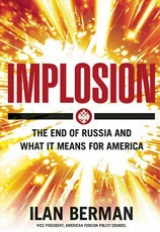
Текст книги "Implosion. The end of Russia and what it means for America"
Автор книги: Ilan Berman
Жанр:
Политика
сообщить о нарушении
Текущая страница: 8 (всего у книги 14 страниц)
CHAPTER TEN
MANAGING THE END OF RUSSIA
In March 2009, when the Obama administration’s outreach to Russia was still in its infancy, America’s chief diplomat made a major gaffe. Meeting in Geneva with her Russian counterpart, Foreign Minister Sergei Lavrov, then Secretary of State Hillary Clinton presented him with a symbolic red button, meant to signify the “reset” of bilateral relations then being advocated publicly by President Obama.
But the button was mislabeled. In a glaring error of translation, it was inscribed with the Russian word peregruzka, meaning “overload,” rather than the correct term, perezagruzka(signifying a “reloading” or “rebooting” of affairs). Both Clinton and Lavrov were quick to laugh off the incident, but a significant message had inadvertently been sent.
A FAILED RESET . . . AND AFTER
In the years since, the “reset” with Russia—which has emerged as a centerpiece of the Obama administration’s foreign policy agenda—has followed a predictable, if disheartening, trajectory. On a number of tactical fronts, Moscow and Washington have indeed drawn considerably closer. In terms of strategic priorities, however, the two countries remain worlds apart.
Most concretely, Russia has become a major player in Coalition efforts in Afghanistan, assuming a key role in the U.S.-led effort there. Today, an estimated 60 percent of U.S. supplies to troops in Afghanistan arrive by air, road, or rail via Russian territory. 1Indeed, it would be fair to say that Moscow has helped sustain the War on Terror’s first front, even as America’s deteriorating relationship with Pakistan has progressively closed off traditional supply routes. As of March 2013, in excess of 2,200 flights, carrying 379,000 military personnel and 45,000 cargo containers, are estimated to have transited Russian territory en route to the Coalition in Afghanistan. 2
Russian assistance on this front, moreover, is expanding. In June 2012, the Russian government came to terms with NATO on a supplemental transit route through the Volga region. 3The move is deeply symbolic, given that the area is home to some 40 percent of Russia’s Muslim population. It also reflects an abiding self-interest: Moscow’s assistance, scholars note, has been rendered not “because of its love for the West.” Rather, it is because Russian leaders are deeply concerned over Afghanistan’s continued role as an incubator of Islamic extremism—and cognizant of the fact that, left unaddressed, the threat could easily migrate to exacerbate ethnic and sectarian tensions within the Russian homeland as well. 4
The two countries likewise have managed to revive their bilateral arms control dialogue, which remained moribund during the later years of the George W. Bush administration. In late 2010, over the objections of many in the U.S. Congress, the Obama administration concluded a new arms control framework agreement with the Russian government. That treaty, colloquially known as New START, was a strategic victory for Moscow, enshrining new bilateral reductions of nuclear arms in a formula that deeply favored the Russian Federation. 5It also provided a concrete affirmation to Moscow elites that Russia still mattered to official Washington—a not-inconsequential thing for a country preoccupied with its own global status. New START looks to be just the beginning; since ratification of the agreement, the two countries intensified their discussions about additional strategic reductions. 6
In service of the “reset,” Washington has also rolled back its commitment to missile defenses in Europe. In September 2009, the Obama administration unveiled a new missile defense policy, dubbed the “phased adaptive approach,” in which it abandoned its predecessor’s commitment to deploy early warning radars and interceptors in Poland and the Czech Republic in favor of a more graduated, four-phase plan to protect American allies (and eventually the U.S. homeland) from ballistic missile attacks from rogue states. 7But even that plan increasingly has come into question. At a summit in Seoul, South Korea, in March 2012, President Obama was accidentally captured on a microphone telling outgoing Russian president Dmitry Medvedev that he would have “greater flexibility” to negotiate over the shape of American missile defenses following his reelection to the U.S. presidency, which took place in November 2012. 8A year later, incoming Secretary of Defense Chuck Hagel announced that budgetary constraints and a rethinking of strategic priorities in the White House had led to a scrapping of the European component of the phased adaptive approach, which would have helped NATO build a missile architecture for Europe. 9
Russia and the United States also collaborate on an array of science and technology issues. In the aftermath of the Obama administration’s 2011 decision to scrap NASA’s space shuttle program, Russia has emerged as America’s de facto gateway to manned space, providing U.S. astronauts with transportation to the International Space Station. 10For the time being, at least, Russia seems both ready and willing to play that role. In March 2013, the Russian government codified plans to collaborate with the United States on space research through the end of the decade. 11Other issues, from cyber-warfare to nuclear research, are likewise the subjects of quiet bilateral cooperation. 12
Strategically, however, the “reset” rests upon very flimsy foundations. This is because it is overwhelmingly an expression of American political desires writ large (and those of the Obama administration in particular), rather than a true, deep strategic and ideological reorientation by both countries. Indeed, Russian president Vladimir Putin has said as much. In December 2012, as part of a major press conference in Moscow, he told reporters that “reset” was an American term and objective, rather than a Russian one. “Reset is not our word,” Putin said, “We didn’t see the need in it at all.” 13
Moreover, because the “reset” is an American, rather than a mutual, construct, even the tactical areas of cooperation that exist today could prove fleeting. Astute observers have noted that there will be fewer areas upon which Moscow and Washington can cooperate in the years ahead—most conspicuously, with the end of war in Afghanistan in 2014. As a result, disagreements are likely to become more prominent and the bilateral relationship as a whole more acrimonious. 14
Indeed, ties between Moscow and Washington already appear to be fraying. A particular flash point has been the so-called Magnitsky Act passed by Congress and signed into law by President Obama in late 2012. The legislation, named after the Russian lawyer who died of medical complications in a Russian prison in 2009 after exposing massive government corruption, blacklists a number of Russian officials implicated in Magnitsky’s death from traveling to the United States and accessing the U.S. banking system. 15The bill has riled Moscow, which has responded with its own legislation, the Dima Yakovlev Law, which bans Americans from adopting Russian children. 16
As a result, policymakers in Washington are actively rethinking America’s relationship with the Russian Federation—and downgrading it. “The divergence of the United States’ and Russia’s core foreign policy objectives has left the White House with two strategic options,” Leon Aron of the influential American Enterprise Institute has written. 17The first amounts to a resetting of the “reset” policy on Washington’s part—a quest for more, and new, areas of commonality between the United States and the Russian Federation that might prove more durable than the current batch of issues under bilateral discussion.
The second, however, is the idea of a “strategic pause” in relations with Moscow, and a reevaluation of U.S. priorities in the relationship. 18Increasingly, official Washington appears to be pursuing the latter course. Despite ongoing diplomatic contacts between the two countries, mounting anecdotal evidence suggests that the Obama administration, having unsuccessfully tried engagement with the Putin regime, is now content to ignore it altogether. 19
American policy may currently be in flux, but the direction it ultimately takes will be informed by a fundamental reality: the Russian Federation is in the throes of a monumental transformation, the results of which will determine whether Russia emerges as a true partner of the West—or a mortal danger to it.
FUTURE IMPERFECT
Tucked away in a busy corner of the Pentagon is a little-known bureau known as the Office of Net Assessment (ONA). Headed by Andrew W. Marshall, the legendary nonagenarian strategist who has advised every American president since Richard Nixon, it serves as the U.S. military’s in-house think tank on a broad range of foreign policy and defense issues. ONA’s specialty, however, is a very specific discipline: the study of “alternative futures,” the different ways in which countries might respond to external and internal changes in an increasingly complex geopolitical environment. 20
Russia is a country ripe for exactly this kind of study. Although the trend lines highlighted in the preceding pages may not be immediately apparent to casual observers of Russian politics, they are already exerting an inexorable pull on the country’s political direction. And while it is impossible to predict with certainty exactly how Russia will evolve in the years to come, several scenarios are plausible.
A STRENGTHENED IMPERIAL IMPULSE
Today the quest for renewed national greatness continues to preoccupy Kremlin elites and ordinary Russians alike. As a result, Vladimir Putin’s ongoing efforts to rebuild Russia’s geopolitical status (through military modernization, regional hegemony, and a nurturing of anti-Americanism) on balance have proven popular at home, at least for the time being. But the Kremlin’s current, “post-modern empire”—a web of influence and strategic dependencies extending throughout the former Soviet Union, into Europe and beyond—can go only so far. As depopulation ensues in earnest in the coming decades, the Russian government will be compelled to adopt an even more aggressive policy toward its former territorial holdings in the post-Soviet space, the Baltics, and Eastern Europe. This is likely to lead to new territorial conflicts along Russia’s periphery, as Moscow increasingly seeks to replace its current virtual empire with a tangible one and thereby prevent, or at least delay, its demographic collapse.
A CHINESE FAR EAST
Russia’s drive to absorb its former Soviet republics will be reinforced by its receding presence in the Far East. The area (which serves as a key part of the Kremlin’s energy strategy and the centerpiece of its Asia policy) is already being transformed by China’s relentless rise. Observers in Moscow note that China’s strategy is not one of outright conflict and that as a result, Beijing is not likely to go to war over the Far East after the expiration of its 2001 territorial treaty with Russia some eight years hence. 21
But even absent outright conflict, the PRC’s growing political and economic influence in the area will make Chinese dominance there a political reality long before it becomes a formal one. This advance is nearly inexorable, driven as it is by China’s internal economic imperatives—unless, that is, Russia is willing to fight for control of the territory. But, at least for the moment, the Kremlin does not appear to be prepared to do so. And because it is not, Moscow’s grip over the country’s distant east will continue to weaken over time, until it disappears altogether.
RUSSIA HEADS WEST (TERRITORIALLY)
The demographic trends now predominant in both “European” Russia and in the country’s distant east mean that the current territorial boundaries of the Russian Federation are not sustainable in the long run. Internally, a massive migration is already beginning to occur. Ordinary Russians—once constrained by Soviet authorities in where they could live—are taking advantage of their newfound, post-Soviet freedom of mobility to move westward, and are doing so en masse. The inhabitants of the inhospitable Far East are moving across the Urals to “European” Russia, where greater economic opportunity (and more temperate climates) exist. Those in the country’s west, meanwhile, are departing the nation altogether. As a result, several decades from now, the country known as Russia is likely to control a smaller territory overall, and its land mass is likely to be situated farther west.
ONE, TWO, MANY CHECHNYAS
A decade ago, it was still possible for the Kremlin to dismiss the Islamist insurgency raging in the North Caucasus as a distant and contained phenomenon. Today, it is not—because the conflict is spreading quickly. Russia is witnessing the beginning of a confrontation between a radicalizing Muslim population and the Russian state writ large. It is, moreover, an insurgency that will inevitably gain in strength in the years to come unless the Kremlin can craft a real, meaningful counterterrorism strategy.
So far, it has not. Instead, Russia’s leaders have engaged in a hard-power campaign against Islamic radicalism, hoping that overwhelming force will pacify the country’s restive republics. The failure of that approach is evident in rising Islamist violence in places like Tatarstan and in the proliferation of extreme Islam throughout the Eurasian heartland. This phenomenon will pose a growing challenge to the stability and legitimacy of the Russian state in the years ahead—a challenge complicated by Moscow’s counterproductive and Shi’a-centric policy in the Muslim world, which will serve as yet another source of grievance for the country’s growing Sunni minority.
A NEW RUSSIAN CIVIL WAR
Nearly two decades ago, Russian civic icon Aleksandr Solzhenitsyn lamented his country’s status as a “torn state” on account of the territorial divisions that took place with the USSR’s collapse. 22Today, Solzhenitsyn’s description is more apt than ever, but for a different reason. Russia is more divided socially than at any time in its modern history. The rise of Islamic radicalism, the influx of Muslim migrants from Central Asia, the rise of rampant xenophobia and racism, and the expanding power of the Russian Orthodox Church cumulatively have the potential to transform Russia into a latter-day Yugoslavia, a nation riven by ethnic violence and sectarian strife. The Russian military provides a snapshot of this phenomenon. Even as the country has become more ethnically diverse (and divided), the Russian armed forces have headed in the opposite direction—becoming more homogenous and rigid. They have also become increasingly ideological, with Russia’s armed forces seeing themselves more and more as “protectors of the state” against threats to the nation’s character and core values. 23The groundwork for a future civil war in Russia, a violent contest for the soul of the Russian state that will be fought along religious and ethnic lines, is thus being laid.

None of these alternative futures is assured. But all are plausible, given the trend lines now visible within the Russian state and society. Each, moreover, holds significant implications for the West.
A Russia engulfed in civil or sectarian warfare could quickly become a threat to its neighbors and to the international community at large. So could an increasingly aggressive Russia bent upon fresh territorial conquests in Slavic parts of the former Soviet Union. Prospects for a Russo-Chinese conflict over the Far East should likewise not be taken lightly, since such a war would inevitably draw in neighboring Asian powers (and, quite possibly, the United States as well). The safety and security of Russia’s strategic arsenal, meanwhile, could be affected by the emergence of organized Islamic separatism within the Russian heartland—or by the country’s descent into protracted civil unrest. And if current demographic trends hold, decades hence Russia could become the world’s first majority-Muslim nuclear superpower with a permanent seat on the United Nations Security Council, fundamentally reconfiguring the nature of the global order in the process.
THE KREMLIN AT THE CROSSROADS
“Russia,” British prime minister Winston Churchill famously remarked in October 1939, during the opening days of the Second World War, “is a riddle, wrapped in a mystery, inside an enigma.” The British leader was commenting on Soviet leader Joseph Stalin’s surprising August 1939 decision to sign a non-aggression pact with Adolf Hitler’s Third Reich. That move helped keep the USSR on the sidelines of the unfolding global conflict, much to the chagrin of the Allied powers—until Germany’s grand betrayal in June 1941 dragged the Soviet Union into what is still known in Russia as the “Great Patriotic War.”
Fast forward seven decades, and little has changed. More often than not, Western policymakers are at a loss to properly explain Russia’s behavior and correctly characterize its relationship with the world. In large measure, official Washington still clings to the conception of post-Soviet Russia as a force that must be accommodated in order to achieve foreign policy success on the world stage. This vision has underpinned the Obama administration’s unfortunate “reset” policy, which seeks to forge a new, less adversarial relationship by acknowledging—and nurturing—Russia’s status as a great power.
All of this, of course, has been music to the ears of elites in Moscow, reinforcing their conception of their country’s global status. Far less understood is the fact that the Russian Federation is a country fast approaching a strategic crossroads. The Kremlin now finds itself a prisoner of demographic and societal trends that will profoundly reshape the nature and workings of the Russian state.
Author and columnist Mark Steyn perhaps said it best. “What will happen in Russia?” Steyn asked wryly in the pages of National Reviewseveral years ago, upon grasping the extent of the country’s coming upheaval. “None of us knows, but we should know enough to know we don’t know.” 24
Indeed, we do not know which direction Russia will take in the years ahead, or whether it will manage to survive at all. What is clear, however, is that Russia’s future is not one of global dominance, as the current occupants of the Kremlin (and their interlocutors in the West) seem to believe. Rather, it is one of ethnic, demographic, and societal turmoil—and, quite possibly, the end of the Russia that we know.
NOTES
CHAPTER ONE
1.See, for example, Louis Charbonneau, “Russian Arms Shipment En Route to Syria: Report,” Reuters, May 25, 2012, http://articles.chicagotribune.com/2012-05-25/news/sns-rt-us-syria-arms-russiabre84p00b-20120525_1_syrian-president-bashar-al-assad-cargo-ship-russian-firm.
2.For a good overview, see George L. Simpson Jr., “Russian and Chinese Support for Tehran,” Middle East QuarterlyXVII, no. 2 (Spring 2010): 63–72.
3.Keith C. Smith, “A Bear at the Door,” Journal of International Security Affairs, no. 13 (Fall 2007): http://www.securityaffairs.org/issues/2007/13/smith.php.
4.See, for example, Ilan Berman, “Russia Shows the US the Central Asia Door,” Jane’s Defence Weekly, July 11, 2007, http://www.ilanberman.com/5923/russia-shows-the-us-the-central-asia-door.
5.Paul Klebnikov, “Gangster-Free Capitalism?” Forbes, November 26, 2001, http://www.forbes.com/forbes/2001/1126/107.html.
6.CSIS Global Organized Crime Project, Russian Organized Crime(Washington, D.C.: Center for Strategic & International Studies, 1997).
7.See, for example, Oleg Bukharin and William Potter, “Potatoes Were Guarded Better,” The Bulletin of the Atomic Scientists, May 1995, http://books.google.com/books?id=PgwAAAAAMBAJ&pg=PA46&lpg=PA46&dq=potatoes+were+guarded+better&source=bl&ots=2QAjY7_Ru4&sig=lwOPzIX54pA4CxnRzn0f1vt0C2Y&hl=en&sa=X&ei=1WpPUfuYD5T_qQHQp4GwCw&ved=0CDkQ6AEwAQ#v=onepage&q=potatoes%20were%20guarded%20better&f=false.
8.See “Pravila Dvizheniya [Rules of the Road],” Rossiiskaya Gazeta, no. 5804, June 9, 2012, http://www.rg.ru/2012/06/09/miting.html.
9.Brad Thayer and Thomas Skypek, “The Perilous Future of U.S. Strategic Forces,” Journal of International Security Affairs, no. 16 (Spring 2009), http://www.securityaffairs.org/issues/2009/16/thayer&skypek.php; Mark Schneider, “New START’s Dangerous Legacy,” AFPC Defense Dossier, no. 1 (December 2011): http://www.afpc.org/files/december2011.pdf.
10.Ibid.; author’s interviews, Moscow, Russia, March 2013.
11.David E. Sanger, “Obama to Renew Drive for Cuts in Nuclear Arms,” New York Times, February 10, 2013, http://www.nytimes.com/2013/02/11/us/politics/obama-to-renew-drive-for-cuts-in-nuclear-arms.html?_r=0.
12.“Putin: Soviet Collapse A ‘Genuine Tragedy,’” Associated Press, April 25, 2005, http://www.msnbc.msn.com/id/7632057/ns/world_news/t/putin-soviet-collapse-genuine-tragedy/#.UGZYqqPaKSo.
13.Thomas de Waal et al., “The Stalin Puzzle: Deciphering Post-Soviet Public Opinion,” Carnegie Endowment for International Peace, March 1, 2013, http://www.carnegieendowment.org/2013/03/01/stalin-puzzle-deciphering-post-soviet-public-opinion/fmz8#.
14.In the words of former Russian Duma Deputy Sergei Kovalev, derzhavnostis a neo-Soviet ideology in which the state “is deified, placed above society, outside society, over society.” Sergei Kovalev, “On The New Russia,” New York Review of Books, April 18, 1996, http://www.nybooks.com/articles/archives/1996/apr/18/on-the-new-russia/?pagination=false.
15.See, for example, Bill Gertz, “The Bear At The Door,” Washington Free Beacon, June 26, 2012, http://freebeacon.com/the-bear-at-the-door/; Bill Gertz, “Putin’s July 4 thMessage,” Washington Free Beacon, July 6, 2012, http://freebeacon.com/putins-july-4th-message/.
16.See estimates included in Graeme P. Herd and Gagik Sargsyan, “Debating Russian Demographic Security: Current Trends and Future Trajectories,” PIR Center Security Index, no. 83 (September 2007): http://www.pircenter.org/media/content/files/0/13412429941.pdf.
17.Nicholas Eberstadt, “The Emptying of Russia,” Washington Post, February 13, 2004, A27.
18.Jonah Hull, “Russia Sees Muslim Population Boom,” Al-Jazeera(Doha), January 13, 2007, http://english.aljazeera.net/news/europe/2007/01/2008525144630794963.html; “Cherez polveka Musulmani v Rossii Mogut Stat Bolshenstvom—Posol MID RF [In Half a Century, Muslims in Russia Could Become the Majority—Russia’s OIC Ambassador],” Interfax (Moscow), October 10, 2007, http://www.interfax-religion.ru/islam/print.php?act=news&id=20767.
CHAPTER TWO
1.Fred Weir, “Putin Vows to Halt Russia’s Population Plunge With Babies, Immigrants,” Christian Science Monitor, February 14, 2012, http://www.csmonitor.com/World/2012/0214/Putin-vows-to-halt-Russia-s-population-plunge-with-babies-immigrants.
2.“Country Comparison: Total Fertility Rate,” Central Intelligence Agency World Factbook, https://www.cia.gov/library/publications/the-world-factbook/rankorder/2127rank.html.
3.Ibid.
4.Ibid.
5.Mark Steyn, America Alone: The End of the World as We Know It(Washington, D.C.: Regnery, 2007), xv.
6.Statistics compiled from United States Census Bureau, “International Data Base,” http://www.census.gov/population/international/data/idb/region.php.
7.“Country Comparison: Total Fertility Rate.”
8.Charles Clover, “Putin Hails Russian Birth-Rate Bounce,” Financial Times, December 21, 2012, http://www.ft.com/intl/cms/s/0/d65c12c4-4b71-11e2-88b5-00144feab49a.html#axzz2FHNUMdP1.
9.Paul Goble, “Russia’s Population Stabilization Only Temporary, Demographer Says,” Window on Eurasia, January 19, 2010, http://windowoneurasia.blogspot.com/2010/01/window-on-eurasia-russias-population.html.
10.Isabel Gorst, “Russia: Love Is Not All You Need,” Financial Times Beyond BRICs, August 2, 2012, http://blogs.ft.com/beyond-brics/2012/08/02/russia-love-is-not-all-you-need/#axzz22D4toNSs.
11.Stephan Sievert, Sergey Zakharov, and Reiner Klingholz, The Waning World Power: The Demographic Future of Russia and the Other Soviet Successor States(Berlin Institute for Population and Development, April 2011), http://www.berlin-institut.org/publications/studies/the-waning-world-power.html.
12.As recounted in Venyamin A. Baslachev, Demografiya: Russkie Proriv. Nezavisimoye Isledovanie(Demography: The Russian chasm; An independent investigation) (Moscow: Beluy Albii, 2006), 6.
13.Vserosiiskii Perepis Naselenie 2010, http://www.perepis-2010.ru/.
14.Vladimir Putin, “Building Justice: A Social Policy for Russia,” RT.com, February 13, 2012, http://rt.com/politics/official-word/putin-building-justice-russia-133/.
15.Ibid.
16.Ibid.
17.Grace Wong, “Russia’s Bleak Picture of Health,” CNN, May 19, 2009, http://edition.cnn.com/2009/HEALTH/05/19/russia.health/index.html; see also Luke Harding, “No Country for Old Men,” Guardian, February 10, 2008, http://www.guardian.co.uk/world/2008/feb/11/russia.
18.“List of Countries by Life Expectancy,” Wikipedia, http://en.wikipedia.org/wiki/List_of_countries_by_life_expectancy.
19.Ben W. Heineman, Jr., “In Russia, A Demographic Crisis and Worries for Nation’s Future,” Atlantic, October 11, 2011, http://www.theatlantic.com/international/archive/2011/10/in-russia-a-demographic-crisis-and-worries-for-nations-future/246277/.
20.Statistics compiled from the World Life Expectancy website, http://www.worldlifeexpectancy.com/.
21.Nicholas Eberstadt and Apoorva Shah, “Russia’s Great Leap Downward,” Journal of International Security Affairs, no. 17 (Fall 2009): 77.
22.Christopher True, “‘Ghost Villages’ Haunt Russian Vote,” Al Jazeera(Doha), March 2, 2012, http://www.aljazeera.com/indepth/spotlight/russianelections/2012/03/20123272311679897.html.
23.Ibid.
24.William Moskoff, “Divorce in the USSR,” Journal of Marriage and Family45, no. 2 (May 1983): 419.
25.Ibid.
26.“Pervuye v Mire: Vimiraya, Razvodim Krabov” (First in the World: Dying Out, Divorce and Crabs), miloserdie.ru, http://www.miloserdie.ru/index.php?ss=20&s=36&id=17477.
27.V. I. Sakevich and B. P. Denisov, “The Future of Abortions in Russia,” Paper presented to EPC-2008, Barcelona, Spain, 2008, http://epc2008.princeton.edu/papers/80419.
28.Ibid.
29.World Health Organization, “Facts and Figures About Abortion in the European Region,” http://www.euro.who.int/en/what-we-do/health-topics/Life-stages/sexual-and-reproductive-health/activities/abortion/facts-and-figures-about-abortion-in-the-european-region.
30.“Pervuye v Mire: Vimiraya, Razvodim Krabov” (First in the World: Dying Out, Divorce and Crabs).
31.“Up To 2.5 Million Abortions Conducted in Russia Each Year,” Interfax, January 25, 2012, http://www.interfax-religion.com/?act=news&div=9004.
32.Sarah Mendelson, “The Security Implications of HIV/AIDS in Russia,” PONARS Policy Memo, no. 245 (February 2002): 2, http://www.gwu.edu/~ieresgwu/assets/docs/ponars/pm_0245.pdf.
33.Guy Faulconbridge, “Russia Warns Of AIDS Epidemic, 1.3 Mln With HIV,” Reuters, May 15, 2007, http://www.reuters.com/article/2007/05/15/us-russia-aids-idUSL1546187520070515.
34.Ibid.
35.Mansur Mirovalev, “Russian Drug Abuse Top Problem, According to Poll,” Associated Press, July 12, 2012, http://www.huffingtonpost.com/2012/07/12/russia-drug-abuse_n_1667786.html.
36.Victoria MacDonald, “Russia Condemned for Its Futile Fight against AIDS,” News 4, July 19, 2012, http://www.channel4.com/news/russia-condemned-for-its-futile-fight-against-aids.
37.Simeon Bennett, “AIDS Deaths Surge in Russia and Ukraine, Defying Global Trend,” Bloomberg, November 21, 2011, http://www.bloomberg.com/news/2011-11-21/aids-deaths-surge-in-russia-and-ukraine-defying-global-trend.html.
38.Adam Taylor, “AIDS-Related Deaths Are Falling Everywhere In The World—But Not Here,” Business Insider, November 21, 2011, http://articles.businessinsider.com/2011-11-21/europe/30424547_1_unaids-report-aids-related-deaths-aids-epidemic.
39.Sergei L. Loiko, “Russians are Leaving the Country in Droves,” Los Angeles Times, November 14, 2011, http://articles.latimes.com/2011/nov/14/world/la-fg-russia-emigration-20111115.
40.As cited in “The Mood of Russia: Time To Shove Off,” Economist, September 13, 2011.
41.Dmitry Oreshkin, “Beg (Flight),” Novaya Gazeta, no. 10 (January 31, 2011): http://www.novayagazeta.ru/society/7330.html.
42.Corey Flintoff, “Educated Russians Often Lured To Leave,” NPR, September 5, 2012, http://www.npr.org/2012/09/04/160548566/educated-russians-often-lured-to-leave.
43.“Kazhdiy Pyatiy Rossiyanin Hotel By Zhite Za Grantsey, Pokozal Opros (Every Fifth Russian Citizen Would Like To Live Abroad, Survey Finds),” RIA Novosti, August 6, 2012, http://ria.ru/society/20120608/668904615.html.
44.Sergei L. Loiko, “Russians Are Leaving the Country in Droves,” Los Angeles Times, November 14, 2011, http://articles.latimes.com/2011/nov/14/world/la-fg-russia-emigration-20111115.
45.Anya Fedorova, Neil Harvey, and Lindsay France, “Russia Will Plug Brain Drain with Foreign Labor By 2030—Report,” Russia Today, July 14, 2012, http://rt.com/news/prime-time/russia-foreign-force-hays-report-163/.
46.“MVF: Pensionniy Vozrast V Rossii Nado Uvelichet Do 63 Let (IMF: Retirement Age In Russia Should Be Raised To 63),” Vesti, June 13, 2012, http://www.vesti.ru/doc.html?id=819920.
47.True, “‘Ghost Villages’ Haunt Russian Vote,” Al-Jazeera(Doha), March 2, 2012, http://www.aljazeera.com/indepth/spotlight/russianelections/2012/03/20123272311679897.html.
48.“Divorce-Prone Russia Marks Family Day,” RIA Novosti (Moscow), July 8, 2011, http://en.rian.ru/russia/20110708/165084698.html.
49.True, “‘Ghost Villages’ Haunt Russian Vote,” Al-Jazeera(Doha), March 2, 2012, http://www.aljazeera.com/indepth/spotlight/russianelections/2012/03/20123272311679897.html.
50.Hillary White, “Russia Considering Abortion Restrictions to Slow Population Collapse,” Lifesitenews.com, April 28, 2011, http://www.lifesitenews.com/news/russia-considering-abortion-restrictions-to-slow-population-collapse/.
51.Sophia Kishkovsky, “Russia Enacts Law Opposing Abortion,” New York Times, July 15, 2011, http://www.nytimes.com/2011/07/15/world/europe/15iht-russia15.html.