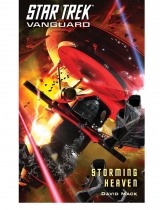
Текст книги "Storming Heaven"
Автор книги: David Mack
Жанр:
Научная фантастика
сообщить о нарушении
Текущая страница: 6 (всего у книги 21 страниц)
He had already pressed the tubolift’s call button when he noticed, at the periphery of his vision and through a brief gap in the river of pedestrians coursing past him, a lone figure standing at the towering wall of transparent aluminum in the observation lounge opposite. Looking more closely, he observed that it was a tall Vulcan woman, her jet hair pulled back in a loose ponytail that revealed the elegant upward curve of her ears. As if she sensed his attention from more than fifteen meters away, she turned her head slightly, enough for him to take in her striking, angular profile. Certain that it was T’Prynn, he slipped and dodged through the busy passageway and then crossed the empty lounge until he stood behind her shoulder.
She stared out the window into the docking bay, as if deep in thought. Several seconds later she acknowledged his presence. Her reflection looked at him. “Hello, Spock.” There was a placid quality to her manner that he did not recall from their last encounter.
“T’Prynn.”
With slow grace, she turned and faced him. “I read of your part in the capture of the Romulan cloaking device,” she said. “It would seem you took to heart my advice regarding the occasional tactical necessity of falsehood.”
He recalled their discussion about the ethics of a Starfleet officer—in particular, a Vulcan—employing lies in the line of duty, especially when doing so harmed others. They had left the matter unresolved when they last parted ways. Though her accusation was correct, in that he had misled a female Romulan starship commander so that Captain Kirk could steal the newest cloaking device prototype, he was not yet prepared to cede his entire argument. For the time being, he contented himself with a rhetorical evasion. “I did as I was ordered to do.”
“A convenient rationalization. One I know all too well.” She softened. “Forgive me. I meant no offense, and I doubt you’ve come in search of a debate. May I be of service?”
He lifted one eyebrow. “I had thought to ask you the same question.” Looking into her eyes, he could see that her once turbulent psyche had been calmed. “When last we spoke, you were a val’reth, beyond the help of the Seleyan Order.”
“Much has changed.” She averted her eyes and looked back out at the docking bay. “A few months after you left, while standing on this very spot, I suffered a psychological collapse. I nearly died.” There was no pathos in her voice, only cold truth. “I was made whole again on Vulcan, by a healer in my native village of Kren’than.”
The mention of the small, technology-free commune stoked Spock’s curiosity. “You lived among the L-langon mystics?”
“For a time. With my sister, T’Nel, when we were young.” Her gaze took on a faraway quality, as though she were peering through a needle’s eye into the distant past. “But after I slew Sten in the Kal-if-fee, maintaining my psionic defenses became too difficult in that place. So, I left Vulcan.” Shifting back into the present, she looked at Spock. “A shipmate of yours brought me to Healer Sobon. A Doctor M’Benga.”
Spock noted the coincidence with curiosity. “Then it would seem we are both in his debt. Doctor M’Benga was instrumental in saving my life on two occasions.”
“Most fortuitous.”
Shifting to an at-ease stance, Spock said, “I presume that Healer Sobon was successful in removing Sten’s katra from your mind?”
A subtle tilt of her head signaled agreement. “He was. The process was difficult and not without risk, but my liberation was more than worth the cost of those hardships.”
“Most agreeable news. . . . Yet your mind remains troubled.” It was only a guess on Spock’s part, but one he’d made with confidence. For all her affectations of serenity, he divined shades of melancholy in her fleeting microexpressions and the subtle intonations of her voice.
An ephemeral flush of shame deepened the green tint of her exquisite features. She was unable, or perhaps simply unwilling, to meet Spock’s gaze as she answered him. “My freedom came at a price, one that I did not expect but in retrospect seems inevitable.” She turned her palms upward and looked at them. “After I awoke, I gave no thought to my art. It wasn’t until I came back here and sat down at the piano that I realized I no longer knew how to play.”
The implications of her statement were intriguing. “All your learned ability was gone?”
“No. I remember the notes, but when I play, the melodies no longer flow. There is no beauty in them. No truth.” She paused. “For most of my life, music was my refuge. My salvation. Now I’m forced to find sanctuary in the silence that follows. It’s a poor substitute.”
Spock thought for a moment. “Have you spoken of this to anyone else?” T’Prynn shook her head. Might this be an opportunity to be of service? “I, too, am a musician. Perhaps, if we were to try playing music together, I might help you find that which you have lost.”
She studied him with a frank curiosity. “You would do this for me? Even though we’re little more than passing acquaintances?”
“You are in need, and I may be able to help you. It seems the logical course of action.”
For the briefest moment, her emotional control seemed to waver, as if a bittersweet smile desperately yearned to be seen on her face. Then her composure returned, and she restrained her reaction to a polite bow of her head. “Most generous of you, Spock. I would be honored to accept your help, and to share in your music.”
Though he would have been hard-pressed to explain why, Spock found T’Prynn’s quiet gratitude most agreeable, indeed.
Packing it in. Doctor Ezekiel Fisher, M.D.—Zeke, to his friends—figured he must have used that phrase hundreds of times over the years, but it had never seemed so apt a description as it did now, as he prepared to vacate his office at Vanguard Hospital. He resisted the urge to indulge in nostalgia over each knickknack and personal effect as he stuffed them all into boxes. Some items, such as his assorted family holographs, he had removed to his quarters a few at a time, in anticipation of filing his resignation. Others, such as the various gag gifts his friends or subordinates had given him over the years, he had waited until today to box up.
A familiar, squarish head topped with gray hair and fronted by an ashen mustache leaned in around the corner of the office’s open doorway. “Excuse me, Zeke,” said Doctor Robles, “I don’t mean to rush you, but—”
“Yes, you do,” Fisher said. He flashed a teasing grin he’d spent a lifetime perfecting. “Hold your horses, Gonzalo. I’ll be out of your hair soon enough.”
Robles scratched absently at his snowy temple. “That’s what you said three days ago.”
“I have a lot of things.” Sensing that the new CMO was about to reach the limits of his patience with the already unconscionable delay in claiming his new office, Fisher held up a hand to forestall any argument. “No more jokes. I’ll just be a few more minutes, I promise.”
Making a V of his index and middle fingers, Robles pointed first at his eyes, then at Fisher, miming the message, I’m keeping an eye on you. Then the fiftyish man slipped away, back to the frantic hustle and deadly drudgery of running Vanguard Hospital on an average day.
Fisher tucked a jawless, cast-resin skull that he had used for close to thirty years as a candy dish into his lightweight carbon-fiber box of bric-a-brac. For a moment he considered leaving “Yorick” as an office-warming gift for Robles, but then he decided that inheriting the prime piece of Vanguard Hospital real estate would be reward enough for the soft-spoken internist. Besides, without it, where would Fisher keep his mints?
As he excavated three years of detritus from the bottom drawer of his desk, he heard a knock at the open doorway. Laboring to push himself back up to a standing position, he grouched, “Dammit, Gonzalo, when I said ‘a few minutes,’ I didn’t think you’d take it so literally.” Then he turned and saw not his successor but his former protйgй, his professional prodigal son, looking back at him. “Well, I’ll be damned.”
Doctor Jabilo M’Benga smiled, adding warmth to his kind face. “I hear I almost missed you.” He stepped inside the office, and Fisher met him halfway. They embraced like brothers, and then Fisher clasped the younger man’s broad shoulders. “Look at you. I hate to admit it, but starship duty agrees with you.”
“You don’t know the half of it,” M’Benga said as they parted. He strolled in slow steps around the nearly empty office. “Hard to imagine this place without you in it.”
Fisher shrugged. “Not that hard. I’ve been doing it for months, and it gets easier all the time.” He continued wedging the last of his private effects into the box. “Sometimes you see the storm coming and you just know it’s time to get out. Know what I mean?”
“I suppose.” M’Benga tucked his hands into the pockets of his blue lab coat. “Though I have to wonder: After more than fifty years in Starfleet, do you think you’re still fit for civilian life? I can’t help but picture you getting home and going stir crazy in about a week.”
That made Fisher chortle. “Oh, I don’t think so. Let me find a seat by a baseball diamond, or a soccer pitch, or a tennis court, and I’ll be right as rain. You’ll see.”
M’Benga mirrored Fisher’s smile. “So. No regrets?”
“Honestly? Only one.” Fisher closed the box. The lid locked with a soft magnetic click. “I’d always hoped you’d be the one to succeed me in this office.” He hefted the box with a grunt, set it atop two others that he’d already sealed for the quartermaster’s office to deliver to him later, then clapped his hands clean and stood beside M’Benga. “But I can see now that you’d never have been happy here. Not really. And I’m glad you found your calling on the Enterprise.”
“So am I. But I’m glad I got the chance to work here with you first.”
“Come with me,” Fisher said. “I want to tell you something.” Moving with the slow, steady gait of a man blessed with good health but burdened by old age, he led M’Benga out of the office and down a corridor through the administrative level of Vanguard Hospital. The younger man walked at his side, close enough for them to converse in the hushed tones considered appropriate in a medical setting. “Be glad for all the places you get to be, and everyone you meet along the way. It’s human nature to focus on beginnings or endings, and that’s why we often lose sight of where we are and what we’re doing, in the moment. But the present moment—the ever-present now—is all we ever really have. Our past is already lost, gone forever. Our future might never come. And as you get older and time feels like it’s speeding up, you even start to feel the now slipping away. And that’s when you realize just how quickly things can end—when you’re busy thinking about what was or what’ll never be.”
M’Benga aimed an amused but admiring sidelong look at Fisher. “All right, Doctor. Let’s put your philosophy to work. What’s your prescription for this moment of now?”
“I thought you’d never ask.” Fisher draped his arm across M’Benga’s shoulders. “How would you like to watch a few dozen Tellarites try to reinvent the sport of rugby out on Fontana Meadow?”
“That depends. Will there be beer?”
“Of course,” Fisher said, as if M’Benga were a Philistine just for asking. “Just because we’re hundreds of light-years from civilization, that doesn’t mean we live like savages.”
The younger man laughed. “Okay, count me in.”
They reached the turbolift, Fisher pushed the call button, and they waited for a lift to arrive. “Let me test your memory, Doctor. What’s the first and only rule of rugby?”
M’Benga put on a thoughtful intensity, and Fisher imagined it was because the young physician was recalling one of the many afternoons they’d spent watching sports together on the meadow years earlier. Then M’Benga smiled and looked at him. “No autopsy, no foul.”
“Good man,” Fisher said, patting him on the back. “First round’s on me.”
PART 2
A MUSE OF FIRE
11
A pale dot on the Sagittarius’s main viewscreen, Eremar looked like nothing special to Captain Nassir’s naked eye. Bereft of planets, it was a dim and tiny ember, a lonely spark in the barren emptiness of the cosmos. The Sagittarius was half a billion kilometers from the pulsar, which, without the benefit of a false-spectrum sensor overlay, looked to Nassir like any other star. He knew better, of course. Incredibly dense, it was a neutron star rotating at a phenomenal rate, and its intense electromagnetic field emitted invisible bursts of extremely powerful and potentially dangerous radiation from its magnetic poles at regular intervals of 1.438 seconds.
Commander Terrell stood beside Nassir’s chair, arms folded, looming over the captain, who hunched forward and did his best imitation of Rodin’s iconic sculpture, The Thinker. Around them the bridge officers worked quietly, each one keeping a close watch for any sign of danger. At the helm, zh’Firro guided the Sagittarius into a standard orbital approach and recon pattern. Sorak monitored the communications panel, Dastin fidgeted nervously as he leaned against the weapons console, and Theriault had her face pressed to the hood over the primary sensor display. The ship hummed along, the deck under Nassir’s feet alive with a steady vibration from the impulse engines pushed to full output.
Nassir had no idea what he and his crew were supposed to be looking for. The pulsar had no planets. Were they seeking a derelict spacecraft? An abandoned space station? What if the Orions had simply used this isolated, hazardous place as a rendezvous point? He pushed that last pessimistic speculation from his mind. The Omari-Ekon’s navigational logs had not indicated any contact with other vessels in proximity to Eremar. They had, however, indicated a number of peculiar maneuvers, and unless a more promising lead presented itself soon, Nassir’s orders were to copy the Orions’ flight path and see where it led.
Theriault dispelled the leaden hush with a brief exclamation of surprise and elation, transforming herself into the focus of attention on the bridge. She looked up from the sensor hood, her youthful face bright with excitement. “I found something! Something really weird!” Before either Nassir or Terrell had the chance to ask her to elaborate, she punched commands into her console and routed her findings to the main screen. A computer model of Eremar was superimposed over the image of the star, and several seemingly random points in close orbit of the pulsar were highlighted. “There’s a network of artificial objects around the pulsar, including one directly in the path of its emission axis.”
Everyone fixed intense stares on the viewscreen, and Nassir rose from his chair. “What in the name of Kasor is that?”
Trembling with barely contained glee, Theriault said, “I have a hypothesis.”
Terrell shot a curious stare her way. “Let’s hear it.”
“I think these objects used to be part of a Dyson bubble,” Theriault said. “They’re all composed of ultralight carbon compounds the sensors don’t recognize.” More commands tapped into the science console conjured a web of arcing lines connecting the far-flung dots to the one at the top. “Based on their positions, I think there used to be a lot more of them, hundreds of thousands, all around this pulsar. Now there are maybe a few hundred left.”
Sorak arched one gray brow. “Most remarkable.”
Getting up from the tactical panel, Dastin asked, “What do those lines represent?”
“Subspace distortions,” Theriault replied. “Tiny tunnels through space-time.”
Nassir began to imagine what this construct must have looked like when it was whole. “Could those subspace tunnels have been transmission conduits for energy and data?”
The perky science officer nodded. “Absolutely.”
Zh’Firro leaned forward until she’d practically draped herself over the helm. “Are they orbiting the pulsar?”
“No,” Theriault said. “They’re statites, not satellites.” She thumbed a switch on her panel and enlarged the sensor image of one of the nearest objects. It resembled a massive disk surrounded by enormous, diaphanous fins. “They maintain their positions by using light sails and radiation pressure to counteract the pulsar’s gravity.”
Terrell’s brow wrinkled with confusion. “But what about the one that lies on the pulsar’s emission axis? How does it hold its position when it gets zapped?”
Theriault shrugged. “No idea.”
“I think we’re about to find out,” zh’Firro said. She looked back at Nassir. “If we follow the Omari-Ekon’s flight plan, we’ll have to make a roughly half-second warp jump into that statite’s shadow. It’s the only way to get there without being fried by a blast from the pulsar.”
Shrinking back into his seat, Dastin muttered, “I don’t like the sound of that.”
“Neither do I,” Nassir said, “but she’s right. If that’s the end point of the Orions’ trip to Eremar, there’s a good chance that’s where they found the artifact.”
That news didn’t seem to sit well with Terrell. “Is it safe for us to go there?”
Theriault’s sunny disposition gave way to trepidation. “Mostly.”
Sorak stepped forward, toward Nassir and Terrell. “To elaborate on Lieutenant Theriault’s response, the statite would shield us from the majority of the pulsar’s immediately damaging emissions—but not all of them. Even in its shadow, we’d still be subjected to dangerous levels of cosmic radiation and electromagnetic effects. Inside the ship, with shields raised, we would have little to worry about. But anyone venturing outside would need to limit their exposure to no more than four hours at a time. They would also require antiradiation therapy upon their return to the ship.”
Dastin shot a dubious look at the Vulcan. “Isn’t that a decision for the doctor?”
“I am a medical doctor,” Sorak said.
Terrell quipped to the new tactical officer, “He also holds doctorates in archaeology and xenobotany. So, if you get the urge to debate him about fossils or flowers . . . don’t.” The gentle rebuke was enough to persuade Dastin to turn his attention back to his own console. Turning back, Terrell asked Sorak, “How long will it take to prep a landing party?”
“Twenty minutes,” Sorak said. “However, there is one further complication.”
Anticipating the Vulcan’s news, Nassir said, “No transporters.”
“Correct, sir.” To the others he explained, “Despite the protection offered by the statite, inside the pulsar’s emission axis the transporter will be inoperable. We’ll need to land the ship and deploy either on foot or in the rovers, depending upon the local gravity and terrain.”
Nassir returned to his chair and sat down, feeling as if a black hole had taken hold of his spirit. He recalled the hyperbolic slogan of a Starfleet recruitment poster he’d seen as a youth on Delta IV: “It’s not just a job, it’s an adventure.”
Isn’t that the truth.
“Sayna, plot a warp jump to the statite. Clark, take Sorak, Theriault, and Ilucci, and suit up down in the cargo hold. We’ll let you know when it’s safe to go ashore.” He thumbed open an intraship channel from his chair’s armrest. “Ensign Taryl, report to the bridge. Doctor Babitz, report to the cargo deck, and bring antiradiation hyposprays for the landing party.”
As Sorak, Theriault, and Terrell left the bridge, Nassir watched the pulsar loom large on the main viewscreen. He couldn’t see the relativistic jets of supercharged particles bursting out of it at regular intervals of less than two seconds, but he knew they were there—just as surely as he knew that even the most infinitesimal miscalculation by zh’Firro would see the Sagittarius reduced to ionized gas before any of them had time to realize they were dead.
He clutched his armrest a little tighter and put on his mask of calm.
It’s not just a job, he reminded himself, it’s an adventure.
The Sagittarius touched down with a rough bump, and Ilucci felt the impact rattle his bones.
Commander Terrell sealed the hatch to the main deck and the centenarian Lieutenant Sorak primed the depressurization sequence for the hold, both acting in preparation for the unsealing of the aft exterior hatch. Ilucci had never enjoyed stuffing his portly form inside an environmental suit, one of the least forgiving of all garments. As the landing party’s departure became imminent, the chief engineer tugged at his suit’s inseam, desperate to relieve its overly snug fit and give himself enough slack to walk with a normal stride. He wondered why the pressure gear always seemed cut for people with stick-figure bodies.
Overcome with what he believed was a reasonable degree of paranoia, he rechecked the settings on his suit: Oxygen level: check. Reserve power: check. Radiation barrier at full: check.
Everything was the same as it had been sixty seconds earlier.
He had almost succeeded in calming his frazzled nerves when the aft ramp began to fold down, away from the underside of the ship’s saucer, toward the ground below. As the sliver-thin crack between ramp and bulkhead widened, Ilucci took in the barren sprawl that awaited the landing party: a tenebrous, trackless waste on the dark side of a radiation-bathed disk blasted sterile by millions of years of bombardment by a pulsar.
Terrell led the landing party down the ramp and out into the forbidding darkness. Despite the small size and supposed low density of the statite, its gravity felt close to Terran normal.
Theriault jumped up and landed almost immediately, displacing the regolith beneath her booted feet. Over the shared helmet comm channel, Ilucci heard her say, “Artificial gravity?”
“That’d be my guess,” he said. “If it’s consistent, we might be able to use the rovers.”
Sorak stepped away from the team and moved a few strides beyond the sheltering overhang of the Sagittarius’ saucer. Ilucci, Theriault, and Terrell followed him. Standing in the open, Ilucci turned in a slow circle, observing his surroundings.
The graceful off-white form of the Sagittarius was veiled in shadow because its running lights were off. Over a hundred kilometers away in every direction, but still clearly visible thanks to the absence of an atmosphere to obscure the view with haze, the horizon curved upward by the slightest degree, making Ilucci hyperaware that they were on the shallowly concave side of the circular statite. Beneath that close horizon, he knew, light sails fanned around the statite’s edge, transforming the pulsar’s regular bursts of lethal energy into power and lift. Overhead, the stars burned with cold, steady fires, offering minimal illumination and no warmth.
He noticed that the others all were facing in the same direction. Turning himself toward the same bearing, he saw why.
An enormous structure stood several kilometers away, at the apparent center of the statite. It looked like a ruptured blister, a gigantic splashing droplet of molten black glass frozen in time. Its shapes and protrusions made it seem simultaneously biological and mechanical. The simple act of looking upon it, even from this distance, filled Ilucci with a cold dread. Everything about the construct made him want to retreat inside the ship; the last thing he wanted to do was move closer to it. Which made it very easy for him to predict what Terrell’s next order would be.
“Master Chief, let’s power up the rovers and head over to that structure, on the double.”
“Aye, sir,” Ilucci said, jogging back up the ramp and inside the ship’s cargo hold, in a hurry not to comply but to turn his back on the biomechanoid horror dominating the bleak nightscape. He took his time powering up one of the two terrestrial rovers, a pair of off-white, six-wheeled all-terrain vehicles optimized for moving personnel but powerful enough to haul cargo. Stenciled on the back panel of each rover was its nickname. “Roxy” was the faster of the two, but “Ziggy” had proved on many occasions to be more maneuverable, particularly at speed or in tight quarters. Roxy started up with no difficulty, and Ilucci hopped behind the controls and guided it in reverse down the ramp. A quick jerk of the wheel and a tap on the brakes, and he spun it to a halt beside the landing party, facing the alien structure. He hooked his gloved thumb over his shoulder at the empty seats. “Meter’s runnin’. Hop in.”
Terrell took the front passenger seat. Sorak sat behind Ilucci, and Theriault climbed into the seat behind Terrell’s. All four of them took a moment to secure their safety straps, and Ilucci gave the rover’s protective roll cage a firm tug to make certain it was secure. “And away we go.” Against his better judgment and natural instincts, he stepped on the accelerator and sped the landing party toward the obsidian nightmare ahead.
The drive across the statite’s surface was eerily silent. No one spoke; they all simply stared at their destination. The rover’s electric motor was quiet even in terrestrial settings, but in an airless environment such as this, it made no sound at all. No motor hum, and almost no appreciable vibration of acceleration. All that Ilucci heard during the drive to the structure was his own shallow breathing, hot and close inside his helmet. He watched the Sagittarius grow steadily more distant in the rover’s side-view mirror.
As they neared to within a hundred meters of the structure, its details became clear and all the more terrifying. It was almost obscenely black. A wall ten meters high ringed its base, and from it a dozen looming towers rose at thirty-degree intervals and curled inward toward its center, like the retracting legs of a burning insect. Every square centimeter of its exterior that Ilucci could see was either mirror-perfect, fissured with cracks, or ringed with tubes that made him think of veins. Small tendrils of violet energy crept up the ebon talon-towers, and when the creepers met at the apex, they coalesced into bolts of blue lightning that stabbed down into the heart of the machine. The design was strongly reminiscent of the Shedai-built Conduits that Operation Vanguard had uncovered throughout the Taurus Reach, but this was clearly the product of a different culture wielding a less organic technology than the Shedai’s.
Terrell nudged Ilucci and pointed to the right. His voice crackled softly over the helmet comm. “Circle its perimeter, Chief. Let’s find an entrance.”
“Copy that, sir.” Ilucci steered right, off their collision course, and followed the curve of the structure. Within a minute it became obvious that the stadium-sized facility was round and highly symmetrical in its design.
They were two-thirds of the way around the wall when Sorak pointed at a subtle variation in the shadows-on-darkness surface of the wall. “There. That looks like an opening.”
“All right,” Terrell said. “Chief, take us in. Sorak, set your phaser for heavy stun and stand by to scout the entrance.”
Ilucci drove the rover toward the wall and slowed to a gradual halt less than ten meters from the opening. Sorak freed himself from his safety harness, leapt from the rover, and dashed forward until he was beside the entrance. He peeked around the corner, then stole into the shadows with his phaser level and aimed straight ahead. Darkness swallowed him in seconds.
“Theriault,” said Terrell, “run a tricorder scan.”
The science officer fumbled with gloved hands to retrieve her tricorder from her suit’s thigh pocket, then she poked clumsily at its controls. A few moments later, she lowered it and shot a flustered look at Terrell. “No good, sir. Too much interference from the pulsar.”
The first officer balled his right hand into a fist. “Meaning we’ll have to go in there blind. I was afraid of that.”
Sorak returned to the doorway and signaled the rest of the team to follow him. Ilucci and the others unfastened their harnesses and clambered out of the rover. As they joined Sorak at the entrance, the Vulcan recon scout said to Terrell, “It appears to be deserted, but I think you and I should do a full search while Theriault and the Master Chief inspect the device.”
“All right.” Terrell motioned for Sorak to head inside. “Lead the way.”
They followed Sorak through a long, zigzagging trapezoidal corridor whose glistening surfaces were all ridged and scaled. It felt to Ilucci like passing through an organic orifice.
Marching into the belly of the beast.
They emerged from its far end inside the aphotic arena, which at first glance resembled a shallow crater of dark volcanic glass. Long tubes radiated from its center, like longitudinal markings on a map, guiding Ilucci’s eye immediately to the pit’s nadir. Forks of sapphire lightning zapped down from the overarching talon-towers, illuminating the spokes of a wheel-shaped onyx frame that held several thousand skull-sized, dodecahedronal crystals identical to the Mirdonyae Artifact secured inside Vanguard’s research lab. Unlike that captured prize, however, these crystals all were perfectly clear, rather than swirling with the eldritch energies of an imprisoned alien life force. Though Ilucci had no words to say why, the very sight of the alien contraption filled him with a sick sense of foreboding.
As Sorak and Terrell split up and began conducting a thorough search of the upper tiers of the stadium’s interior, Theriault shouldered past Ilucci and hurried down the slope of the pit, on a beeline for the crystal wheel. Seeing her rush headlong into peril made Ilucci’s gut twist, reminding him that he’d never really purged himself of his infatuation with the impulsive young Martian woman. Her energetic curiosity was a key ingredient of her charm, and as an officer she was expected to lead by bold example, but he worried about her more than he could ever say. All he could do was pick up his feet and run after her.
By the time he caught up to her, she was circling the thing, trying in vain to scan it with her tricorder. She cursed under her breath, but each profanity was perfectly audible over the comm channel. Ilucci cleared his throat, and she stopped abruptly. “Sorry,” she said. “But I can’t get much on this thing except straight-up visual scans, and even those are coming out pretty rough from all the radiation.” She pointed at the wheel’s hub, a thick trunk of onyxlike stone that appeared to be fused to the ground. “It looks pretty well anchored. I can’t imagine how we’ll ever get this thing out of here. Or fit it into the ship, for that matter.”