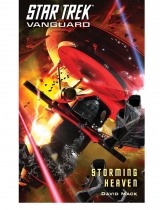
Текст книги "Storming Heaven"
Автор книги: David Mack
Жанр:
Научная фантастика
сообщить о нарушении
Текущая страница: 17 (всего у книги 21 страниц)
Gorkon terminated the transmission, and the screen briefly switched to the red-and-black Klingon trefoil emblem before it faded to black. Jetanien turned to Lugok. “Thank you.”
“For what? You’ve gained nothing.”
“Far from it,” Jetanien said. “True, my generosity has yielded no immediate boon, and for that I am disappointed—but I am not disheartened, because your Councillor Gorkon has, at least, offered me something else in exchange.” He noted Lugok’s dubious stare and added, “Hope for the future. I have heard few people speak as passionately for peace as does your lord.”
“Let us drink, then, old friend.” Lugok walked to his liquor cabinet, opened it, and pulled out a bottle of warnog. He filled two steins and carried them back to Jetanien. Handing one of the metal mugs to the Chelon, he raised his own, and Jetanien joined him in clinking the steins together in a toast. “To peace: May we find it somewhere other than the grave.”
Gorkon descended the granite spiral staircase at the front of his manor, taking a moment as he neared the bottom to straighten his steel-studded red leather jerkin on his lean frame. He stepped off into the main foyer and looked around until he saw Captain Chang loitering in the entryway to the main dining room, admiring the mounted heads of game Gorkon had felled on various worlds throughout the Empire. “Welcome, Captain! Make yourself at home!”
The captain turned and smiled at Gorkon’s approach. “I’m honored to be your guest, my lord. I hope you don’t mind that I came early. Your servant let me in.”
“I’d have met you myself, but I was quelling Azetbur’s latest tantrum,” Gorkon said. “I’ve seen Targhee moonbeasts that were easier to calm. She’s become quite the spitfire of late.”
Chang grinned. “Teenagers. It happens to all of them when they reach that age. Or so my brothers tell me.” They clasped each other’s forearms in a fraternal greeting. “Wait until you taste the bloodwine I brought. It’s a rare Kriosian bottling from an exceptional vintage.”
Gorkon released Chang’s arm and clasped his shoulder. “Will it go with gagh?”
“I’m sure it will.”
“Then we’re both in for a treat,” Gorkon said, leading his loyal thane down a lavishly appointed hallway toward his private library. “My chef is preparing the most succulent gagh in the Empire. This will be a meal worthy of heroes.” As they drifted past marble busts of warriors of renown and famed Heroes of the Empire, he added, “I have other good news, as well.”
A sly look from Chang. “As do I. But I won’t presume to speak out of turn.”
Acknowledging the captain’s deference, Gorkon said, “I’ve interceded on your behalf with Chancellor Sturka and General Korok at the High Command. Your name has been placed on the short list for promotion to colonel. I expect it will become official within the year.” He landed a congratulatory slap on Chang’s back. “We’ll make you a general in no time.”
Chang stopped and turned to face Gorkon, who mirrored him. “You honor me, my lord. I pledge that my service shall bring glory to your name.”
“Of that, I have no doubt,” Gorkon said, ushering the captain to follow him inside his library. On the left side of the room as they entered, a long table built from thick, heavy pieces of Ty’Gokor redwood was strewn with loose papers, open tomes, and hand-annotated star maps. “Now, tell me, Captain: What news do you bring me?”
The captain was ecstatic. “The Gonmog Sector will soon be rid of Starfleet’s bloated starbase. Even as we speak, a Tholian armada bears down upon it. In two days’ time, there’ll be nothing left of it but wreckage and memories.”
Gorkon said nothing and withheld all emotion from his face. News travels quickly, he realized. Chang’s attitude troubled him. Knowing he could not risk asking questions too pointed in their nature, he chose to feign ignorance of the Tholian attack on Vanguard. “What finally prodded the Tholians into action?”
“No one knows, and I for one don’t care. All that matters is that they’ve come loaded for siege, and it promises to be a glorious battle. If not for the risk of being caught unnecessarily in the crossfire, I’d love to be there so I could savor the carnage from my bridge.”
Staring out a window twice his height at the deepening purple twilight descending on the distant outline of the First City, Gorkon folded his hands behind his back. “I imagine the Battle of Vanguard will be quite a spectacle. It’s rather a shame my old nemesis Diego Reyes no longer commands the station. He would have made the Tholians pay dearly to win the day.”
“It would make no difference,” Chang said. “Either way, Starfleet and the bugs will pummel each other into blood and scrap, and then the Gonmog Sector will be wide open for us. If we move now, we could dominate that region in a matter of months.”
That drew a sidelong glance of dark amusement from Gorkon. “Don’t be so confident, Captain. That station might be the Federation’s most visible symbol of power in the sector, but it’s not their only resource.” Dark premonitions crowded his thoughts as he gazed back into the night. “Far from breaking their will, losing Vanguard might actually galvanize Starfleet’s commitment to exploring and colonizing the region.”
“I think you might be overestimating them, my lord.”
“I assure you, I’m not.” He turned and paced away from the window. “The Federation is an unpredictable opponent, Captain. It comprises dozens of species on scores of worlds. That gives it complexity and leads to strange interactions. What breaks one of its members emboldens others.” He stopped and took his House’s centuries-old ceremonial bat’leth off the wall. “To understand the Federation, one must think like a swordsmith. Pure metals can have great luster and value—but if you want a supple blade of fearsome strength that’s light enough to strike quickly, you need an alloy.”
Chang eyed the honor blade in Gorkon’s hand and smirked. “If the Federation is a bat’leth, my lord, then I’m glad our Defense Force is a disruptor: modern, unseen until its moment arrives, and able to deal out death and fire without warning.”
Gorkon laughed and slapped Chang’s shoulder. “Well played, Captain! Qapla’!” He let Chang take a self-mocking bow as he returned his bat’leth to its place on the wall above his mantle. Then he motioned toward the open doorway. “But enough talk of the Federation’s woes. A feast awaits us, and we’d best not keep my new wife waiting.”
“Wise counsel, my lord. Lead on.”
They walked together down the hall, back to the dining room, where the kitchen staff was setting out the first course of their meal—fresh pipius claws and flagons of warnog. Gorkon’s wife, Illizar, met them as they entered. “You’re late.”
“Nonsense,” Gorkon said. “We’re right on time.” His wife shot him a challenging stare, which he weathered in good humor before taking his seat at the head of the table. Illizar took the chair opposite his, and Chang sat halfway between them on one of the table’s long sides, facing the broad picture window that looked out on a vista of dizzying sea cliffs and crashing waves.
As Gorkon hoped, Illizar asked Chang to tell tales of his greatest victories and narrowest escapes, and the Captain provided the evening’s entertainment by obliging the lady of the manor. But as Gorkon listened to Chang spin one yarn after another of vengeance, cunning, and cold-blooded violence, he wondered if such a man was really the ally he needed for the long work that lay ahead. He harbored no doubts of Chang’s loyalty, but unlike Lugok, Chang struck Gorkon as one who might never accept the idea of rapprochement with the Federation. Despite his youth, the man had already amassed a lifetime’s worth of hatred for the Empire’s greatest rival in local space; such animosity, in Gorkon’s experience, was never surrendered easily or without great reservation.
Well, it’s not as if I need to make a diplomat of him overnight, Gorkon reasoned. He expected his political agenda would take decades to bring to fruition. Perhaps, given that much time, I can sway his thinking. Mitigate his bloodlust. Persuade him of my vision for the future.
Gorkon kept telling himself that, while Chang guzzled one goblet after another of bloodwine and filled the dining room with gales of malicious laughter.
31
Every passageway on the Endeavour was crowded with mechanics making last-second repairs through open panels in the bulkheads, ordnance crews moving antigrav pallets stacked high with photon torpedoes, and noncombatant personnel from the station who had been packed like sardines into the ship’s guest quarters and cargo bays.
Bersh glov Mog shouldered through the chaos, moving from one urgent repair to the next, checking his crew’s work and making sure no important corners had been cut. They had spent the past four days shaving minutes off each bit of overdue damage control, sacrificing perfection in the name of having the ship ready for combat before the Tholian armada arrived. The Tellarite chief engineer didn’t know what troubled him more at that moment: the need to tolerate substandard workmanship aboard his beloved starship, or the knowledge that in a few hours there was a high probability it would all be destroyed in a Tholian crossfire.
His snout wrinkled at the stench of melting duotronic cables, and he spun toward its source to see smoldering globs dripping from an open panel in the overhead. “Faran!” He cornered the enlisted engineer’s mate who was ducking away from the molten circuit junction. “You can’t use plasma cutters near the relays! I’ve told you a hundred times!”
“Sorry, sir,” said the frazzled Efrosian, whose drooping blond handlebar mustache and swooping golden eyebrows were sullied with grime, just like his pale hands and his red shirt.
Mog grabbed an extinguisher from an emergency locker, aimed it, and snuffed the fire before it spread past the slagged junction. Then he tossed the extinguisher to Faran, plucked his communicator from his belt, and flipped open its antenna grille. “Mog to—” He stepped barely clear of a pair of gunner’s mates rushing by with another pallet of torpedoes, then tried again. “Mog to Stegbauer. We need a new circuit relay on Deck Five, Section Three.”
“Copy that,” replied the lieutenant, who had distinguished himself by doing outstanding work under tremendous pressure in the past few days. “I’ll have it back on line in thirty minutes.”
“Good man. Shield status?”
“All back to full except aft port ventral. T’Vel and Burnett are working on it.”
Mog nodded to himself. “All right. Impulse systems?”
“Up to ninety percent.”
Not perfect, Mog figured, but good enough for now. “Phasers?”
“Still not getting the power we should. We need to swap out the main coupling.”
The mere suggestion raised the fur on the nape of Mog’s neck. “Absolutely not! We’ll never put it back together in time!”
Stegbauer didn’t sound any happier about it than Mog felt. “In that case, the best we can hope for is seventy-five percent efficiency on forward phasers.”
That was not going to be remotely good enough. Mog walked to a nearby wall companel and checked the chrono. It read 1324. “What’s the Tholians’ ETA?”
“Last update from Vanguard says four hours, nine minutes.”
The chief engineer’s thoughts filled with unspeakably vile Tellarite profanities. “All right, swap out the main coupling. Pull anybody you need to get it done before 1700.”
“Acknowledged. Engineering out.” The channel closed with a soft click.
Mog moved on and continued his inspections—hoping as he went that he hadn’t just signed Endeavour’s death warrant.
“People, please! Form lines!” Chief Petty Officer Ivan Vumelko was a fireplug of a man, squat and solid, with bulging eyes and meaty hands. In his decades of Starfleet service, he had never been easy to push around. Now, however, with only hours until the expected arrival of the Tholian armada, the paunchy customs inspector felt like a boulder being swept away by a tsunami of panic. “Everyone, proceed to your transports in an orderly—”
Something collided with his protruding gut and knocked the breath out of him. He kept trying to force words out, but all he produced were empty gasps. Civilians and noncombatant Star-fleet personnel surged around him, and the flood-crush of the crowd carried him away toward the three small ships parked behind him in the docking bay. Stumbling and fumbling, he weaved through the headlong mass of running bodies until he was clear of it.
Vumelko watched as desperate people scrambled up the gangways of the recently arrived civilian ships, their arms laden and backs burdened with the few personal possessions they had chosen to salvage, only to reach the top and be forced to abandon their duffels and bags in exchange for passage. Every cubic meter of space on these ships had become precious, and only living beings and the bare necessities to sustain them were being taken aboard. A steady rain of luggage tumbled to the deck, each impact reverberating in the cavernous space.
Standing apart as a witness to the madness, Vumelko knew that he was supposed to be heading for one of those transports. Technically, he was considered a noncombatant and had been put on the list for mandatory evacuation aboard the passenger ship Kenitra.
He slipped out of the docking bay and sprinted for the turbolift, determined to put his early training as a gunner’s mate on the starship Tamerlane to good use in a few hours’ time.
Evacuate, my ass, he stewed. If it’s a fight the Tholians want, I’ll give ’em one.
Vanguard’s security center was a bedlam of shouting voices and constant alarms. Standing in the center of the chaos, Haniff Jackson felt as if every crisis he resolved spawned two more.
“Tahir, we’ve got a riot brewing in Docking Bay Sixty-one! Get a squad down there!” Another monitor on the wall to his right flashed a warning. “Holmgren, we’ve got a GTS in progress! Lower Pylon, Slip Two. Lock down the docking clamps and tell Seklir to get over there, RFN!” He had taken to using the acronym GTS for the offense of grand theft starship because the increasing frequency of the crime over the past two days on Vanguard had rendered usage of the formal term burdensome.
More alarms sounded to his left, and he saw several of his deputies were responding to reports of looting in Stars Landing. He shook his head in disgust. There’s nowhere to go, nowhere to fence the goods, and no way off the station with anything more than the clothes on their backs. So what the hell are those idiots thinking?
The dim ambience of computer screens in the darkness was momentarily washed out by a spill of harsh white light from the corridor as the door opened behind Jackson. He turned to see Ming Xiong enter, and he waved the scientist over to his station in the middle of the U-shaped ring of duty stations. Xiong rushed to his side and sounded winded, as if he had run all the way up from the Vault. “What’s up? You said it was urgent.”
“I had an idea,” Jackson said, calling up tactical plans on his master control screen. “Scuttlebutt on the command deck is that you guys wasted a planet with that gizmo of yours.”
Xiong backed up half a step. “I can’t discuss that.”
“Yeah, yeah, it’s classified, I get it. Forget that for a second.” He showed Xiong a simulation of the Tholians’ likely attack plan. “If we could direct just a fraction of the power from your setup to a handful of key points, we could break their momentum before they—”
“It won’t work,” Xiong said. “Bringing the array to full power is a risk under the best of circumstances. And the truth is, we just don’t have the kind of precision control we’d need to use the array as a close-range tactical system. If we tried to do something like this, we’d probably blow ourselves up in the process.”
Jackson held up one hand while he loaded another simulation. “Okay, I thought you might say that. So, look at this. What if you target their fleet right now, while they’re still on approach in tight formation? Just hit an area of effect and—”
“The timing on the effect isn’t precise to within more than twenty seconds. We could barely target a planet in a slow orbit. No way we can hit a fleet moving at warp speed.” He added with a measure of sympathy, “Got a Plan C?”
“Yeah,” Jackson said. “Run like hell.”
Outside the walls of Manуn’s cabaret, the residents of Stars Landing were falling victim to the station’s spreading contagion of hysteria. Inside the cabaret, Manуn packed a few prized possessions into a compact carryall: a rare bottle of Brunello di Montalcino from Earth, an even rarer bottle of Silgov vasha, and a smattering of tiny knickknacks she had carried with her years earlier, on the fateful night when she’d fled her homeworld on the eve of its invasion.
Her wanderlust had fired her imagination long before her exodus, but the threat of the Vekhal’s arrival in force on Silgos Prime had spurred her into flight. She had forsaken home and noble title for freedom; heritage and the companionship of her own kind for survival. At the time it had seemed an easy bargain. Only after years as an exile did she understand the true cost of her salvation: all her fleeting moments of joy had since been tempered by the bitter loneliness of never again seeing one of her own kind.
She had done her best to fill her days and nights with companions. Ironically, in her opinion, she felt most at home when surrounded by as diverse a population as possible, and nowhere had she encountered a polyglot society on a par with the Federation. Among all the civilizations she had encountered across a span of nearly three thousand light-years, the United Federation of Planets was unique.
Perhaps I would have been happier had I stayed safely within its borders, she speculated. In hindsight, she realized, it was only her emotional need to keep moving, to remain figuratively one step ahead of her memories of the Vekhal, that had driven her to leave her safe haven on Bolarus to open a business aboard a starbase in the perilous no-man’s-land of unclaimed space.
In a very short time she had come to think of this place as home, and of its denizens as her friends. Pausing in the doorway before running for her ship, the Niwlolau Leuad (which the Federation’s ever-obliging universal translator had rendered accurately as “Moonlit Mist”), she lamented that she would never again hear T’Prynn play her baby grand piano, or be regaled by one of Quartermaster Sozlok’s ribald tales of misspent youth, or enjoy the succulent delights that her kitchen staff improvised each night, based on whatever fresh ingredients had come in aboard the latest cargo ships. There were few things Manуn had ever been part of that had meant so much to her as this place, and it filled her with sorrow to bid it farewell.
Everything ends, she reminded herself. But for now, I must go on.
With a light step and a heavy heart, she ran for her ship.
“Get your drink and get out!” Tom Walker stepped briskly down the length of his bar, filling one outstretched shot glass after another in a single, unceasing pour. “One and done! Keep it moving!” He reached the end of the bar and turned back to fill another line of empty glasses being pushed forward. “You’ve all heard of last call! This is the very last call! It’s closing time, people! One free shot per customer! Belly up and drink up!”
Twenty-five-year-old Macallan single malt Scotch whisky flowed in an unbroken stream, splashing over hands as much as into glasses, and as the patrons were served, they stepped back from the bar, downed their measures of liquid courage, and bolted for the door. There were civilians and Starfleet personnel all bunched together, everyone looking to take the edge off one last time before everything went to hell. At the other end of the bar, Tom’s night bartender, Maggie, was doing the same thing he was: bolstering morale one ounce of booze at a time. Whereas he was pouring top-shelf scotch, she had opened up the Gran Patrуn Platinum tequila. Tom knew he couldn’t take any of this with him, and it seemed like a sin to leave it behind when so many people on this station were so desperately in need of stiff drinks.
“Drink faster, folks!” Tom shouted. “We gotta go! I didn’t survive cancer just so I could die in space!” The bottle of Macallan 25 ran dry, so he reached for the Macallan 30—the last bottle on the shelf. He pulled off the pour spout, and resumed his free-for-all last call. Less than a minute later, its last drops fell into a waiting glass, and he hurled away the empty bottle. “Party’s over, folks! You don’t have to go home, but you’d better not stay here!” He nodded at Maggie, and she grabbed her shoulder bag from under the bar. Tom picked up his half-filled duffel, and together they slipped out the back door and high-tailed it across Stars Landing on their way to his private ship, the Friday’s Child. He didn’t know where the two of them would end up, but he didn’t really care—as long as they got the hell away from Vanguard and lived to tell about it.
Tim Pennington had searched every watering hole in Stars Landing, looked behind the bar at Manуn’s cabaret, and even checked the seemingly never-used officers’ club on Level Six, but Cervantes Quinn was nowhere to be found. He couldn’t believe that Quinn could have soused himself so utterly that he would have slept through the last three days of evacuation madness aboard Vanguard, but he had run out of ideas for where to look for his friend, so he returned to the first place he’d checked, vowing to start the search over, if that’s what it took.
He forced open the door of Quinn’s residence in Stars Landing. It was easy, since the portal had remained ajar since the first time he’d broken into Quinn’s flat. The barely furnished little bedsit was still empty. The door to the lavatory was open, as was the shower curtain.
“Quinn!” he shouted, thinking he might conjure the old pilot from thin air. “Bloody hell, mate! Where are you? It’s time to go, man!” On a hunch he checked the closet, thinking Quinn might have sought refuge there in a moment of drunken logic, but he found nothing except one of Quinn’s shirts crumpled on the floor. He turned in a circle, one way and then the other, his eyes scanning the room for clues, but all he gained was a bout of vertigo.
Then he turned toward the door, planning to head back to Tom Walker’s place, and found his path blocked by T’Prynn. “If you are searching for Mister Quinn, he has already gone.”
“Gone where? When’s he coming back? We have to get out of here!”
She stepped forward and gently took him by his forearm. “He will not be coming back, Tim. He has already left the station.” She led him toward the door. “It’s time for you to leave, while you still can.”
He pulled his arm free. “You’re sure? That he’s safely away?”
“I give you my word: Mister Quinn is well away from here. Now please go.”
“I’m going,” he lied, jogging away from her. He would make it to his transport; he had enough common sense and desire for survival not to screw that up. But before he left Vanguard, there was one last farewell he needed to make.
Captain Nassir poked his head down through the ladderway to survey the cargo hold of the Sagittarius. It was packed from bow to stern and port to starboard with Starfleet personnel from the station who had piled aboard minutes earlier in search of a ride out of harm’s way.
Noting the density of their accommodations, Nassir asked, “Everybody tucked in?” There were general murmurs of assent and agreement. Nassir figured this was as good a time as any to break the bad news to his unauthorized passengers. “I think it’s only fair to warn you all that this won’t be a smooth ride home, folks. This ship’s been ordered to help Endeavour hold the line, which means we’ll be taking fire. Conditions down here can get ugly real fast, so if you have second thoughts about choosing my boat as your ride, you’ve got thirty minutes to bail out.”
He left them to think that over while he climbed the ladder up to his ship’s truncated engineering deck and transporter bay. Ilucci and his engineering team were all engaged to one degree or another on repairs to various components of the scout ship’s warp core. Nassir caught Ilucci’s eye and asked, “What’s the word, Master Chief?”
“Five minutes away from being five by five, Skipper.”
“Well done. When you finish, go help the Endeavour team. They yanked out their main phaser coupling, and they’re running late getting a new one put in.”
“Two miracles before dinner?” The portly chief engineer traded amused looks with his run-ragged crew of enlisted mechanics, then cracked a reassuring smile. “Good as done, boss.”
The captain pivoted about-face toward the ship’s sensor probe launcher—technically a misnomer, since it was equally capable of launching photon torpedoes. Because of the ship’s limited storage space and the difficulty of moving bulky elements from the cargo deck to the engineering deck, it usually carried only probes and no torpedoes. The rationale for that decision was that the Sagittarius was not designed for heavy combat. Any threat serious enough to merit a photon torpedo was likely one the Archer-class scout ship ought be outrunning.
That afternoon, its entire complement of six sensor probes had been replaced by torpedoes. Junior recon scout Ensign Taryl inspected the new ordnance with her tricorder.
“Do our fish check out, Ensign?”
The Orion woman turned a confused look toward Nassir. “Fish, sir?”
“An old Terran nautical term for torpedoes. I picked it up at the Academy.” Waving off the mismatch in their jargon, he inquired, “Are they ready to go?”
Taryl checked her tricorder one more time, then switched it off. “Ready, sir.”
“Good. Load one into the tube now. When Vanguard gives the order, I want to be ready to come out swinging.”
Ezekiel Fisher haunted the open doorway of his no longer private cabin aboard the Lisbon. He had expected to share his accommodations from the moment the evacuation order was sounded, and he had been right: his VIP cabin for one had become a steerage berthing for six. The once antiseptic-smelling compartment had become a sauna of bad breath and sweaty bodies pressed much too closely together.
The loss of comfort and privacy didn’t really bother him. He had also taken in stride the news that his personal effects had been removed from the cargo hold and abandoned to make room for noncombatant Starfleet personnel who would be coming aboard at the last possible moment. Only monsters value things over lives, he told himself to lessen the sting of the news.
One enlisted crewman after another packed into every free space inside the Lisbon. Some of them claimed corners of the mess hall; others staked claims to slivers of space between hulking blocks of machinery. Other than that, there wasn’t much talking. Apparently, most of those running for their lives seemed to think there wasn’t much left to say.
The tense but muted atmosphere inside the transport was split by the squawk of Captain Boonmee’s voice over the ship’s PA system.
“Attention, all crew and passengers of the Lisbon, this is the captain. Admiral Nogura has just sent a priority comm to all ships still docked at the station. Vanguard is asking for trained medical personnel, preferably with trauma experience, to stay and tend the wounded if necessary. I’ve been asked to emphasize that this call for doctors, nurses, and technicians is strictly voluntary. FYI, we’ll be taking off in fifteen minutes. That’s all.”
Moments later, Fisher saw two people struggling against the tide in the corridor, blading and shouldering their way toward the exit. One of them he recognized from Vanguard Hospital—a Caitian nurse named Kiraar. The other was a human-looking male civilian of middling years whom Fisher didn’t recognize, but the man carried a telltale black medical bag.
Watching those two force their way upstream against the evacuation filled Fisher with guilt. For several painful seconds he wrestled his conscience, fighting the urge to run toward the crisis as he had for most of his adult life. I’ve given Starfleet more than fifty years, he rationalized. That should be enough, shouldn’t it? Part of him wanted to believe that, but the better angels of his nature reminded him of what he knew all too well. If I turn my back now on people in need of a doctor, the last five decades of my life will have meant nothing.
Fisher dodged past his cabinmates to his bunk, retrieved his medical satchel, and slung it over his shoulder. Then he pushed his way out into the corridor and began his own upstream battle back toward the station he thought he’d left behind.
“Dammit, Admiral, that’s a suicide order, and you know it! There’s no way I’m doing that!”
Nogura was not one to tolerate direct repudiation of his orders by a subordinate, much less in such a vociferous and disrespectful manner, and absolutely never in front of others—and Captain Telvane of the Starfleet cargo transport U.S.S. Panama had just committed all three offenses at once, on the supervisors’ deck in the middle of Vanguard’s operations center.
A sudden shocked hush fell like a curtain as every person in ops turned to see what would happen next. Nogura stepped out from behind the Hub and prowled toward Telvane. The burly, square-headed, lantern-jawed, sun-browned freighter captain towered over the admiral, and yet it was the larger man who seemed to lean ever so slightly away as Nogura confronted him. Rather than raise his voice to match Telvane’s outburst, Nogura made his reply cold and quiet.
“This is not open for discussion, Captain. Deploy your ship as ordered.”
Digging deep to dredge up the last of his courage, Telvane protested, “My ship doesn’t belong with a battle group, Admiral. We should be escorting the civilian convoy.”
Nogura roared, “Captain! Your ship has a Starfleet registry and a phaser bank! Get back to your bridge and take your ship into battle, or I’ll find someone who will!”
“What’re you going to do? Court-martial me?”