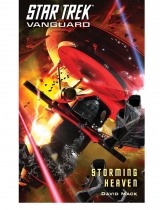
Текст книги "Storming Heaven"
Автор книги: David Mack
Жанр:
Научная фантастика
сообщить о нарушении
Текущая страница: 14 (всего у книги 21 страниц)
Klisiewicz made his final adjustments on his panel. “Resonant frequencies ready.”
Theriault added, “Nodes assigned. Containment protocols ready.”
A grave nod from Xiong. He wiped his sweaty palms down the front of his shirt, then thumbed open a secure comm to Nogura’s office in the operations center. “Admiral, the array is ready. We can initiate Operation Flytrap as soon as you give the word.”
“The word is given, Lieutenant. Good luck.”
“Thank you, sir. We’ll have a report for you shortly. Xiong out.” He closed the channel and took a deep breath. Theriault heard him mutter under his breath, “Now all we have to do is make ourselves an irresistible target to every Shedai in the galaxy. . . . What could go wrong?” Xiong blinked, cracked his knuckles, and set his hands on the master power controls. “Okay, everyone, it’s game time. Stand by to execute in . . . ten . . . nine . . . eight . . .”
Much to Theriault’s dismay, as she listened to Xiong continue the countdown to the activation of the array, she was able to think of a great many things that could go wrong.
Then Xiong said, “Three . . . two . . . one. . . . Execute!”
She and Klisiewicz flipped the final switches on their respective panels.
And the array started screaming.
The mind of the Progenitor stirred in the endless silence, a lone presence in the immeasurable darkness of thought without sensation, existence without form, time without end.
His accursed isolation, his exile into a limbo of his own consciousness, was disturbed by a shriek of primal force and a disorienting flurry of light and energy. It was inchoate, nothing but noise bereft of significance, a howling torrent of madness and desire.
Quickly, the chaos was marshaled into order and forced into shape. The Progenitor dared to indulge a fleeting instant of hope. Had the Wanderer returned to honor her pledge? Was freedom at hand? He imagined the unfettered joy of exacting his revenge upon the Telinaruul. . . .
Then came the agony.
Pain with no physical analog reduced the Progenitor’s universe to one of horrific psychic torment. It was as if his entire essence were being ripped asunder, his every thought rent to pieces, his very being torn in a million directions at once. Never had he known such grotesque suffering, not even when he’d been condemned to this private pit of despair.
All he could do was surrender to the brutal energies that assailed him and let their wild surges of power course through him and bear him away, one mote of consciousness at a time, wearing him down to nothing, as flowing water reduces a boulder to a pebble with the passing of ages. He wondered if this was, at last, his end—being condemned to vanish in a final tide of punishment, flayed to his last iota of existence by a torment beyond his ken to describe.
For the first time since his moment of self-inception, the Progenitor was afraid.
Cold and silent, the Wanderer hovered in space above her newly made Conduit. She reached out with her thoughts to perfect its final details and make it a flawless portal for the subtle form of liberated consciousness. Its link to the universe’s boundless reservoir of dark energy was complete, and already she felt the Conduit’s steady emanations of power and harmony.
Soon it would be time to summon the Shedai to take their vengeance. Before that hour of reckoning, however, she needed to move the Conduit closer to the space fortress. It would be an arduous process, and it would require great patience and stealth on her part not to alert them to her presence. Because the other Serrataal lacked her ability to traverse space by will alone, it would be up to her to place the Conduit in contact with the exterior of the Telinaruul’s fortress, penetrate its fragile metal skin, and then usher her kin inside. Then they would cleanse its interior of its vermin creators—a prelude for the galactic culling to come.
A wail of terror issued from the Conduit and struck the Wanderer with overwhelming force. Driven by fear and reflex, she made her essence cohere when all she wanted to do was flee. The excruciating shrillness of the signal abated, and then the Wanderer knew what it was that she heard: the Song of the Progenitor! Its message was simple, pure, and clear. He was calling out to her, imploring her to answer his summons, to hie unto him without delay.
This was not the plan, she told herself, even as she felt her essence succumb to the Progenitor’s will. His voice was like that of no other Shedai; it was uniquely hypnotic and utterly compelling. Its beguiling melody transited the Conduit and called the other Serrataal.
I have opened the way, the Progenitor said. Gather now and be with me at last.
The Wanderer felt a surge of elation as she let the Progenitor’s voice guide her subtle body of consciousness into the signal stream. Perhaps he has turned their weapon against them!
She surrendered to the flow of the Song, expecting at any moment to recorporealize inside the Telinaruul’s risibly vulnerable fortress. Only as she passed over the Conduit’s final threshold did she detect, in the most ephemeral sense, that something was amiss.
But by then it was too late to save herself—or to warn the others who would follow.
Waves of panic crashed through the Progenitor’s formless prison. Thousands of Serrataal voices cried out in bitter fury, We have been deceived!
In their flashes of memory he beheld a vision of a molten world where they had massed, and though he had not heard any voice in aeons except that of the Wanderer, he recognized them all, each one by its special timbre and quality: the Sage, the Adjudicator, the Warden, the Herald, and countless others. Still first among them all was the Maker, whose confusion, he realized, had arrived separate from the others. Many of the old voices seemed absent, though, and he soon became aware that the missing were the Apostate and those whom he had counted as partisans.
So, the great war within our ranks came at last, the Progenitor deduced. He reasoned that the Maker and her faithful had prevailed. Or had they? Ages earlier, the Tkon had fashioned this prison of the mind with the Apostate’s aid; might this be his great revenge delivered at last?
It did not matter, he decided. At last, he and his progeny were reunited. Together, they would break free of their bonds and renew their patient conquest of the galaxy.
He concentrated, and projected his thoughts through the lattice of united minds.
Be silent. Be still.
Where he had expected obeisance, he found an onslaught of fury and rebellion. Why did you lure us here? they shrieked. You betrayed us! You’ve led us into bondage!
He quelled their storm of protest with a command like a supernova.
BE SILENT. BE STILL.
Their bonfire of rage was extinguished. Reverent awe took its place.
The Wanderer’s voice pronounced to the darkness, This is He of Whom I Spoke.
Thousands of Serrataal sought the guidance of the Maker. She opened her thoughts to the Progenitor, and he reciprocated, while the universe without form that surrounded them echoed with the voices of their scions, the elite of those born to rule creation.
Hundreds of voices wondered in unison, Can it really be He? Others insisted, This cannot be. He was only ever a myth, a tale of our forgotten past. Doubt rippled through the ranks of the Serrataal, tainting their enforced Colloquium.
Silence reigned as the Maker and the Progenitor ended their communion.
It is He, she declared.
All their minds opened to him then, yearning to know the shape of his thoughts.
I am He who was before all else, he proclaimed. He who begat you, tiny godlings. He whose mind is never at rest, whose dreams are the thunder of a million beating wings.
You are my crashing waves, but I am the sea.
You are my flashes of lightning, but I am the storm.
You are my constant starlight, but I am the darkness.
Together, we shall free ourselves from this abyss of damnation . . . and punish all who dare to think themselves our equals.
My God. Xiong could hardly believe the numbers flying across his computer screen. It’s a miracle the whole thing didn’t just melt down. “Containment status! Report!”
“Um . . .” Theriault was tweaking controls and struggling to get a final set of data points from her own panel. “Containment is holding—barely. All assigned nodes have been filled.”
Turning to his right, Xiong shot a hopeful look at Klisiewicz. “Contacts?”
“Nothing but Conduits,” Klisiewicz said. “All Shedai signatures clear.”
Hearing the news out loud made Xiong exhale with such relief that he almost felt deflated. He leaned forward on his panel, supporting himself with one hand while he used the other to palm the sweat from his forehead and push it back up into his hair. “Holy shit,” he said, almost laughing. “We did it! We nearly fried every circuit in here . . . but we really did it.”
Klisiewicz leaned over to steal a look at Xiong’s panel. “Good lord! Look at the power levels inside the array. Is that where it stabilized after we closed the circuit?”
“Yup,” Xiong said. “Our new guests are generating all that on their own. It’s completely off the charts. I’ve never seen anything like it.”
A comm signal beeped on Xiong’s panel. He thumbed open the channel. “Xiong here.”
Nogura’s voice was quieter than usual. “What happened down there, Lieutenant?”
“It worked, sir. We’ve got the Shedai.”
“So, you’ve recaptured it, eh?”
“No, sir,” Xiong corrected. “Not just the one Shedai. We got all of them.”
A long pause followed. “Are you certain?”
“Every last Shedai life sign is locked up inside the array.” He traded smiles with Theriault and Klisiewicz, then added, “Shall I send them your regards, sir?”
“By all means,” Nogura said. “And, might I add . . . well done, Ming.”
“Thank you, sir. I’ll have a full report on your desk inside the hour. Xiong out.” He closed the channel. Half a second later, the Starfleet science personnel crowding the Vault erupted in wild cheers of victory and relief. Some embraced one another; a few clapped.
All that Xiong wanted to do was sit down. If that worked out, he had designs on returning to his quarters and sleeping for a few days, maybe a week. He slogged back to his office—which until very recently had been Doctor Marcus’s office, but before that had been his office, a fact that assuaged some of his guilt about reclaiming it—and sank into his chair. He let his body go limp and his jaw slack as he tilted his head back to admire the ceiling.
His chair slowly spun in a half circle, and as the office’s doorway drifted into his line of sight, he saw Lieutenant Theriault standing in it.
She seemed reluctant to intrude on him. “Sir?”
“Vanessa, we just saved the galaxy together. You can call me Ming.”
“Um, okay. I just wanted to point out that the energy being produced by the Shedai has leveled off, but if it goes much higher for more than a few minutes at a time, we might start to lose containment. It would probably just be a few nodes at first, but . . . well, it wouldn’t be good, is what I’m saying.”
He rubbed his eyes and sat up. “Okay. Do you have a recommendation?”
“Well, it might sound crazy, but . . . maybe we should put in a self-destruct system.”
Xiong chuckled. “It doesn’t sound crazy at all. The Vault already has one.” He admired the grim practicality of Starfleet’s engineers. “It was the first system we installed.”
There was no harmony in the Lattice. Alarm and discord flared and spread like an infection through the SubLinks of the armada under the command of Tarskene [The Sallow], and despite the best efforts of Subcommander Kezthene [The Gray], discipline was slow in returning.
All had heard the Song of the Enemy. Its hated tones had filled local space for only a moment, trumpeting distress and hostility to all who had the ability to hear. Then the Voice, so long despised and feared, had been silenced, and its blazing colors, which had flooded the Lattice, vanished like a snuffed flame. No one knew what it meant—Tarskene least of all.
Moving past his subordinates, he activated the subspace thoughtwave transmitter. Projecting his thought-colors via the Warrior Castemoot SubLink, he accessed the InterLink and petitioned the Ruling Conclave of the Political Castemoot for an immediate audience. Seconds passed while he awaited a response, and he labored to cleanse his mind-line of fretful hues. It would not do for him to present ideas clouded by fear or insecurity.
Velrene [The Azure] acknowledged Tarskene’s salutation with muddled colors, which Tarskene took to suggest that she and the Ruling Conclave had also heard the Song of the Enemy. Her inter-voice wavered with disquiet. What news, Commander?
He projected memory facets shared among his armada’s personnel. From thousands of different mind-lines, the Song of the Enemy echoed and stopped. You have heard it.
All have heard it. Velrene sent back fragments of countless memory-lines, from worlds throughout the Assembly. The Voice was heard on every world.
Tarskene appended his memory-line to the others. And then it was silenced.
Is the Enemy gone? Her inquiry was tinted with hope.
Resentment, fury, and fear darkened Tarskene’s thought-colors. Not gone. Snared. By the Federation, aboard its space station.
Velrene’s mind-line fragmented with disbelief, then surged crimson with rage. It is not possible to contain the Old Ones! They must be destroyed!
He tried to share soothing hues and calming tones via the InterLink, but Velrene’s anger blazed like a wall of lava. We do not yet know the Federation’s intentions. They may yet choose to destroy the Old Ones, for their own safety if nothing else.
She met his suggestion with sickly hues. Doubtful. The Conclave must confer.
A dull gray hum informed Tarskene that his mindwave on the InterLink had been muted. All he could do was wait while Velrene and the other members of Tholia’s ruling elite weighed the matter and sought to harmonize their thought-colors.
A mellisonant chiming summoned him back to attention.
Velrene’s mind-line radiated resolve. For now, Commander, hold the armada where it stands, and observe the space station. If the Federation’s soldiers destroy the Old Ones and take our vengeance for us, so be it. Then her inter-voice shimmered with violent intent. But if they try to steal the power of the Enemy for themselves, that we cannot abide. In such an event, we will have no choice but to act for the good of Tholia—and the galaxy—no matter the cost.
Tarskene mirrored the colors of Velrene’s mind-line with fidelity.
So shall it be done.
25
It had been obvious for a couple of days that something big was happening on the station. Because Fisher was no longer on active duty, no one could tell him anything, but he hadn’t needed to hear the news firsthand. He could tell by the way conversations between Starfleet personnel spontaneously halted or sank into whispers as he passed by in his civilian clothes, and by the heightened level of excitement that seemed to be spreading through the crew like a contagion.
There was no point in angling for information; no one would talk. He guessed the chatter was probably related to Operation Vanguard, in which case he was happier not knowing.
At the same time, he saw no reason to sequester himself in his quarters, which were almost bare now that most of his personal effects had been loaded aboard the transport Lisbon for the journey home—whenever the hell that ended up happening. Delays of incoming cargo had postponed the ship’s departure by at least another week, leaving Fisher with nothing to do but sleep, eat, read, and wander the public areas of the station. He passed most of his afternoons on Fontana Meadow, watching the ad hoc games of competitive sports that tended to spring up on the sprawling greensward that ringed the station’s core, enjoying the fragrance of fresh-cut grass, or reading beside one of the pools, surrounded by the astringent odor of chlorine.
He had taken to spending his evenings enjoying the cuisine, wine, and hospitality of Manуn’s cabaret. In the years he had served aboard Vanguard, he had been there only a handful of times. In the weeks since his retirement, he had been there nearly every night until the house band played its final encore and the bartender enforced the last call. Manуn, the club’s ravishing alien patroness, an expatriate from a race known as the Silgov, had started calling him a regular. Roy, her bartender, had gotten into the habit of comping every third drink for Fisher—not that he ever finished a third drink. To one degree or another, every member of her staff had gone out of his or her way to make Fisher feel welcome and well cared for within their establishment.
He stepped through the front door that evening expecting to be met by Manуn’s radiant smile and the cool but funky rhythms of the cabaret’s jazz quartet. Instead, the club was silent except for a sad, andante melody from the piano. Every guest and employee faced the stage, their jaws slack, eyes unblinking and glistening with emotion, and all of them utterly silent. Turning toward the stage, Fisher understood why.
T’Prynn sat at the piano, spotlit in the inky darkness, her eyes closed and her features sedate as she evoked from the instrument a somber, mournful tune that Fisher found deeply moving—and also more than a bit haunting in its tragic undertones. It was nothing like the crowd-pleasing music that T’Prynn had played in the past. To the best of Fisher’s knowledge, this was the first time she had performed publicly since her return to Vanguard. It fascinated him to see her style so radically transformed.
No one noticed him—or, if they did, they paid him no mind—as he glided through the dining room to an unoccupied table near the stage. Every step of the way he was captivated by T’Prynn’s solo showcase. Soft and gentle, the music seemed to spring from her with the simplicity of breath, yet it sounded as if it were in two places at once, bivalent in its nature, harrowing and yet beautiful, touching but also heartbreaking. Though he could not put into words why, he felt certain the song was a work of profound loneliness, an ode to love and mortality, a musical distillation of longing, pain, and shattering loss.
Her song dwindled to a close that felt as natural and elegiac as it was inevitable, and when it ended, the cabaret was heavy with awed silence.
Strong applause came several seconds later, but there was no cheering; the audience responded with reverence and respect, despite seeming more than a bit shell-shocked. T’Prynn left the stage as the clapping tapered off. Fisher’s table was along her path, and he beckoned her to join him. She detoured gracefully toward him and settled into the chair opposite his. He flashed a genial smile. “That was quite a performance.” When she didn’t respond, he realized his remark had been a bit vague. “It was a beautiful piece. What’s it called?”
“It was an improvisation. I did not think to title it.”
Now he was impressed. “You improvised that? That’s remarkable!”
She accepted his praise with half a nod. “I am gratified to know you found it aesthetically pleasing.” Turning, she caught the attention of a passing server. “Green tea, please.”
The waiter nodded and looked at Fisher. “Doctor?”
“Bourbon, neat.” Before the waiter could ask him to clarify, he added, “Roy knows the one. Thanks.” As the waiter left to fetch the drinks, Fisher turned his attention to the statuesque Vulcan woman sharing his table. “Long time since you played here. What brought you back?”
His question made T’Prynn ruminative. “After being cured of my . . . affliction . . . I had changed. Only after I had accepted myself as I’ve become could I return to my music.”
“I think I understand. Change can be traumatic, even when it’s for the best.”
T’Prynn nodded. “Indeed.”
The waiter returned with their drinks and set them on the table. Fisher grinned at the youth. “Put them on my tab.” As the waiter departed, Fisher and T’Prynn picked up their glasses. Fisher lifted his in a toast. “To friends and loved ones now departed: may our paths cross again in this life or the next.” T’Prynn watched him with curiosity but didn’t raise her glass.
“Do you believe in supernatural ideas of an afterlife, Doctor?”
He couldn’t tell if her question was innocent or accusatory. Either way, he saw no need to dissemble. “Not actually, no. The toast is meant more as an expression of hope or remembrance. I didn’t mean it to be taken literally.” His answer seemed to deepen T’Prynn’s introspection. “Why? Do you harbor some belief in a post-physical existence?”
“It is a complicated question,” T’Prynn said. “On Vulcan, we have the ability to preserve the essence of a person, their memories and persona—we call it the katra—in special arks, so that future generations can commune with them telepathically and benefit from their wisdom. Our philosophers are divided, however, on the question of whether what is contained in the ark is what humans might call a soul, or merely a psychic snapshot of a mind’s electrochemical profile at a moment near death. Either way, I know of many who have derived solace from knowing that those close to them have been judged worthy of such preservation by the Seleyan elders.”
Her answer gave him much to think about. “I’d never really known much about Vulcan mysticism. It sounds like it has quite a remarkable set of traditions.” She didn’t answer, so he continued. “I guess it might be nice to think that someone important to us might be able to live on like that—even if it’s just a copy or a part of them. And nicer still to think we might not have to be completely erased from reality when we die.”
They sipped their drinks for a minute in silence.
“Ultimately,” T’Prynn said, “it is the nature of things to pass away. The universe tends toward entropy, and even time itself will eventually end.”
Fisher sipped his smoky-sweet bourbon and smiled. “True. But that’s why we have to savor life and do all we can to help others enjoy it while it lasts. Because we never know when we’ll lose the people we care about, or when our time will be up.” He set down his glass. “I think there’s an alchemy to life. Call it what you will—circumstance, fate, magic—but it’s always felt to me like there’s an underlying pattern that brings together certain people in the same place at the right time. You can’t force it. It just has to happen. And when it does, when those pieces come together . . . sometimes they make something really special. But part of what makes those mixtures special is that they never last.”
T’Prynn seemed to be looking through Fisher rather than at him, and her voice was flat, as if her thoughts were light-years away. “Everything changes. Always.”
He nodded. “And everything ends.”
PART 3
WALKING SHADOWS
26
“No doubt about it, Chiro, congratulations are in order.” The angular jaw and cheekbones of Admiral Harvey Severson looked distorted to Nogura, not by any error of the subspace transmission but by the smile he wore. Nogura had never seen the man happy before.
“Everyone back here on Earth is singing your praises,” Severson continued, “from Starfleet Command to the suits at the Palais. Capturing all the Shedai in one shot is probably the most significant strategic and tactical victory we’ve had on the frontier in the last five years. I’ve personally recommended you get another stripe on your cuff for this.”
Nogura couldn’t muster much gratitude, because he suspected Severson’s parade of praise was merely camouflage for an impending barrage of bullshit.
“I’m glad you’re all so happy,” he said. “But you could have told me this in writing. So, are you going to tell me what’s so urgent that you’re spending energy and bandwidth on a real-time channel from Earth, or do I have to guess?”
Severson’s jovial mood vanished as quickly as if he’d pulled off a comedy mask—a simile that Nogura suspected contained as much truth as it did poetic license. “Just because Starfleet Command is happy with you, that doesn’t mean they’re satisfied with your team. Specifically, the research plan filed by your new project leader is, shall we say, unambitious.”
“I thought its objectives were more than reasonable,” Nogura said.
Severson’s scathing glower leapt across the light-years. “We’re long past the point of reasonable. Satisfactory isn’t going to cut it. We have an edge over the Klingons in the Taurus Reach for the first time in five years, and we’re not going to let it slip away.”
Nogura resented the implication. “We’re not letting anything slip away, I assure you.”
“You’re not pursuing the advantage, and that’s the same thing. We’ve had our people evaluate Lieutenant Xiong’s research plan, and it’s far too cautious for our taste.”
Suspecting he would not like the answer, Nogura asked, “Cautious in what way?”
“It reads like Doctor Marcus wrote it,” Severson said, as if that were a fault. “Instead of pushing the envelope on the array’s capabilities, it’s focused on studying the Shedai.”
“That’s not surprising,” Nogura said, “considering that Xiong is an A and A specialist.”
His answer only deepened Severson’s animosity. “That’s all well and good, but it’s not what we need right now. Xiong can do as much pure research and write all the history books he wants— after he carries out the experiments and operations we’ve deemed essential.”
“Essential?” It was a simple word, but Nogura knew from experience that when it was spouted by bureaucrats, little that was actually necessary or good ever came of it. “Precisely what are these essential experiments, Admiral?”
Severson relayed a packet of electronic documents via their channel’s data subfrequency as he spoke. “Our experts at Research and Development in New York have put together a set of experiments to test the power-projection capabilities of the array your team built. According to their analysis of Xiong’s report, that little gizmo should be able to alter the very shape of space-time from across virtually any distance, at any coordinates we choose.”
Unable to hide his misgivings, Nogura asked, “To what end, sir?”
“Whatever we want,” Severson said. “In theory, we should be able to crush planets into dust, or even just fold them out of existence entirely, by bending space-time in on itself until it vanishes into some kind of pocket dimension.” He shrugged. “I didn’t exactly follow all the technical mumbo-jumbo, but the end results they suggested sounded pretty exciting.”
“Exciting? I think the word you meant to use was ‘horrifying.’ Sir.”
“Puh- tay-to, puh-tah-to. The point is, Chiro, that’s just one avenue of investigation. We also want to run some tests that we think could help advance Doctor Marcus’s research into new applications for the Jinoteur Pattern. Ideally, we’d have those datasets ready for her by the time she and her team reach Regula One.”
Nogura rubbed his chin. “Two points, sir. First, I’m not comfortable with any of these recommendations. While I understand the enthusiasm the R and D teams have for the work we’re doing out here, I think they must have skipped the section of Lieutenant Xiong’s report in which he makes clear how fragile the array currently is.”
The senior admiral seemed to be losing patience with the conversation. “You’re just being overcautious. I know these things ripped a new hole in your station last year, but that’s the past. You need to put that behind you and focus on the present and the future.”
“I believe I am, sir.”
“Well, I don’t agree. And neither does Starfleet Command. You’re sounding all the same alarms you did when we pressed you to bring the array on line in the first place. You were wrong then, Chiro, and the R and D experts are telling me you’re wrong now.”
“I don’t care what your experts are telling you,” Nogura said. “The only person I know who deserves to be called an ‘expert’ when it comes to this array is Xiong. And frankly, I’m inclined to trust his recommendations over yours.”
The shift in Severson’s bearing was subtle, but Nogura read it clearly enough to know he had just lit the fuse on the man’s temper, and that it was about to blow. “All right,” said the senior admiral. “If you won’t heed my recommendations, then you leave me no other choice but to make it an order. Admiral Nogura, as of now, I am ordering you and all personnel under your command to carry out the research plan and experiment schedule proposed by Starfleet Research and Development and sent to you by me during this conversation. If your team wishes to run supplementary experiments, they may, but only after they have completed the test series prescribed by Starfleet R and D. Is that understood, Admiral?”
“Yes, sir.”
“Very good.” After a moment’s thought, Severson asked, “What’s your second point?”
“Excuse me, sir?”
“A moment ago, you said you had two points. I heard your first. What was the second?”
Nogura nodded, his memory jogged. “Ah, yes. Don’t ever call me ‘Chiro’ again. Nogura out.” He stabbed the button on his desk that terminated the subspace channel, and his screen blinked back to black, erasing the shocked reaction of Admiral Severson.
Sitting alone with his cold coffee and simmering temper, Nogura dreaded the reaction from the team in the Vault when he relayed Severson’s orders. As much as Nogura disliked being micromanaged by the Starfleet brass, he knew that Xiong was going to hate it far more.
“Are they out of their goddamned minds?” Xiong’s dismay escalated as he read each successive page of the proposed experiments and protocols from Starfleet Research and Development. “It’s like they never read a single word I sent them.”
He sat behind the desk in his office, which overlooked the main floor of the Vault. Klisiewicz sat in one of his guest chairs, and Theriault stood against the wall. All three Starfleet scientists read from data slates on which was loaded the same report. As they pored through its contents, Klisiewicz was aghast and Theriault looked perplexed.
“Question,” Klisiewicz said. “Do they know that none of our software for the array is written to do any of this? ‘Blowing up planets’ wasn’t in the original program specs.”