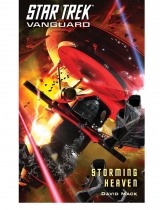
Текст книги "Storming Heaven"
Автор книги: David Mack
Жанр:
Научная фантастика
сообщить о нарушении
Текущая страница: 2 (всего у книги 21 страниц)
He reached the end of the hallway and stopped in front of the drawn curtain on his right. Assured by a furtive glance back the way he’d come that he hadn’t been followed, he knocked lightly on the door frame and whispered, “The hunter stands ready.”
From within the alcove, a hand jerked the curtain aside. Valina, a striking young Romulan woman of unusual height and beauty, was clad in a sheer negligee that left precious little to Duras’s imagination. She flashed a salacious smile. “The prey awaits.” With her free hand she pulled Duras to her and met him in a ferocious kiss. Despite her lean physique, her strength never failed to impress him, and though her species resembled the stoic Vulcans, their hearts burned with passions worthy of Klingons. Pulling free of the kiss, she bit Duras’s lip, a playful nip just hard enough to break the skin and draw blood.
Duras pushed her aside. “Business first.” He turned and pulled the curtain shut behind him. As he stepped farther inside the small room, she stood with her back to the wall, twirling a lock of her long, wavy black hair around one finger and following him with her customary come-hither leer. He wondered if her brazenly sexual demeanor was all an act for his benefit. The first time he met her, she had seemed arch and aloof, just as one would expect of an attachй of the Romulan ambassador to the Klingon Empire. Or had that icy faзade been the act, the mask she wore to conceal a lustful inner life? The only way to know for certain would be to untangle Valina’s intricate web of lies, a task that Duras suspected could take most men years, and an abundance of time was a luxury he did not have. “You know what I need.”
Her leer transformed into a steely glare. “And you know what I want, Duras.”
“I have it.” He reached into an inner pocket of his jacket and took out a data card. On it was a smattering of raw intelligence gathered by the Klingon Defense Forces about the beings known as the Shedai, and the technology their extinct civilization had left strewn throughout the Gonmog Sector. Valina reached for the card, then frowned as Duras pulled it away, teasing her. “This is top-secret information, Valina. I need something of equal value in return.”
She narrowed her eyes and lifted her chin, and in the span of a breath she reverted to being the cold-eyed predator he had met months earlier, when the High Council had welcomed the Romulan ambassador and his retinue to Qo’noS. “What do you want?”
“I need to ensure my House’s rise within the Empire.”
Hostility shone in her dark eyes, betraying her waning patience. “Be specific.”
He stepped past her to the bed and ran his finger along the hard, smooth slab, which was surprisingly clean, considering its surroundings. “If an accident were to befall Chancellor Sturka, it could pave the way for my family’s advancement inside the High Council.”
Valina crossed her arms. “An accident? Or an assassination?”
“Let’s not quibble over semantics.”
His glib deflection of her query was met by a hard stare. “The Tal Shiar won’t do your dirty work for you. If you want Sturka dead, have the spine to do it yourself.”
Duras noted the undercurrent of pride in Valina’s voice as she’d said “Tal Shiar,” and he made two immediate mental connections. First, he inferred from the context that it was likely a proper name for the Romulan Star Empire’s military intelligence apparatus, or at least a part of it; second, he surmised that Valina was likely an undercover operative for the organization.
Both useful things to know.
He expunged all aggression from his voice. “In that case, what can you do for me?”
“I can give you what you really came for.” She flashed an arrogant smirk. “Did you actually think you were being crafty? By asking for something you knew I’d refuse, just to make the thing you really wanted seem reasonable by comparison? If you plan on making a career of lies and deception, you need to work on your conversational tactics.” She reached over to a stack of rough towels in the corner by the bed, plucked out the one second from the bottom, and unfolded it to reveal a concealed data card. “It contains all the technical information your House will need to figure out why your attempts to convert our cloaking devices to your ships haven’t been working—and how to fix it. With control over this vital tactical asset, the House of Duras can rise in stature through its public actions, and earn the thanks and praise of the Empire.”
Duras reached for the card on the towel, but Valina pulled it back and tsk-tsked at him. “You first, my love.”
He held up his card of stolen data in two fingers. “Both at the same time.” He waited for her to mimic his pose. “On three. One. Two. Three.” Their hands struck like serpents, each of them seizing their prize before the other decided to renege on the deal. Then they stood, facing each other, and smiled. “Well,” Duras said, “now that that’s over. . . .”
They flung the cards aside, and then Valina tackled him to the floor, where Duras found what he had really come for in the first place.
4
Master Chief Petty Officer Mike Ilucci leaned forward—his hands on his knees, sweat running in steady streams from beneath his uncombed black hair, nausea twisting in his gut—and groaned.
Even though Ilucci had been careful to moderate his drinking in recent weeks, since technically the Sagittarius crew was not on leave but rather awaiting an opportunity to ship out, he had not been so careful in his choice of cuisines, and his epicurean tendencies seemed to have finally caught up with him. He couldn’t say whether the culprit responsible for his current gastrointestinal distress was the highly acidic Pacifican ceviche on which he’d gorged himself the night before, the overly spicy eggs Benedict with chipotle hollandaise sauce over Tabasco-marinated skirt steak he’d enjoyed for breakfast, or the huge portion of obscenely rich linguine carbonara he’d devoured for lunch that afternoon. Or perhaps some combination of the three.
It didn’t matter, he decided. Hot swirling pain moved through his gut, and it hurt so badly that he imagined he must have swallowed a plasma drill set on overdrive. All he wanted at that moment was a few minutes of peace to let the agony subside.
A moving shadow intruded upon his view of the deck, and then he saw the feet that trailed behind it. From above his bowed head, he heard the familiar voice of enlisted engineer Crewman Torvin. “You all right, Master Chief?”
Grotesque discomfort put an edge on Ilucci’s reply. “Do I look all right, Tor?”
The young Tiburonian sounded nervous and concerned. “Anything I can do to help?”
“Yeah. Kill me.”
Torvin shuffled his feet, apparently at a loss for a reply. “Um . . .”
“What do you need, Tor?”
The lean, boyish engineer doubled over so he could look Ilucci in the eye. His voice cracked as if he were suffering a relapse of puberty. “Before I kill you, can I get you to sign off on the repulsor grid?”
A tired moan and a grudging nod. “Help me up.”
With one hand pushing against Ilucci’s shoulder and the other hovering behind the husky chief engineer’s back, Torvin guided Ilucci back to an upright stance. The chief cleared his throat and lumbered across the main cargo hold of the civilian superfreighter S.S. Ephialtes, with Torvin a few steps ahead of him. Above and around them, teams of engineers and starship repair crews from Vanguard worked under the direction of Ilucci’s engineers, installing a host of new systems inside the freighter’s recently emptied, titanic main cargo hold. Several decks had been torn out, along with most of the ship’s cargo-handling machinery, such as cranes and hoists. The result was a vast, oblong cavity that accounted for the center third of the ship’s interior volume.
Torvin led Ilucci to the center of the deck, where he had installed a gray metal hexagonal platform that stood just over a meter tall and measured two meters on each side. The top of the platform was festooned with an array of smaller hexagons composed of a dark, glasslike substance. The enlisted man lifted a tricorder that he wore slung at his hip, keyed in a command, and powered up the repulsor grid. An ominous low hum filled the air for a moment, and then it faded to a barely audible purr. Shrugging out from under the tricorder’s strap, Torvin handed the device to Ilucci. “I set the amplitude, frequency, and angles according to your specs.” He pointed around the cavernous hold at five other devices: one on the overhead and one on each of the four main bulkheads—forward, aft, port, and starboard. “The load’s balanced on a six-point axis, has two redundant fail-safes, and can support five times the mass of the Sagittarius.”
Ilucci scrolled through the benchmark tests Torvin had run, then nodded. “Nice work, but if this tub drops too fast from warp to impulse we could plow right through its forward bulkhead and end up as a hood ornament.” He shut off the tricorder and handed it back to Torvin. “Do me a favor: hop back to the salvage bay and bring back some more inertial dampers.”
“Just me?” Torvin fidgeted and looked over his shoulder.
“Yeah, just you.” He paused and eyed his flummoxed engineer. “Why? What’s the problem? Afraid you’ll get lost?”
The youth palmed the sweat from his shaved head and absent-mindedly tugged on one of his oversized, finlike Tiburonian earlobes. “No, I, um . . .” He took a breath and calmed himself. “I don’t think the civvies on this ship are too thrilled about us ripping up their hold.”
The chief couldn’t suppress a sympathetic frown. “I wouldn’t be, either, if I was them.” Noting the fearful look on Torvin’s face, he lowered his voice. “Did someone threaten you?”
“Let’s just say I think it might be a good idea if we moved in pairs for a while.”
He gave Torvin a reassuring pat on the shoulder. “Noted.” Then he turned and waved to get the attention of the Sagittarius’s senior engineer’s mate, Petty Officer First Class Salagho Threx. The hulking, hirsute Denobulan nodded back, then crossed the cargo hold at an awkward jog until he joined Torvin and Ilucci, both of whom he dwarfed with ease. “Yeah, Chief?”
“Tor says the civvies have a bug up their collective ass about us gutting their boat, and he thinks they might be looking for a bit of payback on any Starfleet folks they catch alone in the passageways between here and the station.”
Threx looked unsurprised. “I get the same feeling, Master Chief.”
“Okay. Go with Tor and get a pallet of inertial dampers to beef up this repulsor grid. And if any of those grease monkeys start some shit, you have my permission to kick their asses.”
“Copy that, Master Chief.” The bearded giant of a Denobulan beckoned Torvin with a tilt of his head. “Let’s roll.” The two engineers walked toward the exit, both keeping their heads on swivels, looking out for trouble from whatever direction it might come.
Ilucci turned, hoping he might slip away to some dark corner of the freighter to collapse into a coma until his stomach cramps abated, but instead found himself face-to-face with another of his engineers, Petty Officer Second Class Karen Cahow. The short, indefatigable tomboy had grease on her standard-issue olive-green jumpsuit and grime in her dark blond hair, but she looked ecstatically happy. “I figured out how to mask us from sensors in transit!”
The bedraggled chief engineer tried to shuffle past her. “Good job. I’ll put your name in for a medal.” His escape was halted by her hand grasping the upper half of his rolled-up sleeve.
“Don’t you want to hear how I did it?”
Overcoming his urge to retch, he turned and smiled. “Are you sure it works?”
Her face was bright with pride. “Positive.”
“Then I’ll look forward to reading your report.” The perky polymath started to protest, so he cut her off. “Later. Capisce?”
His urgency seemed to drive the point home for her. “Got it.”
“Good. Now go make sure this boat’s ventral doors are rigged for rapid deployment. And if you need me, just follow the stench till you find my shallow grave.”
“Will do, Master Chief.” Cahow bounded away, a bundle of energy so infused with optimism that it made Ilucci want to drink himself stupid and spend a week asleep.
He made it to the cargo hold’s exit, where he collided with the first officer of the Sagittarius, Commander Clark Terrell. The lanky, brown-skinned XO had the muscled physique of a prizefighter and the razor-sharp, lightning-quick intellect of a scientist.
Probably because he’s both, Ilucci mused. During their years of service together on the Sagittarius, he’d learned that Terrell, in addition to having double-specialized in xenobiology and impulse propulsion systems, had been one of the stars of the Starfleet Academy boxing team.
Terrell cracked a brilliantly white grin. “How goes it, Master Chief?”
“By the numbers, sir. We’ll be ready to vent the hold and move our boat in here by 0300 tomorrow.” He rapped one knuckle against the top of his head. “Knock on wood.”
“Outstanding, Chief.” He studied Ilucci with a critical eye. “Are you all right?”
Ilucci swallowed hard, forcing a surge of sour bile back whence it came. “Nothing a year in the tropics wouldn’t fix, sir.” Eager to change the subject, he glanced upward and asked, “How’s Captain Alodae taking the news?”
The query drew a snort and a chortle from the commander, who shook his head in glum amusement. “Let’s just say I’m glad I’m down here with you right now.”
“That well, huh?”
“Master Chief, you don’t even want to know.”
Nogura stood his ground as Captain Alodae jabbed him in the chest with his index finger and raged, “I’m not signing anything! You people have no right to take my ship or my cargo!”
The thick-middled, heavily jowled Rigelian drew his hand back to poke Nogura a second time, only to find his wrist seized mid-thrust by the cobralike grab of T’Prynn, whose gaze was as fearsomely cold as her voice. “Control yourself, Captain.”
Watching from just beyond arm’s reach, the other officers at the meeting—Captain Adelard Nassir of the Sagittarius and Lieutenant Commander Holly Moyer from Vanguard’s office of the Starfleet Judge Advocate General, or JAG—tensed in anticipation of violence.
Alodae retreated half a step from Nogura and jerked his hand free of T’Prynn’s grip. A flurry of emotions distorted his tattooed face, then his nostrils flared as he drew a deep breath. Features still crinkled with anger, he bowed his head to Nogura. “My apologies, Admiral.”
Nogura replied with curt formality, “Apology accepted, Captain.”
Though he was obviously still furious, Alodae reined in his temper enough to lower his voice to just less than a shout. “My point stands. This is a violation of my rights, as well as the rights of my crew, passengers, and employer. You can’t just press us into service and use us any way you like. The Federation has laws against this kind of thing.”
“Very true,” Nogura said. “Unfortunately, we’re not inside the Federation.”
Looking as if he’d just been slapped with a dead fish, Alodae stammered, “Huh—what?”
Moyer stepped in from the conversational sideline. “I’m afraid that’s technically correct, Captain.” The svelte redhead flinched slightly as the fuming Rigelian turned his ire toward her, but she rallied her confidence and continued. “Despite the presence of Starbase 47 as a hub for colonization, commerce, and exploration, formal jurisdiction over this sector remains in dispute. And because this is a Starfleet facility rather than a civilian one, the only law in effect here is the Starfleet Code of Military Justice, which does, in fact, authorize us to commandeer vessels and personnel when required to defend Federation security.” She handed Alodae a data slate.
He glanced at it, then at the Starfleet officers surrounding him. “What if I refuse and tell you to get your people off my ship so we can leave?”
Nogura shrugged. “Then we’d continue this discussion in the brig.”
Moyer added, “You and your crew would be placed under arrest, and Starfleet would impound your vessel. Then we’d issue your ship a military registration, crew it with our own people, and proceed with the operation we’ve already described to you.”
The Rigelian merchant captain’s visage was a taut mask of contempt. “I see. So, that’s it? You hijack my ship and my crew, and we just have to roll over and take it?”
“Well, Starfleet would compensate your employer for the ship, if it came to that,” Moyer said. “Also, you and your crew and passengers would be provided with transport to the nearest Federation port of call and given vouchers for whatever destinations you choose beyond that.”
Alodae narrowed his eyes. “How generous of you.”
“However,” T’Prynn cut in, “if you comply with our requests, you would nominally retain command of your vessel, and after the Sagittarius separates from yours at the Iremal Cluster, you would be free to continue on your way.”
Swiveling his head toward the Vulcan, Alodae asked, “And what about my lost profits, Lieutenant? An empty ship might use less fuel than a full one, but flying empty also burns up time and money. Our margins were razor thin before you folks forced us to do charity work.”
Nogura traded a look with Moyer, then he said to Alodae, “If it’s purely a matter of remuneration, I’m sure we can negotiate a fair settlement.”
“I’ll take you up on that, but it’s not just about the money.” Alodae aimed his ire at Nassir. “If I use my ship to sneak yours away from this station, that puts my ship and crew at risk. We’d stop being civilians and become legitimate military targets.”
The short, bald, and slightly built Deltan starship captain projected placidity as he answered the beefy Rigelian. “Respectfully, Captain, you and your ship are already targets, every time you cross the Federation border into the Taurus Reach. The Klingons and the Tholians don’t care about the legal niceties of your ship’s status. If they decide to board you or blow you to kingdom come, they will. The only difference between this trip and any other you’ve made in this sector is that, this time, Starfleet will be watching over you every step of the way.”
Alodae surrendered to the inevitable. “Fine. Do what you want. But you’d better believe I plan to lodge a formal complaint with the Federation Council after I get my ship home.”
“We would expect nothing less,” said Nogura.
The Rigelian frowned at Moyer. “Let’s go set a price for this little adventure of yours.”
As the JAG officer turned to lead Alodae out of Nogura’s office, Nassir took half a step toward the man. “Captain, I just want to thank you on behalf of—”
“Blow it out your ass,” Alodae groused. “And tell your crew that once we’re on our way, I don’t want to see you or any of them inside my ship.”
Nassir mustered a polite smile. “You won’t even know we’re there.”
“Somehow, I doubt that.” Alodae turned and motioned for Moyer to continue, and the two of them left the office. The hum of activity from the operations center briefly filtered in through the open doorway as they made their exit, then the door hushed closed, and silence reigned inside the admiral’s sanctum.
“Well,” Nassir said to no one in particular, “that went better than I expected.”
Nogura walked to his desk and sat down. “Alodae says he’ll cooperate, but I don’t trust him. He’s willful. And proud.” He steepled his fingers while he considered the situation, and Nassir and T’Prynn waited quietly for him to continue. Then he made up his mind, pressed his palms on the desktop, and pushed himself back to his feet as he looked at Nassir. “Have your chief engineer make sure your bridge crew controls the cargo hold doors on the Ephialtes. I don’t want Alodae or his crew ejecting your ship without permission.”
“Yes, sir.”
He shifted his gaze to T’Prynn. “Post a security team on the Ephialtes to make sure its crew don’t do anything to jeopardize the mission.”
“Understood, Admiral. What rationale shall I give Captain Alodae for their presence?”
Nogura stroked his chin. “Tell him they’re just passengers, heading home now that they’ve finished their tours of duty. And add their fares to his compensation package.”
“Very good. Shall I book them in the first-class cabins?” She noted the incredulous stares of both Nogura and Nassir, then arched one brow in sardonic understanding. “No, of course not. Such generosity by Starfleet would be certain to draw suspicion. Steerage it is, then.”
5
Reality was a muddy blur as Cervantes Quinn blundered through the cobblestone lanes of Stars Landing, a cluster of residential and commercial buildings tucked inside the expansive terrestrial enclosure that occupied the upper half of Vanguard’s saucer hull. Every step he took was a dare to the station’s artificial gravity to pull him down and drop him on his face. His vision and his memory both were dulled by bourbon, a result entirely of his own design. For a few blessed seconds, he could neither see where he was nor remember where he was going.
Such moments had become all that he lived for, the holy grail of his existence. In the months since he had come back from the mission that claimed his beloved Bridy, he had become a surgeon with a shot glass, and whiskey was his scalpel: He used it to carve away his sorrows.
Stumbling half-blind, he relished the near-constant sensation of free fall, the feeling that at any moment he might plunge down a rabbit hole into endless darkness. He longed for such oblivion, for a total divorce from his memories. Then he recalled where he was going: back to his apartment, a depressing hovel adorned by only a few meager furnishings and an ever-growing number of carpet stains. There he would slip into a dreamless and fitful slumber and pray this might be the night when he finally choked to death on his own vomit.
Best not to get my hopes up, he cautioned himself. Otherwise I’ll just be sad when I wake up tomorrow, alive and feeling like hammered crap.
He was in no hurry to get home—or anywhere else for that matter. Most of the reputable drinking establishments in Stars Landing had long since eighty-sixed him for one thing or another. Starting fights, or not paying his tab, or urinating on the bar; it was always something.
Bereft of hope as well as a destination, he spent most of his days hiding from the station’s simulated daylight, and most of his nights dragging his sorry ass from one joint to another in an ever more difficult search for someone who’d serve him a goddamned drink. Morose and at a loss for any other reason to go on, he drifted alone through the twisted wreckage of his life, turning in steadily shrinking circles while waiting for the Great Drain of Time to suck him whole into its infinite abyss and put an end to his misery.
Quinn’s toe caught on the edge of a cobblestone. His elbows hit the road, followed a moment later by his face, and he thought perhaps he’d finally gotten his wish. Then the sharp pain of impact faded to a dull ache of bruises and the steady throb of a fresh gash on his chin. He reached up with one dirty hand and palmed away the bright red blood running in a thick stream over his Adam’s apple, and he chuckled at the hopeless stupidity of his life.
He was still gathering the will to stand when a pair of feet edged into his sharply limited field of vision. A few hard blinks and a deep breath improved his sight from triplicate to duplicate, and he lifted his head to see who was looming over him. It came as little surprise to find freelance journalist Tim Pennington looking back at him. “Hey, Newsboy,” he slurred.
The fair-haired, Scotland-born writer looked annoyingly fit, in a yogurt-and-yoga kind of way. His smile felt condescending. “Quinn. I see you found the fast track back to the gutter.”
“Yeah, but I’m looking up at the stars.”
Pennington looked up. “Those are holograms.” Back down at Quinn. “Can you even see them through those whiskey goggles you call eyes?”
“No, but I know they’re there. And they’re lookin’ back at me.” And laughing.
The younger man kneeled and tried to snake his hands under Quinn’s armpits, but the grizzled old pilot and soldier of fortune shook him off with a violent spasm of twists and jerks.
“Let me help you up,” Pennington said. “We need to get you home.” He reached out again, and this time Quinn was too tired to struggle, so he let his body go limp and transform into dead weight in Pennington’s hands. “Come on, you stupid tosser, get up.”
Drool spilled from the corner of Quinn’s mouth and ran down his shirt as he mumbled in a pathetic monotone, “Leave me here.”
Pennington’s voice cracked from exertion. “Not a chance.”
Exhibiting a degree of stubbornness Quinn hadn’t known the man had, Pennington snuck under Quinn’s arm and draped it across his shoulders, then forced him to his feet. Despite thinking he would passively resist, Quinn found his feet keeping step with Tim’s as the writer lurched forward and led Quinn down a street of blurry lights and murky shadows. “You’re doing great, mate,” he said. “Just a bit farther.”
They might have been lumbering along for seconds or minutes—Quinn couldn’t really tell—but he lost hold of his anger and sank into maudlin gratitude. “Thanks.”
Pennington’s voice was taut from the strain of carrying Quinn. “You’re welcome.”
Not certain he’d made his point, Quinn added, following a wet and odiferous belch, “No, really, I mean it, thanks. I’m glad you found me instead of . . . instead of those security goons.”
Pennington guided Quinn around a corner. “They aren’t looking for you.”
“The hell they ain’t. Busted up some shit real good down at Shannon’s.”
“I squared that, mate. Paid for what you broke. Got the charges dropped.” As they started up some stairs, Quinn’s head dipped forward, and he found himself hypnotized by the off-sync spectacle of their moving shoes. Pennington’s feet stepped straight and sure, Quinn’s splayed in a pigeon-toed pantomime of alcoholic ineptitude.
Weaving and staggering down an open-air promenade, Quinn began to recognize familiar details of the residential building in which he lived. Even in his deeply sotted state, he knew that without Pennington’s guidance, he would never have been able to tell one of the station’s prefabricated living modules from any other, much less have found his own door in this rat’s maze from hell. Then he caught up with the conversation of a minute earlier. Newsboy’s probably the only reason I ain’t in the brig right now. “How ’bout my other bar tabs?”
“Settled,” Pennington said.
They stopped in front of a door that Quinn assumed must be his own. With effort, he swiveled his head toward Pennington, only to find the man’s face too close for him to focus on. “So, does that mean I can go back to Tom Walker’s place?”
“No. It just means he won’t press charges.” The door opened, and Pennington dragged Quinn inside. He led him to a sofa whose upholstery had already suffered a terrifying number of indignities caused by Quinn’s headlong plunge off the wagon of sobriety, and then he slipped out from under Quinn’s arm and let him collapse onto the sofa.
“Home sweet home,” Quinn mumbled into the cushion.
Pennington took a moment to prop Quinn on his side, using pillows to prevent him from rolling onto his back. Then he fetched a small trash can from the kitchenette and placed it next to the sofa. He ran a hand through his sweat-soaked hair. “Need anything else?”
Quinn thought he should find some way to thank Pennington, some way to reward him for playing the part of his guardian angel despite all the stupid crap Quinn had said to him, for being such a good friend to him despite all the misery Quinn had brought into his life, most of it unintentional but a catastrophe nonetheless. Of all the people he had ever known, Pennington was one of the few he still knew who hadn’t written him off as a lost cause. That deserved some kind of recognition. At the very least, it merited a sincere word of thanks. Something.
“Tim . . . ,” he began.
His stomach twisted in a knot, his chest heaved, and he puked a gutful of half-digested food and bile that reeked of sour mash, all over Pennington’s feet.
He was almost grateful to lose consciousness before having to say he was sorry.
Doctor Carol Marcus was on the move and in no mood to stop for anyone or anything. She passed one of her colleagues after another as she circled the main isolation chamber located in the center of the Vault. The recently rebuilt, state-of-the-art top-secret research facility lay deep inside the core of Starbase 47, and it was the most heavily shielded and redundantly equipped section of the entire Watchtower-class space station.
“Watch those power levels,” she said to Doctor Hofstadter as she passed his console. “We can’t afford a spike.” The dark-haired, bespectacled researcher nodded once in confirmation of Marcus’s instruction, then he resumed his work. Striding past another station, Marcus paused long enough to lean past Doctor Tarcoh, a spindly, soft-spoken Deltan man of middle years. She activated a function on his panel. “Remember to keep the sensors in passive mode. I don’t want to feed this thing any signals it can use. You saw what happened last time.” Tarcoh continued his work, duly chastised for his error.
The “last time” Marcus had spoken of, and which every scientist on her team recalled all too vividly, was a disastrous attempt to make contact with a Shedai trapped inside a Mirdonyae Artifact identical to the one still housed inside the Vault’s main isolation chamber. The steps that had been necessary to transmit a signal through the artifact’s baffling subatomic lattices had also enabled the creature snared inside it to replenish its power and exploit damage the Federation researchers had unwittingly wrought in the artifact. That error had led to an explosive episode of escape and the violent destruction of the Starfleet Corps of Engineers vessel U.S.S. Lovell.
As she moved around the laboratory, checking status gauges and second-guessing all her colleagues’ work, her Starfleet counterpart, Lieutenant Ming Xiong, fell into step beside her. “He’s still waiting for you in your office,” Xiong said.