Текст книги "Storming Heaven"
Автор книги: David Mack
Жанр:
Научная фантастика
сообщить о нарушении
Текущая страница: 20 (всего у книги 21 страниц)
Then she noticed one personal transponder that was nowhere near an emergency site, and when she verified that it was in the Vault, she knew it had to be Ming Xiong.
Fear and hatred coursed from the array like a river in flood. Cracks propagated through its matrix, filling the Vault with its delicate symphony of fracturing crystal. The containment system burned out one subsystem at a time while Xiong stood mere meters away, finishing the preparation of the laboratory’s self-destruct system. Overriding its security protocols had taken longer than he’d expected; it had been designed to require at least two senior personnel’s command codes to authorize the self-destruct, but he was the only one left, so he’d hotwired it.
The terror quotient inside the lab escalated on a logarithmic scale as the array’s myriad safeguards broke down. Xiong couldn’t say what was more to blame—the Tholian attack or the obvious struggle of the Shedai to break free of their crystalline prison. He decided the cause didn’t matter. No matter how hard he tried to focus on entering the final command sequence for the self-destruct, every instinct he possessed screamed, Run! Get away from there!
His hands shook above the console, and his mind was empty of everything except fear. No, he told himself. It’s not real. It’s just beta waves from the Shedai. It’s an illusion. He closed his eyes and fought to ignore the unearthly dirge that groaned from the mysterious alien machine, but it was no use. He felt the Shedai’s hateful emanations in his gut; they invaded his thoughts with whispers of interminable pain and suffering to come, cruel fates aborning for one and all.
Just a few more seconds, he berated himself. That’s all it takes. He thought of the billions of innocent civilians on worlds throughout local space, not just in the Federation but across all the currently explored sectors of the galaxy’s Orion arm, and he imagined the brutal horrors that would befall them if even a single Shedai escaped alive from the array. His sense of duty granted him a brief instant of clarity, and he pushed through his fear long enough to enter the final arming sequence. The computer screen flashed COMMAND AUTHORIZATION VERIFIED—SELF-DESTRUCT SEQUENCE ARMED. Then the system prompted him to set a countdown.
Somewhere inside the array, he heard one of the crystals shatter.
His communicator beeped twice on his belt. Keeping watch over the crumbling array, he pulled out his communicator and flipped it open. “Xiong here.”
“Mister Xiong, this is Lieutenant T’Prynn. Are you ready for transport?”
The first narrow tendrils of dark energy snaked out of the machine’s core. Primal fear rooted Xiong in place and left him paralyzed. Watching the black liquid creep upward, he knew it would be only a matter of moments until it shattered another crystal, and another—then all the Shedai would break free, and there would be no hope of ever containing them again.
T’Prynn’s voice cut through the dire wailing of the Shedai. “Mister Xiong! Do you copy? Are you ready for transport?”
Startled back to his senses, Xiong replied, “Negative. I . . . I have to finish something.”
“The rest of the crew is being beamed out as we speak. Endeavour is holding position until all personnel are accounted for. How long until you’re ready?”
An entire row of crystals shattered and rained to the floor in shards. A vast cloud of unnatural black smoke roiled inside the isolation chamber, its inky swirls swimming with violet motes of energy, its entire mass seething with violence and malice.
Xiong fought the temptation to trigger the self-destruct sequence right then. Instead, he forced himself to patch in a feed from Vanguard’s passive sensors, revealing the positions of the Endeavour and the Enterprise, the circling mass of the Tholian armada, and the escaping convoy of civilian vessels escorted by the Sagittarius.
“Tell them I won’t be coming,” Xiong said.
It was the only choice he could live with. If he set a long-enough delay on the self-destruct timer to permit the two Constitution-class starships to reach minimum safe distance, he couldn’t be certain the escaping Shedai wouldn’t disable the system after he left. If he triggered it now, he would doom the two starships and everyone aboard them to a fiery end. His only way of making sure he’d contained the threat he’d helped awaken three years earlier was to stand over it and personally drag it down into oblivion.
“Captain Khatami refuses to leave you behind,” T’Prynn said several seconds later. “Stand by while we establish a transporter lock on your communicator.”
Cracks began to form in the transparent enclosure of the isolation chamber, the wall of triple-reinforced transparent steel that the engineers had assured him was impenetrable.
Xiong realized the Endeavour’s crew would never abandon him as long as there remained a chance that they could pluck him from danger, and he had no time to explain the true nature of the threat before them. He couldn’t take the chance that they would steal him away and leave the Shedai free to terrorize the galaxy for another aeon.
He dropped his communicator to the floor and crushed it under his heel. Putting his weight into it, he ground the fragile device beneath his boot until nothing remained but broken bits and coarse dust.
Inside the isolation chamber, the array collapsed like a house of cards in a gale.
A symphony of shattering crystal filled the air.
Then came the darkness.
T’Prynn watched Xiong’s communicator signal go dark, and then its transponder went off line.
Over the comm, one of the Endeavour’s transporter chiefs was in a panic. “Vanguard! What happened? We’ve lost your man’s signal!”
“Stand by,” T’Prynn said. “I’m trying to isolate his life signs using the internal sensors, but he’s inside a heavily shielded area of the station.”
“Make it quick,” the chief said. “We’re being told it’s time to go.”
Massive interference from the starbase’s overloading reactors and numerous radiation leaks from battle damage made it difficult for T’Prynn to get a clear reading from the station’s lower core levels. Then the signal resolved for a moment—long enough for her to confirm that the Vault’s antimatter-based self-destruct system had been armed, and that the secret laboratory was awash in the most concentrated readings of Shedai life signs she had ever witnessed.
If Xiong was doing what she suspected, then speed was now of the essence.
A final check of her panel confirmed that all the other personnel who had made it to the evac sites had been beamed out. She reopened the channel to the Endeavour.
“We’ve lost Lieutenant Xiong,” she said. “Retreat at maximum speed as soon as I’m aboard. One to beam up. T’Prynn out.”
Kirk swelled with admiration for his crew. Asked to do the impossible, they had carried it off with aplomb, unleashing the Enterprise’s formidable arsenal against the Tholian armada despite being locked into a circular flight pattern with no margin for evasion or error.
Even as the ship had lurched and shuddered beneath a devastating series of disruptor blasts and plasma detonations, chief engineer Montgomery Scott had kept the shields at nearly full power, and helmsman Hikaru Sulu hadn’t wavered an inch from the close-formation position Kirk had ordered him to maintain between the Enterprise and the Endeavour. Ensign Pavel Chekov’s targeting had been exemplary—not only had he dealt his share of damage to the Tholians, he had even picked off several of their incoming plasma charges, detonating them harmlessly in open space several kilometers from the ship.
Every captain thinks his crew is the best, Kirk mused with pride. I know mine is.
Lieutenant Uhura swiveled away from the communications panel. “Captain, we’re being hailed by the Endeavour. Captain Khatami’s given the order to withdraw at best possible speed.”
“Then it’s time to go,” Kirk said. “Sulu, widen our radius, give them room to break orbit. Set course for the convoy, warp factor six.”
Spock stepped down into the command well and approached Kirk’s chair. “Captain, sensors show the Endeavour’s warp drive is off line. She will not be able to stay with us.”
“Sulu, belay my last.” Kirk spun his chair toward Uhura. “Get me Captain Khatami.”
A thunderous collision dimmed the lights and the deck pitched sharply, sending half the bridge crew tumbling to starboard. Kirk held on to his chair until the inertial dampers and artificial gravity reset to normal. “Damage report!”
Spock hurried back to his station and checked the sensor readouts. “Dorsal shield buckling. Hull breach on Decks Three and Four, port side.”
Uhura interjected, “I have Captain Khatami, sir.”
“On-screen,” Kirk said. As soon as Khatami’s weary, bloodstained face appeared on the main viewscreen, Kirk asked, “How long until your warp drive’s back on line, Captain?”
The transmission became hashed with interference as Endeavour weathered another jarring hit. Khatami coughed and waved away smoke. “Any minute now. Go ahead without us.”
“With all respect, Captain: Not a chance. Signal us when you’re ready for warp speed. We’ll cover you till then. Kirk out.” He glanced at Uhura and made a quick slashing gesture, and she closed the transmission before Khatami could argue with him. “New plan. Sulu, stay on the Endeavour’s aft quarter and act as her shield until they recover warp power. Chekov, concentrate all fire aft—discourage the Tholians from chasing us. Spock, angle all deflector screens aft. Everyone else, get comfortable; we’re in for a very bumpy ride.”
35
Billions of radiant specks swam in the frigid darkness that surrounded Ming Xiong. Demonic howls and wails assailed him, but his eardrums were still ringing with tinnitus from the sharp crack of the isolation chamber’s reinforced door exploding away from its frame and pealing the distant bulkhead like a church bell.
He couldn’t bring himself to scream as the Shedai erupted in a torrent from the isolation chamber and gathered around him in a great cloud, a storm of ice and shadow. His mind was numb, his very existence reduced to a state of inarticulate horror. All he could do was cling to his pedestal-shaped console and watch the real-time sensor readouts.
The Enterprise and the Endeavour were still too close to the station for him to risk triggering the self-destruct system. Why haven’t they gone to warp? He feared with each passing moment that he might have to condemn them to share his fate.
At the same time, except for a small force of ships that were pursuing the Endeavour and the Enterprise, the Tholian armada was redeploying into a close-range heavy bombardment formation around the station. As devoutly as Xiong wished he could have left this matter to them, he couldn’t trust their weapons to even affect the Shedai, much less guarantee their destruction. Worse, their impending barrage might damage the Vault’s self-destruct system enough to prevent it from unleashing its maximum yield at the moment of detonation, so he would have to trigger the autodestruct package as soon as they resumed fire on the station, regardless of whether the Endeavour and the Enterprise had escaped the blast zone.
And still, all he wanted to do was run.
A dark flash of motion, a black blur in the shadows, and he felt the sharp bite of an obsidian blade as it slammed through his torso. His knees buckled, and then he felt as if he were standing on rubber legs. Blood, warm and tasting of tin, gurgled up his esophagus and spilled over his chin. He looked down and saw the broadsword-sized, jagged-edged mass that had impaled him. Following its edge back toward its source, he saw that it became translucent within a meter of his body, and after that it gradually changed states, first to a dense liquid and then to a tenuous mass of vapor extended from the great cloud of Shedai.
The tentacle jerked back, yanking its black blade from Xiong’s body in an agonizing blur that left him clutching at his belly with one hand and hanging onto his console with the other. Where he expected to find his blood and viscera spilling out, he found a freezing cold mass of quartzlike stone covering his wound. Then he felt its deathly chill traveling across his skin, and he realized it was spreading. An icy, stabbing sensation inside his gut alerted him to the substance’s cancerlike progression through his internal organs. Cold suffused his body, and he felt his strength ebbing along with his body’s heat.
Then he became aware of other presences, distinct entities, drawing near to him. Hunched giants of smoke and indigo light, they wore auras of arrogance and malice like crowns of evil. The unholy host of spectral figures pressed inward. Then one spoke with a voice that wed the roar of an avalanche with the fathomless echoes of a Martian canyon. “Foolish little spark.” Rich with condescension, its Jovian baritone shook the station. “What made your kind think it could ever contain such as us? You are but glimmers in the endless gaze of time. Weak minds trapped inside sacks of rotting flesh and fragile bone. You are nothing.”
Xiong wished he had some irreverent reply, some witty retort for its taunts, but all he had was a mouthful of blood and a body shivering with hypothermia and adrenaline overload.
“So? Who are you?”
“I am the Progenitor, the wellspring of all that is Shedai. First among the elite.”
“Good for you.”
He stole a look at the console. Endeavour and Enterprise remained at impulse. Come on. Go, already!
The Progenitor loomed over him, its countenance one of perfect darkness, a black hole surrounded by sickly hues and pestilent vapors. Its approach sent frost creeping across Xiong’s console. “All your worlds will pay for your trespasses. Your kind will learn to fear us like never before.” A tentacle of smoke coiled around Xiong’s throat and solidified into a substance that felt like solid muscle sheathed in cold vinyl. Then it lifted him up against the ceiling and started choking him by slow degrees. “Beg for mercy, and I will grant you a swift death. Defy me, and I will keep your consciousness alive to witness every horror and atrocity we visit upon your pathetic Federation.”
The Tholian armada was in position. Its final siege was only moments away.
Xiong could barely feel his hands as he clutched at the Progenitor’s black tentacle. Looking down in terror and anguish, he glimpsed his console, which was now blanketed by a paper-thin layer of frost. He could no longer see the sensor readout’s fine details, but he could still see two bright blue points of light that he knew were the escaping Starfleet ships.
Then both dots vanished from the display. They’ve made the jump to warp!
He forced out a desperate whisper, “Mercy . . .”
The Progenitor dropped him. He rolled as he hit the floor, coming to a stop in front of his console. Fighting past the torturous sensation of a hundred needles of ice drilling through his intestines, Xiong fought his way back to his feet and slumped against his console. He had planned to do so as a ruse, but it had become a necessity.
“So,” the Progenitor mocked, “it’s to be a quick death, is it?”
Xiong looked up at the Progenitor and flashed a bloodied grin. “You have no idea.”
He pressed the autodestruct trigger, and his pit of darkness turned to light.
Bruised and aching, Admiral Nogura stepped out of the turbolift and onto the bridge of the Endeavour, only to be brusquely shouldered aside by the ship’s surgeon, Doctor Anthony Leone, and one of its nurses, who together carried out an unconscious and maimed young lieutenant on a stretcher. “Out of the way,” Leone said, his nasal voice tolerating no argument. The short, sinewy physician seemed to regard Nogura not as a flag officer but as an obstacle.
The turbolift doors hissed closed behind Nogura as he inched toward the center of the bridge. Captain Khatami appeared to have suffered her fair share of lacerations from airborne debris. Blood trickled down from above her hairline and seeped from a cut beside her right eye; numerous bloodstains tainted her gold command jersey in flecks and streaks.
Apparently having caught sight of Nogura out of the corner of her eye, Khatami swiveled her chair toward him. “Admiral, are you all right?”
“I’m fine. Though I might have to court-martial Lieutenant T’Prynn. Again.”
A curious look. “For what?”
“Saving my life,” Nogura grumbled.
Khatami looked slyly amused. “Good luck getting a conviction for that.”
“Did you finish evacuating the station?”
“Yes, sir, thanks to Kirk and the Enterprise. We—” A sudden flash on the main viewer snared her eye and snapped her back into command mode. “Klisiewicz, report.”
The science department chief stared with haunted eyes at the sensor display. “It’s Vanguard, Captain. It blew up and took most of what was left of the Tholian armada with it.”
The image on the main viewscreen changed to show an incandescent cloud of fire blooming against the starry sprawl of deep space, its rolling blazes littered with chunks of the once-mighty starbase and the broken husks of dozens of Tholian warships. Within seconds the storm of superheated gases had already begun to dissipate into the endless darkness.
The autodestruct, Nogura realized. Xiong must have triggered it from the Vault. He descended into the command well. “Are there any Shedai life signs, Lieutenant?”
“Negative, sir. Only a few Tholian life signs, and they’re retreating at warp speed.”
Khatami remained on edge. “What about the ships chasing us?”
McCormack replied, “They’re changing course, sir. Breaking off and heading back toward Tholian space at warp eight.”
That news seemed to bring a wave of relief to everyone on the bridge except Nogura. He stared at the fading glow of the antimatter-fueled explosion that had just wiped Starbase 47 and every remaining member of the Shedai out of existence, and wondered whether, in the long view of history, this five-year covert operation would be deemed a success or a failure, and if the innumerable lives sacrificed in its name would be hailed as heroes and martyrs, or as victims of a national-security misadventure run amok.
Ultimately, it didn’t matter, he decided. It would fall to future generations to judge this undertaking and its consequences with the benefit of hindsight. There was nothing left for him to do now but file his final report as the commanding officer of Starbase 47 and await new orders.
Officially, as of that moment . . . Operation Vanguard was over.
EPILOGUE
A BRAVER PLACE
CALDOS II
Pennington sat in the stern of Reyes’s narrow skiff, clutching the gunwales with both hands. His coat was pulled tightly closed, and his legs stretched toward the middle of the small boat. Reyes sat facing him on the center bench, rowing the five-meter-long watercraft with slow, powerful strokes through the limbo of predawn fog that surrounded them. Reyes’s oar blades cut gentle wakes, and the handles creaked inside the oarlocks. It was impossible to see more than a few meters in any direction, and all Pennington saw was the rippled water of the lake.
“You really didn’t have to do this,” Pennington said.
Reyes’s long hair swayed with the tempo of his rowing. “Yes, I did.”
“I could have waited another hour for the ferry.”
The former Starfleet officer drawled, “I just wanted you out of my house.”
Pennington chuckled. “Suits me. You were out of whiskey, anyway.” Except for the soft splash of water against the boat and the wooden groans of the oars, the world seemed utterly still. Then, even though he couldn’t yet see the mainland, he caught a faint scent of pine and a distant lilt of birdsong from the vast sprawl of virgin forest that ringed the lake.
Exertion deepened Reyes’s respiration, and his exhalations added ghostly plumes to the morning’s heavy shroud of pale vapor. Catching his breath, he asked, “So, I meant to ask: What was the fallout from the Tholians attacking Vanguard?”
“Less than you’d expect.” Pennington dug his hands into his coat pockets to keep them warm. “The Tholians made a stink in Paris about ‘the crimes of the Taurus Reach,’ or some such twaddle. The Federation Council passed off the attack as a ‘benevolent Tholian intervention’ to help Starfleet contain the Shedai threat after an accident aboard the station.”
Reyes chortled and cracked a cynical smile behind his salt-and-pepper beard. “And who blew the lid off that lie? You or the Tholians?”
“Neither. Starfleet started jamming and censoring all transmissions out of Tholian space, and the editorial board at FNS ran with the official spin from the Palais.” He strained to see anything through the fog, mostly as an excuse to avoid eye contact with Reyes as he added, “That was when I handed in my resignation and went to work for INN.”
“And they broke the story.”
“Nope. They’d been co-opted, too.” The memory still made him angry. “Sometimes, I think the whole galaxy’s in on the lie, and I’m the only one left who cares about the truth.” Suddenly recalling that Reyes had been court-martialed years earlier for helping Pennington expose some of Starfleet’s shameful secrets, he added, “Present company excluded, of course.”
A dour glance let him off the hook. “Naturally.” Reyes looked down at the compass resting between his feet and adjusted his stroke to make a minor correction in the skiff’s course. “Speaking of which, whatever happened to my successor?”
“Just what you’d expect for a man who had a Watchtower-class starbase shot out from under him: He got promoted.” That drew a short but good-natured laugh from Reyes, and then Pennington continued. “Since I know you’re probably dying to ask, Captain Khatami and the Endeavour are exploring the Taurus Reach, and so are Captain Terrell and the Sagittarius.”
Reyes looked pleased. “Seems only fair, after all the legwork they did.” He glanced over his shoulder, as if he expected to find something there, then he turned back toward Pennington and continued his slow-and-steady rowing. “Did you keep tabs on anybody else?”
“Everyone I could,” Pennington confessed. “Doctor Marcus and her civilian partners are in some top-secret location—nobody really knows where—doing God-knows-what. Probably learning how to stop time or turn old chewing gum into black holes. Your old pal Jetanien’s still living on that backwater rock, Nimbus III. When I asked him why, he said he was there ‘for the waters.’ Rumor has it the old turtle’s finally lost his mind.”
A thoughtful frown. “What about T’Prynn?”
“No idea,” Pennington said. “Vanished into her work at SI, along with every last shred of proof the Shedai ever existed. I figure at least some of those artifacts must have been taken off the station before it went up in flames, but I’ll be damned if I can find any trace of them.”
“Probably all boxed up in a warehouse on some airless moon at the ass end of space. I doubt they’ll ever be seen again—at least, not in our lifetimes.”
“Maybe that’s for the best,” Pennington said. “I just wish I could find a lead on my old mate, Quinn. He not only disappeared, he erased himself from history, like he was never born.”
Reyes stopped rowing to mop the sweat from his creased forehead with the sleeve of his insulated red flannel shirt. “Take it from me, Tim: some people don’t want to be found.”
Pennington grudgingly saw the wisdom in Reyes’s point. “I know. It’s just my nature to dig at these sorts of things.”
The older man resumed rowing while eyeing him with open suspicion. “True, but you don’t usually do it for free. At least, you never used to. So . . . who paid you to dig me up?”
He tried to deflect the question. “Who says anyone did?”
“FNS? INN?” When he realized no confirmation or denial was forthcoming, he seemed to grow concerned. “The Orions? . . . The Klingons?”
Realizing his reticence had unnecessarily alarmed Reyes, Pennington held out a hand to cue him to stop. “No, no, nothing like that, I promise. If you must know, I’m here on a personal contract. I’m acting more as a private investigator than as a journalist, to be honest.”
Behind Reyes, the mainland dock appeared from the fog—a dim suggestion of a shape at first, then a dark gray outline slowly growing more solid. As Reyes guided the skiff to a halt alongside the mooring posts, a shadowy figure on the dock became half visible through the leaden mist. Reyes stood to secure the skiff for Pennington’s departure with his back toward the unannounced traveler on the dock, and Pennington said nothing as he climbed out of the narrow boat and took a few steps toward the mainland. Then he stopped and looked back.
Reyes turned and climbed onto the dock—probably to bid Pennington farewell and safe travels, the writer surmised—only to find himself speechless.
He faced Rana Desai, who stood and gazed back at him, and in their eyes Pennington saw an affection undimmed by their years apart. Neither of the estranged lovers said anything. Ever a willing martyr to romantic illusion, Pennington imagined the two were so attuned to each other’s feelings that they had no need of words.
Desai graced Reyes with a bittersweet smile. His eyes misted with emotion. He beckoned her with one outstretched hand. She went to him. He lifted her off her feet and swept her into a passionate embrace. As they kissed, Pennington turned and walked away, granting them some well-earned privacy.
Arriving at dry land, he looked back. Desai was in the skiff with Reyes, who rowed them slowly away toward his island, into the veil of fog. Watching their details fade into the mist, Pennington knew that they, like so many other figures both noble and tragic, despite being deserving of honor and remembrance, would be forgotten by history. Their names and deeds would sink into obscurity, borne away by time’s ceaseless current.
He reached inside his jacket, took out his wallet, and opened it to admire a single white blossom, a token of love and memory, a memento of life as it once had been.
Let the world forget, he consoled himself, tucking his wallet back inside his coat and walking back toward town. I’ll remember.
ACKNOWLEDGMENTS
There’s a lot I want to say in this space, because for me this was a very special undertaking, the culmination of a seven-year literary journey that has meant a great deal to me both personally and professionally. First, I want to thank my wife, Kara, for her support and patience over the past several months. She has been my muse, my cheering section, and my sounding board as I wrote the manuscript for this novel. I would have been lost without her.
I also am grateful to my friends and creative partners in the Star Trek Vanguard series. Marco Palmieri, with whom I developed the Vanguard concept seven years ago, and who edited the first four volumes of the series, has been a terrific mentor, guide, and collaborator. His creativity and passion inspired me to challenge myself and craft a more thoughtful work than I had ever attempted before. Authorial duo Dayton Ward and Kevin Dilmore helped make this series the best it could be by infusing it with their vision, talent, and hard work. Our friendly game of one-upmanship, which informed many of the twists and turns of the series’ early installments, made writing each new Vanguard novel a true joy and a labor of love. Thank you, guys, for making this all more fun than I could ever have imagined.
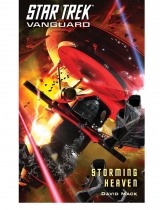
I’d be remiss if I failed to acknowledge two other remarkable visionaries whose artistic contributions are as integral to the Vanguard series as those of the writers and editors. I speak, of course, of designer Masao Okazaki and digital artist Doug Drexler. Masao designed the exterior and interior of Starbase 47, a.k.a. Vanguard, as well as those of the Archer-class scout ship U.S.S. Sagittarius. It was Masao’s designs that brought both the station and that plucky little ship to life in my imagination; thank you, Masao, for making these places “real” to me. Doug, of course, is the man who transformed Masao’s designs into the series’ striking CGI cover renderings. Each time we saw one of Doug’s covers, Marco, Dayton, Kevin, and I would all be blown away—and then we’d collectively wonder, “How will he ever top this one?” And then, whenever the next book in the series came along, he did. You are a master without equal, Doug. Thank you for making ours some of the finest-looking novels on anyone’s bookshelf.
Lest I forget, my sincere thanks also go out to all the editors who have worked on the Vanguard series over the past seven years. In addition to Marco, this roster includes Margaret Clark, Jaime Costas, and Ed Schlesinger. Thanks also to one of our most ardent fans, the knowledgeable John Van Citters, our licensing contact at CBS Consumer Products. And, lest I not get my royalty checks on time, I offer my gratitude to my agent, Lucienne Diver, for dotting my I’s, crossing my T’s, and vetting the pesky fine print in my publishing contracts.
Keeping one’s facts straight is one of the hardest things to do when writing for such a vastly developed shared universe as Star Trek. As such, I am indebted to the many fine sources of information that help me remain in step with both the series’ canon and the vast web of continuity shared by the current line of novels: The Star Trek Encyclopedia and Star Trek Chronology, by Michael Okuda and Denise Okuda; Star Trek Star Charts, by Geoffrey Mandel; and the wiki-based reference websites Memory Alpha and Memory Beta.
Because music is so integral to my creative process, I wish to thank the composers whose work served as my touchstones on this final literary odyssey in the Vanguard saga: Clint Mansell (The Fountain), Ramin Djawadi (Game of Thrones), Hans Zimmer (Sherlock Holmes), Alan Silvestri (Beowulf), Bear McCreary (Battlestar Galactica), and Cliff Martinez (Solaris).
Lastly, my thanks belong to you, the readers of the Vanguard series. Your passion for this series not only made it possible to keep it going for eight books to its natural conclusion, it made it worth doing in the first place. So, until next time—live long and prosper.