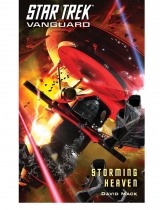
Текст книги "Storming Heaven"
Автор книги: David Mack
Жанр:
Научная фантастика
сообщить о нарушении
Текущая страница: 4 (всего у книги 21 страниц)
Watching the Ephialtes cruise away into danger, however, he found it hard to put a positive spin on the situation. He wondered if the twist of dread he felt knotting his innards at that moment was anything like what Reyes had felt when he first sent the Sagittarius and her crew all alone to Jinoteur, straight into the heart of the beast, just a few short years earlier. The more he thought about it, the more likely it sounded, but knowing that others had experienced this brand of anxiety did nothing to alleviate the suffocating pressure in his chest.
He descended the stairs to the main level and walked to the turbolift. The doors opened as someone called from behind him, “Admiral?” Nogura turned to see a short, fiftyish man with close-cropped steel gray hair and a narrowly trimmed mustache walking toward him. The man wore the blue tunic and insignia of the Medical Division, and he carried a data slate. He offered a genial smile and extended his hand as he caught up to Nogura. “Hello, sir. I’m Doctor Gonzalo Robles, the new acting chief medical officer.”
“Good evening, Doctor,” Nogura said, motioning for Robles to follow him as he stepped inside the turbolift. “What can I do for you?”
Robles used one hand to hold the lift doors open. “Actually, sir, I came up to let you know that you missed your mandatory physical four weeks ago.”
“I what?”
A conciliatory shrug. “Doctor Fisher let a lot of paperwork slide over the last few weeks. I guess he had a case of short-timer’s disease, if you know what I mean.” He held out his data slate toward Nogura. “Anyway, as you can see, I need to complete your physical so I can certify you for duty. It’s really kind of an embarrassment that it’s been allowed to slip this long.”
Nogura took the slate from Robles and looked over its contents. It displayed an order from Robles, as acting CMO, for Nogura to report immediately to Vanguard Hospital for his physical. Looking up at the physician, Nogura said, “Can this wait until tomorrow?”
“Technically, sir, it shouldn’t have waited this long. It’ll only take an hour. If you—”
“Doctor.” Heads turned throughout ops as Nogura’s voice rose in volume, dropped in pitch, coarsened with exhaustion, and echoed off the high ceiling and surrounding bulkheads. “I have been awake for twenty-one hours. I’ve not had a decent meal since yesterday. And as busy as I know you are, I assure you: I am busier. So I am going back to my quarters to log six hours of rack time. When I get up, I will come to your office, and you can do your tests. But if you say so much as one more word before these turbolift doors close, I will have you pushed out an airlock without a spacesuit. Do I make myself clear?” The lack of a response from Robles made it clear to Nogura, and to everyone else, that he had done exactly that. “Good night, Doctor.”
Robles removed his hand from the turbolift doors, which hissed shut. Nogura grasped the control bar. “Level Fifteen, Section Bravo.” As the lift coursed into motion with a hypnotic hum, Nogura shook his head. I should have told Fisher to leave his job vacant.
7
Unemployment suited Ambassador Jetanien. Sequestered inside his nondescript but also heavily fortified and comm-secure residence on Nimbus III, the Chelon diplomat enjoyed a measure of solitude and tranquility unlike any he had known since his childhood.
Months had passed since he and his staff had been forced to evacuate and abandon the Federation Embassy in Paradise City, the nominal capital of Nimbus III. The riot that had engulfed the city and toppled the embassy also had claimed the life of Senator D’tran of Romulus. To the Federation, the senator’s murder had been a public embarrassment, since it had occurred inside the Federation Embassy. For Jetanien, D’tran’s death was an aching loss and a lingering shadow over all he had accomplished in life; he had considered the man a friend, and could not disabuse himself of the suspicion that he had failed him in his final moments.
Hiding his profound dismay from his colleagues and acquaintances had been easy, thanks to the limited expressive range of Chelon faces. Having evolved from an amphibian ancestor on Chelar—known within the Federation by the far blander appellation Rigel III—the Chelons had leathery features and beaklike proboscises. Consequently, their emotional cues often went overlooked by non-Chelons, except for a few who had taken the time to learn their ways.
For his own benefit, Jetanien had taken up the practice of meditation to quell his tempest of self-recrimination, and as a positive reinforcement he had coupled his periods of reflection with sessions of sunbathing. Stretched prone across a heated artificial boulder, he basked in solar rays magnified by special panes in the glass roof above the chamber on the top floor of his villa.
To the casual observer, he would appear to be just another layabout on that backwater world, and that was precisely how he wished to be perceived. Officially, he had been indefinitely furloughed from the Federation Diplomatic Corps following the loss of the Federation Embassy. Unofficially, it was understood by a handful of very highly placed individuals within Starfleet and the Federation government that Jetanien now served as a clandestine diplomatic back channel to both the Klingon Empire and the Romulan Star Empire. Even if all other political relations between the powers should be severed, this secret pipeline of communication would remain, in the hope of someday brokering a true and lasting peace.
He reached down with one clawed manus, pressed a control disguised as a nub on the boulder’s surface, and filled his basking chamber with a fresh blast of steam. The cleansing moist heat soothed his tough hide as it seeped beneath the edges of his dorsal carapace. A sensation much like bliss began to suffuse Jetanien’s being.
Then he heard the buzz of an incoming signal on his private comm channel. Naturally, he thought, simultaneously appreciating and resenting the irony of the moment. He gave himself a gentle nudge and slid down the curved slope of the ersatz boulder. When his feet touched the floor, he pushed himself upright, then plodded across the room to the companel on the wall near the door. It was a local signal, from the outskirts of Paradise City. Knuckling open the channel, he grumbled, “This is Jetanien.”
A gruff male voice replied, “What took you so long, you old turtle?”
“Lugok,” Jetanien said, his mood lifted by contact with his Klingon counterpart. “Forgive me. After all this time, I thought you’d forgotten how to use the comm.”
A deep belly laugh. “Hardly, old friend. To be honest, it feels like I never get a moment away from it. My new master is almost as long-winded as you are.”
“If you dislike long-distance conversations, go home to Qo’noS.”
Lugok became a touch defensive. “I’ve lost my patience for the tempo of life in the First City. Compared to Vanguard or this overcooked trash ball, Qo’noS is a madhouse.”
“No doubt.”
“So, are the pundits still calling for your head because you lost your embassy?”
Jetanien didn’t know which surprised him more: the fact that Lugok was deigning to engage in casual conversation, or that he was managing to sound as if he was interested in Jetanien’s replies. Choosing not to jinx the rare moment of social grace by the Klingon by questioning it, he restrained himself to answering the direct query. “I try not to heed the reactionary tirades of the chattering classes. For the moment, I’ve worked a bit of political judo and turned our setback to my advantage. I’m content to be the punch line of their snide jokes, because it serves to conceal the true nature of my ongoing work. So long as the cause of peace is served, my public disgrace is of little consequence—and possibly even of value.”
“You haven’t changed,” Lugok said wistfully. “You still use fifty words where five will do.” He exhaled heavily, as if he were deflating. “I wish I could be as blasй. Since the riots, my House’s honor has been smeared, and the political elites treat me like a pariah.”
Feeling a deep empathy for Lugok’s predicament, Jetanien said, “I’m sorry to hear that.”
“Don’t be,” Lugok said. “It wasn’t until the powerful hated me that I realized how much I hated them back. And that, as it turns out, is why I’ve contacted you today.”
That sounded promising. “Go on.”
“I’m acting as a confidential adviser to Councillor Gorkon. I trust you know of him.”
“Most assuredly.” In addition to being Chancellor Sturka’s right-hand man on the Klingon High Council, Gorkon was the only high-ranking member of the Klingon government who was sympathetic to the diplomatic initiative Jetanien, Lugok, and their current Romulan contact, S’anra, had undertaken. Gorkon had even gone to great effort and personal risk to extend a hand in truce to his former nemesis, Diego Reyes, in the hope of persuading the Klingon chancellor to make an overture of peace to the Federation. His efforts had withered and died on the vine, but Jetanien still had admired the audacity behind them.
“Gorkon wants to ask a favor of you.” After the briefest pause, Lugok continued. “He wants you to ask your contacts inside the Federation’s various intelligence services to look for hard evidence that the Romulans are forging secret alliances with some of the Great Houses of the Empire, in order to corrupt our government and turn it into a puppet of their own.”
A low rumble born of doubt resonated inside Jetanien’s chest. “I’m not dismissing Gorkon’s request, but I need to ask: doesn’t the Klingon Empire have its own internal intelligence and security apparatus for matters such as this?”
“Gorkon fears those services have already been compromised. And if his suspicions are correct, the Romulans have friends on the High Council, which means we can’t launch a formal investigation without risking serious political consequences—up to and including execution.”
It was a bleak picture, but Jetanien understood Lugok’s concern. If elements within the Romulan Star Empire—most likely operatives and directors of its intelligence service and secret police bureau, the Tal Shiar—were co-opting the Klingon High Council, the diplomatic triumvirate he had established with Lugok and S’anra would be rendered moot. Worse, the Romulans, who already possessed a significant tactical advantage in the form of their cloaking devices, would be in a position to marry that technology to the considerable military, industrial, and economic resources of the Klingon Empire. It was a daunting prospect.
“This is a tall order,” Jetanien said, “but I will set myself to it immediately. I expect my contacts inside Starfleet Intelligence will prove more helpful and forthcoming than their civilian counterparts. As soon as I have some intelligence of note, I’ll contact you to set up a meeting.”
Lugok sounded suspicious. “Just like that? Is this some kind of trick?”
“Why would you think that?”
“Because you haven’t asked for anything in return.”
Jetanien’s exasperation manifested itself as a grinding of his bony mandible. “Lugok, my friend, ours is not some simple quid pro quo arrangement. We are not hagglers in a market. This is how a relationship of trust is built: one act of goodwill at a time.”
The Klingon chuckled cynically. “I don’t know whether to thank you or pity you.”
“Start by thanking me,” Jetanien said. “We’ll see how the rest goes from there.”
8
A battle alert blared from the Valkaya’s overhead speakers. Commander H’kaan leapt from his shower and scrambled into his uniform without bothering to towel himself dry. He pulled on his boots, and raced from his quarters to the bird-of-prey’s bridge to find his first officer, Subcommander Dimetris, and senior noncommissioned officer, Centurion Akhisar, conferring in low voices as they hunched over the shoulders of the tactical officer. Straightening the line of his red sash across his right shoulder with a small tug, he said, “Dimetris. Report.”
The sharp-featured woman turned and saluted H’kaan. “Commander, we’ve sighted the Starfleet vessel Sagittarius, cruising at warp eight-point-five on bearing one-eleven mark six.” She moved aside as H’kaan stepped forward to see the sensor readings for himself.
“Who made the identification?”
Akhisar looked him in the eye. “I did, Commander.” There was neither pride nor defensiveness in the gray-haired man’s declaration. “Hull configuration and energy signatures are a match, and preliminary readings suggest its usual crew complement is aboard.”
Eyeing the star chart for the sectors ahead of the Starfleet ship, H’kaan asked, “What seems to be her destination?”
The centurion deflected the question with a glance to Dimetris, who replied, “Unknown. That heading takes her into uncharted space.” She was quick to add, “We’re still close enough to intercept her, but if we don’t attack soon—”
“I can read the chart.” H’kaan respected Dimetris; in many regards she was an excellent first officer. Her most serious shortcoming, however, was impatience. He turned to Akhisar. “Centurion, did you notify the fleet commander about this contact?”
“Yes, sir. We’re still awaiting his reply.”
Dimetris shot a hard look at the sensor image of the Sagittarius. “And while we wait, our prey widens its lead. We should strike now.”
H’kaan was dismayed by her hotheadedness. “Attacking a Federation vessel could spark a war. We don’t make such decisions. That privilege belongs to our betters.”
His answer only stoked the lithe woman’s frustration. “If we aren’t meant to destroy this ship, why was it designated a target of interest by fleet command?”
“Don’t ask so many questions,” H’kaan counseled her. “You’ll live longer.” He understood her hunger for revenge, and he knew that many members of the crew shared the sentiments she’d voiced. Animosity toward the Federation, and in particular toward Starfleet, had been running high since the crew of the Enterprise had breached the Neutral Zone and entered Romulan space, engaged in a blatant act of espionage, and escaped with a stolen cloaking device. It was not just a public embarrassment for the Romulan Star Empire but a major setback in its ongoing arms race against both the Federation and the Klingon Empire. The “Enterprise incident,” as it had come to be known, had afflicted the Romulan military’s psyche like an open, festering wound. Any opportunity for revenge was now embraced with great relish.
An electronic chirping from the subspace radio console prompted H’kaan, Dimetris, and Akhisar to huddle around the communications officer. Dimetris said, “Kiris, report.”
Sublieutenant Kiris checked the readings on his panel. “Encrypted traffic from fleet command. Decoding now.” He engaged several preprogrammed functions, whose specific workings were classified, and downloaded the new orders to a ciphered data card, which he handed to Dimetris. The subcommander turned to face the centurion, who held up a small device used for deciphering classified directives. He and Dimetris looked at the device’s screen as the orders appeared.
“Commander, we have new orders from Admiral Inaros,” Akhisar said. “‘Engage and destroy Starfleet vessel Sagittarius with extreme prejudice. Authentication code: Tisar, Jolan, Kolet, nine, four, seven, Seetha.’” He looked up at H’kaan. “Message is authentic, sir.”
H’kaan looked at Dimetris, who added, “I concur, sir. Message is authentic.”
“All hands to battle stations,” H’kaan said, stepping smartly to his command console. Dimetris and Akhisar took their places at the other two sides of the triangular station in the center of the bridge. “Subcommander, destroy that ship.”
“Yes, sir.” She lifted her voice and began belting out orders. “Helm, set intercept course, maximum warp. Weapons, stand by for a snap shot. Target their center mass. Centurion, stand by to drop the cloak on my mark.”
Curt acknowledgments came back to her in quick succession, and Akhisar nodded once to indicate he was ready. H’kaan watched the tactical display in front of him and felt his pulse quicken with anticipation as the Valkaya closed to attack position on the Sagittarius. When they reached optimal firing range for torpedoes, he said simply, “Now.”
Akhisar dropped the bird-of-prey’s cloak, and the weapons officer unleashed a burst of charged plasma that slammed into the small Starfleet scout ship and knocked it out of warp.
“Helm,” Dimetris called out, “come about and drop to impulse. Sublieutenant Pelor, charge disruptors and ready another plasma charge. Centurion, raise shields.”
Pelor replied, “Weapons locked!”
Dimetris crowed, “Fire!”
In the scant moments between the order and the action, H’kaan glimpsed the sparking, smoldering mass of the Sagittarius on the bridge’s main viewscreen. Looks like we scored a direct hit with the first shot, he observed with pride. All those battle drills finally paid off.
Then a pair of disruptor beams lanced through the smoldering husk of the Sagittarius, and the ship erupted in a massive fireball that quickly dissipated, vanishing into the insatiable vacuum of deep space. When the afterglow faded, all that remained was glowing debris.
“Secure from general quarters,” H’kaan said. “Well done, all of you.” Much as he tried to remain detached and professional, H’kaan could not resist the urge to gloat over his victory. “Kiris! Send to Admiral Inaros, ‘Starfleet vessel Sagittarius destroyed. Continuing patrol.’ And make sure to notify our friends at the Klingon High Command. I want them to know we’ve just scored the victory that’s eluded them for years.”
Akhisar sidled up to the commander and asked confidentially, “Are you sure you wish to rub their noses in our triumph so boldly?”
“Absolutely. I just wish I could be there to see the looks on their faces.”
A dull and distant buzzing, like a million bees at the bottom of the sea. That was all Nogura heard, all he could latch on to. He felt like a synesthete, seeing the steady, angry sound as if it were an anchor line sunk into the depths to serve as his guidepost, a filament of focus to lead him up out of the oceanic fathoms of sleep, back into the twilight of semiconsciousness.
Slumber’s murky curtain parted, and the waking world flooded into Nogura’s mind, smothering him with its overwhelming, concrete reality. He blinked as he turned his head toward the companel on the end table beside his bed. Despite still being so groggy that he felt as if he were bobbing on a storm swell, he swatted open the comm channel. “Nogura.”
“Admiral, this is Lieutenant Commander Dohan.”
Nogura visualized Yael Dohan as he honed in on her voice. He imagined the swarthy, athletically toned Israeli woman with her short-cropped coal-black hair standing over the Hub, the octagonal situation table on the supervisors’ deck inside the operations center. “Go ahead.”
“The Romulans took the bait, sir. At approximately 0356 station time, a bird-of-prey uncloaked and opened fire, destroying our Sagittarius decoy drone.”
Pinching the sleep from the inner corners of his eyes, he asked, “Are we sure they didn’t know it was a decoy?”
“As sure as we can be, sir. The drone’s sensors picked up a fair amount of encrypted signal traffic before the attack, and our long-range sensors picked up major chatter on the secure Klingon and Romulan frequencies just afterward.”
The admiral covered his mouth as he yawned and hoped the sound didn’t carry over the open channel. “All right,” he said. “What time is it now, Commander?”
“Just after 0438, sir.”
“Hrm. Cut new orders to the Endeavour. Have them divert and proceed to the drone’s last known coordinates at maximum warp.”
“Acknowledged. Dohan out.” There was a soft click as the channel closed.
Collapsing back onto his bed, Nogura hoped this convoluted deception didn’t turn out to be a waste of time, or worse. If the enemy really believed it had destroyed the Sagittarius, then the Klingon and Romulan patrols in the sectors adjoining Vanguard might let up just enough for the real Sagittarius to be safely on its way to Eremar. But if the enemy knew that they’d just destroyed a drone, then every patrol ship in the Taurus Reach would be on high alert.
Let the lie live just a few hours longer, he prayed, that’s all I ask.
Captain Droga considered the news his first officer had just given him and felt torn between jubilation and envy. To make sure his revels weren’t premature, he asked, “This is confirmed?”
“Yes, sir.” Tarpek pointed at the communications officer. “Magron showed me the message from High Command. The Sagittarius was destroyed fourteen hours ago by one of our Romulan allies, roughly fifty-nine light-years from our current position.”
Droga swiveled his chair on its elevated dais until he faced the weapons officer. “Rothgar! What’s been Starfleet’s response to the attack?”
The portly lieutenant looked over his shoulder at the captain. “The battle cruiser Endeavour has been diverted from its regular patrol route. It’s on a direct heading for the coordinates where the Valkaya reported the Sagittarius destroyed.”
“Glorious!” The broad-shouldered, hard-muscled captain stood and hopped down to the main deck beside his burn-and-shrapnel-scarred first officer. “Now we’re free to plunder the prey we’ve been tracking since last night.” He pointed to the slow, hulking vessel on the bridge’s main viewscreen. “Have we figured out what that is?”
Tarpek reached over to a command console and keyed in a few commands. A string of data appeared on the screen, superimposed over the image of the ship: registry, tonnage figures, and other technical gibberish Droga didn’t feel like making time to read. That was the job of the first officer, who reported, “The Federation freighter Ephialtes. Twenty-five crew and officers, maximum speed warp six. Primary function: colony support.”
Stroking his brown-and-gray-bearded chin, Droga could see with his own eyes that the vessel was unarmed and likely had only the most perfunctory shielding. “Is it carrying anything worth stealing?”
“Perhaps,” Tarpek said. “Our scans suggest it’s fully loaded with unrefined minerals.”
The captain nodded. “Probably bound for the refinery on Benecia.” He gave Tarpek’s shoulder a hard, fraternal slap. “Let’s make sure it never gets there. Are we set?”
“Yes, sir. The target is now fully inside the blind spot created by the qul’mIn star cluster, and there’s no indication its crew has detected our presence. The cloaking device appears to be working—for now.”
Droga understood the grievance implicit in Tarpek’s last remark. Their ship, the I.K.S. vaQjoH, was a Klingon bird-of-prey, so far the only class of ship that the Klingon Defense Force had succeeded in equipping with the Romulan invention known as the cloaking device. Even aboard the vaQjoH and ships like her, however, the new technology was plagued by overloads, spontaneous failures, and other potentially disastrous malfunctions. As much as Droga enjoyed being able to creep up on his prey in deep space like a hunter stalking targ in the deep forest, he hated the unreliability of the new system and had serious doubts that it would ever really earn widespread acceptance by the great mass of Klingon warriors. That’s a problem for future generations, he decided as he climbed back into his command chair. Once he settled in, he pointed at the ship on the main screen. “Commander, seize that vessel. I want its cargo.”
“Yes, Captain.” Tarpek moved from station to station, handing out orders and back-slaps as he went. “Garthog, prepare to sweep in from their starboard side. Hold position at five hundred qelIqams. Kopar, stand ready to drop the cloak, on my command. Rothgar, target their engines, but do not fire unless I give the order. We want to board this ship, not destroy it.” Returning to the captain’s side, he shouted, “Drop cloak and come to attack position!”
The bridge lights switched from a dull, ruddy background glow to a harsh white glare as the cloaking device disengaged and the ship’s crew switched into combat mode.
Garthog declared, “In position!”
The weapons officer added, “Torpedoes locked!”
“Magron,” Tarpek said, “open a hailing frequency.” A moment later, the communications officer nodded to Tarpek that the channel was open, and the first officer nodded at Droga.
“Attention, Federation vessel Ephialtes. This is the Imperial Klingon warship vaQjoH. Drop to impulse, surrender, and prepare to be boarded.” Droga waited several seconds while watching the slow mountain of a ship on his viewscreen. Then, to his satisfaction, the enormous cargo vessel slowed to impulse just shy of an intimidating-looking planetary debris field. The vaQjoH circled the freighter once, then took up a prime firing position off the ship’s aft starboard quarter. Looking toward Magron, Droga asked, “Have they surrendered yet?”
Holding up one hand to signal that he needed a moment, Magron first looked perplexed, then alarmed. Slowly, he turned to face the captain. “Sir, we’re being hailed by a different ship.”
“Another ship?” Droga spun toward Tarpek. “Where is it?”
From the weapons console, Rothgar answered, “Behind us, sir.” Anticipating the captain’s next order, he patched the aft angle to the viewscreen, and the image of the Ephialtes was replaced by that of a Constitution-class Starfleet battle cruiser. “They have a full weapons lock,” he added with a note of submission that Droga found distasteful.
“They’re hailing us again,” Magron said.
Bloodlust had Droga’s pulse thundering in his ears, but for once his wisdom prevailed over his passion. He took a deep breath, then said in an even voice, “On speakers.”
“Attention, Klingon vessel vaQjoH. This is Captain James T. Kirk, commanding the Federation starship Enterprise. Power down your weapons immediately, or we will fire upon you. Acknowledge.”
Droga pointed at Magron, who opened the response channel. “Captain Kirk, this is Captain Droga of the Klingon warship vaQjoH. Apparently, there has been some misunderstanding. We—”
“There’s been no misunderstanding,” Kirk interrupted, his words sharp and quick. “You intercepted a Federation vessel and ordered it to surrender and prepare to be boarded. You armed your weapons and locked them on an unarmed civilian ship. That’s an unprovoked act of aggression, Captain.”
Shooting a glare at Rothgar, Droga pointed at the man’s console and then pulled one finger across his throat in a slashing motion. Rothgar released the weapons locks on the Ephialtes and began powering down the weapons. Droga had played his fair share of games of chance, and he had earned a reputation as a skilled gambler. He knew a bluff when he heard one—and this man Kirk was not bluffing. Though the crew of the vaQjoH enjoyed a battle as much as any band of Klingon warriors, Droga was certain none of them were in the mood to commit suicide, and it would do the Empire no service to lose a warship for no good reason.
“We’ve complied with your directive, Enterprise. With your permission, we’ll depart.”
“Yes, you will—on a course we’ll specify, with my ship’s weapons locked onto your warp core. And if you try to engage that cloaking device or go to warp speed before I give you permission to do so, I will blast your ship to bits. Is that understood?”
Humiliation churned into rage deep inside Droga’s gut, but he knew he was in no position to dictate terms. Kirk’s reputation, earned over just the last few years, preceded him. There was no doubt in Droga’s mind that a thoughtless act of bravado at that moment would accomplish nothing except the near-instantaneous destruction of his ship and crew.
“Understood, Enterprise. We await your approved flight plan. Droga out.” Magron cut the channel, and the rest of the crew sagged into their chairs. It was obvious that no songs would be sung over that night’s meal aboard the vaQjoH. Staring at the massive gray battle cruiser lurking on their aft quarter, Droga understood all too well why many of his fellow starship commanders had begun using Kirk’s name as a curse and the word Enterprise as an obscenity.
Discreetly savoring the sweet taste of victory, Captain James T. Kirk watched the Enterprise’s main viewscreen, which showed the aft end of the Klingon bird-of-prey vaQjoH as it retreated toward Klingon space with the Enterprise close behind it. All around Kirk, the sounds of the bridge and the hum of the ship’s impulse engines were a welcome aural backdrop after nearly a full day of eerie silence. Acting on orders from the sector’s ranking officer, the Enterprise had been lurking near a planetary debris field, lying in ambush with its key systems running at minimum levels and all nonessential systems powered down. Now the Constitution-class starship was under way at full power, as Kirk preferred.
Kirk got up from his command chair and strode to the forward console, which was manned by helmsman Lieutenant Hikaru Sulu and navigator Ensign Pavel Chekov. “Keep that ship within optimal firing range, Mister Sulu.”
“Aye, sir,” Sulu said, his baritone cool and professional.
To Chekov, Kirk added, “Make sure you keep the heat on them, Ensign.”
Chekov looked over his shoulder and up at Kirk. “All weapons still locked, sir.”
As he stepped away, he gave the boyish Russian a friendly pat on the shoulder. “Good work.” He climbed the short steps out of the bridge’s command well to its upper ring and joined his first officer, Commander Spock, who peered intently into the cerulean glow emanating from the hooded sensor display. “Spock, any sign the Klingons have armed weapons?”
“None, Captain.” Spock straightened and turned to face Kirk. “They appear to have taken our warning at face value.”
“As well they should.” Kirk looked across the bridge toward the communications console. “Lieutenant Uhura, inform Vanguard that our objective has been accomplished, and we await further orders.”
Uhura nodded. “Aye, sir.” She turned to her panel and sent the message.
The half-Vulcan, half-human first officer leaned closer to Kirk and looked at the image of the Klingon ship on the main viewscreen. “The advance intelligence Vanguard provided about this attack was surprisingly accurate, Captain. Their mission briefing predicted not only the coordinates of the Klingons’ ambush, but its time and likely attack vector.”