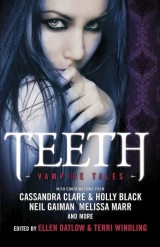
Текст книги "Teeth: Vampire Tales"
Автор книги: Neil Gaiman
Соавторы: Cassandra Clare,Catherynne M. Valente,Cecil Castellucci,Ellen Datlow,Christopher Barzak,Kathe Koja,Tanith Lee,Lucius Shepard,Jeffrey Ford,Steve Berman
Жанр:
Ужасы
сообщить о нарушении
Текущая страница: 21 (всего у книги 22 страниц)
“Okay,” I said. I sat down on a chair. I put the cold coffee on the floor. “Talk. I’ll listen.”
“Thank you,” he said.
A huge old clock ticked on the mantelpiece above the fire. Tock-tock-tock. Each note a second. Sixty now. That minute he’d asked from me before. Or the minute when Juno held me in the sunrise, shaking.
“Daisha. I’m well aware you don’t want to be here, let alone with me. I hoped you wouldn’t feel that way, but I’m not amazed you do. You had to leave your own house, where you had familiar people, love, stability” – I had said I’d keep quiet; I didn’t argue – “and move into this fucking monument to a castle, and be ready to become the partner of some guy you never saw except in a scrap of a movie. I’ll be honest. The moment I saw the photos of you, I was drawn to you. I stupidly thought, This is a beautiful, strong woman who I’d like to know. Maybe we can make something of this prearranged mess. I meant make something for ourselves, you and me. Kids were – are – the last thing on my mind. We’d have a long time, after all, to reach a decision on that. But you. I was. looking forward to meeting you. And I would have been there, to meet you. Only something happened. No. Not some compulsion I have to go out and tear animals apart and drink them in the forest. Daisha,” he said, “have you been to look at the waterfall?”
I stared. “Only from the car. ”
“There’s one of our human families there. I had to go and – ” He broke off. He said, “The people in this house have switched right off, like computers without any electric current. I grew up here. It was hell. Yeah, that place you wanted me to go to. Only not bright or fiery, just – dead. They’re dead here. Living dead. Undead, just what they say in the legends, in that bloody book Dracula. But I am not dead. And nor are you. Did it ever occur to you,” he said, “your name, Daisha – the way it sounds. Day – sha. Beautiful. Just as you are.”
He had already invited me to speak, so perhaps I could offer another comment. I said, “But you can’t stand the light.”
“No, I can’t. Which doesn’t mean I don’t crave the light. When I was two years old, they took me out – my dad led me by the hand. He was fine with an hour or so of sunlight. I was so excited – looking forward to it. I remember the first colors – ” He shut his eyes, opened them. “Then the sun came up. I never saw it after all. The first true light – I went blind. My skin. I don’t remember properly. Just darkness and agony and terror. Just one minute. My body couldn’t take even that. I was ill for ten months. Then I started to see again. After ten months. But I’ve seen daylight since, of course I have, on film, in photographs. I’ve read about it. And music – Ravel’s ‘Sunrise,’ from that ballet. Can you guess what it’s like to long for daylight, to be. in love with daylight. and you can never see it for real, never feel the warmth, smell the scents of it, or properly hear the sounds, except on a screen, off a CD – never? When I saw you, you’re like that, like real daylight. Do you know what I said to my father when I started to recover, after those ten months, those thirty seconds of dawn? Why, I said to him, why is light my enemy, why does it want to kill me? Why light?”
Zeev turned away. He said to the sunny bright hearth, “And you’re the daylight, too, Daisha. And you’ve become my enemy. Daisha,” he said, “I release you. We won’t marry. I’ll make it clear to all of them, Severin first, that any fault is all with me. There’ll be no bad thing they can level at you. So, you’re free. I regret so much the torment I’ve unwillingly, selfishly put you through. I’m sorry, Daisha. And now, God knows, it’s late and I have to go out. It’s not rudeness, I hope you’ll accept that now. Please trust me. Go upstairs and sleep well. Tomorrow you can go home.”
I sat like a block of concrete. Inside I felt shattered by what he had said. He pulled on his jacket and started toward the door, and only then I stood up. “Wait.”
“I can’t.” He didn’t look at me. “I’m sorry. Someone. needs me. Please believe me. It’s true.”
And I heard myself say, “Some human girl?”
That checked him. He looked at me, face a blank. “What?”
“The human family you seem to have to be with – by the fall? Is that it? You want a human woman, not me.”
Then he laughed. It was raw, and real, that laughter. He came back and caught my hands. “Daisha – my Day – you’re insane. All right. Come with me and see. We’ll have to race.”
But my hands tingled; my heart was in a race already.
I looked up into his face, he down into mine. The night hesitated, shifted. He let go my hands, and I flew out and up the stairs. Dragging off that dress, I tore the sleeve at the shoulder, but I left it lying with the shoes. Inside fifteen more minutes we were sprinting, side by side, along the track. There was no excuse for this, no rational reason. But I had seen him, seen, as if sunlight had streamed through the black lid of the night and shown him to me for the first time, light that was his enemy, and my mother’s, never mine.
The moon was low by then, and stroked the edges of the waterfall. It was like liquid aluminum, and its roar packed the air full as a sort of deafness. The human house was about a mile off, tucked in among the dense black columns of the pines.
A youngish, fair-haired woman opened the door. Her face lit up the instant she saw him, no one could miss that. “Oh, Zeev,” she said, “he’s so much better. Our doctor says he’s mending fantastically well. But come in.”
It was a pleasing room, low ceilinged, with a dancing fire. A smart black cat with a white vest and mittens sat upright in an armchair, giving the visitors a thoughtful frowning scrutiny.
“Will you go up?” the woman asked.
“Yes,” Zeev said. He smiled at her, and added, “This is Daisha Severin.”
“Oh, are you Daisha? It’s good of you to come out too,” she told me. Zeev had already gone upstairs. The human woman returned to folding towels at a long table.
“Isn’t it very late for you?” I questioned.
“We keep late hours. We like the nighttime.”
I had been aware that this was often the case at Severin. But I’d hardly ever spoken much to humans – I wasn’t sure now what I should say. But she continued to talk to me, and overhead I heard a floorboard creak; Zeev would not have caused that. The man was there, evidently, the one who was “mending.”
“It happened just after sunset,” the woman said, folding a blue towel over a green one. “Crazy accident – the chain broke. Oh, God, when they brought him home, my poor Emil – ” Her voice faltered and grew hushed. Above also a hushed voice was speaking, barely audible even to me. But she raised her face and it had stayed still rosy and glad, and her voice was fine again. “We telephoned up to the house, and Zeev came out at once. He did the wonderful thing. It worked. It always works when he does it.”
I stared at her. I was breathing quickly, frightened. “What,” I said, “what did he do?”
“Oh, but he’ll have told you,” she strangely reminded me. “The same as he did for Joel – and poor Arresh when he was sick with meningitis – ”
“You tell me,” I said. She blinked. “Please.”
“The blood,” she said, gazing at me a little apologetically, regretful to have confused me in some way she couldn’t fathom. “He gave them his blood to drink. It’s the blood that heals, of course. I remember when Zeev said to Joel, it’s all right, forget the stories – this won’t change you, only make you well. Zeev was only sixteen then himself. He’s saved five lives here. But no doubt he was too modest to tell you that. And with Emil, the same. It was shocking” – now she didn’t falter – “Zeev had to be here so quick – and he cut straight through his own sleeve to the vein, so it would be fast enough.” Blood on his sleeve, I thought. Vampires heal so rapidly. all done, only that little rusty mark. “And my Emil, my lovely man, he’s safe and alive, Daisha. Thanks to your husband.”
His voice called to me out of the dim roar of the waterfalling firelight, “Daisha, come up a minute.”
The woman folded an orange towel over a white one, and I numbly, speechlessly, climbed the stair, and Zeev said, “I have asked Emil, and he says, very kindly, he doesn’t object if you see how this is done.” So I stood in the doorway and watched as Zeev, with the help of a thin, clean knife, decanted and poured out a measure of his life blood into a mug, which had a picture on it of a cat, just like the smart black cat in the room below. And the smiling man, sitting on the bed in his dressing gown, raised the mug, and toasted Zeev, and drank the wild medicine down.
* * *
“We’re young,” he said to me, “we are both of us genuinely young. You’re seventeen, aren’t you? I’m twenty-seven. We are the only actual young here. And the rest of them, as I said, switched off. But we can do something, not only for ourselves, Day, but for our people. Or my people, if you prefer. Or any people. Humans. Don’t you think that’s fair, given what they do, knowingly or not, for us?”
We had walked back, slowly, along the upper terraces by the black abyss of the ravine, sure-footed, omnipotent. Then we sat together on the forest’s edge and watched the silver tumble of the fall. It had no choice. It had to fall, and go on falling forever, in love with the unknown darkness below, unable and not wanting to stop.
I kept thinking of the little blood mark on his sleeve that night, what I’d guessed, and what instead was true. And I thought of Juno, with her obsessive wasted tiny blood-drop offerings in the “shrine,” to a man she had no longer loved. As she no longer loved me.
She hates me because I have successful sun-born genes and can live in daylight. But Zeev, who can’t take even thirty seconds of the sun, doesn’t hate me for that. He. he doesn’t hate me at all.
“So will you go back to Severin tomorrow?” he said to me as we sat at the brink of the night.
“No.”
“Daisha, even when they’ve married us, please believe this: If you still want to go away, I won’t put obstacles in your path. I will back you up.”
“You care so little.”
“So much.”
His eyes glowed in the dark. They put the waterfall to shame.
When he touched me, touches me, I know him. From long ago, I remember this incredible joy, this heat and burning, this refinding rightness – and I fall down into the abyss forever, willing as the shining water. I never loved before. Except Juno, but she cured me of that.
He is a healer. His blood can heal, its vampiric vitality transmissible – but noninvasive. From his gift come no substandard replicants of our kind. They only – live.
Much, much later, when we parted just before the dawn inside the house – parted till the next night, our wedding day – it came to me that if he can heal by letting humans drink his blood, perhaps I might offer him some of my own. Because my blood might help him to survive the daylight, even if only for one unscathed and precious minute.
I’ll wear green to be married. And a necklace of sea green glass.
As the endless day trails by, unable to sleep, I’ve written this.
When he touched me, when he kissed me, Zeev, whose name actually means “wolf,” became known to me. I don’t believe he’ll have to live all his long, long life without ever seeing the sun. For that was what he reminded me of. His warmth, his kiss, his arms about me – my first memory of that golden light that blew upward through the dark. No longer any fear, which anyway was never mine, only that glorious familiar excitement and happiness, that welcomed danger. Perhaps I am wrong in this. Perhaps I shall pay heavily and cruelly for having been deceived. And for deceiving myself, too, because I realized what he was to me the moment I saw him – why else put up such barricades? Zeev is my sunrise out of the dark of the night of my so-far useless life. Yes, then. I love him.
ABOUT THE AUTHORS
NATHAN BALLINGRUD lives with his daughter just outside Asheville, North Carolina. His stories have appeared in Inferno: New Tales of Terror and the Supernatural; The Del Rey Book of Science Fiction and Fantasy; Lovecraft Unbound; SCIFICTION; and The Best Horror of the Year, Volume Two, and will be forthcoming in Naked City: New Tales of Urban Fantasy. He recently won the Shirley Jackson Award for his short story “The Monsters of Heaven.”
CHRISTOPHER BARZAK’s first novel, One for Sorrow, won the Crawford Award for Best First Fantasy. His second book, a novel-in-stories called The Love We Share Without Knowing, was placed on the James Tiptree Jr. Award’s Honor List. His stories have appeared in the young adult anthologies The Coyote Road, The Beastly Bride, and Firebirds Soaring. He is at work on his third novel and teaches fiction writing at Youngstown State University in Youngstown, Ohio, where vampires have begun to fight for equal rights. You can find out more about him at www.christopherbarzak.wordpress.com.
STEVE BERMAN began writing and selling weird stories when he was seventeen. His novel Vintage: A Ghost Story was a finalist for the Andre Norton Award for Young Adult Science Fiction and Fantasy and made the Rainbow List for recommended gay-themed books for young readers by the American Library Association’s GLBT Roundtable. His favorite vampire movie is Near Dark. And if you email him at sberman8@yahoo.com and ask for more vamp-slaying adventures for Saul, he just may write them.
HOLLY BLACK writes bestselling contemporary fantasy for readers of all ages. She is the author of the Modern Faerie Tale series, The Spiderwick Chronicles, and the graphic novel series The Good Neighbors. Currently she is hard at work on The Black Heart, the third book in the noirish caper series The Curse Workers.
EMMA BULL grew up in California, Texas, Wisconsin, New Jersey, and Illinois. As soon as she finished school and headed out on her own, she started collecting more states and a Canadian province. She’s been writing since elementary school, when she discovered that turning in a short story when the teacher asked for an essay got her an automatic A.
She’s been in five bands, plays lame guitar, and likes to sing. She lives (for now, at least) in Arizona with her husband, Will Shetterly, and cats Toby (best cat) and Barnabas (worst cat).
CECIL CASTELLUCCI has published four novels for young adults: Rose Sees Red, Beige, The Queen of Cool, and Boy Proof, and a picture book, Grandma’s Gloves. She also wrote the graphic novels The PLAIN Janes and Janes in Love, illustrated by Jim Rugg, which were the launch titles for the DC Comics Minx line. She has had numerous short stories published in various places, including Strange Horizons, The Eternal Kiss, Geektastic (which she coedited), and Interfictions 2. Her books have been on the American Library Assocation’s Best Books for Young Adults, Quick Picks for Reluctant Readers, and Great Graphic Novels for Teens lists, as well as the New York Public Library’s Books for the Teen Age and Amelia Bloomer lists. Upcoming books include a graphic novel for young readers, Odd Duck, illustrated by Sara Varon, and two new novels, First Day on Earth and The Year of the Beasts. In addition to writing books, she writes plays and opera libretti, makes movies, does performance pieces, and occasionally rocks out. For more information, go to www.misscecil.com.
SUZY MCKEE CHARNAS grew up on the West Side of Manhattan when pizza was fifteen cents a slice. She escaped into the wider world by joining the Peace Corps fresh out of college, and was sent to Nigeria to teach. Home again, she taught junior high until she was lured away to write curriculum for a drug abuse treatment program founded on two ideas: that teachers should stop telling lies about drugs to students, since the students knew more about drugs than they did, so lying just made the teachers look ridiculous; and that teachers and students have a common interest in making school less boring, since they are the ones stuck in classrooms together for years on end.
She married in 1969, and she and her husband went to live in New Mexico (for the big blue sky and high desert horizons), where she began writing science fiction and fantasy full-time. Her books and stories have won her various awards over the years, and a play made from her best-known novel (about a vampire who teaches college) has been staged on both coasts. She lectures and teaches about fantasy, SF, and fiction writing whenever she gets a chance to, and blogs about everything on Live Journal. Her website is www.suzymckeecharnas.com.
CASSANDRA CLARE is the internationally bestselling author of the Mortal Instruments and the Infernal Devices series of young adult urban fantasy novels. She lives with her husband and two cats in western Massachusetts, where she is currently writing Clockwork Prince, the last in the Infernal Devices trilogy. She has always liked vampires.
ELLEN DATLOW has been editing short stories in the science fiction, fantasy, and horror fields for thirty years. She was fiction editor of OMNI Magazine and editor of SCIFICTION, as well as editing anthologies throughout those years and continuing to do so today. Her most recent anthologies include Poe: 19 New Tales Inspired by Edgar Allan Poe; Lovecraft Unbound; Darkness: Two Decades of Modern Horror; Tails of Wonder and Imagination: Cat Stories; Haunted Legends (coedited with Nick Mamatas); The Beastly Bride; and Troll’s-Eye View (these last two with Terri Windling). Forthcoming in 2011 is Naked City: New Tales of Urban Fantasy. She coedited The Year’s Best Fantasy and Horror for twenty-one years and has been editing The Best Horror of the Year for three years. Datlow has won multiple World Fantasy Awards, Bram Stoker Awards, Hugo Awards, Locus Awards, International Horror Guild Awards, and the Shirley Jackson Award for her editing. She was named recipient of the 2007 Karl Edward Wagner Award for “outstanding contribution to the genre.”
Ellen Datlow and Matthew Kressel curate the long-running New York monthly reading series Fantastic Fiction at KGB. She lives in New York City with two opinionated cats.
Her website is at www.datlow.com, and she blogs at http://ellen-datlow.livejournal.com.
JEFFREY FORD is the author of the novels The Physiognomy, Memoranda, The Beyond, The Portrait of Mrs. Charbuque, The Girl in the Glass, and The Shadow Year. His short fiction has been published in three collections: The Fantasy Writer’s Assistant, The Empire of Ice Cream, and The Drowned Life. His fiction has won the World Fantasy Award, the Nebula Award, the Edgar Allan Poe Award, and the Grand Prix de l’Imaginaire. He lives in New Jersey with his wife and two sons and teaches literature and writing at Brookdale Community College.
NEIL GAIMAN is the Newbery Medal—winning author of The Graveyard Book and a New York Times bestseller, whose books have been made into major motion pictures, including the recent Coraline. He is also famous for the Sandman graphic novel series and for numerous other books and comics for adult, young adult, and younger readers. He has won the Hugo, Nebula, Mythopoeic, World Fantasy, and other awards.
KATHE KOJA’s books for young adults include Buddha Boy, Talk, Kissing the Bee, and Headlong; her work has been honored by the International Reading Association, the American Library Association, and the Humane Society of the United States. She lives in the Detroit area with her husband, Rick Lieder, and three rescued cats. Visit kathekoja.com.
ELLEN KUSHNER grew up in Cleveland, Ohio, attended Bryn Mawr College, and graduated from Barnard College. She worked in publishing in New York City, then quit to write her first novel, Swordspoint: A Melodrama of Manners, which took a lot longer than she thought it would. When it was finished, she moved to Boston to be a music host for WGBH Radio and eventually got her own national public radio series, Sound & Spirit, which has been running ever since.
Her second novel, Thomas the Rhymer, won the Mythopoeic Award and the World Fantasy Award. She has returned to the world of Swordspoint in two more novels, The Fall of the Kings (written with Delia Sherman) and The Privilege of the Sword, plus a growing assortment of short stories. Her children’s book The Golden Dreydl was adapted by Vital Theatre as The Klezmer Nutcracker and has become a holiday favorite. Most recently, she and Holly Black coedited a new anthology of stories set in the world of Terri Windling’s Bordertown.
She lives in Manhattan, travels a lot, and can never remember where she put anything. www.ellenkushner.com.
TANITH LEE has written nearly one hundred books and more than 270 short stories, besides radio plays and TV scripts. Her genre crossing includes fantasy, SF, horror, young adult, historical, detective, and contemporary fiction. Plus combinations of them all. Her latest publications include the Lionwolf Trilogy: Cast a Bright Shadow, Here in Cold Hell, and No Flame but Mine; and the three Piratica novels for young adults. She has also recently had several short stories and novellas in publications such as Asimov’s SF Magazine, Weird Tales, Realms of Fantasy, The Ghost Quartet, and Wizards. Norilana Books is reprinting all the Flat Earth series, with two new volumes to follow.
She lives on the Sussex Weald with her husband, writer/artist John Kaiine, and two omnipresent cats. More information can be found at www.tanithlee.com.
MELISSA MARR is the author of the New York Times bestselling Wicked Lovely series (a film of which is in development by Universal Pictures). She has also written a three-volume manga series (Wicked Lovely: Desert Tales) and her first adult novel, Graveminder. All her texts are rooted in her lifelong obsession with folklore and fantastic creatures. Currently she lives in the Washington, D.C., area with one spouse, two children, two Rott-Labs, and one Rottweiler. You can find her online at www.melissa-marr.com.
GARTH NIX was born in 1963 in Melbourne, Australia. A full-time writer since 2001, he has previously worked as a literary agent, marketing consultant, book editor, book publicist, book sales representative, bookseller, and part-time soldier in the Australian Army Reserve. Garth’s novels include the award-winning fantasies Sabriel, Lirael, and Abhorsen and the YA SF novel Shade’s Children. His fantasy books for children include The Ragwitch; the six books of the Seventh Tower sequence; and the seven books of the Keys to the Kingdom series. His books have appeared on the bestseller lists of the New York Times, Publishers Weekly, The Guardian, the Sunday Times of London, and The Australian, and his work has been translated into thirty-eight languages. He lives in a Sydney beach suburb with his wife and two children.
LUCIUS SHEPARD’s short fiction has won the Nebula Award, the Hugo Award, the International Horror Guild Award, the National Magazine Award, Locus Awards, the Theodore Sturgeon Award, and the World Fantasy Award.
His most recent books are a short fiction collection, Viator Plus, and a short novel, The Taborin Scale. Forthcoming are another short fiction collection, Five Autobiographies, and two novels, tentatively titled The Piercefields and The End of Life as We Know It (the latter young adult), and a short novel, The House of Everything and Nothing.
DELIA SHERMAN’s most recent short stories have appeared in the Viking young adult anthologies Firebirds, The Faery Reel, and Coyote Road, and in the adult anthologies Poe: 19 New Tales Inspired by Edgar Allan Poe and Naked City: New Tales of Urban Fantasy. Her adult novels are Through a Brazen Mirror and The Porcelain Dove (winner of the Mythopoeic Award), and, with fellow fantasist and partner Ellen Kushner, The Fall of the Kings.
She has coedited anthologies with Ellen Kushner and Terri Windling, as well as Interfictions: An Anthology of Interstitial Writing, edited with Theodora Goss, and Interfictions 2, edited with Christopher Barzak.
Changeling, her first novel for younger readers, was published in 2007, followed by The Magic Mirror of the Mermaid Queen in 2009. She is a past member of the James Tiptree Jr. Awards motherboard, an active member of the Endicott Studio of Mythic Arts, and a founding member of the Interstitial Arts Foundation board.
Delia has taught writing at Clarion, the Odyssey Workshop in New Hampshire, the Cape Cod Writers’ Workshop, and the American Book Center in Amsterdam. She lives in New York City, loves to travel, and writes wherever she happens to find herself.
Born in the Pacific Northwest in 1979, CATHERYNNE M. VALENTE is the author of more than a dozen works of fiction and poetry, including Palimpsest, the Orphan’s Tales series, Deathless, and crowd-funded phenomenon The Girl Who Circumnavigated Fairyland in a Ship of Her Own Making. She is a winner of the Tiptree Award, the Mythopoeic Award, the Rhysling Award, the Andre Norton Award, and the Million Writers Award. She has been nominated for the Pushcart Prize and the Spectrum Awards, and was a finalist for the World Fantasy Award in 2007 and 2009 and for the Hugo Award. She lives on an island off the coast of Maine with her partner and two dogs.
GENEVIEVE VALENTINE’s fiction has appeared or is forthcoming in Clarkesworld Magazine, Strange Horizons, Fantasy Magazine, and anthologies Federations, The Living Dead II, and Running with the Pack. Her first novel, Mechanique: A Tale of the Circus Tresaulti, about a mechanical circus troupe, is coming in 2011 from Prime. She has an insatiable appetite for bad movies, a tragedy she tracks on her blog, www.genevievevalentine.com.
KAARON WARREN’s third novel, Mistification, was published by Angry Robot Books in 2010, following the award-nominated Slights and Walking the Tree. Her short fiction has appeared in a number of publications edited by Ellen Datlow, including Haunted Legends; Poe: 19 New Tales Inspired by Edgar Allan Poe; The Year’s Best Fantasy and Horror; The Best Horror of the Year, Volume Two; and Tails of Wonder and Imagination: Cat Stories. She lives in Canberra, Australia, with her family.
TERRI WINDLING is an editor, artist, folklorist, and essayist, and the author of books for both children and adults. She has won nine World Fantasy awards, the Mythopoeic Award, the Bram Stoker Award, and the SFWA Solstice Award for outstanding contributions to the speculative fiction field, and her book The Armless Maiden was placed on the short list for the Tiptree Award. She has edited more than thirty anthologies of magical fiction (many of them in collaboration with Ellen Datlow); she created the Borderland series (a pioneering work of urban fantasy); and she’s been a consulting editor for the Tor Books fantasy line since 1986. As a painter, she has had her art exhibited in museums and galleries in England, France, and the United States; she is also codirector of the Endicott Studio, a transatlantic organization dedicated to mythic arts. A former New Yorker, Terri now lives in a small country village in the west of England with her husband, stepdaughter, and a lively black dog. For more information, please visit her website, www.terriwindling.com; her blog, http://windling.typepad.com/blog; and the Endicott Studio’s website, www.endicott-studio.com.
Introduction © 2011 by Terri Windling
“Things to Know About Being Dead” copyright © 2011 by Genevieve Valentine
“All Smiles” copyright © 2011 by Steve Berman
“Gap Year” copyright © 2011 by Christopher Barzak
“Bloody Sunrise” copyright © 2008, 2010 by Neil Gaiman, written as a song lyric for Claudia Gonson and recorded on the CD accompanying The Lifted Brow Volume 4, published in November 2008. This is the piece’s first print publication.
“Flying” copyright © 2011 by Delia Sherman
“Vampire Weather” copyright © 2011 by Garth Nix
“Late Bloomer” copyright © 2011 by Suzy McKee Charnas
“The List of Definite Endings” copyright © 2011 by Kaaron Warren
“Best Friends Forever” copyright © 2011 by Cecil Castellucci
“Sit the Dead” copyright © 2011 by Jeffrey Ford
“Sunbleached” copyright © 2011 by Nathan Ballingrud
“Baby” copyright © 2011 by Kathe Koja
“In the Future When All’s Well” copyright © 2011 by Catherynne M. Valente
“Transition” copyright © 2011 by Melissa Marr
“History” copyright © 2011 by Ellen Kushner
“The Perfect Dinner Party” copyright © 2011 by Cassandra Clare and Holly Black
“Slice of Life” copyright © 2011 by Lucius Shepard
“My Generation” copyright © 2011 by Emma Bull
“Why Light?” copyright © 2011 by Tanith Lee
Teeth
Copyright © 2011 by Ellen Datlow and Terri Windling
All rights reserved under International and Pan-American Copyright Conventions. By payment of the required fees, you have been granted the non-exclusive, non-transferable right to access and read the text of this e-book on-screen. No part of this text may be reproduced, transmitted, down-loaded, decompiled, reverse engineered, or stored in or introduced into any information storage and retrieval system, in any form or by any means, whether electronic or mechanical, now known or hereinafter invented, without the express written permission of HarperCollins e-books.
Library of Congress Cataloging-in-Publication Data
Teeth: vampire tales edited by Ellen Datlow and Terri Windling. – 1st ed.font>
v. cm.
Summary: Contents: Things to know about being dead by Genevieve Valentine – All smiles by Steve Berman – Gap year by Christopher Barzak – Bloody sunrise by Neil Gaiman – Flying by Delia Sherman – Vampire weather by Garth Nix – Late bloomer by Suzy McKee Charnas – The list of definite endings by Kaaron Warren – Best friends forever by Cecil Castellucci – Sit the dead by Jeffrey Ford – Sunbleached by Nathan Ballingrud – Baby by Kathe Koja – In the future when all’s well by Catherynne M. Valente – Transition by Melissa Marr – History by Ellen Kushner – The perfect dinner party by Cassandra Clare and Holly Black – Slice of life by Lucius Shepard – My generation by Emma Bull – Why light? by Tanith Lee.font>
ISBN 978-0-06-193515-2 (trade bdg.)
ISBN 978-0-06-193514-5 (pbk.)