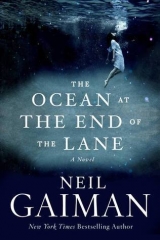
Текст книги "The ocean at the end of the lane"
Автор книги: Neil Gaiman
Жанры:
Современная проза
,сообщить о нарушении
Текущая страница: 8 (всего у книги 10 страниц)
“I didn’t start it!” I told the dead man. “It’s not fair. You started it.”
“Yes,” said the dead man. “Are you coming?”
I sat down with my back to the dead tree in the center of the fairy ring, and I closed my eyes, and I did not move. I remembered poems to distract myself, recited them silently under my breath, mouthing the words but making no sound.
Fury said to a mouse that he met in the house let us both go to law I will prosecute you . . .
I had learned that poem by heart at my school. It was told by the Mouse from Alice in Wonderland, the Mouse she met swimming in the pool of her own tears. In my copy of Alice the words of the poem curled and shrank like a mouse’s tail.
I could say all of the poem in one long breath, and I did, all the way to the inevitable end.
I’ll be judge I’ll be jury said cunning old Fury I’ll try the whole cause and condemn you to death.
When I opened my eyes and looked up the opal miner was no longer there.
The sky was going gray and the world was losing depth and flattening into twilight. If the shadows were still there I could no longer perceive them; or rather, the whole world had become shadows.
My little sister ran down from the house, calling my name. She stopped before she reached me, and she said, “What are you doing?”
“Nothing.”
“Daddy’s on the phone. He says you have to come and talk to him.”
“No. He doesn’t.”
“What?”
“He doesn’t say that.”
“If you don’t come now, you’ll be in trouble.”
I did not know if this was my sister or not, but I was on the inside of the grass circle, and she was on the outside.
I wished I had brought a book with me, even though it was almost too dark to read. I said the Mouse’s “Pool of Tears” poem again, in my head. Come I’ll take no denial we must have a trial for really this morning I’ve nothing to do . . .
“Where’s Ursula?” asked my sister. “She went up to her room, but she isn’t there anymore. She’s not in the kitchen and she’s not in the loo-lahs. I want my tea. I’m hungry.”
“You can make yourself something to eat,” I told her. “You’re not a baby.”
“Where’s Ursula?”
She was ripped to shreds by alien vulture-monsters and honestly I think you’re one of them or being controlled by them or something.
“Don’t know.”
“I’m telling Mummy and Daddy when they get home that you were horrible to me today. You’ll get into trouble.” I wondered if this was actually my sister or not. It definitely sounded like her. But she did not take a step over the circle of greener grass, into the ring. She stuck her tongue out at me, and ran back toward the house.
Said the mouse to the cur such a trial dear sir with no jury or judge would be wasting our breath . . .
Deep twilit dusk, all colorless and strained. Mosquitoes whined about my ears and landed, one by one, on my cheeks and my hands. I was glad I was wearing Lettie Hempstock’s cousin’s strange old-fashioned clothing, then, because I had less bare skin exposed. I slapped at the insects as they landed, and some of them flew off. One that didn’t fly away, gorging itself on the inside of my wrist, burst when I hit it, leaving a smeared teardrop of my blood to run down the inside of my arm.
There were bats flying above me. I liked bats, always had, but that night there were so many of them, and they made me think of the hunger birds, and I shuddered.
Twilight became, imperceptibly, night, and now I was sitting in a circle that I could no longer see, at the bottom of the garden. Lights, friendly electric lights, went on in the house.
I did not want to be scared of the dark. I was not scared of any real thing. I just did not want to be there any longer, waiting in the darkness for my friend who had run away from me and did not seem to be coming back.
. . . said cunning old Fury I’ll try the whole cause and condemn you to death.
I stayed just where I was. I had seen Ursula Monkton torn to shreds, and the shreds devoured by scavengers from outside the universe of things that I understood. If I went out of the circle, I was certain, they would do the same to me.
I moved from Lewis Carroll to Gilbert and Sullivan.
When you’re lying awake with a dismal headache and repose is taboo’d by anxiety, I conceive you may use any language you choose to indulge in without impropriety . . .
I loved the sound of the words, even if I was not entirely sure what all of them meant.
I needed to wee. I turned my back on the house, took a few steps away from the tree, scared I would take one step too far and find myself outside the circle. I urinated into the darkness. I had just finished when I was blinded by a torch beam, and my father’s voice said, “What on earth are you doing down here?”
“I . . . I’m just down here,” I said.
“Yes. Your sister said. Well, time to come back to the house. Your dinner’s on the table.”
I stayed where I was. “No,” I said, and shook my head.
“Don’t be silly.”
“I’m not being silly. I’m staying here.”
“Come on.” And then, more cheerful, “Come on, Handsome George.” It had been his silly pet name for me, when I was a baby. He even had a song that went with it that he would sing while bouncing me on his lap. It was the best song in the world.
I didn’t say anything.
“I’m not going to carry you back to the house,” said my father. There was an edge starting to creep into his voice. “You’re too big for that.”
Yes, I thought. And you’d have to cross into the fairy ring to pick me up.
But the fairy ring seemed foolish now. This was my father, not some waxwork thing that the hunger birds had made to lure me out. It was night. My father had come home from work. It was time.
I said, “Ursula Monkton’s gone away. And she’s not ever coming back.”
He sounded irritated, then. “What did you do? Did you say something horrible to her? Were you rude?”
“No.”
He shone the torch beam onto my face. The light was almost blinding. He seemed to be fighting to keep his temper under control. He said, “Tell me what you said to her.”
“I didn’t say anything to her. She just went away.”
It was true, or almost.
“Come back to the house, now.”
“Please, Daddy. I have to stay here.”
“You come back to the house this minute!” shouted my father, at the top of his voice, and I could not help it: my lower lip shook, my nose started to run, and tears sprang to my eyes. The tears blurred my vision and stung, but they did not fall, and I blinked them away.
I did not know if I was talking to my own father or not.
I said, “I don’t like it when you shout at me.”
“Well, I don’t like it when you act like a little animal!” he shouted, and now I was crying, and the tears were running down my face, and I wished that I was anywhere else but there that night.
I had stood up to worse things than him in the last few hours. And suddenly, I didn’t care anymore. I looked up at the dark shape behind and above the torch beam, and I said, “Does it make you feel big to make a little boy cry?” and I knew as I said it that it was the thing I should never have said.
His face, what I could see of it in the reflected torchlight, crumpled, and looked shocked. He opened his mouth to speak, then he closed it again. I could not remember my father ever at a loss for words, before or after. Only then. I felt terrible. I thought, I will die here soon. I do not want to die with those words on my lips.
But the torch beam was turning away from me. My father said only, “We’ll be up at the house. I’ll put your dinner in the oven.”
I watched the torchlight move back across the lawn, past the rosebushes and up toward the house, until it went out, and was lost to sight. I heard the back door open and close again.
Then you get some repose in the form of a doze with hot eyeballs and head ever aching but your slumbering teems with such horrible dreams that you’d very much better be waking . . .
Somebody laughed. I stopped singing, and looked around, but saw nobody.
“ ‘The Nightmare Song,’ ” a voice said. “How appropriate.”
She walked closer, until I could see her face. Ursula Monkton was still quite naked, and she was smiling. I had seen her torn to pieces a few hours before, but now she was whole. Even so, she looked less solid than any of the other people I had seen that night; I could see the lights of the house glimmering behind her, through her. Her smile had not changed.
“You’re dead,” I told her.
“Yes. I was eaten,” said Ursula Monkton.
“You’re dead. You aren’t real.”
“I was eaten,” she repeated. “I am nothing. And they have let me out, just for a little while, from the place inside them. It’s cold in there, and very empty. But they have promised you to me, so I will have something to play with; something to keep me company in the dark. And after you have been eaten, you too will be nothing. But whatever remains of that nothing will be mine to keep, eaten and together, my toy and my distraction, until the end of time. We’ll have such fun.”
A ghost of a hand was raised, and it touched the smile, and it blew me the ghost of Ursula Monkton’s kiss.
“I’ll be waiting for you,” she said.
A rustle in the rhododendrons behind me and a voice, cheerful and female and young, saying, “It’s okay. Gran fixed it. Everything’s taken care of. Come on.”
The moon was visible now above the azalea bush, a bright crescent like a thick nail paring.
I sat down by the dead tree, and did not move.
“Come on, silly. I told you. They’ve gone home,” said Lettie Hempstock.
“If you’re really Lettie Hempstock,” I told her, “you come here.”
She stayed where she was, a shadowy girl. Then she laughed, and she stretched and she shook, and now she was only another shadow: a shadow that filled the night.
“You are hungry,” said the voice in the night, and it was no longer Lettie’s voice, not any longer. It might have been the voice inside my own head, but it was speaking aloud. “You are tired. Your family hates you. You have no friends. And Lettie Hempstock, I regret to tell you, is never coming back.”
I wished I could have seen who was talking. If you have something specific and visible to fear, rather than something that could be anything, it is easier.
“Nobody cares,” said the voice, so resigned, so practical. “Now, step out of the circle and come to us. One step is all it will take. Just put one foot across the threshold and we will make all the pain go away forever: the pain you feel now and the pain that is still to come. It will never happen.”
It was not one voice, not any longer. It was two people talking in unison. Or a hundred people. I could not tell. So many voices.
“How can you be happy in this world? You have a hole in your heart. You have a gateway inside you to lands beyond the world you know. They will call you, as you grow. There can never be a time when you forget them, when you are not, in your heart, questing after something you cannot have, something you cannot even properly imagine, the lack of which will spoil your sleep and your day and your life, until you close your eyes for the final time, until your loved ones give you poison and sell you to anatomy, and even then you will die with a hole inside you, and you will wail and curse at a life ill-lived. But you won’t grow. You can come out, and we will end it, cleanly, or you can die in there, of hunger and of fear. And when you are dead your circle will mean nothing, and we will tear out your heart and take your soul for a keepsake.”
“P’raps it will be like that,” I said, to the darkness and the shadows, “and p’raps it won’t. And p’raps if it is, it would have been like that anyway. I don’t care. I’m still going to wait here for Lettie Hempstock, and she’s going to come back to me. And if I die here, then I still die waiting for her, and that’s a better way to go than you and all you stupid horrible things tearing me to bits because I’ve got something inside me that I don’t even want!”
There was silence. The shadows seemed to have become part of the night once again. I thought over what I’d said, and I knew that it was true. At that moment, for once in my childhood, I was not scared of the dark, and I was perfectly willing to die (as willing as any seven-year-old, certain of his immortality, can be) if I died waiting for Lettie. Because she was my friend.
Time passed. I waited for the night to begin to talk to me again, for people to come, for all the ghosts and monsters of my imagination to stand beyond the circle and call me out, but nothing more happened. Not then. I simply waited.
The moon rose higher. My eyes had adjusted to the darkness. I sang, under my breath, mouthing the words over and over.
You’re a regular wreck with a crick in your neck
and no wonder you snore for your head’s on the floor
and you’ve needles and pins from your sole to your shins
and your flesh is a-creep for your left leg’s asleep
and you’ve cramp in your toes and a fly on your nose
you’ve got fluff in your lung and a feverish tongue
and a thirst that’s intense and a general sense that you haven’t been sleeping in clover . . .
I sang it to myself, the whole song, all the way through, two or three times, and I was relieved that I remembered the words, even if I did not always understand them.

When Lettie arrived, the real Lettie, this time, she was carrying a bucket of water. It must have been heavy judging from the way she carried it. She stepped over where the edge of the ring in the grass must have been and she came straight to me.
“Sorry,” she said. “That took a lot longer than I expected. It didn’t want to cooperate, neither, and in the end it took me and Gran to do it, and she did most of the heavy lifting. It wasn’t going to argue with her, but it didn’t help, and it’s not easy—”
“What?” I asked. “What are you talking about?”
She put the metal bucket down on the grass beside me without spilling a drop. “The ocean,” she said. “It didn’t want to go. It gave Gran such a struggle that she said she was going to have to go and have a lie-down afterwards. But we still got it into the bucket in the end.”
The water in the bucket was glowing, emitting a greenish-blue light. I could see Lettie’s face by it. I could see the waves and ripples on the surface of the water, watch them crest and splash against the side of the bucket.
“I don’t understand.”
“I couldn’t get you to the ocean,” she said. “But there was nothing stopping me bringing the ocean to you.”
I said, “I’m hungry, Lettie. And I don’t like this.”
“Mum’s made dinner. But you’re going to have to stay hungry for a little bit longer. Were you scared, up here on your own?”
“Yes.”
“Did they try and get you out of the circle?”
“Yes.”
She took my hands in hers, then, and squeezed them. “But you stayed where you were meant to be, and you didn’t listen to them. Well done. That’s quality, that is.” And she sounded proud. In that moment I forgot my hunger and I forgot my fear.
“What do I do now?” I asked her.
“Now,” she said, “you step into the bucket. You don’t have to take your shoes off or anything. Just step in.”
It did not even seem a strange request. She let go of one of my hands, kept hold of the other. I thought, I will never let go of your hand, not unless you tell me to. I put one foot into the glimmering water of the bucket, raising the water level almost to the edge. My foot rested on the tin floor of the bucket. The water was cool on my foot, not cold. I put the other foot into the water and I went down with it, down like a marble statue, and the waves of Lettie Hempstock’s ocean closed over my head.
I felt the same shock you would feel if you had stepped backwards, without looking, and had fallen into a swimming pool. I closed my eyes at the water’s sting and kept them tightly shut, so tightly.
I could not swim. I did not know where I was, or what was happening, but even under the water I could feel that Lettie was still holding my hand.
I was holding my breath.
I held it until I could hold it no longer, and then I let the air out in a bubbling rush and gulped a breath in, expecting to choke, to splutter, to die.
I did not choke. I felt the coldness of the water—if it was water—pour into my nose and my throat, felt it fill my lungs, but that was all it did. It did not hurt me.
I thought, This is the kind of water you can breathe. I thought, Perhaps there is just a secret to breathing water, something simple that everyone could do, if only they knew. That was what I thought.
That was the first thing I thought.
The second thing I thought was that I knew everything. Lettie Hempstock’s ocean flowed inside me, and it filled the entire universe, from Egg to Rose. I knew that. I knew what Egg was—where the universe began, to the sound of uncreated voices singing in the void—and I knew where Rose was—the peculiar crinkling of space on space into dimensions that fold like origami and blossom like strange orchids, and which would mark the last good time before the eventual end of everything and the next Big Bang, which would be, I knew now, nothing of the kind.
I knew that Old Mrs. Hempstock would be here for that one, as she had been for the last.
I saw the world I had walked since my birth and I understood how fragile it was, that the reality I knew was a thin layer of icing on a great dark birthday cake writhing with grubs and nightmares and hunger. I saw the world from above and below. I saw that there were patterns and gates and paths beyond the real. I saw all these things and understood them and they filled me, just as the waters of the ocean filled me.
Everything whispered inside me. Everything spoke to everything, and I knew it all.
I opened my eyes, curious to learn what I would see in the world outside me, if it would be anything like the world inside.
I was hanging deep beneath the water.
I looked down, and the blue world below me receded into darkness. I looked up and the world above me did the same. Nothing was pulling me down deeper, nothing was forcing me toward the surface.
I turned my head, a little, to look at her, because she was still holding my hand, she had never let go of my hand, and I saw Lettie Hempstock.
At first, I do not think I knew what I was looking at. I could make no sense of it. Where Ursula Monkton had been made of gray cloth that flapped and snapped and gusted in the storm-winds, Lettie Hempstock was made of silken sheets the color of ice, filled with tiny flickering candle flames, a hundred hundred candle flames.
Could there be candle flames burning under the water? There could. I knew that, when I was in the ocean, and I even knew how. I understood it just as I understood Dark Matter, the material of the universe that makes up everything that must be there but we cannot find. I found myself thinking of an ocean running beneath the whole universe, like the dark seawater that laps beneath the wooden boards of an old pier: an ocean that stretches from forever to forever and is still small enough to fit inside a bucket, if you have Old Mrs. Hempstock to help you get it in there, and you ask nicely.
Lettie Hempstock looked like pale silk and candle flames. I wondered how I looked to her, in that place, and knew that even in a place that was nothing but knowledge that was the one thing I could not know. That if I looked inward I would see only infinite mirrors, staring into myself for eternity.
The silk filled with candle flames moved then, a slow, graceful, under-the-water sort of a movement. The current pulled at it, and now it had arms and the hand that had never let go of mine, and a body and a freckled face that was familiar, and it opened its mouth and, in Lettie Hempstock’s voice, it said, “I’m really sorry.”
“What for?”
She did not reply. The currents of the ocean pulled at my hair and my clothes like summer breezes. I was no longer cold and I knew everything and I was not hungry and the whole big, complicated world was simple and graspable and easy to unlock. I would stay here for the rest of time in the ocean which was the universe which was the soul which was all that mattered. I would stay here forever.
“You can’t,” said Lettie. “It would destroy you.”
I opened my mouth to tell her that nothing could kill me, not now, but she said, “Not kill you. Destroy you. Dissolve you. You wouldn’t die in here, nothing ever dies in here, but if you stayed here for too long, after a while just a little of you would exist everywhere, all spread out. And that’s not a good thing. Never enough of you all together in one place, so there wouldn’t be anything left that would think of itself as an ‘I.’ No point of view any longer, because you’d be an infinite sequence of views and of points . . .”
I was going to argue with her. She was wrong, she had to be: I loved that place, that state, that feeling, and I was never going to leave it.
And then my head broke water, and I blinked and coughed, and I was standing, thigh-deep in the pond at the back of the Hempstocks’ farm, and Lettie Hempstock was standing beside me, holding my hand.
I coughed again, and it felt like the water fled my nose, my throat, my lungs. I pulled clean air into my chest, in the light of the huge, full harvest moon, that shone on the Hempstocks’ red-tiled roof, and, for one final, perfect moment, I still knew everything: I remember that I knew how to make it so the moon would be full when you needed it to be, and shining just on the back of the house, every night.
I knew everything, but Lettie Hempstock was pulling me up out of the pond.
I was still wearing the strange old-fashioned clothes I had been given that morning, and as I stepped out of the pond, up onto the grass that edged it, I discovered that my clothes and my skin were now perfectly dry. The ocean was back in the pond, and the only knowledge I was left with, as if I had woken from a dream on a summer’s day, was that it had not been long ago since I had known everything.
I looked at Lettie in the moonlight. “Is that how it is for you?” I asked.
“Is what how it is for me?”
“Do you still know everything, all the time?”
She shook her head. She didn’t smile. She said, “Be boring, knowing everything. You have to give all that stuff up if you’re going to muck about here.”
“So you used to know everything?”
She wrinkled her nose. “Everybody did. I told you. It’s nothing special, knowing how things work. And you really do have to give it all up if you want to play.”
“To play what?”
“This,” she said. She waved at the house and the sky and the impossible full moon and the skeins and shawls and clusters of bright stars.
I wished I knew what she meant. It was as if she was talking about a dream we had shared. For a moment it was so close in my mind that I could almost touch it.
“You must be so hungry,” said Lettie, and the moment was broken, and yes, I was so hungry, and the hunger took my head and swallowed my lingering dreams.
There was a plate waiting for me in my place at the table in the farmhouse’s huge kitchen. On it was a portion of shepherd’s pie, the mashed potato a crusty brown on top, minced meat and vegetables and gravy beneath it. I was scared of eating food outside my home, scared that I might want to leave food I did not like and be told off, or be forced to sit and swallow it in minuscule portions until it was gone, as I was at school, but the food at the Hempstocks’ was always perfect. It did not scare me.
Ginnie Hempstock was there, bustling about in her apron, rounded and welcoming. I ate without talking, head down, shoveling the welcome food into my mouth. The woman and the girl spoke in low, urgent tones.
“They’ll be here soon enough,” said Lettie. “They aren’t stupid. And they won’t leave until they’ve taken the last little bit of what they came here for.”
Her mother sniffed. Her red cheeks were flushed from the heat of the kitchen fire. “Stuff and nonsense,” she said. “They’re all mouth, they are.”
I had never heard that expression before, and I thought she was telling us that the creatures were just mouths and nothing more. It did not seem unlikely that the shadows were indeed all mouths. I had seen them devour the gray thing that had called itself Ursula Monkton.
My grandmother would tell me off for eating like a wild animal. “You must essen, eat,” she would say, “like a person, not a chazzer, a pig. When animals eat, they fress. People essen. Eat like a person.” Fressen: that was how the hunger birds had taken Ursula Monkton and it was also, I had no doubt, how they would consume me.
“I’ve never seen so many of them,” said Lettie. “When they came here in the old days there was only a handful of them.”
Ginnie poured me a glass of water. “That’s your own fault,” she told Lettie. “You put up signals, and called them. Like banging the dinner bell, you were. Not surprising they all came.”
“I just wanted to make sure that she left,” said Lettie.
“Fleas,” said Ginnie, and she shook her head. “They’re like chickens who get out of the henhouse, and are so proud of themselves and so puffed up for being able to eat all the worms and beetles and caterpillars they want, that they never think about foxes.” She stirred the custard cooking on the hob, with a long wooden spoon in huge, irritated movements. “Anyway, now we’ve got foxes. And we’ll send them all home, same as we did the last times they were sniffing around. We did it before, didn’t we?”
“Not really,” said Lettie. “Either we sent the flea home, and the varmints had nothing to hang around for, like the flea in the cellar in Cromwell’s time, or the varmints came and took what they came here for and then they went away. Like the fat flea who made people’s dreams come true in Red Rufus’s day. They took him and they upped and left. We’ve never had to get rid of them before.”
Her mother shrugged. “It’s all the same sort of thing. We’ll just send them back where they came from.”
“And where do they come from?” asked Lettie.
I had slowed down now, and was making the final fragments of my shepherd’s pie last as long as I could, pushing them around the plate slowly with my fork.
“That dunt matter,” said Ginnie. “They all go back eventually. Probably just get bored of waiting.”
“I tried pushing them around,” said Lettie Hempstock, matter-of-factly. “Couldn’t get any traction. I held them with a dome of protection, but that wouldn’t have lasted much longer. We’re good here, obviously—nothing’s coming into this farm without our say-so.”
“In or out,” said Ginnie. She removed my empty plate, replaced it with a bowl containing a steaming slice of spotted dick with thick yellow custard drizzled all over it.
I ate it with joy.
I do not miss childhood, but I miss the way I took pleasure in small things, even as greater things crumbled. I could not control the world I was in, could not walk away from things or people or moments that hurt, but I found joy in the things that made me happy. The custard was sweet and creamy in my mouth, the dark swollen currants in the spotted dick were tangy in the cake-thick chewy blandness of the pudding, and perhaps I was going to die that night and perhaps I would never go home again, but it was a good dinner, and I had faith in Lettie Hempstock.
The world outside the kitchen was still waiting. The Hempstocks’ fog-colored house cat—I do not believe I ever knew her name—padded through the kitchen. That reminded me . . .
“Mrs. Hempstock? Is the kitten still here? The black one with the white ear?”
“Not tonight,” said Ginnie Hempstock. “She’s out and about. She was asleep on the chair in the hall all this afternoon.”
I wished I could stroke her soft fur. I wanted, I realized, to say goodbye.
“Um. I suppose. If I do. Have to die. Tonight,” I started, haltingly, not sure where I was going. I was going to ask for something, I imagine—for them to say goodbye to my mummy and daddy, or to tell my sister that it wasn’t fair that nothing bad ever happened to her: that her life was charmed and safe and protected, while I was forever stumbling into disaster. But nothing seemed right, and I was relieved when Ginnie interrupted me.
“Nobody is going to die tonight,” said Ginnie Hempstock, firmly. She took my empty bowl and washed it out in the sink, then she dried her hands on her apron. She took the apron off, went out into the hallway and returned a few moments later wearing a plain brown coat and a pair of large dark green Wellington boots.
Lettie seemed less confident than Ginnie. But Lettie, with all her age and wisdom, was a girl, while Ginnie was an adult, and her confidence reassured me. I had faith in them both.
“Where’s Old Mrs. Hempstock?” I asked.
“Having a lie-down,” said Ginnie. “She’s not as young as she used to be.”
“How old is she?” I asked, not expecting to get an answer. Ginnie just smiled, and Lettie shrugged.
I held Lettie’s hand as we left the farmhouse, promising myself that this time I would not let it go.
When I had entered the farmhouse, through the back door, the moon had been full, and it was a perfect summer’s night. When I left, I went with Lettie Hempstock and her mother out of the front door, and the moon was a thin white smile, high in a cloudy sky, and the night was gusty with sudden, undecided spring breezes coming first from one direction, then from another; every now and again a gust of wind would contain a sprinkling of rain that never amounted to anything more than that.
We walked through the manure-stinking farmyard and up the lane. We passed a bend in the road, and we stopped. Although it was dark, I knew exactly where I was. This was where it had all begun. It was the corner where the opal miner had parked my family’s white Mini, the place that he had died all alone, with a face the color of pomegranate juice, aching for his lost money, on the edge of the Hempstock land where the barriers between life and death were thin.
I said, “I think we should wake up Old Mrs. Hempstock.”
“It doesn’t work like that,” said Lettie. “When she gets tired, she sleeps until she wakes up on her own. A few minutes or a hundred years. There’s no waking her. Might as well try and wake up an atom bomb.”
Ginnie Hempstock planted herself in the middle of the lane, facing away from the farmhouse.
“Right!” she shouted to the night. “Let’s be having you.”