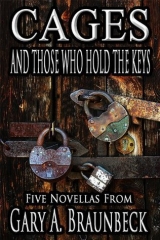
Текст книги "Cages and Those Who Hold the Keys"
Автор книги: Gary A. Braunbeck
сообщить о нарушении
Текущая страница: 7 (всего у книги 31 страниц)
Even though he knew time was slipping away, Martin was so stunned by the sight he couldn’t move for several moments.
The painting possessed a dark edginess echoing movements of the past—social realism, German expressionism, Dadaism, surrealism, even a touch of the more recent imagists—yet no one style conflicted with the others; its identity came from an effortless fusion into something that, Martin thought—if it could be labeled at all—might be called “Cumulativism”. It beckoned to him, demanded his awe, his closeness, but as he neared it, at the moment of communion, the faces within seemed to withdraw, distancing themselves from him. Soft shadows of sadness bled from each corner into the center of the painting, creating a disquieting rippling effect, the emotional residue of a broken and embittered heart, searching for a place of healing in a universe that ultimately had no use for either sadness or redemption.
It was the most astonishing thing he had ever seen.
He couldn’t make out the landscape for the crowd of near-life-sized people in the foreground; instead, their shapes seemed to almost be the landscape, with heads in place of hills. Forty faces—he counted them—stared out, their expressions ranging from benevolent acceptance to fury so white-hot you could feel it radiating outward to sear the skin. The faces in front were the most detailed, yet their expressions were the most placid. The faces behind grew less developed the farther back they appeared—many were little more than a few splotches—yet their expressions were instantly recognizable. These faces were thoughtful, their eyes alive: there was a man dressed in an old leather coat, his darkly lustrous face accented by an even darker beard as he stared downward and a little to the right, a shepherd’s cap held in his wind-burnt hands, a man of hushed, gentle resignation, his dignity whispering of well-earned rest, a warm fire waiting at home, and the rich scent of bread baking in the kitchen; behind him stood an exquisite woman in a golden dress that fluttered gently in the breeze, and though her back was turned forward and you saw her face only in profile, it was easy to see the care she took before presenting herself to the world, her delicate hands the ghost of an errant wish—that a woman might never grow old, never lose the radiance that kissed her face when a suitor came to call, never see her beauty dissolve little by little in the unflattering sunlight of each morning, and never know a day when the scent of fresh roses from an admirer did not fill her rooms; next to her stood a bittersweet girl with long dark hair tumbling about her shoulders, her face seemingly held in a velvet cradle, a hand covering her mouth, eyes with sad dark places around them that told you she often hid behind a scrim of gaiety to conceal a lonely heart; she was every night you sat isolated and alone, wishing for the warm hand of a lover to hold in your own as autumn dimmed into winter and youth turned to look at you over its shoulder and smile farewell.
A single, hard, unnoticed tear spilled from Martin’s eye, trailing down his cheek.
“‘To take into the air my quiet breath . . .’” he whispered. “‘To cease upon the midnight with no pain . . . .’”
Above all these face was an agate sky that warned of the coming storm; a cold veil of rain approached from the upper right side, a sprinkle becoming mist becoming a terrible cloud formation that erupted across the top of the scene to cover nearly one-fifth of the entire painting: swirling black tinged with grey and purple, its mass thinning somewhat as it spread outward to form the shadow of a great, winged creature.
Martin shook himself from a sudden chill, stepped back once more, then gave the painting one last look.
“Okay,” he whispered to the emptiness. “I found the painting. Now where’s the goddamn key?”
A voice behind him said, “‘The world is a stone, soldier . . .’”
Martin whirled around to find himself once again face to face with the six-year-old boy he’d once been. “Jesus Christ, scare me to death, why don’t you?”
“Sorry.”
“What are you doing here, any—?”
You’ll know the key when you find it—or when it finds you.
Martin smiled. “It’s you, isn’t it? You’re the key!”
The little boy shook his head.
Martin’s heart sank. “Then why are you here?”
“‘The world is a stone, soldier . . .’” “You already said that; repeating it doesn’t help me.” “You have to remember.” “Remember what?”
The little boy shook his head and released one those deeply dramatic sighs of which only children are capable, then said: “When you bought him that hot dog and soda that day, you said that you’d once been a writer. He asked what kind of stuff you wrote and you told him stories and books and a few—”
“. . . a few lousy poems,” said Martin. “Yeah . . . I think I remember saying something like that.”
“He said that there was no such thing as a lousy poem, only lousy poets.”
Martin laughed. “That’s right! I remember really liking that line.”
The little boy nodded. “You said you might use that sometime, and he said you could have it . . . for the price of a poem.”
Something in the back of Martin’s mind was stirring beneath its covers. “Yeah . . . that’s right . . . that’s what he said.”
“And you recited one for him, and he loved it. He loved it so much that it gave him an idea.” The boy nodded toward the painting. “He painted that because of you, because of the poem you recited to him. You were the inspiration.
“You’ve forgotten too many of the good things, Martin. You only see your mistakes.
“The admission to the Midnight Museum is that poem. That’s the key. It was one of the many good things about yourself that you’ve forgotten.”
Martin knelt down in front of the boy. “Where did you come from? Did Bob or Jerry send you?”
The little boy shook his head.
“Then how did you get here?”
“With you. I’ve always been with you. You just forgot about me. I got out the other night, after you took the first bunch of pills. I didn’t want to die just because you did. Dumb bunny.”
“I’m . . . I’m sorry.”
The little boy reached out and put his hand on Martin’s shoulder. “You don’t have to be sorry about anything, not anymore.”
“Why?”
“Because Mom and Dad still love you, they always did and always will, and because . . .‘The world is a stone, soldier . . .’”
The thing stirring in Martin’s brain threw back the covers, reached out, and turned on the light.
Martin rose slowly to his feet and turned to face the painting.
“‘The world is a stone, soldier,’” he said. “‘It holds no thought of long brown girls, dead gulls, vanishing town. The great clock with its golden face, face-down; Beneath these cloud-ribbed skies where stars would rot
if stars were men. No alien gods remain along the
boulevards . . .’”
In the painting, the sky began to brighten ever so slowly, allowing beams of broken sunlight to pierce the clouds and fall on the faces of the people gathered below, the faces, Martin now realized, of other Substruo.
He moved a little closer as the light glided across more faces, and a few of those faces closed their eyes and turned up toward the glow.
Martin continued reciting the next stanza, amazed that he was remembering any of this slight, forgettable bit of verse that he’d written a full decade before meeting Bob that day: “‘In this bleak land Civic ghosts dissemble. The street lamps stand, delinquent angels weeping in the rain.’”
The people in the painting began to move; some toward the back, some to the side, others merely turning to the left or right where they stood, creating an opening, revealing a path.
“‘There are countries untroubled by the seas,’” whispered Martin.
The path was wider, clearer now. A few of the people were looking right at him, smiling; the man with the shepherd’s cap even lifted his hand to wave Martin closer.
“‘There are greener worlds, soldier, and other skies; music in the square, women under flowered trees, and summer slides into soft decay, leaf unto leaf . . .’” The woman in the golden dress, who before had stood in profile, now directly faced Martin, and began to offer her hand. Martin reached out and took hold; it was a delicate hand, satin-gloved, exquisitely feminine, and flooded his arm with warmth.
“‘There are always tomorrows, soldier, and other battles done; this music in the square, these women under flowered trees, as summer slides into soft decay, leaf unto leaf; And larks into falcons rise from the yellow sleeves of eternal day.’” Her sudden soft smile was a song his heart had forgotten, and now remembered, could no longer contain. He stepped in among them.
The shepherd laughed; the girls smiled; the older ones, hunched and slow but not beaten, never beaten, grasped his arm and bid him welcome, bade him thanks.
“I would walk with you a ways,” said the woman whose hand held his, “if you would like.”
Martin could barely find his voice. “Yes . . . I’d like that very much.”
He turned and looked down the path, back out into the cold ruined room where his six-year-old self was still standing.
The little boy lifted his hand and waved.
Martin said: “You’re a fine little fellow.”
“And you are a good and decent man,” replied the boy. “Someday you’ll know that. I’ll keep the door open for you as long as I can.
“Now go stop that miserable fucker in his tracks.”
The woman laughed and pulled Martin away, leading him into a field of trees whose bright blue leaves formed upturned faces, and beneath whose shade deeper shadows danced.
Coming to a stop, the woman turned Martin to face her and kissed him firmly on the lips. “Just so you know, his favorite book was Alice in Wonderland.” Martin looked at the dancing shadows, that had now stopped, forming a deep, dark circle beneath the trees. “Have you your weapon, still?” asked the woman. Martin shook the crowbar from his sleeve and held it up.
“‘There are always tomorrows, soldier, and other battles done,’” said the woman, kissing Martin once again. “Might I suggest you remember the old rule of tuck-and-roll?”
“What are—?”
He never finished the question, because Gold Dress gave him a playful push backward, and before he could regain his balance to stop it, he spun around and was falling down the hole made by the stilled dancing shadows.
I’m finally flying, he thought as he dropped downward, arms out at his sides, legs behind him.
It took perhaps fifteen seconds for him to reach the floor, and by then he had pulled himself into a ball, legs bent to lessen the severity of the landing, and when he hit, he hit hard, but he remembered to tuck-and-roll, and when he came up again, when he stood, his entire body still thrumming with the echoed impact of the landing (pain, yes, no doubt about that, but muffled, waning), he took only three seconds to steady himself and pull in a deep breath before running forward, toward the marbled doorway only a few dozen yards away, the magnificent marble doorway into whose columns were carved whimsical figures of monkeys, serpents, lions, butterflies, Hindu– and Greek-inspired deities, and figures who bore so close a resemblance to the circus Tumblesands Martin almost expected them to step forward and take a bow.
The entablature above the doorway proclaimed:
THE MIDNIGHT MUSEUM
Afternoon Tours Available
“Funny,” he said, then—smacking the crowbar against his hand to assure himself of its weight and power—stepped through.
The floor was a highly-polished chessboard of alternating black-and-white marble tiles whose configuration, coupled with the incredible height of the ceiling, gave the interior an almost-dizzying forced perspective, but despite the bright tract lighting, the large wall-mounted video monitors (all of which were currently displaying electronic snow), and the enormous oval skylight set into the center of the cavernous ceiling, it was a dim-spirited place, a terrible place, a place where gigantic tumors squatted in fossilized silence, where syphilitic skulls stared out from glass cases, and where a pair of tubercular torsos encases in bulky Lucite squares sat atop short ersatz-Roman columns, one on each side of the entrance to the innumerable displays—among which a quick glance would find: infected eyes; rows of malformed infants in chemical-filled Plexiglas coffins; sliced cross-sections of human faces; a baby without sexual organs; a colon grown to seven times normal size; a plaster cast of Siamese twins, made after death, with armpit hairs in the casting; a special display centering around a nameless man who died in 1897 when the tissue connecting his muscles mutated torturously into bone; something called “The Soap Lady”—a body buried in soil possessing rare properties that turned her corpse into adipocere, her mouth open as if she’d died calling out the name of some long-forgotten love; the skeletons of an eight-foot giant and a three-foot dwarf (The remains of an old magic man and his ungrateful apprentice? Martin wondered); and the obscene death-mask of a little boy whose grotesque facial cleft had turned him into a human gargoyle. No sound. No movement. Death inviting the viewer to pause, so as to better esteem the agonizing poetry of its more creative handiwork.
Unable to absorb all of it at once, Martin focused his eyes straight ahead, on the sign reading Rights of Memory.
He swallowed, took a deep breath, and moved toward it.
Upon entering, the first thing he saw were rows upon rows of bookshelves crammed to overflowing with ancient volumes that reached from the floor to the ceiling.
The books were all three times the size of any encyclopedia he’d ever seen; stamped in gold on their spines were words and sigils he didn’t understand. The smell of mildew wafting down from their pages filled the air, even though only a few of them lay open, face-down, on nearby reading tables.
So Gash has been passing the time with a little light reading.
The video monitors came on, and Martin immediately jumped behind one of the reading tables.
Oh, some hero-to-the-rescue you are, jackass! First little sound and you’re scrambling for cover.
After the better part of a minute with Gash still a no-show, Martin realized that the monitors must be on some kind of automatic timer—or what passed for such a thing in this place.
He moved from behind the table in slow increments, not fully rising to his feet until he was certain company wasn’t coming.
Each screen was displaying a different image: Spring-greened fields; animals giving birth; scenes of war that shook and jerked from side to side because whoever was holding the camera couldn’t keep it still; an empty playground; a pair of gloves lying on a sand dune in the moonlight; silently screaming faces; children playing; old folks
(Bob, lying in that room in the Taft . . . no, he wasn’t among them)
dying; homeless ones begging for money from passing strangers; couples making love; people in uniforms torturing prisoners; babies being murdered by their parents; priests celebrating Mass; bright fireworks over rivers; assassinations; roses in bloom; wedding photographs; mangled bodies in bomb-blasted streets—
–Martin had to look away, shaking his head to clear it of the images.
Gripping the crowbar with both hands, he moved toward the center of the room, turning in slow circles as he did, not giving anything a chance to sneak up from behind.
The video monitors blinked, then returned to their previous state of silent electronic snow.
Overhead, something moved.
Martin looked up and saw what appeared to be a large, pulsating, organic black sac hanging from between two of the monitors. A thin red tube ran down from its center, dividing into several more that branched out in all directions like veins or exposed nerves.
He held his breath, then looked down at his feet.
The floor itself—already dizzying when stilled—was pulsing in rhythm with the sac overhead, as if the entire structure was a living thing, a single entity composed of several disparate parts, each one somehow alive—but not in the same way Martin himself was alive; this level of existence (if it could be called that) more resembled that of someone in REM sleep, or a hospital patient deep in a coma.
It took a moment for the impact of this to register, and when it did, Martin smiled.
Gash was sleeping again; maybe just a quick little nap, forty winks before finishing the job, but . . . yeah; asleep once more.
Stepping past a glass case containing something that looked like a giant insect carapace with angel’s wings, Martin moved toward a pile of bodies (Christ, how he hoped they were just life-sized and –like statues), all of which had been set aflame at some point in the past: they had melted in places, fusing together into a grotesque mass of entwined limbs and bloated flesh that encircled a glass case in the middle. At various points, a few of the red “veins” from the ceiling sac entered the mass through moist, puckered knots.
But this still wasn’t the worst of it.
Behind the mass and the glass case they encircled, the first in a series of naked human figures hung upside-down by its shackled ankles, swinging back and forth at the end of a rusted chain.
It wore Bob’s face, broken with grief, darkened by terror.
In the center of its chest was a moist, round, bloody hole.
It’s not him; remember that.
Easier said than done, because each succeeding figure not only shared Bob’s face and the gaping bloody chasm in the center of his chest, but built upon his original expression of grief and terror, his horror more defined, enabling Martin to witness the perverted evolution of his anguish: rage, euphoria, self-loathing, ecstasy, confusion, pride, and—on the final, hideously-realized figure—helpless resignation. This last image of Bob was looking directly at something massive that lay
(slept?)
under a gigantic tarpaulin at the farthest side of the room.
Martin thought: Oh, fuck me . . .
Because he knew what was under there.
(Make damn sure he doesn’t spot you—and more important than that, make sure you don’t see him. It, actually. Trust me on this: you lay eyes on that thing, you’d sooner rip them out of their sockets than have to look at it a second time.)
“Don’t freeze-up now, Dipshit,” he whispered to himself. “You got this far.”
He turned toward the body-heap once again, this time looking at the display in the center.
Even this far away, Martin could easily make out the words on the plaque:
As Was, As Is
This baby had no cranium, and was nestled on a bed of cotton in the large glass case filled with what he assumed was formaldehyde; whatever it was, years of soaking in the chemical had turned the baby’s skin a ghostly white. It sat in a semi-upright position, legs bent at the knees, feet horizontal, arms thrust straight out from the elbows as if resting on the arms of a chair: a wise old sage upon his throne, waiting on a lonely mountaintop for the truth-seekers to arrive.
Stepping as lightly as he could (the fucking floor would not stop pulsing), Martin began to climb the body-heap, forcing himself to ignore the elastic, spongy softness of each face or torso he stepped on.
It didn’t help that he could fully use only one hand to assist his climb, the other busy gripping the crowbar.
Even though it took him only a minute to reach the top, to Martin it felt like an hour; by the time he was able to fully stand before the display, he was drenched in sweat, his heart trip-hammering in his chest as if trying to squirt through his rib cage.
He stared down at the malformed baby. “Let me ask you something, little man As-Was,” he whispered between gulps of air. “Could this be just a tad more ominous? I mean, seriously. Throw in some cobwebs and a cameo by Boris Karloff, and we’d have the serious makings.”
Keep joking, he told himself. As long as you can make with the smartasseries, you won’t have to think about what’s under that tarpaulin or admit how goddamn you-should-pardon-the-expression scared you are.
Leaning closer to the case, Martin said, “I take it from the notable lack of enthusiasm that you’re more of a Vincent Price man, am I right? I am right, aren’t I?”
As-Was made no reply. Extra cotton had been packed behind its neck and around its shoulders to prevent its head from lolling forward or around; only close scrutiny revealed the clear, thin wire that ran down from the lid of the case, snaking through the dense layers of cotton to attach itself—via a small silver hook—to a catch protruding from the base of his skull.
Despite his rising anxiety (it wasn’t quite outright terror yet, but it was probably within walking distance of the neighborhood), Martin couldn’t resist reaching out with his free hand and giving the case a small but solid shake, if for no other reason than to re-affirm that he was really here. The formaldehyde rippled once, twice, more, each rising disturbance pattern expanding into the one above and below it, creating hybrid ripples that looked like rolling lines of static on an old television screen, and as each series of ripples broke against the surface, As-Was began moving in response to the mild turbulence: first a finger—up, then down, tapping in rhythmic thoughtfulness, a smooth liquid reflex; then a hand—side to side, waving as if it were trying to attract someone’s attention; then an arm—shuddering; then both arms; and, finally, the head—up-down, up-down, the wise old sage nodding in sympathy as the truth-seekers spoke of their dilemma.
Here in the Midnight Museum, moments became the real becoming dreams becoming now and in a blink were gone: then.
The liquid in the case stilled.
As-Was’s bobbing head lolled forward, chin resting against its chest.
The nightclouds retreated, allowing the moonlight to spill through the skylight and grow brighter against the baby’s pallid features. Slanted shadows dissolved. No more sound, save for the soft, ragged rasp of Martin’s breathing. No further movement. Death moving on to busy itself with the weaker living who did not understand the aesthetic of its efforts.
Martin stepped back, readying himself to raise the crowbar and do what he’d come here to do, but froze when all the video monitors surrounding him simultaneously flickered back to life.
Each screen displayed the same image: Bob, as he was right now, as he was at this very second, lying on his shabby bed in his even shabbier room, struggling for every breath. The image was silent and chilly and ashen and dead, save for the diffuse light that shone down from the icy edge of a dispassionate Heaven.
“Oh, Christ,” said Martin, the words emerging somewhere between a nauseous choke and strangled sob.
He watched on-screen as Bob involuntarily opened his mouth, gasping for air; even though there was no sound, Martin thought he could hear Bob’s scream, silent and gnarled and endless: Do it, for chrissakes! In the Midnight Museum, the baby’s mouth opened, releasing a bubble of air that had not been in its lungs a moment before. Bob’s right hand twitched. As did the baby’s.
Bob’s eyelids quivered, then stilled as he released another breath, sinking further into himself and the living death of his affliction.
The baby’s eyelids also quivered, but then snapped open, revealing the burnished, obsidian-black marbles that had been used to replace its eyes. It smiled up at Martin, revealing starched, toothless gums.
“Now or never,” it whispered in a voice clogged with thick liquid age.
Before Martin could react, As-Was reached behind its head with one fishbelly-flesh arm and yanked the hook from the catch in the back of its skull—
–and with unexpected force kicked its feet against the glass, spiderwebbing a crack from which liquid squittered outward as it pressed its arms against the sides of the case to gain more balance before kicking again and then screaming—
–but Martin was ready now, stepping sideways and gripping the crowbar in both hands, swinging it farther back and higher, determined to come down with all the power he had, do it all in one or two massive blows, he could do it, he knew he could, he had to—
–As-Was slammed his feet against the glass once more, heels-first this time, the crack widening as small chunks of glass spit outward, the front of the case pissing an arc of formaldehyde that hit Martin in the belly, soaking his shirt and pants, pooling at his feet, and with one quick last look at Bob’s dying face on the monitors, he swung the crowbar with all he had, connecting with the crack and shattering the front of the case, the liquid vomiting out, soaking him, running in rivulets down the heap of bodies upon which he was standing—
–As-Was tumbled forward, spitting up, then caterwauling at the top of his lungs just like any baby would when it woke up at three in the morning and Mommy and Daddy weren’t there in the dark and it was hungry—
–and Martin squatted down like a baseball catcher and scooped As-Was into the crook of his free arm, his other hand still gripping the crowbar, and this little son-of-a-bitch was slick, slippery, and would not hold still, would not stop kicking, would not give it a rest with the spitting-up but that wasn’t going to stop him, no way, because he’d done it he’d actually for the first time in his life done something that he thought mattered and no squalling little black-eyed flat-top monstrosity was going to screw this up for him—
–and just as he spun around and began to slide down the heap ass-first like a kid with a sled on a snowy hill he saw something from the corner of his eye that kicked his anxiety right in the parts and turned it into outright terror—
–the tarpaulin in the far corner lay flat on the floor.
Not just flat—neatly folded.
You son-of-a-bitch! thought Martin.
He’d been tricked.
Gash had never been asleep, he’d only wanted Martin to think he was asleep, had probably been chuckling to himself while folding the tarpaulin as Martin smashed the case and fought against the rush of formaldehyde and As-Was kicking his chest and screaming and spitting up . . .
Martin hit the floor and slid forward a few yards, propelled not only by the angle of the descent from the body-heap but because the liquid from the case had continued running forward, creating a slick little river across the floor, and by the time he was able to stop scuttling and sliding around and finally get to his feet, two enormous, heavy thumps caused everything above, below, and around him to shudder just as an equally enormous shadow rose up to block out most of the light.
(Don’t look, don’t look, for the love of God whatever you do, don’t look)
Martin hunched forward and ran toward the entrance, As-Was still kicking and clawing and screaming against his chest, and then the floor shook again as Gash took two more
(Simon says take two)
giant steps, only now he was stomping because the bookshelves began to wobble and tilt, raining down dozens of heavy volumes, one of them coming so close to crushing Martin’s skull the corner of its cover tore a small section from the top of his ear, but he kept running, and there it was, there was the entrance, and then he was through and moving forward to where he could see a circle of light spilling down from—
–“Oh, shit!” said Martin—
–from the hole above, from the hole above that it had taken him fifteen seconds to fall through, from the hole above that there was no goddamn way he could reach, even if he didn’t suck at basketball no way could he jump that high, smooth move, Einstein, you got this far and God knows we’re all more than a little shocked by that, warn us next time, will you, but you know what, here’s a question, a real brain-teaser, a little mental exercise for all you over-the-hill glorified janitors out there: why do you always start waxing the floor in the toilet stall?
Everything was shaking apart as Gash continued stomping forward.
(don’tlookdon’tlookdon’tdon’tlook)
Give up?
Answer: because you don’t want to wax yourself into a corner. The difference between a good plan and a not-so-good plan is that a good plan usually includes a way out. Martin looked up and saw all the faces from the painting encircling the way out, peering down. “I don’t suppose any of you have something like a rope?” Their faces told him everything he needed to know.
Martin looked down at the floor and released his breath. If I had a razor, I’d probably open a vein right about—
–then it hit him.
A vein.
The ceiling sac.
Not giving himself time for second thoughts, he turned, hunched down, and ran back into the museum, his eyes focused on the veins running down from the sac and not, repeat not on the foot the size of a couch that had just slammed down on the floor a few yards away from him, and when Martin reached the nearest vein he swung up and out with the crowbar, severing it near floor and loosing a spray of bright blood that geysered in all directions as the vein snapped and whipped around like a live electrical wire, and he had maybe five seconds to grab hold of it and hope he could pull it loose from the sac and that meant either dropping As-Was or the crowbar, and it really wasn’t much of a choice, so it was good-bye crowbar, and he dropped it, grabbed the whip-curling end of the severed vein and somehow managed to twist it around his wrist, grabbing onto it and pulling with everything he had.
From deep inside the core of the sac, something gurgled, then screamed.
Martin moved backward, toward the entrance, pulling, pulling, trying to keep his balance on the blood-slicked floor as the screaming from inside the sac grew louder, ragged, and more intense, damn near deafening him, but then the other end of the vein came loose with a wet, stubborn rip and fell limply to the floor.
Damn thing was strong. Chalk one up for the janitor. He turned to run out– —but Gash was having none of that. And that’s when Martin made his only mistake. He didn’t look away when the thing stepped into the path of his escape.
Gash walked on tree-thick legs that crawled with living sinew on the surface. Where his groin should have been was a bloated, black, seeping cluster of tumors. His skin—if it could be called that—had the jagged, ferromagnesian texture of andesine, though not quite as dark. His arms were held in place like prostheses by moldy leather straps that formed an X across his chest. A curved section of copper tubing snaked from the tumors of his groin to a glass container strapped to his hip. With each heavy, tormented step he took, the tube discharged into the container a thick, reddish-brown liquid full of wriggling ebony chunks.