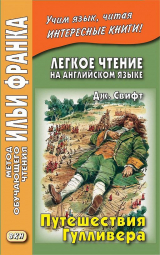
Текст книги "Английский язык с Джонатаном Свифтом Путешествия Гулливера"
Автор книги: Джонатан Свифт
Соавторы: Илья Франк
Жанры:
Зарубежная классика
,сообщить о нарушении
Текущая страница: 8 (всего у книги 16 страниц)
push [pʋʃ] eventually [ɪ'venʧuəlɪ], assistance [ə'sɪstəns]
I rested for two or three minutes, then gave the boat another push until the sea was no higher than my arm-pits. I fastened more ropes to nine other ships. There was a good wind and we eventually arrived within forty yards of the shore. We waited until the tide was out and, with the assistance of two thousand men, we turned the boat over. It was only slightly damaged.
It took me ten days to make the oars (десять дней у меня ушло на то, чтобы сделать весла; to take – брать; занимать, отнимать, требовать /времени, чьей-л. работы/) with which to row my boat to the port of Blefuscu (с помощью которых /я смог/ привести лодку в порт Блефуску; to row – грести, работать веслами). A crowd of people had gathered to greet me (множество людей собрались там, чтобы приветствовать меня; crowd – толпа, скопление людей), full of wonder at such a large boat (пораженные зрелищем такого большого судна: «полные удивления/изумления при виде…»). I told His Majesty that good fortune had put this boat in my way (я сказал императору, что эту лодку послала: «поставила мне на пути» счастливая звезда; good fortune – фортуна, удача, счастье, везение), to help me return to my native country (чтобы помочь мне вернуться на родину: «в родную страну»). I begged him to help me prepare the boat for my journey (я умолял его помочь мне подготовить лодку для путешествия; to beg – нищенствовать, просить подаяния; просить, упрашивать, умолять) and to give me permission to leave (и дать дозволение на отъезд; to leave – покидать; уезжать). This he was pleased to do (он соблаговолил дать согласие сделать это = то, что я просил; to please – радовать, доставлять удовольствие; желать, хотеть; соизволить, соблаговолить /также to be pleased/).
oar [ɔ:], gather [‘ɡæðə], journey ['dʒə:nɪ]
It took me ten days to make the oars with which to row my boat to the port of Blefuscu. A crowd of people had gathered to greet me, full of wonder at such a large boat. I told His Majesty that good fortune had put this boat in my way, to help me return to my native country. I begged him to help me prepare the boat for my journey and to give me permission to leave. This he was pleased to do.
I was surprised (меня удивляло) not to have heard any news about me at the Court of Blefuscu from the Emperor of Lilliput (что я /долгое время/ не слышал ни о каком послании касательно меня от императора Лилипутии ко двору Блефуску; news – известие, новость, сообщение). I was told later that His Imperial Majesty had believed (позднее мне сообщили, что его императорское величество был уверен) I would return within a few days (что я возвращусь через несколько дней), but that now he was worried about my long absence (но теперь = к этому времени он /уже/ был обеспокоен моим долгим отсутствием). After a few more days (еще через несколько дней) he sent someone to Blefuscu with a copy of the articles of impeachment against me (он послал в Блефуску кого-то = одну особу с копией моего обвинительного акта).
This messenger told the Emperor of Blefuscu (этот посланец передал императору Блефуску) that, in order to keep the peace between the two Empires (что ради сохранения мира: «чтобы сохранить мир» между двумя = обеими империями), the Emperor of Lilliput demanded (император Лилипутии требует) that I should be sent back tied hand and foot (чтобы я, связанный по рукам и ногам, был отправлен обратно /в Лилипутию/).
surprise [sə'praɪz], someone ['sʌmwʌn, -wən], demand [dɪ'mɑ:nd]
I was surprised not to have heard any news about me at the Court of Blefuscu from the Emperor of Lilliput. I was told later that His Imperial Majesty had believed I would return within a few days, but that now he was worried about my long absence. After a few more days he sent someone to Blefuscu with a copy of the articles of impeachment against me.
This messenger told the Emperor of Blefuscu that, in order to keep the peace between the two Empires, the Emperor of Lilliput demanded that I should be sent back tied hand and foot.
The Emperor of Blefuscu took three days to think about this (императору Блефуску потребовалось три дня, чтобы обдумать это). He then sent an answer (затем он послал ответ), saying that it would be impossible to send me back tied up (в котором говорилось, что будет невозможно = он не считает возможным отправить меня обратно связанным). Although I had taken his fleet (/ибо/ хотя я и отобрал /у него/ флот), he owed me much for helping to make peace (он очень обязан мне за помощь при заключении мира; to owe – быть должным /кому-л./; быть в долгу /перед кем-л./; быть обязанным /кому-л./). He told the Emperor of Lilliput (он сообщил императору Лилипутии) that I had found a large boat (что я нашел большую лодку), which would carry me on the sea (в которой я смогу отправиться в море: «которая сможет везти меня по морю»). He hoped that both Empires would be free of me in a few weeks' time (/и/ он надеется, что через несколько недель обе империи от меня избавятся: «будут свободны/избавлены»).
saying ['seɪɪŋ], although [ɔ:l'ðəʋ], owe [əu]
The Emperor of Blefuscu took three days to think about this. He then sent an answer, saying that it would be impossible to send me back tied up. Although I had taken his fleet, he owed me much for helping to make peace. He told the Emperor of Lilliput that I had found a large boat, which would carry me on the sea. He hoped that both Empires would be free of me in a few weeks' time.
The messenger returned to Lilliput with this answer (с этим ответом посланец возвратился в Лилипутию). The Emperor of Blefuscu then offered to protect me (/а/ император Блефуску предложил мне тогда свое покровительство: «защищать меня») if I stayed (если я останусь). Although I believed him (хотя я ему и верил), I had decided never again to trust princes or ministers (я решил никогда больше не полагаться на монархов или министров) if I could avoid it (если я могу = есть возможность избежать этого). So I thanked him (потому я поблагодарил его), but asked to be excused (но просил меня извинить /сказав, что не могу остаться/).
protect [prə'tekt], again [ə’ɡe(ɪ)n], avoid [ə'vɔɪd]
The messenger returned to Lilliput with this answer. The Emperor of Blefuscu then offered to protect me if I stayed. Although I believed him, I had decided never again to trust princes or ministers if I could avoid it. So I thanked him, but asked to be excused.
I told him that since fortune had sent me this boat (я сказал ему, что раз уж судьба послала мне эту лодку), I had decided to sail away rather than be the subject of disagreement (я решил лучше уплыть, чем служить поводом: «объектом/предметом» раздора; disagreement – отсутствие согласия; разногласие; разлад, ссора) between two such mighty monarchs (между двумя столь могущественными монархами). The Emperor seemed to be pleased with this (император, казалось, был = остался доволен этим = ответом), and I decided to leave as soon as possible (и я решил отплыть как можно скорее).
fortune ['fɔːʧən], disagreement [‘dɪsə’ɡri:mənt], monarch ['mɔnək]
I told him that since fortune had sent me this boat, I had decided to sail away rather than be the subject of disagreement between two such mighty monarchs. The Emperor seemed to be pleased with this, and I decided to leave as soon as possible.
Five hundred workmen helped me (пятьсот рабочих помогли мне) to make two sails for my boat (сделать два паруса для моей лодки). I made ropes (я изготовил канаты/веревки) by twisting together ten, twenty or thirty of theirs (скручивая вместе /по/ десять, двадцать или = и тридцать их /канатов/). I happened to find a large stone by the seashore (на морском берегу я случайно нашел большой камень; to happen – случаться, происходить; to happen to do smth. – непреднамеренно, случайно совершить какое-л. действие) which I was able to use as an anchor (который я мог использовать в качестве якоря). I cut down some of the largest trees (я срезал несколько самых крупных деревьев) to make oars and masts (чтобы сделать весла и мачты), which was very difficult work (что оказалось очень трудной работой). After I had done the rough work (после того, как я сделал грубую/черновую обработку = грубо обтесал стволы), his Majesty's ships' carpenters helped me to make them smooth (корабельные плотники его величества помогли мне сделать их гладкими = зачистить их).
twist [twɪst], theirs [ðɛəz], smooth [smu:ð]
Five hundred workmen helped me to make two sails for my boat. I made ropes by twisting together ten, twenty or thirty of theirs. I happened to find a large stone by the seashore which I was able to use as an anchor. I cut down some of the largest trees to make oars and masts, which was very difficult work. After I had done the rough work, his Majesty's ships' carpenters helped me to make them smooth.
In about a month, when everything was prepared (приблизительно через месяц, когда все было готово), I sent word to his Majesty (я известил его величество: «послал слово его…») that I was ready to leave (что готов отправится в путь). The Emperor and royal family came out of the palace (император с августейшей семьей вышли из дворца) and I lay down on the ground to kiss their hands (и я лег на землю, чтобы поцеловать их = им руки). His Majesty then gave me fifty purses (затем его величество подарил мне пятьдесят кошельков). Each contained two hundred sprugs (каждый /из них/ содержал в себе /по/ двести спругов). He also gave me a picture of himself (также он пожаловал мне свой портрет: «картину/изображение себя самого»), which I immediately put inside my glove to protect it (который я сразу же положил себе в перчатку для сохранности; inside – внутри; внутрь).
immediately [ɪ'mi:dɪətlɪ], picture ['pɪkʧə], glove [ɡlʌv]
In about a month, when everything was prepared, I sent word to his Majesty that I was ready to leave. The Emperor and royal family came out of the palace and I lay down on the ground to kiss their hands. His Majesty then gave me fifty purses. Each contained two hundred sprugs. He also gave me a picture of himself, which I immediately put inside my glove to protect it.
I had a large store of food on board my boat (на борту лодки = в лодке у меня имелся = был приготовлен большой запас продовольствия). There was meat from a hundred cows (мясо = туши ста коров) and three hundred sheep (и трехсот овец), as well as bread and plenty to drink (а также хлеб и вдоволь питья; plenty – изобилие; достаток; множество; избыток). I took with me six live cows (я взял с собою шесть живых коров), two bulls (двух быков) and some ewes and rams (и несколько овец и баранов; ewe – овца-самка; sheep /мн. ч. sheep/ – овца как род животных; овца или баран). I wanted to bring them home to my country (я хотел привезти их к себе на родину: «домой в свою страну») to breed (для разведения: «чтобы /их/ разводить»). I had a good bundle of hay (я захватил с собою большую вязанку сена) and a bag of corn (и мешок зерна) to feed them on board (чтобы кормить их на борту = в пути). I would gladly have taken a dozen people (я бы с удовольствием взял /с собою/ дюжину человек = туземцев), but His Majesty wouldn't allow it (но его величество ни за что не согласился на это: «не позволил этого»; wouldn't выражает здесь упорное нежелание).
board [bɔ:d], ewe [ju:], dozen ['dʌz(ə)n]
I had a large store of food on board my boat. There was meat from a hundred cows and three hundred sheep, as well as bread and plenty to drink. I took with me six live cows, two bulls and some ewes and rams. I wanted to bring them home to my country to breed. I had a good bundle of hay and a bag of corn to feed them on board. I would gladly have taken a dozen people, but His Majesty wouldn't allow it.
I set sail on September 24th, 1701, at six o'clock in the morning (я отплыл: «поставил парус» 24 сентября 1701 года в шесть часов утра; 24th – the twenty-forth; 1701 – seventeen oh one или seventeen hundred and one). At six o'clock in the evening (в шесть часов вечера) I saw a small island to the north-west (я заметил на северо-западе небольшой островок), where I dropped anchor (где = у которого я бросил якорь). I ate some food (немного подкрепившись: «я съел немного пищи») and slept well for about six hours (/я/ часов шесть хорошо поспал).
September [sep'tembə], o'clock [ə'klɔk], ate [et, eɪt]
I set sail on September 24th, 1701, at six o'clock in the morning. At six o'clock in the evening I saw a small island to the north-west, where I dropped anchor. I ate some food and slept well for about six hours.
The wind was favourable (ветер был попутный: «благоприятный»), so I steered the same course as the day before with the help of my pocket-compass (и я взял с помощью карманного компаса тот же курс, что и накануне; to steer – править рулем, управлять; вести /судно/; следовать, идти /по определенному курсу/; before – впереди; прежде, раньше). I wanted to reach Van Diemen's Land (я хотел достигнуть Земли Ван Димена). I saw no land that day (в тот день земли я не увидел), but at about three in the afternoon of the next day (но около трех /часов/ пополудни следующего дня) I saw a sail steering to the south-east (я увидел парусное судно, двигавшееся на юго-восток).
favourable ['feɪv(ə)rəb(ə)l], compass ['kʌmpəs], south-east [‘saʋ(θ)'i:st]
The wind was favourable, so I steered the same course as the day before with the help of my pocket-compass. I wanted to reach Van Diemen's Land. I saw no land that day, but at about three in the afternoon of the next day I saw a sail steering to the south-east.
I hailed her, but got no answer (я окликнул его: «ее», но ответа не получил; при обозначении судов часто используют местоимения женского рода). I sailed nearer and in about half an hour she saw me (я подплыл ближе, и где-то через полчаса он = корабль заметил меня), hung out her flag (вывесил = поднял флаг) and fired a cannon (и выстрелил из пушки). It is not easy to express the joy I felt at the hope (нелегко выразить = трудно описать радость, которую я ощутил, когда явилась надежда: «при надежде») of once more seeing my beloved country (вновь увидеть любимое отечество). My heart leapt (мое сердце забилось сильнее /от восторга/; to leap – прыгать, скакать; забиться сильнее /от испуга, радости; о сердце/; взыграть) to see a British flag on the ship (когда я увидел британский флаг на корабле). I got aboard with all my cows (я взошел на борт со всеми моими коровами), sheep and provisions in my pockets (овцами и провизией в карманах).
beloved [bɪ'lʌvɪd, bɪ'lʌvd], leapt [lept, li:pt], aboard [ə'bɔ:d]
I hailed her, but got no answer. I sailed nearer and in about half an hour she saw me, hung out her flag and fired a cannon. It is not easy to express the joy I felt at the hope of once more seeing my beloved country. My heart leapt to see a British flag on the ship. I got aboard with all my cows, sheep and provisions in my pockets.
The captain of the ship, which was returning from Japan (капитаном корабля, который возвращался из Японии), was Mr John Biddel of Deptford (был мистер Джон Бидл из Дептфорда). He was a very kind man (человек очень любезный) and an excellent sailor (и превосходный моряк). There were about fifty men on board (на борту находилось около пятидесяти человек). I met an old friend, one Peter Williams (я встретил одного /моего/ старого товарища, Питера Вильямса; one – один; некий), who assured the captain of my good character (который заверил капитана в моей добропорядочности; character – характер, нрав; репутация). When I told him where I had come from (когда я рассказал ему = капитану, откуда я приплыл), he thought I was mad (он решил, что я сумасшедший). They thought the dangers I had experienced (они подумали, что опасности, которые я пережил; experience – /жизненный/ опыт; to experience – знать по опыту; испытывать, переживать) had disturbed my mind (повредили мой разум; to disturb – приводить в беспорядок; портить). But when I showed them the cattle and sheep in my pocket (но когда я показал им коров и овец /бывших/ у меня в кармане; cattle – скот /особенно крупный рогатый/; коровы и быки), they knew I was telling the truth (они поняли, что я говорю правду; to know – знать; понимать, осознавать).
Japan [dʒə'pæn], assure [ə’ʃuə], character ['kærɪktə]
The captain of the ship, which was returning from Japan, was Mr John Biddel of Deptford. He was a very kind man and an excellent sailor. There were about fifty men on board. I met an old friend, one Peter Williams, who assured the captain of my good character. When I told him where I had come from, he thought I was mad. They thought the dangers I had experienced had disturbed my mind. But when I showed them the cattle and sheep in my pocket, they knew I was telling the truth.
I also showed them the gold and the picture (также я показал им золото и портрет) the Emperor of Blefuscu had given me (которые мне дал/подарил император Блефуску). I gave the captain a present of four hundred sprugs (я вручил капитану четыреста спругов: «дал подарок в виде…») and promised to give him a present of a pregnant cow and sheep (и обещал подарить ему стельную корову и овцу; pregnant – беременная; стельная /о корове/, суягная /об овце/ и т. д.) when we arrived in England (когда мы прибудем в Англию).
gold [ɡəʋld], present ['prez(ə)nt], cow [kaʋ]
I also showed them the gold and the picture the Emperor of Blefuscu had given me. I gave the captain a present of four hundred sprugs and promised to give him a present of a pregnant cow and sheep when we arrived in England.
We arrived in England on April 13th, 1702 (мы прибыли в Англию 13 апреля 1702 года). I put my cattle to graze on a bowling green at Greenwich (я пустил свой скот попастись на лужайке для игры в шары в Гринвиче; green – зеленый; зелень; лужайка, луг), where they fed heartily on the fine grass (где они с удовольствием поедали тонкую и нежную траву; to feed – кормить; питаться, кормиться; heartily – сердечно, от всего сердца; охотно, усердно; fine – прекрасный, превосходный; изящный; тонкий, мелкий, нежный). I couldn't have kept them alive (я не смог бы сохранить: «сохранить живыми» их = этих животных) on such a long voyage (в течение столь долгого путешествия) if the captain hadn't given me some of his biscuits (если бы капитан не давал мне своих галет; biscuit – сухое печенье; галета), which, mixed with water, was their best food (которые, смешанные с водою = размоченные в воде, были их = для них лучшей пищей).
April ['eɪprəl], Greenwich [‘ɡrɪnɪdʒ,’ɡrenɪdʒ], biscuit ['bɪskɪt]
We arrived in England on April 13th, 1702. I put my cattle to graze on a bowling green at Greenwich, where they fed heartily on the fine grass. I couldn't have kept them alive on such a long voyage if the captain hadn't given me some of his biscuits, which, mixed with water, was their best food.
For the short time I stayed in England (за /то/ короткое время, что я оставался/пробыл в Англии) I made a good profit (я собрал значительную сумму денег; profit – прибыль, доход) showing my cattle (показывая моих животных). I sold them for six hundred pounds (я продал их за шестьсот фунтов; to sell) before beginning my second voyage (перед началом своего второго путешествия). The breed has increased since my return (со времени моего возвращения их племя выросло/размножилось; breed – племя, порода, род; потомство; to increase – возрастать, увеличиваться; расти; размножаться), especially the sheep (особенно овцы). I hope their fine fleece will improve the wool business in this country (надеюсь, что их превосходная/тонкая шерсть поможет поправить положение суконной промышленности в этой стране; fleece – овечья шерсть, руно; wool – шерсть; шерстяная пряжа или ткань; to improve – улучшать; поправлять, налаживать).
profit ['prɔfɪt], sold [səʋld], especially [ɪ'speʃ(ə)lɪ]
For the short time I stayed in England I made a good profit showing my cattle. I sold them for six hundred pounds before beginning my second voyage. The breed has increased since my return, especially the sheep. I hope their fine fleece will improve the wool business in this country.
I stayed with my wife and children for two months (я провел с женой и детьми два месяца). My desire to see foreign countries (мое страстное желание видеть чужие страны) wouldn't allow me to stay any longer (не позволяло мне остаться дольше). I bought a nice house at Redriff for my family (я купил для семьи хороший дом в Редрифе; to buy) and left a large sum of money with my wife (и оставил жене большую сумму денег).
desire [dɪ'zaɪə], foreign ['fɔrɪn], bought [bɔ:t]
I stayed with my wife and children for two months. My desire to see foreign countries wouldn't allow me to stay any longer. I bought a nice house at Redriff for my family and left a large sum of money with my wife.
When I set off (когда я отправлялся в путь), hoping once more to improve my fortune (снова надеясь увеличить: «улучшить» свое состояние; fortune – счастье; удача; богатство, состояние), all of us were in tears (все мы: «из нас» были в слезах). I boarded the merchant ship Adventure (я сел на купеческий/торговый корабль «Адвенчер»; to board – подниматься на борт /корабля/; adventure – приключение; смелое предприятие; авантюра; риск), commanded by Captain John Nicholas of Liverpool (под командованием Джона Николаса из Ливерпуля). My story of this voyage is told in the second part of my travels (история этого путешествия рассказывается во второй части моей книги; travels – путешествия; описание путешествий).
tear [tɪə], merchant ['mɜʧ:(ə)nt], adventure [əd'venʧə]
When I set off, hoping once more to improve my fortune, all of us were in tears. I boarded the merchant ship Adventure, commanded by Captain John Nicholas of Liverpool. My story of this voyage is told in the second part of my travels.
PART 2
A VOYAGE TO BROBDINGNAG
1
Two months after my return to England (через два месяца после возвращения в Англию) I decided to go to sea again (я решил снова уйти в море). On June 20th, 1702, I set sail for Surat in the Adventure (20 июня 1702 года, я отплыл на /корабле/ «Адвенчер» в Сурат). We sailed before a fair wind (мы плыли/шли с попутным ветром; fair – красивый, прекрасный; хороший, ясный /о погоде/; попутный /о ветре/) until we reached the Cape of Good Hope (пока не достигли мыса Доброй Надежды), where we put in for fresh water (где мы зашли в порт, чтобы запастись пресной водой: «ради пресной воды»; to put in – вставлять; останавливаться /в гостинице/; /мор./ заходить в порт; вставать на рейде; fresh – свежий; пресный /о воде/).
months [mʌnθs], June [dʒu:n], fair [fɛə]
Two months after my return to England I decided to go to sea again. On June 20th, 1702, I set sail for Surat in the Adventure. We sailed before a fair wind until we reached the Cape of Good Hope, where we put in for fresh water.
The Captain, John Nicholas, decided (решил) that we should spend some months there (что нам необходимо провести там несколько месяцев). It was the end of March before we set sail again (был /уже/ конец марта, когда мы снова поставили паруса). Once again all went well (все опять шло хорошо) until we ran into heavy winds on April 19th (пока 19 апреля мы не попали в сильные ветра; to run – бежать; двигаться; ходить, плыть /о поездах, судах и т. п./; to run into… – налететь на /кого-л., что-л./; /неожиданно/ попасть в /какие-либо обстоятельства/; heavy – тяжелый; сильный, интенсивный). Violent gales began to blow as we sailed north of Madagascar (яростные/жестокие шторма начали бушевать: «дуть», когда мы проходили к северу от Мадагаскара; gale – сильный ветер; шторм; буря). They continued for twenty days (они продолжались двадцать дней), forcing us to the east (относя нас к востоку; force – сила; насилие, принуждение; to force – двигать, толкать с силой /что-л./; теснить). We were east of the Molucca Islands (мы находились /уже/ восточнее Молуккских островов) before we ran into calmer weather on May 2nd (когда: «прежде чем» 2 мая ветер /наконец/ утих: «мы оказались в более спокойных погодных условиях»; weather – погода; 2nd = the second).
violent ['vaɪələnt], blow [bləʋ], weather ['weðə]
The Captain, John Nicholas, decided that we should spend some months there. It was the end of March before we set sail again. Once again all went well until we ran into heavy winds on April 19th. Violent gales began to blow as we sailed north of Madagascar. They continued for twenty days, forcing us to the east. We were east of the Molucca Islands before we ran into calmer weather on May 2nd.
Our captain knew those seas very well (наш капитан знал эти моря очень хорошо). He told us to prepare for a storm (он приказал нам приготовиться к шторму) and right enough a wind from the south, called the southern monsoon, hit us the very next day (и действительно: «достаточно/вполне верно» уже на следующий день по нам ударил ветер с юга, называемый южным муссоном). The storm was very fierce and lasted several days (шторм был очень жестокий и продлился несколько дней). I'd say (по моему расчету: «я бы сказал»; I'd say = I would say) the wind carried us about five hundred leagues to the east (ветер отнес нас приблизительно на пятьсот лиг на восток). By the time it had dropped again (к тому времени, как он cтих; to drop – капать; падать; снижаться, понижаться, уменьшаться), not even the oldest sailor on board could tell exactly (даже самый старый моряк на борту не мог точно сказать) what part of the world we were in (в какой /именно/ части света мы находимся).
south [saʋθ], southern ['sʌðən], monsoon [mɔn'su:n], fierce [fɪəs]
Our captain knew those seas very well. He told us to prepare for a storm and right enough a wind from the south, called the southern monsoon, hit us the very next day. The storm was very fierce and lasted several days. I'd say the wind carried us about five hundred leagues to the east. By the time it had dropped again, not even the oldest sailor on board could tell exactly what part of the world we were in.
Our ship was undamaged (корабль наш был не поврежден), the sailors were in good health (моряки совершенно здоровы; health – здоровье) and we had enough food (у нас было достаточно съестных припасов), but we had very little water (но очень мало воды). The wind was still blowing hard from the south-west (ветер с юго-запада дул по-прежнему сильно). The captain decided to continue sailing towards the east (капитан решил продолжать плыть на восток), keeping a look-out for land (наблюдая, не покажется ли где-нибудь земля: «высматривая землю»; to keep – держать, не отдавать; сохранять; продолжать делать /что-л. в течение некоторого времени/; to look out – выглядывать; высматривать; look-out – наблюдение).
undamaged [ʌn'dæmɪdʒd], health [helθ], look-out ['lukaʋt]
Our ship was undamaged, the sailors were in good health and we had enough food, but we had very little water. The wind was still blowing hard from the south-west. The captain decided to continue sailing towards the east, keeping a look-out for land.
It was June 16th before land was sighted (земля показалась только 16 июня; «было = наступило 16 июня, прежде чем была замечена земля») and on the following day we saw quite clearly (и на следующий день мы совершенно ясно увидели) that it covered a large area (что она простиралась на большое пространство; to cover – накрывать, покрывать; охватывать; расстилаться; распространяться; area – территория; площадь; пространство). The captain decided (решил) to anchor the Adventure (поставить «Адвенчер» на якорь) about a league from a narrow strip of land (на расстоянии примерно в лигу от узкой полосы земли) jutting out into the sea (выступающей в море). Twelve sailors were sent off in a small boat to go ashore (двенадцать матросов были посланы в небольшой лодке на берег). They were given bottles for fresh water (им дали бутыли для пресной воды), if any could be found (если они смогут ее найти: «она сможет быть найдена»; any – какой-нибудь; сколько-нибудь). I asked permission to go with them (я попросил позволения отправиться с ними). I wanted to see what I could of the country (я хотел посмотреть, насколько возможно, эту страну: «увидеть, что смогу, в этой стране») while they were searching for water (пока они будут искать воду).
following ['fɔləʋɪŋ], area ['ɛərɪə], search [sɜʧ:]
It was June 16th before land was sighted and on the following day we saw quite clearly that it covered a large area. The captain decided to anchor the Adventure about a league from a narrow strip of land jutting out into the sea. Twelve sailors were sent off in a small boat to go ashore. They were given bottles for fresh water, if any could be found. I asked permission to go with them. I wanted to see what I could of the country while they were searching for water.
We could see no river or any other source of fresh water (ни реки, ни какого-нибудь другого источника пресной воды мы не увидели). The men began to walk along the shore (матросы стали ходить вдоль берега; man – мужчина, человек; солдат, рядовой; матрос) looking for any source that was near the sea (высматривая какой-нибудь источник/родник, расположенный недалеко от моря). We saw no sign of people (мы не заметили никаких признаков населения). I went off by myself (сам я в одиночку пошел) to look around a little further inland (осмотреться немного подальше от берега; inland – внутри страны /не у моря или границы/).
river ['rɪvə], source [sɔ:s], myself [maɪ'self], further ['fə:ðə]
We could see no river or any other source of fresh water. The men began to walk along the shore looking for any source that was near the sea. We saw no sign of people. I went off by myself to look around a little further inland.
The country seemed to be very bare and rocky (страна, казалось, была весьма бесплодной и каменистой/скалистой; bare – голый; непокрытый; пустой; лишенный растительности). I walked for about a mile (я прошел около мили) without seeing anything of interest (не заметив ничего интересного) and so I decided to go back to the shore (и потому решил идти обратно к берегу). As soon as I turned (как только я повернулся = повернувшись), I saw that our sailors were already in the small boat (я увидел, что наши матросы были уже в лодке) and rowing as fast as they could back to the Adventure (и гребли изо всех сил: «так быстро, как /только/ могли» обратно к кораблю). I was just going to call to them (я как раз = уже собирался окликнуть их), even though they would hardly have been able to hear me (хотя они вряд ли смогли бы меня услышать), when I saw a huge creature wading into the sea (как вдруг увидел громадное существо, идущее вброд по морю). He was chasing the sailors as fast as he could (он = оно со всех ног преследовало матросов).