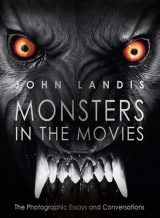
Текст книги "Monsters in the Movies "
Автор книги: Джон Лэндис
Жанр:
Ужасы
сообщить о нарушении
Текущая страница: 7 (всего у книги 15 страниц)
Ghosts[ Book Contents]
Henry Robin and a Specter [Thiébault, 1863]
A man about to shoot himself is confronted by his own ghost in this photomontage by Thiébault.

Ghosts[ Book Contents]
Macbeth [Théodore Chassériau, -]
The Ghost of Banquo by Théodore Chassériau depicts the scene in William Shakespeare’s Macbethat the banquet when only Macbeth can see the ghost of the murdered Banquo.

Ghosts[ Book Contents]
The Shining [Stanley Kubrick, 1980]
Jack Nicholson as Jack Torrance, driven insane by the ghosts of Overlook Hotel, breaks down the door in an attempt to kill his wife and child. Based on the novel by Stephen King.

Ghosts[ Book Contents]
The Innocents [Jack Clayton, 1961]
Deborah Kerr as Miss Giddings, the governess. Beautifully photographed by Freddie Francis, this is one of the best ghost movies ever made.

Ghosts[ Book Contents]
The Orphanage [Juan Antonio Bayona, 2007]
Another disturbing ghost story, set in an orphanage in Spain. Produced by Guillermo Del Toro.

Ghosts[ Book Contents]
The Uninvited [Lewis Allen, 1944]
After watching this film, you will never smell mimosa again without looking anxiously over your shoulder.

Ghosts[ Book Contents]
Poltergeist [Tobe Hooper, 1982]
Steven Spielberg produced this all-American suburban ghost story. JoBeth Williams’ initial delight at invisibly moving kitchen chairs turns to terror when her daughter stares into a television showing nothing but static and announces, “They’re here.”

Ghosts[ Book Contents]
The Haunting [Robert Wise, 1963]
Claire Bloom and Julie Harris react to the very loud sounds made by “something” in the hallway outside their bedroom door in this Robert Wise classic.

“It was an evil house from the beginning —a house that was born bad.”
Dr. John Markway (Richard Johnson), The Haunting
Ghosts[ Book Contents]
The Amityville Horror [Stuart Rosenberg, 1979]
Based on the best selling “true story” about a haunted house in Long Island, New York, The Amityville Horrorwas sold with the wonderful tagline, “FOR GOD’S SAKE, GET OUT!”

Ghosts[ Book Contents]
Topper [Norman Z. McLeod, 1937]
Cary Grant and Constance Bennett as the ghosts of George and Marion Kerby, killed in a car accident. This delightful comedy also stars Roland Young as Cosmo Topper, the only person who can see or hear them. Based on the novel by Thorne Smith.

“You know something George? I think we’re dead.”
Marion Kerby (Constance Bennett), Topper
Ghosts[ Book Contents]
Kwaidan [Masaki Kobayashi, 1964]
Kwaidan means “ghost story” in Japanese, and this beautiful anthology film is comprised of four Japanese folk tales compiled by Lafcadio Hearn. Pictured is “Hoichi the Earless,” a blind musician who has an intense and agonizing encounter with the ghostly subjects of his songs.


Christopher Leeas Kharis, impaled by Peter Cushing as John Banning, in The Mummy[Terence Fisher, 1959].
MUMMIES
In 1922, archeologist Howard Carter’s expedition discovered the tomb of Tutankhamun in Egypt. The fabulous treasures of “King Tut’s Tomb” created a worldwide sensation and renewed the public’s fascination with ancient Egypt.
Universal Studios’s tremendous success with Frankenstein[1931] and Dracula[1931] had them looking for a third Universal Monster to exploit. They settled on The Mummy[Karl Freund, 1932], yet another story about a living corpse. Universal even used the same music for the opening credits of The Mummyas they did for Dracula, Tchaikovsky’s Swan Lake!
Boris Karloff again sat patiently while make-up man Jack Pierce created yet another classic monster. Using cotton, collodion, clay, and spirit gum on Karloff’s face and hands, Pierce then wrapped him in singed linen bandages and coated it all with dust. Karloff only had to go through this once (the Mummy only appears in one memorable scene in his burial dressing), but he referred to this make-up as the worst and “most trying day” he had ever endured on a movie. The film is a romance, with Karloff’s priest Imhotep being mummified and buried alive for daring to fall in love with the Princess Ankh-es-en-amon. Centuries later, his sarcophagus is discovered and opened. When one of the archeologists reads aloud from the life-giving Scroll of Thoth, the Mummy Imhotep awakens, in one of the great moments in fantasy cinema. The terrified archeologist (Bramwell Fletcher) can only scream and say, “He went for a little walk.”
The Universal Mummysequels became increasingly silly, as the Mummy (now called Kharis) became just a shuffling automaton. And now it could be anyone under those bandages—Lon Chaney, Jr., Tom Tyler, and stunt man Eddie Parker all took turns as Kharis.
In the late 1950s, the then-booming Mexican film industry started to produce its own Mummy movies—Aztec Mummy movies. Meanwhile, the UK’s Hammer Films bought the rights to Universal’s Mummyand made their own The Mummy[Terence Fisher, 1959] with Christopher Lee in the title role.
Stephen Sommers’ big-budget remake of The Mummy[1999] was heavy on the CG and an international hit. It, too, spawned sequels, one of which, Tomb of the Dragon Emperor[Rob Cohen, 2008] was shot in China and brought us action hero Jet Li as the mummified first Emperor of China.
None of the many Mummy films produced since the Universal original have captured the sense of love and sorrow, dignity and decay of Karloff’s performance.
My vote for the best, non-Karloff Mummy movie goes to Don Coscarelli’s wonderfully insane Bubba Ho-tep[2002]. Based on the novella by Joe R. Lansdale, it tells the story of what really happened to Elvis Presley. It features an ancient Mummy that sucks the souls from his victims in a rude way, as well as fantastic performances from Bruce Campbell and Ossie Davis. The movie breathes fresh life into what had become a tired concept.
Mummies[ Book Contents]
The Mummy’s Tomb [Harold Young, 1942]
Ad art for The Mummy’s Tomb; Lon Chaney, Jr. plays Kharis for the first time.

Mummies[ Book Contents]
The Mummy [Karl Freund, 1932]
Boris Karloff as Ardath Bay, the name the Mummy Imhotep uses in modern day Cairo.

Mummies[ Book Contents]
Las Luchadoras Contra La Momia [Rafael Portillo, 1957]
Popoca the Aztec warrior mummy attacks a tomb robber in La Maldición de la Momia Azteca.

Mummies[ Book Contents]
The Mummy [Karl Freund, 1932]
Boris Karloff as Imhotep the Mummy reaches for the sacred Scroll of Thoth; Bramwell Fletcher watches in terror.

Mummies[ Book Contents]
The Mummy [Terence Fisher, 1959]
Christopher Lee as Kharis The Mummy, after he’s been shot, but before he’s impaled.

Mummies[ Book Contents]
The Mummy [Karl Freund, 1932]
Boris Karloff with Zita Johann in a trance as the reincarnation of his lost love, the ancient Princess Ankh-es-en-amon.

“My love has lasted longer than the temples of our gods. No man ever suffered as I did for you!”
Imhotep (Boris Karloff), The Mummy
Mummies[ Book Contents]
The Mummy [Stephen Sommers, 1999]
In this Universal Studios’ remake “Ardeth Bay” (Oded Fehr) is a separate character from the Mummy. The Mummy, High Priest Imhotep, was played by Arnold Vosloo and a lot of very expensive CG done by the folks at George Lucas’s Industrial Light & Magic.

“Death is only the beginning”
Imhotep (Arnold Vosloo), The Mummy
Mummies[ Book Contents]
The Mummy: Tomb of the Dragon Emperor [Rob Cohen, 2008]
Brendan Fraser’s character Rick O’Connell’s third Mummy adventure, this time in China. Jet Li’s eyes are staring out of the Mummy face of Chinese Emperor Han.

Mummies[ Book Contents]
Bubba Ho-tep [Don Coscarelli, 2002]
The true story of what really happened to Elvis Presley. The Mummy was played by Bob Ivy. Bruce Campbell as Elvis and Ossie Davis as President John F. Kennedy are both outstanding.

IN CONVERSATION
Guillermo Del Toro
“Horror films are a rollercoaster of the soul.”

Guillermo Del Toro wearing the hand of Hellboy on the set of Hellboy II: The Golden Army[2008].
Mummies[ Book Contents]
JL: Guillermo, how would you define a monster?
GDT: A freak of nature. Something that is unnatural. I think the difference between a monster and every other thing in horror is that the monster is a biological entity, it’s alive.
JL: What about a ghost?
GDT: A ghost is not a monster.
JL: What about a monster’s ghost? What about a ghost that kills people? You’re saying monsters have to be physical beings?
GDT: Or beings that come out of nature. They can be related to physics, like the Monster from the Id [in Forbidden Planet, Fred M. Wilcox 1956]. The Id is a monster.
JL: What about Frankenstein’s Monster?
GDT: Yes, Frankenstein created a monster.
JL: What about zombies?
GDT: Zombies would be monsters. Monsters have to be physical in some way.
JL: So, would Sissy Spacek in Carrie[Brian De Palma, 1976] be a monster?
GDT: I don’t think Carrieis a monster movie; it’s a horror movie.
JL: Aha! Are there any monsters in David Cronenberg’s movies?
GDT: The only Cronenberg monster movies are The Fly[1986] and The Brood[1979], because all the little freaks are monsters. And, to some extent, Rabid[1977], because the Marilyn Chambers character becomes a vampire monster. A monster is anything that can be deformed, that can be altered, but has some root in nature. Godzilla is a monster, the Gill-Man [from Creature From the Black Lagoon, Jack Arnold, 1954] is a monster.
JL: What about monsters from space?
GDT: They can be monsters, as long as they are physical entities.
JL: Can a robot be a monster?
GDT: I think you can have a monster robot, or a robot monster.
JL: You’re like me, Del Toro, you like monsters.
GDT: Yeah, I love them.
JL: You grew up in Guadalajara. What were your favorite monsters, as a child?
GDT: Frankenstein’s creature—the Boris Karloff version [1931]—The Gill-Man, and the monster in Alien[Ridley Scott, 1979]. In fact, these are still my favorite monsters.
JL: Why do you love the Alien monster?
GDT: Because it broke every rule about how to shoot a man in a suit. The suit was designed to break the silhouette of the man inside, and Ridley Scott had him walking on all fours, or backwards.
JL: I love that monster, but I didn’t like that metallic tongue with teeth thing that came out of its mouth. It just didn’t feel organic to me.
GDT: I loved that! Anyway, those are my first three. Then would come the werewolf in The Wolf Man[George Waggner,1941]. I used to dress up as Lon Chaney, Jr.’s Wolf Man when I was a kid. I’d go to school dressed as a wolf man! I had the Wolf Man mask, but I didn’t buy the Don Post werewolf hands. I bought the gorilla hands, because they were better-looking. So I went with the gorilla hands, gorilla feet, and the werewolf mask to my secondary school.
JL: What did your parents think of that?
GDT: They let me do it! And I bought the cheap artificial hair and would put it under my checkered shirt, and the other kids beat the crap out of me! (Laughs.)
JL: What is it that you find most intriguing about werewolves?
GDT: The blackout is the most interesting part.
JL: You mean that the werewolf has no memory of what happened the night before when he changes back to being human?
GDT: Yeah, like David waking up in the zoo pen in An American Werewolf in London[John Landis, 1981]. And how incredibly earnestly Lon Chaney, Jr. suffered in The Wolf Man.
JL: Curt Siodmak (screenwriter of The Wolf Man) was the first to push the idea of the werewolf as a victim.
GDT: And one of the great sufferers ever is Lon Chaney, Jr. You really wanted to tell him that everything was going to be all right. What attracts me most about the Wolf Man myth was the sympathetic nature of the character.
JL: When Dr. Jekyll drinks his formula, he becomes Mr. Hyde, who is a manifestation of Jekyll’s lust and bad thoughts. Whereas the werewolf is Other, it’s completely not you, it’s like you become this separate beast.
GDT: The Wolf Man becomes a werewolf in spite of himself.
JL: The werewolves in The Wolf Manand American Werewolfare victims; Frankenstein’s monster is a victim…
GDT: The Gill-Man in some ways.
JL: He’s a total victim!
GDT: Yeah. He’s like King Kong in many ways.
JL: Whereas the Alien is a predator.
GDT: Yeah, but what I love about the Alien is what I love about insects: Remote perfection.
JL: How do you feel about vampires?
GDT: My favorite vampire movie is Nosferatu.
JL: The Murnau, [1922], or the Herzog [1979]?
GDT: Both. And I also loved Willem Dafoe in Shadow of the Vampire[E. Elias Merhige, 2000] and Barlow (the vampire in Tobe Hooper’s Salem’s Lot,who was made up to resemble Nosferatu, 1979). That physicality is what I like the most.
JL: Vampires live forever, as Béla Lugosi [in Dracula, Tod Browning, 1931] says, “To die, to really die, that would be glorious.” And then there’s the sexual side of vampires; there’s also this weird AIDS and blood transfusion thing. What did you think of Kathryn Bigelow’s Near Dark[1987]?
GDT: I loved it. For me, the vampire myth in the Carpathian Mountains with the castle and the cape was always very remote. It’s much more interesting set in an urban or suburban environment, like Salem’s Lotor I Am Legend[Francis Lawrence, 2007].
JL: What about Christopher Lee’s Dracula?
GDT: I love him! He is a righteous, arrogant figure; a guy that believes he deserves everything by lineage.
JL: Exactly. John Carpenter said that Dracula is all about the European aristocracy literally feeding off everybody.
GDT: Christopher Lee’s Dracula exudes entitlement. Everybody talks about how sexual his Dracula was, but I think it was just very forthright. He went for it straight.
JL: One of the reasons people talk about it being sexual is that it’s only relatively recently that vampires bite great chunks out of their victims. When Lugosi’s and Lee’s Dracula made those polite little punctures, their victims swooned. They became orgasmic!
GDT: Yeah. The whole sexual subtext of the vampire, I’m not denying. Also there was a lot less wardrobe for the ladies in the Hammer films; they were a lot more scantily clad!
JL: OK, so what about mad scientists, mad doctors, like Dr. Moreau? Island of Lost Souls[Erle C. Kenton, 1932]? Have you ever seen it?
GDT: I love it! I have a homage in Blade II[2002]: The “House of Pain!”
JL: Island of Lost Soulsis one of my favorite horror movies. What do you think of witches and warlocks—movies like The Devil Rides Out[Terence Fisher, 1968]?
GDT: I don’t think those are monster movies; those are supernatural movies.
JL: Do you think ghosts are scary?
GDT: Well, I have two simple rules that define horror for me: The things that create fear are either things that shouldn’t be, but are, or things that should be, but are not. I’ll give you an example (of the first rule): Your father died a week ago, you walk into your house and he’s sitting at the dining table, completely still. That generates fear. An example of the second rule is: The scene in Poltergeist[Tobe Hooper, 1982], where the woman turns around, then turns back, and all the chairs are piled up in the kitchen: that shouldn’t be, but is.
JL: But you don’t consider anything supernatural to be monstrous?
GDT: Like I said, I’m willing to make an exception with vampires and werewolves because they have a physical manifestation. But in traditional tales of vampires—in many, many countries—the vampire is a spirit; it doesn’t have a physical body. A monster has to have physicality.
JL: But what about a demon that grabs you and causes you bodily harm? I can picture a scene where people are in a room: there are terrible sounds, the walls are bending inwards, it’s getting increasingly terrifying, and they’re having this same argument! (Laughs.)
GDT: Yes! I think that there are many ways a ghost can physically manifest itself, but it doesn’t have a body. We’re going to go by my rules! I’ll tell you: Most of the time a monster has a natural or physical body that has something to do with science, or biology, gone awry.
JL: What about the character of Regan in The Exorcist[William Friedkin, 1973], when she’s possessed by Satan?
GDT: She’s not a monster!
JL: Isn’t Satan a monster?
GDT: No, he’s a spirit! He’s a spiritual entity.
JL: What about gnomes, or fairies, or elves, or leprechauns?
GDT: They’re not monsters. Not for me.
JL: But they have physical bodies!
GDT: They are not monsters; they come from a completely different lore.
JL: OK, well, now that you’ve destroyed half of my guide, I’m going to go ahead and call them monsters anyway! Let’s talk about Psycho[Alfred Hitchcock, 1960] and The Texas Chainsaw Massacre[Tobe Hooper, 1974], Peeping Tom[Michael Powell, 1960], movies like that.
GDT: Yeah, those are about psychopaths. Are they in your guide?
JL: Psychopaths are humanmonsters! They’re the only monsters that scare me. I’m not really scared by any monster in a movie, any monster as you define them, or any monster as I’m broadly defining them: Werewolves, vampires, they don’t scare me; they do not exist. But people are crazy, they do terrible things, and they scare the shit out of me!
GDT: Has there ever been a monster movie that scared you?
JL: While actually watching the movie– absolutely! I’m a great audience, a real sucker for the sudden “BOO!” I’ve always maintained that The Exorcistis the greatest horror film because, although I don’t believe in Jesus or Satan, during the course of the film I was scared.
GDT: Alienmust have scared you.
JL: Actually, when I saw it the first time, I kept thinking: “This is a remake of It! The Terror From Beyond Space[Edward L. Cahn 1958]” and Planet of the Vampires[Mario Bava, 1965]! It was like a haunted house movie in space. But it’s beautifully made. I love the scene with John Hurt… you know, the chest-burster?
GDT: Yeah.
JL: What made that scene work, isn’t the chest-burster itself—that’s kind of a dumb-looking puppet—but the moment when it actually bursts out of him—the horror on the actors’ faces, their reactions, are so real. But I think Aliens[James Cameron, 1986] is a better movie than Alien. It was brilliant of James Cameron to make Aliensan action movie. Forgive me. I know that’s sacrilegious.
GDT: No, no, it isn’t! I’m just trying to define what a monster movie is. Hitchcock never did a horror film except for The Birds[1963]. That truly had a supernatural agent at work; it may not be ghosts, but it was supernatural. And to my mind, Spielberg did two great horror films: one was Duel[1971], because he elevated that truck to the state of a mechanical monster; and the other one was Jaws[1975], because he gave that shark intelligence and motivation… That is a monster movie that has haunted me for my entire life. I used to love the sea before I saw Jaws—I still love it, I still scuba dive, I snorkel, but I’m always nervous!
JL: Okay, the last question—and this is the one that everyone has given me radically different answers to. It’s the one I expected the same answer to, but they’ve all been very different: Why do you think people like going to see scary movies?
GDT: I think it is part of our nature as myth-making mammals to tell stories of the dark and what lives in it. The earliest storytellers, seated around the campfire, were trying to make sense of the world. They needed to create angels and demons, and beauty and monsters. Fear can be a very powerful, spiritual experience, and we look for it. People say going to a horror movie is like a rollercoaster ride and I partially agree. But the rollercoaster analogy is limited. On a ride, you’re only scared of being physically damaged. Horror films are a rollercoaster of the soul.
JL “Horror films are a rollercoaster of the soul.” That’s wonderful!
GDT They have a sort of purging effect. For a while, they allow you to believe in the supernatural in a stupidly rational world.
JL: Why do you think the audience for these films is mostly young people?
GDT: Because I think that horror movies destroy the illusion of order and sanity in the world. Order and sanity is a very adult concern. No one knows better the fragility and vulnerability of the real world than kids. At its worst, horror is a very repressive genre. But at its best, it’s an incredibly anarchic and iconoclastic one. Kids identify with that.
JL: Muchas gracias, mi amigo!
GDT: You are more than welcome!