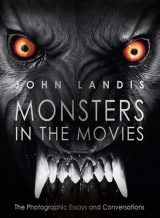
Текст книги "Monsters in the Movies "
Автор книги: Джон Лэндис
Жанр:
Ужасы
сообщить о нарушении
Текущая страница: 14 (всего у книги 15 страниц)
Human Monsters[ Book Contents]
Freaks [Tod Browning, 1932]
Cleopatra (Olga Baclanova), the beautiful trapeze artist, flirts with Hercules the strongman (Henry Victor), humiliating her husband Hans, a midget (Harry Earles). Freaksremains a powerful, and heartbreaking film.

Human Monsters[ Book Contents]

The performers in the circus sideshow gather round to see the Bearded Woman’s (Olga Roderick) new baby.
Human Monsters[ Book Contents]
The Elephant Man [David Lynch, 1980]
John Hurt as John Merrick (whose real name was actually Joseph Merrick), in a lovely film that plays fast and loose with the true story. With Anthony Hopkins as the doctor who becomes Merrick’s friend. Make-up artist Chris Tucker created Hurt’s effective make-up from casts of Merrick’s body, still held by the Royal London Hospital.

Human Monsters[ Book Contents]
The Hunchback of Notre Dame [Wallace Worsley, 1923]
Lon Chaney as Quasimodo in an amazing make-up of his own design and execution. One of the few films that Irving Thalberg ever put his name on as a Producer (shared with boss Carl Laemmle). Patsy Ruth Miller is Esmeralda. From the novel [1831] by Victor Hugo.

Human Monsters[ Book Contents]
The Hunchback of Notre Dame [William Dieterle, 1939]
Charles Laughton gives a magnificent performance as the hunchbacked bell ringer, conveying Quasimodo’s humanity through the grotesque (and uncomfortable) make-up by Perc Westmore and George Bau. Maureen O’Hara is Esmeralda.

Human Monsters[ Book Contents]
The Phantom of the Opera [Rupert Julian, 1925]
In this hand-tinted sequence, Lon Chaney as Erik the Phantom attends the Paris Opera’s Gala Costume Ball dressed as Death.

Human Monsters[ Book Contents]
The Phantom of the Opera [Arthur Lubin, 1943]
Claude Rains as “Erique” instead of Erik (why character names are so often changed I do not know) and this time he is a violinist, not a composer. Universal’s Technicolor remake of their own picture has more of Nelson Eddy singing than any real horror. But this film has the most spectacular falling chandelier sequence of all the Phantom of the Operapictures. Susanna Foster is Christine.

Human Monsters[ Book Contents]
The Phantom of the Opera [Terence Fisher, 1962]
Hammer had produced their own Draculaand Frankensteinand Mummymovies; some more rifling through Universal’s vaults brought them to Gaston Leroux’s Phantom of the Opera. Their version starred Herbert Lom as the Phantom and Heather Sears as Christine.

Human Monsters[ Book Contents]
The Phantom of the Opera [Joel Schumacher, 2004]
The film version of Andrew Lloyd Webber’s musical. Gerard Butler is the Phantom and Emmy Rossum is Christine.

Human Monsters[ Book Contents]
The Phantom of the Paradise [Brian De Palma, 1974]
De Palma’s satirical, rock‘n’roll Phantomstarred Paul Williams as Swan, a Mephistophelian figure to William Finley’s Phantom.

Human Monsters[ Book Contents]
The Mystery of the Wax Museum [Michael Curtiz, 1933]
Crazed sculptor Lionel Atwill has Fay Wray in his clutches. In a desperate attempt to escape, she beats on his face which cracks and breaks! His wax mask falls to reveal his disfigured face.


Human Monsters[ Book Contents]
House of Wax [André De Toth, 1953]
Warner Brothers’ 3D Technicolor remake of their own Mystery of the Wax Museum[1933].

Human Monsters[ Book Contents]

Vincent Price as Professor Henry Jarrod, watches in terror as his wax figures burn.
Human Monsters[ Book Contents]

Also given here is a close up of Jarrod’s burned face revealed after Phyllis Kirk (whom he intended to dip into bubbling, molten wax) has broken his wax mask.
Human Monsters[ Book Contents]
The Man Who Laughs [Paul Leni, 1928]
Conrad Veidt as Gwynplaine, who King James II has had put in an iron maiden and permanently disfigured so that his face is always a hideous grin. An adaptation of the novel [1869] by Victor Hugo.

Human Monsters[ Book Contents]
Darkman [Sam Raimi, 1990]
From an original story by Sam, this is his own twisted version of a comic book superhero movie. Liam Neeson plays Peyton Westlake, disfigured by the bad guys when they blow up his lab. Darkman is shown here with Frances McDormand as Julie Hastings.

Human Monsters[ Book Contents]
Sweeney Todd: The Demon Barber of Fleet Street [Tim Burton, 2007]
Burton’s film of Stephen Sondheim’s musical telling of the tale. With Johnny Depp as Sweeney Todd and Helena Bonham Carter as Mrs. Lovett.

Human Monsters[ Book Contents]
Cannibal Holocaust [Ruggero Deodato, 1980]
Shot in the rainforests of the Amazon using indigenous people as the cannibals, this is about a documentary crew who are captured and eaten. Using “found footage” that shows us what happened in explicit detail, this is a pretty disgusting film. Over 30 years later it remains controversial.

Human Monsters[ Book Contents]
Manhunter [Michael Mann, 1986]
Brian Cox as Dr. Hannibal Lecter in Mann’s adaptation of the Thomas Harris novel Red Dragon[1981]. The screen debut of “Hannibal the Cannibal.”

Human Monsters[ Book Contents]
The Old Dark House [James Whale, 1932]
Morgan (Boris Karloff) has evil thoughts concerning Margaret Waverton (Gloria Stuart).

Human Monsters[ Book Contents]
White Heat [Raoul Walsh, 1949]
James Cagney as psychopathic, mother-fixated gangster Cody Jarrett. Edmond O’Brien’s undercover cop corners Cody atop a gas storage tank; Cody shouts, “Made it Ma, top of the world!” and fires his gun into the tank, which explodes in a gigantic fireball.

Human Monsters[ Book Contents]
Kiss of Death [Henry Hathaway, 1947]
A film noirthat introduced Richard Widmark as psychotic killer Tommy Udo. Widmark plays Udo full tilt, complete with insane giggle as he ties an old lady to her wheelchair and then pushes her down the stairs.

Human Monsters[ Book Contents]
Peeping Tom [Michael Powell, 1960]
Carl Boehm and Anna Massey in this study of a psychotic voyeur. A movie so disturbing it basically ended Powell’s career.

Human Monsters[ Book Contents]
Jack the Ripper [Robert S. Baker, Monty Berman, 1959]
A straightforward account of Britain’s most infamous serial killer. Considered very brutal when it was released, its violence is rather tame for today’s jaded audience.


Putting finishing toucheson Boris Karloff’s costume and make-up for The Mummy[Karl Freund, 1932].
MONSTER MAKERS
From the earliest days of the Nickelodeons, filmmakers have consistently invented new techniques to help us “suspend our disbelief.”
The French filmmaking pioneer Georges Méliès was one of the first to use the camera to create visual effects. By pausing in turning the hand crank on his camera for a moment, Méliès was able to make people and objects appear and disappear as if by magic.
Linwood G. Dunn’s work in the 1920s perfected the optical printer, revolutionizing optical effects. Literally a camera set up to re-photograph already exposed film, creating multiple layers of images onto a negative, the optical printer enabled the movies to present astonishing compositions on screen. One of the greatest creators of “optical effects” was John P. Fulton, whose innovative and stunning work on The Invisible Man[James Whale, 1933] still dazzles the eye. My favorite of Fulton’s effects are the homunculi Dr. Pretorius so proudly displays in The Bride of Frankenstein[James Whale, 1935].
Building sets and vehicles to a much smaller scale allowed scenes of breathtaking destruction to be shot with minimal cost and danger. “Miniature” car crashes, airplanes, explosions, volcanoes, rocket ships, and more, have all been constructed on a stage or back lot to help visualize story elements that would have been impractical to recreate full size. Master miniature makers include the legendary Lydecker Brothers, Howard and Theodore. The Lydecker Brothers were on staff at Republic Pictures and worked on such classic serials as Adventures of Captain Marvel[1941], and Commander Cody: Sky Marshal of the Universe[aka Radar Men From The Moon, 1952-3]. Japanese master Eiji Tsuburaya was the resident special FX go-to guy for Toho Studios. Tsuburaya’s work is seen in almost every Godzillafilm. Derek Meddings started work on the Gerry and Sylvia Anderson puppet TV shows like Fireball XL5[1962] and Thunderbirds[1965-66]. Derek went on to do the miniatures on Superman[Richard Donner, 1978] and for the James Bond pictures The Man with the Golden Gun[Guy Hamilton, 1974] and The Spy Who Loved Me[Lewis Gilbert, 1977].
Greg Jein built the iconic miniature of the Death Star for Star Wars[George Lucas, 1977], and the aliens’ mother ship for Close Encounters of the Third Kind[Steven Spielberg, 1977].
Matte painters like Albert Whitlock, Harrison Ellenshaw, Peter Ellenshaw, Norman Dawn, and Matthew Yuricich created remarkable illusions for movies with a paint brush and a pane of glass (see the illustrations given in the section Matte Painting).
The producer and director George Lucas and his crew at Industrial Light & Magic have brought movies into the digital age. Special effects in the movies will continue to evolve, but never forget that every movie you see, has been literally handmade.

Two giants of the fantasy film:Georges Méliès and Carl Laemmle meet in Paris. Méliès is the father of special effects; Laemmle was one of the founders of Universal Pictures, the studio that produced most of the classic monster movies.

Shooting a close-upof Boris Karloff as the Monster in Frankenstein[James Whale, 1931].
The Monster Makers[ Book Contents]
Creature From the Black Lagoon [Jack Arnold, 1954]
Bob Dawn (white shirt), Robert Hickman (kneeling), and Jack Kevan (black suit) adjust the Gill-Man costume on Ben Chapman (Ricou Browning did the underwater swimming in Florida). Universal’s head of make-up Bud Westmore got sole screen credit, but Jack Kevan did most of the work.


Willis O’Brienposes with the full-size head used for close-ups in King Kong[Cooper, Schoedsack, 1933].
MONSTER DIRECTORS
James Whale, Tod Browning, George A. Romero, William Castle, and Jack Arnold are five directors whose monster movies have had lasting impact and influence. Between them, they have brought us Dracula, Frankenstein, Night of the Living Dead, The Tingler, Creature From the Black Lagoon, The Mummy, The Incredible Shrinking Man, and many more classic movie monsters!

Boris Karloffas the Monster is scrutinized by well-dressed director James Whale and cameraman John J. Mescall on the set of The Bride of Frankenstein[1935]. The elegant Whale never failed to inject an element of camp into all of his horror films.

George A. Romeropoints to where some new zombie atrocity will take place on the set of Land of the Dead[2005]. Romero has single-handedly made the zombie themonster of the 21st Century.

William Castlein a gag photo at the sound stage door of one of his many thrillers. Castle often used carny-style gimmicks to sell his movies to the public.

Tod Browningon set with Olga Baclanova, who played the beautiful, cruel trapeze artist in Freaks[1932]. Baclanova is in costume and make-up as the pathetic sideshow freak her character becomes in the film’s gruesome climax.

Jack Arnold(white jacket) with actor Grant Williams on the set of The Incredible Shrinking Man[1957]. Both director and star are dwarfed by the giant set and props used to create the illusion of the lead character’s tiny size.
MAKE-UP ARTISTS

On the set of Metropolis,[Fritz Lang, 1927], make-up and costume personnel attend to Brigitte Helm in most of her costume as the robot Maria.

William Tuttlesupervised the make-up on The Wizard of Oz[1939] eventually replacing Jack Dawn as Head of Make-up at MGM. In this photo can be seen a Morlock mask from The Time Machine[1960] and a head used in The Picture of Dorian Gray[1945], as well as life masks of MGM stars. Tuttle received an honorary Academy Award for 7 Faces of Dr. Lao[1964].

Bud Westmore, of the Westmore dynasty of Hollywood make-up artists, was Head of Make-up at Universal and is credited on more than 450 movies and TV shows. His credits include the Lon Chaney biopic starring James Cagney, Man of a Thousand Faces[1957] and The Andromeda Strain[1971].

Jack Pierce(on left), assisted by Otto Lederer, applies make-up to Boris Karloff at Universal Studios in 1931. Pierce’s brilliant design for the Monster (in collaboration with director James Whale) was a perfect match with Karloff’s gaunt features, making his Frankenstein Monster an international icon. Pierce also created the make-ups for other classic Universal Monsters including The Mummy[1932], Werewolf of London[1935], and The Wolf Man[1941].

Lon Chaney, pictured with his make-up kit, checks out a set of false teeth in his mirror on the set of A Blind Bargain[Wallace Worsley, 1922]. Chaney was known as “The Man of a Thousand Faces” for his remarkable ability to turn himself into dozens of grotesque characters. Erik, The Phantom of the Opera[Rupert Julian, 1925] and Quasimodo, The Hunchback of Notre Dame[Wallace Worsley, 1923] are his two most famous roles.

Rob Bottin(wearing scary contact lenses) poses with one of his creations for John Carpenter’s The Thing[1982], a movie that really showcases his amazing work. Rob made the grotesque murder victim tableaus in David Fincher’s Seven[1995], the werewolves in Joe Dante’s The Howling[1981], and the mythical creatures in Ridley Scott’s Legend[1985] including Tim Curry’s remarkable Lord of Darkness.

Dick Smith, pictured turning David Bowie into an ancient vampire in Tony Scott’s The Hunger[1983], is called the godfather of special effects make-up. Dick’s legendary make-ups include: The Exorcist[William Friedkin, 1973], The Godfather[Francis Ford Coppola, 1972], Taxi Driver[Martin Scorsese, 1976]; he received an Academy Award for Amadeus[Milos Forman, 1984].

Tom Saviniis noted for his gory make-ups in Maniac[William Lustig, 1980] and Friday the 13th[Sean S. Cunningham, 1980], and his many collaborations with George A. Romero. Now active as an actor, he played Sex Machine in From Dusk Till Dawn[Robert Rodriguez, 1996]. Tom also runs a successful make-up academy.

Roy Ashtonwas Hammer Studios’ main make-up artist, shown here making-up Peter Cushing as the living dead Arthur Grimsdyke for Tales from the Crypt[Freddie Francis, 1972].

Stan Winston, pictured with Michael Jackson in make-up for the short film Ghosts[Stan Winston, 1997]. Stan won three Academy Awards; one for Make-up and one for Special Effects for Terminator 2: Judgment Day[James Cameron, 1991], and one for Special Effects for his lifelike, full-size animatronic dinosaurs in Jurassic Park[Steven Spielberg, 1993].

John Chamberswon an honorary Academy Award for his groundbreaking work on Planet of the Apes[Franklin J. Schaffner, 1968]. John’s foam-rubber, prosthetic appliances allowed facial mobility and could be mass-produced to equip large numbers of actors. Chambers also did clandestine disguise work for the FBI and CIA and played the National Guard Captain in Schlock[1971].

Stuart Freebornmade the apes for Stanley Kubrick’s 2001: A Space Odyssey[1968]. He is shown here working on Chewbacca’s head for George Lucas’ Star Wars[1977].

Gregory Nicoterois the N in famed special effects make-up company KNB. Greg often collaborates with Quentin Tarentino, Robert Rodriguez, Frank Darabont, and George A. Romero. Here’s Greg working on the hit TV zombie series The Walking Dead[2010-].

Howard Bergeris the B in KNB. Howard won an Academy Award for his work on The Chronicles of Narnia: The Lion, the Witch and the Wardrobe[Andrew Adamson, 2005].

Rick Bakerworking on an appliance for Tim Burton’s remake of Planet of the Apes[2001]. Rick and I first met on my first feature film Schlock[1971]. He was 20, I was 21. Since then, Rick has gone on to win seven Academy Awards, his first for An American Werewolf in London[1981], when the Academy established the category.
MONSTER DESIGNERS

Millicent Patrickdesigning the Gill-Man for Creature From the Black Lagoon[Jack Arnold,1954]. Ms. Patrick was not given a screen credit for what many consider one of the greatest monster designs.

Chris Muellerin the Universal Make-up lab, sculpting the original mask for Creature From the Black Lagoon.

H. R. Gigeris a Swiss artist known for his surreal and bizarre paintings. Ridley Scott hired him to design the title creature in Alien[1979]. Giger is pictured here with one of his friends.
STOP-MOTION ANIMATION
Stop-motion animation is an art that is still practiced by filmmakers like Henry Selick in The Nightmare Before Christmas[1993], James and the Giant Peach[1996], and Coraline[2009] and Nick Park. Park is the creator of Wallace and Gromit and has won four Academy Awards, for Creature Comforts[1989], The Wrong Trousers[1993], A Close Shave[1995], and Wallace & Gromit: The Curse of the Were-Rabbit[2005]. Pictured are three of the greatest stop-motion animators in movie history.

Randall Cookis shown animating a demon from Ghostbusters[Ivan Reitman, 1984].

Ray Harryhausenanimating Mighty Joe Young[Ernest B. Schoedsack, 1949]. Ray’s big break came when Willis O’Brien hired him as an assistant on this movie. Ray Harryhausen’s tremendous body of work has had enormous influence on generations of filmmakers.

Willis O’Brien, the pioneering stop-motion animator and innovator, whose crowning achievement is King Kong[Merian C. Cooper, Ernest B. Schoedsack, 1933]. O’Brien is pictured here with the triceratops the ship’s crew discover on Skull Island. In his hand he holds a crew member puppet. O’Brien’s film work goes back to 1915 with The Dinosaur and the Missing Link: A Prehistoric Tragedyfor the Edison Co. His last film was Stanley Kramer’s It’s a Mad, Mad, Mad, Mad World[1963].
MATTE PAINTING
Matte painting is now done digitally on computer, but it used to be done by hand-painting on glass. An example of traditional matte painting is shown, in a scene from The Age of Innocence[Martin Scorsese, 1993].

Albert Whitlockwon Academy Awards for his work on Earthquake[Mark Robson, 1974] and The Hindenburg[1975]. In The Hindenburg, his painting on glass of the huge zeppelin was so detailed that the illusion of flight was done by merely moving his glass painting past the camera! Albert’s work can be seen in films as varied as The Andromeda Strain[Robert Wise, 1971], Slaughterhouse Five[George Roy Hill, 1972], The Man Who Would Be King[John Huston, 1975], and The Blues Brothers[John Landis, 1980].

An exceptional special-effects cameraman and a superb matte artist respectively, Bill Taylor (on left) and Syd Dutton worked with Albert Whitlock for many years. They formed Illusion Arts when Whitlock retired. They are pictured with in-house producer Catherine Sudolcan.

A painting on glassby Syd Dutton and Robert Stromberg, showing the interior of a grand train station.

A live-action sceneshot on a set with actor Daniel Day-Lewis.

The finished shotwith the live-action seamlessly inserted into the painting on an optical printer.
MINIATURES
The War of the Worlds [Byron Haskin, 1953]
Special-effects technicians on the miniature set on stage at Paramount Studios prepare the Martian war machines for another attack.

The Monster Makers[ Book Contents]
The Land Unknown [Virgil W. Vogel, 1957]
Technicians prepare a shot of a dinosaur in the water tank on stage. Notice the painted backdrop and prop trees made to scale to give the illusion of depth. In the finished film, this dinosaur is gigantic and dwarfs the superimposed actors.


LONDON, NEW YORK, MUNICH,
MELBOURNE, DELHI
This book contains material previously published in print edition in October 2011
by Dorling Kindersley Limited,
80 Strand, London WC2R 0RL.
A Penguin company.
ISBN: 9781405366977
Copyright © 2011 Dorling Kindersley Limited, London
This digital edition published in 2011 by
Dorling Kindersley Limited.
eISBN: 9780756696078
Author: John Landis
Creative Team: SENIOR EDITOR: Alastair Dougall, SENIOR ART EDITOR: Guy Harvey, EDITOR: Jo Casey, DESIGNERS: Rhys Thomas, Laura Brim, Yumiko Tahata, Nick Avery, Mark Richards, Sophia Tampakopoulos, MANAGING ART EDITOR: Ron Stobbart, PUBLISHING MANAGER: Catherine Saunders, ART DIRECTOR: Lisa Lanzarini, PUBLISHER: Simon Beecroft, PUBLISHING DIRECTOR: Alex Allan, PRODUCTION EDITOR: Clare McLean, PRODUCTION CONTROLLER: Nick Seston
Digital Conversion Team: Linda Zacharia, Gemma Casajuana Filella, Roz Hitchcock, Jay Pandey, Saurabh Pratap, Hari Dutt, Manjari Rathi Hooda, Nain Singh Rawat, Ruchi Bansal, Rachna Nair, Archna Sharma.
Digital conversion by DK Digital Content, London and DK Digital Media, Delhi
All rights reserved. No part of this publication may be
reproduced, stored in a retrieval system, or transmitted in
any form or by any means, electronic, mechanical,
photocopying, recording, or otherwise, without the prior
written permission of the copyright owner.
Discover more at
www.dk.com