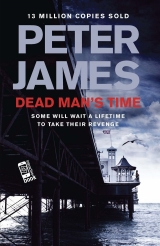
Текст книги "Dead Man's Time"
Автор книги: Peter James
Соавторы: Peter James
Жанры:
Триллеры
,сообщить о нарушении
Текущая страница: 17 (всего у книги 29 страниц)
63
From an upstairs window of his new home, where he had set up an observation post and where he sat in darkness, Amis Smallbone waited for Roy Grace to arrive home. It was half past midnight.
Smallbone had rented the place fully furnished. It was modern stuff, really not to his taste, but it was a lot better than the shithole he had just vacated.
Tomorrow, he was expecting delivery of two pieces of electronic kit. One was an up-to-date, encrypted police radio from a bent technician who had worked in the Police Communications Department. The other was a scanning device, which he had bought through a contact of Henry Tilney, that could pick up any phone call, whether a landline or mobile, within a two-hundred-metre radius, and read any email or text.
He looked forward to becoming fully acquainted with his new neighbours’ movements. But what he was looking forward to most of all was Detective Superintendent Roy Grace discovering who his new neighbour was. After years of the detective being in his face, the thought that he was now going to be in Grace’s face was very sweet indeed.
But not as sweet as all the different possibilities for destroying his life that were going through his mind. As if picking up his thoughts through the wall, he heard a baby crying. The Grace baby.
He poured himself another large whisky, and lit another cigarette. Then stiffened.
Someone was walking through the entrance gate: a man in a suit and tie, holding a bulging briefcase.
Hey, Noah! Smallbone mouthed silently. Daddy’s home!
64
Gavin Daly poured himself another large Midleton whiskey and relit his cigar. It was just gone half past midnight and he was wide awake, fuming. The news, earlier, from the New York nautical timepiece dealer Julius Rosenblaum, had lit the fire inside him. He was a man on a mission. A man on fire.
Laid out on his desk in front of him was a three-foot-tall Ingraham chiming mantel clock. Beside it lay his specialist timepiece tool kit spread out, each item in its velvet sleeve. Also on the table lay the Colt .32 revolver, with six live rounds in the chambers, that he had been handed all those years back on Pier 54. It was heavy and cold and smelled of the gun-oil with which he lovingly cleaned it every year, on the anniversary of his father’s disappearance.
Inside the clock’s fine inlaid mahogany case was a round brass gong. It was hollow, and comprised two brass discs screwed together. It was a slow and intricate job but finally he carefully removed the gong, laid it down, then began undoing each of the screws. None of them had been touched in over the one hundred and fifty years since the clock had been made, and it took him time to free each one in turn. He was perspiring by the time he had finished. He laid the discs down and then picked up the revolver, and laid it in one. It fitted snugly.
He went through to the kitchen, glad that Betty was up in her room, probably asleep, and helped himself to a couple of J-cloths. Then he returned to his study.
He wrapped the revolver in the cloths, binding them with Scotch tape, then placed the package inside one disc of the gong. He placed the other disc over it, then held the gong up and shook it. To his immense satisfaction, there was no sound at all.
Then, with painstaking care, he began to replace the gong in the clock, and reassemble the chiming mechanism. It was important, if anyone were to take a close look, that it was in perfect working order.
He finished shortly before 3 a.m. But still he wasn’t tired.
Still he burned.
A fire that had been lit on a February night in 1922 burned even more intensely now, early on this September morning nine decades later.
He crushed the tiny remaining stub of his cigar out in the ashtray, then looked down once more at the page of the Daily News. At the four names written in the margin.
At one in particular.
Pollock.
Mick Pollock.
Pegleg Pollock.
Then at the list of names, scribbled in his shaky handwriting, on the notepad on his desk. The ones given to him by the genealogist Martin Diplock.
Coincidence? God’s calling cards?
Or a dead man whose time had come?
65
At 4 a.m. Noah began crying, wanting another feed. Feeling totally exhausted, Grace climbed out of bed and followed Cleo through into his room as she switched on the light.
‘Go back to bed, darling,’ she said, lifting Noah out of his cot.
‘I’ll sit up with you.’ In truth, he felt wide awake. He was still finding it hard to believe that the lovely Sarah Courteney was having an affair with that little shit, Gareth Dupont. And he sincerely hoped for her sake that her thug of a husband, Lucas, never found out.
Cleo carried Noah back into the bedroom, then sat on the edge of the bed and lowered her nightdress over her right breast. Roy Grace watched, mesmerized. This tiny creature was their son. His son. One day he would play football with him. Cricket. Go swimming. Maybe cycling. This frail human, sucking away on Cleo’s breast. They had made this little person. Brought him into the world. They would be responsible for him for ever.
Cleo had a small rash above her breast. Her hair tumbled around her face as she looked down at Noah, with such deep love in her eyes that Grace felt his own eyes filling. Noah’s thin, straggling hair was matted forward across his forehead in a way that reminded him of the character of Bill Cutting that Daniel Day-Lewis played in Gangs of New York.
Throughout his career, he had confronted a few monsters. But you couldn’t pigeon-hole murderers into any one category. Some were tragic people who killed in the heat of the moment out of jealousy, and spent the rest of their lives regretting those few minutes of madness. Some were greedy villains with no conscience, who would kill for a bag of beans. And then there were the predators who slaked a lust by killing.
There was one common denominator among most of the people he had ever locked up. They came from broken homes.
He hoped that Noah would never find himself in a broken home. Cleo had been upset with him a few days ago, for working so late. Looking at the woman he loved and the child he loved, he knew, as much as he loved his job, that if he had to make a choice right now between his career and being a good father to his son, he would quit the police tomorrow.
Then, in his mind, he saw the photograph of Aileen McWhirter’s face – like a ghost.
It was followed by the image of Lucas Daly’s wife, the broadcaster Sarah Courteney, with her incredibly sexy body, taking off her mask in Gareth Dupont’s bedroom. She was shagging him? Shagging a man who had robbed and murdered her husband’s aunt?
Just what the hell was all that about?
Different scenarios played in his mind. Had Gareth Dupont targeted her as an unwitting stooge? Perhaps to get information about the old woman’s movements? He was casting his mind back to the visit he had paid her at her Shirley Drive home, with DS Batchelor. She had told him then she was close to Aileen McWhirter. She had also seemed genuinely upset over her death. Crocodile tears?
He didn’t think so. She had a bullying husband, which made her vulnerable; had Gareth Dupont preyed on that? That was the most likely scenario, he decided. He’d called her, to try to make an appointment to go and talk to her again – without her husband present – but she told him she was out of town for two days, working on a pilot for a new daytime television show.
‘I think we’ve got new neighbours,’ Cleo said.
‘Oh?’
‘The house next door that was up for rent.’
‘The owners are in Dubai, right?’
‘Yes, I think on a two-year contract. The TO LET sign’s been taken down and I saw lights on in there this evening.’
‘You haven’t met them?’
‘No – and so far they’ve been very quiet.’
‘Do you think we should invite them over for a drink sometime?’
She shrugged. ‘I suppose that would be a nice gesture. Sometime when you are actually here,’ she added pointedly.
He nodded.
‘Go to bed, darling,’ she said. ‘You look exhausted.’
‘I was thinking,’ he said, and smiled.
‘Thinking what?’
‘How lucky Noah is to have such an amazing mother.’
‘His dad’s not bad, either!’
‘Sometimes.’
‘Yeah.’ She wrinkled her nose in agreement, and grinned. ‘Sometimes.’
Noah burped.
Grace went back to bed, but sat up, picked up the book he had been reading, and found his place. It was one from the pile of books on the early gang history of New York that he had bought from City Books.
Halfway through the first page of the chapter he saw a name, and froze.
66
Gavin Daly was feeling his age this morning. He’d stayed up until 5 a.m. phoning his old contacts in America, first in New York, then, as it became late, he switched to a contact in Denver, Colorado, followed by one in Los Angeles. He was feeling ready for his eleven o’clock glass of wine and his first cigar of the day. Then he heard the front doorbell ring.
A few minutes later his housekeeper knocked on his study door and entered. ‘There’s a police officer asking if he could have a word with you, Mr Daly.’
He nodded, his eyes feeling raw. ‘Show him in – I’ll see him here.’
Moments later, Roy Grace entered. Daly stood up and mustered a cheery smile. ‘Detective Superintendent, what a pleasant surprise. Do you have some news for me?’
‘I’d like to have a chat with you, Mr Daly.’
He ushered Grace to one of the studded red chesterfields. ‘I was about to have a drink. Do you like white Burgundy?’
‘I do, but I’m on duty, sir. Some coffee would be very welcome.’
The detective looked and sounded as tired as he himself felt. Daly instructed Betty to bring coffee and his wine, then sat back in his chair and swivelled round to face Grace. ‘Do you have some news for me?’
‘We made an arrest last night, sir, of a male suspect involved in your sister’s robbery.’
‘That’s extremely welcome news. May I know his name?’
‘Do you have any views on possible suspects yourself, sir?’
‘I don’t, no.’
‘Other than the knocker-boy, Ricky Moore?’ Grace watched his eyes carefully.
‘Other than Moore, no.’
‘I’d appreciate your keeping this confidential, for the moment.’
‘Of course.’
‘The man we arrested is called Gareth Dupont. Does that name mean anything to you?’
Daly shook his head. Then echoed the name. ‘Gareth Dupont?’
Grace continued studying his face. ‘I can’t say too much at the moment, but we have evidence linking him to the scene. You’ve never heard your sister mention his name?’
‘Never.’
‘I’m trying to find out if he would ever have had a legitimate reason for being in the house.’
‘Not so far as I know.’
‘I wonder if you could tell me in a little more detail about the watch that was taken from your sister’s safe? To help us try to identify it. It’s extremely difficult without a photograph, as I’m sure you can appreciate. We know the make and we have a description, but there are quite a number that may fit that description.’
Daly shook his head. ‘No, this was unique. Well, let me qualify that, almost unique. I don’t know how much you know about watches, Detective Superintendent?’
Grace glanced down at the sturdy but heavily scratched Swiss Army watch Sandy had given him for his thirtieth birthday, the day she disappeared; its leather strap was almost worn out. ‘Very little, I’m afraid.’
‘Well, it’s pretty fair to say that Patek Philippe & Cie, founded in 1851, is the inventor of the pocket watch, which evolved into the wristwatch familiar to us all today. The firm invented automatic winding, the perpetual calendar, the split-seconds hand, the chronograph, the minute repeater – as a result, vintage Patek Philippes tend to have an exceptionally high value. The world record price ever paid for a watch was $11.3 million, at auction some years ago, and that was for a unique Patek Philippe – it was known as the Patek Philippe Henry Graves Supercomplication.’
‘So, the one that was stolen from your sister’s safe – would there be many identical ones?’
‘To be honest with you, it was always a mystery how my father obtained the watch in the first place. He was a humble dockworker – all right, he was in a gang, but the gang basically existed to protect the rights of Irish people on the Manhattan and Brooklyn waterfronts. Even back then the watch would have had a very high value. But you have to remember parts of New York were pretty lawless in those days. I like to think he might have won it in a poker game, or been given it in lieu of a debt, but I know from the history he was a hard man – you had to be to survive then. It’s possible he got it some other way.’
The two men smiled at each other, the innuendo hanging, unresolved, in the air.
‘Now, as to your question about other identical ones. Some years back when I realized the watch was so valuable, I tried to find its provenance. I contacted Patek Philippe in Geneva and gave them the serial number, but they said that it did not tally with their records; the number was wrong.’
Grace frowned. ‘Is that implying the watch is a fake?’
‘That’s what I thought at first. But then I found out something that was common practice back in those days. You see, at that time, all their watches were bespoke, commissioned by buyers. Many months of work would go into a single pocket watch. Well, apparently, top apprentices would make themselves a duplicate at the same time, secretly of course. I suspect that’s what my father’s watch is. I believe in the rag-trade, where workers make themselves duplicate garments from left-over cloth, it is called cabbage.’
‘Some cabbage!’ Grace said, and smiled. ‘And it doesn’t detract from its value?’
‘Far from it,’ Gavin Daly said. ‘It’s an important piece. Part of watchmaking history.’
‘You never took photographs?’
‘Oh, I did, I have them somewhere. But maybe they got misfiled or thrown out. I’ve searched high and low and so far nothing. And, of course, the photo Aileen had has gone.’
Changing the subject abruptly, Grace asked, ‘So how did your son get on with his golfing weekend in Marbella?’
‘To be honest, I wouldn’t know. Lucas and I are not that close.’
He nodded, then sat in silence for some moments. ‘Do you know an Anthony Macario or a Kenneth Barnes?’
‘No, I don’t.’ He answered too quickly, as if he had expected to be asked. And that, together with his eye movements, gave Grace a strong indication he was lying. Daly compounded this by scratching his nose, a further tell-tale sign.
‘They were found floating in the water at Puerto Banus yesterday morning, with a capsized dinghy near them. It normally takes two to three days for a body to rise to the surface after being put into the sea in warm water. Your son went to Marbella on Friday. I always like to look at coincidences.’
Grace paused as the housekeeper came in with a tray on which was a bottle of wine opened, a single glass, a china cup and saucer, a small coffee pot and a milk jug. While she was setting down their drinks, he took the opportunity to look around the room, seeing what he could learn about the old man from his lair.
He looked at the crammed bookcases, the busts, some on shelves, some on plinths, and at the beautiful gardens beyond the window. Then at the fine inlaid mahogany clock with a Roman numeral dial on the old man’s desk.
The housekeeper departed, and Grace took a grateful sip of his coffee.
Daly was glaring at him, his mood perceptibly different now, bordering on openly hostile. ‘Just what are you insinuating, Detective Superintendent?’
‘Nice coffee, thank you.’ He set the fine bone china cup down in its saucer. Then he pointed at the clock. ‘That’s very beautiful.’
Daly looked at it, then looked at Grace, with a strange expression. He looked decidedly uncomfortable suddenly, Roy Grace thought.
‘It’s an Ingraham. Handmade in 1856. A very fine example. I’m shipping it to a client in New York.’
‘So you still keep your hand in?’
‘Oh, indeed. Keeping active, that’s my secret. Keep doing what you love. You’re a young man, but you’ll understand me, one day.’ Gavin Daly caressed the clock, becoming animated. ‘This was made by a true craftsman. There’s nobody today could make something like this.’ Then his mood reverted to anger once more. ‘So, would you mind telling me exactly what you are insinuating?’
‘Well, let’s take Ricky Moore. Your sister was tortured, hideously, with cigarettes and heated curling tongs. The night after she died, Moore was kidnapped and tortured with a hot instrument.’ Grace raised his arms and smiled disarmingly. ‘Bit of a coincidence, but perhaps no more than that. Then your son went to Marbella the following Friday and just days later, two bodies were found. Their time of death is estimated by our Spanish police colleagues at between Friday night and sometime on Saturday.’ Grace picked up his cup, blew on the coffee, and drank some more.
‘And just what the hell does that have to do with Lucas?’
‘I was hoping you might be able to tell me, sir.’
‘I told you, we rarely speak.’
Grace put his cup down, then pointed at the bust of T. E. Lawrence. He recognized him because Cleo had been studying Lawrence for her Open University degree in philosophy, and had encouraged him to read some of his writings. ‘You have him there for a reason, I presume?’
‘I have all of them for one reason. They were great Irishmen whose works I admire.’
‘Then you’ll remember something Lawrence once said: “To have news value is to have a tin cat tied to one’s tail.” ’
Daly frowned. ‘Actually, I don’t remember that. What in hell does that mean?’
‘It means I can hear the sound of your son clanking every time you move, Mr Daly.’
Daly stood up, his face flushed with rage. He pointed at the door. ‘Out, Mr Grace – Detective Superintendent or whatever your damned rank. Out! If you want to speak to me or my son again, I’ll give you the number of my solicitor.’
‘Mind if I finish my coffee first?’
‘Yes, actually I do. Just get the hell out of my house, and don’t bother to come back without a warrant.’
The housekeeper let Roy Grace out through the front door. He thanked her for the coffee, and walked across the gravel towards his car with a smile on his face. He was leaving with a lot more than he had dared to hope for.
67
‘They’re nineteenth century,’ Lucas Daly said to the two quiet, polite Chinese dealers in business suits, to whom he had sold items previously, pointing at the pair of baluster-shaped Chinese vases. The Chinese and Japanese were among the few people who still spent good money on antiques these days.
‘Cantonese.’ He pointed at the panels of Oriental figures. ‘Quite exquisite! We acquired them from the home of the Duke of Sussex – he was forced recently to sell off some heirlooms to pay for maintenance of his stately home. We understand from him that these were bought in Canton by his great-great-grandfather, who helped John Nash with many of his acquisitions for the Royal Pavilion. They’re really exceptional pieces, I think you’ll agree.’
There was no Duke of Sussex. He’d bought them from a local fence, Lester Stork, no questions asked, for one hundred pounds.
‘How much?’ asked one of them.
‘Two thousand five hundred for them both. Very rare to find a pair in such good condition, you see—’
‘Lucas?’ His assistant, Dennis Cooper, who had on an even more hideous Hawaiian shirt than normal, interrupted him.
‘I’m busy.’
‘It’s your father. Says it’s urgent!’
‘Tell him I’m with important customers.’
When he turned back, the two Chinamen were walking towards the door.
‘Hey!’ he said. ‘Hey! Make me an offer!’
‘Don’t like your face,’ the one he had been talking to said.
‘Fuck you!’ he shouted back, as the door closed behind them.
Dennis Cooper wheeled his chair over and held the phone out to him. He snatched it, angrily, from his hand. ‘I’m busy, Dad.’
‘You twat!’ Gavin Daly said. ‘You absolute bloody idiot. You were meant to get information from them, not kill them.’
Lowering his voice and moving further away from his assistant, Lucas Daly replied, ‘What do you mean?’
‘I told you to go to Marbella to find out where the watch is. I didn’t tell you to kill anybody. What the hell did you think you were doing? Why did you kill them? I want my watch back. I don’t want blood on my hands.’
‘I didn’t kill anyone.’
‘No? So how come the bodies of Tony Macario and Ken Barnes were found floating in Puerto Banus Harbour?’
‘I’ve no idea.’
‘No idea? Really? You and your Albanian thug, Boris Karloff, went to see them, right?’
Lucas Daly tried to think fast, on his feet. Not one of his natural talents. ‘Yeah – like – we had a chat with them. They were a bit pissed – been out clubbing. They were fine when we left them. Like I told you, they said Eamonn Pollock had gone to New York. We searched the boat and found the safe, which had nothing in it. Then we left.’
‘I’ve just had a visit from the Senior Investigating Officer on the case, Lucas. He made it pretty damned clear he thinks I’m involved in their deaths.’
‘They were drunk when we left them, Dad. Maybe they fell overboard.’
‘Did you look up at the night sky?’
‘Up at the night sky? What do you mean?’
‘Did you look up at the bloody night sky when you were there? After you and Boris left them?’
‘His name’s not Boris; it’s Augustine Krasniki.’
‘So what did you see when you looked up at the night sky?’
‘I don’t think I looked up at the night sky at all, Dad.’
‘Shame. You know what you’d have seen?’
‘No, what?’
‘Pigs flying.’
‘Yeah, well, it was cloudy that night.’
‘Very funny. Listen. I may need to fly to New York at short notice.’
‘New York? Why?’
‘Because I think the watch might be there and, if it is, I know who has it.’