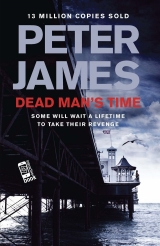
Текст книги "Dead Man's Time"
Автор книги: Peter James
Соавторы: Peter James
Жанры:
Триллеры
,сообщить о нарушении
Текущая страница: 11 (всего у книги 29 страниц)
41
All his life, Roy Grace had been able to think clearly under pressure. At this moment, in the pitch darkness, as his torch stopped several feet away, he knew his assailant would be expecting him to lurch forward to grab it. So instead, he rolled sharply away from it, connecting with something hard but yielding right behind him.
‘Ouch! Shit. Owwww.’
Someone cursing dropped something which thudded onto the floor. A torch? A gun? Then he heard the heavier thud of someone falling over. He twisted around in the darkness, balling his right fist, ready to punch out, rolled fast, grabbed his torch and shone it in the direction of the sounds.
And saw Gavin Daly, in a green suit, flat on his back, tie askew, eyes shut. For a moment, he thought he had killed the old man. He knelt and shone the beam directly on his face; after a few moments, Daly blinked.
‘You okay?’ Grace asked.
The old man blinked again, worriedly. Grace shone the beam on his own face for a few seconds, so Daly could see who it was. ‘Jesus!’
‘Are you okay?’ he repeated.
‘I’m okay,’ Daly gasped.
‘You scared the shit out of me.’
‘Next time come in a bloody marked police car,’ Daly gasped again. ‘And what the hell are you doing here anyway?’ He struggled with his arms, pushing himself upright, then exhaled.
‘Perhaps you can tell me what you’re doing here, sir,’ Grace said. He stood up and switched on the bedroom light, then helped the old man to his feet. Then he saw his silver-headed cane on the floor – and realized that was what he had been hit with. He handed it back to Daly.
‘I’ve just lost my sister, the only person I had left in the world who I loved.’ He shrugged. ‘I just wanted to be here – to feel her presence. Okay? And one of your officers told me I should keep an eye on this house. He said the bastards might return and take more stuff, or tell others about the things they didn’t take. I’ve had the most valuable items they left moved into storage. But someone has been here and taken something.’
‘What was it?’ Grace knelt, and examined the painful weals above his ankles.
‘Sorry if I hurt you.’
‘You’re bloody strong – especially for a man your age,’ Grace said, unable to conceal the admiration in his voice.
‘Apologies, but I didn’t know who the hell you were. I thought you might be the bastard who took the photograph of the Patek Philippe watch from Aileen’s album, coming back for something else.’
‘Aileen’s album?’
‘It was here, in her bureau, on that Thursday evening when I came here, minus the photograph of the watch.’
‘It wasn’t removed by one of my team?’
Daly shook his head. ‘No, I asked your Detective Branson colleague. It was the album with the pictures of all the high-value contents. It must have been one of the burglars who came back and took that one photograph to make it harder for you lot to identify the watch, do you think? My guess is they took that photo, as the watch is not insured, so the insurance company would have no record of it.’
Grace frowned. If that was the case, it meant the robbery team was even bigger than they had suspected. ‘It’s a possibility, sir, but that must have happened in the past forty-eight hours – no one would have had access while the house was sealed as a crime scene.’
‘Well, I decided to lie in wait for them if they did come back,’ Daly replied. ‘I barely sleep these days, anyway. But I thought you were meant to have a round-the-clock guard on this house?’
He was right, Grace knew. But he couldn’t tell him that budget cuts meant that wasn’t possible. ‘It’s being patrolled hourly, sir.’
‘It is? Well, I’ve been here since six o’-bloody-clock and I haven’t seen a police car all evening.’
‘How old are you, Mr Daly?’
‘Ninety-five.’ He exhaled sharply again.
‘You’re damned fit. You’re damned fit for a man twenty years younger! What’s your secret?’
Daly’s eyes twinkled for a moment. ‘Whiskey, cigars and the occasional wild, wild woman, Superintendent.’
Grace grinned. Then he returned to serious mode. ‘I know you’ve been asked this before, but how long did your sister live here?’
Daly thought for some moments. ‘It would have been since 1962.’
Grace thanked him.
‘Is that useful information, Detective?’
‘It might be. Tell me, sir, you know the antiques world better than anyone in this area – do you have any thoughts on who might have been behind this? Anyone local who has the ability to handle something of this size?’
‘Someone knew about the contents all right,’ Gavin Daly said. Grace stared at the single bed, which looked far too small for this huge bedroom.
‘The watch,’ Daly said. ‘You know, ultimately, that’s all I care about. Whatever else the bastards took, they can keep.’ He sat down on the bed, looking defeated.
‘Presumably the insurance will cover much, if not all, that was taken, sir?’
‘To hell with the insurance. I don’t need the money. I hope they don’t pay out. My asshole son will only put it up his nose after I’m gone, anyway.’
‘Lucas?’
‘Yes.’ He sat in silence for some moments, then looked sheepishly up at Grace. ‘You probably think I’m a hard old bastard, and you’d be right.’
Grace shook his head. ‘No, I don’t.’
‘Do you have children, Detective – Detective Chief – Chief whatever? Do you?’
‘I have a young son.’
Daly nodded, then dug his hand into his inside pocket and pulled out a leather cigar holder. He removed the cover then held it out to Grace. There were three cigars in it.
Grace shook his head. ‘Thank you. I’d love one sometime, but not at this moment.’
Daly replaced the top, with a wistful smile. ‘That black detective feller I spoke to, your colleague?’
‘Detective Inspector Branson?’
He nodded. ‘Quite a comedian, isn’t he? Bit of a film buff.’
‘He’s a walking encyclopaedia of movies,’ Grace acknowledged.
Daly pursed his lips. ‘I told him something he didn’t know.’
‘Oh, really?’ Grace prepared to commit this nugget to memory, to rib Glenn with it.
‘That miserable old bastard, W. C. Fields. Know what he said when he was asked how he liked children?’
He shook his head.
‘Fried.’
Grace grinned.
‘Children, Detective Grace. I’ll tell you something. They’re almost always going to disappoint you. But that’s enough about me and my problems. What do you think? You seem to be a smart guy. Everyone tells me I’m lucky to have you on this case.’
‘I don’t have enough information at this stage to give you an informed opinion, sir. But I will tell you what my gut’s telling me. Someone with inside information did this.’
Gavin Daly nodded. ‘That knocker-boy. That’s where you need to start looking.’
‘We’re looking at him,’ Grace replied. ‘But someone’s already been looking at him even harder.’ He gave Daly a questioning stare. ‘Any idea who that might be?’
The old man’s eyes darted to the right for an instant; then he returned his stare, silently and resolutely for some moments, before shaking his head. Then he said, ‘You said you like cigars.’
‘I do.’
‘Come out into the garden. Let’s smoke a cigar together. I want to tell you my life story, about my sister and me. Maybe it will help you to understand.’
42
To reassure Gavin Daly about security, Grace requested a patrol car to sit at the top of the drive of his sister’s house, while Daly called his chauffeur to come and collect him. Grace then stayed on in the house for a while, on his own, thinking about his conversation with the old man.
Thinking about why the old man had lied to him. He could tell from the direction the old man’s eyes had moved that there was a high probability he had lied. When he had asked Daly his age a short while ago he’d had no reason to lie; as he thought about the answer his eyes had moved to the left, to the memory side of his brain. Similarly his eyes had moved to the left when he had asked him the secret of his fitness, and how long his sister had lived in the house; but they had not moved left when he’d asked him who might have tortured Ricky Moore, they’d moved right, to the construct side of his brain. Where lies came from.
Was he taking the law into his own hands?
All his checking out on Gavin Daly so far had revealed him to be a man with a great deal of charm, but an utterly ruthless business streak. He was a rogue, or certainly had been once, like so many of the Brighton antiques fraternity. But he had no criminal record. His son appeared to be in the same mould, but without the charm. He needed to get Ricky Moore to talk, but apart from the man being in hospital, in great pain, Bella had reported he was clearly far too scared to give any names. Maybe putting pressure on Moore when he was feeling better might be a route to follow. Threatening to arrest him on a murder charge might persuade him to talk. Suspects on murder charges did not get bail. It could be a year to eighteen months for Moore to sweat before the trial came up. Faced with that time in jail, or naming names, Moore might well squeal.
One thing he felt certain about was that the knocker-boy was involved – whether in the planning and execution of the burglary, or simply selling on the information. The fact that Moore was tortured with a similar – but uncommon – torture implement to that used on Aileen McWhirter was evidence enough. If Moore was innocent, he would have made a complaint to the police, so he was clearly hiding something, scared of someone. But why had he been tortured? And by whom? Old man Daly knew about it, and might have ordered it. For what reason? Most likely, Grace thought, it was to get the names of the perpetrators, and go after them. And if the old man was involved, it was likely his son was too. People taking the law into their own hands, assuming they could do better than the police, always worried him, because they invariably made a mess of everything. And he still felt that the reward Daly had put up was bigger than he would have liked.
He needed to have Lucas Daly interviewed as soon as possible. And to find out his whereabouts late last Friday night around the time of Moore’s torture. A richly funded vigilante campaign was something Roy Grace seriously did not need.
It was just after 11.30 p.m. when he set the alarm and drove away from the house. He turned onto the forecourt of the Esso garage at Dyke Road Park, went into the Tesco Express and looked at the depleted selection of flowers. Most of them looked as tired as he felt. The best of the bunch was a small bouquet of crimson roses. He bought them for Cleo, then walked back out to his car and drove down to his own house, just off Hove seafront.
The sale board outside had an UNDER OFFER sticker on it. Please God, whoever you are, buy the damned place, he thought, as he unlocked the front door. It would be one headache less. He switched on some lights, then hurried through into the kitchen, and went over to the goldfish bowl.
The fish, which he had won at a fairground well over a decade ago, was swimming around and around, as if on a quest, as he always did. And, as Grace had suspected, his food hopper was empty.
Grace filled it, and for good measure sprinkled several pinches of food onto the surface of the water. Marlon rose and began gulping it down.
‘How are you doing, old chap?’
Marlon continued eating.
He was a surly creature, who had never been much of a conversationalist. But he was the last living link Roy Grace had with Sandy, who had been with him when he had won him, shooting an airgun at targets at a funfair in Hove Park. They’d bought a companion for Marlon on a couple of occasions. Each time, a couple of days later, they’d come down in the morning to find just one fish in the tank – Marlon, looking a tad fatter and smugger.
If Glenn was really going to move back home, and stay there, he would need to transport the fish to Cleo’s house at some point. But, at Marlon’s age, he was worried about him surviving the journey and the transition. It was pathetic, he knew, to have this little fish, with its fading gold colour, being the only link to his former life. But he couldn’t help it.
He thumbed through the stack of post on the table that Glenn had forgotten to bring over to his office. Mostly it was junk, but almost at the bottom was a letter from the estate agent’s, Mishon Mackay. He ripped open the envelope.
Inside was a letter from Darran Willmore, the negotiator at the agency who was handling his property. It contained the good news that the offer, at the full asking price, had now been confirmed by the solicitors for the purchaser. Our client, currently resident overseas, has assured us that she is in funds, and has lodged the deposit with her solicitors here in Brighton, subject to contract.
Grace felt a quiet thrill of excitement. Finally, finally, he could truly move on.
*
Twenty minutes later as he drove slowly past the wrought-iron gates, which were the entrance to Cleo’s town house, he noticed the TO LET sign on the outside wall had been removed. It was for the adjoining house in the old factory that had been converted into seven urban dwellings. The house had been empty for some months – Cleo’s neighbours were overseas, working on a long-term contract in Dubai.
He found a parking space a short distance away, then sat in the car for some minutes, debating whether to call Glenn and see how he was. It was bad to think ill of the dead, he knew, but he was finding it hard to be sad about Ari’s death. She had been a total and utter bitch, treating Glenn, who was one of the loveliest guys on the planet, like complete dirt for this past year. It was terrible for their two lovely kids to have lost their mother so suddenly. But now they had their father back, who was, frankly, an infinitely better person.
Holding the flowers, he walked back, let himself in through the gates, and then into Cleo’s house. Humphrey came bounding over to greet him, stamping his paw expectantly, demanding a walk.
Roy Grace bent down and stroked him. ‘I’ll take you out in a minute, okay?’
Then he listened for any sound of a greeting from Cleo. But there was none. Hopefully she was asleep.
Starving hungry, he tiptoed through into the kitchen area. On the worktop was Humphrey’s red bowl, filled with dog food. It was covered with cellophane and had a handwritten note taped to the top.
Please feed Humphrey.
He is starving.
Grace frowned. Great, he thought. Thank you so much, darling.
Humphrey looked up at him expectantly.
‘That’s all I am, isn’t it, boy? Your servant, and Marlon’s servant. Right?’
Humphrey barked. Instantly he hushed the dog, not wanting to wake Noah. He removed the cellophane and lifted the bowl. Beneath it was another note.
Yours is in the fridge.
You don’t deserve it.
But I love you.
XXXXX
43
This region of the southern Spanish coast, officially named in all the sunny tourist brochures as the Costa del Sol, had long been known to the British police by the less welcoming sobriquet the Costa del Crime. In the immediate aftermath of the Second World War, its main town, Marbella, was rumoured to have offered open house to fleeing wealthy Nazis. And until 2001 it had no properly enforceable extradition treaty with England. For decades it was a safe haven for British crooks on the run, who could live the good life with impunity.
If corruption were an Olympic sport, two of its recent mayors, both jailed, would have had gold medals in their trophy cabinets, and ninety-four dignitaries, also jailed, would have slugged it out for silver and bronze. Today the area played host to brutally active Russian, Albanian and Irish Mafia clans, along with a thriving community of British gangsters. Yet despite the occasional shooting, the crime rate was relatively low, and with its year-round benign climate, it was a long-established playground for expats and tourists.
Several miles west of Malaga airport, Lucas Daly drove the rented Jeep fast up a twisting highway cut through the mountains, keeping an eye on the arrow on the satnav. He used to know the area well, having owned an apartment in Marbella’s bling suburb of Puerto Banus for some while, until he had been forced to sell it to pay gambling debts four years ago. He had not been back here since.
It was 11.30 a.m. local time. Down below them to their left was a town of white houses, and the cobalt-blue Mediterranean beyond. Although the air-conditioning was whirring away on maximum power, Daly kept his window wound down, savouring the blast of 34-degree heat on his face after the crap English summer he’d endured. ‘Shit, it’s hot,’ he said, shaking a Marlboro Light out of the pack.
‘I’m sorry,’ the Apologist said.
‘You don’t always have to apologize for everything.’
The Apologist said nothing for some moments. Then he said, ‘Okay, I’m sorry.’
Lucas Daly grinned then patted his henchman on the shoulder. ‘You know why I like you, Augustine?’
‘No.’
‘Coz you’re a moron! You’re always fucking apologizing!’
‘I’m sorry.’
Daly lit the cigarette, then answered a phone call from his bookmaker in Brighton. Immediately his mood soured. He’d placed a bet on a horse race, and paid on his Amex, but it had not gone through. It was a long-odds hot tip, a dead cert, from a bent trainer he knew who had a horse running at Brighton. He’d bet far bigger than usual. If the horse, Fast Fella, won, it would give him some welcome respite from his immediate problems.
He pulled into a layby, and hastily gave his bookie the details of another card, which he kept for emergencies and which was not yet maxed out. Then they drove on in silence, which was usual. The Apologist didn’t have a lot of conversation, unless the subject was football, about which he could talk for hours. He knew everything there was to know about every football team in the whole of Britain, their strip, their key players’ names, their goal count for the season. Lucas avoided talking football with him; it was like pressing the switch on a machine that had no off button.
And besides, he had other stuff on his mind. A lot of stuff. Bad stuff.
Total shit.
One particular loan shark, who had recently bailed him out of his latest problem, was turning nasty. He’d been stiffed on a major deal. And his cantankerous father was refusing to help him. His best hope was for the old bastard to die soon. Alternatively a change in his run of bad luck with the horses and at the gaming tables. Hopefully this bet would be the start of it.
Driving past Marbella and Puerto Banus and on for a few more miles, they headed along the main drag into the neighbouring town of Estepona. To their left was the pyramid shape of the Crown Plaza. To their right, a large Lexus dealership and a closed-down car wash. The arrow on the satnav was pointing right, but Lucas Daly knew where he was.
They drove up past a short promenade of shops and bars into a residential area of small, white houses and apartment blocks. Ahead on their left was a row of shops, at the end of which was a bar with an outside terrace and the name LARRY’S LOUNGE printed in red capital letters on a scalloped awning. Two shady-looking men in their thirties, in dark glasses, accompanied by a bored, tarty-looking younger woman, were seated at an outside table. One man was smoking a huge cigar.
Daly pulled into a parking space a short distance past the bar. They climbed out into the searing heat, and headed towards the bar. Daly, a lightweight bomber jacket slung over his shoulder, was dressed in white T-shirt, jeans and brown suede Gucci loafers, and walking with his customary swagger; the Apologist, a foot taller than him, wore a T-shirt, tracksuit bottoms and trainers.
Inside the bar was a cool blast of air. Half a dozen men lounged in front of a TV screen, mounted high on the wall, showing a replay of some football game. Three of them, heavily tattooed, wore singlets and cut-off jeans, like a uniform. All of them were holding beer cans, and shouting at the screen. A few years ago, Lucas would have known the faces in here, but these were strangers to him.
The Apologist stopped and stared at the screen for some moments. ‘Manchester United and Sunderland. Not a good game.’
Two of the men glared up at them suspiciously. They walked on.
The interior was a cross between an ersatz English pub and a bodega, with an L-shaped oak bar, wooden stools, beer pumps, oak barrels on the wall lined with bottles, and shelves stacked with spirit bottles. Tiffany lamps hung from chains all the way around, and British football club pennants decked the walls, along with framed signed photographs of past Manchester United, Newcastle, Arsenal and Chelsea teams.
Behind the counter stood a tall, wiry man, with short thinning hair, dressed in a grey button-down shirt, opened to the navel. A tall glass of lager stood in front of him. He looked at Lucas Daly. ‘Seen you before, haven’t I?’
‘Yeah, you might have done. Used to own a place in Banus. Drank here a few times – until that fellow got shot.’
‘You and half of the Costa del Sol. Screwed my business totally,’ he said, in an East London accent. ‘That was five years ago, but people got long memories. No one comes here no more – apart from a few regulars.’ He pointed at the slobs watching the footy. ‘I have to work as a window cleaner some days, to make ends meet. Thing is, you see—’
Lucas Daly interrupted him. ‘I’m looking for Lawrence Powell.’
‘Yeah? You’ve found him.’ He gave him a stony stare.
‘I’m a mate of Amis Smallbone. He told me to tell you that you’re a tosser.’
Lawrence Powell grinned. Then, looking uneasily, first at the Apologist then back at Daly, he said, ‘Thought he was still inside.’
‘He’s out.’
‘He’s a fucking idiot, that one.’ He shook his head, then tapped the side of it. ‘Nutter. So what can I get you, gentlemen?’
‘A San Miguel and a Diet Coke.’ Daly glanced at the Apologist for approval, and got it. The man never drank alcohol. ‘Do you have any food?’
‘Crisps.’
‘That all?’
‘Plain or cheese and onion?’
‘One of each.’
The drinks arrived, with the crisps. Daly dug into them hungrily, while the Apologist drained his Coke. The barman stood, silently and patiently, behind the bar. ‘So, Amis is all right?’ he asked.
‘He was needing a good dentist, last time we saw him.’ Daly smirked at the Apologist, who nodded pensively, but distractedly, as if his mind was on some forgotten sadness.
‘I’m looking for some people living out here,’ Daly said. ‘I’m told you know them. Eamonn Pollock, Tony Macario and Ken Barnes?’
‘You’ve got nice friends,’ Powell replied.
‘I only do quality.’ Lucas Daly glanced at a barstool, two away from where he was sitting. He could see the bullet hole in the top of the seat, where a previous occupant had been shot through the groin in an argument over a woman. He’d been in here when it had happened, and still winced, five years on, at the screams of pain from the .38’s recipient.
‘They shouldn’t be hard to find,’ Larry Powell said. ‘Eamonn Pollock’s halfway up his own asshole. You just need a powerful torch. Tony Macario and Ken Barnes are all the way up it. They’re so far up it they could clean his teeth through his throat. They’re easyJet gangsters, them two.’
‘Meaning?’ Daly asked.
Powell shot a glance at the group in front of the television, to make sure none of them was listening, then leaned forward conspiratorially. ‘They do jobs for Pollock. He keeps his nose clean and his belly filled with the proceeds of their labour. Nice work. He fixes jobs for them in England, pops them on an easyJet flight. Twenty-four hours they’re back here. He makes sure never to use anyone with a British criminal record. No dabs, no DNA.’ He shrugged, and sipped his lager.
‘And if someone I knew wanted any of them whacked?’ Daly asked.
Lawrence Powell shrugged again. ‘Not a problem. Give a Moroccan a Bin Laden.’
Daly swigged down some of his beer, straight from the bottle, frowning.
‘What? Did you say, Give a Moroccan a Bin Laden?’
‘Yes.’
‘Can you talk in English?’
Lawrence Powell led them outside onto the terrace, and pointed out across the Mediterranean, at two hazy shapes on the horizon. ‘That lump of rock is Gibraltar. The other’s North Africa. Morocco,’ he said. ‘Their police have a useless fingerprint database and an even more useless national DNA database. A Moroccan can come over here, do a hit and be back in his own country before the police have even reached the crime scene. He’ll be harder to find than a specific grain of sand in the desert.’
‘And a Bin Laden?’ Lucas Daly asked.
‘A five-hundred-Euro note. They say they’re as elusive as Bin Laden was.’ Powell grinned. ‘Morocco’s a short ferry ride away from Ceuta.’ He jerked a finger to his left, west. ‘A Moroccan can live a couple of years on that kind of dough. Life’s cheap there.’
‘And you have access to these Moroccans?’ Daly asked.
‘I have access to everything.’ Lawrence Powell rubbed his index finger and thumb together.
Behind them, in the bar, there was a loud cheer as someone scored.
Back inside, Daly put a hundred Euro note on the counter, followed by four more.
Powell slipped them behind the bar. ‘So what’s in it for me?’ He looked at them expectantly.
‘How long does it take you to deliver?’
‘Same day service. Just bell me.’ He pushed a business card across the counter.
Daly slipped it in his wallet, then pulled another hundred Euro note out and placed it on the counter. Powell looked at it like it was a dog turd. Daly added a second. ‘Pollock, Macario and Barnes. Where do I find them?’
Powell raised three fingers, indicating he wanted another banknote.
Lucas Daly nodded at the Apologist. The Albanian grabbed him by the throat and lifted him in the air. Powell, choking, shook his head vigorously, making yammering sounds. No one behind them looked round; they were engrossed in the football.
The Apologist let Powell’s feet touch the floor, but kept hold of his throat. ‘My boss is not a hole-in-the-wall cash dispenser. He asked you a question. He’d like an answer. Sorry to hurt you.’
‘Contented,’ Lawrence Powell croaked. ‘At Puerto Banus.’
‘It’s okay, let him go,’ Lucas Daly said. ‘Contented at Puerto Banus?’ he said to Lawrence Powell. ‘That the name of a house or apartment block?’
Powell, rubbing his throat, and gulping down air, croaked, ‘It’s a boat. A sodding great yacht, okay?’
‘You’d better be right,’ Lucas Daly said. ‘I’d hate to have to come back and disturb you again.’ He turned to the Apologist. ‘We don’t like disturbing people, do we?’
‘I’m sorry,’ the Apologist said to Lawrence Powell. ‘For the inconvenience.’