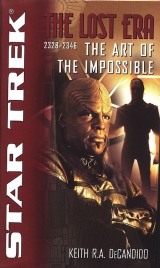
Текст книги "The Art of the Impossible "
Автор книги: Keith R. A. DeCandido
Жанр:
Научная фантастика
сообщить о нарушении
Текущая страница: 7 (всего у книги 22 страниц)
“Very well done, Mr. Troi,” Garrett said, unstrapping herself, then reaching down and grabbing the shuttle’s medikit. “Get us out of here before we have to do it again.” To Vaughn, she said, “Let me take a look at those hands, Lieutenant.”
They managed to get the rest of the way out of the nebula without incident, though the SIF was down to fifteen percent by the time they made it past the nebula’s edge. Vaughn’s hands were deemed adequately cared for until he could go to the Carthagesickbay, but that trip wasn’t immediately called for, at least.
“Set course back to the Carthage?”Troi asked, preparing to do that very thing.
“No.”
Troi shot his commanding officer—now back in the copilot’s seat—a look. “Sir?”
“I want to test a theory first.”
Vaughn, who now had Starfleet-issue bandages around his hands, and whose brown-and-gray hair was now flying in several directions, lending a comic air belied by the serious tone of voice he always had, leaned forward. “Commander, with all due respect, we need to return to the Carthageimmediately. Captain Haden—and Ambassador Dax—need to be informed. So does Starfleet. We’re going to need reinforcements, and also—”
“Lieutenant, kindly sit back and shut up. You’re right, the Cardassians have decided to put a backup plan in place, hiding a fleet in the nebula. But think about it for a second. The Klingons may have a backup plan of their own, and they don’t needa nebula to hide in, they have cloaking technology.”
“So why’d they hide in the nebula before?” Troi asked.
Garrett shrugged. “Power consumption, maybe. Or they wanted to take advantage of their superior sensors in the vicinity of the nebula. Ultimately, it doesn’t matter. Mr. Troi, is there any way to scan for cloaked ships?”
Troi blew out a breath. “Not easily. Every time we come up with a way to penetrate a cloak, the Klingons or the Romulans come up with a better cloak.”
“Yes or no, Mr. Troi.”
“I’m sorry, Commander,” Troi said after a moment, hating himself for doing it, “but I can’t be that definitive.”
Garrett actually smiled at that. “Good man. I prefer an honest answer. Do an intensive scan of the vicinity, long-and short-range, tell me if anything screams ‘cloak’ at you.”
“I’ll do my best, sir.”
Troi spent the better part of an hour scanning the area. Garrett and Vaughn left him to it, for the most part, both going aft to get some ration packs. Garrett also did a check of all the shuttle’s systems, making sure that the Hoplitewould survive to make it back to the Carthagein one piece—with, Troi heard her mention, specific emphasis on the environmental systems to make sure that the air they lost in the breach would be replenished.
The only interruption came when Vaughn walked over with a mug of tea. “Thanks,” Troi said as he took the steaming mug from Vaughn’s hands. He took a quick whiff, and identified it as the generic tea included in the packs. Pity, I could go for some raspberry herb tea right now.Still, Troi appreciated the gesture.
“I should be thanking you. You saved my life, Ian. It’s greatly appreciated.”
Troi smiled. “You’d have done the same for me.”
“Possibly, but I didn’t have to. You thought very quickly on your feet, and acted without hesitation. Pretty impressive. I just hope that Haden and Garrett appreciate what they’ve got.”
Troi grinned. “Me, too.” He took a sip of the tea, which was bitter, but still warm and comforting.
Then the sensor alarm sounded—a much milder sound than the hull breach alarm from earlier, indicating that the scan was complete.
Garrett apparently heard it from the aft section, as she came forward seconds later. “Report.”
Looking over the results of the scan, Troi shook his head. The final results told the same story that the preliminary findings had been telling him for the past hour. “Best I can give you is a definite maybe, Commander. We’re picking up subspace variances that couldindicate a fleet of cloaked ships. But it could also be simple background radiation.”
“I’m willing to bet it’s the former,” Vaughn said. He looked at Garrett. “Neither the Empire nor the Cardassians have shown themselves to be adept at negotiation where force or guile will do the job nicely.”
“I tend to agree.” Garrett bit her lip. “All right, enough sightseeing. Mr. Troi, set a course for the Carthage.Tell them that we had to cut short our exploration of the nebula, and point to the hole in our rear if they ask why. We’ll give the captain and ambassador a full report on board.”
Troi nodded. “Yes, sir.”
Damn, but I wish I wasn’t right. This can’t possibly bode well.
Chapter 11
U.S.S. Carthage
In the quarters on the Carthageassigned to Talen Kallar, an alarm went off. The alarm emanated from a small device implanted in the ear of the cabin’s occupant, so only he heard it. He barely hesitated in his assigned task of organizing files from the notes that had been taken during the most recent negotiating session. Kallar had a reputation as a physical bumbler, and was more likely to trip over his own feet than walk a straight line, but he was good at the dreary paperwork tasks that always fell upon interns. As a youth, and the lowest-ranking person in Legate Zarin’s delegation, Talen Kallar was assigned those duties.
However, the alarm was not intended for “Talen Kallar,” for the alarm heralded a signal from a device crafted by the organization that had created Talen Kallar. The name and background credited to Kallar in fact had been a fiction written by the Obsidian Order as a cover for one of their newest agents, a recent graduate of Bamarren named Corbin Entek.
While “Kallar” finished coding the latest file for Olett to look over, Entek made mental note of the fact that the alarm indicated that people had entered Captain Vance Haden’s ready room.
According to the ship’s chronometer, the next communications sweep would be in one minute. After that, Entek had a ten-minute window to activate the transmitter in the same device that had sent the alarm. The Carthage’s communications system did an automatic sweep for unauthorized transmissions every ten minutes.
To Entek, that was one of many reasons why he knew that Cardassia would eventually dominate the galaxy. If the Federation—arguably the greatest power in the quadrant—had such lax security on one of their military vessels, they would be ripe for the taking. There was no reason why those scans couldn’t be perpetual, leaving no window for such espionage as Entek was performing. Entek’s original theory, when he was told of this odd security measure, was that it was to conserve power. However, the very room in which he sat proved that to be a false assumption—the Carthagewas a momument to wasted energy, from the overly large rooms to the availability of separate quarters for each member of two full negotiating teams.
The other proof of lax security was the very manner in which Entek had planted the device. The captain had ordered the first officer to give Legate Zarin and his staff a tour of the Carthage—as if they were vacationers visiting a museum! Entek had actually laughed in the human commander’s face when she said she was taking him on that tour, and only a quick conversion of that laugh to a hysterical giggle had enabled him to maintain his cover as a callow youth.
Of course, Entek’s supervisor, whose name Entek did not know, would have said that he wasa callow youth, and he had only gotten this assignment because Zarin would be on the lookout for an Order agent in his midst, so they needed to put in someone the legate would never suspect under any circumstances. Since Zarin generally believed that nobody under the age of forty had any sense or business doing anything responsible, the ideal infiltration candidate was the most youthful member of his delegation.
That cover also provided his means of planting the listening device, which was the size of Entek’s thumbnail, under which he had stored it. When the tour took them to the captain’s ready room, “Kallar” tripped over the carpet, taking advantage of his clumsy maneuver to place the device in a corner. Its surface was sensor-blind—the only way it could be detected was when it transmitted an audiovisual record of the room to the receiver in Entek’s ear.
The chronometer indicated that the time for the communications scan was complete, so Entek removed the device from his ear and plugged it into his handheld computer.
His computer screen lit up with the image of a tharul’s-eye view of the ready room, the feet of the room’s occupants large, their heads comparatively small. Entek could barely see the perspectively tiny head of Vance Haden from his position sitting at his desk. Also present were Commander Rachel Garrett, the first officer who had provided the “tour,” Lieutenant Ian Troi, the ship’s science officer, Lieutenant Elias Vaughn, a consultant from Starfleet Command, and Ambassador Curzon Dax.
Entek went through his mental list of facts pertinent to the four humans and one Trill in the room. Troi had recently married an aristocrat on Betazed, a planet full of pacifist telepaths that Entek had always thought would be among the first worlds to fall when the Federation either collapsed on itself like the bloated mess it was or was finally overtaken by a superior force—ideally, Cardassia.
As for the others, Haden was a war veteran, having fought against the Romulans prior to the Tomed Incident, with a reputation for being somewhat blunt. Garrett was an expert fencer, and had had several dealings with the Klingon Empire over the years. Her experience was as nothing compared to that of Dax, who was one of the negotiators at the Khitomer Accords, and had forged personal bonds with several prominent Klingon military figures.
The only person about whom Entek knew nothing of consequence was Elias Vaughn. His official role was as a consultant, a functionally meaningless term that usually signified intelligence work. The Order’s knowledge of Federation intelligence was scattershot at best, but Vaughn wasn’t part of any of it that he was aware of. We’ll need to change that.
“Are you sure about this?”Dax was saying. The Trill sounded agitated.
Speaking with a certain confidence, Troi replied. “About the Cardassian ships, yes. About the Klingon ships, not so much.”
Entek frowned. His first thought was, What Cardassian ships?The only Central Command ship in the area was the Sontok.
“But it fits the profile,”Garrett was saying.
“That’s ridiculous,”Dax said, making some kind of gesture that Entek couldn’t make out from his vantage point. “The Klingons wouldn’t hide out like that.”
“What, it wouldn’t be honorable?”Haden’s words were laced with sarcasm.
Dax stared at the captain. “As a matter of fact, it wouldn’t. They’ve been completely up-front with us.”
“C’mon, Ambassador,”Garrett said. “You know as well as I do how fanatical Klingons get when it comes to anything sacred. Honor’s all well and good, but they’re not going to give up Ch’gran without a fight, and they’re not going to count on winning that fight over a negotiating table. Look what happened thirty-five years ago.”
Archly, Dax said, “Unlike you, Commander, I wasthere thirty-five years ago. Iwrote parts of the Khitomer Accords, so kindly don’t try to lecture me on the events leading up to them.”
To her credit, the commander was wholly unintimidated by the ambassador’s posturing. “Then you should remember that even coming to the table was too arduous a concept for some Klingons to wrap their minds around. So much so that they assassinated a perfectly good chancellor. If they can do that, I don’t think hiding a fleet nearby in case things don’t go their way can be considered out of character.”
“This will get out of control quickly,”Vaughn said. Entek noted that the human spoke in an even tone, and also that the lieutenant’s hands were bandaged. “The minute either Zarin or Worf decides that things aren’t going right, that one will call in the cavalry, and five minutes later, the other one will call in his, and this whole thing will blow up in our faces.”
Calmly, Haden said, “You’re projecting a bit, Lieutenant.”
“I don’t think so, sir.”
“Oh you don’t, do you?”Haden spoke as if he were lecturing a child. In fact, his tone reminded Entek a great deal of that of his Order supervisor. “We know there’s something that’s at least sixty-five percent likely to be anAkril -class ship in the Betreka Nebula. We know there’s a reading that might indicate a fleet of cloaked Klingon ships. Or, conversely, theHoplite stumbled across some debris from the battle here three weeks ago and those subspace variances are just background radiation, and your overactive imagination is transforming them into a pair of fleets.”
It took all of Entek’s willpower not to curse out loud.
Dax smiled. “I wouldn’t worry on that score, Captain. I doubt anyone’s accused the lieutenant of having an overactive imagination.”His face grew serious. “But you’re both right. We don’t know enough, and it is precisely because of that lack of knowledge that the situation isalready out of control.”
“We need to call in reinforcements,”Garrett said. “We’ll be a sitting duck if those fleets decide to go at it.”
“Too risky,”Haden said. “I don’t disagree with you, Number One, but Monor and Qaolin already have their bowels in an uproar because I let theHoplite out in the first place. They’re keeping a close eye on us.”
Entek noted the phrases “sitting duck” and “bowels in an uproar” for addition to their growing linguistic database on the Federation. Both had definitions that seemed obvious from context, though Entek tagged them both for verification and a tracing of etymology.
Dax shook his head. “What we need to do is put our cards on the table and call their bluff.”
“That’s a quaint metaphor,”Vaughn said with a level of snideness that Entek couldn’t help but admire. He also made a note for the Order to determine what that metaphor was—it was obviously some kind of contest involving cards, but that hardly narrowed the field. “But I doubt they’re bluffing.”
“I’m sure they think that, too—and will continue to do so, right up until they have to actually play their cards. But one reason why I think they’ve assembled these fleets in the first place—”he looked at Haden “—assuming theyhave assembled the fleets—is because they’re far from home. Reinforcements beyond whatever they’re hiding behind cloaks or in nebulae are days away, and probably not easily diverted. I’m not sure either Zarin or Worf will be willing to start something they can’t finish.”
“I’ve read the transcripts of the meetings so far,”Vaughn said. “I haven’t seen anything to indicate that either side is going to budge. Where does that leave us?”
“I have no idea where it leaves you, Lieutenant, but it leaves me with the winning hand. I just have to play it.”
Again, the alarm beeped. The ten-minute window was about to close. Cursing, Entek turned off the listening device. He had been hoping to hear more, but he dared not risk a second transmission. Another one so soon might be detected by the Carthage’s communications officer even without the automatic scan.
Besides, he’d heard enough. Haden may have had his doubts, but Entek didn’t. Central Command had objected to negotiations from the beginning. It was completely in character for them to assemble a fleet in secret and hide it in the Betreka Nebula, not bothering to inform the Order or the Detapa Council about it.
To Entek’s frustration, there was nothing he could do. His job was purely to gather intelligence—and this meeting had gleaned a great deal, beyond the significance of this particular mission. He had neither the means nor the ability to acton any of it, though. Indeed, he would not even be reporting back to his supervisor until he was back on Cardassia.
Assuming we survive this negotiation,he added dolefully, a state of affairs which hadn’t been in doubt until Entek overheard the meeting in Haden’s ready room.
Entek removed the device from the handheld computer and placed it back in his ear. Then he called up his ongoing report for the Order. He had a great deal to add to it now.
“Enter!” General Worf spoke the single word in the Klingon language when the doorchime to his quarters sounded. As expected, Lorgh walked in.
“You sent for me?” his aide who was not his aide asked.
Seated at the too-comfortable chair Starfleet had provided, Worf reached onto the table that held his workstation and grabbed a mug. He handed it to Lorgh. “Drink with me, Lorgh.”
Taking the mug, Lorgh asked, “For what reason, General?”
“I have just been informed that my son has taken a mate.”
Lorgh smiled. “For that, I will even drink Starfleet’s warnog.”
“I appreciate the sentiment, but so great a sacrifice will not be required.” The general indicated the bottle of bloodwine on the table. “I have been saving this for a special occasion.”
Peering at the table, Lorgh saw that the bloodwine was from the Ozhpri vintner—one of the finest in the Empire. “A worthy vintage.” He held up the mug. “To your son.”
“To Mogh, son of Worf, and soon to be mate of Kaasin, daughter of Prella.”
They both drank. Worf reveled in the oily slickness of the bloodwine that seemed to coat his throat as it went down.
“May they both bring you many strong children to perpetuate your House.”
Worf laughed. “Well said, though I will settle for at least one heir.” He took another gulp of wine, then regarded his aide. “At the reception, you said that the Council preferred to fight this battle across a negotiating table. I am beginning to think that such is a battle we cannot win. The Cardassians refuse to even acknowledge the importance of Ch’gran. They denigrate it, call it a mere pile of wreckage. It has been exceedingly difficult to keep from killing Legate Zarin. I believe that we will never reach an understanding. We may need to call in the fleet.”
Lorgh shook his head and walked over to the cabin’s window, which had a spectacular view of the Betreka Nebula. “That may satisfy our honor in the short term, General, but it will not gain us Ch’gran—or much else. The Cardassians are strong, and getting stronger.”
“As are we,” Worf said.
“Yes, but they grow stronger from a position of strength—they are expanding, improving their resources, and their economy can support a military buildup. Cardassia has gone from an unknown and irrelevant nation to an important participant in quadrant politics in a very short time, General. They build on a solid foundation.”
The general snarled. “Whereas we rebuild from weakness.”
“Sad, but true, sir. The Defense Force’s shipyards have lain dormant for several turns. Vessels that should have been decommissioned years ago still fly the stars, some being held together with little more than targguts and wishful thinking. A war with Cardassia is not one we can win.”
Worf shook his head. “I fear you are correct.” He drank down the rest of his wine and poured more. “We have become too reliant on others—the Federation, the Romulans…”
“What have the Romulans to do with this?”
The general gulped his bloodwine. His thoughts took a dark turn, and he wondered how much of Ozhpri’s finest he would need to imbibe before he was sufficiently drunk to deal with those thoughts. “Many of our finest Houses have fallen into debt since the destruction of Praxis. Are you familiar with the House of Duras?”
“Yes. As I recall, they brokered many technological exchanges with the Romulans when we were their allies.”
Worf nodded. “Our Houses have long been in conflict. Their House head is an old man now. His son, Ja’rod, has rekindled those old ties with the Romulans now in the hopes of alleviating debts they have accrued. Further—they have introduced other families to Romulan sources that can aid them.”
“I was not aware of this,” Lorgh said, and Worf wondered if he was honest.
“Your superiors should be. If not, they are fools, and we are in worse trouble than I thought.” He leaned forward. “Do you not see, Lorgh? Our people are becoming weak, desperate. Honor must be served, but honor does not put food on the table. It is no easy thing for a noble-born Klingon to starve like some laborer in the lowlands. Finding Ch’gran is the thing that can save us, remind us of who we are.” He leaned back in the irritatingly pleasant chair and gulped down the rest of his bloodwine. Then he threw the mug across the room; it clattered against the wall, but the noise was muted by the room’s carpeting. Damn Federation even spoils a perfectly good gesture of anger.“If we lose that, too, after losing so much, I fear for the future of the Empire.”
“Our future is strength,” Lorgh said with the confidence of youth. “It is our present that is of concern. We will be great once again.”
“But at what cost? Will we be ruled from Qo’noS, Romulus, or Earth?”
Lorgh had nothing to say to that.
The doorchime then rang again.
Worf hadn’t been expecting anyone else, but he said, “Enter,” this time in the human language.
This proved wise, as the door opened to Wai-Lin Li, the chief of security for the Carthage.A short woman with a compact form, she moved with a lithe grace that bespoke fine martial skills. Worf would have expected no less from someone in charge of security. While most humans were soft, Starfleet rarely put people in positions for which they were unsuited, and the job of security chief necessitated a certain physical prowess. “General Worf, I need you to come with me, sir. Ambassador Dax has called an emergency negotiating session.”
“What for?”
“I don’t have that information, sir. I was simply ordered to escort you to the briefing room.”
“Very well.” Worf rose and exited his quarters, Lorgh falling into step behind him.
When they arrived at the briefing room, Worf noticed a much larger security contingent present. Usually two guards were posted inside the room during conferences, which Worf had thought a reasonable precaution. Now, however, four guards stood inside the room, with two more posted outside.
I do not like this,he thought, and shot Lorgh a look. Something has changed.Worf knew that the Carthagehad sent a shuttle into the nebula, which had then been damaged and had returned to the ship only two hours ago. Initially, the general had believed the captain’s claim that they were engaged in scientific research—the Federation never passed up an opportunity to stare at natural phenomena for long periods of time—but now he wondered if something else was going on.
He also wondered if the shuttle had detected the fleet that lay in waiting. No, the Federation has no way to penetrate our cloaking shields.
Worf noted that Li took up position in the room as well. Dax was in his usual seat at the center of the table. “What is the meaning of this?” the general asked the ambassador.
“We’ll discuss it when Legate Zarin arrives.” Dax’s tone was much harder than usual.
Escorted by another member of the Carthage’s security force—who also took up position, bringing the number of guards in the room up to six—Zarin and his female aide came in. “What is the meaning of this?” he asked, a parroting of Worf’s own words that made the general a bit uncomfortable. But then, it was a reasonable question for either of them to ask. “I was in the midst of very important work—”
“This is the only work that should concern you right now, Legate,” Dax said, “and it’s taken on a new wrinkle.”
“A ‘wrinkle’?” Zarin asked.
“Obviously something important has changed, Ambassador,” Worf said. “Kindly tell us what it is.”
Then Dax smiled that insincere smile that Federation diplomats were particularly adept at. “I’ll be happy to, General, Legate. These negotiations are over. The Federation has unilaterally decided to take over Raknal V. We refuse to accept any claim made on the world by either Cardassia or Qo’noS, and any attempt to refute our claim will be met with force.”
Zarin quivered with rage, and Worf felt similar anger coursing through his own veins. I knew that trusting these negotiations to this charlatan was unwise. “Great” Curzon Dax indeed.
“How dareyou! You have no more claim to Ch’gran than this petaQ!”
“I can assure you, Ambassador, that this act will not go unchallenged.”
“I’m sure it won’t, Legate,” Dax said. “In fact, I’m sure you’ll start by leaving this room and having Gul Monor fire on the Carthage—just as the general here,” he pointed at Worf, “will instruct Captain Qaolin to do likewise. But the Sontokand the Wo’bortasare still under repair, and the Carthageis ready for a fight. Captain Haden’s record in battle is not inconsiderable, either. No, your best bet would be to call in reinforcements. Luckily, there’s a Klingon fleet a few million kilometers away under cloak that can destroy the Carthageand move on to claim Raknal V.”
Zarin turned angrily on Worf. “What!? You agreed to bring only oneship! Typical of Klingons—you claim to be creatures of honor, yet you cannot keep to a simple agreement. We should have known better than to think you capable of negotiating in good faith.”
Worf, however, regarded Dax. It seems I have underestimated the Federation. I am a foolish old man to have let them outmaneuver me like this.He could feel Ch’gran slipping away from him—and with it, all the work he had done to climb out of General Chang’s shadow being undone.
Dax walked around to stand between the two negotiators. “Of course, Legate, you won’t be able to take such an action sitting down, as it were. So you’ll have to summon the reinforcements you have in the Betreka Nebula.”
Blinking, Worf looked at the legate. Based on the expression on Zarin’s face, Dax spoke the truth. “You dare to accuse usof not negotiating in good faith?” Worf asked.
“We simply wish to protect our claim,” Zarin said weakly.
“And we want to restore a sacred relic to our people! Perhaps we have violated the letter of our negotiating terms, but we did so out of a desire to see justicedone! Ch’gran is Klingon, even youcannot deny that! We fight for our heritage. I wonder what feeble excuse youhave for breaking your word.”
Dax said, “Obviously, you cannot resolve your agreements without fighting each other, so fight each other you must. Tear yourselves to pieces. Sacrifice all the gains you have made over the past few decades. Deplete your economies in a costly war that will drive you into debt and devote your forces to a distant region. Plunge your nations into ruin.”
“You underestimate Cardassia,” Zarin said smugly.
“And you, sir, underestimate the Klingons,” Dax said. “They will fight you until their dying breath to reclaim Ch’gran. This is not a conflict either of you can win.”
Dax said nothing Worf had not already thought—or discussed with Lorgh. “Do you have an alternative, Ambassador, or do you simply enjoy stating the obvious?”
Again, Dax smiled. “Actually, I do—have a solution, that is, though I will confess that sometimes stating the obvious has its joys. Have a seat, gentlemen.” Dax himself sat in one of the chairs, activating the triangle viewscreen at the table’s center.
Worf gave Lorgh a nod, and took a seat on one end, Lorgh doing likewise in the chair perpendicular to his. He noticed that the screen gave a topographical view of Raknal V.
Zarin and his aide remained standing. “I refuse to continue these negotiations. The Klingons—”
“Have a seat,Legate,” Dax snapped. “Right now, the Carthagehas its phasers trained on the Sontok—with photon torpedoes,” he added, “targeting the Wo’bortas.The only thing keeping Captain Haden from giving the order to fire is my word. All I have to do is nod to Commander Li there, and the Carthagewill fire.”
“You have no right—”
Dax rose and stood face to face with Zarin. “We have everyright, sir. You have both violated the terms of the negotiations. The Federation is wholly justified in viewing this military buildup as a hostile act.” The Trill’s nose was now almost touching that of the legate. “Now kindly—sit– down.”
Zarin sat down. Worf revised his estimate of Curzon Dax upward slightly.
Then the insincere smile came back, and the Trill retook his seat. “What I propose is simple. Both the Klingon Empire and the Cardassian Union have a claim on Raknal V. I think it’s patently clear from the joyous times we’ve spent in this room that neither side is willing to alter its negotiating position, and neither of you would even beat the negotiating table if you were willing to go to war over this. So you need to find a third option—one that allows you each the opportunity to legitimize your claims.”
Worf’s estimate starting sliding back downward again. “If you have such an option, kindly state it.”
“For once, I agree with the general,” Zarin said. “You may like the sound of your own voice, Ambassador, but I find it grating.”
“Sticks and stones, Legate,” Dax said, a phrase that Worf found meaningless. “Sixty years ago, the Federation and the Klingons signed the Organian Peace Treaty. The conflict that predated the treaty involved the dispute of several border worlds. One of the terms of that treaty was that each nation would be given the opportunity to develop those worlds and prove their claim to be the strongest.”
Worf frowned. “You suggest that we do the same for Raknal?”
“Yes.” Dax pointed to the rendering of the planet on the viewscreen. “The world has two continents. What I propose is the following: The northern continent will be under the direction of Cardassia. You will treat that continent as if it were one of your colony worlds—set up some kind of governmental body and proceed accordingly. The southern continent will be under the jurisdiction of the Klingon Empire under the same terms. Both the Klingon governor and the Cardassian ruling body will make regular reports to me. When I am satisfied that one nation or the other has proven itself best able to exploit the world’s resources, I will make a decision as to whom it will be ceded.”
Zarin stood up. “Preposterous!”
“On the contrary, Legate. Whoever gains the planet will have earnedit. Rather than simply gaining it by stumbling across it—or,” he added with a glance at Worf, “by the happenstance of one’s ancestors having stumbled across it centuries ago—you will have proven that it deserves to belong to you. Or, as the case may be, not.”