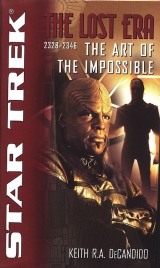
Текст книги "The Art of the Impossible "
Автор книги: Keith R. A. DeCandido
Жанр:
Научная фантастика
сообщить о нарушении
Текущая страница: 21 (всего у книги 22 страниц)
Chapter 39
Raknal V
“Governor, theWo’bortas has arrived to pick us up.”
Qaolin almost choked on his bloodwine at that. Once again, fortune sees fit to spit in my drink.The final indignity in a lifetime of indignities: the very vessel whose command he had to give up to take over this shipwreck of an assignment was the one that would take him away from it.
He looked around at the run-down office that had been his home for eighteen years. The weapons and artwork and furniture had all been packed up and would be transferred to the Wo’bortascargo bay. Knowing the Cardassians, they would probably condemn all the Klingon construction and replace it with their own hideous architecture. Good. The idea of any of those lifeless cowards making use of Klingon buildings is revolting.
Taking another gulp of bloodwine, Qaolin laughed. So this is what it’s come to. I had hoped that the deaths on theChut or the collapse of that building would finally end this battle. Even the Cardassians transplanting those damned fish of theirs might have finally led the Great Curzon to declare a victor in this tiresome little war we have been fighting. Instead, it was a simple change in power. A battle that should have been won is instead ended by politics.He drank more bloodwine, emptying the bottle. How I hate politics.
Qaolin had no idea what he was going to do next. After giving it a great deal of consideration, he was seriously tempted to just go home—or perhaps not even that, but take his share of the holdings of his House and purchase some land on a distant world of the Empire. I can spend my days hunting and my nights drinking. That might not be a bad way to occupy the rest of my life.
Then he opened the drawer of the empty desk and retrieved the one item he had not packed up.
A vintage bottle of bloodwine from the Ozhpri vintner. I’ve been saving this for when I was victorious over Monor and had restored Ch’gran to our people.
Of course, he had lost to Monor, and Ch’gran’s restoration would be at the hands of diplomats and politicians. Damn Monor, he beat me.What was worst was that the Cardassian had not shown any signs of weakening. Qaolin had arrived at Raknal V swearing he would not let Monor take Ch’gran from him. A vibrant young man, he was fresh from his first command, with a good life and career ahead of him. He had proven himself to be quick-witted, strong, and one who could thrive in the volatile atmosphere of the Defense Force. Now, he was leaving Raknal V, Monor having succeeded in taking Ch’gran. A drunken wreck with a broken spirit and few prospects, Qaolin was dull-witted, weak, and wouldn’t last a minute on a Defense Force ship.
But Monor? He arrived at Raknal V an insufferable clod and he was now taking over Raknal V as the same insufferable clod. It was maddening.
Qaolin stared at the bottle of bloodwine.
Then he smiled.
Prefect Monor stared at the view of his planet from his office. The sun was starting to set behind the solid, Cardassian-constructed buildings that would now serve as the focal point of Cardassia’s colony on this world. Monor’s World.
“I like the sound of that,” he said aloud.
“The sound of what, sir?”
Monor turned to see that Ekron had entered. The years had been kind to Monor’s aide. For one thing, age had softened his ridges, so they didn’t quite make his face look so craterlike. For another, after a rocky start, he took quite well to living planetside. Monor suspected that change mostly came about when the prefect finally gave in and let him pursue that imbecilic hevritproject of his—though even Monor had to admit that the transplanting had been a success, for all the difference it made to the price of kanar.Still, it kept Ekron happy, and as long as he was happy, he was efficient, which was what mattered to Monor. He’d have been lost in this post without Ekron’s efficiency.
“I was just admiring the view of my planet,” he said in answer to Ekron’s query. “And it is, you know. Mine. Make a note for me to send a message to Central Command seeing if they can name the planet after me. Least they can do after saddling me with those damned Foreheads for eighteen years. It’ll be good to see the last of them, let me tell you. Don’t know what it took for one of them to see sense, but I’m glad that K’mpec person at least has a brain. He’s probably some kind of mutant—the only Forehead with an actually measurable cranial capacity. Hard to believe, really, that people with such massive heads can have such tiny brains. Make a note of that, Ekron, we should do some kind of study.”
“Yes, sir,” Ekron said. “Ah, you have a package, sir. It was just delivered from the southern continent.”
“What!?” Monor turned around. “Dammit, man, do I have to do allthe thinking around here? That could be—”
“It’s already been thoroughly scanned, sir,” Ekron interrupted.
Of course it has, you old fool, Ekron’s no idiot.“And what is it?”
“It’s a bottle of bloodwine, sir.” Ekron handed a box to Monor.
Gingerly, half expecting it to explode, Ekron’s scan notwithstanding, Monor opened the box.
Inside was a bottle with some kind of Forehead logo on it, along with that scrawl they insisted was a language. Also inside was an optical chip.
He handed the latter to Ekron. “I’m going to regret this, but put it in the viewer.”
“Yes, sir.”
Ekron did so, and the viewer on Monor’s office wall lit up with the hideous face of Qaolin.
“Greetings, my old enemy. Eighteen years ago, we faced each other in combat worthy of song, and one that intertwined our destinies on this forsaken ball of rock. Today, we part, with victory in your grasp. I must admit, this was not the ending I had in mind for our battle when our ships first engaged over this world, but I cannot deny that you have been a worthy foe. Therefore I give you this parting gift—the finest bottle of the finest bloodwine from our finest vintner. I salute you, Prefect Monor—you have been a worthy foe.Qapla’ !”
The message then ended. “At least he wasn’t slurring,” Monor muttered. Then he handed Ekron the bottle. “Destroy it.”
“Sir? It wasa gift.”
Monor’s lips curled in distaste. “Please. It’s a Forehead abomination. I want all traces of those creatures abolished from my world, starting with this blood vinegar of theirs and finishing with that filthy Ch’gran wreck. That’s what started this whole mess, you know. I tell you, Ekron, I wish you’d never found that damned relic. If you hadn’t, we’d have just colonized this place eighteen years ago and I could’ve retired.”
Taking the bottle from Monor, Ekron said, “As you say, sir.”
“I want that bottle vaporized, Ekron. Hell, I want it atomized.I don’t even want there to be microscopic traces of that damned Forehead swill on my world, is that understood?”
“Yes, sir. If you’ll excuse me, sir.”
Ekron took his leave. Monor went back to the window and watched the rest of the sunset on his world.
Chapter 40
Betazed
Elias Vaughn sipped his single-malt Scotch as he stood on the periphery of the crowd. He saw several familiar faces at the reception, but thankfully no one he knew well enough to actually talk to. Some nodded their heads at him, others ignored him. None came to talk to him, which suited him fine. He was just marking time until the transport arrived in any case. The reception was unusually quiet, as most of those present were telepaths, and so defaulted to talking among themselves psionically.
Finagling the invitation to this reception was the only way Vaughn could justify the trip to Betazed without it getting in the way of the mission he and T’Prynn were about to go on in the Arvada system. But it was something he felt the need to do now, before Arvada III, in case that mission went bad.
Vaughn wasn’t even sure what the reception was for—all he knew was that Uhura got him on the guest list.
“Well, well, well, look who’s here.”
Closing his eyes, Vaughn thought, Not him. Why did he have to be here?
Giving in to the inevitable, he turned to see the familiar smug face, irritating smile, shock of white hair, and black spots of Curzon Dax. He was dressed in an ankle-length blue jacket decorated with some kind of sun-and-moon pattern over a white shirt and black pants.
“Ambassador,” he said with a minimal inclination of his head. As Dax approached, Vaughn caught a whiff of allirapunch. Wistfully, Vaughn remembered that Ian Troi was rather fond of that stuff—in fact, it was at the reception on the Carthageeighteen years ago that he introduced Vaughn to the beverage. Seeing Dax drink it now seemed wrong to Vaughn.
“Have to admit to being surprised to see you here, Vaughn. You never really struck me as the partying type.”
“I have some personal business to take care of on Betazed.” That was as much as he was willing to share.
“Fair enough. It seems to be a day for surprises. I thought for sure that Lwaxana Troi would be present—I’m told she nevermisses a party—but she’s not around, either.” Dax hesiated, then took a sip of his punch. “Listen, I’m glad you’re here, actually. I was so caught up in the political nonsense on Qo’noS after we left the Great Hall I never had a chance to thank you.”
Vaughn almost choked on his Scotch. “Excuse me?” Curzon Dax is actually expressing gratitude? Tome ?
“Well, for your help, for one thing,” Dax said with a smile. No doubt he’s enjoying my discomfiture.“Your tracking down those records proved to be a very handy bargaining chip. I think it’s safe to say that relations with the Empire are stronger than ever.”
“That’s good.”
“Yes.” He shook his head. “I have to ask, Commander—how didyou obtain that information?”
Rather than answer, Vaughn simply stared at the older Trill.
“All right, fine, don’t tell me. I suppose it’s probably safer this way. In any case, I’m also grateful to you for seeking me out on Risa two years ago. I have to admit, I let the entire Raknal V situation get away from me. I should have been keeping a closer eye on things. Hell, I should never have proposed that solution in the first place.”
“Not that I don’t agree—” Vaughn started.
Dax grinned. “Considering that you said so from the beginning.”
“—but why do you say that?”
“I thought I understood how to make both sides talk to each other, but I couldn’t have misjudged the Cardassians more if I tried. Klingons thrive on that sort of competition, but the Cardassians think it’s their destiny to overrun the galaxy. I’m not even sure they have a conceptof competition. They just prefer to run roughshod over everything. As for the Klingons…” He smiled. “If I’ve learned nothing else over the years, it’s that the only people who can deal with Klingons are Klingons.”
“That’s very profound, Ambassador,” Vaughn said, almost meaning it.
“Excuse me, Lieutenant Commander Vaughn?”
Vaughn turned at the new voice, which belonged to a young woman with dark black eyes. “Yes?”
“Your transport is ready.”
Dax gave a small bow. “I assume this is your personal business. I will leave you to it. Safe journeys, Commander. Perhaps we’ll meet again some day.”
I sincerely hope not,Vaughn thought. Not quite impolitic enough to say that, but not trustful enough of himself to say anything else, Vaughn simply returned the bow, then followed the Betazoid woman to the transport.
Lwaxana had said she would meet him there. Deanna was not coming along, as the ten-year-old girl did not like to go to that place. Lwaxana probably left her with Mr. Xelo.
Leaving the reception behind, Elias Vaughn got into the transport that would take him to the grave of Ian Troi.
Epilogue
Giv’n to the
Strong
A World in the
Cardassian Union
The girl could feel the pull of the hevriton the line.
“That’s it,” Father whispered, a proud smile on his face as they sat in the boat in the middle of the river. The sun was out, reflecting off the crystal clear water. Father held a fishing rod of his own in his hands, but he soon set that aside to make sure that the girl would be able to bring in her catch. Father had been teaching her to fish because his own father had taught him to fish, and his mother had taught him, and her mother had taught her. Families did that sort of thing, he said. It was their second day out on the river in the small wooden boat.
“Bring the fish in,” Father then said.
Slowly, gently, she moved the lever on the control that would wind in the fishing line. The mechanism was sensitive, and she had to get the speed just right—not so slow that the hevritwould have time to wriggle off the end of the line, but not so fast as to cause the hevritto come loose on account of too much force.
“Take it easy,” Father cautioned her.
She eased the lever to a slower speed, then realized that was too slow and made it faster again. Soon she got it just right.
When Grandfather purchased the land on this world, he had invited his entire family to spend a vacation here, and the girl had never enjoyed herself more on a trip in her life. Her sister and brother could play silly war games all they wanted. She preferred spending this time learning to fish with Father.
When the end of the line with the hevritattached burst through the water with a cold splash, she grinned so widely she thought her cheek ridges would fold over her ears. With Father’s help, she removed the hevritfrom the line, where it had been attracted by the sonic vibrations emitted by the device on the end—a wonderful piece of Cardassian ingenuity. The meter-long fish was quite heavy, as big as anything she had ever seen Father, Grandfather, or Great-Grandmother catch—and shecaught it!
Father placed a hand on the girl’s shoulder and grinned. “Your first catch. I think Grandfather will be very proud of you. And Mother will enjoy something new to cook. Good work.”
The girl happily replayed those words in her mind over and over again as she and Father steered the boat back toward the shoreline. Mother and her brother and sister were waiting for them, along with Grandfather.
“Father,” her sister was whining even before they docked the boat, “he’s making me play the Bajoran terrorist again. Iwant to be the gul this time!”
As Father went to settle yet another stupid argument between her siblings, she carried the container with the hevritover to Mother and Grandfather.
“I see you brought dinner,” Mother said with a laugh.
“I caught this!” she said enthusiastically. “Father helped a little, but I caught it all by myself!”
“Good for you,” Grandfather said. “That’s the way it should be done.”
Few compared to Mother when it came to cooking. Not only that, but she showed her daughter all the tricks, from how to skin the hevrit,the best way to remove the tiny bones from the meat, the proper removal of the head, and so much more.
Night fell, and Mother, Father, Grandfather, and all three children gathered around a fire that was more for illumination than warmth, as it was quite balmy here. As they feasted on the hevrit,the girl turned to her grandfather and asked him for a story.
“That seems only fair,” Grandfather said. “I think a story’s damn fine payment for this meal you’ve given us.”
Grandfather took a moment to adjust the way he was sitting, and he also set his plate aside. Then he leaned forward and started speaking to the three children. The girl was rapt with attention—she loved stories.
“Once there was a people who were very happy. They lived on the greatest planet in the galaxy, and everyone had enough to eat and they were strong. But soon they started to run out of food. And the planet that had given them so much soon ran out of things to give them. The people then became very unhappy. They suffered and starved and they were no longer strong.”
Then Grandfather sat up straight, startling the girl. “But soon, they found their way to the stars! And from the stars, they gained salvation, for there they found many more worlds that had food and minerals and so much else. Once again, they were well fed. Once again, they were strong.”
Her brother said, “Who are they, Grandfather?”
“Stu-pid,” her sister said, “he’s talking about us.”
Grinning, Grandfather said, “Yes, I do speak of our people.”
The girl was confused. “We were unhappy?”
“Not for very long,” Grandfather said in a reassuring tone. “Because we arestrong. We are, in fact, the strongest people in the galaxy. All that stands against us now are the many inferior species around us—humans, Bajorans, Klingons, Trills, Romulans, Vulcans, Andorians, Ferengi, Lissepians—but the Cardassian Union will always triumph. It is our destiny to spread our greatness throughout the cosmos.”
Grandfather leaned forward again. “Once, we found a world called Raknal V. It was ours for the taking, of course, but Klingon treachery tried to take it away from us. They made a fraudulent claim on the world, and the gullible fools of the Federation took their side. A senile old Trill tried to trick us into accepting a ridiculous competition, to make us fight for what was rightfully ours. In the end, of course, we triumphed. The Klingons gave us the world and the Trill let them. No amount of trickery, no amount of butchery, no amount of posturing could keep us from our destiny—nor will it ever.”
“Now then,” Mother said, “you should finish your hevrit.It’s time to get some sleep.”
Even as her siblings complained that they weren’t tired, the girl wolfed down the rest of her fish, then prepared her bedroll. After a long day of fishing, she was tired. Besides, she was an obedient child. She knew that if she remained obedient, she too would be strong, as a Cardassian should be.
As she lay down to sleep, she turned to her parents. “Mother? Father?”
“Yes?” they said in unison.
“Some day, I will grow up and join the military and be the finest soldier in the Union and I will find more new worlds that will bring glory to Cardassia!”
Mother, Father, and Grandfather all laughed. Father said, “Of that, my darling child, I have no doubt at all. But for now, go to sleep. Tomorrow, we’ll go home and tell your grandmother about the first fish you caught.”
Content with the day’s accomplishments, the girl drifted off to sleep. Her rest was peaceful and undisturbed, because she knew that she slept under the protection of the Cardassian Union…
Acknowledgments
The thanks must commence with editor Marco Palmieri, who conceived The Lost Eraand has shepherded it into existence. Marco is expert at taking the seed of many of the best stories (“Wouldn’t it be cool if…?”) and nurturing it into the most beautiful flower—or, in this case, a six-rose nosegay. (Hey, c’mon, people say my prose needs to be more florid…) I also must thank Ira Steven Behr and Robert Hewitt Wolfe, who wrote the Star Trek: Deep Space Nineepisode “The Way of the Warrior,” thus providing me with the basis for this novel in a conversation between Bashir and Garak about the eighteen-year Betreka Nebula incident between Cardassia and the Klingons.
My fellow Lost Eraauthors, Michael A. Martin, Andy Mangels, Jeff Mariotte, Margaret Wander Bonanno, and especially the ones on either side of me, David R. George III and Ilsa J. Bick, are all deities among scribes. David and Ilsa had several characters and situations in common with me, and both were a joy to work with. Our cooperative efforts have made our stories more coherent and, I hope, more enjoyable for the reader, which is, after all, the primary goal.

Also of tremendous use were various Star Trekreference tools, particularly The Star Trek Encyclopediaby Michael and Denise Okuda, with Debbie Mirek; Star Trek Chronologyalso by the Okudas; The Klingon Dictionaryby Marc Okrand; and especially Star Chartsby Geoffrey Mandel.
The Lost Erabooks in general and this book in particular had to weave stories from little dribs and drabs of information that the various TV shows and movies provided at many different stages. In addition to all those onscreen references (far too numerous to list here), I need to acknowledge the contributions of several works of written fiction that provided useful background material for some of the political, social, and physical forces at work in the Federation, the Cardassian Union, the Klingon Empire, and the Romulan Star Empire during this period: the comic book Enter the Wolveswritten by A.C. Crispin and Howard Weinstein; Peter David’s young adult book Worf’s First Adventure; the Dark Matterstrilogy by Christie Golden; the two-part Martok biographical novel The Left Hand of Destinyby J.G. Hertzler and Jeffrey Lang; the Garak biographical novel A Stitch in Timeby Andrew J. Robinson; Josepha Sherman and Susan Shwartz’s Vulcan’s Heart; and Lesser Evilby Robert Simpson.
I make a habit of thanking the actors who play the characters I portray in the text, which is a bit more of a challenge than usual in The Art of the Impossible, since so many of the folks herein are either of my own creation, or never appeared on-screen, or did so but briefly. However, I would be remiss if I did not acknowledge the contributions in providing voices, faces, and mannerisms of the following: Michael Ansara (Kang), Frank Owen Smith (Curzon Dax), Majel Barrett (Lwaxana Troi), Theodore Bikel (Sergey Rozhenko), Georgia Brown (Helena Rozhenko), Amick Byram (Ian Troi), John Colicos (Kor), Charles Cooper (K’mpec), Paul Dooley (Enabran Tain), Michael Dorn (General Worf), John Fleck (Koval), Danny Goldring (Legate Kell), John Hancock (Vance Haden), Richard Herd (L’Kor), Thelma Lee (Kahlest), Mark Lenard (Sarek), Nichelle Nichols (Uhura), Tricia O’Neil (Rachel Garrett), Christine Rose (Gi’ral), Alan Scarfe (Tokath), Gregory Sierra (Corbin Entek), and Ben Slack (K’Tal).
I’ve always had a great fondness for the Romantic poets of the late eighteenth and early nineteenth centuries, and one of my favorites is William Blake. It is from his America: A Prophecythat I took the titles of this book’s sections.
The continued support of the online community has been especially heartening, and I must thank all the good folks at the Star TrekBooks Bulletin Board at PsiPhi.org, the TrekLiterature Board at TrekBBS.com, Simon & Schuster’s discussion board at StarTrekBooks.com, the Star TrekBooks and Deep Space Nine AvatarYahoo! Groups at groups.yahoo.com, and the Federation Library at StarTrek-Now.com.
The usual gangs of idiots: the Malibu crowd, the Geek Patrol, the Forebearance (in particular GraceAnne Andreassi DeCandido, a.k.a. The Mom), and especially my writers group CITH, who have put up with truckloads of pages dumped on them at once and still managed to go through and make those pages better.
Last, but never least, heaping dollops of thanks to the love of my life, Terri Osborne, as well as our cats, Mittens and Marcus, all three of whom were always there to provide love, affection, and a desire to be scritched. (Okay, maybe I’m sharing too much here…)