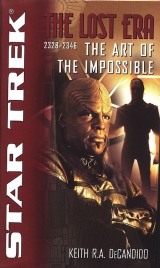
Текст книги "The Art of the Impossible "
Автор книги: Keith R. A. DeCandido
Жанр:
Научная фантастика
сообщить о нарушении
Текущая страница: 19 (всего у книги 22 страниц)
Chapter 34
B’alda’ar Base
“There I was, on a planet full of grishnarcats. The only two of any consequence were a fierce one named Baroner and a Vulcan trader.”
Several of the Klingons listening to Captain Kor tell his tale in the midst of the dark, crowded bar made their disdain for Vulcans quite clear. From his seat at a table halfway across the bar, Dax smiled as his old friend silenced their grumbles. “Do not underestimate Vulcans! They can be a fierce and powerful force when provoked. They lull you into a false sense of security by being so insipidly bland,” the captain said with a grin, “but they have their moments.”
Kor, a mug of chech’tluthin one hand, started pacing in front of the bar. It, as well as the stools, railing, tables, and mugs, were all made of the same solid wood that derived from a tree native to this world. The wood had a complex grain and was as solid as many metals. The wood scent, combined with the alcohol, gave the bar a natural feel that most modern bars could not achieve—especially, Dax noted with a smile, in the Federation, where “antiseptic” was all too often the order of the day.
“I soon learned that Baroner and his Vulcan ally were none other than Captain Kirk and Lieutenant Commander Spock of the Enterprise.The honor of killing Kirk would have been great, but it was war, and prisoners had their uses. So I put them in a prison—but the other Organians freed them. I killed two hundred of them for this effrontery, yet they seemed utterly unconcerned. I was prepared to kill more, when Kirk and Spock themselves burst into my office.”
Laughing as he poured his chech’tluthtoward his face—some of it, Dax noted, even actually making it into his mouth—Kor then went on. “Truly they were worthy foes.” He cocked his head. “More or less. Humans tend to be sentimental, even in war, and Kirk was no different. But when it came time to fight, he fought—or tried to. That was when the Organians stepped in and forced us to cease hostilities.”
The Klingons present had less love for the Organians than they did the Vulcans, but the captain shushed them. “Believe me, no one hates the Organians more than I. They claim to have evolved beyond us, yet they have no joy, no passion, no lusts!” To accentuate this last point, Kor grabbed an attractive Caitian female—who was about a quarter of old razorbeast’s age, Dax knew—and gave her a friendly snarl. The woman purred back, and everyone around them laughed. “Besides, if not for what the Organians did that day, I doubt we would have been in a position to gain the Federation’s assistance when Praxis was lost to us.”
Several grumbled at that—nobody liked being reminded of Praxis—but then Kor laughed. “Of course, that was not my last chance to face Kirk in battle! No, we fought again later, at the legendary Delta Triangle!” He gulped down the rest of his drink. “But that is a tale for another day.”
Some were disappointed at this postponement, others were relieved, others simply went back to whatever they were doing before the aged captain enthralled them with his words. Most were Klingons, and therefore had no trouble finding someone to wrestle or head-butt or drink copious amounts with. I think that’s what I like best about these people—theyknow how to have a party.
The storyteller himself, though, went straight for the small wooden table where Dax sat, nursing a beer. Dax had no idea how or why a bar located on a base deep in the heart of the Klingon Empire served Earth beer, but he hadn’t had any in years, and he found he missed it.
“Now there is a face I didn’t expect to see here,” the old Klingon said.
“I, on the other hand, fully expected to find your face here as soon as I learned that the Klothoswas in orbit here at B’Alda’ar. Speaking of your face, you’ve got chech’tluthin your beard.”
Kor laughed. “I’m saving it for later.” He fell more than sat into the seat opposite Dax. “So—if you were seeking out the Klothos,it stands to reason that you were seeking out its captain.”
Holding up his beer in tribute, Dax said, “Your powers of observation remain keen as ever, Kor. A colleague and I have been spending the last several weeks doing some—research into the head of the High Council.”
Kor frowned. “Why do you wish to investigate Kravokh? He is a good man, from all accounts, and he has made us strong once again.”
“Perhaps, but he’s also obsessed with Ch’gran. And I’ve learned why. He—”
“He is the descendant of one of the original colonists, of course.”
Dax stared at Kor for several seconds. “My colleague and I—neither of whom are without resources—took weeks to dig that up. The least you could’ve done, old friend, was let me gloat over our work.”
Kor’s laughter echoed off the ceiling. “Ah, Dax, I’ve missed you so. It’s not as if you were ignorant of my knowledge, or you would not have sought me out in this lovely establishment.” He gestured, taking in the entire dark, high-ceilinged bar. “You know that I served with Kravokh’s father, and I suppose now you wish me to provide you with insight into the chancellor’s mind.”
Dax grinned. “And they say you’re getting forgetful with age, Kor.”
“Nonsense! No one says that!” He spoke with mock outrage that only lasted about half a second before he, too, grinned. “They say I’m getting forgetful with drink!” And, as if to prove those words prophetic, he gulped down the rest of his chech’tluth.“Now, then, where was I?”
“Kravokh.”
“No, Kravokh’s father. Yes, J’Doq and I served together years ago. I remember once, after we defeated Tholian raiders, we came to a bar—rather like this one, actually—and spoke of glories past. He went on at some length about the great deeds his family had committed—it was quite tiresome, to be honest.”
Dax pointedly made no comment.
“Then I remember him saying, ‘And of course, there was Ch’gran.’” Kor smiled. “This was something of a surprise, since I had no idea that his House descended from those heroes. I said as much.” Kor frowned. “The next part was peculiar, for J’Doq said, ‘Bah! Klartak may have been my ancestor, but he was no hero. I know the truth.The whole family knows the truth, and if it ever got out it would destroy the Empire.’”
Now Dax leaned forward. This is even more than I’d hoped for.“So what was the truth?”
Kor seemed distracted. “Hm?”
“The truth about Ch’gran, what was it?”
“How should I know?” Kor shrugged, took a dry sip of his drink, realized it was empty, then tossed the wooden mug aside. “Right after J’Doq said that, he passed out. We never spoke of it again.”
Incredulous, Dax asked, “You didn’t question him further?”
“Listen carefully, Dax. I said, wenever spoke of it again. Icertainly did, but the toDSaHwouldn’t say a word after he sobered up– andhe never got drunk in my presence again.” Kor snorted. “He became very dull after that. But enough of this!” He got up, grabbing Dax by the arm as he did so. “Dax and Kor are together again! We must celebrate!”
“Who am I to argue with the hero of Klach D’Kel Bracht?”
Slamming Dax on the back, which caused the Trill to stumble forward toward the bar, Kor laughed and said, “Have I told you the story of how I massacred the Romulans on that day, my old friend?”
“Not for several years, no,” Dax said dryly.
“Then you must hear it again, for I tell it much better now. There I was…”
The beeping seemed to echo in the Trill’s skull.
He tried to remember where he was. Then he tried to remember his name. After several seconds, that came to him: he was Curzon Dax, a Federation ambassador.
And he had the mother of all hangovers.
Then he recalled the first thing: he was on his private transport, a small Trill craft that had an exquisitely comfortable bed—which made the feeling of metal against his cheek rather confusing. He opened his eyes to discover that he had fallen asleep about a meter from that bed on the cold, hard deck.
Ah, well. At least I had the presence of mind to make it back to the ship.“Computer, turn off that damned beeping!”
“Please repeat request.”
Dax sighed. Although he had intended to enunciate those words, looking back, it came out more like, “Kapooer, tnoffat dameepng!” So instead, he gathered every ounce of strength he had and sat up.
This was a mistake. The interior of the ship proceeded to leap about, jump up and down, and generally act quite silly. Dax closed his eyes—which served to give him a burst of color inside his eyelids—then opened them again. The ship had, blessedly, calmed down.
Finally, he focused on the fact that the beeping was the comm system. He managed to crawl over to the workstation and activate the viewer.
Too late, he realized he should have disabled the video feed, but by then the face of Elias Vaughn was already on the screen. “Rough night?”
“Vaughn, the last thing I need right now is a high-handed lecture from you about the perils of drinking.”
“Good, because you’re not getting one—unless, of course, talking to Kor proved a waste of time.”
With the mention of that name, the rest of the night came back to Dax. The drinking. The stories of everything ranging from Klach D’Kel Bracht to the Albino to T’nag to the Korma Pass to the Delta Triangle and back to Organia again. The drinking. The flirting with those two rather comely Rigelian women. The drinking. And, oh yes, the drinking.
Vaughn was still droning. “Believe me, Ambassador, I’m fully aware that the best tool to use in interrogating a Klingon is often a case of bloodwine.”
Dax smiled. Vaughn wasn’t as stupid as he looked. But then, with that beard, he couldn’t be.“Well, you can rest assured it was successful—sort of.” Thinking about where he and one of the Rigelian women wound up, perhaps “sort of” was overstating the case, but Vaughn didn’t want—or deserve—to hear about that. “Kor didserve with J’Doq. And J’Doq—and Kravokh—did have an ancestor on Ch’gran. Andthere’s some kind of secret that relates to his ancestor—fellow named Klartak.”
At that, Vaughn’s eyes narrowed.
“What is it?” Dax prompted.
“It can wait until you’re of a better mind to appreciate it.”
“Don’t coddle me, Commander, this isn’t my first hangover. What. Is. It?”
“I was able to dig up some of the sealed records from the Ch’gran wreck they found in the Betreka Nebula about fifty years back. Klartak was the second-in-command under Ch’gran.”
“Interesting,” Dax said, though it wasn’t really. “Still, that doesn’t explain Kravokh’s obsession.”
“I’m afraid it does. You see, Klartak wasn’t just Ch’gran’s first officer—he’s also the one who led the mutiny.”
Chapter 35
I.K.S. Sompek
K’mpec was livid.
It was not enough that the distress call to the Morska system was a fake. All the Sompekfound when Morska came on long-range sensors was a buoy of some sort that exploded within seconds of the Sompek’s commencement of that very sensor probe. No sign of the Konmator its Cardassian attackers. One of Captain Kang’s officers did report, however, that the buoy could well have been a communications relay that faked the signal, though it was impossible to be sure. Kang had the debris beamed on board just in case.
But then, to add insult to injury, they received a disaster call from Khitomer—they were under attack by Romulans. Had the convoy remained on-station, had Kravokh heeded Kang’s advice and only sent two ships, then they would have been only two hours from Khitomer. Now they were at least seven hours away.
When they received the distress call from Khitomer, the first thing Kang said was, “Is thiscall genuine?” He stared right at Kravokh as he said it.
“It is a disaster beacon, sir. Those cannot be faked.”
K’mpec was touched by the young officer’s naïveté, though it was true that disaster beacons were harder to fake than simple distress calls, as they had several added layers of identity markers. That was why the original disaster call when Praxis exploded still got out, despite attempts by the High Council to suppress them.
“Set course for Khitomer, maximum speed.” Kang gave the order without consulting Kravokh. The chancellor, for his part, said nothing. The first sensible thing he has done this day,K’mpec thought.
“Sir,” Kang’s pilot said, “do you mean maximum speed of the convoy or of the Sompek?”
Kang did not hesitate. “All ships are to execute at their maximum velocity. If some are left behind, so be it!” His voice rising with every word, Kang cried, “We will not leave our comrades to die at the hands of Romulan filth!”
A cheer went up around the bridge, including several of the councillors and their bodyguards.
Only Kravokh remained silent.
However, when the cheers died down, the chancellor did speak. “Captain Kang, while I appreciate the need for dispatch, given the circumstances, I do not appreciate my convoy being taken—”
“It is not yourconvoy, Kravokh.” Kang looked directly at the chancellor, not bothering to rise from his chair. Kravokh’s office required a modicum of respect, but Kang was not giving him even that. “Icommand this fleet’s flagship. And we have seen the result of the last time I ceded my command to you. I will not make that same mistake twice.”
A strong chancellor would have killed a ship captain that made such a pronouncement, especially in front of so many other members of the High Council. In fact, a strong chancellor would not have needed to do so, because those other members of the High Council would be falling all over each other to do it themselves.
Instead, they stood their ground.
K’mpec had known that this day would come. The battlements on which Kravokh stood had been crumbling since Narendra III—K’mpec knew this, because he had been standing on the same unsteady land. But where K’mpec had spent the two years since building a new fortress, strengthening his position, Kravokh had stayed in place.
Now Kravokh’s defenses were gone. He stood alone with no one and nothing to defend him.
“Kravokh, son of J’Doq!” K’mpec bellowed the name, his deep voice echoing off the bulkheads of the Sompekbridge. At this, the bridge quieted down. “For the second time in as many years, you have let your obsession with Cardassia cloud your judgment—and allow Klingons to die dishonorably. As I stand before these warriors, I assure you—there will not be a third.”
On the word third,K’mpec unsheathed his d’k tahg.
“Do not be a fool, K’mpec.” Kravokh took out his own dagger, and looked around the bridge. “We do not have time for such idiocy! I am your supreme commander, and I—”
“Youare the fool,” Kang said. “If somehow you survive K’mpec’s assault, you will face a phalanx of warriors who will gladly take their try.”
“It is a good day to die, Kravokh,” K’mpec said. “Let the final memory of your reign be that you died with honor—in combat.”
Kravokh shook his head. “You are allfools. You have no idea what is at stake. The fate of the Empire could well hang in the balance, and you do not see it– cannotsee it.”
His voice almost a whisper, K’mpec said, “What I see, Kravokh, are hundreds of Klingon corpses—the victims of your incompetence. The dead cry out for vengeance.”
All around the bridge, a chant started. Though he was not sure who started it, soon everyone, even Kang, had joined in: “K’mpec! K’mpec! K’mpec!”
Kravokh whirled around at all of the councillors who had betrayed him. Some of them, K’mpec knew, were the some ones who cheered his victory over Grivak in Council Chambers twelve years ago. Kravokh’s eyes fell on one in particular—Ruuv, who had been Kravokh’s aide when he was a mere councillor, elevated to the Council when Kravokh ascended to the chancellorship. At the sight of Ruuv cheering on Kravokh’s opponent, the chancellor’s shoulders sagged. “So be it, K’mpec. If I am to die this day, it will be with my eyes open and a weapon in my hand.”
K’mpec smiled. “As it should be.”
Then there was no need for words.
Though neither swift nor agile, K’mpec yielded to no one in his ability to wield a d’k tahg.In his younger days, he had been feared throughout his home planet of Mempa IV; he achieved champion standing in the Mempa Knife Duels for seven years running before his Defense Force career took away his ability to participate regularly.
Kravokh was most skilled with swords and other, longer weapons. He was good enough with the d’k tahgto hold his own, but he was no match for K’mpec. The councillor’s own prodigious belly proved more of an impediment than his foe. But K’mpec had challenged him with a d’k tahgand—especially given his lack of support among his peers—he was in no position to demand that a different weapon be used.
More fool him,K’mpec thought as he blocked a clumsy thrust of Kravokh’s. K’mpec countered with a punch to his enemy’s belly, causing Kravokh to bend over forward, then quickly followed with a slash at the chancellor’s neck.
Now bleeding profusely from the cut, Kravokh slashed back clumsily, enough to keep K’mpec from moving in for the kill. However, Kravokh chose to hold the wound shut with his right hand, leaving him with only his left to fight. This,K’mpec thought, will end soon.
“You do not know what you are doing, K’mpec. The Empire will fall to ruin if we do not crush the Cardassians and reclaim Ch’gran!”
“The Empire is already falling to ruin, Kravokh. But the fall stops here– now.”
K’mpec threw a punch at Kravokh, who instinctively blocked it with his knife hand. The blade penetrated K’mpec’s gauntlet and flesh, but the pain was nothing, the wound minor—besides, it left the chest open.
With a powerful thrust, K’mpec’s d’k tahgpenetrated Kravokh’s heart.
The erstwhile chancellor fell to the deck of the Sompekbridge.
The cheering of K’mpec’s name had died down as the fight had progressed—though K’mpec had mostly tuned it out in any case—but now the chanting grew louder and louder, even as K’mpec knelt down besides Kravokh’s fallen form. There was no need to pry his eyes open, as they stared straight up at the bridge’s ceiling.
Then he leaned back and screamed to the heavens. Most of the bridge crew did likewise.
As K’mpec removed the coat of office from Kravokh’s body, Ruuv said, “Long live K’mpec! Long live the Klingon Empire!”
Cheers filled K’mpec’s ears.
He allowed himself to enjoy the cheers for several seconds before holding up one hand. “Enough!” That quieted the bridge. “There is much to be done. The Empire has a long road ahead.”
In as close to a deferential tone as he was likely to ever hear from the old captain, Kang said, “What are the chancellor’s orders?”
“Proceed as before, Captain. Our first priority is Khitomer. The rest—” he looked down at Kravokh’s fallen form “—will be dispensed with in due time.”
Chapter 36
U.S.S. Intrepid
“No, not like that! You must hold it so it can rest against your forearm!”
Sergey Rozhenko forced a frown onto his face, even though he wanted to smile. Of course, he knew by now how to hold a bat’leth—Worf had shown him the proper hold a dozen times over the past few days—but he also knew that the young Klingon enjoyed his role as stern tutor to Rozhenko’s bumbling student. And Doctor Tavares said that the time Rozhenko was spending with the boy—virtually all his off-duty time—was aiding in Worf’s recovery.
It also aided in Rozhenko’s recovery. The more time he spent with the six-year-old Klingon boy, the less the stench of burned flesh lingered in his nostrils.
The Intrepidwas docked at Starbase 24. As good as the ship’s sickbay was, both Worf and the woman they’d beamed up required the superior medical facilities on the starbase. According to Tavares, the boy had suffered brain damage that needed to be repaired. He had come out of surgery just fine, however, and was now recovering in the Intrepidsickbay.
Juanita Tavares herself entered as Rozhenko took yet another stab at a proper bat’lethgrip, and instead almost took a stab at his own abdomen.
Shaking his head and blowing out a breath of frustration, young Worf said, “You are nevergoing to be a warrior this way, human.”
Smiling, Tavares said, “Good thing he’s an engineer, then. How are you feeling, Worf?”
“I am fine.” The perfect stoic.
“Good.” She turned to Rozhenko. “Chief, can I talk to you for a minute?”
“Of course.” He handed the weapon gingerly to the boy, who almost snatched it out of Rozhenko’s hands. “Perhaps tomorrow I will get it right.”
“I doubt it.” The boy’s voice was sullen, but Rozhenko could tell that the boy looked forward to continuing the lesson. His face had the same I’m-enjoying-this-but-I-want-you-to-think-I’m-mad look that his son Nikolai got whenever he was feeling especially stubborn.
Rozhenko followed the raven-haired doctor to her office. “I have good news and bad news,” she said, sitting at her desk.
Taking the guest chair, Rozhenko smiled. “Experience has taught me that it is best to get the bad news out of the way.”
Tavares chuckled. “Maybe, but the bad news stems from the good. All of Worf’s brain damage has been healed. It’s a good thing we got here when we did—and that Doctor T’Mret was available. However, there’s no reason why he can’t live a normal, happy life from here on in.”
“And the bad news?”
She sighed. “He did suffer some memory loss, and there’s no way to get that back. The tissue was repaired, but the damage was done. There will be parts of his life prior to the attack that are lost to him forever.”
“If the attack itself is one of those parts, then this was a blessing, Doctor.”
Tavares visibly shuddered. “I won’t argue with you there. The Klingons who arrived at Khitomer are still sorting everything out, but they double-checked with their Homeworld—the only people at Worf’s family’s home there are serving staff. According to them, the entire family was at Khitomer.”
Afraid to ask the question, yet knowing he had to, Rozhenko asked, “Have they found any other survivors?”
Tavares shook her head sadly. “Not all the bodies are accounted for, but they could have been vaporized—or captured.” She smiled wryly. “From what Captain Deighan told me, if it’s the latter, they’re dead anyhow. Klingons would rather die than be taken prisoner.”
That was an attitude Rozhenko could never understand, but he was not about to get into a philosophical discussion right now—that could wait until dinner. “What about the woman?”
“She’s the other reason I wanted to talk to you,” Tavares said with a smile. “She finally came out of the coma about half an hour ago. Her name’s Kahlest, and she’s apparently Worf’s ghojmok,which seems to be their equivalent of a nursemaid.”
So she is the same woman Worf claimed to be protecting back on Khitomer.“Good.” Rozhenko was relieved. His act of pretending to be Worf’s bat’lethstudent was only going to carry him so far. The boy needed someone who knew how to take care of him, especially if his whole family was dead.
“I told her that you’d been taking an interest in Worf, and she seemed both relieved and scared. Then she asked to talk to you.”
“To me?” That surprised Rozhenko. “Why?”
Shrugging, Tavares said, “I honestly don’t know. She also asked to be transferred to the starbase medical facility after she talks to you.”
“With Worf?”
“She didn’t say.”
Rozhenko then proceeded to the part of sickbay where the Kahlest woman lay on a biobed. She seemed nice enough, for a Klingon. At least she wasn’t bleeding profusely, nor was she missing any limbs—or her head. He liked the idea of having another image, besides Worf, of an intact Klingon to focus his attention on, so it would crowd out all the corpses on Khitomer.
The woman sat upright and spoke in a whispery voice. “You are the human who has been caring for Worf?”
Tilting his head to one side, Rozhenko said, “You could say that. I have been spending time with him when I can. He has been teaching me the bat’leth.”He smiled. “Worf does not think I am very good at it.”
Kahlest did not return the smile. “You must listen to me, human. Worf must be taken away. It is not safe for him.”
“What do you mean?”
The nurse looked back and forth, as if expecting there to be spies. Rozhenko had heard stories that Klingons kept their citizenry under constant surveillance, but he had no idea how truthful they were. “Worf’s father was sent to Khitomer to find a spy. I do not know if he found him, but if he did, that person’s family may take vengeance on Worf, as the last survivor.”
Rozhenko’s head started swimming. “I do not understand. Vengeance?”
With an impatience that was of far greater moment than Worf’s annoyance with Rozhenko’s bat’lethskills, Kahlest said, “Do you know nothing,human? If Worf returns to the Empire, he will be a target.”
“Won’t you be, as well?”
“No. I am dead. I will remain dead.”
Remembering some other stories he heard about Klingons, Rozhenko said, “You do not plan to kill yourself?”
Now, Kahlest looked upon him with pity. “You really do know nothing of us, do you?” She grabbed Rozhenko’s arm. “I beg of you, if you want that boy to live to grow into the great warrior I know he can be—do notlet him return to the Empire. If you do, his life will be as forfeit as that of those people on Khitomer.” She let go of his arm, and looked down. “And of me.”
The first thing Sergey Rozhenko did when he returned to his quarters was contact Helena on Gault.
When the face of the most beautiful woman in the galaxy appeared on the viewer in the quarters Sergey shared with another noncom (currently on duty in security), his heart sang. Her smile brightened the darkened room—he hadn’t bothered to turn the lights on, he knew his way around just fine, thanks.
“Sergey!”Then her smile fell. “What is wrong?”
He chuckled and shook his head. “I never could keep anything from you.”
Then he told her everything. He told her about the Intrepidresponding to the distress call and Lieutenant Tobias informing him that he’d be on one of the away teams. He told her about the broken, burnt bodies and the two survivors they did find. No details were spared. If he tried to hide something, she’d know. If he tried to downplay how much it affected him, she’d know that, too. She always did. Besides, they took a vow to share their lives—that included the hardships. Helena would never forgive him if he didn’tdivulge it all.
“That poor boy,”she said when he told her about Worf. “He’s the same age as Nikolai?”
Again, he chuckled. “A few years younger, though you would not know it to look at him. He’s twice as big as Nikolai. Doctor Tavares says that Klingons develop faster than humans.” Then he once again became serious. “There is something else.” Slowly, hoping he could convey Kahlest’s trepidation—he couldn’t really call it fear—he shared what she had told him in sickbay.
Helena frowned. “I don’t know, Sergey.”
Knowing it was a weak argument, Sergey said, “We did say that we wanted to have a second child when I came home next month.”
Naturally, Helena plowed right through it. “Yes, a secondbaby ! Who would not come for at least another nine months! Not a Klingon boy that we’d have to take in right away!”
“We have the space in the house.”
“Wonderful. And how will Nikolai react? Instead of having the better part of a year to prepare him we have, what, a few days? And how will we care for this boy? Do you know what he eats? What kind of clothes he wears? Will he be allergic to the furniture? How does he sleep?”
“Lenotchka—” He hesitated.
“What is it?”she asked gently. Sergey rarely used the diminutive except when they were in person.
“The boy has nothing. No home to go to. Just memories of a—a very bad place. I know because I have that memory now, too.” The smell of burnt flesh came back, unbidden, and Sergey’s quarters seemed to darken to the same dimness of that engine room he, Tobias, and the damage-control team had beamed into.
A second passed. Two. Then Helena’s smile came back, and the room lit up all over again. “Then we will give him better memories. Bring him home, Sergey, if he will come.”
“Good.” He smiled. “We will not regret this, Helena.”
She smirked. “I already do. I will see you soon.”
“Not soon enough. I love you.”
“I love you, too.”
After Helena’s beautiful face faded from the viewscreen, Sergey decided to return to sickbay. He wanted to speak to his new son.