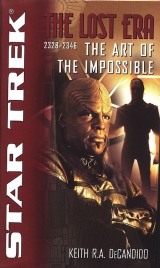
Текст книги "The Art of the Impossible "
Автор книги: Keith R. A. DeCandido
Жанр:
Научная фантастика
сообщить о нарушении
Текущая страница: 12 (всего у книги 22 страниц)
First K’Tal walked up to the chair holding his painstik, and issued the traditional challenge. “Face me if you dare!” Then he jabbed the corpse with the painstik, its red glow spreading across the chancellor’s chest.
Ditagh did not move.
The purpose of the ceremony was to verify for all to see that the old leader was truly dead. Like many old traditions, it served little purpose beyond the symbolic in this day and age. Indeed, many of the old rites had fallen away over time like the leaves off a dying tree, but this one remained.
Next was Grivak. Like Ditagh, he was a large, muscular warrior, with enough canniness to make up for an appalling lack of intelligence. His record in battle was excellent; his record in politics unspectacular. In fact, his career was similar to that of Ditagh’s when he ascended, which no doubt accounted for the strength of his petition to succeed him.
“Face me if you dare,” Grivak said, sounding bored. He barely touched Ditagh with the painstik.
A woman named Altrom then approached. She had no aide, and carried her own painstik. Kravokh knew her as an agitator who mainly wished to reverse Kaarg’s decree that women could not serve on the Council.
“Face me,” she cried, “if you dare!”She practically shoved the painstik through Ditagh’s belly.
The other two petitioners took their turn, then, finally, it was down to Kravokh. Ruuv handed him the painstik, and he approached the corpse, now smoking with the remnants of five painstik bursts.
The erstwhile chancellor looked much older in death than he had in life. Yet part of him seemed almost—relieved? As if the burden of the chancellorship was too much for him,Kravokh thought. Certainly I would not argue that point.Ditagh had succeeded Kaarg, a reactionary chancellor whose entire platform consisted of not being Azetbur, but with no plan beyond that. The Ditagh regime was more of the same. Kravokh vowed that he would be remembered as more than the idiotic footnote that was, he hoped, the only fate that awaited Kaarg and Ditagh in the future.
“Face me if you dare,” Kravokh said, and applied the painstik. And of course, Ditagh did not face him, nor anyone else. The Sonchiwas especially fitting for a chancellor whose regime would be known as an era of doing nothing.
K’Tal then once again approached the chair, this time without the painstik, and spoke the phrase for which the ceremony was named. “He is dead.”
Then the young man turned to face the five petitioners. “I will now choose the final candidates to succeed Ditagh, as laid down in the traditions of our people.” K’Tal paused, letting the moment stretch. If someone with more of a sense of humor than he credited K’Tal with having were Arbiter, Kravokh would have half expected him to choose Altrom as one of the candidates. But K’Tal was in no position to make so radical a choice without dire consequences to his burgeoning career.
Several seconds passed. The politician in Kravokh admired the delaying tactic, though the warrior in him cried out for blood. Kravokh had worked his whole life for this moment, and he did not want it delayed because some boy wanted the spotlight on him for a few extra seconds.
“Kravokh, Grivak, come forward!”
It took all of Kravokh’s willpower to keep from smiling.
The fight did not last very long. Kravokh had been up all the night, spending half of it researching Grivak’s fighting style and programming it into his holographic sparring partner and the other half engaging the hologram in combat. Grivak’s thrusts and parries were all from above—if Kravokh emphasized strokes that came from below, Grivak would have a harder time defending or moving to the offensive. Although the real Grivak proved more adaptable than the hologram—the latter was limited by the short timeframe and its programming—Kravokh still made relatively short work of his competitor.
His bat’lethfirmly lodged in Grivak’s chest, Kravokh now stood over his fallen foe. I’ve done it,he thought. I lead the Empire.
It almost didn’t seem real. He still remembered the day he set himself on this course: it was when Kaarg announced that no women would serve on the Council shortly after he ascended. It was then that the simple thought entered his head: I can run the Empire better than this fool.He spent the next two decades consolidating his support, making a name for himself, gaining a seat on the High Council. Then, when the Ch’gran colony was at last found, he stepped up his efforts. The remains of Ch’gran hadto be retrieved at all costs, and he knew that Ditagh would not—indeed could not—be the one to do it.
Now he had succeeded. The battle was won. He was chancellor.
Before him, the entire High Council, the other petitioners and their aides, all stood. Several of them cheered his name, as they had been doing since the tide of victory started to stem his way during the fight with Grivak.
The first order of business was to honor his fallen foe. Though Grivak was an unworthy fool, he died a good death, and deserved all considerations due him for that. Kravokh knelt down, pried open the warrior’s eyes, and then screamed to the heavens. Around him, the other Klingons did likewise, warning the Black Fleet that another Klingon warrior was crossing the River of Blood to Sto-Vo-Kor.Their screams echoed throughout the high-ceilinged chamber for several seconds after the screams themselves ceased.
Then Kravokh rose and walked over to the chair on which Ditagh’s corpse still sat. As he did so, the assembled Klingons rumbled in anticipation of Kravokh’s first words as the new Klingon supreme commander.
“Centuries ago, Ch’gran ventured forth into the black sky to bring greatness to our people after the Hur’q left us ravaged. The destruction of Praxis left us ravaged again, and we have let the Empire flounder and grow weak. We have even let the remains of Ch’gran—found after all these turns—lie fallow in the hands of outsiders.”
He walked back to Grivak’s corpse and yanked his bat’lethfrom his fallen foe’s chest. Holding it aloft, the blade dripping Grivak’s blood onto the chamber floor, he continued. “Today dawns a new day for the Empire. No longer will we sit while the Federation and the Cardassians grow stronger! No longer shall we allow outsiders to sully our sacred relics! Cardassians will remain pariahs on our worlds! Any Cardassian ship that violates our borders will meet the same fate as the Boklar!And Raknal V willbe ours! The Klingon Empire will once again be a force to be reckoned with! We will be strong! We are Klingons, and we will achieve our destiny!”
All of those present cheered his words, even those who, Kravokh knew, were his enemies, for none could deny the heart of what he said. Even Ditagh’s most fervent supporters knew that it was time for a change.
Kravokh would bring about that change. And he would bring Ch’gran home to Qo’noS. That was the most important thing of all…
Part 3
Fierce Flames
Burnt Round the
Heavens
2343—2346
Chapter 19
Shuttlecraft Woodlawn
“Have you found her yet?”
Lieutenant Elias Vaughn—or, rather, Lieutenant Commander Elias Vaughn; he still wasn’t used to the new rank—spoke through gritted teeth as he piloted the shuttlepod through the turbulent storm that was ravaging the northern continent of Devniad, the restraining straps cutting into his chest. The Woodlawnwas a small craft, with only room for four people to sit, and at that it was cramped. All remaining space was given over to the experimental warp engine– and why they felt the need to field-test the new miniature propulsion system on this mission is a question I will probably never get an adequate answer to,Vaughn thought as he compensated for yet another updraft. The staccato pounding of the rain against the hull and viewport combined with the difficult maneuvering to give him a sharp pain behind his right eye that he knew would be a full-blown headache in about five minutes.
Next to him, Lieutenant Commander T’Prynn manipulated her console, a receiver protruding from her pointed left ear. “I am still registering neither a human life sign, nor any signal that can be identified as Federation.” She looked over at Vaughn. “We have now scanned the entire continent. Logic suggests that we expand our search.”
“If nothing else, the weather’s probably better.” Vaughn set a new course. “Can’t imagine how a Federation special emissary would get to another continent while a hostile military takeover’s going on around her, but you’re right—it isthe most logical course of action.”
One of T’Prynn’s eyebrows climbed up her forehead. “Do you not believe that Special Emissary Tartovsky is capable of fending for herself?”
“If she is, she’s unique among the diplomats that I’ve known.” Gunning the thrusters, Vaughn took the shuttle southward—the next nearest continent on Devniad was to the south—and keeping an eye on the sensors for Cardassian ships. So far, their tiny shuttle had evaded detection, but that couldn’t possibly last. Damn you, Tartovsky, why couldn’t you stay put so we could have found you and gotten you out?
But that was hardly fair. All Vaughn knew for sure was that the Cardassians had suddenly, and violently, taken over this planet in neutral space while Raisa Tartovsky was in the process of negotiating a trade agreement with the natives. According to the gul in the fancy new ship of a type that Starfleet Intelligence had thought was still on the drawing board, Federation citizens were permitted to remain on-planet but would be subject to Cardassian law.
Relations with the Cardassians and the Klingons deteriorating, while both powers are engaged in a massive military buildup. Relations with the Romulans nonexistent. Relations with the Tholians and the Tzenkethi never all that great to begin with. We do live in interesting times.The Federation was on the brink of four potential wars—five, if you counted the Romulans, which Vaughn generally did. True, they’d been withdrawn since Tomed, but Vaughn was therefor Tomed, and he knew that the Romulans’ isolationism would not be permanent.
“Approaching the southern continent.” Vaughn noted with relief that the rainstorm did not extend southward, and the weather was clearer. Unfortunately, that also meant that the shuttle was not masked by cloud and rain cover, which made their being seen by the Cardassians a greater likelihood. He deliberately did not mention this to T’Prynn, as her quoting the odds of same would just add to his headache.
“I am receiving a Federation signal,” T’Prynn said. She adjusted her console. “Computer verifies that it is the frequency and code assigned to Special Emissary Tartovsky. However—” She hesitated. “I am receiving no readings from that position.”
T’Prynn had transferred the coordinates of the signal to Vaughn’s display. “No life signs means she may be dead.” Dammit.
“I did not say there were no life signs, Commander, but that I am receiving no readings. However, scans indicate a cave system at those coordinates, and the initial planetary geological survey of Devniad indicated a high fistrium content in the crust.”
“So Tartovsky could be alive and hiding where she can’t be scanned. Luckily, her transmitter can penetrate the fistrium.”
Again, T’Prynn’s eyebrow raised. “Fistrium only interferes with the signals from sensors and transporters. There is no evidence that it has ever impaired subspace transmissions.”
Vaughn smiled through his recently grown salt-and-pepper beard. “Isn’t that what I said? I’m going to bring her in for a landing.”
“Acknowledged. And, of course, the fistrium has also rendered moot your objection to this vehicle.”
I guess I should have expected that,Vaughn thought, holding in a sigh. He found a clearing about ten meters from the source of the signal where he could put down the Woodlawn.When he and T’Prynn had been given this assignment, Vaughn had objected to their being issued an experimental shuttle with no transporters. After all, transporters were a most valuable tool in an extraction. However, they needed a warp-capable craft small enough to avoid easy detection by the Cardassian conquerors. The fresh-out-of-the-shipyards Woodlawnfit the bill, but it was too small to be equipped with a transporter.
Ever since Ian Troi saved his life with a shuttle transporter in the Betreka Nebula, Vaughn had come to appreciate shuttles that were so equipped.
As he brought the pod down, he thought about Ian. When Rachel Garrett was given the Enterprise,Ian had been promoted to second officer of the Carthage,and he was likely to become first officer any day now. Vaughn hadn’t seen him since Kestra’s funeral. The thought of that poor child drowning at such a young age made the sixty-eight-year-old Vaughn grateful that he’d had as much life as he did—and, at the same time, feel deeply sorry for Ian and Lwaxana that their oldest daughter would not have that opportunity.
Good Lord, that was seven years ago. Deanna’s the same age now that Kestra was when she died. Time’s slipping away too damn fast.He made a mental note to send a letter to Ian on the Carthagewhen he got back to the starbase.
But first,he thought as he touched the Woodlawndown on the dirt of Devniad’s southern continent, to business.
Just as Vaughn unbuckled himself from his seat, T’Prynn said, “Picking up several Cardassian life signs—one-point-three kilometers away and closing.” She looked over at him. “It is likely that they also detected Special Emissary Tartovsky’s signal and are tracking it. You must move with dispatch.”
Smiling grimly, Vaughn grabbed a tricorder from the small supply cabinet under the console. “I wasn’t planning to dawdle, believe me.”
Opening the hatch, he stepped out into the warm air. A stiff breeze blew through his graying hair, and he had to hold up his hand to shield his eyes from the bright, red sun.
Gazing down at the tricorder, he confirmed that Tartovsky’s signal was coming from a position nine-and-a-half meters from where he stood. He was also picking up a human life sign. How the hell—?Then he realized—from the ground, he could detect Tartovsky through the mouth of the cave in which she hid. But that also meant that those Cardassians—who were now just one kilometer away and closing awfully fast—could also detect that life sign. Not to mention Vaughn, T’Prynn, and the shuttlepod…
Pumping his legs—with, he was proud to say, the same vim and vigor with which he ran as a youth in the Academy—Vaughn dashed toward the cave mouth. Pulling up seconds later, he saw a two-meter-wide opening in a large chunk of rock that looked like it was embedded in a grassy hill. Not a bad hiding spot,Vaughn thought, revising his estimate of Tartovsky upward a bit.
Proceeding slowly into the much cooler cave, he activated the light beacon on his tricorder. All it served to do was illuminate sheer rock.
“Don’t move!” cried out a female voice from deeper inside the cave. Vaughn shone his light toward the voice, and the beam framed a round face that blinked in the onslaught of light. Said onslaught did not cause her to lower the phaser pistol she held in her right hand.
“Special Emissary Tartovsky, I presume. I’m Lieutenant Elias Vaughn from Starfleet. I’m here to get you out of here. I have a shuttle.”
“Nice try. You should tell your Cardassian masters to train your spies better.”
What the hell is she talking about?
“That rank insignia on your shoulder patch is for a lieutenant commander, not a lieutenant.”
Hell’s teeth,he thought. Of all the times for a slip of the tongue…“I was only recently promoted, ma’am. I need you to put the phaser down so we can get out of here.”
“Recently promoted? You look like you’re at least fifty. Still only a lieutenant?”
“Lieutenant commander, as you pointed out, ma’am. We really need to leave.”
She shook her head and made a tchanoise. “You Cardassians are pathetic. You definitely need a better breed of spy. If you’re so damn good at rescue missions, why are you still a lieutenant at your age?”
Because the kind of work I do requires a low profile, but telling you that would go against that very principle.“Ma’am, there are actual Cardassians on the way who will most likely shoot both of us if we don’t get to my shuttlepod and get out of here. In fact—oh, the hell with it.” With one swift motion, he unholstered his own phaser and shot the special emissary.
She crumpled to the ground, stunned.
Vaughn ran over to her unconscious form. He saw that she was bleeding from a badly bandaged wound in her leg. She’d have fallen unconscious from blood loss if we’d kept up that inane conversation much longer.Under any other circumstances, he would have been willing to wait her out, but they didn’t have the time. Picking her up in a rescue carry and securing her with his right arm, he ran back out the way he came, the hot air blasting him in the face as he exited the cave.
Tapping his combadge with the butt of the phaser he held in his left hand as he ran, he said, “Vaughn to T’Prynn. Get ready to go, Commander.”
“Cardassian patrol approaching. They will be within sight of theWoodlawn in thirty-five seconds, Elias.”
No way he’d be able to close the distance that quickly—not while burdened with Tartovsky. And the Woodlawnwasn’t armed.
“The hatch is open, and I am armed with a phaser rifle, Commander. I will cover your approach.”
Vaughn grinned. “You read my mind, Commander.”
“Hardly.”
The Woodlawncame into Vaughn’s sight just as the phaser fire went flying over his head. Dammit,he thought as he fired back.
Another shot hit about a meter in front of him, tossing rocks and dirt into the air. Pain sliced across Vaughn’s head as one rock collided with his forehead. And here I was hoping to stave off that headache.
He ran around to see a Cardassian trading phaser fire with T’Prynn. Said Cardassian was between Vaughn and the Woodlawnhatch. Vaughn fired off a quick shot, which missed, and a second, which didn’t. Between those two, the Cardassian took a shot into the Woodlawnbefore collapsing to the ground.
Vaughn yelled, “Go!” even as he leapt into the Woodlawn’s rear two seats, his own body and that of Tartovsky forming a rather ungainly pile in the shuttlepod.
To his irritation, the shuttle did not move.
Clambering up from under the unconscious special emissary, he saw why: the Cardassian’s last shot had apparently hit T’Prynn in the shoulder. Green blood pooled under her red uniform and also poured forth from a wound in her head. Dammit.
Slamming his hand on the control that would close the hatch, Vaughn got into the pilot seat and noted that T’Prynn had already run the preflight sequence—all that was left was for the hatch to close and for Vaughn to engage the engines. Pausing only for a half a second to smile at his comrade—a pause he needed to take while waiting for the hatch to seal in any event—he then lifted off, the sound of Cardassian phaser fire hitting the shuttlepod’s hull with the same intensity that the rain was hitting it less than half an hour earlier.
Now let’s hope we’re small enough to stay off the sensor screens of those big ships in orbit—which are now looking for a small Starfleet shuttlepod. Well, nobody said this job would be easy.
Chapter 20
Cardassia Prime
It had been fifteen years since Corbin Entek had set foot in the Obsidian Order’s fifty-story public headquarters in the cul-de-sac. Back then, he was being debriefed by Enabran Tain himself on the disastrous Raknal V negotiations. Since then, Entek had thrived, becoming a top operative for the Obsidian Order.
In all that time, he had never again laid eyes on Tain. He had simply received instructions from assorted supervisors and then carried out his assignments. He had the feeling that soon he would be one of the supervisors rather than the supervised, and in fact he’d hoped that this summons would be a prelude to that.
A different receptionist sat at the main desk, of course, and instead of a retinal scanner, he now had to place his hand on a device that would verify his DNA.
Once again, Entek was to report to Room 2552. Tain again.Entek was pleasantly surprised.
When he arrived on the twenty-fifth floor, Entek saw that a different woman, this one with longer, blacker hair, now sat at the workstation outside Tain’s office. As her predecessor had a decade-and-a-half earlier, this woman activated her comm unit and said simply, “He’s arrived.”
“Send him in.”
Entek entered Tain’s office to find that, unlike the identity of his assistant, very little had changed. The office was still sparsely furnished, the east wall still contained a large viewer—this time the image was of the Dakhur Hills on Bajor. Entek chose to take this as a good sign. He knew that there was a supervisory position open administering Order affairs on Bajor, and he had hopes for it. Central Command had, typically, let the situation on Bajor get out of hand. The resistance movement was growing in strength and needed to be crushed. Central Command’s more overt methods were not getting the job done, and it was Entek’s considered opinion that more subtle means were required.
Of course, it was also possible that Entek was not here to receive good news. One thing he had learned in his time as an agent of the Order: it was best notto come to the attention of Enabran Tain if you could avoid it. If he had known fifteen years ago what he knew now, he would have approached his Tain-led debriefing following Raknal with a great deal more trepidation.
One other thing had changed over the years: Tain was a lot bulkier around the middle than he had been. I suppose that comes of working in an office rather than out in the field.
“Come in, Entek, come in, have a seat,” Tain said.
Entek sat down, noting that the guest chair was of a different type than the one from fifteen years ago, and yet it felt the same: neither particularly comfortable nor uncomfortable. It served its purpose as a chair, no more, no less.
“The last time you were in this office, you asked me if you would be assigned to Raknal V. I told you then that you were too young, too raw to take such an assignment.” He chuckled. “I never imagined that the situation would still be an issue fifteen years later. How closely have you followed the situation with the Klingons?”
“As closely as duties have allowed,” Entek said honestly. “I do know that no Klingons have been permitted on our worlds and that the Klingons have done the same to our people in their territory. Border skirmishes have been on the up-swing.”
Another chuckle. “That is an understatement. Any time a Cardassian ship and a Klingon ship are within a parsec of each other, there’s a good chance of torpedoes being exchanged sooner rather than later. The Grannal,the Pa’Dan,and the Baknabhave all been engaged by Klingon ships in the past month alone. The Klingons still blame us for the Chut’s destruction, and they’re very good at holding grudges. In addition, relations with the Federation have gotten worse since that incident with the Enterpriseseven years ago.” Tain shook his head. “There was a confrontation just yesterday—the Alkargot into a running firefight with a Federation ship, the Stargazer.Every attempt at trade talks with the Federation have failed, and Central Command insists on being aggressive with them and letting the situation grow worse. An all-out war is one thing, but these hostile skirmishes with both powers without a formal declaration pick away at us.”
With that, Entek had to agree. He also was starting to suspect the true reason for his summons. “It does not bode well. There are also rumblings on Romulus. Praetor Dralath is losing popular support, and their emperor has become little more than a figurehead. It is quite possible that they may come out of the shell they have been hiding in since Tomed and strike at either the Klingons or the Federation—or even us.”
That seemed to intrigue Tain. “What leads you to that conclusion?”
Entek shifted nervously in his seat. He had made a report to this effect only the previous week, and his new assumption was that it had come to Tain’s attention, hence his summons here. “Dralath is not an imaginative man. The Romulan economy is failing, the people are disaffected. Successful Romulan politicians tend toward long-term planning, but every indication points to Dralath being an unsuccessful one. His profile is one that prefers simple short-term solutions.”
“You believe he will start a war.”
It was not a question. Perhaps hehas read the report.“It is a common solution to declining popularity among ineffectual leaders. And we would be a ripe target—an upstart power that is already in conflict with the Klingons and the Federation.”
“A fine observation.” Tain smiled. “To answer your unspoken question, yes I read your report. It is a very canny analysis, and indicates that we need to do further study of the Romulans, especially while Dralath remains in power.” Entek tried not to be too obvious in letting his pride show.
“In the meantime, however, there is the matter of our continued difficulties with the Federation and the Klingons. If the Romulans are planning an assault on us, we need to be prepared, not engaged in petty squabbles. Federation–Klingon relations are not at their best at the moment, but they might well unite to fight a common enemy in us.”
A thought occurred to Entek. “The same might be true if the Romulans attack one of them.”
“If they choose to go that way, yes.” Tain leaned back. “What we have here, Entek, is a powder keg, one that will explode in the face of Cardassia no matter who lights it. What we need to do is apply some water. The root and cause of all our difficulties with the Klingons is Raknal V. Central Command insists that all is well on the planet. I’m more skeptical. Our last operative on-world was killed in what appears to have been an accident—certainly the planet has had enough of them. However, it was probably an assassination by one of Prefect Monor’s lackeys.”
Entek tried to avoid a sigh. This was not what he had been hoping for. Fifteen years ago, he had been eager to return to Raknal V; now, the planet held little interest for him. Bajor was, to his mind, more important to Cardassia’s future. Tain, however, thought otherwise, and Entek knew better than to argue with him. “What is my assignment to be?”
Tain leaned forward. Up until now, his tone had been pleasant, conversational—he discussed the political situation in the quadrant with all the ease and comfort of an uncle chatting about the latest sporting events with a favorite nephew. Now, though, his voice hardened, his hands folded on his immaculate desk. “Cardassia needs fewer enemies right now. The longer the situation on Raknal goes on, the more likely it is that we will have to go to war. Klingon military forces have built up impressively since Chancellor Kravokh came to power, and our own forces are divided among the Federation, the Klingons, and internal difficulties on Bajor and Chin’toka VI—and Raknal V, which now has a garrison dedicated to defending it, despite its distance. What I want from you, Entek, is to observe the situation on Raknal V. Central Command may be convinced that it’s worth devoting the resources to; I’m not. If it’s possible to cede the planet to the Klingons and end this—and give them their precious Ch’gran relic back—I think it’s something we should consider.”
Where fifteen years ago, Entek considered Tain to be sensible, despite Entek’s enthusiasm, for not sending him to Raknal V, now Entek thought Tain unwise for doing so. Entek’s expertise was on the Romulans and the Bajorans. Why devote such a resource to a backwater planet that was the flashpoint of a conflict with a species Entek hadn’t even thought about since he disembarked from the Carthagea decade and a half ago?
But he also knew better than to question an assignment from Tain himself. Just the fact that he was leaving this office in one piece—and with an assignment that the head of the Order considered important—spoke well for Entek’s future.
Tain stood up. Entek did likewise. “Your supervisor will have all the details of your cover on Raknal V at your next meeting. Make your reports to her.”
Entek nodded and turned to leave.
“Oh, and Entek?”
He stopped and turned to face Tain again.
“I told you once that I make use of my valuable resources.” Entek noted that the avuncular tone had returned, as had his bland smile. “I still do.”
The words did not fill the older Entek with the same pride as they did the younger one, but he, at the very least, was willing to take it guardedly as a good sign…