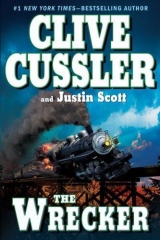
Текст книги "The Wrecker"
Автор книги: Clive Cussler
Жанр:
Боевики
сообщить о нарушении
Текущая страница: 5 (всего у книги 24 страниц)
“Of course. He saved your life. I hope to meet him one day to thank him personally.”
“The man who wrecked that train killed Wish,” Bell said coldly.
“Oh, Isaac. I’m so sorry.”
With that, Bell filled her in, as was his custom with her, detailing all he knew of the Wrecker’s attacks on Osgood Hennessy’s Southern Pacific Cascades Cutoff and how he was trying to stop them. Marion had a keen, analytical mind. She could focus on pertinent facts and see patterns early in their development. Above all, she raised critical questions that honed his own thinking.
“Motive is still an open question,” he concluded. “What ulterior motive is driving him to such destruction?”
“Do you believe the theory that the Wrecker is a radical?” Marion asked.
“The evidence is there. His accomplices. The radical poster. Even the target-the railroad is a prime villain to radicals.”
“You sound dubious, Isaac.”
“I am,” he admitted. “I’ve tried to put myself in his shoes, tried to think like an angry agitator-but I still can’t imagine the wholesale slaughter of innocent people. In the heat of a riot or in a strike, they might attack the police. While I will not condone such violence, I can understandhow a man’s thinking gets twisted. But this relentless attack on ordinary people … such viciousness makes no sense.”
“Could he be a madman? A lunatic?”
“He could. Except that he is remarkably ambitious and methodical for a lunatic. These are not impulsive attacks. He plans them meticulously. And he plans his escape just as carefully. If it’s madness, it’s under fine control.”
“He may be an anarchist.”
“I know. But why kill so many people? In fact,” he mused, “it’s almost as if he is trying to sow terror. But what does he gain by sowing terror?”
Marion answered, “The public humiliation of the Southern Pacific Railroad Company.”
“He is certainly achieving that,” said Bell.
“Maybe instead of thinking like a radical or an anarchist or a madman, you should think like a banker.”
“What do you mean?” He looked at her, uncomprehending.
Marion answered in a clear, steady voice. “Imagine what it is costing Osgood Hennessy.”
Bell nodded thoughtfully. The irony of “thinking like a banker” was not lost on a man who had turned his back on an obligatory career in his own family’s powerful bank. He touched her cheek. “Thank you,” he said. “You’ve given me a lot to ponder.”
“I’m relieved,” said Marion, and teasingly added, “I’d rather you ponder than get into gunfights.”
“I like gunfights,” Bell bantered back. “They focus the mind. Though in this case we may be talking about sword fights.”
“Sword fights?”
“It’s very strange. He killed Wish and another man with what appears to be some kind of sword. The question is: how does he get the drop on a man with a gun? You can’t hide a sword.”
“What about a sword cane? Plenty of men in San Francisco carry sword canes for protection.”
“But just unsheathing it, drawing the blade out of the cane, would give a man with a gun all the time he needed to shoot first.”
“Well, if he comes after youwith a sword, he’ll be sorry. You fenced for Yale.”
Bell shook his head with a smile. “Fenced, not dueled. There’s a big difference between sport and combat. I recall my coach, who had been a duelist, explaining that the fencing mask hides your opponent’s eyes. As he put it, the first time you fight a duel, you are shocked to meet the cold gaze of a man who intends to kill you.”
“Were you?”
“Was I what?”
“Shocked.” She smiled. “Don’t pretend to me you’ve never fought a duel.”
Bell smiled back. “Only once. We were both very young. And the sight of spurting red blood soon convinced us that we didn’t really want to kill each other. In fact, we’re still friends.”
“If you’re looking for a duelist, there can’t be too many of them left in this day and age.”
“Likely, a European,” mused Bell. “Italian or French.”
“Or German. With one of those horrible Heidelberg scars on his cheek. Didn’t Mark Twain write that they pulled the surgeon’s stitches apart and poured wine in their wounds to make the scars even uglier?”
“Probably not a German,” said Bell. “They’re known for the plunging blow. The thrust that killed Wish and the other fellow was more in the style of an Italian or a Frenchman.”
“Or the student of?” Marion suggested. “An American who went to school in Europe. There are plenty of anarchists in France and Italy. Maybe that’s where he became one.”
“I still don’t know how he takes a man with a gun by surprise.” He demonstrated with a gesture. “In the time it takes to draw a sword, you can step in and punch him in the nose.”
Marion reached across the teacups and took Bell’s hand. “To tell the truth, I would be delighted if a bloody nose is the most I have to worry about.”
“At this point, I would love a bloody nose, or even a flesh wound or two.”
“Whatever for?”
“You remember Weber and Fields?”
“The funny old gents.” Wally Kisley and Mack Fulton had taken her to dinner while passing through San Francisco recently and kept her laughing all evening.
“Wally and Mack always say, ‘Bloody noses are a sure sign of progress. You know you’re close when your quarry pokes you in the snoot.’ Right now, I could use a good poke in the snoot.” The comment brought a smile to their faces.
Two women, fashionably dressed in the latest hats and gowns, entered the hotel lobby and crossed it in a flourish of feathers and silk. The younger was so striking that many of the lowered newspapers remained on their owners’ laps.
Marion said, “What a beautiful girl!”
Bell had already seen her in a mirror.
“The girl wearing pale blue,” said Marion.
“She is Osgood Hennessy’s daughter, Lillian,” said Bell, wondering if it was coincidence that had brought Lillian to the St. Francis while he was here, and suspecting it was not.
“Do you know her?”
“I met her last week aboard Hennessy’s special. She’s his private secretary.”
“What is she like?”
Bell smiled. “She has pretensions to being a seductress. Flashes her eyes like that French actress.”
“Anna Held.”
“She is intelligent, though, and savvy about business. She’s very young, spoiled by her adoring father, and, I suspect, very innocent when it comes to matters of the heart. The dark-haired woman with her used to be her tutor. Now she’s Hennessy’s mistress.”
“Do you want to go over and say hello?”
“Not when I have only minutes left to spend with you.”
Marion returned a pleased grin. “I am flattered. She is young, unspeakably beautiful, and presumably very rich.”
“You are unspeakably beautiful, and when you marry me you will be very rich, too.”
“But I’m not an heiress.”
“I’ve known my fill of heiresses, thank you very much, since we were taught the Boston Waltz in dancing school,” he said, grinning back. “It’s a slow waltz with a long glide. We can dance it at our wedding, if you like.”
“Oh, Isaac, are you sure you want to marry me?”
“I am sure.”
“Most people would call me an old maid. And they would say that a man your age should marry a girl her age.”
“I’ve never done what I ‘should’ do. Why should I start now when I’ve finally met the girl of my dreams? Andmade a friend for life?”
“But what will your family think of me? I have no money. They’ll think I’m a gold digger.”
“They will think I am the luckiest man in America.” Isaac smiled. But then he added, soberly, “Any who don’t can go straight to hell. Shall we set a date?”
“Isaac . . . I have to talk to you.”
“What is it? Is something the matter?”
“I am deeply in love with you. I hope you know that.”
“You show me in every way.”
“And I want ever so much to marry you. But I wonder if we could wait a little while.”
“Why?”
“I’ve been offered an exciting job, and it is something I would like to try very much.”
“What sort of job?”
“Well . . . you know who Preston Whiteway is, of course?”
“Of course. Preston Whiteway is a yellow journalist who inherited three of California’s leading newspapers, including the San Francisco Inquirer.”He gave her a curious smile. “The newspaper you happen to work for … He’s said to be quite handsome and a celebrated ‘man-about-town,’ and he flaunts his wealth, which he earns publishing sensationalist headlines. He’s also sunk his hooks into national politics by using the power of his newspapers to get his friends appointed to the United States Senate-first among them Osgood Hennessy’s lapdog legislator, Senator Charles Kincaid. In fact, I believe that it was your Mr. Whiteway who gave Kincaid the moniker ‘Hero Engineer.”’
“He’s not myMr. Whiteway, but-Oh, Isaac, he has a wonderful new idea. He came up with it while the paper was reporting on the earthquake-a moving-picture newsreel. He’s calling it Picture World.They’ll take moving pictures of actual events and play them in theaters and nickelodeons. And, Isaac!”-she gripped his arm in her excitement-“Preston asked me to help get it started.”
“For how long?”
“I’m not sure. Six months or a year. Isaac, I know I can do this. And this man will give me a chance to try. You know that I took my degree in law in Stanford’s first graduating class, but a woman can’t get a job in law, which is why I’ve worked nine years in banking. I’ve learned so much. It’s not that I want to work my whole life. But I want to makesomething, and this is my chance to make something.”
Bell was not surprised by Marion’s desire to work at an exciting job. Nor did he doubt their love. They were both too well aware of their great good fortune at having discovered each other to ever let someone come between them. Some sort of a compromise was in order. And he could not deny that he had his own hands full trying to stop the Wrecker.
“What if we were to promise that in six months we would set a date to marry? When things have settled down? You can still work and be married.”
“Oh, Isaac, that would be wonderful. I so much want to be in at the beginning of Picture World.”
The bells of the Magneta Clock began to strike four o‘clock.
“I wish we had more time,” she said sadly.
It seemed to Bell like only minutes since they had sat down. “I’ll drive you to your office.”
He noticed that Lillian Hennessy was looking pointedly the other way as they left the lobby. But Mrs. Comden parted her lips in a discreet smile as their eyes met. He returned a polite nod, struck again, forcibly, by the woman’s sensuality, and gripped Marion’s arm a little tighter.
A fire-engine-red, gasoline-powered Locomobile racer was parked directly in front of the St. Francis. It was modified for street traffic with fenders and searchlight headlamps. The hotel doormen were guarding the car from gawking small boys, threatening dire punishment to the first who dared lay dirty fingers on the gleaming brass eagle atop its radiator, much less breathe near its red leather seats.
“You got your race car back! It’s beautiful,” said Marion, showing her delight.
Bell’s beloved Locomobile had been beaten half to death by a five-hundred-mile race against a locomotive from San Francisco to San Diego, with the locomotive steaming on smooth rails and the Locomobile pounding over California’s rock-strewn dirt roads. A race, Bell remembered with a grim smile, that he had won. His trophy had been the arrest of the Butcher Bandit at gunpoint.
“As soon as the factory rebuilt it, I had it shipped out here from Bridgeport, Connecticut. Hop in.”
Bell leaned past the big steering wheel to turn the ignition switch on the wooden dashboard. He set the throttle and spark levers. Then he pumped the pressure tank. The doorman offered to crank the motor. Still warm from the drive from the freight depot where Bell had taken delivery, the four-cylinder engine thundered to life on the first heave. Bell advanced the spark and eased the throttle. As he reached to release the brake, he beckoned the smallest of the boys who were watching big-eyed.
“Can you give me a hand? She can’t roll without blowing her horn!”
The boy squeezed the big rubber horn bulb with both hands. The Locomobile bellowed like a Rocky Mountain bighorn. Boys scattered. The car lurched ahead. Marion laughed and leaned across the gas tank to hold Bell’s arm. Soon they were racing toward Market Street, weaving around straining horse carts and streetcars and thundering past slower automobiles.
As they pulled up in front of the twelve-story, steel-frame building that housed the San Francisco Inquirer,Bell spotted the last parking space left by the curb. A fair-haired gent in an open Rolls-Royce veered toward it, blowing his horn.
“Oh, there’s Preston! You can meet him.”
“Can’t wait,” said Bell, stomping his accelerator and brake in quick succession to skid the big Locomobile into the last spot, a half second ahead of Preston Whiteway’s Rolls.
“Hey! That’s my spot.”
Bell noticed that Whiteway was as handsome as rumored, a bluff, broad-shouldered, clean-shaven man with extravagant waves of blond hair. As tall as Bell, though considerably bulkier in the middle, he looked like he had played football in college and could not recall the last time he had not had his way.
“I got here first,” said Bell.
“I own this building!”
“You can have it back after I say good-bye to my girl.”
Now Preston Whiteway craned his neck to look past Bell, and bawled, “Marion? Is that you?”
“Yes! This is Isaac. I want you to meet him.”
“Pleased to meet you!” said Preston Whiteway, looking anything but. “Marion, we better get upstairs. We’ve got work to do.”
“You go ahead,” she said coolly. “I want to say good-bye to Isaac.”
Whiteway leaped from his car, bellowing for the doorman to park it. As he charged past, he asked Bell, “How fast is your Locomobile?”
“Faster than that,” said Bell, nodding at the Rolls-Royce.
Marion covered her mouth to keep from laughing, and when Whiteway had moved out of earshot she said to Bell, “You two sounded like boys in a school yard. How could you be jealous of Preston? He’s really very nice. You’ll like him when you get to know him.”
“I’m sure,” said Bell. He took her beautiful face gently in his hands and kissed her lips. “Now, you take care of yourself.”
“Me? You take care of yourself. Please, take care of yourself.” She forced a smile. “Maybe you should bone up on your sword fighting.”
“I intend to.”
“Oh, Isaac, I wish we had more time.”
“I’ll get back as soon as I can.”
“I love you, my darling.”
HIGH ABOVE THE CASCADES Cutoff construction yard, a single gondola car had been left behind on a siding. It sat a short distance above the switch that, when closed, would connect the siding to the steep grade of a supply spur that connected the railroad’s newly built lumber mill in the forest miles up the mountain to the construction yard below. The car was heavily laden, heaped higher than its sides with a crown of freshly sawn mountain hemlock crossties bound for the cutoff’s creosoting plant to be impregnated with coal tar preservative.
The Wrecker saw an opportunity to strike again, sooner than he had planned, killing two birds with one stone. This attack would rattle not only the Southern Pacific Railroad. If he could pull it off, it would announce how immune he was from the protective efforts of the Van Dorn Detective Agency.
He was a coldly methodical man. He had planned the tunnel attack meticulously, allotting time to every stage, from recruiting an accomplice with the ideal mix of zeal and naivete to pinpoint ing the geologically propitious location for the dynamite to planning his escape route. The Coast Line Limited attack had taken similar efforts, including using a hook to make it obvious that the destruction was sabotage, not a mere accident. He had similar schemes for wreckage lined up, in various stages of readiness, although some of them had to be scrapped now that the Van Dorn detectives were guarding key rail yards and maintenance shops.
But not every sabotage job had to be planned. The railroad system that crisscrossed the nation was immensely complex. Opportunities for destruction abounded, so long as he employed his superior knowledge to be ever alert to mistakes and negligence.
So long as he moved quickly and did the unexpected.
The gondola would remain only briefly on the siding. With twenty-seven hundred ties required per mile of track, it could not be more than a day or two before a hard-pressed materials superintendent down in the yard roared “Where the hell are the rest of my ties?” and terrified clerks began desperately combing through invoices and dispatches for the missing car.
The nearest hobo jungle big enough that he would not be noticed, in the crush of men cooking meals, hunting a space to sleep, and coming and going on their endless quest for work, was outside the rail yards in Dunsmuir, California. But Dunsmuir was a hundred fifty miles down the line. That left no time to recruit a believer. He would have to do the gondola job himself. There was risk in attacking alone and risk in attacking quickly. But the destruction he could wreak with that single car was almost incalculable.
8
WITH MARION’S GOOD-BYE KISS STILL SWEET ON HIS LIPS, Isaac Bell settled into his seat on the flyer to Sacramento and waited for the train to pull out of Oakland Terminal. She knew him well, better than he knew himself. On the other hand, there were things she might never know. How could you be jealous of Preston?Let me count the ways, thought Bell. Starting with, Whiteway is there with you and I’m not, because I’m falling behind in my race to stop the Wrecker.
He closed his eyes. He hadn’t slept in a bed for days, but sleep eluded him. His mind was racing. From the state capital, he would take a series of trains north toward distant Oregon. He needed a fresh look at the Cascades Cutoff tunnel collapse, with an eye toward reckoning whether the Wrecker intended another attack at the front end of the tunnel. On the way, he would meet with Archie Abbott, who’d wired him that he might be hitting pay dirt with the hobo jungle outside Dunsmuir.
“Mr. Bell?”
The conductor interrupted Isaac’s thoughts. The man touched a knuckle to his polished visor in a respectful salute, and said with a sly wink, “Mr. Bell, there’s a lady asking if you would be more comfortable sitting with her.”
Suspecting he would find the enterprising young Miss Hennessy in the next Pullman, Bell followed the conductor up the aisle. The conductor led him off the train and directed him across the platform toward a private car coupled to a baggage car hauled by a sleek Atlantic 4-4-2 so shiny it looked like it had just come from the shop.
Bell stepped aboard the car and through a door into a plush red parlor that would not have looked out of place in Anne Pound’s brothel. Lillian Hennessy, who had changed out of the pale blue that matched her eyes into a scarlet tea gown that matched the parlor, greeted him with a glass of champagne and a triumphant smile. “You’re not the only one who can charter a special.”
Bell replied coolly, “It is inappropriate for us to be traveling alone.”
“We’re not alone. Unfortunately.”
As Bell was saying “Besides, may I remind you that I am committed to Marion Morgan,” a jazz band struck up in a room at the rear of the car. Bell peered through the door. Six black musicians playing clarinet, bass fiddle, guitar, trombone, and cornet were gathered around an upright piano improvising on Adaline Shepherd’s brisk hit rag, “Pickles and Peppers.”
Lillian Hennessy pressed close to look past Bell’s shoulder. She was tucked into a swan-bill underbust corset, and Bell felt her breasts soft against his back. He had to raise his voice to be heard over the music. “I’ve never met a jazz musician qualified to act as a chaperone.”
“Not them.”She made a face. “Her: Father caught wind of my scheme to ambush you in San Francisco. She sent her to keep an eye on me.”
The cornet player wheeled his horn in the air, as if to spear the ceiling. In the gap he opened in the circle of musicians, Bell saw that the piano player arched over the keys, with fingers flying, eyes bright, and full lips parted in a gleeful smile, was none other than Mrs. Comden.
Lillian said, “I don’t know how he found out. But thanks to Father and Mrs. Comden, your honor will be safe, Mr. Bell. Please stay. All I ask is that we become friends. We’ll have a fast ride. We’re cleared straight through to the Cascades Cutoff.”
Bell was tempted. The line north of Sacramento was congested with materials and work trains heading to and from the cutoff. He had been considering ordering up one of Hennessy’s specials. Lillian’s was ready to roll. Steaming northward on cleared tracks, the railroad president’s daughter’s special would save him a day of travel time.
Lillian said, “There’s a telegraph in the baggage car, if you need to send messages.”
That tipped it. “Thank you,” Bell said with a smile. “I accept your ‘ambush,’ though I may have to hop off at Dunsmuir.”
“Have a glass of champagne, and tell me all about your Miss Morgan.”
The train lurched into motion as she handed him the glass. She licked a spilled drop from an exquisitely delicate knuckle and flashed her eyes in French-actress mode. “She was very pretty.”
“Marion thought you were, too.”
She made another face. “‘Pretty’ is rosy cheeks and gingham dresses. I am usually called more than pretty.”
“Actually, she said you were unspeakably beautiful.”
“Is that why you didn’t introduce me?”
“I preferred to remind her that she is unspeakably beautiful, too.”
Lillian’s pale blue eyes flashed. “You don’t pull your punches, do you?”
Bell returned a disarming smile. “Never in love, young lady-a habit I recommend you cultivate when you grow up. Now, tell me about your father’s troubles with his bankers.”
“He has no trouble with his bankers,” Lillian shot back. She answered so quickly and so vehemently, Bell knew what to say next.
“He said he would by winter.”
“Only if you don’t catch the Wrecker,” she said pointedly.
“But what of this Panic brewing in New York? It started last March. It doesn’t appear to be going away.”
Lillian answered with sober deliberateness. “The Panic, if it remains one much longer, will bring boom times in the railroad business to a crashing halt. We’re in the midst of wonderful expansion, but even Father admits it can’t go on forever.”
Bell was again reminded that Lillian Hennessy was more complicated than a coddled heiress.
“Does the Panic threaten your father’s control of his lines?”
“No,” she said quickly. Then she explained to Bell, “My father learned early on that the way to pay for his second railroad was to manage his first so well that it was solvent and creditworthy and then borrow against it. The bankers would dance to histune. No railroad man in the country would fare better. If the others collapsed, he’d snap up the pieces and come out of it smelling like a rose.”
Bell touched his glass to hers. “To roses.” He smiled. But he was not sure whether the young woman was boasting truthfully or whistling past the graveyard. And he was even less sure of why the Wrecker was so determined to uproot the tangled garden of railroads.
“Ask any banker in the country,” she said, proudly. “He will tell you that Osgood Hennessy is impregnable.”
“Let me send a wire telling people where to find me.”
Lillian grabbed the champagne bottle and walked him to the baggage car, where the conductor, who doubled as the train’s telegrapher, sent Bell’s message reporting his whereabouts to Van Dorn. As they were starting to head back to the parlor car, the telegraph key started clattering. Lillian listened for a few seconds, then rolled her eyes and called over her shoulder to the conductor, “Do not answer that.”
Bell asked, “Who is that transmitting, your father?”
“No. The Senator.”
“Which Senator?”
“Kincaid. Charles Kincaid. He’s courting me.”
“Do I gather that you are not interested?”
“Senator Charles Kincaid is too poor, too old, and too annoying.”
“But very handsome,” called Mrs. Comden, with a smile for Bell.
“Very handsome,” Lillian agreed. “But still too poor, too old, and too annoying.”
“How old?” Bell asked.
“At least forty.”
“He’s forty-two and extremely vigorous,” said Mrs. Comden. “Most girls would call him quite a catch.”
“I’d rather catch mumps.”
Lillian refilled her glass and Bell’s. Then she said, “Emma, is there any chance that you might hop off the train in Sacramento and disappear while Mr. Bell and I steam our way north?”
“Not in this life, dear. You are too young-and far too innocent-to travel without a chaperone. And Mr. Bell is too . . .”
“Too what?”
Emma Comden smiled.
“Interesting.”
THE WRECKER HURRIED UP the lumber-mill spur after dark, walking on the crossties so as not make noise crunching the ballast.
He carried a four-foot-long crowbar that weighed thirty pounds. On his back was a Spanish-American War soldier’s knapsack of eighteen-ounce cotton duck with a rubberized flap. Its straps tugged hard on his shoulders. In it were a heavy two-gallon tin of coal oil and a horseshoe he had lifted from one of the many blacksmiths busy shoeing the hundreds of mules that pulled the freight wagons.
The chill mountain air smelled of pine pitch, and something else that took him a moment to recognize. There was actually a hint of snow on the wind. Although it was a clear night, he could feel winter coming early to the mountains. He increased his pace, as his eyes adjusted to the starlight. The rails shone in front of him, and trees took shape along the cut.
A tall, long-legged, fit man, he climbed the steep slope with swift efficiency. He was racing the clock. He had less than two hours until moonrise. When the moon cleared the mountains, lancing the darkness with its full light, he would be a sitting duck for the railway police patrolling on horseback.
After a mile, he came to a Y junction where the spur split. The left-hand spur, which he had been climbing, descended to the construction yard. The spur to the right veered to join the newly completed main line to the south. He checked the switch that controlled which spur was connected.
The switch was positioned so that a train descending from the lumber mill would be routed toward the construction yard. He was tempted to send the heavy car on to the main line. Properly timed, it would collide head-on with a northbound locomotive. But such a collision would block the tracks so the dispatchers would have to stop all trains, which would block his only way out from this end of the line.
The grade continued, a little lighter, and he increased his pace. After another mile, he saw the dark gondola looming. It was still there!
Suddenly, he heard something. He stopped walking. He froze in place. He cupped his hands to his ears. He heard it again, an incongruous sound. Laughter. Drunken men laughing, farther up the mountain. Way in the distance, he could see the orange glow of a campfire. Lumberjacks, he realized, sharing a bottle of Squirrel whiskey. They were too far away to hear him or see him, blinded by the blaze of their fire. Even if they heard the car roll through the switch, by then there would be no stopping it.
He stepped from the spur across a ditch to the siding on which sat the laden gondola. He found the switch handle and threw it, closing the point where the two sets of tracks met, joining the siding to the lumber spur. Then he went to the gondola, kicked wooden chocks from under the front truck, found the cold rim of the brake and turned it until the brake shoes lifted from the car’s massive iron wheels.
Now she could roll, and he waited for her to start moving of her own weight since the siding was on an incline. But she sat fast, locked by gravity or the natural minute flattening of her wheels as she sat heavily on the rails. He would have to improvise a car mover.
He went to the back of the gondola, placed his horseshoe a few inches behind the rearmost wheel, propped his crowbar under the wheel where it met the rail, and lowered the bar to the horseshoe, which would serve as his fulcrum. He threw his weight down on the bar and rocked on it.
The bar slipped with a loud screech of metal on metal. He shoved it under the wheel again and resumed rocking. The wheel moved an inch. He jammed the crowbar in deeper, kicked the horseshoe to meet it, and again threw his weight on his makeshift car mover.
A voice spoke, directly overhead, almost in his ear.
“What you doing there?”
He fell back, astonished. Leaning down from the heap of crossties was a lumberjack, waking from a drunken sleep, breath reeking as he slurred, “Partner, you start her rolling, she won’t stop ‘til she hits bottom. Let me hop down before she sets off.”
The Wrecker swung the crowbar in a lightning blur.
The heavy steel crunched against the drunk’s skull and knocked him back on the ties like a rag doll. The Wrecker watched for movement, and, when there was none, calmly resumed rocking on the crowbar as if nothing had happened.
He felt the space between the wheel and fulcrum open. The gondola was rolling. He dropped the crowbar and jumped on the car with the tin of coal oil. The car rolled slowly toward the switch and rumbled through it and onto the spur, where it gathered speed. He scrambled past the body of the drunk and turned the brake, tightening it until he felt the shoes rub the wheels, slowing the gondola to about ten miles an hour. Then he opened the tin and splashed the oil on the ties.
The gondola rolled on for a mile to the Y junction, where the grade began to steepen.
He lit a match and, shielding it from the wind of passage, touched it to the coal oil. As the flames spread, he released the brakes. The gondola lunged ahead. He hung down behind the back wheels. The moon chose that moment to clear a mountain and cast light on the tracks brightly enough to illuminate a safe place for him to jump. The Wrecker took it as his just due. He had always been a lucky man. Things always broke his way. Just as they were breaking his way now. He jumped, landed easily. He could hear the gondola turning to the left, rumbling heavily through the Y junction and toward the construction yard.
He turned to the right, down the spur to the main line, away from the yard. The wheels made a humming sound as the gondola sped down the steep grade. The last thing he saw was orange flames moving rapidly down the mountain. In three minutes, every cinder dick on the mountain would be running hell-bent toward the construction yard while he was running the other way.